
Criminal record expungement is a court process that destroys or deletes arrest and conviction data under state law, removing public access and often allowing you to deny the offense. It differs from sealing, which restricts access but keeps the record, and from a pardon, which forgives but does not erase. It clears the official file, not the internet.
Key facts
- Expungement destroys the record, sealing restricts access, and a pardon forgives without erasing.
- Maryland guidance puts a typical petition at about three months from filing to a judge’s final order.
- Indiana allows conviction expungement only once in a lifetime in many circumstances, so filing order matters.
- At least 24 states had passed automatic record clearing laws as of March 2024.
Where ContentRemoval.com comes in. ContentRemoval.com handles the second front once the court has done its part: the mugshot sites, people-search listings, stale news pages and search results that a signed order does not reach. Criminal defense counsel and family offices often bring us in alongside the petition rather than after it. A free 15-minute Exposure Scan maps every online copy and the route for each, and the report is yours to keep. Get a Free, Confidential Exposure Scan or read how our court record removal work is done.
A record from years ago usually resurfaces at the worst possible moment. A board appointment is moving forward. A family office is deep into diligence. A premium lease is nearly signed. Then counsel, compliance, a landlord, or an investigator finds an old arrest or conviction that you assumed had faded into irrelevance.
That’s when individuals start asking a basic question under very specific pressure: what is criminal record expungement, and will it solve the problem in front of them?
The legal answer matters. So does the operational one. For high-stakes clients, expungement can remove a formal barrier to employment, housing, licensing, and transactions. But legal relief and reputation repair are not the same thing. A court can clear an official record. It can’t automatically rewind search results, data broker listings, old mugshot pages, or archived reporting that has already spread.
The Unexpected Obstacle to Your Next Milestone
The pattern is familiar. An executive is in the final round for a leadership role. A public figure is preparing for a financing event or media cycle. A founder is moving into a building with strict screening. Everything looks controlled until an old criminal matter appears in due diligence and shifts the conversation from capability to risk.
The damage is rarely limited to the legal record itself. It changes how other people behave. A recruiter pauses. A lender asks follow-up questions. A counterparty starts wondering what else they haven’t seen.
That anxiety is not niche. Nearly one-third of the adult working-age population in the United States, approximately 70 million people, has a criminal record, and in states like Michigan only 6.5% of eligible individuals obtain an expungement within five years of becoming eligible because the process is so complex, according to the Brennan Center’s analysis of criminal records and expungement uptake.
For some readers, the issue crosses borders. If the matter involves Canadian procedures or parallel screening concerns, Information on clearing criminal records can help frame how another jurisdiction handles the problem.
A criminal record also affects housing in ways many clients underestimate. The practical risk isn’t abstract. It can interfere with access to high-end rentals, co-op approvals, and relocation plans, which is why this analysis of whether an old arrest record can prevent you from securing a premium apartment matters well before an application is submitted.
Why sophisticated clients get caught off guard
Individuals don’t ignore the issue because they’re careless. They ignore it because they assume age equals irrelevance. That assumption fails when screening gets deeper.
Three things usually trigger the problem:
- A new gatekeeper appears. A private equity firm, regulated employer, landlord, or licensing body runs checks that prior employers never ran.
- Visibility increases. Promotion, media exposure, political activity, or a transaction invites more scrutiny than ordinary life.
- The internet preserved the story. Even if the official record is old, search results can keep it current.
The record you forgot is often the record someone else has just discovered for the first time.
Expungement Sealing and Pardons A Legal Distinction
Clients often use expungement, sealing, and pardon as if they mean the same thing. They don’t. If you choose the wrong remedy, you may spend time and money without achieving the outcome you need.
What expungement changes
Expungement is the strongest form of record relief discussed in most state systems. In the framework described by the Ohio reference cited here, expungement involves the physical destruction of arrest and conviction data, while sealing restricts access but keeps the record available to law enforcement and certain government entities, as explained in this discussion of how Ohio distinguishes expungement from sealing.
That distinction affects timing. In Ohio, a third-degree felony requires a 13-year wait for expungement versus 3 years for sealing. The gap tells you something important. Legislatures usually treat expungement as broader relief and make clients wait longer for it.
What sealing changes
Sealing limits public visibility. It can be enough for many employment and housing scenarios because ordinary public searches and many non-government screenings won’t see the record in the same way. But sealing is not erasure. Government agencies and law enforcement may still access it.
For a client whose main concern is a standard public-facing background check, sealing may be sufficient. For a client dealing with intense scrutiny, reputational vulnerability, or applications requiring precise disclosure analysis, the difference matters.
What a pardon does, and doesn’t do
A pardon is different from both. It is forgiveness by the relevant executive authority. It does not necessarily erase the existence of the event from the record. A pardon may help with rights, narrative, and some collateral consequences, but it does not function like a digital reset button and usually does not eliminate public memory of the case.
Here’s the comparison that clients need before making any filing decision:
| Mechanism | Record Status | Public Access | Legal Disclosure Requirement |
|---|---|---|---|
| Expungement | Record is treated as destroyed or deleted under applicable law | Public access is generally removed | Often allows the person to deny the offense in many contexts, subject to jurisdiction-specific exceptions |
| Sealing | Record remains but access is restricted | Public access is limited, government access usually remains | Disclosure rules are narrower than with an open record, but depend on the application and jurisdiction |
| Pardon | Offense is forgiven, not necessarily erased | Public visibility may remain | Disclosure obligations often remain because the underlying record may still exist |
Practical rule: Choose the remedy based on the problem you need solved. If the issue is legal eligibility, the answer may differ from the remedy needed for reputational containment.
The business reality behind the terminology
For an executive or company principal, the wrong assumption creates two separate failures. First, counsel may obtain sealing when the client really needed expungement. Second, the client may receive expungement and assume the online problem is over when it isn’t.
That’s why the legal label matters less than the operational effect. Ask four questions early: Who can still see the record, what can you legally say about it, which gatekeepers still require disclosure, and what remains online after the court process ends?
Navigating Eligibility A Strategic Assessment
Eligibility isn’t a checkbox exercise. It’s a risk decision. The right question is not just “Can I file?” It’s “Should I file now, for this case, in this jurisdiction, with these future consequences?”
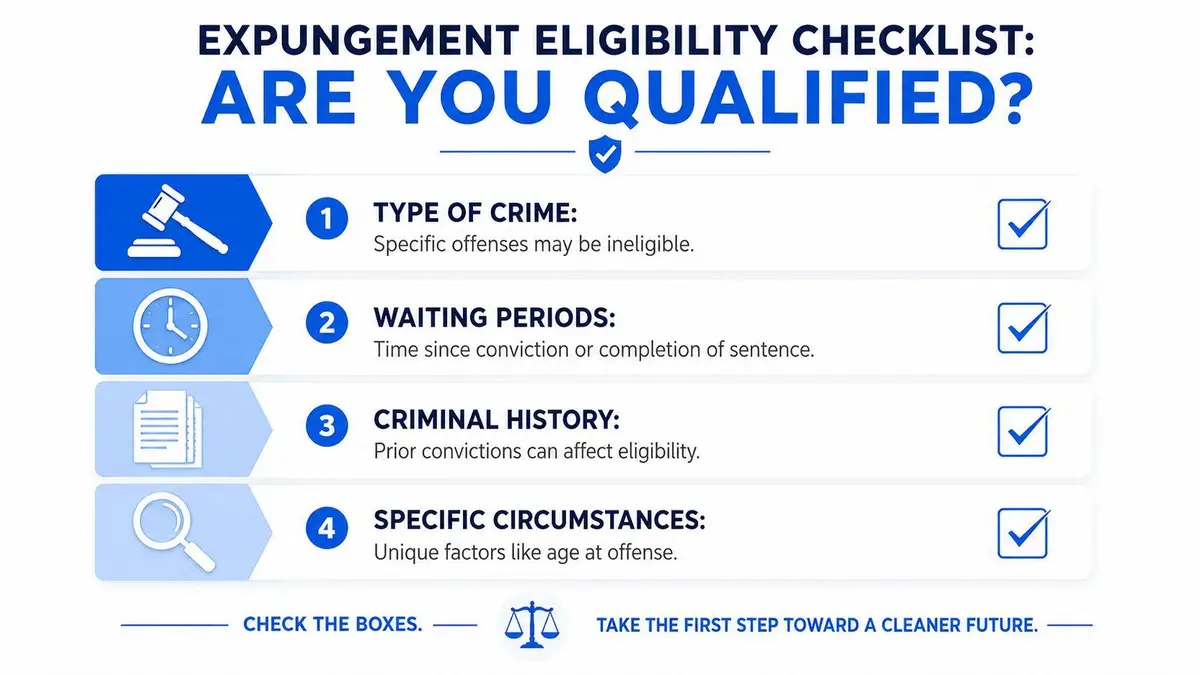
The four issues that drive real eligibility decisions
When lawyers assess whether expungement is available, they usually start with a core set of variables:
- Type of offense. Some charges qualify more readily than others, and some are excluded altogether.
- Time elapsed. Waiting periods often begin after conviction, sentence completion, or final disposition, not from the date you first think the matter ended.
- Record pattern. A single isolated event is treated differently from multiple matters spread across time.
- Special facts. Age at the time of offense, non-conviction status, payment history, and later arrests can all reshape eligibility.
Those are legal criteria. The strategic layer is different. A filing that is technically available may still be a poor move if it uses a limited opportunity on the wrong case.
The one-time-only trap
In many states, strategy matters as much as eligibility. Indiana permits expungement of a conviction only once in a lifetime in many circumstances, which means clearing a lesser matter now can block the chance to clear a more serious one later, as outlined in Indiana’s expungement frequently asked questions.
That changes the analysis for clients with multiple incidents. If one charge is embarrassing but manageable, and another is more harmful to licensing, fundraising, tenancy, or board service, filing too early can be a costly mistake.
A careful assessment usually asks:
- Which record causes the greatest present-day damage?
- Which matter is likely to remain legally eligible if you wait?
- Could a future arrest, unresolved fine, or procedural mistake destroy the option entirely?
- Does your professional calendar create a deadline that justifies acting now?
A technically eligible filing can still be strategically wrong.
Why high-profile clients need a broader review
Public-facing clients face a second layer of risk. They aren’t only judging whether the court will grant relief. They’re judging how the filing interacts with media exposure, licensing renewals, travel concerns, investor diligence, and family privacy.
That’s why a serious review doesn’t start with forms. It starts with inventory. Every court case, alias variation, data broker profile, old article, and cached mention should be mapped before anyone decides which petition to file and when.
The Expungement Process Demystified
Expungement is not a button you press. It is a formal court process, and precision matters from the first filing onward.
A visual overview helps before looking at the mechanics.
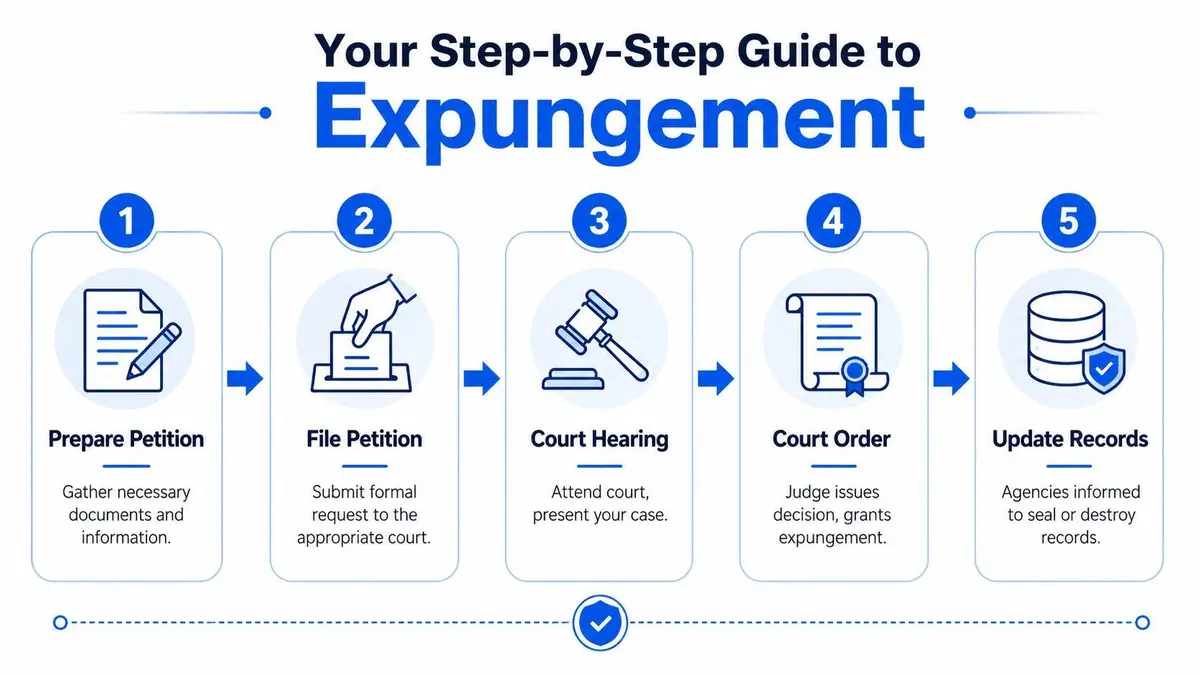
What usually happens in practice
In many jurisdictions, the process starts with gathering the exact case details, confirming eligibility dates, and preparing the correct motion or petition. The filing then goes to the appropriate court, and the prosecutor must be notified. If the prosecutor objects, the matter may move to a hearing.
According to Maryland’s public legal guidance, the process typically takes about three months from petition filing to a judge’s final order, and the record is only officially expunged after the order is issued and all fees are paid, as explained in this guide to expungement and changing your criminal record.
The process sounds linear. It often isn’t. Administrative delays, missing dispositions, unpaid obligations, incorrect case numbers, and agency lag can stall what looked straightforward.
The five points where cases usually go sideways
- Bad case identification. Old dockets, aliases, or fragmented records lead to incomplete filings.
- Wrong timing. Clients count the waiting period from the wrong date.
- Prosecutor objections. A case that looked routine becomes contested.
- Payment issues. The court signs the order, but the relief is not fully effective until fees are satisfied.
- Agency follow-through. Courts can issue the order, yet downstream databases may take longer to reflect it.
For clients trying to understand a state-specific process before retaining counsel, this overview on how to get a fresh start in Texas is a useful example of how state procedure can differ.
Later in the process, many clients want a plain-language walk-through of how the filing sequence works and why hearings occur. This short explainer is helpful:
What a court order does, and what it doesn’t
A granted order directs the court and related agencies to handle the record according to law. That is significant relief. But it doesn’t guarantee that every private actor who copied the information has updated its systems.
That distinction becomes decisive once your concern extends beyond the courthouse and into Google results, tenant screens, executive vetting reports, or old press coverage.
The Patchwork of State and Federal Laws
No single national rule answers what is criminal record expungement for every client. The United States runs on a fragmented system, and that fragmentation changes both legal options and timing.

Why one state’s answer doesn’t travel well
Some states allow broad relief. Others are narrower. Some distinguish sharply between convictions and non-convictions. Others build automatic clearing into the system for certain matters. Federal records present a separate complication because there is no general federal expungement statute for most criminal records.
That means clients often make a category error. They read a favorable article from another state, assume the same result is available to them, and plan around relief they can’t obtain.
The more public your life is, the less room there is for that mistake. A filing calendar tied to a financing round, relocation, election cycle, or licensing event needs jurisdiction-specific advice, not internet folklore.
The move toward automatic relief
There has been real legislative momentum. As of March 2024, at least 24 states had passed laws for automatic record clearing, and New York’s Clean Slate Act was set to automatically seal misdemeanor records after 3 years and felony records after 8 years, according to the National Center for State Courts’ record relief report.
That trend matters because it shows lawmakers recognize the burden of petition-based systems. It does not mean manual filings are obsolete. Many clients still need petitions, specific legal analysis, or cleanup work for records that fall outside automatic schemes.
The strategic takeaway for executives
This legal patchwork has a digital counterpart. Even when one state creates strong relief, the internet doesn’t respect state borders. A record copied by a private site in another jurisdiction, indexed by a search engine, or preserved in reporting may outlive the legal record itself.
That’s one reason debates around privacy rights in the United States remain unsettled. If you’re assessing whether any American equivalent to erasure exists online, this overview of the right to be forgotten in the US gives the broader legal context.
State law can clear an official file. It cannot, by itself, standardize what private databases, search engines, publishers, and screening vendors do next.
The Digital Ghost Why Expungement Is Not Erasure
Many legal guides conclude their explanations too soon. They explain the court process accurately, then leave clients with the false impression that a granted order equals disappearance.
It doesn’t.
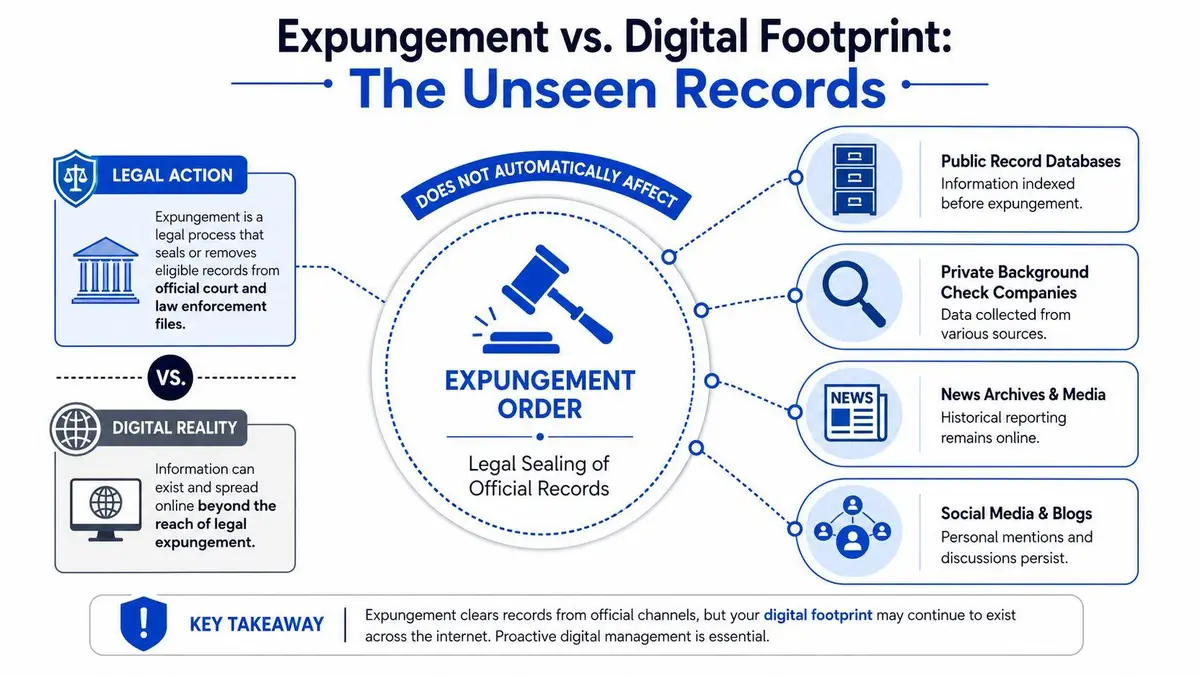
The record may be gone. The visibility may remain.
A court can order official repositories to expunge or seal a record. But private companies may have already collected the data. Mugshot sites may have mirrored it. People-search platforms may have scraped it. Old news articles may still rank. Social posts and forum threads may still mention it.
Florida guidance captures the core problem. Expunged records can persist on commercial data aggregators and mugshot sites because third-party data brokers often do not receive real-time updates from courts, which is why legal expungement alone provides incomplete protection for high-profile clients without de-indexing and source removal work, as reflected in the Florida discussion of seal and expunge process frequently asked questions.
That is the digital ghost gap. The law changes the status of the official record. The internet preserves prior copies.
Where the ghost usually lives
When clients say, “My case was cleared, but it still shows up,” they are usually seeing one or more of these sources:
- Private background check vendors that bought or scraped records before the order.
- Mugshot and arrest sites that don’t update unless forced, persuaded, or pressured under specific rules.
- Search engine results pointing to stale pages, snippets, or caches.
- News archives and blogs that remain lawful to publish even after the record changes status.
- Social platforms and discussion boards where the issue has been repeated by others.
Some of those sources can be removed. Some can be de-indexed. Some require legal notices, platform procedures, or factual correction requests. Others require suppression strategies because direct removal isn’t available.
Why high-profile clients need a parallel track
For a private individual, an incomplete cleanup is frustrating. For a chief executive, investor, celebrity, physician, or family office principal, it can be commercially dangerous. A stale result can infect a financing memo, board package, tenant screening file, or press narrative long after a judge has granted relief.
This is the point where legal counsel and digital remediation need to work side by side. One practical option is to use a specialist that serves expungement orders to platforms and data sources, monitors whether pages remain indexed, and pushes de-indexing or source removal where available. ContentRemoval.com handles that kind of post-order online cleanup in matters involving arrest records, mugshots, and search visibility.
Expungement fixes legal status. It does not automatically fix discoverability.
Developing Your Two-Front Strategy for a Clean Slate
A real clean slate now requires two coordinated campaigns. One runs through the court system. The other runs through the internet.
Front one is legal relief
You need counsel who understands the jurisdiction, the waiting periods, the filing mechanics, and the strategic trade-offs. That includes deciding whether expungement, sealing, or another remedy best matches the problem. It also includes timing. A strong filing at the wrong moment can produce avoidable denial or waste a limited opportunity.
Front two is digital remediation
Once relief is granted, someone has to identify what still circulates online, which databases copied the record, where search results continue to surface it, and what can be removed versus merely pushed down or de-indexed.
That second front often involves:
- Source removal efforts aimed at the website hosting the content
- Search de-indexing requests where legal or policy grounds exist
- Background check disputes if a commercial screener is reporting stale information
- Monitoring to catch reposts, mirrors, and resurfacing mentions
If the issue is specifically an arrest record that continues to appear online after the legal process, this guide to arrest record removal and restoring digital privacy gives the operational framework.
What doesn’t work
Waiting rarely works. So does sending one generic email and assuming compliance will follow. Clients also lose time when they treat every online mention as legally identical. A mugshot site, a major news archive, a people-search platform, and a search engine each require different tactics.
The strongest outcomes come from sequencing. Confirm the legal remedy. Obtain the signed order. Map every online copy. Then pursue removals and de-indexing in a structured order based on harm, ranking, and likelihood of success.
FAQs for High-Profile Individuals and Businesses
Will expungement remove news articles about my case
Usually, no. Expungement changes the official legal record. It does not automatically compel a publisher to delete historical reporting, blog posts, commentary, or syndicated archives. Some publishers will consider updates, anonymization, or removal requests under specific circumstances. Others won’t. If the article remains online, search strategy and source-specific removal analysis become necessary.
Can I legally say the incident never happened
That depends on the jurisdiction and the context. Some expungement laws allow you to deny the offense in many employment and housing settings. Certain government applications, licensing boards, immigration matters, and security-sensitive processes may still require disclosure or permit access. The exact wording on the application matters, and so does the law of the state that granted relief.
If my record is expunged, will private background checks stop showing it
They should update, but that doesn’t always happen immediately or completely. Some vendors rely on data purchased before the order was entered. Others update on delayed cycles. When a private report still shows a matter that should no longer appear, the issue shifts from court relief to private database correction and dispute handling.
Can a company address a criminal record tied to its founder or executive
Yes, but the approach depends on whether the problem is legal, reputational, or both. The legal piece focuses on the individual’s record status and disclosure obligations. The business piece focuses on search results, investor materials, media narratives, and whether the issue is being associated with the company brand. Many organizations need message control and digital cleanup even when the executive obtains legal relief.
Does expungement help with international travel or professional licensing
Sometimes, but there is no universal answer. Foreign border authorities and professional regulators operate under their own rules. Some may care primarily about convictions. Others may ask broader questions that still require careful disclosure analysis. Expungement can improve the legal posture, but it does not guarantee admission, licensing, or restoration of every opportunity.
Is the expungement process itself confidential
Not automatically. The process is a court action, and aspects of it may be visible depending on the jurisdiction, the docket system, and the procedural posture. Even where the end result is favorable, the existence of the filing may still be discoverable by someone looking carefully enough. That is another reason online reputation strategy shouldn’t wait until after the court order.
What should I do first if I’m under immediate pressure
Start with triage, not assumptions.
- Identify the exact case and obtain the docket information.
- Determine whether the immediate threat is legal screening, media visibility, or both.
- Get jurisdiction-specific legal advice on eligibility and timing.
- Audit search results and private-site visibility before anyone else controls the narrative.
- Preserve records, screenshots, and the final order once relief is granted.
A rushed filing can create new problems. So can waiting while stale content continues to circulate through searches, reports, and private screenings.
If an old record is threatening a transaction, appointment, lease, or public profile, ContentRemoval.com can assess the digital side of the problem confidentially and coordinate a practical removal strategy alongside your legal process. The goal isn’t abstract reputation management. It’s to identify what still appears, determine what can be removed or de-indexed, and reduce the gap between legal relief and what the world still sees.
Frequently asked questions
Does expungement remove my mugshot from Google?
Not on its own. A court order directs official repositories, but mugshot sites, data brokers and search engines may have copied the record before the order and often do not receive updates from courts. Those copies need separate source removal, de-indexing or dispute work.
Should I expunge the smaller charge first?
Be careful. The article notes that some states, including Indiana, allow conviction expungement only once in many circumstances, so clearing a minor matter now can block relief for a more damaging one later. Rank your records by present-day harm before filing.
Is sealing enough if I just want to pass a background check?
For many employment and housing screens, sealing limits public visibility enough to help, though government agencies and law enforcement can still see the record. Clients facing licensing boards, intense diligence or media scrutiny usually need the fuller relief of expungement plus a digital cleanup.