
Continuous monitoring in reputation protection is a standing defensive process that detects harmful content early, validates whether it is a real threat, routes it into legal, platform or security action, and keeps watching for reuploads after removal. It replaces periodic checks and Google Alerts with persistent coverage across search, social, forums and mirror sites.
Key facts
- Basic alerts fail on coverage, identity, timing and action gaps, missing forums, aliases and reposts.
- An effective system has four linked functions: detection, validation, response support and persistence control.
- Watchlists should cover aliases, family members, staff, project codenames and known attack language, not just one name.
- Useful metrics are time to detection, time to remediation, reoccurrence rate and escalation accuracy.
Where ContentRemoval.com comes in. ContentRemoval.com pairs removal with monitoring for executives, public figures and family offices, so that content taken down on Friday is not quietly back on Monday under a new filename. Security teams, chiefs of staff and outside counsel tend to make the first contact. A free 15-minute Exposure Scan maps what is appearing, where it started and whether earlier removals are holding, and the report is yours to keep. Get a Free, Confidential Exposure Scan or read how our content removal work is done.
At the moment a problem becomes visible to you, it has usually been visible to someone else for hours, sometimes longer.
That is the blind spot most executives, public figures, and family offices discover too late. A fake profile appears on a secondary platform that no one on your team checks. A private image is posted in a niche forum before it reaches mainstream search results. A coordinated review attack starts subtly, just outside the narrow range of standard alerts. By the time the issue reaches counsel, communications, or security, the damage isn’t theoretical. It is already propagating.
That is why the question what is continuous monitoring can’t be answered with a generic IT definition alone. In high-stakes reputation protection, continuous monitoring is not a dashboard and it is not a convenience. It is a standing defensive posture designed to detect, assess, escalate, and contain risk before it hardens into a public crisis.
Beyond Google Alerts The New Threshold for Digital Defense
A chief executive learns about an impersonation account from a customer. A public figure finds out that private material has resurfaced because a journalist calls for comment. A family office discovers that personal details were circulated in a hostile forum only after security staff notice unusual contact attempts.
None of these scenarios begins with a dramatic headline. They begin in the margins, where ordinary monitoring fails.
Google Alerts and periodic brand searches were built for a slower internet. They can still have limited value for basic visibility, but they don’t provide persistent coverage across the fragmented places where reputational harm often starts. Harmful content rarely announces itself in one obvious location under one obvious keyword. It spreads through reposts, screenshots, aliases, misspellings, fringe communities, mirror sites, and copycat accounts.
The distinction between continuous monitoring and periodic checks is not academic. LifeSignals notes that continuous monitoring closes oversight gaps by providing real-time data for earlier detection of deterioration. In reputation work, that deterioration is rarely clinical. It is a leak gaining traction, a false allegation being indexed, or a manipulated video crossing from obscurity into circulation.
What basic alerts miss
A standard alert system usually breaks down in four places:
- Coverage gaps leave out forums, image-sharing channels, cloned pages, and fast-moving social reposts.
- Identity gaps miss executive nicknames, misspellings, shell brands, product names, and related persons.
- Timing gaps delay notice until a search engine has already surfaced the issue.
- Action gaps tell you something exists, but not whether it is escalating, replicating, or likely to reappear after removal.
Periodic checking works if your risk arrives on schedule. Reputation attacks never do.
There is also a practical collection problem. Many sites actively resist automated access, rate-limit requests, or deploy anti-bot defenses that defeat simple scrapers. For anyone trying to understand why shallow monitoring misses so much of the web, Scrapfly’s guide on defeating anti-bot systems is a useful technical reference. The point is not to turn a legal or security team into a scraping shop. It is to understand why commercial alert tools often see only the easiest layer of the problem.
The new threshold
For high-profile clients, the threshold has moved. Monitoring is no longer a communications accessory. It sits alongside legal strategy, personal security, and incident response.
A serious monitoring posture answers three immediate questions. What appeared. Where it appeared first. Whether it is likely to spread before your team can intervene.
If your process can’t answer those questions quickly, you don’t have continuous monitoring. You have delayed awareness.
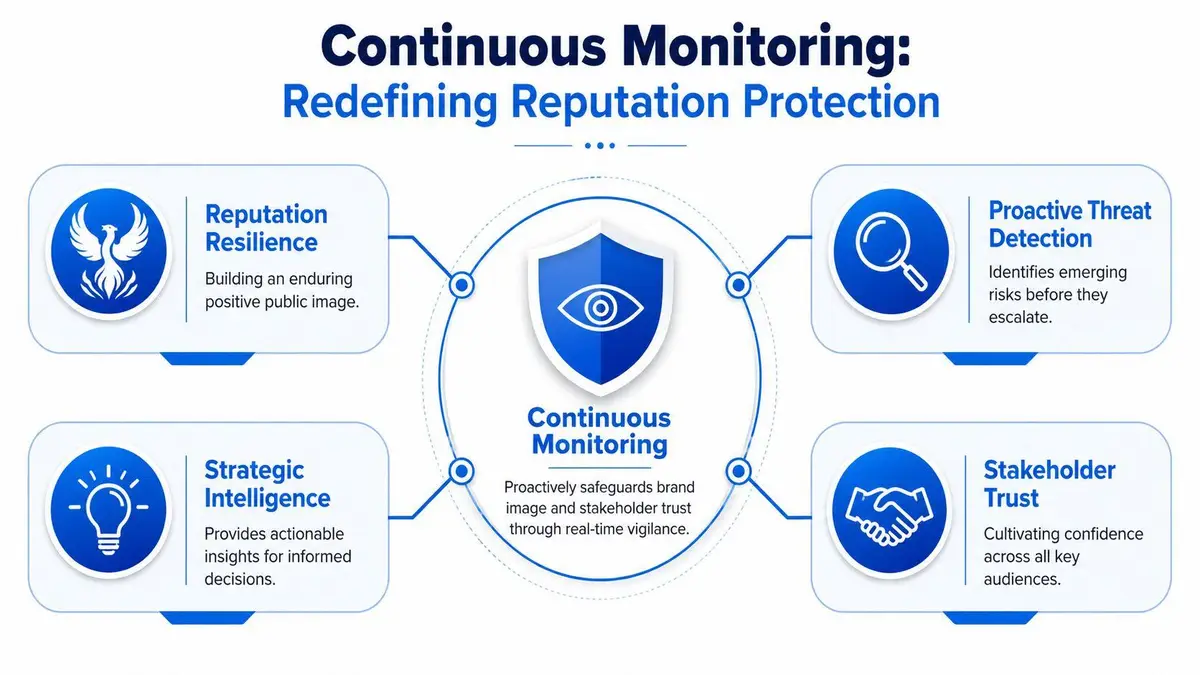
Continuous Monitoring Redefined for Reputation Protection
The formal starting point comes from security practice. NIST’s framework defines Information Security Continuous Monitoring as maintaining “ongoing awareness of information security, vulnerabilities, and threats” to support risk management, and the framework is built around a seven-step lifecycle rather than point-in-time review, as summarized in this NIST-based overview of continuous monitoring.
That definition matters because it establishes the core principle. Risk has to be assessed continuously, not episodically. But in reputation protection, the concept has to be adapted. The threat environment is different. The evidence is noisier. The legal options vary by platform, jurisdiction, and content type. Above all, the work does not end when something is merely found.
Detection is only the first layer
In reputation matters, a basic alert behaves like a smoke detector. It may tell you there is smoke. It does not tell you the source, whether the fire is spreading through adjacent rooms, whether someone set it deliberately, or whether the same actor will return tomorrow.
True continuous monitoring is closer to a managed security system. It watches for early signals, verifies whether the event is real, maps how far it has spread, supports intervention, and keeps watch after takedown or suppression efforts begin.
That last point is where most public explanations fail. They describe monitoring as listening. They rarely address the harder question: what happens after harmful content is found and removed?
The overlooked issue of re-uploads
A major gap in public discussions of continuous monitoring is the difference between initial detection and reoccurrence prevention. In ordinary consumer tools, detection is often the entire product. In serious reputation defense, detection is only the opening move.
Content can be removed from one platform and then re-uploaded to another. A fake account can be suspended and then recreated under a slight variation. An image can be reposted as a cropped version, mirrored copy, or screenshot. If the monitoring model does not account for recurrence, the client ends up paying repeatedly for the same crisis.
That is why the most advanced services monitor not just for mentions, but for return patterns. ContentRemoval.com describes this operating model directly in its work, including beginning actions within 24 to 48 hours and preventing reuploads through continuous monitoring, a point captured in the verified background reference to its model in this discussion of continuous monitoring and reupload prevention.
Practical rule: If a provider can only tell you when harmful content appears, but not how they track recurrence after removal, you are buying notice, not protection.
What the term should mean in practice
For reputation protection, continuous monitoring means a live process with four linked functions:
| Function | What it does in practice |
|---|---|
| Detection | Finds harmful mentions, leaks, impersonation, reposts, and emerging narratives |
| Validation | Separates genuine threats from noise, satire, coincidence, and false positives |
| Response support | Routes the issue into legal, platform, PR, or security action |
| Persistence control | Watches for re-uploads, clones, and recurrence after intervention |
A more accurate way to frame the service is continuous reputation defense. If you want a narrower operational definition, start with reputation monitoring services that treat surveillance, takedown support, and recurrence tracking as one workflow rather than disconnected tasks.
That is the answer to what continuous monitoring is in this field. It is not passive listening. It is ongoing control over how reputational harm is detected, contained, and prevented from returning.
The Operational Components of an Effective System
A reputation incident rarely fails because no one saw it. It fails because the system did not connect signal, judgment, and response fast enough. A workable model has two operating parts: machines that scan widely and people who decide accurately. If either side is weak, the client gets noise, delay, or false comfort.
The technical side has to cover more than obvious search results. Harm often appears first in places that do not rank well, are designed for rapid sharing, or are removed and reposted before a standard alerting tool catches up. That is why serious providers build monitoring around source coverage, identity variation, correlation rules, secure handling of sensitive data, and recurrence tracking after removal. For high-profile matters, that last point often separates a contained event from a recurring one. A provider that cannot watch for reposts and slight variations in the same material is leaving a known gap in the defense model.
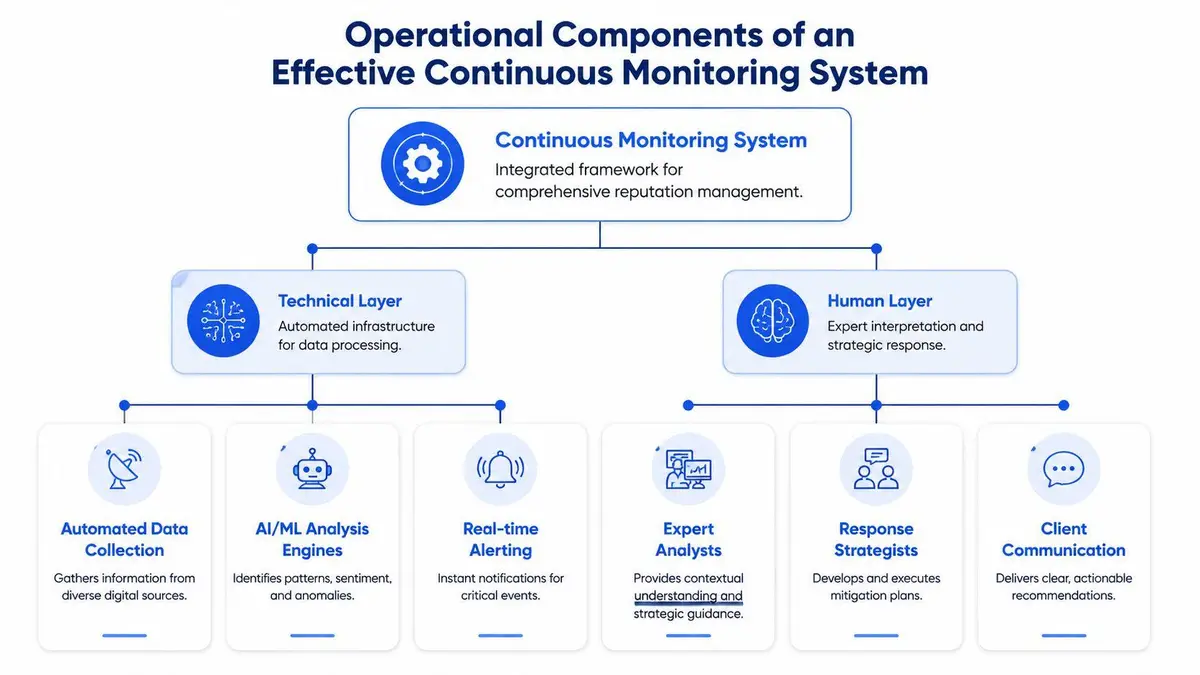
The technical layer
Technology handles volume and speed. It scans, indexes, matches, and groups activity across channels that no analyst could review manually in real time.
Scope decides whether that machinery is useful. A weak watchlist built around one name will miss impersonation, coded references, cropped copies, and reposts from adjacent accounts. A stronger approach monitors identity terms, known aliases, brand and project references, recurring attack language, and the secondary names that often appear around the principal. This online reputation monitoring strategy guide is directionally right on one point: term selection determines whether the feed produces warning or clutter.
In practice, useful monitoring usually covers:
- Primary identity terms such as the principal’s name, company, product, and known aliases
- Adjacent exposure terms including family members, executive assistants, board members, project codenames, and flagship assets
- Threat-specific terms such as leak language, scam language, impersonation markers, or known defamatory phrasing
- Re-upload indicators including altered filenames, cropped images, repeated captions, and account clusters associated with prior reposting
A mature technical setup also protects the material it collects. That means controlled access, careful retention, and handling rules that account for cross-border exposure and confidential instructions. Clients looking for professional online monitoring that is built to reduce risk quietly should ask how evidence is stored, who can review it, and how recurrence is tracked after takedown activity.
The human layer
Software can flag a pattern. It cannot decide what that pattern means for a board, a family office, a campaign, or pending litigation.
Analysts make the distinction that protects the client. They assess whether an account is parody or impersonation, whether a post is isolated anger or the start of a coordinated push, and whether a removal request will contain the issue or inflame it. They also decide what deserves immediate escalation and what should be watched without disturbing the principal.
False positives create their own risk.
Teams that are flooded with low-grade alerts start discounting the feed. Then the actual issue arrives looking like the last ten harmless ones. Good analysts prevent that drift. They suppress background noise, preserve evidence, add context, and route the matter to legal, platform, communications, or security teams in plain language.
What works and what doesn’t
Consumer-grade tools and executive-grade monitoring can look similar on a dashboard. Operationally, they are very different.
What works:
- Tightly scoped watchlists based on actual exposure, not generic brand mentions
- Cross-channel incident grouping so a source post, its reposts, and related impersonation accounts are treated as one matter
- Clear escalation rules that distinguish nuisance, reputational threat, extortion risk, and physical safety concerns
- Post-removal surveillance that watches for re-uploads, evasive edits, and mirror distribution
- Analyst review before escalation so the client receives judgment, not raw volume
What fails:
- Name-only alerts that miss variants, coded references, and related entities
- Automation without supervision that overwhelms counsel or communications staff with weak signals
- Periodic reporting that arrives after a narrative has already spread
- One-time takedowns that ignore reposting behavior and leave the same material free to return
The standard is straightforward. An effective system shortens decision time, improves containment, and reduces the chance that harmful content comes back under a slightly different form. In reputation protection, monitoring is only half the job. Persistence control is the other half.
Strategic Implementation for Executives and Public Figures
The value of continuous monitoring becomes obvious when you look at how different clients face risk.

For an executive, the first sign of trouble is rarely a press article. It is usually a small anomaly. A pseudonymous post that references confidential information. A cluster of hostile commentary around earnings, layoffs, or a disputed transaction. A fake social profile contacting employees or investors. If that material is detected early, counsel can preserve evidence, communications teams can prepare a position, and security staff can assess whether the issue is reputational only or part of a broader attack surface.
For a public figure, the pattern is different. Threats often arrive as impersonation, manipulated media, or the circulation of intimate or private material. Timing matters because harmful content can become far more difficult to contain once it moves from a niche channel into mainstream reposting. Continuous monitoring allows intervention while the issue is still small enough to isolate.
Three high-stakes use cases
The CEO under pressure
A board-facing executive doesn’t need a broad stream of sentiment data. They need warning of the few developments that can alter negotiations, investor confidence, or leadership credibility. Monitoring should focus on executive names, deal terms, litigation references, activist language, and identity misuse. The output should go into a decision channel, not a marketing dashboard.
The public figure facing impersonation
An actor, creator, or political figure is vulnerable to cloned accounts, false endorsements, fabricated direct messages, and altered video. Here, speed is inseparable from containment. A delayed response allows screenshots and secondary uploads to multiply. Monitoring has to support immediate routing into takedown, account reporting, and legal preservation.
After detection, teams often need a coordinated protocol like the one outlined in professional online monitoring for peace of mind, where legal, platform, and reputation actions are treated as one incident rather than separate departments chasing separate tasks.
The family office protecting principals
For family offices, the issue is often privacy rather than publicity. Doxxing attempts, location disclosure, family-member targeting, and malicious aggregation of personal details can create direct safety concerns. Monitoring here should include names, addresses where lawfully relevant, schools, household staff references, travel-linked chatter, and shell entities that could expose ownership structures.
Monitoring has to sit inside decision-making
Best practice is not to silo monitoring in marketing or junior communications staff. GroupCaliber’s guidance on enterprise reputation management makes the broader point that continuous monitoring should be integrated directly into executive decision workflows so that real-time reputation data informs business strategy, crisis response, and customer-facing adjustments.
That principle is sound, but the implementation has to be disciplined. Executives should not receive every alert. They should receive verified incident briefings with legal, operational, and reputational implications clearly stated.
A useful briefing usually answers:
- What happened
- How credible it is
- Where it is spreading
- What can be done immediately
- Whether recurrence is likely
Here is a practical example of the broader operating environment:
The 360-degree model
The strongest implementations connect monitoring to legal, communications, and security in one loop.
If monitoring ends at awareness, the client is still exposed. It has to end in action.
That is what separates passive observation from strategic defense. The system should not merely tell a principal what the internet is saying. It should help determine what happens next.
Measuring Success and Proving Value
Clients under pressure usually ask the right question early. Is this working?
The wrong answer is a report full of mention counts, impression estimates, and screenshots without hierarchy. Those are activity records. They are not proof of protection.
A better starting point comes from the logic behind Continuous Controls Monitoring. The Cloud Security Alliance’s explanation of CCM frames the shift correctly: real-time monitoring replaces inefficient point-in-time checks and allows intervention as anomalies emerge before they become costly failures, including reputational crises. That same logic should govern how results are measured.
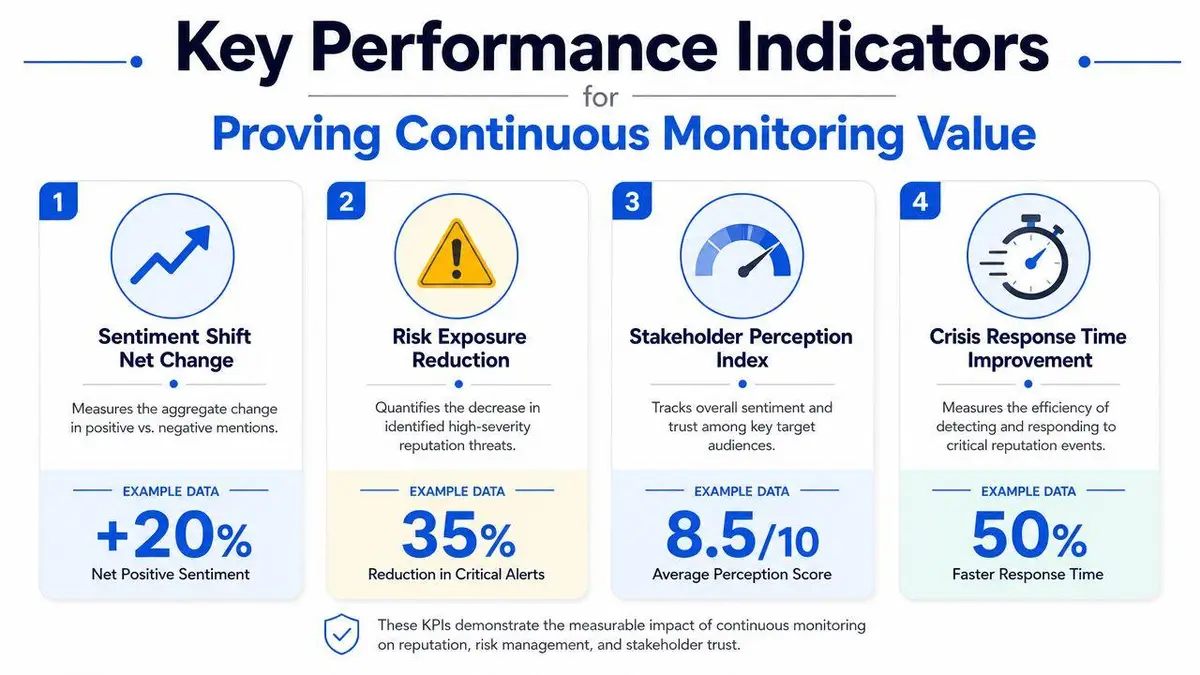
The metrics that matter
The most useful indicators in reputation protection are operational, not theatrical.
| Metric | Why it matters |
|---|---|
| Time to detection | Shows how quickly a new threat is identified after appearing |
| Time to remediation | Measures how fast the team can neutralize, remove, suppress, or contain the issue |
| Re-occurrence rate | Indicates whether removed content, suspended accounts, or suppressed narratives are returning |
| Escalation accuracy | Tests whether the system is surfacing serious threats without overwhelming decision-makers with noise |
A vanity report may tell you there were many mentions. A useful report tells you a harmful event was found quickly, assessed accurately, routed properly, and did not return after intervention.
Reporting should read like an intelligence brief
Executives do not need raw data dumps. They need concise, structured reporting that supports action and demonstrates control.
A sound report usually includes:
- Incident summary with a plain-language explanation of what surfaced
- Severity assessment explaining why the issue matters or does not
- Spread analysis identifying whether the issue is isolated or replicating
- Action log showing what has been done and what remains open
- Recurrence watch confirming whether the matter is stabilizing or reappearing
Board-level test: If a report cannot explain what risk was reduced, it is not a management document.
For clients evaluating spend, the more useful conversation is not “how many mentions were captured?” It is whether the process reduced exposure, shortened response cycles, and prevented repeat incidents. That is the framework behind justifying the cost of online monitoring services, where value is tied to averted escalation rather than vanity output.
A practical caution
Some providers will overstate certainty because measurement in reputation work is messy. Not every avoided crisis can be quantified cleanly. But that does not mean value is immeasurable.
If the system consistently detects threats early, routes them into action, and reduces recurrence, the client is buying fewer surprises, fewer emergency escalations, and fewer repeat takedowns. In this field, that is a meaningful result.
The Legal and Privacy Dimensions of Monitoring
A family office discovers that private images were removed from one platform on Friday, then reappear over the weekend under new accounts and slightly altered filenames. At that point, the legal question is not whether monitoring matters. It is whether the monitoring process was disciplined enough to support fast, defensible action without creating a second problem in privacy, evidence handling, or confidentiality.
That is the standard.
A monitoring program for reputation protection should be lawful, proportionate, and built for scrutiny. It should focus on publicly accessible material and defined specialist sources, collect only what is needed, preserve a clear record, and restrict access to people who have a reason to see it. In high-stakes matters, careless collection can weaken a complaint, complicate litigation strategy, or expose the client to avoidable disclosure risk.
Privacy by design is a legal control, not a technical preference. Data should be protected in transit and at rest. Sensitive details should be masked where possible. Storage location, retention periods, and access permissions should be set with the client’s regulatory and confidentiality position in mind. That matters more, not less, when the subject is a private individual, a public figure, a regulated business, or a family office operating across jurisdictions.
The practical test is simple. If outside counsel asks how the material was found, who handled it, what was retained, and whether the collection stayed within a lawful scope, the provider should be able to answer clearly.
Monitoring also changes the quality of legal remedies. A lawyer can send a stronger notice or make a better platform report when there is a timestamped record of where content appeared, how it spread, and whether the same actor reposted after removal. In reputation work, recurrence often matters as much as the first publication. A single post may support one response. Repeated re-uploads after takedown can justify a more aggressive legal and operational posture.
That point is routinely missed by providers that treat monitoring as passive alerting. For reputation protection, the harder problem is not just detection. It is proving reappearance, linking copies across accounts and platforms, and documenting enough continuity to support removal, escalation, or injunctive relief. Preventing re-uploads is where a serious monitoring capability separates itself from a generic brand-listening tool.
This is especially important in matters involving non-consensual intimate imagery, impersonation, false allegations, doxxing, or coordinated harassment. The legal right may exist on paper. Its value depends on speed, evidence quality, and the ability to show that the threat is ongoing rather than isolated.
Before any engagement, a discreet provider should be ready to answer five questions:
- What sources are monitored, and what legal basis supports that monitoring
- How confidential client information is segregated, stored, and access-controlled
- How evidence is preserved so counsel can use it
- How repeat postings and re-uploads are tracked after takedown efforts
- How the monitoring team coordinates with outside counsel, crisis advisers, and security personnel
The useful definition of continuous monitoring in this context is narrower and more demanding than the generic IT version. It is a controlled intelligence function for finding harmful content early, preserving admissible evidence, and stopping removed material from returning.
If your name, business, family, or clients are exposed to impersonation, leaks, false allegations, or recurring harmful content, ContentRemoval.com can assess the risk confidentially and outline a customized monitoring and response plan. The useful first step is a discreet review of where the threat is appearing, how it is spreading, and whether prior removals are holding.
Frequently asked questions
Are Google Alerts enough to monitor my reputation?
Not for high-profile exposure. The article explains that alerts and periodic brand searches were built for a slower internet and miss forums, image-sharing channels, cloned pages, misspellings and fast reposts. They tell you something exists, not whether it is spreading or likely to return.
What happens after harmful content is removed if you keep monitoring?
The monitoring shifts to return patterns: reuploads on other platforms, recreated accounts under slight variations, cropped or mirrored images and repeated captions. Documenting that recurrence also strengthens later platform reports and legal notices, because repeated reposting after takedown can justify a firmer response.
What should a monitoring report for an executive contain?
Not raw mention counts. A useful report reads like an intelligence brief with an incident summary, a severity assessment, spread analysis, an action log and a recurrence watch. Executives should receive verified incident briefings, not every alert.