
Brand protection is the discipline of controlling how your name, likeness, intellectual property, products and digital identity are used by other people, especially hostile ones. It rests on three pillars, legal enforcement, digital risk monitoring and supply chain integrity, and it is measured by how quickly abuse is detected and taken down, not by effort.
Key facts
- The three pillars are the legal shield, the digital watch and the supply chain lock.
- Time to Takedown, Mean Time to Detection and takedown success ratio are the core performance measures.
- Standard hosting provider takedowns can average 5 to 14 business days, while specialists may begin within 24 to 48 hours.
- Platform and marketplace IP channels are often faster than court action when the evidence package is tight.
Where ContentRemoval.com comes in. ContentRemoval.com works the enforcement end of brand protection: getting cloned sites, impersonation accounts, leaked documents, counterfeit listings and defamatory pages removed, then watching for reuploads. Brand, legal and security teams usually bring us in when the remediation gap has become the real threat. A free 15-minute Exposure Scan maps what is live, what is removable and by which route, and the report is yours to keep. Get a Free, Confidential Exposure Scan or read how our content removal work is done.
A client usually calls after the moment that matters.
A fake Instagram account starts messaging investors from the CEO’s name. A cloned website goes live with a payment form that looks legitimate enough to fool busy customers. A confidential PDF, pulled from an old email chain or shared by a disgruntled insider, appears in search results before your team has even agreed on who owns the response. The first instinct is often to treat this as a PR issue. It isn’t. It’s a control issue.
That’s the right way to understand what is brand protection. It isn’t a slogan, a trademark filing, or a vague reputation exercise. It’s the discipline of controlling how your name, likeness, intellectual property, products, and digital identity are used by other people, especially hostile ones. If you’re high-profile, wealthy, regulated, or publicly visible, your exposure is wider and the abuse is more complex.
The commercial stakes are obvious. The strategic stakes are larger. The global authentication and brand protection market was valued at USD 2.99 billion in 2024 and is projected to reach USD 7.64 billion by 2032, a 12.80% CAGR, according to Fortune Business Insights on the authentication and brand protection market. Markets don’t grow like that because executives suddenly became interested in theory. They grow because counterfeiting, impersonation, piracy, and digital fraud are now regular operating risks.
For a new client, I don’t frame the problem as “protecting reputation.” That phrase is too passive. I frame it as preserving command over your identity, your channels, your customer trust, and your legal rights. Once you look at it that way, the standard advice starts to look inadequate. Detection matters. Legal rights matter. Monitoring matters. But the primary failure point in most programs is simpler. They find the attack, then they move too slowly to contain it.
Introduction Beyond Reputation, A Matter of Control
A brand attack rarely announces itself in a clean, orderly way. It appears as noise. A board member forwards a suspicious account. A customer support lead flags unusual complaints. Counsel spots a copied logo on a marketplace listing. By the time the matter reaches the principal, the abuse has often spread across search, social, email, and messaging apps.
That spread is why brand protection has to sit closer to risk management than marketing. Marketing builds visibility. Brand protection decides who gets to exploit that visibility, and how quickly you can stop them. For executives, founders, family offices, and public figures, the target is often personal as much as commercial. Your name can be weaponized even when your company’s trademarks are untouched.
What control actually means
Control starts with ownership of assets, but it doesn’t end there. You need authority over domains, social handles, app listings, product imagery, copyrighted material, executive identities, and the evidence trail required to enforce your rights. If one of those elements is unmanaged, attackers use it as an entry point.
A practical definition looks like this:
- Identity control: stopping impersonation, fake profiles, cloned websites, and false affiliations.
- Content control: removing leaked, defamatory, pirated, or manipulated material.
- Commercial control: shutting down counterfeit sales, unauthorized resellers, and diversion channels.
- Technical control: reducing the ability of attackers to weaponize your domains, email, and web presence.
Practical rule: If someone else can profit from your name faster than you can shut them down, you don’t have brand protection. You have monitoring.
Why high-profile clients face a different problem
A local business and a public executive both face impersonation risk. The difference is speed, scale, and consequence. A fake account targeting a private company may cause confusion. A fake account targeting a listed company executive can move markets, trigger legal exposure, or damage negotiations.
The same applies to leaked material. A stale article or forum post is one problem. A confidential term sheet, internal memo, intimate image, or personal address posted online is another category entirely. The response cannot be improvised. It has to be immediate, coordinated, and discreet.
The Core Pillars of Brand Protection
Most clients arrive with a fragmented setup. Legal owns trademarks. Security owns phishing. Marketing watches social. Operations deals with grey market leakage. That structure guarantees gaps. Brand protection only works when you treat it as a single fortress with three supporting pillars.
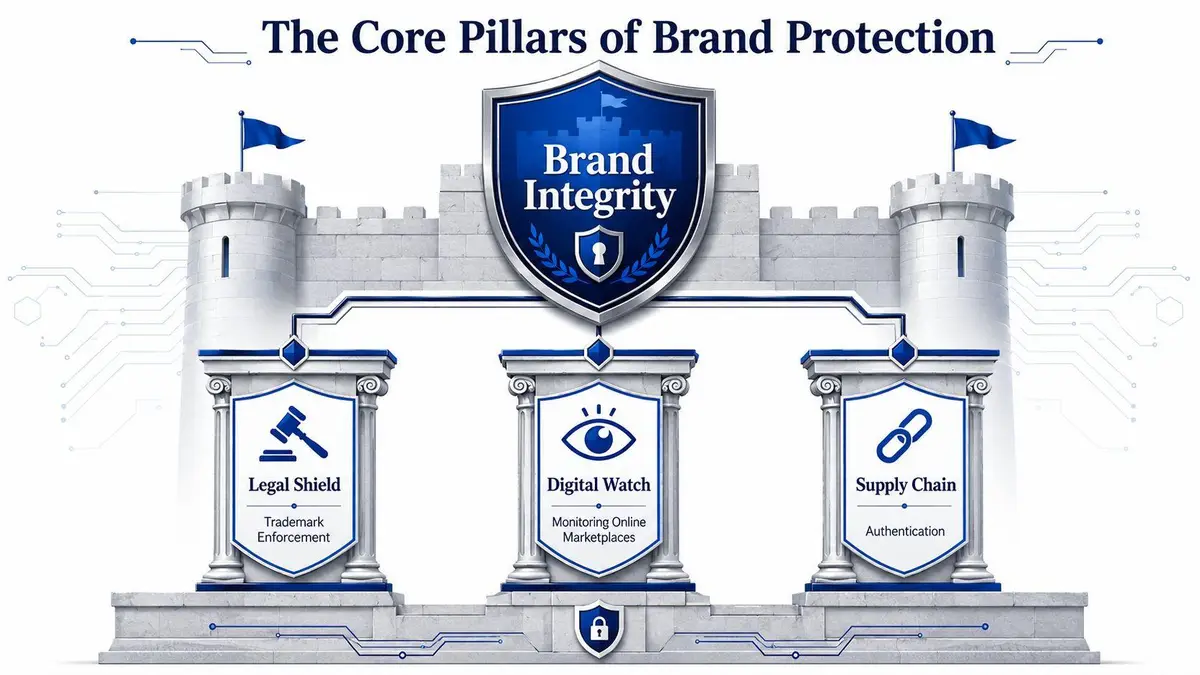
Legal shield
The first pillar is intellectual property enforcement. This is the legal foundation. Trademarks, copyrights, design rights, licensing controls, and contractual restrictions give you standing to act. Without that foundation, every enforcement effort becomes slower and more negotiable.
This pillar also includes evidentiary discipline. You need records of ownership, first use, registrations, platform account authority, and prior infringement history. When those records are weak, platforms delay. So do marketplaces, registrars, and counterparties.
Digital watch
The second pillar is digital risk mitigation. This is your active perimeter. It covers domain abuse, phishing, social impersonation, fraudulent ads, fake apps, search manipulation, and data exposure. It also connects directly to customer trust. Research shows 87% of consumers would refuse to do business with a company if they had concerns about its security practices, and 59% say a single data breach would negatively affect their willingness to purchase from that brand, according to CDP’s analysis of data privacy statistics and brand trust.
If your security baseline is weak, your brand protection program is weak. For smaller regional teams that need a practical grounding in operational controls, this guide on cybersecurity for North West businesses is a useful reference point. For live brand surveillance, a dedicated reputation monitoring capability gives you earlier visibility into abuse that won’t show up in a conventional security queue.
Strong brand protection doesn’t ask whether an attack is “legal,” “technical,” or “reputational.” It asks who can stop it fastest.
Supply chain lock
The third pillar is supply chain integrity. Many executives underestimate this because it feels operational rather than reputational. That’s a mistake. Counterfeits, unauthorized distribution, packaging fraud, and diverted inventory all become reputation events once the customer encounters them.
This pillar includes authentication measures, seller verification, channel enforcement, product image control, and traceability. In luxury, food, pharmaceuticals, and consumer products, this isn’t optional. It’s part of protecting trust at the point of purchase.
The pillars are distinct, but they aren’t separate. Legal rights support digital takedowns. Digital monitoring exposes supply chain abuse. Supply chain data strengthens legal enforcement. Remove one pillar and the fortress becomes decorative.
Anatomy of a Threat Common Attacks on Your Brand
The attacks that matter most aren’t random. They follow predictable patterns, exploit the same operational weaknesses, and hit the same pressure points: trust, speed, and confusion. If you want a workable answer to what is brand protection, look at what you’re defending against.
Executive impersonation and fake digital assets
This is one of the most damaging attacks for public-facing clients because it borrows your authority rather than merely copying your logo. The attacker sets up a social profile, lookalike domain, fake email identity, or cloned landing page that appears close enough to pass casual scrutiny. Then they contact customers, counterparties, journalists, investors, or staff.
The harm is immediate. The victim doesn’t experience “brand misuse.” They experience deception under your name. If you’re a CEO or principal, that can contaminate fundraising, M&A outreach, media narratives, and internal trust all at once.
Counterfeiting and marketplace abuse
Counterfeits damage revenue, but the more serious issue is quality attribution. Buyers blame the authentic brand for the fake product’s failure. That’s especially serious where safety, authenticity, or exclusivity matters. Luxury goods, wellness products, supplements, medical items, and premium consumer products all carry this risk.
Marketplace abuse often sits beside counterfeit activity. Unauthorized sellers reuse official images, scrape product descriptions, and create the illusion of legitimacy. Even when the product is genuine, channel violations can distort pricing, warranty expectations, and customer support burden.
Defamation, disinformation, and coordinated narrative attacks
Not every attack is commercial. Some are reputational warfare. Anonymous posts, forum threads, fabricated allegations, manipulated screenshots, and coordinated amplification campaigns can be launched by competitors, former employees, litigants, extortionists, or online opportunists.
These incidents require careful handling. The wrong response can legitimise the content, widen distribution, or create a public record that didn’t previously exist. Brand protection here is part legal analysis, part removal strategy, part search containment.
The first question isn’t “Is this false?” The first question is “Where is it hosted, how is it spreading, and what mechanism removes it fastest?”
Data leaks and privacy breaches
For high-net-worth individuals and senior executives, leaked information is often the point where brand protection becomes personal security. A posted address, passport image, internal memo, litigation draft, intimate image, or confidential commercial file shifts the matter beyond reputation. It becomes a risk to safety, strategic advantage, and privacy.
This category also includes stolen credentials, exposed internal materials, and dark web circulation. The response must account for source removal, search suppression, reupload risk, and platform escalation. A narrow legal letter isn’t enough if copies are propagating across multiple services.
Piracy and unauthorized content distribution
Creators, media brands, educators, luxury service providers, and public figures face a parallel problem. Their content gets copied, repackaged, leaked, mirrored, and monetized elsewhere. Sometimes the issue is straightforward copyright infringement. Often it overlaps with impersonation, subscription fraud, or affiliate abuse.
The business damage isn’t confined to lost revenue. Pirated content lowers perceived exclusivity, confuses search results, and trains audiences to consume your work in uncontrolled environments.
Brand threat matrix
| Threat Type | Primary Impact | First-Line Remedy |
|---|---|---|
| Executive impersonation | Fraud, trust erosion, investor or customer confusion | Platform reporting, identity verification challenge, urgent takedown evidence package |
| Counterfeit listings | Revenue loss, product quality complaints, channel distortion | Marketplace enforcement, IP notice, seller escalation |
| Defamation or false allegations | Reputation damage, stakeholder concern, search contamination | Host or platform complaint, legal review, de-indexing strategy |
| Data leak or privacy exposure | Personal risk, confidentiality loss, extortion leverage | Source removal, emergency platform escalation, search removal action |
| Pirated content | Revenue leakage, brand dilution, unauthorized distribution | Copyright enforcement, host notice, repeat-upload monitoring |
The Arsenal of Brand Protection Remedies
Most clients overestimate legal remedies and underestimate technical ones. A solicitor’s letter has value. It also has a pace, a jurisdiction, and an audience. If a fake site is live and collecting payments, you don’t need a philosophical debate about rights. You need evidence, escalation, and removal.

Legal enforcement
Use legal enforcement where ownership is clear, precedent matters, or the infringer is persistent enough to justify a formal record. That includes trademark misuse, copyright infringement, domain disputes, contractual misuse of brand assets, and repeat marketplace violations.
The main tools are familiar:
- Trademark action: best for unauthorized use of names, logos, packaging, and confusingly similar identifiers.
- Copyright complaints: useful for copied text, images, video, internal documents, and creative works.
- Cease-and-desist letters: appropriate when the target is identifiable and likely to react to formal pressure.
- Platform and marketplace IP channels: often faster than court action if your evidence is tight.
Legal remedies create strategic advantages. They rarely create speed on their own.
Technical takedowns
Technical takedowns are what stop active abuse before it matures. They rely on platform rules, hosting terms, registrar policies, app store procedures, search engine policies, and evidence chains built for operations, not argument.
Effective brand protection requires continuous monitoring of Certificate Transparency logs and passive DNS to discover phishing sites, and the key benchmarks are Mean Time to Detection (MTTD) and Time to Takedown (TTTD), as outlined in Netcraft’s guide to brand protection in 2026. Those two measures tell you whether your program is functioning in practice.
For evidence intake and case assembly, teams often need to process screenshots, listings, documents, platform records, and structured case data quickly. In that context, an AI data extraction engine can help turn messy enforcement inputs into usable workflows. Where the issue involves copied assets, unauthorized listings, or rights-based abuse, a focused intellectual property protection service can sit alongside legal counsel and platform escalation.
Search removal and visibility control
Sometimes the source won’t move quickly, or won’t move at all. Then the next line of defense is visibility control. That includes de-indexing where policy permits, reducing search prominence, and preventing the abusive asset from becoming the first thing a customer, journalist, or investor sees.
This doesn’t replace source removal. It buys containment while source-level action continues. For sensitive matters, especially leaks and defamatory material, that sequencing matters.
Match the remedy to the threat
The mistake I see most often is using the same remedy for every problem. That wastes time.
- If the threat is fraudulent and live, start with technical takedown.
- If the threat is persistent and rights-based, build legal pressure in parallel.
- If the threat is already ranking or spreading, add search-focused containment.
- If the threat is intimate, confidential, or safety-related, escalate for emergency handling and reupload monitoring.
A good remedy isn’t the one that feels strongest. It’s the one that gets harmful material offline before it does another day of damage.
Building Your Brand Protection Program A Framework
A working program isn’t a stack of tools. It’s an operating model. The internal teams that handle this best treat brand protection as a cycle with clear ownership, escalation paths, and evidence standards.

Stage one, audit and assess
Start by mapping what you own and what can be abused. That includes official domains, social accounts, executive identities, product names, logos, content libraries, app listings, marketplace presence, and sensitive material that would be damaging if exposed.
Then identify weak points. Dormant domains, inconsistent account ownership, poor evidence retention, unclear approval chains, and unmonitored executive identities are common failures. If your team doesn’t know what “normal” looks like, it won’t spot the anomaly early.
Stage two, monitor and detect
Modern brand intelligence platforms aggregate data from the open web, dark web, and social platforms, using NLP and data science to map, score, and prioritize risk events. They can connect your business attributes to related digital assets such as typosquat domains and lookalike social accounts, as described by Recorded Future’s overview of brand intelligence and protection.
That capability matters because the signal is spread across many surfaces. Detection has to cover more than Google alerts and occasional social sweeps.
A mature monitoring layer usually includes:
- Brand asset monitoring: names, logos, products, executive identities, and key phrases.
- Channel monitoring: marketplaces, app stores, social platforms, forums, paste sites, and dark web sources.
- Risk scoring: ranking incidents by severity, likelihood of customer harm, and urgency of response.
Stage three, enforce and remediate
Most internal programs often falter at this point: The team detects a problem, then stalls over approval, evidence, or channel ownership. Fix that before the crisis arrives. Build response playbooks by threat type, pre-approve escalation routes, and define what qualifies for urgent action.
If third parties support the response, your service structure matters. A practical reference for procurement and accountability is this guide to drafting outcome-based agreements. It pushes the conversation toward response standards, deliverables, and measurable results rather than vague promises.
Stage four, measure and refine
Every incident should improve the system. Which platform resisted removal? Which evidence package worked fastest? Which executive account remains vulnerable? Which marketplace repeatedly hosts infringing sellers?
Review patterns, not anecdotes. Then tighten ownership, expand monitoring, and simplify escalation. The program doesn’t mature because you buy more software. It matures because you reduce delay and ambiguity after detection.
When to Engage Specialist Brand Protection Services
You should bring in specialists when delay has become the primary threat.
Most internal teams can spot a problem. Many law firms can write an excellent letter. Very few can compress the time between discovery and meaningful removal across platforms, hosts, search engines, and jurisdictions. That interval is the remediation gap, and it’s where most brand damage becomes expensive.

Fake websites and impersonation accounts cause measurable brand equity loss within 48 to 72 hours, while standard takedown workflows through hosting providers can average 5 to 14 business days. Specialized firms can begin remediation within 24 to 48 hours, according to Doppel’s analysis of brand protection strategy gaps. That difference is not administrative. It is the difference between a contained event and a developing crisis.
The trigger events that justify outside intervention
Bring in specialist support when any of these conditions appear:
- The threat is active and customer-facing: fake sites, payment scams, impersonation accounts, or leaked material already circulating.
- The issue crosses jurisdictions or platforms: one team rarely has the contacts, process knowledge, and evidence discipline to manage a fragmented attack.
- The content is highly sensitive: intimate imagery, personal data, internal documents, extortion material, or family-related exposure.
- Discretion matters as much as removal: public escalation can worsen the damage.
- Reuploads are likely: removal without monitoring only creates a loop.
This is also the point where a specialist online brand protection process becomes more useful than a generic advisory relationship. If you need a fuller view of how those interventions work across search, websites, and social channels, this comprehensive guide to online brand protection services is a sensible starting point.
If the harmful material can spread faster than your internal approvals can move, the matter has already outgrown an internal-only response.
Measuring Success KPIs for Brand Protection
You shouldn’t judge brand protection by effort. Judge it by containment.
The first KPI is Time to Takedown. If harmful material stays live too long, everything else is secondary. The second is Mean Time to Detection, because speed after discovery doesn’t help if discovery comes late. The third is takedown success ratio, which shows whether your evidence, channel strategy, and escalation logic are working.
Then look at impact indicators:
- Reduction in repeat abuse: are the same actors, accounts, or listings returning?
- Reduction in counterfeit or infringing visibility: are harmful listings and copied assets becoming less prevalent?
- Customer complaint pattern: are confusion, fraud reports, or trust-related complaints falling?
- Sentiment and loyalty signals: are damaging narratives being contained before they harden?
A mature program turns these into executive reporting, not vanity metrics. The point isn’t to feel protected. The point is to prove that abusive content is found quickly, removed efficiently, and less likely to recur.
If you can’t measure detection speed, removal speed, and recurrence, you don’t yet know whether your brand protection program works.
If your name, business, or digital identity is under pressure, ContentRemoval.com can assess the threat discreetly and outline a practical removal strategy. The work starts with identifying the fastest enforceable path, reducing the remediation gap, and containing reuploads before they become a second crisis.
Frequently asked questions
Is brand protection the same as trademark registration?
No. Trademarks give you standing to act, but the article describes brand protection as an operating model that also covers digital monitoring, technical takedowns, search visibility control and supply chain integrity. A registration without fast enforcement is monitoring, not protection.
When should a company bring in a brand protection specialist?
When delay has become the main threat: the abuse is live and customer-facing, crosses platforms or jurisdictions, involves highly sensitive material, requires discretion, or is likely to be reuploaded after removal. The article frames that interval between discovery and removal as the remediation gap.
Which remedy should come first when a fake website is live?
Start with technical takedown through the host, registrar and platform channels while preserving evidence. Build legal pressure in parallel if the actor is persistent, and add search containment if the asset is already ranking. The article warns against defaulting to a legal letter for every incident.