
AI-generated content is text, images, audio, video or code produced by a model that predicts output from learned statistical patterns rather than understanding the subject. It is probabilistic, so it can sound confident while getting facts wrong. For anyone with a public profile, the risk is fluent, fast-spreading fabrications: fake articles, synthetic quotes, deepfake clips and impersonation assets.
Key facts
- AI-generated writing surpassed human-authored content in November 2024 and reached 52% of new content by May 2025, per Graphite.
- Ahrefs found 74.2% of 900,000 new pages analyzed in April 2025 contained AI-generated content.
- Use the SIFT method: Stop, Investigate the source, Find better coverage, Trace claims to the original.
- Never use a generative model to verify its own output; detectors are for triage, not final judgment.
Where ContentRemoval.com comes in. ContentRemoval.com handles synthetic content once it has become a reputation, privacy or legal problem: mapping every live copy, cached snippet and mirror, choosing the remedy that matches the harm, and running de-indexing, platform reports, legal demands and monitoring in parallel. Board members, communications leads and counsel usually make contact after a fabricated article or clip is forwarded to them. A free 15-minute Exposure Scan maps what is removable, and the report is theirs to keep. Get a Free, Confidential Exposure Scan or read how our content removal work is done.
You’re in a meeting when a board member forwards a link that shouldn’t exist. It reads like a credible trade publication, it uses your name, and it repeats a claim you’ve never made. By the time counsel weighs in, the piece has already been copied, reposted, and stitched into search results. That is the modern reputational problem with AI-generated content. It can look polished, travel fast, and create enough doubt to unsettle investors, clients, and family offices before anyone has time to verify it.
Introduction with a Real Reputation Crisis
For executives and high-net-worth individuals, the first shock is rarely the content itself. It’s the speed of the spread and the way other people react to it. A false profile, a manipulated article, or a synthetic quote can sit beside legitimate coverage long enough to damage trust, especially when the audience assumes the writing is real because it sounds fluent.
That fluency is the trap. AI output can mimic the tone of a publication, a founder’s voice, or a legal summary without understanding the subject. Once the material is indexed or mirrored, the issue stops being only reputational. It becomes a legal, privacy, and escalation problem that needs fast containment, not public hand-wringing.
Understanding the Core Concepts
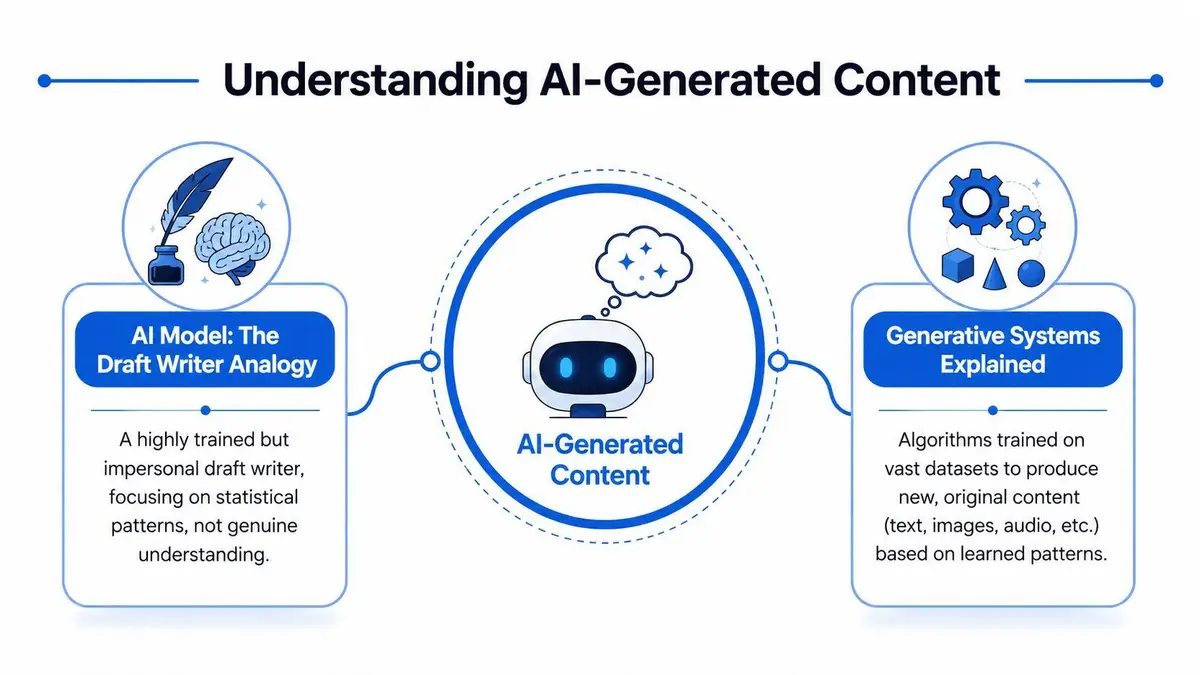
AI-generated content is best understood as a model-output pipeline, not as a machine that knows what it is saying. It works like a highly trained but impersonal draft writer that has absorbed patterns across large datasets and then predicts what should come next. It can produce text, images, audio, video, or code by following statistical relationships, not by pulling a fixed answer from a shelf.
That distinction matters because the output is probabilistic. The same prompt can produce different results, and the system can sound certain while still getting facts wrong. The point is straightforward. Generative systems rely on learned statistical patterns to create new material, which is why errors, style drift, and hallucinations can appear even when the copy looks polished and professional. IBM’s overview of AI-generated content
Why the label is a distraction
The term AI-generated content gets used too loosely. The more useful distinction is between content that merely passes through an AI tool and content that depends on the model’s output. That difference affects originality, liability, disclosure, and how difficult it is to unwind damage once the material is published.
The broader market reality is hard to ignore. A large analysis of over 65,000 English-language articles found AI-generated writing surpassed human-authored content in November 2024 and reached 52% of all new content by May 2025. The Graphite analysis of web content trends That does not mean every page is low quality. It does mean AI-assisted production has moved into the mainstream, and anyone managing a public profile should assume the content environment is saturated with synthetic drafts, rewrites, and fabrications.
What decision-makers should care about
If you are responsible for a reputation, the key question is not whether AI was used. It is whether the final output can be trusted, attributed, and defended. A fluent paragraph that cannot be traced, verified, or safely reused is a liability.
For executives and high-net-worth individuals, the risk is rarely abstract. Synthetic content can expose private details, blur authorship, and create records that are difficult to retract once they circulate through search, syndication, or copied reposts. That is why discreet review and removal planning matter before a publication becomes a permanent problem.
Practical rule: Treat AI-generated copy as a draft until a human has verified the claims, the sourcing, and the legal exposure.
Examining the Creation Workflow
A synthetic draft does not appear by accident. A model is trained on large datasets, then it produces output token by token, pixel by pixel, or frame by frame from learned patterns. That structure gives a team speed and scale, but it also creates clear points of failure, especially when the prompt is vague or the review process is rushed. IBM’s explanation of the model-output pipeline
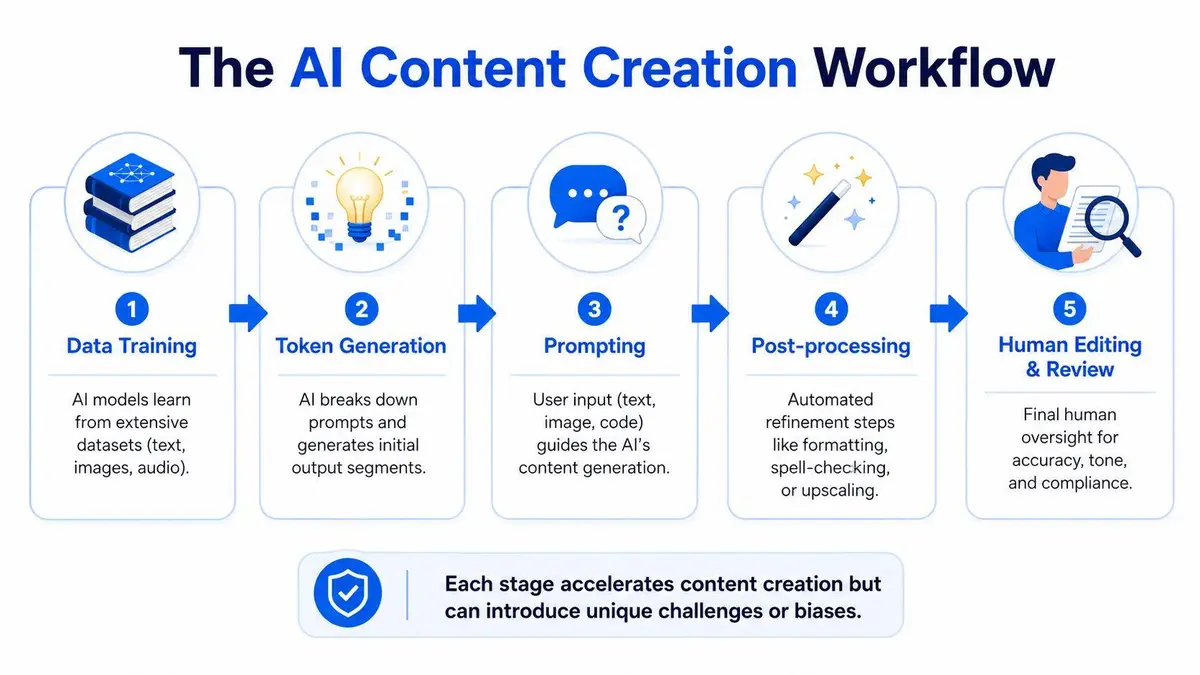
The content pipeline usually moves through five linked stages. First comes data training, where the system learns statistical patterns from massive datasets. Then token generation, where the model predicts the next pieces of output. After that, prompting steers the draft, post-processing cleans or reformats the result, and human editing and review are supposed to catch what the machine missed. Each stage can speed production, yet each stage can also introduce a fresh error.
Where the breakdown usually happens
The first failure is usually the prompt itself. A shallow prompt produces a shallow answer. A prompt that asks for a legal summary, a medical explanation, or a reputation-sensitive bio without enough context can produce text that sounds plausible and is wrong in detail. Hallucination starts there, and fluent prose is not proof of accuracy.
The second failure is post-processing. Automated formatting, spell-checking, translation, and upscaling can make a bad draft look more credible. A polished falsehood is more dangerous than a rough one because people are less likely to question it. AI output should be reviewed for facts, attribution, tone, and downstream legal risk before it reaches publication.
The third failure is attribution. If a model borrows style, phrasing, or structure too closely, the issue can shift from quality to ownership and disclosure. The output can also drift from brand voice or become inconsistent across platforms, which is a serious concern for people whose public messaging has to stay controlled.
Generating content quickly is easy. Publishing it safely is the hard part.
Why this matters in real operations
The same pipeline that helps a team draft a web page can also produce a false news rewrite, a fake executive bio, or an impersonation asset. Once that material is live, every copycat version makes remediation harder. Detection and verification need to sit inside the workflow, not after the damage has already spread.
Illustrating Real World Examples and Use Cases
A corporate marketing team uses AI to draft landing-page copy, then edits it lightly and publishes it. That’s the benign version. The risk appears when the draft includes a made-up certification, an overstated client result, or a fabricated claim about leadership credentials. For a public company, even a small accuracy failure can create disclosure and trust problems that extend far beyond the marketing team.
A second scenario is AI-enhanced news rewriting. A publisher takes a real article, rewrites it with AI for speed, and pushes it out with weaker sourcing than the original. The result may look like routine aggregation, but if the rewrite strips context or introduces a false implication, the reputational harm lands on the person named in the piece, not on the machine. That matters when the subject is a CEO, investor, or family office principal who can’t afford noise in the record.
Deepfake video is more severe. A synthetic clip can place a public figure in a fabricated setting and make the person appear to say or do something compromising. Even when the clip is exposed quickly, screenshots and reposts can keep circulating. The reputational damage is driven by confusion, not believability alone.
Phishing sits in a different category because the goal is extraction, not publicity. AI-crafted messages can imitate the tone of a personal assistant, lawyer, or banker well enough to pressure a rushed reply. The danger here is operational, but the fallout often becomes reputational too once confidential information leaks.
How to read the pattern
These cases share one feature. They all depend on speed, plausibility, and distribution. The more public the target, the more important it is to separate harmless automation from material that can trigger legal or privacy exposure.
If the content looks official, urgent, and hard to trace, assume it was designed to bypass scrutiny.
Identifying Reputation and Legal Privacy Risks
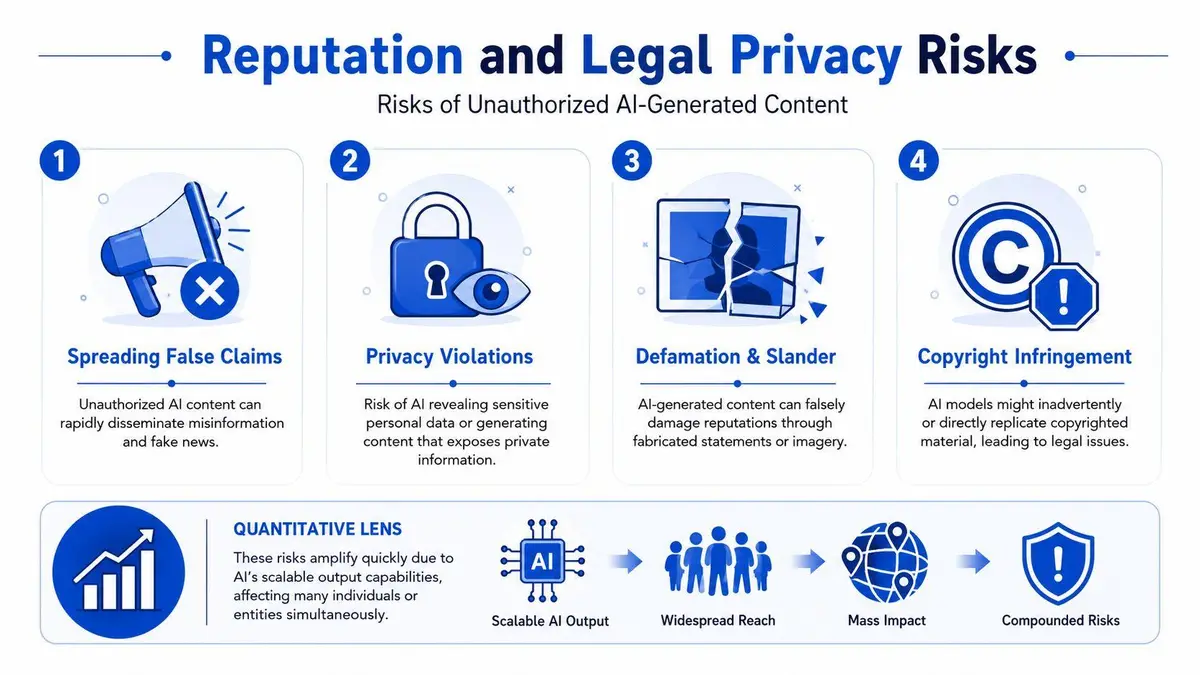
AI-generated content becomes dangerous when it crosses from drafting help into unauthorized publication. False claims can spread at scale, private facts can be exposed without consent, and copied material can create copyright problems that move quickly from content dispute to legal threat. For high-profile clients, the issue is rarely a single offending page. It’s the residue left across search results, screenshots, feeds, and archives.
The scale changed fast. In April 2025, Ahrefs analyzed 900,000 newly created web pages and found 74.2% contained AI-generated content, which shows how embedded AI has become in publishing workflows. Ahrefs’ analysis of new web pages That doesn’t make every AI-assisted page harmful. It does mean the volume of machine-assisted material is now large enough that reputational risk can appear in many places at once.
Reputation damage is usually cumulative
Defamation rarely arrives as a single catastrophic post. It builds through repetition. One fabricated article gets mirrored, then rewritten, then quoted by another site that never checked the original. At that point, the falsehood starts to look established because it has been repeated often enough.
Privacy risk is just as serious. AI can surface sensitive details from prompts, disclosures, or scraped material and turn them into content that exposes private information in a public-facing format. Once that happens, the damage isn’t only emotional. It can affect family security, business negotiations, and personal relationships.
Copyright and misuse issues complicate removal. A copied or derivative synthetic asset may sit on platforms that respond differently depending on whether the claim is framed as defamation, impersonation, privacy invasion, or infringement. That’s why the remedy has to match the harm.
The legal path depends on the injury
Some matters call for immediate legal escalation. Others call for documentation and monitoring first. A fabricated accusation in a search result deserves a different response than a low-value scraped page that can be buried or de-indexed. The wrong move can prolong exposure or even amplify the content.
For privacy-sensitive cases, the strategy often overlaps with broader digital erasure work. A separate guide on the right to be forgotten explains how privacy claims can intersect with search visibility and removal strategy, which is useful when the problem is not only falsehood but persistence in search. Strategic guide to the right to be forgotten
What to document first
- Capture the source URL and timestamps: Save the offending page, the date it appeared, and any reposts before edits happen.
- Preserve the context: Screenshot the page, surrounding headlines, and search snippets so the full exposure is clear.
- Identify the harm category: Separate defamation, privacy invasion, impersonation, and copyright issues. They’re not the same claim.
- Map the spread: Note where the content appears across platforms, archives, and search results before you choose a response.
Outlining Detection Techniques and Their Limits
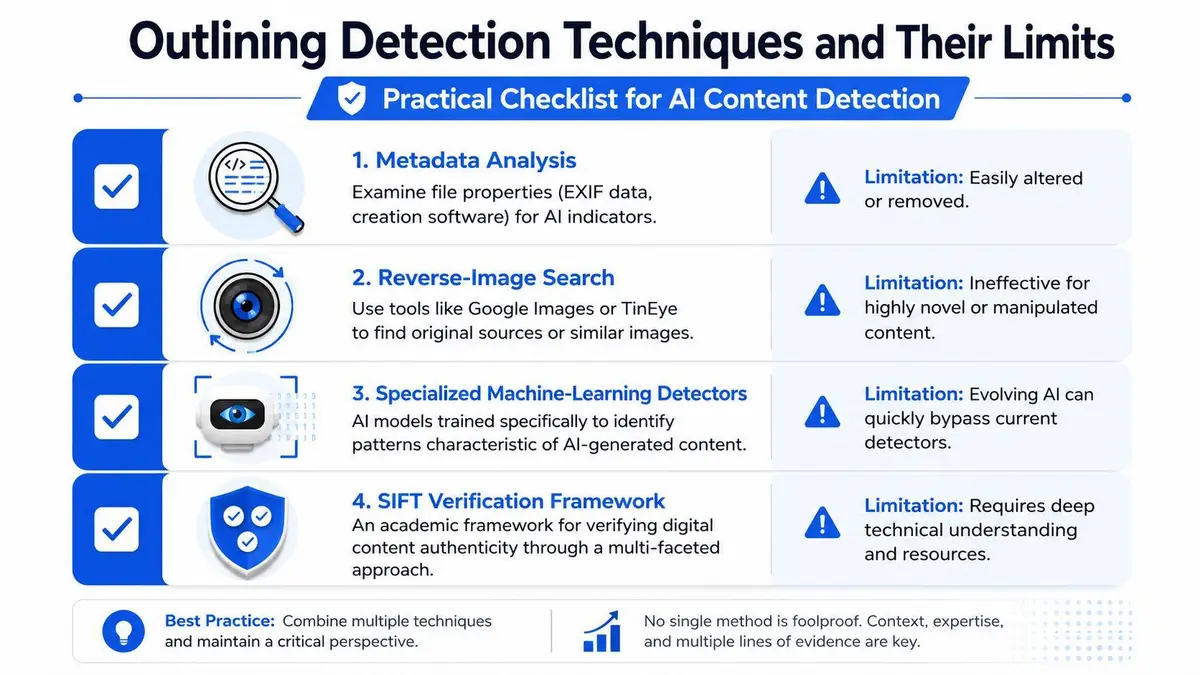
A decent detection process starts with skepticism, not software. Boston University’s SIFT method is the cleanest starting point because it forces the reviewer to Stop, Investigate the Source, Find Better Coverage, and Trace Claims to the original. Boston University’s verification guidance That approach is valuable because it treats AI output as unverified until a primary source says otherwise.
Use the source trail first
Metadata analysis can help when a file still carries useful properties, but metadata is easy to alter or strip. Reverse-image search can identify earlier versions or similar visuals, but it gets weaker when the image is novel or heavily manipulated. Specialized machine-learning detectors can flag patterns associated with synthetic text or media, yet the models they rely on are constantly chasing a moving target.
The SIFT method is stronger because it doesn’t ask the detector to be perfect. It asks the reviewer to verify the claim against a better source. That’s the right instinct when the goal is to avoid embarrassment, legal missteps, or escalation based on a false positive.
Know when tools stop being enough
AI detection tools are useful for triage, not final judgment. A confident detector result does not prove authorship, and a weak detector result does not prove authenticity. If the content has legal, commercial, or reputational consequences, the review has to move beyond machine classification.
University guidance also warns against using a generative model to verify its own output. That warning is common sense dressed in institutional language. If the source may have produced the error, it can’t be the only thing you use to clear the error.
For ongoing oversight, a dedicated monitoring process is more sensible than a one-time search. A focused reputation-monitoring workflow can catch repeated publication, impersonation, and resurfacing before stakeholders encounter the content. Reputation monitoring framework
Bottom line: Use detectors to sort noise, then use primary sources to make decisions.
Practical Guidance for Managing and Removing Content
Start with containment, not commentary. If AI-generated content is harming an executive, family member, or company principal, the first move is to identify every live copy, cached snippet, repost, and indexed version. The second move is to document what kind of harm is present, because a defamation claim, a privacy claim, and a copyright claim can require different notices and different escalation paths.
After that, the response usually moves through several channels in parallel. A legal demand letter can pressure the host or publisher when there’s a clear basis for removal. DMCA notices can help when the issue involves copied creative material. Search engine de-indexing requests matter when the content won’t disappear quickly at the source, but needs to be pushed out of public visibility. Platform reporting is useful for impersonation, synthetic media, and policy violations. When material is being copied into less visible corners of the web, dark-web remediation and continuous monitoring become part of the containment plan.
Jurisdiction matters. A page hosted in one country, indexed in another, and copied by a third party may require different sequencing than a simple takedown request. That’s why generic templates fail high-stakes cases. The legal theory has to match the platform, the host, and the actual injury.
For clients dealing with urgent exposure, the right process is a confidential assessment first, then a targeted action plan. The work should begin quickly, but not recklessly. If a matter is handled correctly, the goal is not public drama. It’s quiet reduction of visibility and durable suppression of repeat exposure. A practical starting point for broader takedown strategy is this removal process overview.
What a serious response looks like
- Assess the content: Confirm what is live, where it appears, and whether the harm is reputational, legal, or privacy-related.
- Choose the right remedy: Use removal, de-indexing, reporting, or suppression based on the platform and the claim.
- Move fast on duplication: Copied content is often the actual problem, not the first upload.
- Keep monitoring after removal: Reuploads are common, and the same material can reappear under a new URL.
A strong response doesn’t just delete one page. It cuts off the pathways that let the page keep resurfacing.
Conclusion and Frequently Asked Questions
AI-generated content is no longer a novelty. It’s a production layer that can help, mislead, or injure depending on how it’s used. For high-profile clients, the safest position is simple. Monitor continuously, enforce clear AI-use rules, and involve experts the moment a synthetic asset starts affecting search visibility, privacy, or legal exposure. Coverage increasingly shows generic AI text is ignored by search engines unless it offers first-party data or a defensible point of view, which means remediation, not mass replacement, is often the right response. CMSWire on generic AI content and search visibility
How quickly can harmful AI content be de-indexed?
It depends on the platform, the host, and the claim. De-indexing can move faster than source removal, but if the material is copied widely, the visible problem may persist until the mirrors are addressed too.
What evidence is needed for a defamation takedown?
You need the offending content, proof of publication, and enough context to show why the statement is false and harmful. Screenshots alone are rarely enough, but they’re a necessary start.
When should AI-detection tools be supplemented by expert review?
Whenever the content affects reputation, privacy, legal rights, or public trust. If the result could trigger a dispute, a takedown, or a formal response, human review should follow the tool.
A CTA for ContentRemoval.com.
Frequently asked questions
How can I tell if an article about me was written by AI?
Start with skepticism rather than software. Investigate the source, look for better coverage of the same claim and trace it to an original. Metadata checks, reverse image search and machine detectors help with triage, but their results are not proof of authorship either way.
Can a fake AI-generated article about me be removed from Google?
Often, but the route depends on the harm. A fabricated accusation may need a legal demand to the host plus a de-indexing request, impersonation goes through platform reporting, and copied creative material can use a DMCA notice. Copies and mirrors usually need addressing before the visible problem disappears.
What should I document first when synthetic content appears about me?
Capture the source URL and timestamps, plus full-page screenshots including surrounding headlines and search snippets. Identify the category of harm, whether defamation, privacy invasion, impersonation or copyright. Then map everywhere the content appears across platforms, archives and search results before choosing a response.