
A value statement is a precise declaration of the non-negotiable principles that govern an organization’s decisions, public comments and conduct under pressure. A mission describes what you do and a vision where you are going, but values describe how you behave and are meant to be permanent. An effective statement is authentic, specific and limited to three to five values.
Key facts
- Vision answers where we are going, mission answers what we do, values answer how we behave.
- Limit the statement to three to five core values, each with a single sentence describing observable behavior.
- Aspirational overreach and generic jargon create a hypocrisy gap that critics exploit.
- Values should almost never change; revise only during an identity-level transformation.
Where ContentRemoval.com comes in. A value statement is the defense you build in calm times; ContentRemoval.com is the one you call when an attack has already outrun it and false claims, leaked material or impersonation are shaping how the market reads your integrity. Communications directors, general counsel and founders usually make contact once the narrative has moved into search results. A free 15-minute Exposure Scan maps what is removable, and the report is theirs to keep. Get a Free, Confidential Exposure Scan or read how our content removal work is done.
A value statement is not a list of aspirational words for a corporate website. It is an organization’s ethical constitution, a precise declaration of the non-negotiable principles that govern every decision, public comment, and strategic action. It is not a marketing slogan. It is the definitive “why” behind your conduct, especially under pressure.
Defining Core Principles in a Volatile World

For an executive, brand, or public figure under constant scrutiny, a well-crafted value statement is a practical tool for risk management. It is the foundational code of your professional identity. When a crisis inevitably strikes (negative press, a controversial decision, an internal scandal) this document becomes your first line of defense, demonstrating that your actions were guided by consistent, established principles.
This extends far beyond generic corporate platitudes like “integrity” or “excellence.” An effective value statement defines specific, unbreakable rules of engagement. A commitment to ‘Discretion,’ for example, is not merely a word. It is a clear directive shaping how client data is handled, partnerships are vetted, and communications are managed. It preemptively answers the question, “Why did you do that?” with a documented, rational framework.
The Statement as a Shield
Without a defined set of values, your actions are left open to interpretation, or, more accurately, misinterpretation. In a reputational vacuum, adversaries, competitors, or a hostile media will assign their own motives to your decisions, invariably casting them in the worst possible light. A strong value statement acts as a shield, deflecting these attacks by providing an established framework for your conduct.
This framework is also critical for internal alignment. It ensures every individual, from the C-suite to client-facing staff, understands the ethical guardrails of their role. A solid value statement is the bedrock of ethical decision-making, guiding behavior and policy as detailed in the principles of ethical workplace communication.
A value statement is the final arbiter in any high-stakes decision. When financial incentives, market pressures, and public opinion collide, your values are the only constant that can guide your organization toward a defensible action that protects long-term trust over short-term gain.
This is precisely why understanding what a value statement is and how it functions is fundamental to reputation management. It establishes the official standard against which all actions can be measured, providing a powerful defense when your integrity is challenged. To see how this ties directly into public perception, you can explore our analysis of managing your brand reputation.
The Critical Distinction Between Values, Mission, and Vision
Values, mission, and vision are not interchangeable. For a leader or brand under scrutiny, confusing them is a strategic failure that invites accusations of hypocrisy and disorganization. These three statements are hierarchically linked, and understanding their distinct functions is fundamental to leading with integrity.
Consider your strategic framework as a complex legal case.
- Your Vision Statement is the desired final verdict. It is the aspirational future state you aim to achieve, answering the question, Where are we ultimately going?
- Your Mission Statement is the legal strategy. It defines the “what” and “how” of your organization, the specific work you undertake to achieve that verdict. It answers, What do we do to get there?
Both of these can be adapted. A shift in the market landscape might require a new legal strategy (Mission), or a change in long-term objectives may alter the desired verdict (Vision). Your values, however, are different.
Values as The Unchanging Rules of Court
Your Value Statement represents the immutable rules of professional conduct you adhere to throughout the proceedings. These principles dictate how you behave, regardless of the strategy or objective. If one of your values is “Unyielding Discretion,” you adhere to it during a straightforward negotiation just as you would during a contentious public dispute.
A value statement is the ethical bedrock that remains constant. While strategy and goals can adapt, values cannot. This is what anchors leadership decisions during a crisis, ensuring that actions are principled, not opportunistic.
This distinction is vital for reputation management. When you face a difficult decision, such as declining a lucrative client who poses a significant reputational risk, your mission and vision may not offer a clear answer. Your values will.
They provide a solid justification for your actions, proving consistency and principle. That integrity is a cornerstone of the best practices in online reputation management.
The table below clarifies their distinct roles.
Strategic Framework Comparison
| Statement Type | Core Question Answered | Primary Focus | Strategic Role in a Crisis |
|---|---|---|---|
| Vision | Where are we going? | The Future (Aspiration) | Provides long-term context but is often too broad for immediate decisions. |
| Mission | What do we do? | The Present (Action) | Defines operational scope but can be temporarily sidelined by a crisis. |
| Values | How do we behave? | The Constant (Principle) | Serves as the ultimate decision-making filter and public justification for actions. |
Ultimately, your mission explains what you do, and your vision explains why it matters long-term. But your value statement explains who you are at your core.
In the court of public opinion, character is everything.
The Anatomy of a Bulletproof Value Statement
A value statement that falters under public pressure is not merely useless. It is a liability. When a statement is vague or aspirational, it becomes a weapon for critics to use against you, highlighting the gap between your stated beliefs and your actual conduct.
A strong value statement is engineered for the real world. It is a functional asset for managing reputation, not a list of abstract nouns. To make a value statement effective, you must attach specific, actionable behaviors to every principle. This is how you convert a simple word into a governing rule that can withstand intense scrutiny.
Your values are the foundation of your entire strategy.
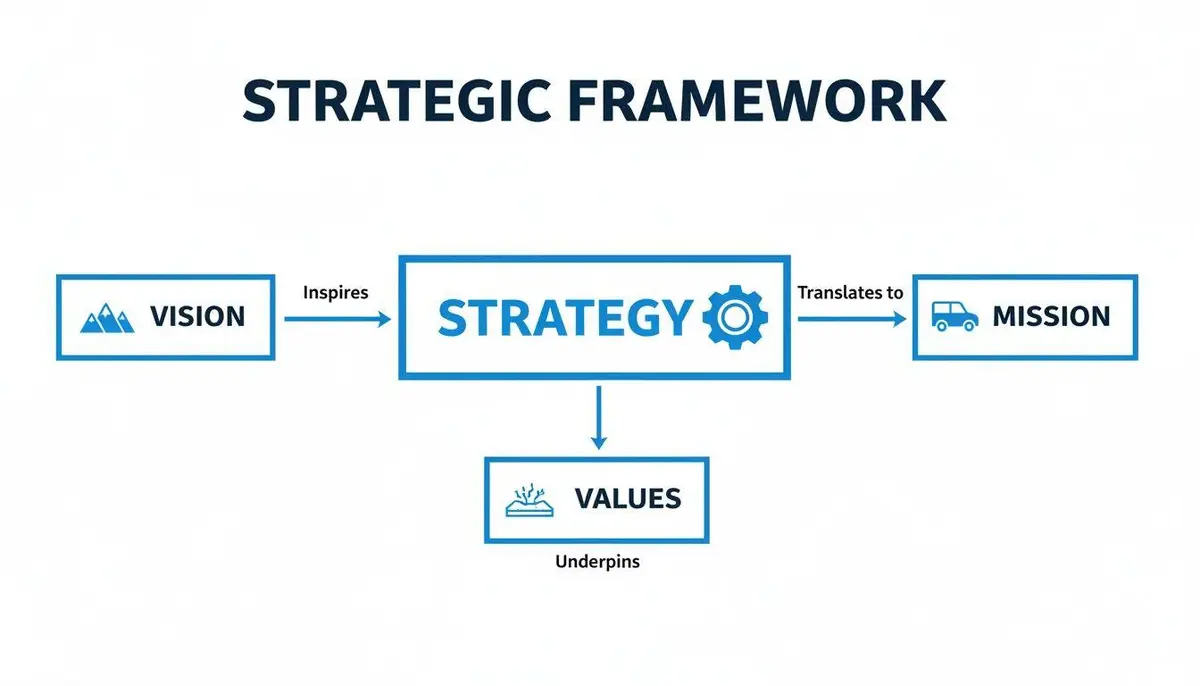
The diagram illustrates this relationship. Your Vision is the objective, and your Mission is the method. But your Values are the solid ground upon which everything is built.
The Three Pillars of a Resilient Statement
To construct a statement that holds up in a crisis, it must rest on three non-negotiable pillars. Use these as an audit for your current values or a guide for developing new ones that are battle-ready.
1. Authenticity
Your values must reflect what your organization is, not what it wishes to be. They should describe the principles by which you already operate.
When a secretive entity claims “Transparency,” it creates a hypocrisy gap: an easily exploited weakness that erodes trust. Authenticity closes that gap. It makes your statement a credible reflection of reality, which is your most potent defense.
2. Specificity
Generic corporate buzzwords render a value statement meaningless. Words like “Innovation” or “Excellence” are hollow without a concrete, actionable directive.
Instead of a vague commitment to “Integrity,” a far stronger and more defensible value is: “We decline any client engagement that presents a conflict of interest with our existing partners, without exception.”
The distinction is critical. There is no room for interpretation. It is a clear rule for making decisions.
3. Permanence
Finally, your values must demonstrate a long-term, unwavering commitment. These are not seasonal marketing campaigns or business strategies that fluctuate with market trends.
This permanence signals to all stakeholders (your team, your clients, and the public) that your principles are not for sale and will not be compromised for short-term gain. This is the source of true trust and a rock-solid reputation. A statement built on these pillars is not just a document; it is armor.
Value Statements in High-Stakes Scenarios

Having principles on paper is one thing. Whether they hold up under pressure is another. A value statement is merely an aspirational document until tested by a real crisis. That is the moment you discover if it is a genuine playbook for difficult decisions or a hollow declaration.
Consider a C-suite executive whose firm publicly champions “Unyielding Client Confidentiality.” During a contentious merger, they are pressured to release sensitive client data. This is the moment of truth. By citing that core value, the executive can refuse the request, not as an act of obstruction, but as a non-negotiable commitment to the firm’s principles.
That single action transforms the value statement into a reputational shield. It provides the executive and their communications team with a ready-made script for a crisis, offering a clear, powerful justification embedded in the company’s identity.
The Litmus Test for Leadership
This dynamic is not exclusive to large corporations. It applies equally to private entities, such as a multi-generational family office. Assume their core value is “Legacy Preservation Over Speculative Gains.” This becomes critical when a younger family member proposes a high-risk, high-reward investment that contradicts decades of cautious strategy.
The value statement empowers the managing partners to veto the idea on solid ground. It ceases to be a personal argument or a rejection of ambition; it becomes a disciplined choice based on the family’s foundational rules. This approach protects not only their capital but also the internal harmony of the family.
A value statement serves as the final, objective arbiter when competing interests arise. It draws a clear line between acceptable and unacceptable actions, proving that decisions are governed by consistent principles, not by momentary pressures or individual whims.
From Corporate Principle to Consumer Trust
Consider a consumer brand. A media firestorm erupts over a supplier’s unethical labor practices. If that brand’s value statement includes “Ethical Supply Chain Integrity,” they have no choice but to act decisively and swiftly. That value is their mandate.
It provides the justification to immediately sever ties with the supplier, even at a significant financial cost. This decisive action, rooted in a documented value, communicates a powerful message. It demonstrates to customers, employees, and the market that the company’s ethics are not negotiable.
The need for such transparent, values-driven communication is accelerating. Market analyses show a significant increase in demand for services that help brands manage their public-facing content, as seen in the forecast of the content analytics market from Fortune Business Insights.
In each scenario, the value statement is an active, strategic tool. It is not a passive document; it provides justification, guides action, and ultimately defends your reputation when it matters most.
Common Pitfalls That Undermine Your Reputation
A poorly constructed value statement is a liability. When your stated principles fail to align with your actions, that document becomes evidence of hypocrisy for critics to exploit.
To understand what a value statement is, you must first recognize how they fail.
The most frequent error is aspirational overreach. This occurs when an organization adopts a value it has no operational capacity or intent to uphold. A business with a history of environmental fines claiming “Sustainability” as a core principle does not create a credibility gap; it invites public ridicule and attacks from activists.
Another common failure is reliance on generic jargon. Words like “Innovation,” “Teamwork,” or “Excellence” are hollow without a precise definition of what they look like in practice. These buzzwords render the statement forgettable and provide no tangible guidance for day-to-day decisions.
The Set-and-Forget Document
Perhaps the most dangerous pitfall is treating your value statement as a one-time project, to be written, posted online, and forgotten. When values are published but not integrated into business operations, they breed internal cynicism and create significant vulnerabilities.
Your value statement must be an active, living document embedded in your organization’s operational DNA. It must inform hiring decisions, performance reviews, strategic planning, and crisis response protocols. If it only exists on your website’s “About Us” page, it is functionally useless.
This failure to integrate values creates exposure. As the market for content services platforms grows, companies are managing vast amounts of data. Claiming “data security” as a value without operationalizing it through robust platform management is to invite a catastrophic breach. Learn more from in-depth reports on content services platforms.
Internal Disconnect and External Risk
If your own team disregards your value statement, it is only a matter of time before that internal disconnect causes a public-facing problem. If your hiring process does not screen for alignment with your principles, you are building a team that may actively work against them, leading to public scandals that directly contradict what you claim to represent.
Failing to align with external regulations can also make your values appear to be a smokescreen. Overlooking critical HR compliance pitfalls, for instance, can demolish public trust instantly, no matter how inspiring your value statement seems.
Each of these mistakes transforms a powerful reputational tool into a source of immense risk.
How to Draft and Implement Your Value Statement
Creating a value statement is less a creative writing exercise and more an act of drawing a line in the sand. The objective is not to craft a feel-good poster but to define the strategic bedrock of your organization. The process must be sharp, decisive, and led by a small, core group of decision-makers who can speak for the entity’s soul. Keep the committee small to define principles, not to achieve a watered-down consensus.
Your goal is to forge a tool that will defend your reputation under fire.
A Framework for Drafting Your Values
Abandon open-ended brainstorming sessions that produce generic words like “integrity” or “innovation.” Instead, force the conversation into real-world scenarios by asking a few difficult, non-negotiable questions.
Assemble your core leadership team and demand concrete answers to the following:
- What deal would we never take, even if it were incredibly profitable? This question uncovers your ethical hard stops.
- What non-negotiable trait must every new hire or promotion demonstrate? This defines the human element of your culture.
- When a crisis hits, what is the one rule that will absolutely guide our first response? This stress-tests your principles under duress.
Answering these questions forces your values from the abstract into the operational. The output should be three to five core values, each supported by a single sentence describing a tangible, observable action.
From Document to Defense Mechanism
A value statement collecting dust is useless. Its power is only unleashed when it is woven into the operational fabric of your organization.
A value statement is only as strong as its enforcement. It must be integrated into performance reviews, strategic planning, and, most critically, your crisis communications protocol. It becomes the “why” behind your actions when you are under the most intense scrutiny.
Putting your values to work is also a powerful method of managing your digital footprint. As the content moderation services market approaches $26.3 billion, a clear set of principles provides a significant advantage. Your value statement can guide your own content and social media policies, proving you operate on a higher standard. Learn more about this trend and its impact on reputation management on OpenPR.com.
When fully integrated, your value statement is not just a document. It is an active shield for your reputation. For a deeper analysis of protecting your digital presence, you can learn how to take care of your online reputation in our detailed guide.
Frequently Asked Questions About Value Statements
When we advise executives and public figures on constructing their reputational frameworks, a few questions consistently arise. Here are the most common inquiries, along with our direct counsel.
How Many Values Should We Include?
We recommend a strict limit of three to five core values. This number is not arbitrary; it is a practical constraint. Any more than five, and the list becomes too cumbersome for anyone to remember, let alone apply in a high-stakes situation.
A concise, focused list compels you to make difficult choices about what is truly fundamental. Each value must be a non-negotiable principle, not a “nice-to-have” aspiration. This clarity is what makes a value statement a reliable decision-making tool.
Should a Personal Value Statement Differ From a Corporate One?
The core principle, unshakable authenticity, remains the same, but the scope differs.
A personal value statement is an individual’s North Star. It guides your professional conduct, public communications, and the opportunities you choose to pursue. A corporate statement, by contrast, must guide an entire organization. It establishes the cultural tone, shapes strategy, and provides every employee with a shared standard of conduct.
How Often Should We Update Our Value Statement?
Almost never. Your values are the foundation of your organization; you do not alter the foundation when you repaint the walls. While your business strategy must adapt to market conditions, your core values are intended to be permanent.
The only time a revision should be considered is during a fundamental, identity-level transformation of your organization’s purpose. Frequent changes signal instability and completely undermine the statement’s power as a constant, reliable guide.
When your reputation is on the line, you require a specialist who understands the stakes. ContentRemoval.com combines legal expertise with proprietary technology to discreetly and permanently remove damaging online content. If you are facing a reputation threat, secure your confidential assessment and action plan by visiting ContentRemoval.com.