
Wealth manager reputation management is a risk discipline, not a branding exercise. It begins with a forensic audit separating assets you control from those you do not, triages each harmful item by legal hook, builds layered owned assets that hold branded search, runs continuous monitoring with a response ladder, and pursues removal before suppression for defamatory or invasive content.
Key facts
- 96% of referred clients still research a financial advisor online before making contact, per Wealthtender.
- Tag every harmful item with its most plausible remedy: platform terms, impersonation policy, copyright, privacy or provable falsity.
- Sequence is source removal first, de-indexing second, suppression third.
- AI-generated defamation cases against financial professionals reportedly rose 300% from Q1 2025 to Q1 2026.
Where ContentRemoval.com comes in. ContentRemoval.com handles the containment side for advisory practices: false reviews from non-clients, defamatory finance blogs, impersonation profiles, leaked documents and persistent search results, with de-indexing, source removal and protective monitoring run quietly alongside compliance. Managing partners, compliance heads and the general counsel of a family office usually make the first call. A free 15-minute Exposure Scan maps what is removable, and the report is theirs to keep. Get a Free, Confidential Exposure Scan or read how our reputation management work is done.
You’re usually not alerted when your reputation starts to fail. You see it sideways. A prospective client goes quiet after a warm introduction. A family office principal delays a meeting without explanation. An existing client forwards a search result and asks, carefully, whether there’s “any context” behind it.
By the time a wealth manager notices the problem, the internet has often done what it does best. It has frozen accusation, gossip, error, and hostility into something that looks permanent. That’s why wealth manager reputation management can’t be treated as a branding exercise. It’s a risk discipline. For high-net-worth practices, it sits beside legal exposure, client retention, and operational trust.
I advise clients on this from the unpleasant end of the problem. Not after a good quarter and a polished press mention. After a false review appears, after a leaked document is indexed, after an impersonation profile goes live, after a search result starts costing real conversations. At that point, broad PR language is useless. You need triage, evidence, removal strategy, and a plan that survives scrutiny.
The Inevitable Digital Threat to Your Practice
You find the problem at 6:40 a.m. before market open. A referral source has sent a screenshot of a review accusing your firm of misconduct. The writing is polished, specific enough to sound credible, and vague enough to avoid immediate removal. Then you search your own name and see a second issue. A low-authority finance blog has published an “opinion” piece that frames your discretion as secrecy.
That isn’t a vanity problem. It’s a pipeline problem.
A 2025 Wealthtender study found that 96% of clients who are referred to a financial advisor will still research them online before making contact, which means even strong personal introductions are filtered through search, reviews, and digital credibility before a prospect ever replies (financial services review management data). If your digital surface is weak, referral strength gets diluted before you can defend yourself.
Most firms still respond to this with marketing language. That’s a mistake. Reputation pressure in wealth management sits at the intersection of trust, privacy, and perceived judgment. A bad result doesn’t merely create doubt about service quality. It invites doubts about ethics, controls, and suitability.
If you want a useful primer on how visibility and trust intersect in a regulated sector, this overview of digital marketing in the financial services industry is worth reading. But once harmful material is already live, marketing alone won’t solve it.
Practical rule: If a search result could change how a cautious prospect interprets your integrity, treat it as a legal and commercial threat, not a communications inconvenience.
Early signs are often easy to rationalize away. That’s exactly why they become expensive. If you’re seeing strange reviews, impersonation signals, or hostile content patterns, review these signs your online reputation is at risk before the issue spreads into client conversations.
Conducting a Forensic Reputation Audit
A proper audit starts where ordinary self-searching stops. Typing your name into Google tells you what Google thinks is most visible at that moment. It does not tell you what’s indexed beyond the first page, what’s cached, what appears in image search, what’s circulating in closed communities, or what can be weaponized later.
A forensic reputation audit is an evidence exercise. You are not asking, “Do I look good online?” You are asking, “What exists, who controls it, how visible is it, and what legal or technical options apply?”

Map every controlled and uncontrolled asset
Start by separating assets you control from assets you don’t.
Controlled assets include your firm bio, personal profile pages, LinkedIn presence, corporate domains, podcast appearances you can update, and directories where you can correct copy. Uncontrolled assets include review platforms, forum threads, news archives, scraped profile sites, third-party biographies, complaint pages, and reposts.
That distinction matters because the response path differs. Controlled assets are optimization opportunities. Uncontrolled assets are removal, correction, suppression, or monitoring problems.
Your audit should inventory at least these categories:
- Search-facing pages: Branded search results for your name, your firm, senior partners, and legacy family names.
- Review surfaces: Google Reviews and sector-relevant review pages, including suspicious or duplicate reviewer behavior.
- Media mentions: News articles, syndicated copies, interview transcripts, and hostile commentary.
- Social impersonation risks: Unofficial accounts, abandoned old profiles, copycat pages, and fake executive identities.
- Privacy exposures: Personal addresses, direct contact details, family information, leaked PDFs, and archived files.
- Underground signals: Mentions in forums, anonymous boards, and early signs of resale or leak activity.
The first pass should be manual. The second should use tooling. Google Alerts has limited utility. It’s slow and incomplete. More serious audits rely on search operators, platform-specific review analysis, archive checks, metadata review, and broader tracking systems such as reputation monitoring services that watch for changes across search, websites, and social platforms.
Triage by threat type, not by emotion
Clients often want to start with the content that feels most insulting. That’s understandable and usually wrong. Start with the content that creates the greatest exposure.
Use a risk table like this one:
| Threat type | Typical example | Primary response |
|---|---|---|
| Defamation | False accusation of fraud, misconduct, or criminality | Evidence preservation, counsel review, takedown demand, possible court-backed action |
| Privacy violation | Home address, personal mobile, family information, leaked documents | Host removal request, de-indexing request, broker opt-outs, monitoring for reposts |
| Impersonation | Fake LinkedIn, cloned email identity, spoof social account | Platform report, identity verification submission, preserve evidence for escalation |
| False review abuse | Review from a non-client or coordinated attack | Platform dispute, proof package, pattern documentation, response strategy |
| Harmful but lawful commentary | Opinion article, hostile blog, criticism framed as commentary | Suppression strategy, rebuttal decision, SEO counter-positioning |
| Data persistence | Removed item still visible in search cache or archive | Cache refresh, de-index request, archive strategy |
Professionals separate irritation from liability. A cruel opinion piece may be survivable. A leaked document containing private identifiers is not.
Preserve first. Screen-record, save source code where relevant, capture URLs, cache state, timestamps, and account identifiers before any outreach begins.
Benchmark trust signals inside the practice
External search risk often starts with an internal service problem that nobody escalated. That’s why the audit must include client feedback patterns, not just public search results.
A systematic audit methodology shows that firms with an NPS above 50 correlate with 20% higher client retention, and that matters in a field where 20% first-year churn is often tied to poor communication and unresolved reputational issues (online reputation management for financial advisors). I don’t cite that to recommend a survey program as a branding tool. I cite it because internal dissatisfaction predictably leaks outward when no one captures it early.
Look for the legal hook
Every harmful item should be tagged with the most plausible remedy path. That may include platform terms violations, impersonation policies, copyright misuse, privacy law, confidentiality breaches, harassment patterns, or provable falsity.
Use this simple classification model:
- Can it be removed at source?
If yes, pursue that first. - If not, can it be de-indexed or suppressed?
Search invisibility is often commercially sufficient even when source removal is slow. - If neither is immediately available, can it be neutralized?
That means evidence preservation, controlled response, and stronger competing assets.
A real audit ends with a docket, not a mood. Every item should have an owner, a response path, a legal theory if one exists, and a recheck schedule.
Building Your Digital Fortress Through SEO and Thought Leadership
The strongest reputation defense is ownership. Not ownership in the moral sense. Ownership of what appears when someone searches your name.
If you leave your first page to chance, someone else will fill it. A reviewer, a scraper, a blog operator, a litigation database, or an opportunist with a taste for insinuation. The right answer is to build a digital fortress made of assets you control and content that search engines trust.

This isn’t “content marketing” in the soft sense. It’s asset protection through search dominance.
The commercial case is straightforward. 68% of customers are willing to pay up to 15% more for the same service if it comes from a provider with a better reputation (reputation management statistics). Wealth management clients are not buying a commodity. They are buying judgment under uncertainty. A stronger digital reputation supports premium positioning because it lowers perceived risk before the first meeting.
Control the first page before someone else does
Most wealth managers already have enough raw material to build a strong branded search presence. They just haven’t organized it.
Your fortress should include a personal site or robust biography page, a fully developed LinkedIn profile, updated firm leadership pages, podcast or webinar appearances, article bylines, event speaker pages, and professional directory entries that use consistent naming. The goal is saturation of branded queries. When a prospect searches you, they should encounter a clean set of authoritative assets before they ever reach a stray complaint page or stale mention.
That requires discipline in three areas:
- Consistency: Use one professional naming convention across all profiles.
- Depth: Thin bios don’t rank well and don’t reassure discerning prospects.
- Freshness: Search engines favor active, updated, relevant pages.
Many firms publish harmless market commentary that says nothing. That won’t hold the page. Search visibility rewards specificity, expertise, and repeated topical relevance.
Thought leadership has to carry legal and reputational weight
For wealth managers, thought leadership should do three jobs at once. It should establish competence, reinforce trustworthiness, and create rankable assets tied to your name.
Write or record material that a prospect would use during diligence. Commentary on succession planning, family governance friction, liquidity-event preparation, philanthropic structures, concentrated stock risk, or cross-border lifestyle transitions is better than generic market recap content. It gives search engines substance and gives prospects evidence of judgment.
A useful strategic framework appears in this executive guide to digital privacy and reputation strategy, which ties controlled content, search visibility, and privacy protection together in a way most PR firms don’t.
Publish for the search result, not for applause. If a page can’t rank for your name or reassure a cautious prospect, it’s decorative.
Build assets with layered authority
Not all positive content is equal. A weak post on a low-authority subpage won’t displace a well-linked hostile article. You need layered authority.
Use a mix like this:
| Asset | Why it matters | What to optimize |
|---|---|---|
| Personal bio page | Core branded ranking asset | Full name, credentials, service focus, media mentions |
| Strong trust and search visibility | Headline, summary, featured media, consistent firm identity | |
| Firm leadership page | Institutional validation | Rich copy, schema where available, updated achievements |
| Byline articles | Independent authority signals | Topic depth, author bio, branded links |
| Video interviews | Strong credibility and search blend | Titles, descriptions, transcript accuracy |
Search suppression is often misunderstood. You cannot “push down” strong negative content with random blog posts. You need pages that deserve to rank. That means structured copy, reputable placements, and internal linking across your controlled assets.
Here’s a useful visual on how defensive visibility fits into broader digital protection:
SEO is not a substitute for removal
Many advisory firms waste time. They hire a marketing agency to publish positive content while a false allegation remains fully indexed. That’s half a strategy.
If content is defamatory, invasive, impersonating, or plainly false, removal should be explored first. SEO then supports the perimeter by reducing the impact of future issues and strengthening branded control. In practice, the best programs do both. They remove what can be removed and fortify what must remain visible.
There are situations where one specialist option among several makes sense. Firms handling discreet executive and family-office matters sometimes use ContentRemoval.com for de-indexing, source removal, and ongoing protective monitoring when the issue goes beyond ordinary PR management. That’s not a branding play. It’s a technical and legal containment step.
Implementing Continuous Threat Monitoring Systems
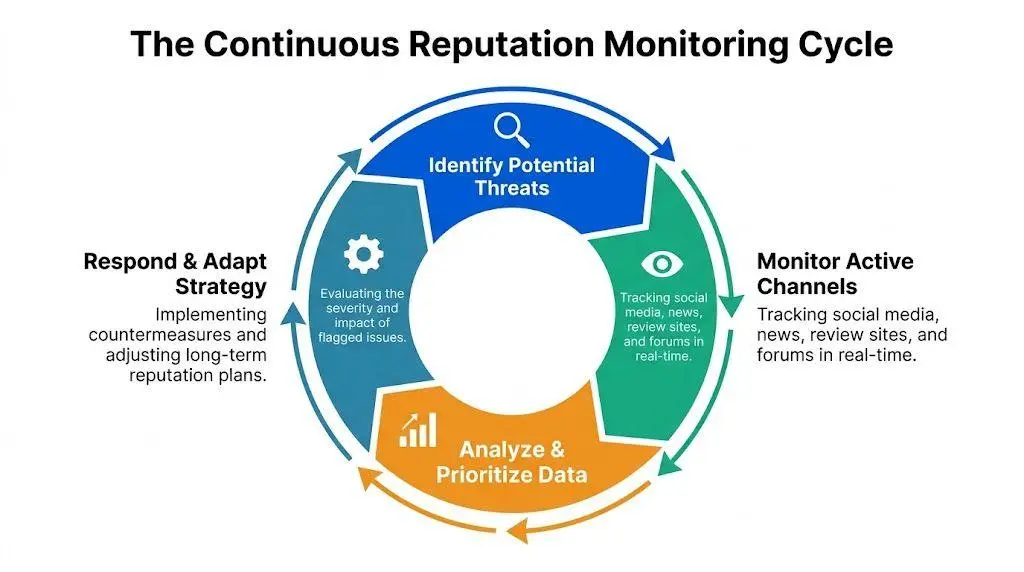
A one-time audit gives you a snapshot. Reputation threats move faster than snapshots.
The reason continuous monitoring matters is simple. Harmful content doesn’t arrive on a schedule. It appears on a Friday evening, on a niche forum, under a misspelled version of your name, attached to a screenshot that gets reposted before anyone in your office notices. By Monday, your general counsel is looking at a problem that had a clean interception window two days earlier.
What basic monitoring misses
Most wealth managers start with manual checks and a few alerts. That’s better than ignorance and still inadequate.
Manual review misses name variations, image-based references, reposts on low-visibility domains, comments inside forum threads, and impersonation attempts that use affiliated staff names rather than the principal’s exact name. It also misses acceleration. A post with little traction at publication can become dangerous once an account with reach amplifies it.
The situation is worse with synthetic content. AI-driven reputational risks are surging, with a reported 300% increase in AI-generated defamation cases against financial professionals from Q1 2025 to Q1 2026 (AI-generated reputation risk for wealth managers). That trend changes the surveillance standard. Passive monitoring is obsolete when fabricated reviews, cloned voices, and manipulated videos can be produced cheaply and distributed quickly.
What a live monitoring system should track
A serious system watches across layers, not just channels.
- Branded search changes: New pages, rank movement, image results, autocomplete shifts.
- Review anomalies: New negative reviews, repeated language patterns, reviewer account irregularities.
- Social signals: Mentions, quote-posts, impersonation handles, account creation events.
- News and blog indexing: Fresh articles, syndications, mirror copies, cached remnants.
- Leak indicators: Mentions of private documents, contact details, family names, or staff identities.
- Dark web and closed-channel chatter: Sale, swap, or targeting signals that may precede public abuse.
A monitoring system also needs escalation logic. Not every mention deserves action. But every flagged issue should be scored for visibility, credibility, replicability, and legal implications.
Speed matters most before a falsehood becomes a search result with backlinks and screenshots attached.
Build a response ladder, not just alerts
Monitoring fails when alerts arrive with no decision path. The right structure is a response ladder.
| Trigger | Immediate action | Escalation path |
|---|---|---|
| Suspicious review appears | Capture evidence, assess reviewer authenticity | Platform challenge and response decision |
| Fake profile detected | Preserve URLs and identifiers | Platform impersonation report, legal review if coordinated |
| Defamatory post indexed | Archive evidence and assess factual falsity | Takedown demand, de-index strategy, counsel involvement |
| Leaked file or personal data exposed | Verify scope and mirrors | Privacy-based removal, host outreach, ongoing repost monitoring |
| Synthetic media appears | Authenticate media and preserve copies | Platform safety report, forensic review, legal action |
The core principle is early interception. A threat you catch at publication can often be constrained. A threat you discover after reposting and indexing becomes a campaign.
Executing Crisis Response and Strategic Content Removal
When harmful content goes live, hesitation usually makes the situation worse. But indiscriminate reaction can also compound damage. A public rebuttal can boost visibility. An angry email can be screenshot and shared. A legal threat sent without evidence can fail and teach the other side your pressure points.
The right response starts with classification. You need to know what you are looking at before you decide whether to answer, report, suppress, or litigate.

Choose the response that fits the threat
Use this practical matrix:
| Situation | Public response | Removal path |
|---|---|---|
| False review from a non-client | Usually limited, factual, non-admissions | Platform dispute supported by evidence |
| Impersonation account | No public debate | Platform identity complaint and rapid escalation |
| Defamatory article | Usually no reactive comment at first | Host demand, legal review, search de-index strategy |
| Leaked private file | No public acknowledgment beyond need-to-know stakeholders | Immediate host removal, privacy complaints, repost tracking |
| Critical but lawful opinion | Sometimes no response at all | Suppression, counter-content, selective correction |
The discipline here is to avoid confusing visibility with solvability. Some content should be answered. Much of it should be discreetly removed. The wealth-management instinct to remain discreet is often correct, but only if discretion is paired with speed.
Understand the difference between removal, de-indexing, and suppression
Clients often use these terms interchangeably. They are not the same.
Source removal means the material comes off the originating website or platform. That is the cleanest outcome. It may be available where content violates platform rules, infringes rights, discloses private information, impersonates an identity, or crosses a legal line.
De-indexing means the content remains on the source site but is removed from search visibility, or materially reduced there, through search-engine processes or legal mechanisms. This is important as many harmful pages receive most of their practical power from search discovery, not from loyal readership.
Suppression means building stronger, more authoritative content that outranks the harmful result over time. This is useful, but it is not a cure for clearly unlawful or invasive material.
Here’s the simple version:
- If the content is removable at source, pursue that first.
- If source removal is slow or unavailable, assess de-indexing options.
- Use suppression to stabilize long-term search results and reduce recurrence risk.
Use the correct legal instrument
A removal strategy works when the legal theory matches the violation.
If someone copied your protected content or used your material without authorization, a copyright-based complaint may be viable. If a page publishes false factual allegations, defamation analysis becomes relevant. If the issue is impersonation, platform identity rules often provide a faster route than broad legal correspondence. If private material has leaked, privacy rights, confidentiality obligations, and data-protection arguments may be stronger than a generalized complaint about unfairness.
This is also why “just send a cease and desist” is poor advice. Bad takedown practice hardens opposition. It gives hostile publishers time to mirror the content, edit the page for legal defensibility, or frame your outreach as censorship.
Quiet, documented, jurisdiction-aware action usually outperforms theatrical outrage.
Family offices face a different kind of exposure
Wealth managers advising family offices need to recognize that a principal’s reputation issue rarely stays personal. It migrates into legacy, succession, and governance.
For prominent family offices, the great wealth transfer creates unusual digital exposure. An estimated 40% of family offices report increased online scrutiny post-transfer, while traditional PR rarely addresses risks such as leaked documents, impersonation, or targeted misinformation against heirs (legacy reputation and the great wealth transfer). That is why crisis handling for this group must account for family names, related entities, personal staff, and successor visibility, not just the adviser’s own profile.
Move fast, then keep the site under watch
A takedown is not the end of the matter. Harmful content reappears. Mirrors are created. Search caches lag. Screenshots circulate after the original URL is gone.
A proper crisis workflow includes evidence preservation, initial action, confirmation of removal or de-indexing status, then ongoing watch for reuploads and derivative abuse. Without that final layer, you are solving the first publication and ignoring the second.
Aligning Reputation Strategy with Compliance and Client Trust
A wealth manager can’t borrow the playbook of a consumer brand. You operate inside conduct rules, record-keeping obligations, advertising constraints, and a client relationship built on judgment. That means your reputation strategy has to be defensible internally before it becomes persuasive externally.
The first principle is simple. Never let the marketing function run reputation response without compliance review. Review solicitation, testimonial handling, public replies, and corrective statements can all create avoidable exposure if they’re done casually.
Turn client feedback into an early-warning control
Many firms separate service quality from reputation management. That division is artificial. Friction in communication, reporting, onboarding, responsiveness, or expectation-setting is where many public complaints begin.
Top-performing wealth management firms that use team-accountable, client-centric metrics like NPS see 4.9x greater returns, and post-interaction NPS surveys can surface issues before they spill into public reputation damage (BCG on consistent success in wealth management). The point isn’t to chase a vanity score. The point is to detect disappointment while it is still private and solvable.
Create one communications standard for adverse events
When a reputation issue surfaces, staff often improvise. Advisers reassure one way, assistants say something else, and relationship managers try to calm clients with language that may sound like an admission. That inconsistency creates legal and relational risk.
A compliant communication standard should answer three questions:
- Who speaks externally? Usually one designated person or tightly controlled group.
- What can be said? Factual, narrow, and documented.
- What must not be said? Speculation, anger, admissions, and attacks on the complainant.
A simple internal decision chart helps:
| Audience | Objective | Safe communication posture |
|---|---|---|
| Existing clients | Preserve confidence | Acknowledge awareness, state matter is being addressed, avoid discussing disputed facts |
| Prospective clients | Prevent uncertainty from spreading | Use controlled, factual language and redirect to verified firm information |
| Internal staff | Prevent inconsistency | Share approved guidance and reporting lines only |
| Referral partners | Maintain professional trust | Give concise reassurance without litigating the dispute |
The client wants calm competence, not a dramatic defense. If your response sounds emotional, rewrite it.
Don’t outsource trust to reviews
Some advisers become fixated on collecting visible praise after a reputational scare. That can backfire if it drifts into improper solicitation or looks engineered.
A better approach is to tighten service delivery, capture structured feedback through compliant channels, and improve the assets you control. Public trust comes from consistency. Search results matter, but so do intake emails, billing clarity, response time, and whether a nervous client gets a coherent answer from your office during a difficult week.
Reputation management works best when compliance, legal, operations, and client service act as one system. When they don’t, online damage is usually a symptom, not the disease.
Achieving Permanent Reputational Resilience
Your reputation won’t stay secure because you had one successful cleanup. It stays secure because you treat it as a permanent asset under active protection.
That means auditing before there’s a crisis. It means building search control before an attacker or disgruntled former client defines your name. It means monitoring continuously, responding precisely, and choosing legal and technical remedies based on evidence rather than emotion. For wealth managers serving high-net-worth clients, that level of discipline isn’t excessive. It’s standard care.
The firms that handle this well don’t wait for public damage to become obvious. They act while the issue is still containable, still removable, still quiet.
If you need discreet help assessing a review attack, defamatory article, impersonation profile, leaked document, or persistent search result, request a confidential assessment with ContentRemoval.com. The right first step is a clear risk analysis, a lawful removal strategy, and a plan that protects both your practice and your clients without unnecessary noise.
Frequently asked questions
Should a wealth manager respond publicly to a false review?
Usually only in a limited, factual way with no admissions, and only after evidence is captured and the reviewer’s authenticity assessed. The main work happens off the page: a platform dispute supported by a proof package and pattern documentation, with compliance reviewing any public wording.
What is the difference between removal, de-indexing and suppression for a financial advisor?
Source removal takes the material off the originating site. De-indexing leaves it there but removes it from search visibility, which is often commercially sufficient. Suppression builds stronger content that outranks it over time, and it is not a cure for clearly unlawful or invasive material.
What should a wealth management firm monitor to protect its reputation?
Branded search changes including image results and autocomplete, review anomalies, social mentions and impersonation handles, new articles and mirror copies, leak indicators for private documents or family names, and dark web chatter. Each alert should carry a scored escalation path rather than sit in an inbox.