
A threat intelligence service for reputation protection is an early-warning and intervention system covering impersonation, doxxing, leaked material and defamation campaigns across forums, messaging apps, the dark web and search. It should deliver technical, tactical, operational and strategic intelligence, and it only protects you if it moves from detection to evidence preservation, takedown, de-indexing and legal escalation.
Key facts
- Statista estimates the threat detection market at about $13.5 billion in 2024, projected past $54 billion by 2034.
- A 2025 OpenSSF study found 45% of vendors monitor only the top 10% of public dark web nodes.
- Build the collection brief around essential elements of information: names, aliases, images, addresses, documents and brands.
- Ask vendors who executes remediation after an alert and what the night and weekend protocol is.
Where ContentRemoval.com comes in. ContentRemoval.com operates the detection plus remediation model this article describes: monitoring for emerging exposure, then source removal, impersonation takedowns, de-indexing and dark web remediation under one confidential engagement. Executives, family offices and the security consultants advising them usually make contact when their existing stack flags a threat but cannot act on it. A free 15-minute Exposure Scan maps where harmful material is circulating and what is removable, and the report is theirs to keep. Get a Free, Confidential Exposure Scan or read how our reputation management work is done.
A threat rarely announces itself in a form your general counsel can file away neatly. It shows up as a fake social profile using your name and headshot. A thread on an obscure forum with your home address. A leaked document passed around privately before it reaches search results. A manipulated image sent to journalists, investors, or family members before anyone on your internal team knows it exists.
That’s the point at which organizations discover their existing security stack wasn’t built for them. It may detect malware, suspicious logins, or network anomalies. It usually won’t tell you that your reputation is being operationally targeted in places where humiliation, extortion, impersonation, and doxxing spread faster than any formal response process.
A proper threat intelligence service closes that blind spot. But only if it does more than monitor. Detection without removal is not protection.
The New Frontline in Reputation Defense
For a high-net-worth individual or public-facing executive, digital risk is personal before it becomes corporate. A forged account can trigger investor confusion. A leaked private image can become a blackmail attempt. A defamatory post can move from a fringe board to mainstream indexing if no one acts quickly.
That’s why threat intelligence has moved far beyond the SOC. Recorded Future cites Statista estimates that the global threat detection system market was about $13.5 billion in 2024 and is projected to exceed $54 billion by 2034, a projection that reflects how threat intelligence has become a serious protection function for brands, executives, and sensitive assets, not just an IT line item (Recorded Future on threat intelligence).
Reputation risk starts where standard monitoring stops
Most executives already understand endpoint protection, legal review, and media strategy. Fewer have a system for identifying hostile activity before it reaches the press, the board, or their family. The practical exposure sits in the gap between cyber signals and personal harm.
A classic example is old hardware or improperly retired storage. If sensitive material leaves your control through physical media, the downstream problem becomes digital discovery, circulation, and removal. That’s why operational hygiene matters at the front end as much as takedown capability matters at the back end. For organizations handling sensitive records, Reworx Recycling data destruction is a useful reference point because secure disposal is still one of the simplest ways to prevent avoidable leaks from becoming a reputation event.
Practical rule: If a service only tells you what happened, it’s an alerting layer. If it helps you stop spread, remove content, and coordinate response, it’s a protection layer.
The better way to think about a threat intelligence service is as an early-warning and intervention system for identity, privacy, and reputation. It should monitor hostile content, impersonation, exposed data, and campaign behavior across channels that matter to your life and business. It should also support decisions about what to suppress, what to document, what to escalate legally, and what to remove first.
For readers looking at the broader discipline, this guide to online brand protection services is useful because it places monitoring in the wider context of abuse prevention, enforcement, and ongoing reputation defense.
Decoding the Four Layers of Threat Intelligence
A serious threat intelligence service doesn’t hand you a stream of disconnected alerts. It should brief you the way a diplomatic security team would brief a principal before travel. What are the indicators. Who’s behind them. What campaign is developing. What does this mean for the next quarter, not just the next hour.
Cyberproof’s framework is the right one. An effective service produces technical, tactical, operational, and strategic intelligence, and that structure is what turns raw indicators into decisions (Cyberproof on managed threat intelligence).
The hierarchy that matters
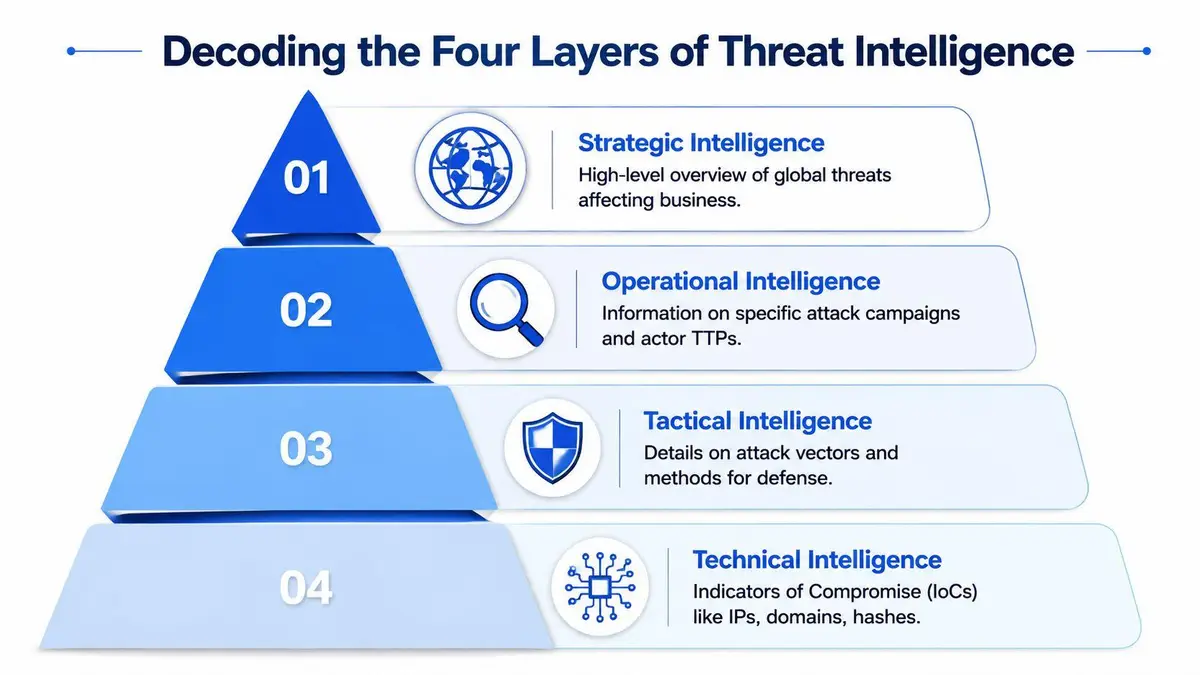
At the base sits technical intelligence. This is the machinery. Domains, hashes, infrastructure, login artifacts, malware mechanisms, and other indicators of compromise. It matters because it tells an analyst where the hostile activity is touching the internet.
Above that is tactical intelligence. This is about method. How the adversary operates, what lures they use, how they impersonate, where they seed material, and how they try to pressure a target. For reputation cases, this often reveals whether you’re dealing with a one-off nuisance, a coordinated harassment actor, or a repeat extortion pattern.
Then comes operational intelligence. At this stage, the facts become specific to you. Which campaign is active. Which assets are being targeted. Which channels are involved. Whether a leak is being staged for wider release. Operational intelligence is the layer that lets a legal team, family office, or communications advisor act with sequence instead of panic.
At the top is strategic intelligence. This is the broadest view. Why this is happening, what the long-term motive appears to be, and what the likely downstream business or personal consequences are if no one intervenes.
Raw feeds are not intelligence
Here’s a simple way to distinguish value from noise:
| Layer | What you receive | What you should be able to do |
|---|---|---|
| Technical | Indicators and infrastructure clues | Confirm the threat is real |
| Tactical | Adversary behavior and TTPs | Anticipate how the attack will unfold |
| Operational | Case-specific context | Decide who acts first and where |
| Strategic | Long-range assessment | Set policy, budget, and legal posture |
A weak vendor floods your team with the first row. A competent one carries you through all four.
This short overview is worth watching because it gives non-technical stakeholders a quick sense of how intelligence matures from machine data into decision support.
> If your provider can't explain the difference between an indicator, a campaign, and an executive risk implication, you're buying telemetry, not intelligence.Use Cases Beyond Corporate Cybersecurity
At 6:40 a.m., your chief of staff sees a fake account using your name to contact investors. By 7:15, a private Telegram channel is trading your home address and family details. By 8:00, search results begin surfacing a false allegation designed to look credible. A standard threat intelligence service can flag each event. It still leaves the underlying problem untouched.
Your exposure is personal, reputational, and time-sensitive. The required outcome is removal, suppression, and containment before the material spreads across platforms, mirror sites, and search results.
The remediation gap is where most services fail

Many providers still sell monitoring as if the alert itself solves the issue. It does not. For executives, founders, family offices, and public figures, the hard part starts after detection. Someone has to preserve evidence, identify the pressure point, contact the platform, issue the notice, coordinate counsel, and keep pushing until the content is removed or suppressed.
That gap is why many corporate-grade services underperform in private client work. They are built to inform a security team, not to stop a reputational attack already in motion.
Where high-value clients get exposed
The pattern is usually broader than a single cyber incident. It often starts with one post, one account, or one leak, then spreads into search, social, messaging apps, cloned profiles, and secondary reposts.
- Doxxing and personal exposure create immediate safety risk. The right response includes evidence capture, rapid reporting, removal requests, and legal escalation where publication crosses into harassment or extortion.
- Leaked intimate content and synthetic media require active enforcement. You need source removal, de-indexing, repeat-upload monitoring, and escalation paths with platforms that will not act on a generic abuse report.
- Defamation campaigns behave like distributed operations. One article becomes five copies, then social amplification, then forum threads designed to rank in search. The response has to address the network, not just the original URL.
- Executive impersonation affects counterparties fast. A proper response links attribution, platform complaints, account takedowns, and direct warning to the people most likely to be deceived.
Detection is only the opening move. Personal threat intelligence earns its value when it leads to takedown, de-indexing, legal action, and repeat-incident control.
If a provider cannot move from discovery to enforcement, you are paying for early notice of damage that will still go live. That is an incomplete service.
ContentRemoval.com is one example of the right operating model. The work is not limited to alerts. It includes reputation monitoring for emerging exposure, source removal, impersonation takedowns, de-indexing, and dark web remediation. For private clients, that combination matters more than another dashboard.
From Raw Data to Actionable Directives
The phrase “we monitor the clear, deep, and dark web” doesn’t mean much on its own. Serious clients don’t need more dashboards. They need an instruction set that says what was found, why it matters, and what happens next.
Cisco’s description of modern platforms is useful here. Current threat intelligence platforms are expected to centralize collection from multiple data sources and formats, then use automation and AI to process real-time data and turn threat history plus live telemetry into findings teams can act on immediately (Cisco on cyber threat intelligence).
What competent processing looks like
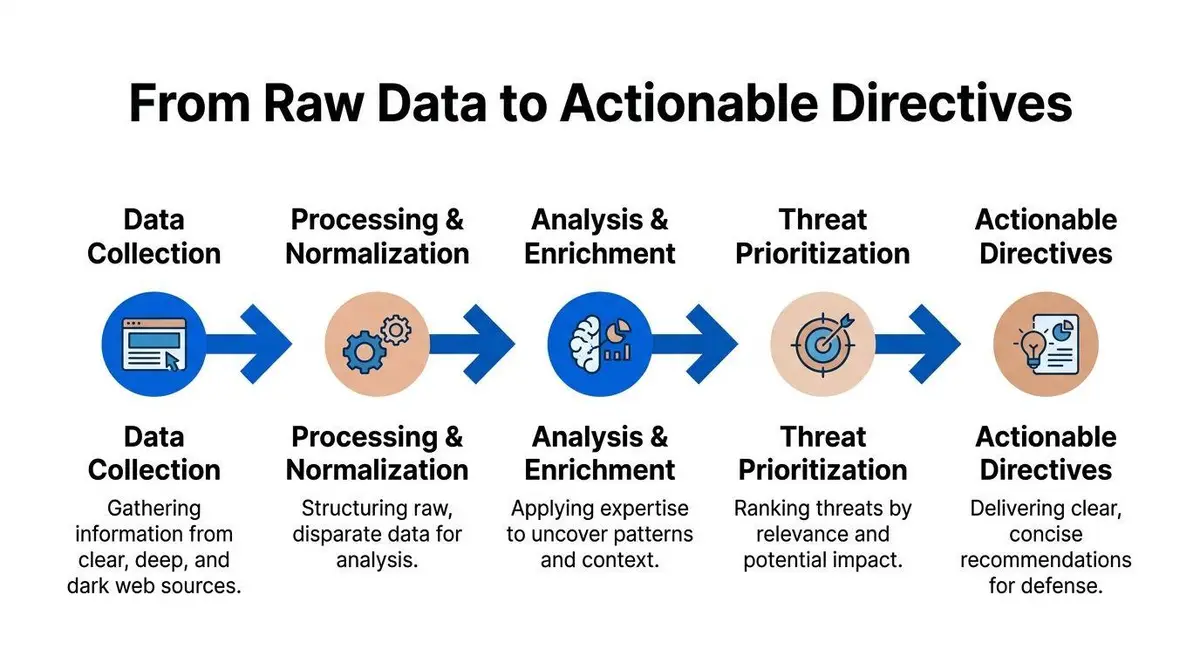
The workflow should look disciplined, not theatrical.
- Collection begins broadly. Sources may include open web pages, fringe forums, messaging channels, marketplaces, paste sites, social platforms, search results, and breach-related repositories. The service should gather signals relevant to your defined exposure, not just whatever its crawler happens to see.
- Normalization strips away noise. Raw material arrives in different formats, languages, and quality levels. Automation should consolidate duplicates, connect aliases, and group related mentions so analysts aren’t reviewing the same threat ten times under ten labels.
- Human analysis establishes context. This is the stage weak vendors underinvest in. An analyst should determine whether the content is authentic, recycled, targeted, credible, or likely to spread. That judgment decides whether the case goes to legal, security, communications, or direct takedown.
The output should read like a directive
A vague output says: “Potential mention of executive observed on a forum.”
A useful output says: confidential material referencing the executive was identified on a specific site; the content appears to be newly circulated; the poster is attempting amplification; initiate takedown protocol, preserve evidence, notify counsel, and prepare search suppression if indexing occurs.
That’s the difference between monitoring and management.
For clients who need persistent surveillance after the first incident, reputation monitoring services make sense only if they’re tied to a response model. Monitoring without a defined intervention path just lengthens your inbox.
The best report is short. It tells you what matters, what can wait, and who needs to move in the next hour.
A mature threat intelligence service should also align reporting cadence to risk. Some matters require standing daily review. Others need immediate escalation triggers only. If a provider can’t tailor alerts to your actual exposure, expect fatigue, missed priorities, and internal confusion.
Evaluating a Threat Intelligence Partner
Procurement conversations in this market are full of inflated language. “AI-powered monitoring.” “Dark web visibility.” “Complete coverage.” Those phrases don’t answer the only question that matters. Can this provider find the threat that affects me, verify it quickly, and help remove or contain it before it spreads.
The sharpest due-diligence test involves coverage claims.
Dark web claims need proof
A 2025 OpenSSF study found that 45% of commercial vendors monitor only the top 10% of publicly accessible dark web nodes, missing the majority of private, higher-risk markets. The implication is blunt. You should demand third-party validation of node coverage before procurement (Rapid7 on threat intelligence fundamentals).
A provider that won’t answer direct questions about where it has access, how it validates collection depth, and how it handles private or non-indexed environments is relying on marketing, not capability.
Questions worth asking in the first meeting
Use a screening framework that forces specificity:
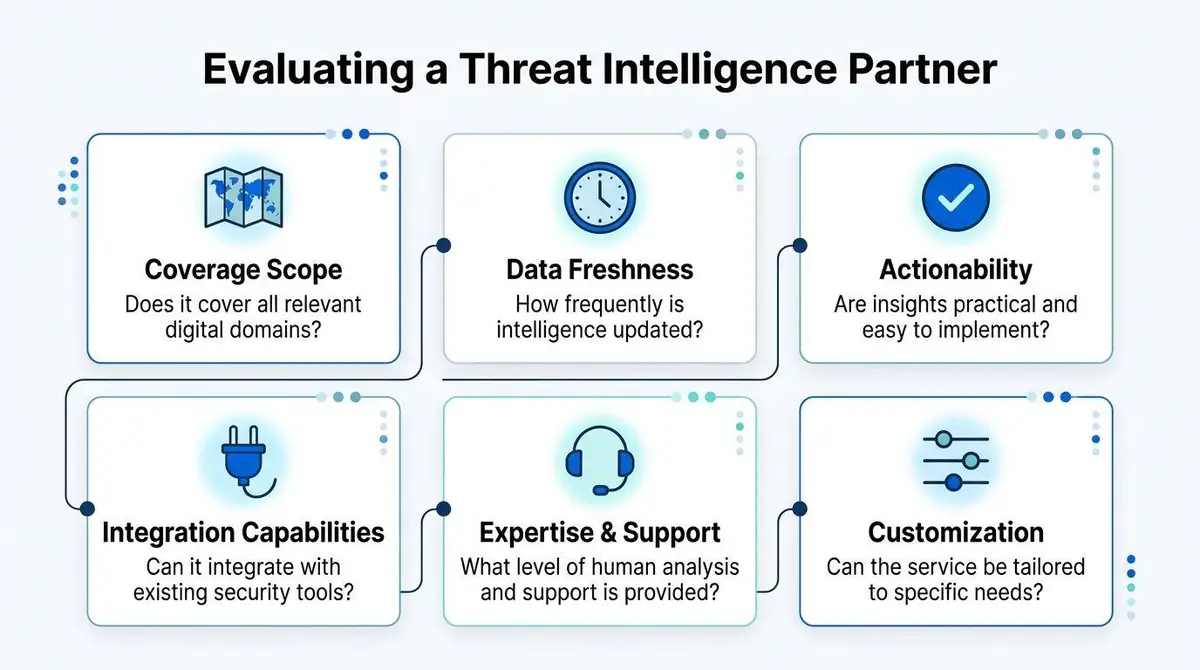
- Coverage scope matters more than slogans. Ask which environments are monitored for your case type, including fringe forums, closed communities, impersonation surfaces, and image-sharing channels.
- Analyst involvement should be explicit. Ask who triages ambiguous findings and whether you’ll receive machine summaries or analyst-reviewed intelligence.
- Remediation capacity must be built in. Ask whether the same provider can coordinate platform reports, de-indexing requests, legal escalation, and evidence handling.
- Crisis protocol should already exist. Ask what happens when a harmful post appears at night, over a weekend, or just before a major transaction or public event.
A simple comparison model helps expose weak vendors fast:
| Vendor claim | What you should ask |
|---|---|
| “We monitor the dark web” | Which parts, with what independent validation |
| “We use AI” | Where does human review begin |
| “We provide alerts” | Who executes remediation after the alert |
| “We support executives” | What is your protocol for personal safety and reputational harm |
This guide to evaluating professional content removal services is useful reading before procurement because it frames the practical difference between a reporting vendor and a firm that can act under pressure.
A vendor who hides behind broad coverage language usually has broad coverage problems.
You should also insist on sample outputs. Not polished demos. Real redacted reports. If the reporting is long, generic, and difficult to prioritize, it will fail under stress.
An Executive Checklist for Implementation
The right implementation starts with precision. Don’t buy a threat intelligence service as a generic subscription and hope your team adapts around it. Define what you need to know, what requires intervention, and who holds decision authority when a threat appears.
Start with the right collection brief
The service should be built around essential elements of information, often shortened to EEIs. That means identifying the exact signals that matter to you: names, aliases, executive images, family references, home addresses, confidential documents, portfolio company brands, litigation terms, and impersonation patterns. Without that brief, your provider will collect too much irrelevant data and miss the threats that matter.
Then map response ownership. Some incidents belong with counsel. Some go to corporate security. Others require platform escalation, media containment, or direct outreach to technical teams. If no one owns those paths in advance, the delay will multiply the harm.
The minimum operating checklist
Use this as a working standard:
- Define your EEIs clearly so the service hunts for the right people, assets, and exposure patterns.
- Confirm remediation is included before signing. If content removal, de-indexing, legal coordination, or impersonation enforcement sit outside the contract, assume you’ll be left holding the problem.
- Set an escalation protocol that identifies who gets called first for privacy breaches, blackmail attempts, leaked media, and false content.
- Require evidence handling so screenshots, timestamps, URLs, and chain-of-custody records are preserved properly if legal action follows.
- Review intelligence strategically on a recurring basis, not only during active incidents, so patterns are recognized early and protection priorities stay current.
A threat intelligence service should function as an ongoing advisory capability, not a passive feed. For executives and high-profile families, that means integrating it with legal strategy, communications judgment, and active enforcement from day one.
The blunt recommendation is simple. Buy detection only if your problem is technical. Buy detection plus remediation if your problem involves your name, image, family, or reputation. Most high-net-worth clients need the second category, and they usually discover that after the first damaging post, not before.
If you need a threat intelligence service that doesn’t stop at alerts, ContentRemoval.com can assess the exposure, identify where harmful material is circulating, and advise on removal, de-indexing, impersonation takedowns, and related remediation steps under a confidential engagement.
Frequently asked questions
What is the difference between threat monitoring and a threat intelligence service?
Monitoring tells you something happened. A threat intelligence service verifies the finding, explains the adversary’s method and campaign, tells you who should act first, and connects to removal. If a provider stops at alerts, you are buying telemetry rather than protection.
How do I verify a vendor’s dark web coverage claims?
Ask which environments are monitored for your case type, how collection depth is validated and how private or non-indexed markets are handled, and request third-party validation of node coverage. Insist on real redacted sample reports rather than polished demos.
What should a threat intelligence report for an executive look like?
Short and directive. It should state what was found, where, whether it is new or recycled, whether amplification is underway, and the next steps: preserve evidence, notify counsel, start takedown and prepare search suppression if indexing occurs. Long generic reports fail under pressure.