
Threat intelligence basics for reputation defense come down to one shift: treating digital hostility as a campaign rather than an isolated post. Threat intelligence is evidence-based knowledge about who is attacking, their motives and methods, and what to do next. It works through four levels, strategic, operational, tactical and technical, and a six-stage lifecycle from direction to feedback.
Key facts
- Gartner defines threat intelligence as evidence-based knowledge including context, indicators, implications and actionable advice.
- The lifecycle runs direction, collection, processing, analysis, dissemination and feedback.
- 57% of companies lack triage for urgent content removal; 31% of threats begin on the dark web or via AI.
- Precursor signals include new impersonation accounts following your contacts and partial files posted to test interest.
Where ContentRemoval.com comes in. ContentRemoval.com joins monitoring, analyst judgment and takedown into one chain, so evidence gathered upstream supports platform escalation, de-indexing and reupload prevention without losing hours between vendors. Chiefs of staff, general counsel and family office security leads usually make contact after a first screenshot has already circulated. A free 15-minute Exposure Scan maps where the principal is vulnerable and what is removable, and the report is theirs to keep. Get a Free, Confidential Exposure Scan or read how our reputation management work is done.
At 6:30 a.m., your chief of staff forwards a screenshot. A private image is circulating in a closed channel. A fake account using your name has started following journalists. A hostile post is ranking in search before your legal team has finished its first email. Most clients reach this point believing they have a content problem. They don’t. They have an intelligence failure.
By the time harmful material is visible to the public, the adversary has usually been planning for longer than you think. They may have tested usernames, seeded rumors in fringe forums, approached former staff, or prepared mirrored uploads to survive takedown attempts. If your only response starts after publication, you’re operating on the attacker’s timeline.
Anticipating Attacks Before They Occur
A chief executive doesn’t wake up one morning and suddenly become the target of a coordinated smear campaign. Someone builds it. Someone rehearses it. Someone watches for the moment when a board dispute, financing event, divorce filing, regulatory issue, or political controversy makes the hit more effective.
That’s why threat intelligence basics matter far beyond the security department. For an executive, founder, or public figure, threat intelligence is the discipline of seeing hostile intent early enough to change the outcome.
What reactive defense looks like
The familiar sequence is brutal. First comes discovery. Then panic. Then a scramble across lawyers, assistants, PR advisers, and platform forms. Meanwhile, the harmful material spreads because nobody mapped where it originated, who is amplifying it, or which accounts and hosting points matter most.
A proper reputation monitoring system changes that sequence. It gives you early warning, pattern recognition, and priority. Instead of asking, “How do we remove this everywhere?” you start with the sharper question: “Where did this begin, what does the adversary want, and what must be neutralized first?”
Practical rule: If you first learn about a digital attack from a colleague, journalist, or client, your monitoring posture is already behind the threat.
Why context matters more than volume
High-pressure clients often assume the answer is more alerts. It isn’t. Noise creates delay. The issue is context. A single post from the wrong account at the wrong moment can be more dangerous than hundreds of routine mentions.
This is also why complex risk work often crosses categories. A reader trying to understand how political violence, criminal financing, and influence operations intersect may find useful background in this explanation of what is narcoterrorism. The lesson is broader than that topic alone. Modern threats rarely stay in one box. Reputation attacks, extortion attempts, leaks, impersonation, and harassment often overlap.
Threat intelligence basics force you to treat digital hostility as a campaign, not an isolated incident. That shift is where real protection starts.
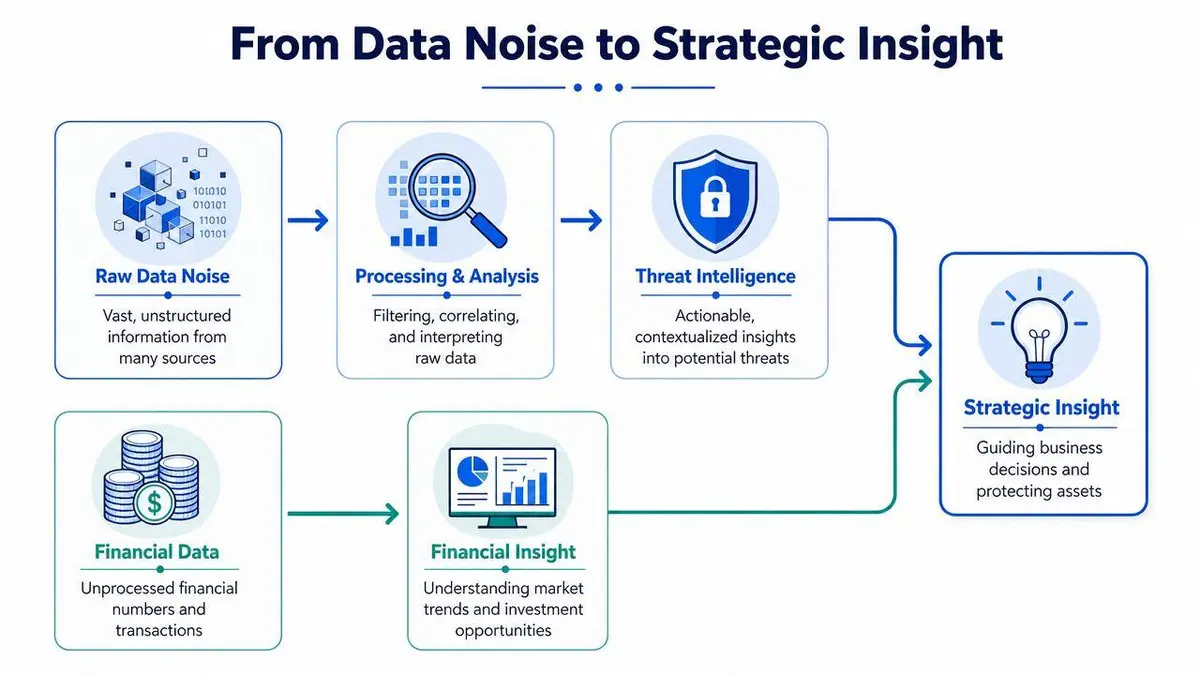
From Data Noise to Strategic Insight
Executives already understand intelligence in another form. You wouldn’t make a major investment decision by staring at an undifferentiated stream of market chatter, payment records, analyst notes, and raw filings. You’d want those inputs filtered into decision-ready insight. Threat intelligence works the same way for digital risk.
What threat intelligence actually is
The cleanest definition comes from Gartner, cited by SOC Prime. Threat intelligence is defined by Gartner as evidence-based knowledge, including context, mechanisms, indicators, implications, and actionable advice, about existing or emerging hazards to an organization’s assets. This evidence-based approach transforms raw data into actionable intelligence by integrating who is attacking, their motives and capabilities, and specific indicators of compromise (IoCs), as outlined in SOC Prime’s explanation of threat intelligence.
That definition matters because it separates intelligence from raw collection. A flood of alerts is not intelligence. A stack of screenshots is not intelligence. Intelligence tells you what’s relevant, who matters, and what decision follows.
The difference between data and judgment
For reputation defense, the raw inputs might include search results, social mentions, account registrations, dark web chatter, leaked files, internal reports, and platform complaints. None of that has strategic value until someone connects the dots.
A useful way to think about it is this:
| Input | By itself | As intelligence |
|---|---|---|
| Anonymous forum post | Rumor | Possible pre-leak signal tied to a known grievance |
| New social account using your image | Annoyance | Early-stage impersonation infrastructure |
| Stolen document fragment | Isolated breach indicator | Proof of a coming publication campaign |
| Surge in hostile mentions | Noise | Coordinated amplification around a trigger event |
The questions intelligence should answer
Good threat intelligence basics always lead back to business judgment. If your advisers can’t answer the following questions, they’re collecting data, not producing intelligence.
- Who is the likely adversary. A disgruntled insider, competitor proxy, extortionist, activist network, obsessed individual, or opportunistic scraper all require different responses.
- What’s the motive. Financial gain, humiliation, influence, litigation pressure, ideological hostility, and media disruption produce different attack patterns.
- How will the attack unfold. Through impersonation, leaks, false allegations, search placement, platform abuse, or coordinated reposting.
- What should happen next. Escalate legal preservation, begin takedown work, harden accounts, brief leadership, or hold action to avoid tipping off the actor.
The real value isn’t knowing more. It’s knowing what to do before everyone else sees the problem.
That’s the core of threat intelligence basics for a non-technical leader. You’re not buying information. You’re buying earlier, clearer judgment under pressure.
The Four Levels of Threat Intelligence
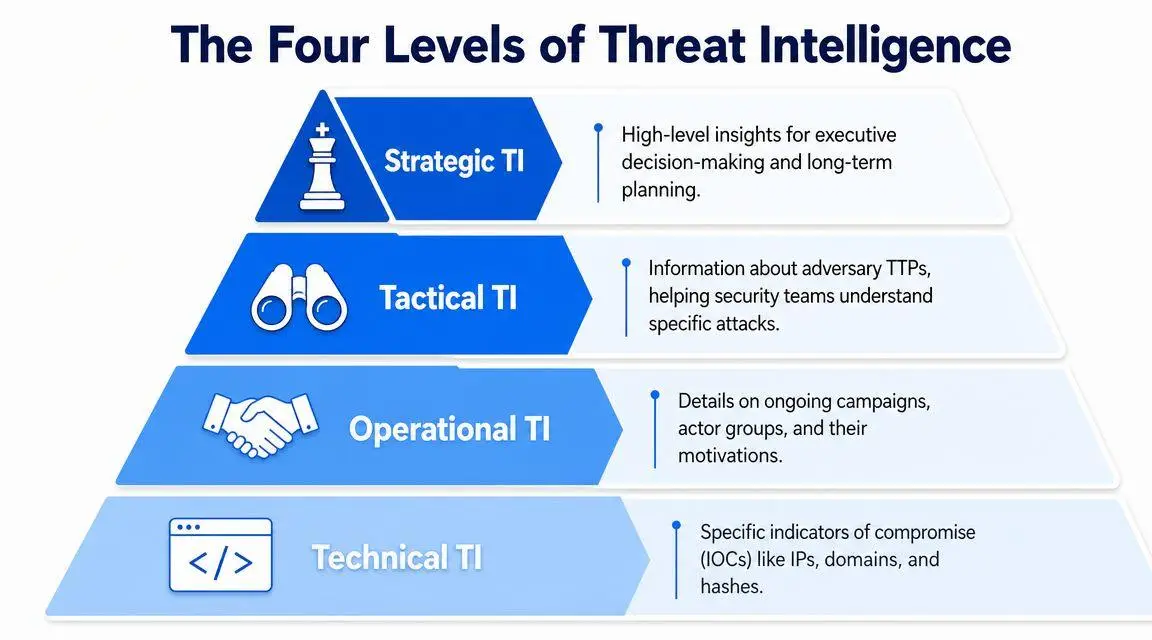
Most articles flatten threat intelligence into one generic capability. That’s a mistake. Different decisions require different forms of intelligence. If you’re protecting a prominent individual or a sensitive business, you need four levels working together. They answer different questions, reach different people, and move at different speeds.
Strategic intelligence for leadership
This is the boardroom layer. It tells principals, general counsel, chiefs of staff, and family office leaders what kinds of digital threats are most likely to affect them and where the exposure sits.
Strategic intelligence doesn’t obsess over a single account or file hash. It asks harder questions. Which public events increase vulnerability? Which business disputes could spill online? Which personal assets, family details, archived media, or old litigation records offer an attacker a means of pressure?
For high-net-worth clients, this level drives budget, governance, and escalation authority. It determines whether digital reputation protection is treated as a reactive admin function or as a serious risk discipline.
Operational intelligence for the security lead
Operational intelligence is about campaigns in motion. It helps the people running security, legal response, or executive protection understand what the adversary is trying to achieve and how they tend to operate.
This layer can reveal whether an actor usually leaks in stages, whether they seed content in fringe communities before mainstream release, or whether they rely on impersonation to bait journalists and business contacts. It is especially useful when a threat is not random but organized.
Tactical intelligence for active defense
Tactical intelligence helps the response team act quickly. It focuses on adversary behavior, not abstract risk. Effective threat intelligence requires the identification of specific Indicators of Compromise and the detailed mapping of Tactics, Techniques, and Procedures, or TTPs, to understand not just what happened but the precise behavioral patterns of the attacker, including their motives, capabilities, and the specific vulnerabilities they exploit to gain access, as described by CyCognito’s overview of cyber threat intelligence.
That matters in reputation cases because takedown speed improves when you know the pattern. If an actor repeatedly uses newly created impersonation profiles, mirrored uploads, and recycled media captions, your team can spot the next move faster.
Board-level question: What can damage us over the next quarter?
Response-team question: What do we block in the next hour?
Technical intelligence for specialists
Technical intelligence sits closest to the evidence. It includes the concrete indicators that let analysts, investigators, and platform specialists tie incidents together. In a classic security context, that may include domains, malware traits, or infrastructure clues. In reputation defense, it can include repeat account artifacts, hosting patterns, reused media assets, and publication fingerprints.
The names are less important than the coordination. Strategic intelligence tells leadership what matters. Operational intelligence explains the campaign. Tactical intelligence supports rapid disruption. Technical intelligence gives specialists the proof points to act.
If one layer is missing, the whole picture degrades. Leadership overreacts or underreacts. Security teams chase noise. Legal advisers lose time. Harmful content stays live longer than it should.
The Intelligence Lifecycle A Continuous Process
Threat intelligence basics aren’t a report you buy once and file away. Effective intelligence behaves like a disciplined operating system. It learns, sharpens, and reorients every time a new threat appears or an old one changes shape.
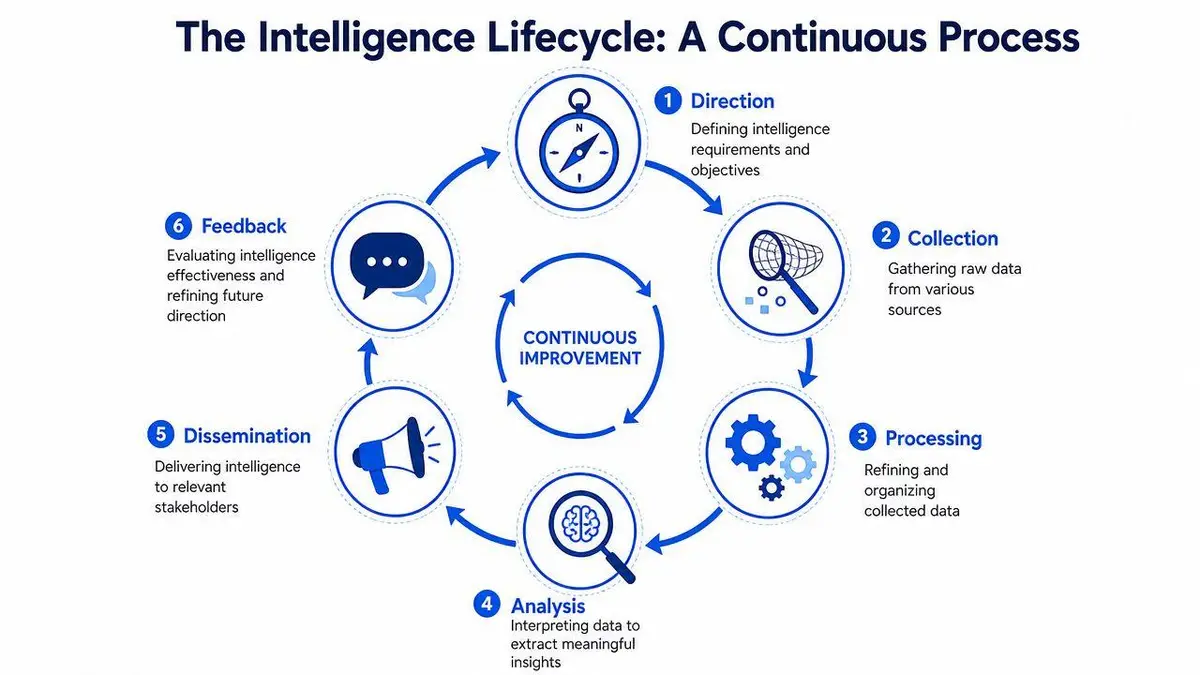
The accepted framework is straightforward. The CTI lifecycle is a continuous six-stage process comprising Direction, Collection, Processing, Analysis, Dissemination, and Feedback, which systematically transforms raw data into actionable intelligence to guide security teams in making informed decisions, as explained in CrowdStrike’s threat intelligence primer.
Direction and collection
Direction is where most weak programs fail. If you don’t define what matters, the rest becomes expensive noise. A principal with family privacy concerns, active litigation, and a visible public profile needs different intelligence requirements than a founder preparing for a transaction.
Collection follows direction, not the other way around. You gather the material that matches the risk question. That may include public sources, internal reporting, closed-community signals, impersonation traces, or evidence of planned leaks.
A concise way to set direction is to ask:
- What are we protecting. Name the person, assets, accounts, relationships, and information categories that matter most.
- What are we worried about. Separate embarrassment, blackmail, fraud, impersonation, data exposure, and coordinated defamation.
- What decision will this intelligence support. Escalation, takedown, containment, legal preservation, or silent monitoring.
Processing and analysis
Raw material is messy. Processing structures it so it can be reviewed. Duplicates are removed, false positives are filtered, timelines are organized, and disconnected items are grouped into something coherent.
Analysis is where expertise earns its fee. This is the part that distinguishes coincidence from preparation. An analyst asks whether a new fake profile is random, whether a forum mention has access to real material, whether an uploader is linked to prior incidents, and whether the threat is performative or operational.
If your advisers only forward screenshots, they’re functioning as couriers. Analysis begins when someone tells you what those screenshots mean and what consequence follows.
Dissemination and feedback
Intelligence is wasted if it lands in the wrong format or reaches the wrong person. A principal needs a clean brief with implications and decisions. Counsel may need evidentiary structure. A platform specialist needs the exact facts required for reporting and escalation.
Feedback closes the loop. Was the threat real? Did the alert come early enough? Was the dissemination usable? Did legal and technical teams receive what they needed? The answers reset the next cycle.
| Lifecycle stage | What a sophisticated client should expect |
|---|---|
| Direction | Clear risk priorities tied to real assets |
| Collection | Relevant inputs, not indiscriminate monitoring |
| Processing | Structured evidence and reduced noise |
| Analysis | Judgment on actor, motive, and likely next step |
| Dissemination | Tailored reporting for decision-makers |
| Feedback | Continuous refinement after each incident |
A mature lifecycle doesn’t eliminate threats. It stops you from being surprised by the obvious signals you failed to organize.
Applying Threat Intelligence to Reputation Defense
Most writing on threat intelligence stops at cyber defense. That’s incomplete. For executives, founders, and public figures, the more urgent question is how intelligence helps prevent humiliation, extortion, search contamination, impersonation, and the spread of unlawful content. That’s where the gap usually appears.
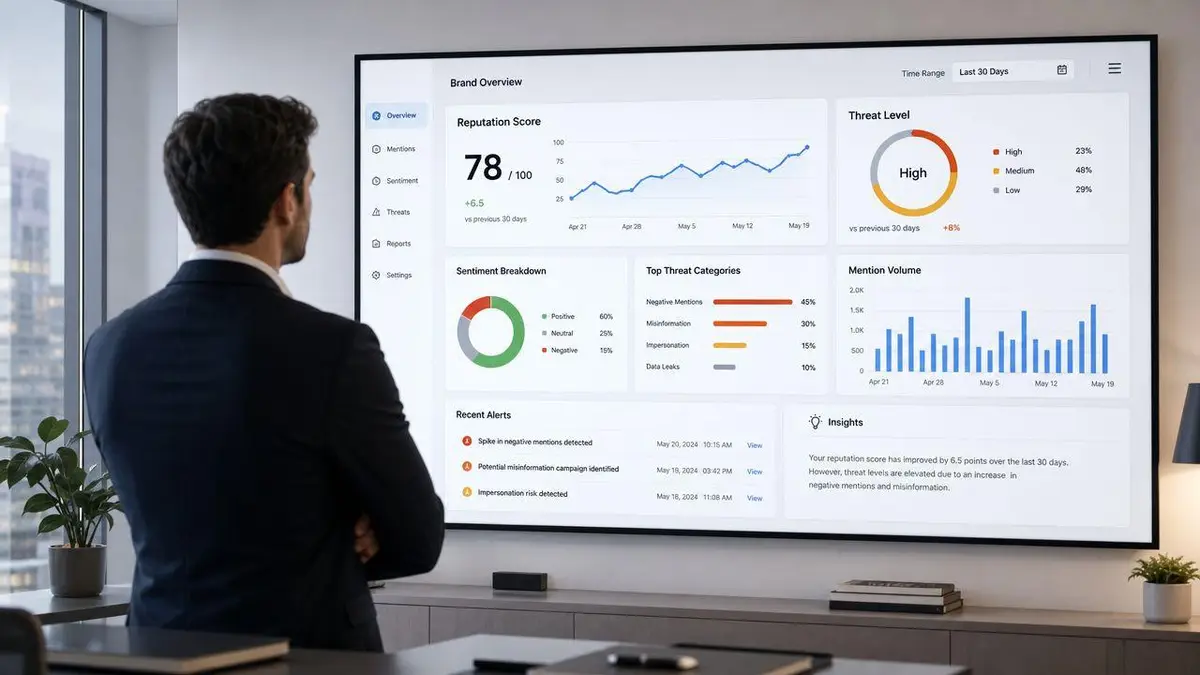
Recent reporting highlights the problem directly. Existing threat intelligence basics fail to explain how to integrate threat intelligence with AI-driven monitoring and rapid content removal workflows. Recent data indicates 57% of companies lack CI-driven triage for urgent content removal, even as 31% of reputational threats now originate from dark web or AI-generated impersonation, according to Rapid7’s discussion of threat intelligence fundamentals.
Early warning before publication
Reputation attacks rarely begin on the front page. They often start in obscure channels, small communities, burner accounts, or private exchanges. That’s where intelligence earns its value.
If an attacker is preparing to leak private material, there are often precursor signals. Someone asks whether a dataset has value. A known alias resurfaces. A partial file appears to test interest. A fake account starts following people close to the target. Seen in isolation, each event looks minor. In sequence, they form a warning.
For a family office or executive office, this changes the response posture. Instead of waiting for broad publication, the team can preserve evidence, tighten vulnerable accounts, alert counsel, and identify where rapid takedown pressure should begin.
Intelligence-led takedowns work faster
Content removal is far more effective when driven by intelligence rather than panic. If you know which platforms are primary, which reposting nodes are likely, and how the adversary typically recycles material, your team can prioritize the first wave correctly.
That’s why the workflow matters as much as the monitoring. The objective isn’t merely to detect harmful content. It’s to move from detection to action without losing hours to confusion. A specialist can combine monitoring, analyst review, and content removal for harmful online material so the evidence gathered upstream directly supports takedown requests, escalation, and reupload prevention. ContentRemoval.com is one firm that offers that kind of integrated service.
Three reputation threats where intelligence changes outcomes
- Leaked intimate or confidential material. Intelligence can reveal whether the leak is isolated, staged for wider release, or linked to extortion. That affects whether you act discreetly, involve counsel first, or begin simultaneous source and search removal.
- Impersonation of a principal or executive. Tracking behavior across accounts can expose clusters, not just one fake profile. That matters because removing one account while ignoring the wider network rarely solves the problem.
- False narratives and coordinated defamation. Intelligence can distinguish random criticism from deliberate amplification. The remedy for a coordinated campaign is different from the remedy for one defamatory post.
Operational advice: Don’t separate monitoring from remediation. When different vendors handle detection, legal review, and takedown with no common intelligence layer, delay becomes part of the damage.
Why AI matters, but not by itself
AI-driven monitoring helps because harmful material now appears faster, in more formats, and across more channels than manual teams can reliably track. But automation without judgment creates another problem. It flags too much, misses context, and can’t decide which signal threatens reputation, privacy, safety, or advantage.
The modern standard is integration. Monitoring identifies likely threats. Analysts validate them. Legal and platform specialists act on the strongest evidence. Continuous review then checks for mirrors, reposts, or derivative impersonation.
That’s the overlooked application of threat intelligence basics. Not abstract awareness. Not technical theater. A practical system for spotting hostile activity early and removing harmful material before it dominates search, social, and media attention.
Establishing Your Intelligence Capability
Most principals don’t need an in-house intelligence unit. They need a reliable capability that answers the right questions, escalates quickly, and supports discreet intervention. Building that capability starts with honesty about what you can and can’t do internally.
In the broader security market, Threat Intelligence Platforms have become essential tools that integrate external threat feeds with internal data, significantly enhancing threat identification and response capabilities. Artificial intelligence and machine learning are increasingly utilized within these platforms for automated data collection and analysis, as noted by Recorded Future’s overview of threat intelligence. The platform matters, but the operating model matters more. Technology without review discipline usually produces clutter.
What a sensible maturity model looks like
A basic posture means you know which names, assets, and channels require monitoring. You’ve defined escalation paths. Counsel, communications, security, and assistants know who owns what.
A stronger posture adds analyst review, incident playbooks, and direct links between detection and takedown. At that stage, the team isn’t just collecting alerts. It can distinguish nuisance activity from genuine reputational threat.
A mature posture closes the loop. Monitoring, intelligence, legal review, and removal operate as one chain. Reuploads are watched. Patterns are documented. Repeat actors are identified earlier the next time.
Questions worth asking now
Use this checklist to test whether your current setup is real or cosmetic:
- Which digital assets matter most. Personal name, executive biography, family details, archived media, private imagery, company leadership pages, or investor-facing profiles.
- Where are your blind spots. Closed groups, impersonation on secondary platforms, search indexing, dark web chatter, or multilingual abuse.
- Who decides under pressure. If a leak appears tonight, can someone authorize immediate action without committee delay?
- How does evidence move. Can the team preserve, assess, and route proof in a form that supports legal action and platform escalation?
- What happens after removal. If content resurfaces tomorrow, is anyone watching?
For many clients, the right next step isn’t hiring more generalists. It’s using a specialist process and pressure-testing your exposure with a framework such as this strategic checklist for preparing for an online reputation attack.
Good intelligence doesn’t make you paranoid. It makes you harder to surprise.
Threat intelligence basics sound technical. In practice, they’re about judgment, timing, and control. If your name, family, business, or capital can be used as a target, this capability is no longer optional. It’s part of modern personal risk management.
When a leak, impersonation campaign, or defamatory publication threatens your position, speed matters, but precision matters more. ContentRemoval.com works with executives, public figures, family offices, and legal advisers to assess exposure, identify actionable threats, and remove harmful content discreetly across platforms and search results. A confidential review will show where you’re vulnerable, what should be prioritized, and how to respond before a contained issue becomes a public one.
Frequently asked questions
What is threat intelligence in plain terms for a non-technical executive?
It is the discipline of seeing hostile intent early enough to change the outcome. Rather than a stream of alerts, it answers who the adversary is, what they want, how the attack will unfold and what decision follows, so you act before the material reaches journalists, boards or family.
How does threat intelligence help with a leaked image or impersonation account?
It reveals whether a leak is isolated, staged for wider release or tied to extortion, which decides whether you act quietly, involve counsel first or begin source and search removal at once. For impersonation, tracking behavior across accounts exposes the whole cluster rather than one fake profile.
Do I need an in-house intelligence team to protect my reputation?
Usually not. Most principals need a defined capability: named assets and channels to watch, clear escalation paths, analyst review to separate nuisance from threat, and a direct link between detection and takedown. A specialist process covers that without hiring generalists.