

Searching for someone online safely means treating discovery as intelligence collection, not a casual lookup. Define what you must prove before you act, build exact-match queries, pivot through confirmed identifiers, verify identity with two independent sources, treat people-search databases as leads rather than proof, and apply proportionality so the search never becomes a privacy problem of its own.
Key facts
- Search the full name in quotation marks first, add one identifier such as city or employer, and exclude noisy domains.
- A cited OSINT guide reports false matches in up to 40% of common-name cases when two-source verification is skipped.
- Cached pages, aggregators and de-indexed results create digital ghosts, so check recency signals and internal consistency.
- Apply three tests before escalating: is the objective legitimate, is the information necessary, is the next step defensible.
Where ContentRemoval.com comes in. ContentRemoval.com handles the matters that begin with a search and cannot end with one: anonymous defamation that needs tracing, impersonation across platforms, leaked material, and cached or de-indexed pages that keep resurfacing, with evidence preserved in a form platforms and counsel can use. Family offices, legal teams and executive security leads usually make contact once self-help has produced fragments rather than a verified file. A free 15-minute Exposure Scan maps what is removable, and the report is yours to keep. Get a Free, Confidential Exposure Scan or read how our content removal work is done.
You have a name, a photograph, and a reason to be careful.
Maybe you’re vetting a potential counterparty before a transaction closes. Maybe a family office needs to locate someone discreetly. Maybe your legal team is trying to identify the actual operator behind a leak, a fake account, or a hostile post that keeps resurfacing. In each case, the instinct is the same: search quickly and get an answer.
That instinct is understandable. It’s also where expensive mistakes begin.
Searching for someone online isn’t a casual act anymore. It’s a risk exercise. The challenge isn’t finding data. It’s deciding which data is current, which is misleading, which is legally usable, and which should be left alone. If you approach this like a consumer, you’ll collect noise. If you approach it like an analyst, you’ll produce something you can act on without creating a second problem.
The Strategic Imperative of Digital Discovery
A search query looks simple. The environment behind it is not.
Google alone is projected to process 5.9 trillion searches annually in 2026, and with 6.12 billion global internet users, the odds that any public figure or executive is being searched are effectively unavoidable, according to Google search market and usage projections. That scale matters because it changes the nature of online discovery. You are no longer searching a neat archive. You are entering a crowded, manipulated, constantly updated system where relevance and truth are not the same thing.
For high-profile individuals, that distinction is operational. A stale profile can look current. A defamatory post can outrank a legitimate biography. A false association can spread because search engines and social platforms reward engagement before accuracy. The result is simple: if you’re searching for someone online with real stakes attached, speed without discipline is dangerous.
Think like an investigator, not a user
Users frequently search for convenience. They type a name, skim the first page, and stop. That method is fine when the consequences are trivial. It fails when reputational, legal, or security concerns are on the table.
A disciplined search starts by defining the decision you’re trying to make. Are you confirming identity? Mapping affiliations? Locating current contact channels? Assessing reputational exposure? Each objective demands different evidence and a different tolerance for uncertainty.
Practical rule: Don’t begin with “What can I find?” Begin with “What must I prove before I act?”
That shift changes everything. It keeps you from overvaluing the first plausible result. It also reduces the chance that your own search activity becomes part of the problem, especially in sensitive matters involving family, litigation, celebrity exposure, or executive security.
Control the narrative before someone else does
The most strategic people I advise search themselves as rigorously as they search others. That’s not vanity. It’s defensive intelligence. If you want a clear framework for that process, review why searching and Googling your name matters. You cannot manage exposure you haven’t measured.
The strategic imperative is straightforward. Treat discovery as intelligence collection. Require corroboration. Assume contamination, and remember that the first result is often the least reliable thing you’ll read all day.
Foundational Search and Social Media Protocols
Most failed searches begin with laziness. The user enters a first and last name, scrolls, and mistakes visibility for accuracy.
That approach misses the structure professionals use. Strong results come from query design, platform context, and pattern recognition. They don’t come from typing harder.

The search environment has also changed. 50.33% of Google searches are zero-click, and 46% of U.S. adults aged 18 to 29 use platforms such as TikTok or Instagram as their primary search tool, according to search behavior data on zero-click and social search. That means a person’s first impression is often formed by a snippet, an AI summary, or a platform-native result rather than a click through to an original source.
Build queries that remove noise
Start with exact-match searches for the full name in quotation marks. Then add one unique identifier at a time. City. Employer. School. Industry. Username fragment. Phone area code. A good query narrows context without introducing assumptions.
Use subtraction aggressively. If a common name is cluttered by irrelevant platforms, exclude them with operators such as -site:facebook.com or -site:pinterest.com. This doesn’t make the search more advanced for its own sake. It strips away high-volume junk so the meaningful residue becomes visible.
A practical sequence looks like this:
- Exact name first: Search the full name in quotation marks before adding modifiers.
- Add one discriminator: Pair the name with a city, employer, or school rather than stacking several variables at once.
- Exclude noisy domains: Remove large social platforms when they flood results with irrelevant profiles.
- Search by handle variation: Test likely username formats, initials, maiden names, and shortened versions.
The mistake I see often is overcomplication. People throw too many terms into one query, then trust whatever survives. That’s sloppy. Precision beats volume.
Search social platforms like an analyst
A profile page is only the front door. Useful signals sit elsewhere. Tagged photos, reposts, old bios, comment histories, follower overlaps, event attendance, and group affiliations often reveal more than the polished main profile.
This matters when dealing with impersonation, hidden associations, or dormant identities. A fake executive profile can look convincing until you inspect interaction patterns. A legitimate account can look suspicious until cross-platform behavior confirms continuity. If your concern involves false professional representation, this guide on reporting a fake LinkedIn profile impersonating you reflects the level of scrutiny these matters require.
Social search isn’t a side channel anymore. For younger audiences, it is the search layer.
Read the result page, not just the links
Because zero-click behavior is so dominant, you need to study what appears before any click happens. Knowledge panels, AI summaries, featured snippets, autocomplete suggestions, and related searches shape perception immediately. If you ignore that layer, you miss the version of the subject the majority of users will see.
Many reputational problems often begin in this way. Users don’t investigate thoroughly. They accept the summarized version. So when you’re searching for someone online, inspect the summary architecture itself. Sometimes the most consequential falsehood isn’t buried in a page. It’s sitting above all of them.
Advanced Reconnaissance and OSINT Methodologies
Once foundational searching stops producing clean answers, you need a method. Not more tabs. Not more guesswork. A method.
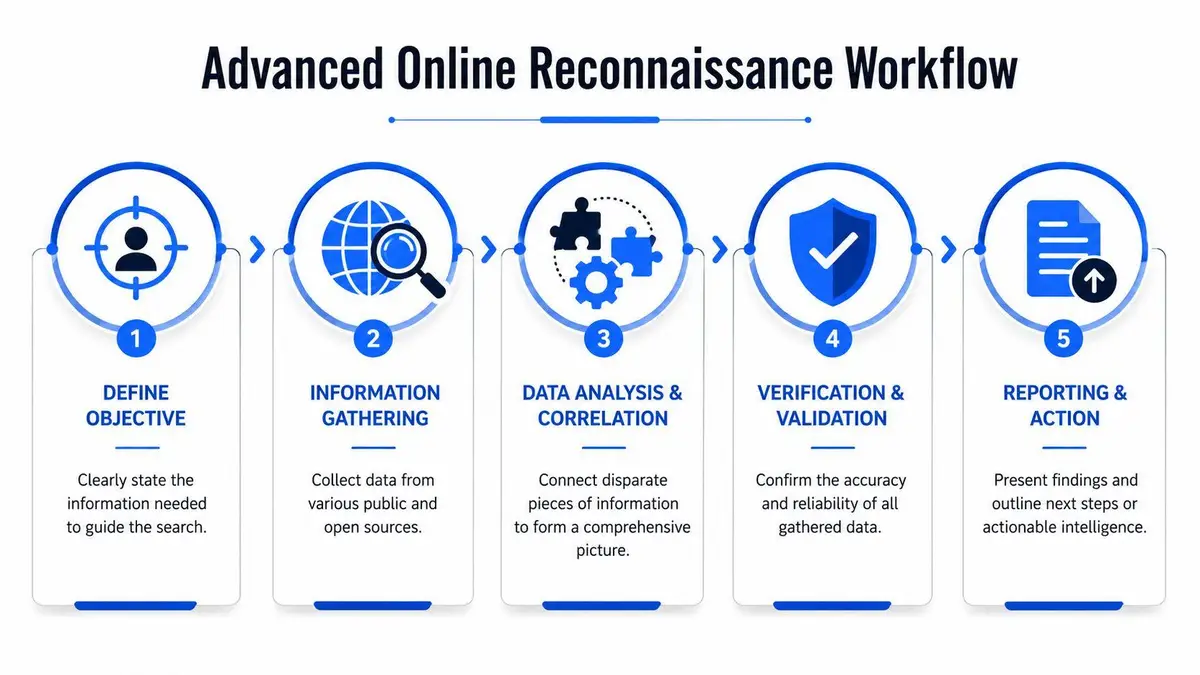
The strongest online investigations follow an OSINT workflow. That means you begin with confirmed facts, pivot through unique identifiers, and refuse to treat a single source as sufficient. Done properly, OSINT is less about tools than about sequence.
A visual framework helps clarify the progression:
Start with seed data and pivot outward
A rigorous OSINT workflow begins with seed data such as full name, approximate age, location, employer, email, phone number, username, or a known photograph. Investigators then pivot from one confirmed identifier to the next, and they verify identity with at least two independent sources. When that verification step is skipped, false matches occur in up to 40% of cases involving common names, according to this OSINT people-search methodology guide.
That statistic should reset your standards. If the name is common, a plausible match is almost meaningless until corroborated.
Use reverse image search when you have a face but no reliable profile. Use username enumeration when you have one confirmed handle. Tools like CheckUsernames can help surface where a handle appears across platforms, but the tool is only useful after you confirm the handle belongs to the right person. The same applies to reverse email lookups and phone checks. They are pivot tools, not proof.
For broader privacy exposure, it also helps to understand what data brokers collect and expose about executives. Those databases often bridge the gap between an isolated identifier and a wider digital footprint.
Treat people-search databases with suspicion
Commercial people-finder platforms attract users because they compress effort. They also create false confidence.
They frequently aggregate stale records, recycled addresses, disconnected phone numbers, and relatives who were relevant years ago but not now. Their value is directional. They can suggest leads. They should not drive a decision on their own. If a database says a target lives in a given city, you still need independent confirmation from current activity, recent affiliations, or active public traces.
Here’s the discipline professionals apply:
- Confirm one anchor fact first. An employer page, a current social account, a recent speaking appearance, or a verified contact channel.
- Pivot from that anchor. Search the username, image, email pattern, or associated organization.
- Cross-check chronology. If a result points to an old city but the current employer suggests another location, resolve the conflict before moving on.
- Log what is inferred versus what is proven. This step is often overlooked. That’s why their file becomes unusable.
A short explainer on video can help if you’re training a team or briefing counsel before a matter escalates:
The real differentiator is disciplined correlation
Amateurs collect fragments. Professionals correlate them.
A photo tied to a conference page supports a LinkedIn profile. A matching username on an old forum may connect to a current Instagram alias. A Maps review tied to an email can reveal geographic continuity. None of these pieces matters alone. Combined, they turn uncertainty into a usable intelligence picture.
That’s the difference between “I found someone” and “I know this is the right person.”
Verifying Identity and Assessing Data Integrity
The most dangerous sentence in digital investigations is this one: “We found it.”
Found what, exactly? A living profile? A cached page? A scraped record? A de-indexed result preserved by a third party? Too many people treat discovery as verification. It isn’t. It’s only the opening move.

Guides on searching for someone online often ignore the digital ghost problem, where outdated or de-indexed content remains visible in caches and aggregators. For high-profile individuals, an estimated 40% of search results can be outdated, according to this discussion of online people-finding blind spots. If you act on stale data, you don’t just waste time. You create legal, reputational, and operational exposure.
Identify whether the data is alive or residual
A current profile usually shows behavioral continuity. Recent posts. Updated professional information. Ongoing interactions. A pattern of use that aligns with present reality.
A ghost record behaves differently. It may rank well but show old employer details, broken links, recycled biographies, or data copied from another source that no longer exists. Cached versions are especially deceptive because they preserve material after the subject has changed or removed it.
Use this quick integrity check before relying on any result:
- Check recency signals: Look for timestamps, recent engagement, updated profile photos, and current affiliations.
- Look for internal consistency: City, employer, title, and social behavior should align across sources.
- Test the pathway: If a search result points to a profile, verify the profile still exists and isn’t a dead or redirected artifact.
- Separate source from mirror: An aggregator may be republishing old information from a primary source that has already changed.
Field judgment: If the data appears perfect but static, assume it’s old until you prove otherwise.
Build a verification file, not a bookmark list
You need a record of what you confirmed, how you confirmed it, and what remains unresolved. That record matters if the search leads to legal action, internal reporting, or personal contact.
In reputation matters, I often advise clients to distinguish between public records that remain legitimately accessible and records that may have been sealed, corrected, or legally limited in visibility. If your review touches criminal history, a practical legal reference on steps for Texas record expungement shows why older records can be misleading if you don’t understand the legal status behind them. The point isn’t jurisdictional trivia. It’s this: records can change in legal meaning even when copies still circulate online.
Dormant doesn’t always mean fake
One more mistake deserves attention. People often assume inactivity equals impersonation. Sometimes it does. Sometimes it means the subject abandoned the account years ago and an old profile still lingers in search results.
Use a simple decision test:
| Signal | Likely interpretation |
|---|---|
| Recent interactions with known associates | Active and likely current |
| Old biography with no recent activity | Dormant or residual |
| New account with thin network and copied photos | Possible impersonation |
| Mixed details across platforms | Requires deeper verification |
When identity matters, “probably” isn’t enough. You need a file that would withstand scrutiny from counsel, a board member, or a hostile journalist.
Navigating the Legal and Ethical Minefield
It is often believed that the legal issue begins after they find someone. That’s wrong. It begins the moment intent turns into conduct.
The ethical problem is even sharper. Technical ability doesn’t create entitlement. If you can identify a person’s address, relatives, travel patterns, or dormant accounts, that doesn’t mean you should use that information. High-stakes searches fail when the searcher becomes reckless, invasive, or vindictive. Then the original objective gets buried under a harassment claim, a privacy complaint, or reputational blowback.
Privacy is not a footnote
The standard “how to find someone” article treats privacy as a soft afterthought. That’s amateur thinking. Privacy is a stop signal. If the target has clearly reduced visibility, removed profiles, or narrowed public channels, that tells you something material. It may tell you to proceed through counsel, through an intermediary, or not at all.
The legal analysis usually turns on intent and use. Searching public information for due diligence is one thing. Using gathered details to pressure, embarrass, contact repeatedly, or expose family members is another. Regulators and platforms don’t care that the data was “online anyway” if your behavior crosses into misuse.
Successful searching sometimes means deciding not to push further.
Use proportionality as your governing standard
A disciplined search asks whether the level of intrusion matches the objective. A family office verifying identity before a financial distribution has a legitimate reason to seek corroboration. A rival trying to surface personal details for advantage does not. The method may look similar. The legal and ethical posture is entirely different.
Apply three questions before escalating any search:
- Is the objective legitimate? Due diligence, safety, legal response, and fraud prevention are legitimate. Curiosity dressed up as diligence is not.
- Is the information necessary? If a current professional identity answers the question, you don’t need personal family data.
- Is the next step defensible? Ask whether you’d be comfortable explaining your conduct to a judge, regulator, or board.
Don’t contaminate your own position
This matters particularly in matters involving defamation, estranged relationships, employee disputes, journalists, and public figures. If you search aggressively and then make contact clumsily, you may compromise evidence, trigger account deletions, or hand the other side a narrative of stalking or intimidation.
The disciplined path is usually indirect. Preserve what’s public. Document what appears current. Avoid unnecessary contact. Keep the search team small. If escalation is likely, coordinate legal review before outreach. The strongest position is the one that remains clean if later examined.
A search that produces the right answer but creates a larger liability is not a success. It’s a strategic error.
When Professional Intervention Becomes Essential
There is a clear line between competent self-help and matters that require specialist handling. Many cross it long before they realize they have.
If you’re tracing anonymous defamation, dealing with leaked material, confronting impersonation across multiple platforms, or conducting sensitive due diligence with personal safety implications, DIY work becomes risky fast. The stakes are too high, the evidence requirements are too exacting, and the margin for error is too small.
The point where self-help fails
Professional intervention becomes necessary when any of the following is true:
- The target is actively evasive: They use aliases, burner accounts, recycled content, or shifting identities.
- The content is harmful and time-sensitive: Leaks, impersonation, false allegations, or intimate material don’t wait for you to learn procedure by trial and error.
- The matter crosses borders or platforms: Different intermediaries control different choke points, and sequence matters.
- Your actions may later be scrutinized: Litigation, board review, law enforcement contact, or media attention changes the standard immediately.
DIY takedowns often fail because platforms and intermediaries reject poorly documented requests. They want specific evidence formats, preserved properly, before they act. In parallel, cross-border matters require sequence: identify the strongest jurisdiction, preserve evidence before outreach, target the correct intermediary, and separate urgent relief from final resolution. Those are not administrative details. They determine whether the material stays live or loses visibility quickly.
Suppression and removal are not the same remedy
This distinction is where advanced strategy begins. Content suppression reduces visibility, usually through de-indexing or burying material in search results. Content removal aims to erase the material from the source. They are different tools for different constraints, and this explanation of suppression versus removal strategy captures the distinction well.
Suppression is often the faster route to immediate reputational relief. Removal is stronger when achievable, but it depends on platform rules, host cooperation, and jurisdictional authority. In serious matters, a hybrid approach is usually the only serious approach.
| Aspect | DIY Search | Professional Investigation |
|---|---|---|
| Objective definition | Often vague or reactive | Tied to a clear legal, reputational, or security outcome |
| Evidence handling | Inconsistent, incomplete, or contaminated | Preserved in a form platforms and counsel can use |
| Identity verification | Frequently based on one plausible result | Confirmed through multiple independent sources |
| Risk control | User often overlooks privacy and misuse issues | Strategy accounts for legal and ethical boundaries |
| Harmful content response | Usually limited to reporting tools | Combines de-indexing, intermediary targeting, and source removal where possible |
| Cross-platform coordination | Fragmented | Sequenced and centralized |
| Discretion | Hard to maintain | Managed with confidentiality and controlled outreach |
If the matter can affect your name, your family, your company, or an active legal position, treat online searching as a professional discipline, not a weekend project.
If you’re facing impersonation, leaks, defamatory search results, cached material that won’t disappear, or a sensitive identity-tracing issue, ContentRemoval.com can assess the exposure discreetly and map the fastest path to containment. Their work is built for executives, public figures, family offices, and legal teams that need precision, confidentiality, and action rather than generic advice.
Frequently asked questions
How do I find someone online without breaking the law?
The legal line turns on intent and use rather than access. Searching public information for due diligence, safety, legal response or fraud prevention is legitimate; using what you find to pressure, repeatedly contact, embarrass or expose family members is not. Ask whether the objective is legitimate, the information necessary and the next step defensible to a judge or regulator.
Are people-search sites accurate?
They compress effort but create false confidence. They frequently aggregate stale addresses, disconnected numbers and relatives who were relevant years ago. Treat them as directional leads, then confirm with an anchor fact such as a current employer page or active account before relying on anything.
How do I know if a search result about someone is current or outdated?
Look for behavioral continuity: recent posts, updated professional details and ongoing interactions. A ghost record ranks well but shows old employer details, broken links or copied biographies. Test whether the profile still exists, separate the original source from mirrors, and assume anything that looks perfect but static is old until proven otherwise.