
Risk mitigation strategies for digital reputation threats have to run at platform speed, not committee speed. The four approaches apply: avoidance by removing stale bios, dormant accounts and exposed contact details; reduction through monitoring, content controls and access hardening; transfer of takedown execution to specialists; and documented acceptance for low-reach content, with pre-built playbooks for defamation campaigns, leaks and impersonation.
Key facts
- Four threat categories: malicious content, privacy breaches, impersonation and content weaponization such as NCII or stolen files.
- A cited 2025 McKinsey figure: 73% of executives call reputation their top unmanaged risk, only 28% have digital protocols.
- Rapid assessment asks five things: vector, velocity and reach, asset proximity, defensibility and execution.
- Score the program on time to detect, assign, file, contain, and the rate of successful removals.
Where ContentRemoval.com comes in. ContentRemoval.com is the transfer option in this framework: the operator that runs takedowns, impersonation removals, leak response and de-indexing across search, social, forums and publisher sites while counsel protects the legal position and PR handles messaging. Family office principals, chiefs of staff and general counsel usually make contact when internal sign-off cannot move as fast as the content. A free 15-minute Exposure Scan maps what is removable, and the report is yours to keep. Get a Free, Confidential Exposure Scan or read how our content removal work is done.
Most advice on risk mitigation strategies is built for committees, not crises. It assumes you have weeks to identify stakeholders, draft protocols, and move a problem through legal, compliance, communications, and executive review. That model fails the moment a leak, impersonation account, or defamatory post starts spreading at internet speed.
If you’re a public figure, founder, family office principal, or executive, your real exposure isn’t abstract enterprise risk. It’s a live digital threat attached to your name, your company, your children, your portfolio, or your personal safety. You don’t need another binder. You need a response system that can make decisions quickly, remove harmful material, and contain reputational fallout before search results, screenshots, and reposts lock the damage in place.
Why Traditional Risk Models Fail in Digital Crises
The standard corporate playbook is too slow for online attacks. A traditional assessment cycle might be acceptable for procurement, vendor review, or internal controls. It is useless when a false allegation is trending, a fake account is contacting investors, or private material has already been copied across platforms.
The central mistake is treating digital reputation harm like any other business risk. It isn’t. It moves faster, replicates instantly, and gets harder to reverse with every hour of delay.

Speed is the deciding variable
The most popular advice says to slow down, gather facts, and work the process. That sounds sensible. It’s also how executives lose control of a digital crisis.
Emerging data shows that 68% of digital reputation crises reach irreversible damage within 24 hours, and a 2026 Gartner study found that companies using rapid-response takedown services within 24 to 48 hours reduced long-term reputation loss by 54% compared to those following traditional 30-day protocols (MetricStream on risk mitigation strategies).
That single point should change how you think about mitigation. In digital reputation matters, speed isn’t one factor among many. It is the factor.
Practical rule: If harmful content is already public, your first objective is containment, not internal consensus.
A slow framework also creates a false sense of professionalism. Teams feel organized because they’ve opened a matter, assigned owners, and booked meetings. Meanwhile, the content remains indexed, mirrored, screen-recorded, and redistributed. The internet doesn’t care that your governance process is underway.
Bureaucracy creates a blind spot
High-net-worth clients often assume their existing advisors have this covered. Usually they don’t. General counsel can evaluate legal exposure. A PR firm can shape messaging. Cybersecurity teams can investigate intrusion. None of those functions, on their own, are designed to execute fast takedowns across search, social, forums, publisher sites, and copycat uploads.
That gap is where damage compounds. One team drafts. Another escalates. A third waits for approval. No one owns the operational task of removing or suppressing the material.
You need a dedicated digital crisis playbook with pre-authorized actions, defined thresholds, and a specialist response lane. If your current framework still relies on monthly reviews and layered sign-off, it belongs in governance. It does not belong in a live reputation event.
A more detailed executive response model appears in this online reputation management strategy guide for 2026, but the core principle is simple. Treat digital threats as high-velocity incidents. The response clock starts when the material appears, not when your team finishes discussing it.
Mapping Your Digital Threat Landscape
Most organizations classify risk cleanly on paper and miss the one category that can destabilize leadership overnight: digital reputation exposure tied to identity, privacy, and search visibility. That’s a strategic mistake.
A 2025 McKinsey report found that 73% of executives consider reputation their top unmanaged risk, yet only 28% have dedicated mitigation protocols for digital reputation threats. It also notes that a single viral leak can cost $10M+ in revenue for high-profile clients (Pirani on risk mitigation).
The threats that actually matter
Not every hostile mention deserves the same response. A mature risk posture starts by separating nuisance from material threat. I divide executive digital exposure into four categories.
| Threat Category | Common Vectors | Primary Mitigation Objective |
|---|---|---|
| Malicious content | Defamation, false reviews, coordinated smear posts, misleading forum threads | Remove false material, preserve evidence, reduce search visibility |
| Privacy breaches | Doxing, leaked contact details, exposed family information, data broker listings | Limit discoverability, remove personal identifiers, reduce physical and financial risk |
| Impersonation | Fake social profiles, spoofed email identities, fraudulent outreach, cloned executive pages | Verify identity, stop audience confusion, shut down fraudulent channels |
| Content weaponization | NCII leaks, stolen internal files, manipulated media, unauthorized use of private content | Trigger emergency takedown paths, contain reuploads, protect counterparties and family |
This classification matters because each category requires a different response path. A data leak is not handled like a fake review problem. An impersonation campaign is not handled like a legacy news result. If you treat everything as “bad press,” you’ll waste time and choose the wrong remedy.
Asset inventory comes before defense
Before you can defend anything, you need to know what exists. That includes domains, executive bios, dormant social accounts, old microsites, newsletter archives, cloud-stored media, and third-party profiles. It also includes the less obvious surface area around you: family mentions, charitable affiliations, board memberships, litigation references, and leaked data trails.
For privacy-specific exposure, a useful starting point is Understanding Crufti’s data privacy. It helps clarify how personal data is collected and surfaced across consumer-facing digital systems, which is exactly the kind of background executives need when assessing where sensitive information may be leaking from.
Reputation risk becomes unmanageable when nobody has a complete map of what can be targeted.
The practical consequence is straightforward. If your team can’t answer where your names, accounts, photos, archived content, and contact details are exposed, you don’t have a mitigation plan. You have assumptions.
The business impact is rarely confined to “reputation”
Digital attacks spill into operations quickly. Impersonation affects investor communications. Doxing creates personal security concerns. False allegations interfere with hiring, partnerships, and lender confidence. Leaked material can become an advantage in litigation or negotiations.
That’s why reputational containment should sit alongside breach and crisis workflows, not beneath them. If you’re dealing with exposed personal or corporate data, this strategic guide to handling reputational damage from a data breach is the kind of cross-functional lens most internal teams miss.
Adapting the Four Core Mitigation Strategies
Traditional risk teams treat mitigation like a quarterly governance exercise. Digital crises punish that mindset. By the time a committee agrees on ownership, the post has spread, the search result has indexed, and the impersonation account has copied your identity across three platforms.
The four classic strategies still apply. What changes is the operating standard. In a live reputation threat, each strategy needs a fast, execution-first version built for hours, not months.
Companies that adopt the four core risk mitigation strategies show a 35% higher resilience rate against emerging threats, and 78% of successful organizations regularly conduct risk workshops to identify vulnerabilities (Atlas Systems on risk mitigation).
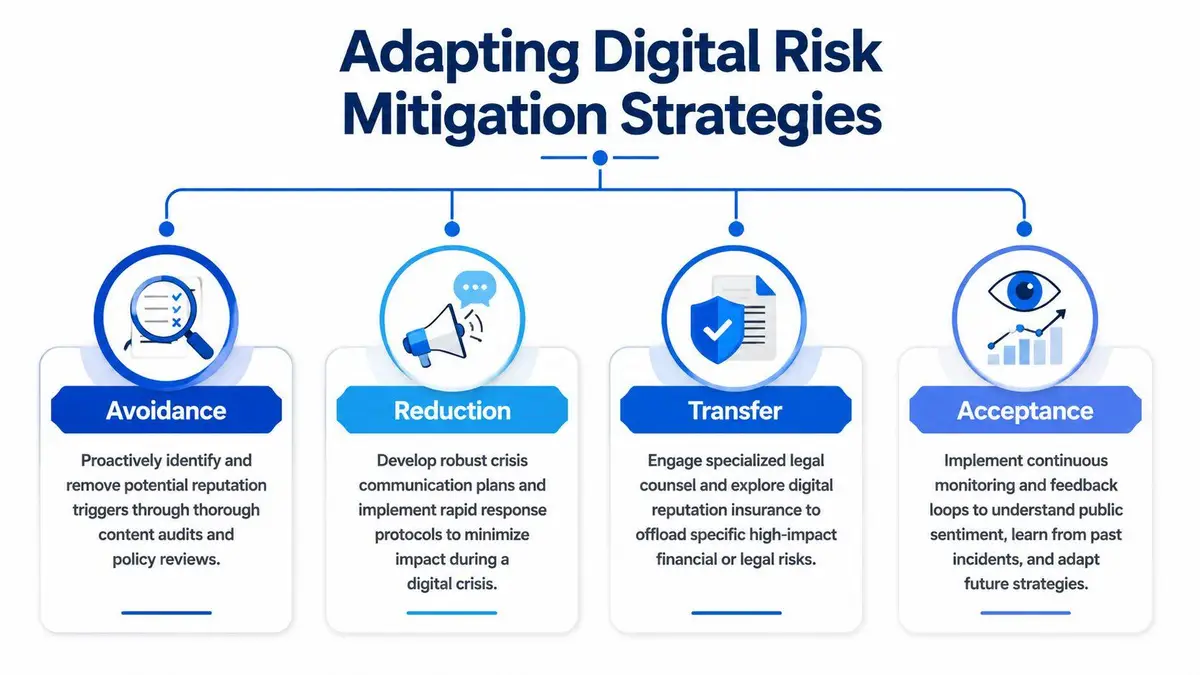
Avoidance means removing future triggers
Avoidance starts before a crisis. You strip out the material that gives an attacker easy ammunition.
For a high-net-worth client, that means removing stale executive bios, closing dormant accounts, cutting unnecessary family references, and pulling direct contact details from old event pages, directories, and cached profiles. Every forgotten asset becomes a usable entry point. If a legacy microsite still exposes a personal number or signature block, fix it now.
This is not cosmetic work. It reduces the number of places an adversary can scrape, spoof, or weaponize.
Reduction means tightening control over exposure
Reduction is operational discipline. It limits how much damage a hostile actor can do after they identify a target.
For cybersecurity-adjacent exposure, 43% of executives prioritize cybersecurity risk mitigation as a top focus in 2026, with reduction strategies commonly involving multi-factor authentication, encryption, network segmentation, and security awareness training (SkillPanel on risk mitigation strategy). That matters because many reputation incidents begin with weak access control, careless publishing rights, or poor media handling.
A strong reduction program includes:
- Monitoring discipline: Track executive names, aliases, brand references, and new lookalike accounts across search, social, and public forums.
- Content controls: Restrict who can capture, store, approve, and distribute sensitive photos, videos, files, and internal recordings.
- Access hardening: Use multi-factor authentication, role-based permissions, and strict account recovery rules on systems tied to executive identity.
Internal teams often stop at monitoring. That is too slow and too passive. Monitoring without authority, controls, and response rules just tells you that you are losing.
Transfer means shifting execution to operators who can act fast
Transfer is an execution decision. You assign the technical and procedural burden to people who know platform reporting standards, evidence requirements, legal escalation routes, and removal mechanics.
That can include outside counsel, forensic investigators, or specialist takedown teams. The point is speed and accuracy. Your communications staff should not be learning de-indexing workflows, impersonation reporting, or leak containment while the attack is live.
The right transfer decision is the one that shortens exposure fast enough to matter.
Acceptance means choosing what not to fight
Acceptance is selective restraint. You use it when a piece of content has low credibility, low reach, and no realistic path to search visibility or mainstream pickup.
That decision must be documented. Set a threshold for escalation, preserve evidence, and monitor for changes in spread, engagement, and republication. If those conditions shift, acceptance ends and active mitigation begins.
Silence is not a strategy. Controlled non-engagement is.
A Rapid Response Assessment Framework
Once a threat is live, standard risk scoring is too blunt. Likelihood and impact still matter, but they don’t tell you what to do in the first hour. In a digital crisis, you need a framework that accounts for spread, removability, and proximity to your most sensitive assets.
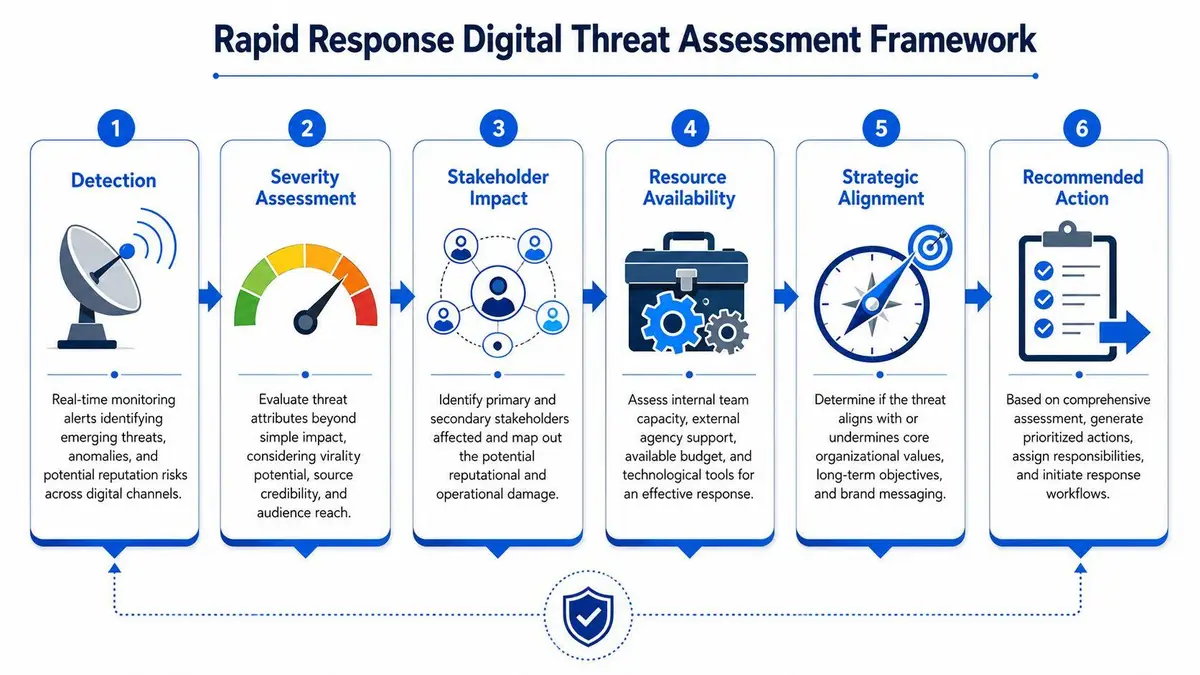
A useful rapid model has five operating questions.
Identify the vector
Start with precision. Is this a social post, search result, forum thread, review cluster, data exposure, private image leak, or impersonation account? Each vector triggers a different chain of custody, reporting route, and removal standard.
Do not let your team describe the issue vaguely. “There’s something online” is not a workable incident classification.
Assess velocity and reach
Next, determine how fast the content is moving. Is it confined to one platform, or has it already migrated into search, messaging apps, aggregator sites, and repost accounts? A low-credibility post can still become material if it is spreading rapidly or being amplified by accounts with audience concentration.
Many executives tend to react emotionally. They fixate on how offensive the content is, not how far it has traveled. Reach matters more than outrage.
Here’s a short way to evaluate it:
- Virality velocity: Is distribution accelerating or stalling?
- Audience concentration: Is it reaching investors, employees, clients, journalists, or family networks?
- Indexation risk: Has search already captured the content or its derivatives?
Triage by asset proximity
Not all attacks hit equally hard. A post targeting your child’s school, residence, private travel, or deal counterparties sits closer to core assets than a stray insult on an obscure forum.
Decision standard: Prioritize threats by what they can touch next, not by how upsetting they are now.
Asset proximity forces discipline. If the content threatens physical safety, market confidence, legal posture, or key relationships, it moves to the front of the queue immediately.
The operational backbone for this kind of thinking aligns with a structured process. Effective risk mitigation relies on identifying threats, assessing and prioritizing risks, developing mitigation strategies, implementing controls, and continuously validating them through audits and simulations (Datto on IT risk mitigation).
Before execution, use this visual framework to align the team:
Determine defensibility and execute
Defensibility means one thing. What is the strongest available basis for platform action, search de-indexing, legal escalation, or direct publisher intervention?
A fake account may be highly defensible. A private image leak often has urgent grounds. A harsh opinion piece may be difficult unless it crosses into actionable falsehood or privacy violation. Your team should know the difference before it wastes precious time filing weak requests.
Execution then becomes simple:
- Choose the remedy: Report, escalate, de-index, legal notice, suppress, or monitor.
- Assign one owner: One person controls the action log and approval path.
- Set a review point: Reassess after the initial response to decide whether the matter is contained or expanding.
Actionable Mitigation Playbooks for Crisis Scenarios
In a crisis, generic guidance is a liability. Your team needs pre-built playbooks that can be executed under pressure without debate. The first few hours are about containment, evidence, and route selection.
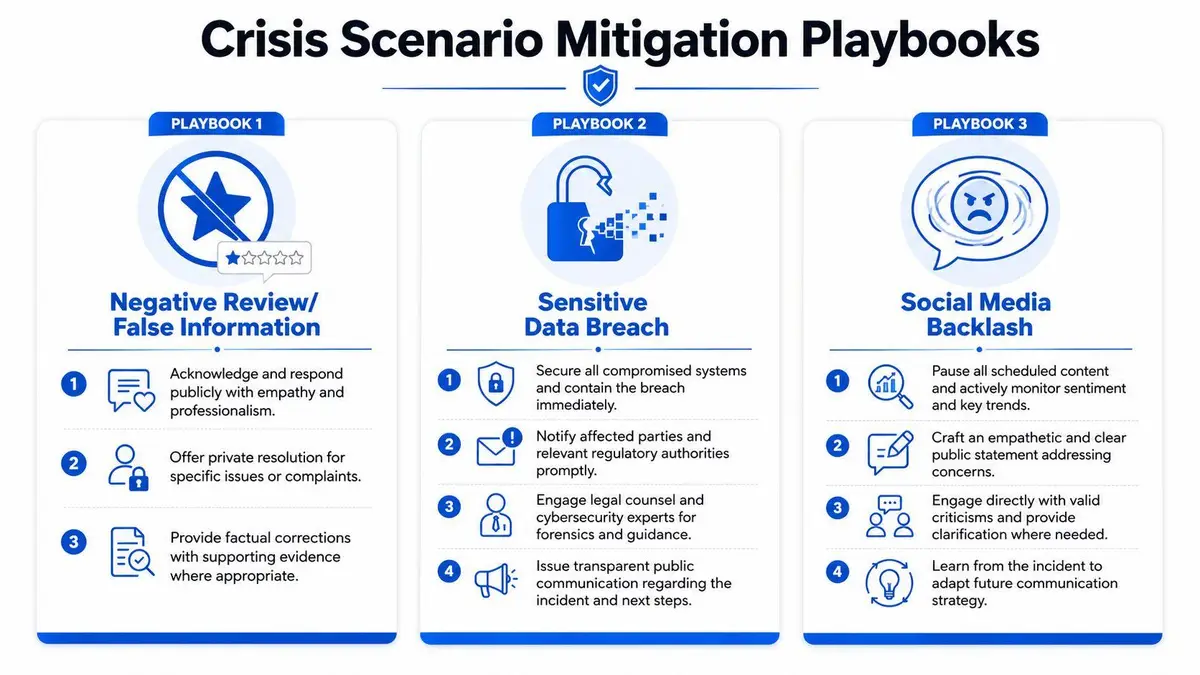
Coordinated defamation campaign
This scenario usually appears as a cluster. Multiple posts, repeated claims, similar language, mirrored reviews, and account behavior that suggests coordination rather than spontaneous criticism.
Move in this order:
- Capture evidence first: Archive URLs, account handles, timestamps, search appearances, and screenshots before anything is edited or removed.
- Separate fact from narrative: Identify which statements are false assertions, which are opinion, and which accounts appear linked.
- Escalate where effective recourse is available: Use platform reporting for manipulated behavior, harassment, impersonation, or policy violations. Where legal falsity is clear, prepare a parallel escalation path.
- Stabilize search exposure: If the content is indexing, work on suppression and de-indexing strategy while takedown efforts are underway.
Your objective is not to argue with attackers. It is to break the distribution system supporting them.
Sensitive content leak or doxing event
This is the category where delay is most expensive. If private images, home details, passports, contact data, or family information are circulating, treat the incident as both a reputation issue and a security event.
The first moves should be immediate:
- Lock down exposure points: Secure compromised accounts, shared drives, or messaging channels that may be feeding the leak.
- Preserve chain of evidence: Keep a clean record of what was posted, where, and by whom.
- Trigger emergency removals: Use the fastest available channels for privacy, NCII, or safety-based takedown requests.
- Coordinate legal and personal security: If addresses, family routes, or sensitive identifiers are exposed, reputational containment alone is not enough.
A strong post-incident recovery plan matters just as much as the first response. This post-crisis online reputation repair checklist for executives is useful when the immediate fire is under control and the focus shifts to cleanup, suppression, and long-tail monitoring.
Executive impersonation account
Impersonation attacks are often underestimated because they look superficial at first. They aren’t. A convincing fake profile can interfere with investor trust, employee instructions, media outreach, and transaction security.
Respond with discipline:
- Verify the scope: Identify all fake accounts, duplicate pages, spoof domains, and fraudulent contact routes.
- Protect official channels: Publish verification signals through official accounts, websites, or counsel where appropriate.
- File removal requests with proof: Use identity documentation, trademark support if available, and evidence of confusion or fraud.
- Alert internal and external stakeholders: Staff, assistants, board contacts, and close counterparties should know what is genuine and what is not.
A fake account is not a branding inconvenience. It is an operational threat wearing a reputational disguise.
Implementing a Proactive Defense System
Traditional risk programs move at committee speed. Digital attacks move at platform speed. If your approvals, asset records, and response authority are still built for quarterly reviews, you have already accepted avoidable exposure.
A proactive defense system exists to compress time. It gives your team a current asset map, clear decision rights, and standing workflows for takedowns, escalation, and evidence capture. The objective is simple: spot the threat early, contain it fast, and keep it from hardening into search results, screenshots, and copycat attacks.
What a modern defense system should include
Start with ownership. Every domain, social account, archived microsite, cloud repository, executive profile, and third-party listing needs a named owner, a recovery path, and a review schedule. If nobody can say who controls an asset, that asset will become a liability during a crisis.
Then tighten visibility and control:
- Executive and brand monitoring: Track names, family identifiers, company references, impersonation signals, and sudden spikes in harmful mentions.
- Credential and exposure checks: Watch for leaked logins, reused passwords, and packaged personal data circulating in criminal forums or breach repositories.
- Asset governance: Keep a live register of domains, social handles, old campaign sites, data rooms, cloud tools, and vendor-managed properties.
- Pre-cleared authority: Approve escalation paths in advance so legal, communications, security, and executive staff can act in hours, not after a week of internal alignment.
Physical security offers the right standard. A residence or office with serious protection uses controlled entry, verified access, and a clean audit trail. Digital reputation defense should operate the same way, and a property access management system is a useful benchmark for that discipline.
Measure what matters
Track speed and outcome. If your team cannot show how quickly it detects a threat, who takes control, how fast platforms receive a complete removal package, and whether harmful content stays down, the system is not ready.
Use a short scorecard:
- Time to detect a threat
- Time to assign an owner
- Time to file the first action
- Time to contain spread across major platforms
- Rate of successful removals, suppressions, or account recoveries
These are executive protection metrics, not technical vanity metrics. They show whether your operation can prevent a hostile post, leak, or impersonation account from setting the public narrative before your advisers are even on the phone.
A specialist team on retainer closes the gap that internal functions leave open. Legal protects legal position. PR protects messaging. IT protects systems. Someone still needs to run the incident end to end, make judgment calls fast, and push every track at once.
When a digital threat reaches your name, business, family, or private assets, delay raises the price. ContentRemoval.com works with executives, public figures, family offices, and legal teams on discreet content removal, impersonation takedowns, leak response, de-indexing, and ongoing monitoring. Start with a confidential assessment, define the threat clearly, and act before the internet fixes the story in place.
Frequently asked questions
Why do traditional risk management frameworks fail against online attacks?
They assume weeks to identify stakeholders, draft protocols and move a matter through legal, compliance and communications. A leak, fake account or defamatory post spreads, indexes and gets mirrored while that process runs, and no single function owns the operational job of removing or suppressing the material.
What should an executive do first when a fake profile impersonates them?
Verify the scope by finding every fake account, duplicate page, spoof domain and fraudulent contact route. Protect official channels with verification signals, file removal requests backed by identity documents and evidence of confusion or fraud, and brief staff, board contacts and close counterparties on what is genuine.
How do you decide which online threats to ignore?
Acceptance is a documented choice for content with low credibility, low reach and no realistic path to search visibility or mainstream pickup. Set an escalation threshold, preserve evidence and monitor spread and engagement. If those conditions change, acceptance ends and active mitigation begins.