
Reputation recovery after media coverage is a control exercise, not a messaging one. The first question is what can be removed, de-indexed, challenged or displaced before the article hardens into a permanent search liability. The playbook runs a 72-hour lockdown with evidence preservation, chooses between PR containment and technical removal, executes a phased takedown, suppresses what remains, and monitors reposts.
Key facts
- In the first 72 hours: one spokesperson, no off-record conversations, no comment section battles, preserve everything.
- Rank targets by impact: search-visible pages first, then authoritative source articles, then reposts, then forum threads.
- Even substantially accurate coverage can contain unlawful photos, private details or misleading headlines worth challenging.
- A cited TASC Group summary reports 68% of executives saw negative articles still visible six months after PR efforts.
Where ContentRemoval.com comes in. ContentRemoval.com handles the removal track after a damaging story runs: forensic review of the article and its mirrors, source takedowns and search de-indexing where the facts support them, suppression of what remains and post-removal monitoring, coordinated with the client’s counsel and communications lead. Board chairs, general counsel and family office principals usually make contact within days of publication. A free 15-minute Exposure Scan maps what is removable, and the report is yours to keep. Get a Free, Confidential Exposure Scan or read how our reputation management work is done.
You wake up to a text from your general counsel, then another from your board chair, then a flood of messages from people who suddenly want “a quick call.” The article is live. Screenshots are circulating. Search results are already changing. Your name, your company, or your family office is now attached to a digital asset you didn’t approve and can’t ignore.
At that point, people make the same mistake. They hire public relations, draft a statement, and start talking about “rebuilding trust.” That’s incomplete. If the hostile content remains indexed, searchable, repostable, and quotable, you haven’t solved the problem. You’ve narrated around it.
Reputation recovery after media coverage is not primarily a messaging exercise. It is a control exercise. The first question is not what to say. The first question is what can be removed, de-indexed, challenged, frozen, or displaced before the story hardens into a permanent search liability.
The Modern Playbook for Crisis Response
Traditional PR assumes the news cycle ends. Search engines don’t. A damaging article can lose public attention and still keep doing damage every time an investor, journalist, regulator, customer, or future employer types your name into Google. That is why so many “successful” crisis responses feel hollow to the client. The headlines fade, but the asset survives.
That is the core distinction discerning clients need to understand. Narrative management and digital liability removal are not the same thing. The first tries to influence perception. The second tries to alter what remains accessible, indexable, and discoverable.
A 2025 study cited by TASC Group reports that 68% of executives facing media scandals saw negative articles remain visible in search results six months after PR efforts, while 82% of those using legal removal services saw top-page negative content drop by 75% within 30 days (TASC Group summary of the Reputation Management Institute findings). That gap matters. It’s the difference between managing noise and removing ammunition.
What serious clients should prioritize
If I’m advising a high-profile client in the first hours after publication, I don’t treat the article as a “story.” I treat it as a hostile digital asset with several attack surfaces:
- Search visibility: Is it ranking for your name, brand, or company?
- Platform vulnerability: Does it violate platform terms, privacy standards, copyright, trademark, or defamation thresholds?
- Replication risk: Is it already being scraped, reposted, excerpted, or embedded elsewhere?
- Commercial impact: Does it affect counterparties, lenders, boards, clients, or family members?
That framework changes the response. You stop asking whether the coverage is “fair.” You start asking what can be neutralized.
Practical rule: If harmful content remains easy to find, your crisis is still active, even if the press office says the issue has “moved on.”
This is why executives dealing with a coordinated attack, false reporting, or a smear operation should think in terms of takedown strategy first and messaging second. If that sounds aggressive, good. Passive clients lose control fastest.
For a related strategic framework on hostile campaigns, see this executive playbook for handling a targeted online smear campaign.
The First 72 Hours Immediate Crisis Triage
The first mistake is speaking too early. The second is allowing ten people inside your organization to improvise at once. The third is failing to preserve evidence before someone edits, deletes, or republishes it elsewhere.
Speed matters. Brands that respond to negative media coverage within the first 48 hours are 2.5x more likely to recover public trust, and social media spreads negative stories 1200% faster than traditional news cycles according to New Media’s reputation management statistics. That does not mean you rush into a public statement. It means you move immediately to lock down the environment.

Impose a digital lockdown
For the first day, your priority is containment of self-inflicted damage. Pause all scheduled marketing, investor relations content, promotional social posts, and automated email sequences. Anything cheerful, salesy, or off-message will look deranged next to a public crisis.
Issue one internal instruction set. Keep it short.
- Single spokesperson only: Everyone else says nothing publicly, including on personal social accounts.
- No off-record conversations: Executives and employees routinely misjudge what’s private. Assume every message can leak.
- No comment section battles: Staff, friends, and loyal customers often make the situation worse by arguing online.
- Preserve all materials: Save the article, screenshots, timestamps, URLs, social reposts, and any prior correspondence with the publisher.
This stage is not about optics. It’s about avoiding unforced errors while your legal and technical team assesses their strategic advantages.
Build the crisis cell
You do not need a committee. You need a compact team with authority. In most serious cases that means senior legal counsel, one executive decision-maker, one digital investigator or reputation specialist, and one communications lead who understands they are not in charge of strategy.
The team should answer four questions immediately:
- Is the content false, misleading, unlawfully obtained, privacy-invasive, or platform-violative?
- Where is it hosted, mirrored, excerpted, and indexed?
- Which audiences matter most in the next week?
- What action can start today without increasing exposure?
Silence in the first hours is acceptable. Uncontrolled chatter is not.
Preserve evidence before anyone “cleans things up”
Clients often want the piece gone so badly that they forget to document it. That’s reckless. A proper evidentiary record strengthens takedown requests, legal notices, search de-indexing efforts, and any later negotiation with publishers or platforms.
Capture:
- Original URLs and headline variants: Publishers change titles after the backlash starts.
- Search result snapshots: Record how the material appears for brand and name queries.
- Social propagation: Note which accounts amplified the article and whether they added false commentary.
- Metadata and dates: Publication timing can matter if you need to show malice, coordination, or repeated republication.
Conduct a rapid impact audit
Not every ugly article is equally dangerous. Some die on arrival. Others become search poison. The difference depends on discoverability, authority, and audience.
A rapid audit should classify the threat across these dimensions:
| Audit area | What to check | Why it matters |
|---|---|---|
| Search exposure | Whether the story appears for your name, company, or branded queries | Search visibility turns a temporary event into a long-tail liability |
| Publisher authority | Whether the domain is a major outlet, niche trade publication, blog, or forum | Higher-authority domains tend to persist in search |
| Replication | Whether social posts, aggregators, or forums are copying it | Replication multiplies cleanup work |
| Legal vulnerability | Privacy issues, factual errors, copyright, impersonation, or policy violations | Vulnerability determines removal options |
| Stakeholder reach | Whether clients, regulators, employees, or lenders are seeing it | Business damage comes from who sees it, not only from volume |
Decide what not to do
In the first 72 hours, several impulses are almost always wrong.
- Don’t threaten publicly: A loud legal threat invites more coverage.
- Don’t over-explain: Long statements create new excerpts and new headlines.
- Don’t buy visibility blindly: Paid media and boosted posts can amplify name association with the crisis.
- Don’t assume deletion solves it: Even if the publisher edits the piece, cached results and reposts may remain.
If you do this phase correctly, you end day three with discipline, evidence, a map of the threat, and a shortlist of assets to target. That puts you in position to choose a real recovery path instead of improvising under pressure.
Containment vs Removal Choosing Your Recovery Path
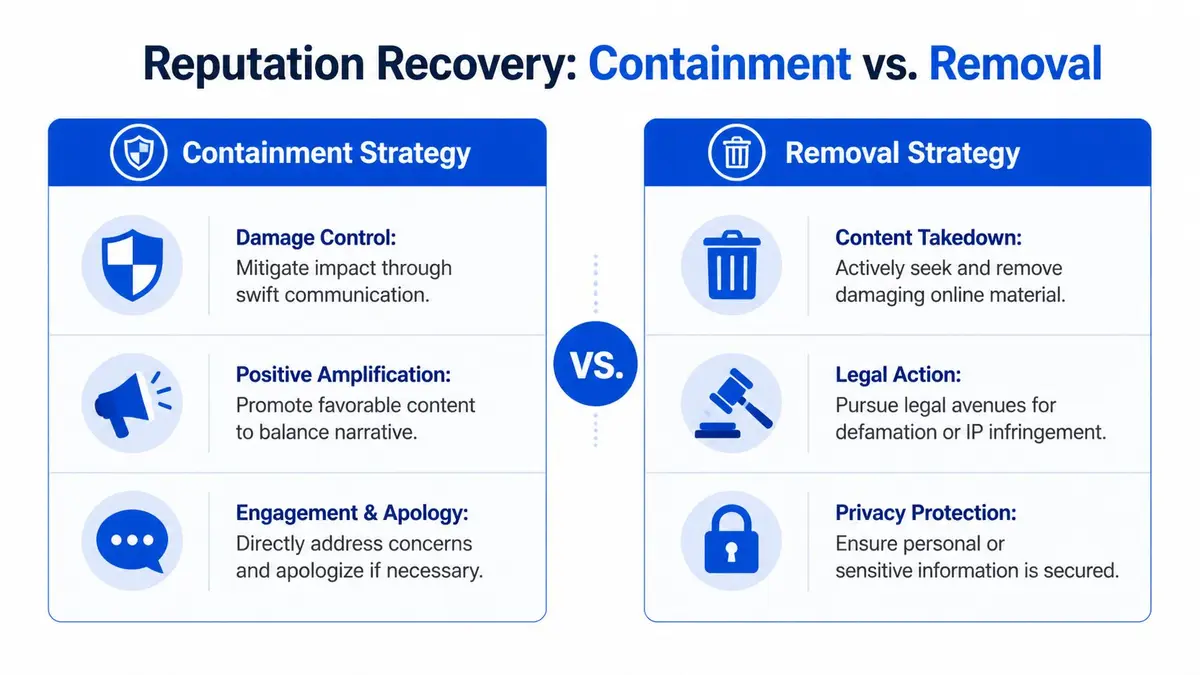
Every crisis produces the same strategic fork. You can try to contain the damage, or you can try to remove the asset creating it. Many advisers pretend these are just different tactics under the same umbrella. They are not. They reflect different goals.
A containment strategy accepts the continued existence of the negative material and tries to reduce its influence. A removal strategy treats the material itself as the problem and moves to eliminate, de-index, block, or technically suppress it. If you are a visible executive, investor, founder, physician, athlete, or public figure, removal is usually the more rational default. Your risk is not just this week’s press cycle. Your risk is persistent discoverability.
What containment actually does
Containment uses familiar tools. Public statements. Media outreach. Interview placement. Social posts. Reputation-friendly content. Maybe a carefully drafted apology. Sometimes that’s necessary. It can calm stakeholders and buy breathing room.
But containment has a built-in weakness. It leaves the original asset in circulation. If a future investor, customer, journalist, or admissions officer finds the damaging article first, your polished statement won’t matter much. They will anchor on the hostile material and interpret everything else through it.
Containment is often the right support layer. It is rarely enough as the primary plan.
What removal changes
Removal shifts the objective. Instead of merely arguing with the article, you challenge its right to stay visible. That can involve source takedowns, search de-indexing, copyright or trademark enforcement, privacy claims, impersonation complaints, terms-of-service violations, and legal review for defamation or unlawful publication.
This approach is less theatrical and more effective. It also suits clients who value discretion. A takedown campaign doesn’t require more interviews, more explanations, or more public performance.
The cleanest crisis response is the one that reduces visibility while everyone else is still drafting talking points.
Decision Matrix PR Containment vs Technical Removal
| Metric | PR Containment Strategy | Technical Removal Strategy |
|---|---|---|
| Primary objective | Reduce reputational fallout | Eliminate or limit discoverability of the harmful asset |
| Speed to first action | Depends on approvals and messaging | Can begin immediately once target assets are identified |
| Permanence | Limited if original content remains online | Stronger when source removal or de-indexing succeeds |
| Discretion | Often public-facing | Can be handled quietly through legal and platform channels |
| Search impact | Indirect | Directly targets indexed visibility |
| Reliance on public cooperation | High | Lower, depending on platform and legal leverage |
| Best use case | Legitimate criticism that requires response | False, invasive, unlawful, duplicated, or strategically harmful content |
| Main weakness | Leaves digital liability intact | Not every asset is removable |
How I advise clients to choose
If the coverage is substantially accurate, widely syndicated, and tied to a matter you must publicly address, containment may be necessary. But even then, you should still audit every version of the content for removal opportunities. Accurate coverage can still contain unlawful photos, private details, misleading headlines, outdated snippets, or platform violations.
If the content is false, malicious, privacy-invasive, copied, manipulated, or hosted on a vulnerable platform, don’t waste time treating it as a brand storytelling problem. Treat it as a takedown problem.
A good decision test is simple:
- If the material can be challenged, challenge it.
- If it can’t be removed completely, reduce its visibility.
- If it still remains, build assets that outrank it.
That sequence matters. Too many firms reverse it. They start by publishing cheerful content and hoping Google gets the hint. Google won’t. Search engines reward authority, freshness, relevance, and clean technical signals. Hope isn’t a strategy.
Executing the Technical Takedown Strategy
The public usually imagines content removal as sending one stern email and waiting for compliance. Serious operators know better. Effective takedown work is forensic, phased, and relentless. You assess the asset, identify pressure points, choose the right channel, and sequence actions so the most damaging visibility points are addressed first.

The timing matters. Companies responding within 24 hours achieve 3x better recovery rates, with a timeline that begins in the first 24 hours, continues through 24 to 72 hours, and extends into the following weeks for implementation and monitoring according to The Marketing Agency’s crisis response timeline. For technical takedowns, that same discipline applies. Delay gives the asset time to spread, rank, and replicate.
Phase one forensic review
Before you send anything, you need a proper diagnostic. I want to know who published the piece, where it is hosted, what exact claims it makes, whether those claims changed over time, which media elements are embedded, and whether the content has already been mirrored elsewhere.
The review usually focuses on five categories of factors:
- Defamation exposure: False factual assertions that damage reputation.
- Privacy invasion: Publication of personal, financial, medical, family, or location-sensitive material.
- Copyright misuse: Unauthorized use of photographs, video, reports, or proprietary material.
- Trademark or impersonation issues: Misleading branding or false affiliation.
- Platform rule breaches: Harassment, doxxing, manipulated media, non-consensual content, or prohibited disclosure.
A bad takedown fails because the argument is vague. A strong takedown aligns the complaint to the exact rule, right, or legal defect that the platform or publisher already recognizes.
Phase two target prioritization
Not every harmful URL deserves equal attention. A disciplined team ranks assets by impact.
- Search-visible pages come first, especially those ranking for your exact name or company.
- Source articles on authoritative domains come next because suppression is harder if they remain live.
- Social reposts and excerpts follow because they accelerate distribution.
- Forum threads, image results, and copycat pages are handled in a structured sweep.
Many firms waste time chasing obscure reposts while the main search result keeps doing the damage.
De-indexing and source removal are different tools
Clients often use these terms interchangeably. They shouldn’t.
Source removal means removing the content from the originating website or platform. That’s the cleaner outcome because it addresses the root asset.
De-indexing means pushing for removal from search visibility even if the source page still exists in some form. This can be valuable when the publisher refuses to delete but the content qualifies for search-level challenge under applicable rules or legal arguments.
The right sequence depends on the facts. In some matters, you hit the source first. In others, you move in parallel. What you should not do is assume that one successful action finishes the job. It rarely does.
A page that disappears from search but remains live can still be weaponized. A page that is deleted at the source but remains cached can still surface. Good operators plan for both.
For executives assessing the mechanics, this strategic guide to removing content from a website lays out the distinction clearly.
Phase three escalation and documentation
Once requests are submitted, you monitor responses, revisions, partial compliance, and secondary publication. Some publishers edit rather than remove. Some platforms remove one post while leaving derivative posts untouched. Some search results linger until recrawl.
That means every action needs documentation. Keep copies of notices, timestamps, response language, and evidence of ongoing harm. If you later need legal escalation, a search challenge, or cross-platform enforcement, that file becomes essential.
One factual mention here is enough. ContentRemoval.com offers de-indexing, source removal, and post-removal monitoring as part of digital reputation work. That type of service is useful when a matter spans search, publisher outreach, and social platform enforcement at the same time.
Technical takedown work is not glamorous. That’s why it works. It replaces vague reassurance with a sequence of actions that changes what people can find.
Dominating Search Results with SEO Suppression
Once you remove what you can, you have a second job. You need to control the remaining first page. That means building a search environment where your preferred assets occupy the space that a hostile article used to hold, or where any lingering negative result gets pushed into irrelevance.
Suppression is often misunderstood. It is not fake positivity. It is not spam. It is not paying for junk articles and hoping they stick. Proper suppression is a structured search strategy built around owned assets, credible third-party references, clean technical optimization, and consistent publication.
According to 5WPR’s analysis of reputation recovery examples, proactive positive content publishing after a crisis can yield a 45% uplift in public sentiment when apologies are paired with visible action and followed by authentic materials such as case studies and thought leadership. That finding supports a point experienced operators already know. Good content matters after the emergency phase, but only if it is credible and tied to reality.
Build the right asset stack
For a high-profile executive or founder, I usually want a layered portfolio rather than one hero page.
- Primary owned site: Your official profile, biography, media page, and statement archive.
- Controlled profile assets: LinkedIn, company leadership page, speaker profiles, and verified social accounts.
- Third-party authority pages: Interviews, trade features, board bios, conference pages, and professional memberships.
- Substantive thought leadership: Articles, commentary, white papers, interviews, and public-facing case materials.
The point is occupancy. You are trying to claim as many high-authority branded search positions as possible.
Suppression is different from marketing SEO
Commercial SEO chases category keywords. Suppressive SEO chases branded result control. Those are different disciplines.
A search suppression campaign focuses on:
| Asset type | Role in suppression |
|---|---|
| Official website pages | Establish central authority for branded queries |
| Executive bios and profiles | Capture exact-name searches |
| Newsworthy positive coverage | Adds independent validation |
| Social profiles | Fill visible first-page slots quickly |
| Long-form expertise content | Strengthens topical authority over time |
The work includes title tags, entity consistency, internal linking, media schema where appropriate, editorial placements, and persistent branded publishing. It also requires judgment. Thin content won’t hold rankings. Over-optimized fluff can backfire.
If a result is weak, Google eventually notices. Suppression works when the replacement assets deserve to rank.
A more specific framework for this process is available in this guide to suppressing negative search results for executives.
Use content that reflects action, not spin
Many reputations stall precisely because the client wants search cleanup, but they refuse to create anything credible enough to replace the negative result. Search engines and human readers both punish obvious spin.
Effective assets often include:
- Leadership commentary: Not generic inspiration. Actual informed analysis tied to the executive’s domain.
- Operational updates: If there was a real issue, publish proof of corrective steps in a controlled environment.
- Professional profiles: Clean, complete, consistent profiles across major platforms.
- Media materials: Interviews, bios, speaking appearances, and expert contributions.
Here’s the broader context in video form for teams that need to align around search visibility strategy.
What good suppression looks like
You know the campaign is working when branded searches return a coherent digital identity rather than a patchwork of hostile references. Someone researching you should find official pages, legitimate profiles, credible coverage, and current material that reflects who you are now.
The goal is not to pretend the crisis never happened. The goal is to ensure it no longer dominates discovery.
Long-Term Monitoring and Prevention
A cleanup without monitoring is temporary. The article may be gone, but a scraped copy can surface later. The impersonation account may disappear, then reappear under a variant handle. A forum thread may sit dormant for months before a journalist finds it during due diligence. High-profile clients need standing surveillance, not occasional vanity searches.
Build a permanent watch system
At minimum, your monitoring program should track your name, your company, brand variants, family names where relevant, executive titles, and any sensitive terms connected to the original incident. Google Alerts can help at the low end, but serious matters require broader coverage across search, social platforms, forums, news aggregators, review sites, and image sharing environments.
You also need a triage rule. Not every mention deserves action. Some deserve a record, some need a response, and some need immediate escalation. If your team treats every negative remark as a fire, they’ll miss a genuine fire.
A practical monitoring stack usually includes:
- Search monitoring: Track branded result changes and new indexation.
- Social listening: Flag reposts, impersonation, coordinated commentary, and unusual spikes.
- Review site monitoring: Watch for false reviews, review-bombing, and doxxing in business listings.
- Domain and identity checks: Look for fake profiles, copycat sites, and unauthorized uses of names or marks.
Handle social platforms and forums differently
Search cleanup logic does not always work on social media. Platforms care about impersonation, harassment, manipulated media, privacy violations, and policy compliance. They generally care less about your preference not to be criticized. That means your complaint must be framed correctly.
For forums and comment sections, discretion matters. Publicly arguing with anonymous users often extends the life of the thread and invites more participation. Quiet reporting, moderator escalation, and documentation usually work better.
If the issue involves impersonation or deceptive profiles, move fast. The longer a fake account remains active, the more screenshots and reposts it creates. Have a standing process for profile capture, evidentiary preservation, and platform submission.
Move from reactive to preventive
The strongest clients use the post-crisis period to harden their digital footprint. They lock down dormant usernames, update executive bios, clean old profile pages, centralize press materials, and standardize public-facing information across platforms. They also train assistants, junior staff, and marketing teams not to freelance online during a flare-up.
The best reputation defense is not a clever statement. It is a clean digital environment with fast escalation when something hostile appears.
Long-term prevention also requires disciplined record-keeping. Preserve prior takedowns, publisher contacts, known hostile accounts, and language patterns from prior attacks. Repeat actors often repeat methods. If you know the pattern, you can intercept it earlier next time.
Frequently Asked Questions
High-profile clients usually ask the same questions, but they ask them under pressure and often after bad advice. Here are the direct answers.
Critical Questions in Reputation Recovery
| Question | Answer |
|---|---|
| Should I issue a public statement immediately? | Usually not. First stabilize the situation, preserve evidence, and determine whether a statement helps or merely creates more searchable material. |
| Is PR enough to fix this? | Often no. PR can support recovery, but it usually leaves the damaging asset intact. If the content remains indexed, it can keep harming you long after the news cycle moves on. |
| Can negative articles actually be removed? | Sometimes yes, sometimes partially, sometimes not at the source. The result depends on factual inaccuracies, privacy issues, platform rules, copyright, trademark, and the publisher’s posture. De-indexing may still be possible even when full removal is not. |
| What if the article is technically true but highly damaging? | Then the analysis shifts. You look for unlawfully disclosed private details, misleading framing, stale or disproportional search prominence, unauthorized media use, and whether suppression should become the main strategy. |
| Will threatening the publisher help? | Usually only if done carefully and privately. Public threats can trigger more coverage, more screenshots, and more hostile commentary. |
| Should my staff defend me online? | No. Internal supporters often create discoverable arguments, emotional screenshots, and inconsistent explanations. One channel, one strategy, one decision-maker. |
| What matters more, source removal or search de-indexing? | Source removal is cleaner. De-indexing is still valuable. In practice, strong campaigns often pursue both where the facts allow. |
| How long does recovery take? | It depends on the content, the publisher, replication, and your search footprint. Some actions begin quickly, but durable recovery usually combines takedowns, suppression, and monitoring over time. |
| Can I just bury the story with new content? | Not if the negative result sits on an authoritative domain and you do nothing else. Suppression works best after removal attempts and with credible assets that deserve to rank. |
| What should I expect from a specialist firm? | A disciplined audit, legal and technical issue spotting, prioritized takedown action, search strategy, documentation, and ongoing monitoring. If a firm offers only “better messaging,” it is not solving the real problem. |
The uncomfortable truth clients need to hear
You may not get every item removed. That’s reality. But most clients don’t need perfection. They need control. They need the harmful asset to lose visibility, authority, and commercial impact.
That is why specialist digital crisis work beats generic communications advice in serious matters. It focuses on what your counterparties, investors, journalists, and customers can find.
What legal counsel should watch for
Lawyers who do not work regularly in digital reputation matters often over-focus on the merits of a defamation case and under-focus on platform influence, search behavior, duplication, and timing. Litigation may be appropriate, but litigation is slow. Search harm is immediate.
An advanced approach asks two questions at once: what wins in court, and what reduces discoverability now? Those are related questions, but they are not the same question.
When to call for outside help
Call early if any of the following are true:
- The content ranks for your name or company
- Private information, images, or family details are exposed
- The article is being copied or amplified across platforms
- Your board, investors, clients, or regulators are already asking questions
- You are considering a public response but haven’t yet mapped removal options
Most damage in these matters comes from delay, bad sequencing, and amateur escalation. A rushed statement is easy to issue and hard to undo.
If you’re dealing with reputation recovery after media coverage and need a confidential, action-first assessment, ContentRemoval.com handles legal and technical content removal, de-indexing, suppression strategy, and ongoing monitoring for executives, public figures, and high-risk clients. The right move is usually not more noise. It’s removing the liability, reducing visibility, and restoring control.