
Reputation protection for business leaders is the strategic defense of a personal and corporate identity that are now inseparable. It starts with diagnosing the attack vector: strategic defamation, AI-driven impersonation, a weaponized leak, negative press or dark web exposure, then fights on three fronts: legal authority to compel action, technical removal or de-indexing, and communications that hold stakeholder confidence.
Key facts
- Five threat vectors: strategic defamation, AI impersonation, weaponized leaks, negative press and dark web exposure.
- Legal tools include cease and desist letters, defamation suits leading to court orders, and DMCA notices for stolen files.
- The first 24 to 48 hours are for intelligence gathering and triage, not public action.
- Copyright cases can resolve in days; coordinated smear campaigns on offshore blogs can take weeks or months.
Where ContentRemoval.com comes in. ContentRemoval.com operates the technical front for business leaders under attack: source removal, search de-indexing, forensic support against deepfakes and impersonation, leak containment and monitoring for reuploads, coordinated with the leader’s counsel and communications team rather than replacing them. The general counsel, chief of staff or board chair usually makes the first call. A free 15-minute Exposure Scan maps what is removable, and the report is yours to keep. Get a Free, Confidential Exposure Scan or read how our reputation management work is done.
As a business leader, you are not merely managing a company; you are the steward of its public perception. Reputation protection is not damage control. It is the strategic defense of your personal and corporate identity against persistent digital threats.
This requires a specialized blend of legal, technical, and communications strategies to remove defamatory content, neutralize false narratives, and build a digital fortress around your name. It is an essential function for securing your career, maintaining shareholder confidence, and protecting the trust you have worked to build.
Your Reputation Is Your Most Valuable Asset

For an executive, reputation is not an abstract concept. It is a measurable, high-value asset. The line separating your personal identity from your company’s market valuation has vanished. A single defamatory article, a coordinated smear campaign, or a damaging personal data leak can erase years of hard-won trust and investor value in hours.
This reality elevates reputation protection for business leaders from a reactive measure to a core strategic priority. Failure to act has immediate and severe financial repercussions. Your public perception carries a quantifiable value, and any threat to it must be managed with the same urgency as any other critical business risk.
The Financial Imperative of Reputation
The financial stakes are staggering. Global studies now draw a direct line between a company’s reputation and its shareholder value. One landmark report found that businesses actively prioritizing their reputation realize an additional 4.78% in annual shareholder returns. That positions reputation as a tangible asset class with an estimated global worth of $7 trillion.
For an executive at any scale, this data is undeniable proof: your reputation is a primary driver of profit, not a soft PR metric.
Your digital footprint is the modern battleground where market perception is won or lost. Every search result, news article, and social media mention contributes to a permanent record that influences investors, board members, and clients.
The Inextricable Link Between Leader and Company
As a leader, your personal reputation is inextricably welded to your organization’s health. An attack on you is an attack on the company. Adversaries understand this symbiotic relationship and exploit any personal vulnerability, real or fabricated, to destabilize your business.
Defending this interconnected identity demands a specialized approach. While personal development, such as the effort to improve verbal communication skills, can fortify your public image, it is insufficient when you are under direct attack.
The only effective defense is a proactive, multi-front strategy. It requires combining legal action to enforce your rights, technical intervention to scrub damaging content from its source, and strategic communications to reclaim control of the narrative. This is not crisis management. It is asset protection.
What a Digital Attack Really Looks Like

When your reputation comes under fire, the first step is not damage control. It is diagnosis. You must understand the specific nature of the attack, because each vector has its own playbook, motive, and solution. A generic response is a wasted effort.
Think of it as a medical emergency. You would not treat a fracture with a bandage. The same principle applies here. Effective reputation protection for business leaders begins by correctly identifying the weapon being used against you to deploy a precise, surgical countermeasure.
To clarify what you may be facing, we have analyzed the most common digital threats. This table outlines the threat, its likely impact, and our immediate remediation priority.
Threat Vector Analysis for Business Leaders
| Threat Vector | Primary Impact | First Priority Remediation |
|---|---|---|
| Strategic Defamation | Damage to credibility, influences search results, disrupts business deals. | Content takedown and de-indexing from search engines. |
| AI-Driven Impersonation | Deep erosion of trust, financial fraud, stock price manipulation. | Forensic analysis to prove falsehood and rapid removal from platforms. |
| Weaponized Leaks | Exposure of confidential data, loss of competitive advantage, internal distrust. | Containment of the data’s spread and identifying the leak source. |
| Negative Press | Public narrative controlled by others, damage to brand and investor confidence. | Proactive PR engagement and search engine reputation management (SERM). |
| Dark Web Exposure | Compromised credentials, risk of identity theft and corporate espionage. | Data removal from dark web markets and comprehensive security audits. |
Each of these threats requires a unique strategy. Correctly identifying the vector is the first, and most critical, step toward regaining control.
Strategic Defamation Campaigns
This is reputational warfare. It is not a negative review; it is a coordinated campaign to publish false, damaging information about you. This material appears on anonymous blogs, fringe news sites, and across networks of fabricated social media accounts.
The timing is rarely coincidental. These attacks are often launched to sabotage a specific event: a merger, a product launch, or a crucial funding round. The content is carefully optimized with your name and company keywords to dominate Google search results, effectively poisoning the well for anyone conducting due diligence.
The goal of strategic defamation is to create a false digital reality that drives real-world consequences. By controlling what investors, partners, and board members see online, an attacker controls the narrative.
AI-Driven Impersonation and Disinformation
Artificial intelligence has armed adversaries with a powerful new toolkit. We now contend with AI-generated “deepfake” audio and video, where your face and voice are convincingly manipulated to say or do things you never did. This also includes sophisticated fake profiles on platforms like LinkedIn that mimic your personality to defraud contacts or spread disinformation.
These attacks are exceptionally dangerous because they strike at the core of trust. A single deepfake video can crater a stock price or destroy a key business relationship long before its authenticity can be disproven. The technical nature of the threat demands an equally sophisticated response, one grounded in digital forensics and a deep understanding of platform takedown policies.
As digital threats evolve, this has become a primary concern for executives. According to research from RepTrak, a top priority for leaders is combating AI-driven fakes and leaks by doubling down on human authenticity.
Weaponized Leaks of Confidential Information
While defamation is built on falsehoods, a weaponized leak uses truth against you, specifically, your truth. This occurs when private and confidential information is stolen and deliberately exposed. We have seen everything from internal company documents and trade secrets to personal emails, private photos, and financial records disseminated online.
The information is often dripped out strategically through anonymous forums or provided to journalists to create a slow-burning crisis. The damage is twofold: it exposes sensitive business or personal details, and it portrays you as either careless or untrustworthy, undermining your credibility.
The first move is always to contain the spread while simultaneously working to get the exposed data removed from public view. This is a complex legal and technical chess match often spanning multiple jurisdictions, and it is a core discipline of professional reputation protection.
The Three Fronts of Reputation Defense
A serious online attack on your reputation is not a single problem, but a battle fought on three simultaneous fronts. Victory requires a coordinated strategy that combines Legal authority, Technical execution, and strategic Communications.
This is not a task for a single specialist. A common error is for a leader to hire a PR firm to “handle” a crisis, only to discover the firm lacks the power to actually remove defamatory content. Conversely, a law firm can issue intimidating letters but rarely possesses the technical expertise to erase the digital footprint. A truly effective defense requires a specialized team operating in lockstep.
The Legal Front
The legal front is your foundation. It is where you establish the authority to act. Without a solid legal basis, you are merely making requests. With it, you are making demands that carry real-world consequences for your attackers.
This is not solely about filing lawsuits, though that is sometimes necessary. It is about using the correct legal tools for the specific situation:
- Cease-and-Desist Orders: The initial, formal notice. A letter from your counsel puts an attacker on notice: remove the content or face legal action.
- Defamation Lawsuits: When a formal request is ignored, a lawsuit can secure a court order that compels a website host or publisher to remove false, damaging material. This is a powerful, though patient, process.
- Copyright Claims (DMCA): The Digital Millennium Copyright Act is one of the fastest tools in the arsenal. If an adversary has stolen and published your company’s proprietary documents, internal photos, or videos, a DMCA takedown notice can achieve rapid removal.
This legal groundwork provides the leverage required for the technical team to execute its mission. It transforms a polite request into a non-negotiable directive.
The Technical Front
This is where the fight becomes tactical. The technical team consists of digital operators whose sole focus is to make damaging content vanish from public view. Their work is precise, discreet, and zeroes in on achieving one of two outcomes.
Think of it as digital surgery. The legal team provides the official diagnosis and permission to operate, while the communications team manages external perception. But the technical specialists are in the operating room, meticulously removing the threat.
Their mission is twofold:
- Source Removal: The gold standard: the complete deletion of the negative post, article, or image from the website where it is hosted. Once it is gone from the source, it is gone permanently.
- Search Engine De-indexing: When a source is uncooperative or anonymous, the next objective is to render the content undiscoverable. By removing the page from Google, Bing, and other search engines, you effectively cut off its audience. If no one can find it, its power to inflict harm is neutralized.
Without a strong technical component, any reputation protection for business leaders is incomplete. This is the element that delivers the tangible result: making the problem disappear.
The Communications Front
While legal and technical teams operate behind the scenes, the communications front manages perception. This is about maintaining confidence among the stakeholders who matter most: your board, investors, employees, and clients.
It is far more than spin. It is about controlling the narrative and ensuring your side of the story is heard. A professional Digital PR strategy can shape public opinion by issuing carefully crafted statements or seeding positive content to suppress negative noise. It also prepares you for difficult questions from the media.
Knowing this front is expertly managed provides a leader the operational space required to continue running the business. You cannot afford to let a crisis consume all of your attention. To get ahead of these issues, you must spot them early. To learn more about identifying emerging threats before they escalate, see our guide on advanced reputation monitoring.
When all three fronts are synchronized, your defense becomes formidable. You are not just extinguishing a fire; you are building a more resilient and defensible presence for the future.
When a reputation crisis strikes, the first instinct may be to fight every fire at once. That is a mistake. A chaotic, scattered response exacerbates the damage. You need a methodical action plan, a calm, deliberate process that restores your control.
Think of it as a surgeon preparing for a complex operation. Every step is planned, every tool is ready, and the goal is clear: resolve the issue without causing further harm. This structured approach removes panic from the equation and transforms a crisis into a manageable project with distinct stages.
The most effective defense campaigns are not siloed; they integrate legal, technical, and communication strategies from start to finish.
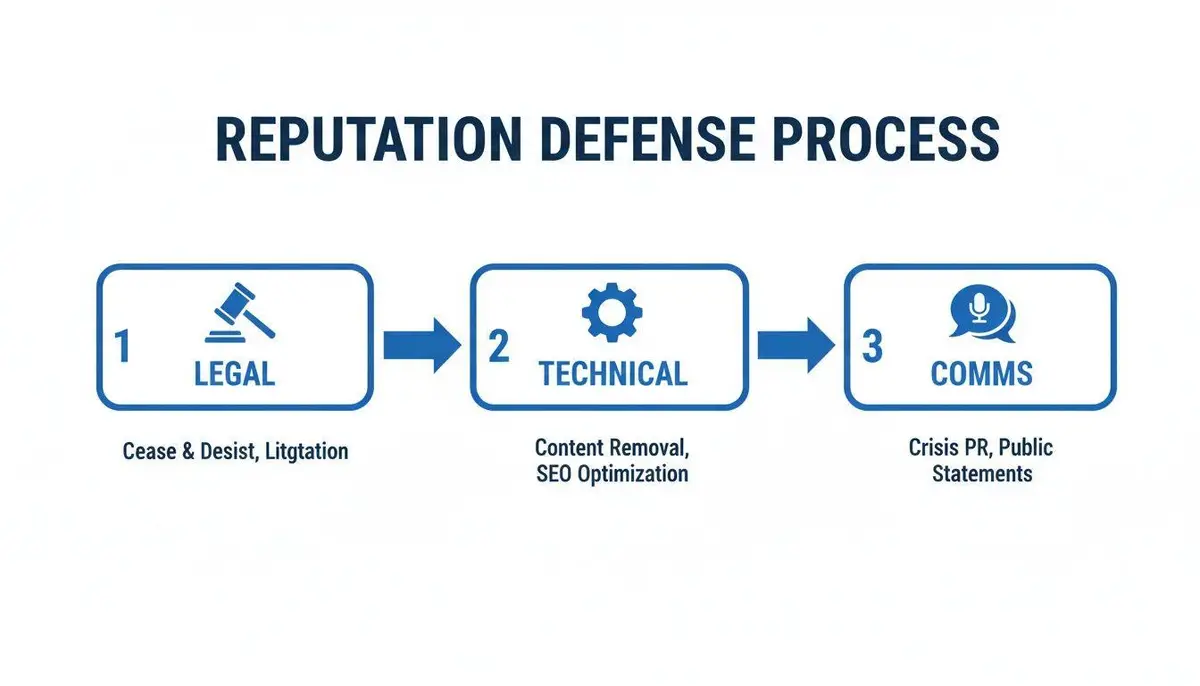
These three pillars (legal authority, technical execution, and strategic communications) must work in concert at every stage. This is not a relay race; it is a unified team effort.
Phase 1: Rapid Assessment and Triage
The first 24 to 48 hours are critical. This is not the time for action; it is the time for intelligence gathering. We must obtain a complete, unvarnished view of the threat before making a single move.
This triage involves rapidly identifying the attack vector, locating every piece of damaging content, and determining where it is hosted. We analyze the legal jurisdiction of the host websites, the anonymity of the attackers, and the immediate damage to your search results. This diagnostic work informs the entire strategy.
Phase 2: Strategic Takedown and Suppression
Once we have a complete map of the battlefield, we begin execution. This is not a blind, all-out assault. It is a targeted campaign, focusing first on the most visible and damaging content to stop the bleeding.
Our legal and technical experts work in tandem, deploying a mix of tactics:
- Source Removal: We go directly to the source. Using precise legal arguments and direct technical channels, we compel website owners and platform administrators to permanently delete the harmful material.
- Search Engine De-indexing: If the source will not cooperate, we make it invisible. We submit formal requests to Google, Bing, and other search engines to remove the content from their results. The page may still exist, but it becomes undiscoverable.
Every action is calculated for maximum impact in the minimum amount of time. You can gain a better understanding of how these tactics function by reading about how we remove unwanted online content for our clients.
Phase 3: Proactive Monitoring and Prevention
Content removal is only half the task. Determined adversaries often re-upload it, and new threats can emerge without warning. This is where we shift from a reactive to a proactive posture.
A reputation crisis demands decisive, immediate action. A single negative event can spiral, but speed is a powerful mitigator. Research shows brands responding within 48 hours are 2.5 times more likely to regain public trust, and those with a plan can reduce financial losses by up to 30%. To learn more about how speed impacts outcomes, review these findings on modern reputation risks.
We deploy advanced monitoring systems that constantly scan the web, from public sites to the deep and dark web, for your name or keywords related to the crisis. These systems send real-time alerts, enabling us to spot and neutralize new attacks or re-uploaded content before they gain an audience. It is a digital shield that ensures once a problem is solved, it stays solved.
Phase 4: Long-Term Fortification
With the immediate threat neutralized, the final phase is about making you a harder target in the future. We shift from defense to building a more resilient online presence.
This involves actively cultivating a strong, positive digital footprint that can absorb an impact. By creating and promoting authoritative content that you control, securing key online profiles, and shaping the narrative across important platforms, we build a “firewall” of positive assets. It is a long-term strategy that not only guards against future crises but also strengthens your personal brand, turning a defensive necessity into a competitive advantage.
How to Choose the Right Reputation Protection Partner
Choosing a partner to defend your name is not another vendor procurement. When you are under attack, it is one of the most critical decisions you will make. The market is saturated with traditional PR agencies and law firms, but a digital crisis demands a specialist, a team with a rare combination of legal, technical, and operational skill.
Selecting the wrong partner does not just waste money. It wastes time, your most valuable asset in a crisis, while the problem spirals out of control. You do not need an advisor; you need a tactical operator who can take immediate, decisive action. You must vet them on what truly matters.
Speed and Discretion
In a reputation crisis, the clock is your enemy. A single negative post can become viral in hours, cementing a narrative that is nearly impossible to reverse. Your partner must be capable of launching a counter-offensive within 24 to 48 hours: not weeks. Ask them directly: what does day one look like? What specific actions do you take upon engagement?
Equally vital is absolute confidentiality. This work is intensely sensitive, dealing with private corporate and personal details. A professional firm operates under ironclad NDAs and utilizes hardened security protocols. Your privacy is not a feature; it is the foundation of their entire operation.
Technical Removal Capabilities
This is what separates genuine experts from pretenders. A PR agency can help shape a story, but it cannot compel a website to remove a defamatory article. A true specialist must have proven, proprietary methods for both removing content at the source and de-indexing it from search engines like Google.
The core service you are buying is removal. Can the firm actually compel platforms to delete content, or do they just send threatening letters and hope for the best? This is the single most important question you can ask.
You must probe their methodology. Do they possess established back-channels with hosting providers and platform administrators? Do they understand the technical nuances of removing a result from Google versus Bing or DuckDuckGo? Their answers will reveal their actual capabilities.
Legal and Jurisdictional Expertise
Online attacks do not respect borders. A defamatory post may be hosted in Eastern Europe, written by an individual in Southeast Asia, and targeted at you in the United States. Your partner needs a track record of navigating this complex web of international law.
Ask them about their direct experience with:
- Cross-border Takedowns: Can they provide examples of removing content from jurisdictions with weak enforcement?
- Court Orders: How quickly can they obtain a court order that major platforms like Google will recognize and act upon?
- Copyright vs. Defamation: Do they know when to use a swift DMCA takedown notice versus a more complex defamation claim? Using the correct tool is critical.
A firm’s ability to apply the right legal pressure in the right country is often the key to success. For a deeper examination of this process, see our guide on evaluating professional content removal services.
To synthesize this, it is useful to see how these different options compare. A specialist firm is built for a different purpose than a traditional agency.
Vendor Selection Criteria Comparison
| Criteria | Specialist Removal Firm | Traditional PR Agency | Traditional Law Firm |
|---|---|---|---|
| Primary Goal | Content removal & de-indexing | Narrative management & press | Legal action & litigation |
| Speed | Action within 24-48 hours | Weeks to develop a strategy | Weeks or months to file suit |
| Core Tools | Technical exploits, platform relations, targeted legal action | Press releases, media outreach | Cease & desist letters, lawsuits |
| Jurisdiction | Global, cross-border expertise | Primarily domestic media markets | Limited by legal jurisdiction |
| Cost Model | Often fixed-fee or results-based | Monthly retainers (hourly) | Large retainers & billable hours |
As the table illustrates, attempting to solve a technical removal problem with a PR or traditional legal solution is like bringing a knife to a gunfight. They are different tools for different problems.
Results-Based Model
Finally, analyze how they charge for their work. Be wary of firms demanding large, open-ended hourly retainers with no clear end date. The best partners in this field offer results-based or fixed-fee pricing for specific outcomes.
This model aligns their goals directly with yours. They are compensated in full only when the damaging content is actually removed. Any firm confident in its ability to deliver will not hesitate to back it up with a performance-based structure.
Here are the answers to the questions we hear most often from business leaders facing a reputation crisis. When you are under attack, you need direct answers, quickly.
How Long Does It Take to Remove Negative Content?
There is no single answer. The timeline depends entirely on the type of content, its hosting location, and the applicable laws. Every situation requires a unique operational plan.
For example, a clear-cut case of copyright infringement, such as the theft of your photos or documents, can often be resolved in a few days. A DMCA takedown notice is a fast-acting legal tool to which most platforms must respond quickly.
However, a coordinated smear campaign on anonymous blogs hosted overseas is a different challenge. Unraveling that can take weeks, sometimes months. It demands a careful sequence of technical de-indexing, legal challenges, and direct negotiation. Any credible firm will provide a realistic timeline, but only after a full analysis of the problem.
Is Permanent Removal From the Internet Possible?
Yes. In many cases, we can achieve what is known as “source removal.” This is the gold standard: the harmful article, fake review, or leaked file is permanently deleted from the server where it was first posted. Once the source is gone, it is gone for good.
We accomplish this using a combination of legal leverage, such as a court order, and technical expertise to compel the website owner or hosting company to delete the content. It is the most definitive solution possible.
When the source is not immediately accessible (for instance, on an anonymous offshore site) the objective shifts to search engine de-indexing. We make the content invisible by having it removed from Google’s search results. The page may technically still exist, but if it cannot be found, its power to cause harm is effectively nullified.
The best reputation protection for business leaders is often a two-pronged attack. First, we move swiftly to de-index the content and stop the immediate damage. Then, we begin the persistent work of achieving permanent removal from the source.
Can My Internal Team Handle a Reputation Attack?
Your in-house legal and PR teams are vital for managing the company’s message and maintaining stakeholder confidence, but they are not structured for this type of conflict. A digital reputation attack is not a typical PR problem; it is a highly specialized technical and legal battle that demands a different skill set.
Your PR agency is expert at shaping the media narrative, and your general counsel knows corporate law intimately. But neither possesses the daily operational experience required to navigate the complex terms of service for hundreds of online platforms, file the precise legal orders needed, or use proprietary technology to scrub content from search engine caches.
A specialist firm does not replace your team; we become a tactical component of it. We have one mission: the surgical removal of damaging content. This frees your personnel to focus on their core functions, running the business and managing the public response, while we handle the technical and legal operations behind the scenes.
How Much Does Professional Reputation Protection Cost?
The investment is dictated by the scope and severity of the attack. Removing a single negative article will cost substantially less than combating a widespread campaign requiring legal action across multiple jurisdictions.
You should be cautious of any firm that works exclusively on an open-ended hourly retainer. That model can lead to escalating costs with no guarantee of a successful result. The most reputable specialists will offer a fixed-fee or results-based price for a clearly defined outcome.
This approach aligns our objectives perfectly with yours. You are paying for a result, the successful removal of the content, not merely for hours billed. Following a confidential review of your situation, a professional partner should provide a clear proposal outlining the exact costs tied to specific milestones. This ensures total transparency and control from the outset.
When your reputation is on the line, acting quickly and decisively is paramount. The threats are real, but so are the solutions. At ContentRemoval.com, we provide the specialized technical and legal firepower that high-profile leaders need to defend against online attacks. We operate with speed, complete discretion, and a relentless focus on achieving the objective.
If you are under attack, do not wait for the damage to escalate. Contact us for a confidential assessment and let us build a strategy to restore your name.
Frequently asked questions
Why can’t my PR agency or law firm handle an online attack on their own?
A PR agency shapes the media narrative but cannot compel a website to remove a defamatory article. A law firm can issue letters and file suits but rarely has the technical expertise or daily platform experience to erase the content or de-index it. Effective defense needs legal, technical and communications teams working in lockstep.
What is the difference between source removal and de-indexing for an executive?
Source removal deletes the article, post or image from the site hosting it, which is the definitive result. De-indexing removes the page from Google, Bing and other search engines when the host is anonymous or uncooperative, so the content still exists but cannot be found. Many matters use both: de-index first to stop the damage, then pursue removal.
How should a leader respond to a deepfake video of themselves?
Treat it as a forensic and platform matter rather than a debate. Preserve the file and every derivative link, commission analysis to prove the falsehood, and file with platforms under their manipulated media and impersonation policies while counsel assesses legal routes. Speed matters because a convincing fake can move a stock price before it is disproven.