
Elite reputation management services for executives are digital intervention, not public relations. They combine legal takedowns of defamatory, infringing or privacy-violating content, technical de-indexing that removes URLs from Google results even when the source stays live, and strategic suppression that displaces accurate but damaging coverage with authoritative content, all run under strict confidentiality with continuous monitoring afterward.
Key facts
- Source removal deletes content from the host; de-indexing leaves the page live but invisible in search results.
- Removal grounds come from defamation, copyright infringement, privacy violations or a site’s own terms of service.
- Google de-indexing arguments cite policies such as the Right to be Forgotten, non-consensual imagery or exposed financial data.
- Flagrant impersonation accounts can come down in days or weeks; contested defamation can take several months.
Where ContentRemoval.com comes in. ContentRemoval.com is a specialist of this kind: it applies legal grounds to compel removal, files de-indexing requests with search engines, removes impersonation accounts and leaked media, and keeps the matter compartmentalized under NDA so the public never learns a problem existed. Executives, family offices and their general counsel usually make first contact through a private channel. A free 15-minute Exposure Scan maps what is removable, and the report is yours to keep. Get a Free, Confidential Exposure Scan or read how our reputation management work is done.
When a damaging story, a private data leak, or a targeted smear campaign surfaces online, the consequences are immediate and severe. For an executive, this is not a public relations inconvenience; it is a direct threat to your career, personal assets, and your company’s market value. The conventional playbook, contacting a publicist or general counsel, is insufficient against a threat that moves at the speed of information. This is the operational theater for specialized reputation management services, which function less like PR and more like a digital special forces unit.
Why Specialized Reputation Management Is Non-Negotiable
For high-profile individuals and their families, a pristine online reputation is not a vanity metric. It is a hard asset that directly underpins professional credibility, facilitates investment, and maintains personal security. A single adverse search result can nullify a partnership, influence a judicial outcome, or trigger a regulatory audit. The danger is not theoretical; it carries a substantial financial cost.
The initial instinct is often to engage a PR firm. While adept at shaping narratives and securing positive press, they possess no mechanism to surgically remove harmful content. Similarly, a legal team, however formidable in a courtroom, operates on a timeline of litigation, an eternity in the digital realm where a crisis can disseminate globally within minutes.
The Inadequacy of Conventional Solutions
Traditional methods fail because they are not engineered for the internet’s architecture. A publicist cannot compel a hostile blogger to retract a post. A lawsuit will not force Google to de-index a defamatory article overnight. These approaches lack the requisite technical and platform-level expertise to resolve the core problem.
This creates a dangerous operational gap. While your traditional advisors debate strategy, the damaging content remains live, accumulating views, shares, and backlinks. The problem becomes exponentially more entrenched with each passing hour.
Specialized reputation management firms operate within that gap. They integrate legal tactics, technical proficiency, and direct platform negotiations to neutralize threats at their source. This is not about “managing an image.” It is about re-establishing control over your digital footprint to protect what you have built. The market’s projected expansion to USD 14.01 billion by 2035 confirms that global leaders now recognize this as an essential cost of conducting business.
The New Standard for Digital Defense
A material digital crisis for an executive involves content that places your capital, safety, or career in jeopardy. An effective countermeasure requires a service capable of executing specific actions:
- Leveraging legal grounds to compel the removal of defamatory or copyright-infringing material.
- Operating on a technical level to de-index damaging URLs from search engine results.
- Suppressing negative information by strategically promoting authoritative, positive content.
This is a synthesis of digital forensics and tactical operations. The work is precise, demanding a granular understanding of internet law, search algorithms, and the dynamic policies of Google, news aggregators, and social media platforms. For any executive facing such pressure, recognizing the need for this specialized capability is the first and most critical step. Our detailed analysis in online reputation management for executives provides further context.
Understanding Your Arsenal of Digital Defenses
When confronting a digital attack, you must know the specific tools available in your defensive arsenal. The term “reputation management services” is not a monolith; it describes a set of precise interventions, each designed to neutralize a particular class of online threat. Misapplication is counterproductive, akin to using a sledgehammer where a scalpel is required.
Effective defense is a function of precision, deploying the right solution for the specific problem. This is not a broad PR campaign. It is a targeted operation that must begin with a comprehensive threat assessment, which is why a modern search engine for people is a crucial first step in mapping an executive’s public-facing digital footprint.
The diagram below illustrates how PR, legal, and specialized reputation management teams integrate to shield an executive’s digital presence.
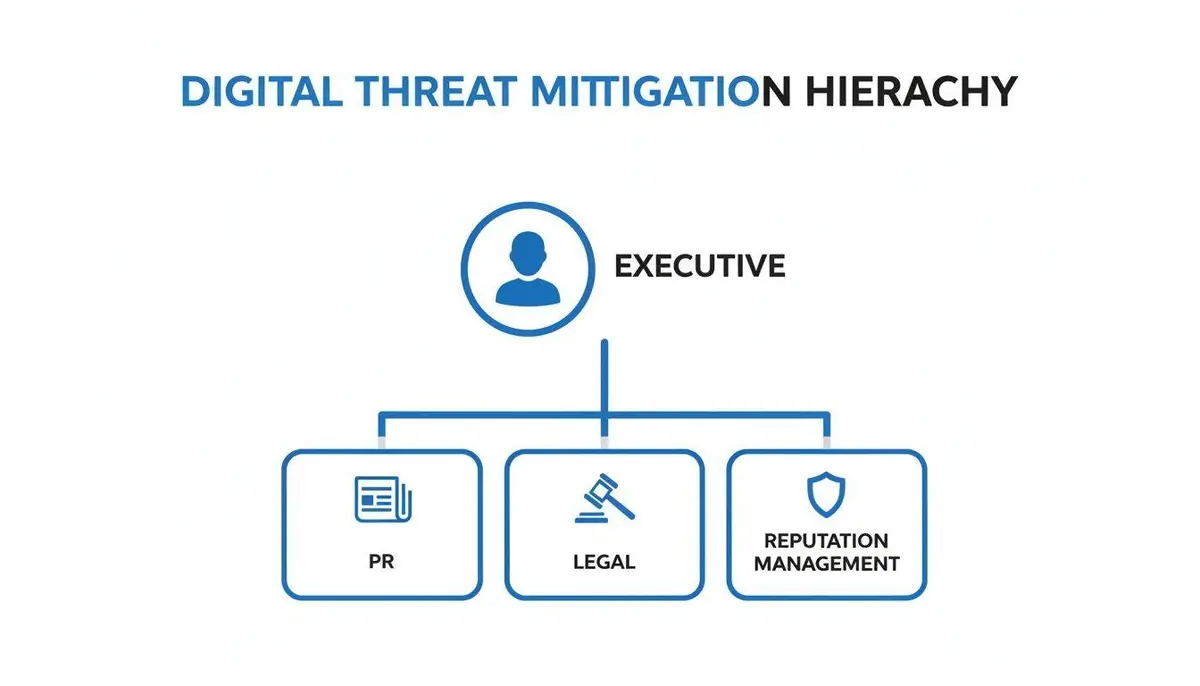
While your legal and PR teams are critical strategic advisors, the reputation management specialists are the operational unit executing direct digital actions.
Content Removal vs. De-Indexing: A Critical Distinction
A primary point of confusion lies in the methods for making content “disappear.” There are two fundamentally different approaches: Source Removal and De-Indexing. Both render unwanted content invisible to the public, but their mechanisms are entirely distinct.
Source Removal is the definitive solution. It means the hostile content (the article, post, or image) is permanently deleted from the host server. It ceases to exist online. This is the objective when a strong legal basis exists, such as a clear instance of defamation, copyright violation, or a breach of a website’s terms of service.
De-Indexing is a more common and often more practical remedy. The content itself remains on the source website, but we instruct search engines like Google to remove the URL from their search results. Although the page still exists, it becomes undiscoverable via search. This effectively renders it invisible to 99% of the public. De-indexing is a powerful tool for addressing content that does not meet the strict legal threshold for removal, such as a factually accurate but outdated negative news story.
The choice between source removal and de-indexing is purely strategic. It is a calculated decision based on the nature of the content, the identity of the publisher, the legal jurisdiction, and the real-world probability of success.
Targeted Solutions for Specific Threats
Beyond removal, a complete defensive arsenal includes several other specialized services. These are precise remedies for distinct digital threats. The following matrix delineates common threats and their corresponding solutions.
Reputation Management Service Matrix: Problem vs. Solution
| Threat Scenario | Primary Service Solution | Objective | Typical Approach |
|---|---|---|---|
| A defamatory blog post with false claims is ranking high on Google. | Defamation Takedown | Get the false content removed from the source website. | Legal demands to the publisher/host based on libel laws; court orders. |
| Private photos or confidential documents have been published without consent. | Leaked Media Remediation | Rapid, widespread removal of the content from all platforms. | DMCA copyright claims, right-to-privacy arguments, platform reporting. |
| An old, negative news story is the first result for your name. | Strategic News Suppression | Push the negative article down in search results so it’s not seen. | Creating and promoting high-quality positive content to outrank the negative. |
| Someone is using your name and photo to create a fake social media profile. | Impersonation Removal | Remove the fake account and reclaim your identity. | Direct reporting to the platform’s impersonation/identity teams. |
| A negative article on a foreign news site is causing damage but is hard to remove. | De-Indexing | Make the article impossible to find via search engines like Google. | Technical and legal requests submitted directly to the search engine. |
| Dozens of fake, one-star reviews are tanking a product or business rating. | Review Remediation | Identify and remove fraudulent reviews from platforms like Google or Trustpilot. | Analyzing review patterns and reporting violations of platform policies. |
This matrix shows that for every specific digital threat, a specialized operational response is required. Success depends on correctly diagnosing the problem and applying the right tool from the outset.
A Closer Look at Key Services
Demand for these services is accelerating. While the retail sector currently constitutes 24.20% of the market, healthcare is the fastest-growing segment with an 18.82% CAGR, driven by the profound impact of online patient reviews.
Here are a few of the most critical services in greater detail:
- Defamation Takedowns: This is a legally intensive process. It involves constructing a watertight case demonstrating that a statement is not only false but has also caused tangible harm. This argument is then presented to the publisher, their hosting company, or, if necessary, brought before a court.
- Leaked Media Remediation: When private photographs, videos, or documents are exposed, speed is paramount. The objective is swift and comprehensive takedown. A combination of copyright claims (DMCA), right-to-privacy arguments, and platform-specific policies against non-consensual content is deployed to erase it from websites and search results.
- Strategic News Suppression: For negative press that is factually accurate, legal removal is not an option. However, it does not have to define your digital narrative. Suppression ensures it does not dominate search results. By creating and promoting a high volume of positive, authoritative content, we systematically displace the negative article until it is relegated pages deep in search results.
Understanding these distinctions is the foundation of building a resilient defense. Each service is a deliberate, calculated action designed to neutralize a specific threat and restore control over your digital identity.
How We Make Negative Content Disappear
Knowing what tools are available is one thing; knowing how to deploy them is another. Eliminating damaging online content is not a simple request. It is a sophisticated process that integrates legal strategy, technical execution, and direct negotiation with platforms. The process is less like sending an email and more like litigating a case, where every action is deliberate and aimed at a specific outcome.

Ultimately, every strategy falls into one of two categories: Content Removal or Content Suppression. Both aim to cleanse online search results, but they operate through fundamentally different mechanisms and are applied to distinct problems.
Forcing Removal at the Source
The cleanest, most permanent solution is deleting the content from the website where it was published. This requires compelling a news outlet, blogger, or review site to remove it permanently. This is not accomplished by polite requests. It is achieved by applying leverage.
That leverage is almost always legal. The process begins by scrutinizing the harmful content to identify a specific, actionable violation. In our experience, these typically fall into several key categories:
- Defamation: The content makes a false statement of fact (not opinion) that has demonstrably damaged a reputation.
- Copyright Infringement: An entity has used proprietary photos, videos, or written material without permission. The DMCA and related statutes provide a powerful enforcement mechanism.
- Privacy Violations: The publication includes private, sensitive information that constitutes doxing, harassment, or a clear breach of a platform’s own policies.
- Terms of Service Violations: Frequently, the most direct path to removal is demonstrating that the content violates the publisher’s own site policies, giving them a clear incentive to remove it without a legal battle.
Once a solid legal argument is established, a formal demand letter is served to the site owner and their hosting company. If they fail to comply, a court order may be the next step. It is a precise, evidence-driven campaign that hinges on a deep understanding of internet law.
The Power of Search Engine De-Indexing
What happens when source content cannot be removed? This is common with legitimate news articles from major publishers. They may be damaging, but they are not illegal. In these instances, the strategic focus shifts to de-indexing.
De-indexing does not alter the original article. It instructs search engines like Google to remove the page from their search results. Consequently, the content becomes invisible to the 99% of people who would have discovered it via search.
The page continues to exist, but if no one can find it, it is neutralized. This is achieved by submitting a detailed legal request directly to the search engine, arguing that the content violates one of their specific policies, such as the “Right to be Forgotten” in Europe, rules against non-consensual explicit imagery, or the exposure of sensitive financial or medical data. Success depends on framing the argument to meet the narrow criteria used by Google’s legal team for these evaluations.
For a granular breakdown of this process, our guide on how to remove negative content from Google search provides further detail.
The Digital Physics of Suppression
When content can neither be removed nor de-indexed, the final strategy is suppression. This is the practice of outranking the problem. It is not a public relations exercise; it is a technical discipline rooted in the fundamental principles of search algorithms. The objective is to bury the negative result so deep in search rankings that it becomes effectively undiscoverable.
This is a long-term strategy involving the creation and promotion of a wave of positive, authoritative content that displaces the negative item from the first page of search results. The methodology is as follows:
- Develop Positive Assets: We create a portfolio of high-quality content (executive biographies, interviews, professional profiles, and positive articles) all optimized to rank for your name.
- Publish on Authoritative Sites: These assets are placed on websites that search engines already trust, such as reputable business journals, industry-specific publications, and optimized personal websites or social media profiles.
- Build Authority and Promote: We then build the credibility of these new, positive pages by acquiring high-quality backlinks and social media signals. This signals to Google that these new pages are more important and relevant than the old, negative one.
Over time, this positive content ascends in the rankings, systematically pushing the negative link down to the second, third, or fourth page of Google. Since the vast majority of users never click past the first page, the problem is neutralized. It is a strategic investment in reclaiming control of your digital narrative.
How to Select an Elite Reputation Management Firm
When protecting your reputation, there is no margin for error. Selecting the wrong firm to manage a crisis will not only leave the original problem unresolved. It can substantially worsen the situation. A botched attempt can attract more attention to the negative content and create new complications that make a real solution more difficult to achieve.
This is why you cannot engage a general marketing agency. You must be exceptionally deliberate in identifying a true specialist. The analogy is apt: you would not ask a general practitioner to perform complex neurosurgery. Likewise, you cannot expect a standard PR or digital marketing agency to handle the intricate legal and technical work of content removal or suppression. While many firms offer “reputation management,” they rarely possess the specialized skills required for high-stakes scenarios.
Vetting Core Competencies and Experience
The first step is to penetrate the marketing language and assess what a firm can actually do. An elite team will be fluent in the languages of law, technology, and platform policies. Your role is to test that fluency with direct, incisive questions. Vague or evasive answers are a significant red flag.
Demand proof. While any legitimate firm will protect client confidentiality, they must be able to share anonymized case studies that mirror your situation. If you are dealing with a false narrative on a news site, they should be able to articulate a similar case: the strategy employed, the duration, and the final outcome.
Your questions must be specific and technical. Do not hesitate to probe.
- Legal Expertise: What legal frameworks do you primarily use for takedowns: defamation, copyright, privacy torts? Do you have in-house counsel or a retained law firm specializing in internet law?
- Technical Proficiency: Describe your process for securing de-indexing from Google. When executing a suppression campaign, what technical measures do you take to build and rank positive assets?
- Platform Relationships: Describe your experience engaging with the legal departments at Google, major news publishers, or specific social media platforms.
The objective is to move beyond generic assurances like “we’ll clean up your image.” You are retaining a specialized team for what is effectively a surgical operation. They must prove mastery of the requisite tools and tactics.
Understanding Engagement Structures and Timelines
True reputation management services are not a low-cost commodity, and the pricing structure should reflect the intensity of the work. Be wary of firms offering standardized packages or promising instantaneous results. This is not how this discipline works.
Most high-level engagements are structured in one of two ways:
- Project-Based Fees or Monthly Retainers: This is standard for complex, ongoing work like a news suppression campaign or a contested legal action. The fee covers the sustained effort of a dedicated team.
- Success-Based Fees: For more clear-cut removal cases, some firms work on contingency. You pay only upon successful takedown of the content. This model is advantageous as it perfectly aligns the firm’s interests with yours.
No credible firm will ever guarantee a specific outcome or timeline before conducting a thorough analysis of your case. They will, however, provide a clear, transparent plan of action with estimated timelines for each phase following an initial assessment. For a deeper look at what to ask, our guide on how to choose an online reputation management company offers more key questions.
The Critical Role of Operational Security
For any high-profile individual, confidentiality is not a feature. It is a core requirement. Your vetting process must stress-test a firm’s security protocols and discretion.
Ask directly how they will protect your identity and the sensitive details of your case. How are communications secured? What NDAs are their team members subject to? What is their policy on using client engagements in their own marketing?
A firm that genuinely values discretion will provide immediate, clear, and reassuring answers. Anything less is a risk you cannot afford. In a reputation crisis, selecting your partner is the single most important decision you will make. A methodical, critical eye is your best defense.
Ensuring Confidentiality and Long-Term Protection
When confronting a reputation crisis, confidentiality is absolute. The information involved is often intensely personal, financial, and professional. A leak or a procedural error does not just create a setback; it can ignite a new and often worse crisis.
This is precisely why such work cannot be entrusted to non-specialists. True discretion must be engineered into every step of the process, from the initial consultation to the final report. This requires the use of encrypted communication, strict compartmentalization of case details, and ironclad legal agreements binding every team member.

The Risks of Inexpert Action
One of the greatest threats to your privacy is an amateur. A poorly executed removal attempt can easily backfire, triggering the Streisand Effect: where the act of trying to conceal something only amplifies its dissemination.
Consider a heavy-handed legal letter sent to a blogger. Instead of removing the post, they publish your threat, and a minor issue becomes a viral story about an attempt to silence criticism. Such a miscalculation is unaffordable. Every action must be precise, carried out by specialists who understand the second- and third-order effects of their actions and know when to apply pressure versus when a quiet, subtle approach is optimal.
A core tenet of elite reputation management is that the best work is invisible. The objective is to resolve the problem so discreetly that the public never knows a problem existed. This requires a level of finesse that generalist agencies do not possess.
To formalize these protections, strong legal agreements are non-negotiable. Utilizing an NDA template with all involved parties is a foundational first step, establishing a clear legal expectation of privacy from the outset.
Beyond the Takedown: Long-Term Strategic Protection
Removing a single negative article is one battle in a larger war. Your online presence is a dynamic entity, not a static file. New threats can emerge at any time, from any source: a disgruntled former employee, a competitor’s smear campaign, or an unforeseen data breach.
This is why effective reputation management is not a one-time fix. It is an ongoing strategic function, analogous to a cybersecurity detail for your personal brand. The objective rapidly evolves from reactive cleanup to proactive, long-term defense. This is achieved through a combination of relentless monitoring and the fortification of your digital foundation.
The Role of Continuous AI-Driven Monitoring
Modern defensive strategies rely on sophisticated, AI-driven monitoring systems that serve as 24/7 digital sentinels. These tools perpetually scan the entire web (surface, deep, and dark) for any mention of your name, your company, or other designated keywords.
- Surface Web Monitoring: This covers all publicly accessible information on Google, including news sites, blogs, forums, and major social media platforms, providing real-time alerts upon any mention.
- Deep Web Monitoring: This extends into private databases, court record aggregators, and other sources not indexed by search engines, helping to identify threats before they become public.
- Dark Web Monitoring: This is critical for detecting the most dangerous risks, such as the sale of personal credentials, compromised financial data, or malicious chatter on criminal forums.
This constant stream of intelligence allows your team to identify and evaluate new threats instantly. Instead of discovering a problem after the damage is done, you are alerted the moment it appears. This enables a swift, surgical response to neutralize the threat while it is still small and manageable, transforming reputation management from a reactive emergency service into an essential insurance policy for your digital life.
Critical Questions for Executives and Legal Counsel
When your reputation is under attack online, you and your legal team require immediate and precise answers. There is no time for theoretical discussions. You need to know what is possible, the associated costs, and the expected timeline to make informed decisions under pressure.
Here are direct answers to the most critical questions we receive from clients in high-stakes situations.
Can You Permanently Remove a Negative News Article or Court Document?
The answer is nuanced. Achieving permanent deletion of content from the source website is the gold standard, and we can accomplish this in specific scenarios. If we can prove the material is defamatory, violates copyright, or breaches certain privacy laws, a strong legal basis exists to compel the publisher to remove it.
However, for content that is factually accurate but damaging, such as an old news story about a settled lawsuit, a legal takedown is not viable. Here, the strategy pivots to de-indexing. We work directly with search engines like Google to remove the link from their results. To the public, it is effectively gone. If an individual cannot find it by searching your name, it might as well not exist. For most clients, successful de-indexing delivers the same practical outcome as full removal.
The right approach (source removal, de-indexing, or suppression) is not a one-size-fits-all solution. It is a strategic decision made after a thorough, confidential analysis of the content, the publisher, the legal jurisdiction, and the probability of success for each path.
How Long Does the Reputation Management Process Take?
Anyone who promises an instant fix is not being truthful. The timeline is dictated entirely by the specifics of your case and the chosen strategy.
Certain actions can be executed quickly. A clear-cut impersonation account on social media, for example, typically violates platform terms of service so flagrantly that we can secure its removal within days or weeks.
More complex situations, however, demand patience and sustained effort.
- Contested Defamation: If we are litigating against a well-funded publisher who contests a defamation claim, resolution through legal channels can take several months.
- Search Engine Suppression: This is a long-term strategic campaign. While initial positive shifts in search results can often be observed within 90 days, achieving stable, dominant control over the first page of Google typically requires 3 to 6 months of consistent work, and sometimes longer.
A credible firm will not provide a generic timeline. We deliver a clear, phased plan with realistic milestones based on a deep analysis of your unique circumstances.
What Is the Difference Between Your Services and a Traditional PR Firm?
The distinction is fundamental. A public relations firm is an expert in shaping narratives and managing public perception. They are masters of communication, crafting press releases and handling media outreach.
We, conversely, are specialists in digital intervention. Our function is not to discuss the problem; it is to eliminate it. We employ a combination of legal and technical tactics to directly remove, de-index, or suppress harmful content.
Consider this analogy: if your company faces a crisis, your PR agency is essential for managing public-facing communications. They are not, however, equipped to file a de-indexing petition with Google’s legal department or execute a technical campaign to suppress a negative article. We handle the digital threat at its source; they manage the public conversation around it.
How Do You Ensure My Confidentiality Throughout the Process?
For our clientele, privacy is a non-negotiable requirement. Our entire operational structure is designed from the ground up to provide the absolute discretion that executives, public figures, and high-net-worth families demand.
From the initial contact, all communications are routed through secure, encrypted channels. Every engagement is protected by a robust Non-Disclosure Agreement (NDA), and we internally compartmentalize case details so that information is shared strictly on a need-to-know basis.
You will never see us promote our work by naming clients. We are not a typical agency that leverages “success stories” in its marketing. Our reputation is built on silence. We demonstrate our track record during private consultations using anonymized case studies, never by revealing the identities of those we protect. For us, success means resolving a problem so quietly that no one ever knew it existed in the first place.
When your reputation is on the line, you need a partner with the expertise and discretion to act decisively. The team at ContentRemoval.com specializes in surgically removing damaging content and protecting the digital reputations of the world’s most successful individuals and brands. To discuss your situation in complete confidence, schedule a confidential assessment.
Frequently asked questions
What is the difference between a reputation management firm and a PR agency?
A PR agency shapes narratives and manages public perception through press releases and media outreach. A reputation management specialist removes, de-indexes or suppresses the harmful content itself using legal and technical tactics. PR manages the conversation around the problem; the specialist eliminates the problem at its source.
Can an old negative news article be removed from search results?
If the article is factually accurate, a legal takedown is not viable, so the strategy pivots to de-indexing or suppression. De-indexing asks Google to drop the URL from results under a specific policy, while suppression builds and promotes authoritative positive content until the article falls to later pages. For most clients, that delivers the same practical outcome as removal.
How do I vet a reputation management firm?
Ask which legal frameworks they use for takedowns, whether they have internet law counsel, how they secure de-indexing from Google, and what experience they have with platform legal departments. Request anonymized case studies that mirror your situation, and stress-test their confidentiality: encrypted communications, NDAs for every team member, and no marketing use of client engagements.