
Reputation management for celebrities is asset protection rather than publicity. It combines proactive shielding through a full archive audit, privacy controls and monitoring, a remediation playbook that matches source takedown, search de-indexing or suppression to the content type, and real-time crisis communications built around verification, one holding statement and a designated verifier for deepfakes and manipulated audio.
Key facts
- Four threat classes matter: digital defamation, data exposure, disinformation campaigns and AI-generated abuse such as deepfakes.
- One industry guide recommends a 10-year social media audit, then quarterly reviews of the full digital footprint.
- True, journalistic coverage usually calls for narrative rebalancing rather than removal attempts that fail or backfire.
- In the first six hours, appoint one fact gatherer and one approver, then speak once on one owned channel.
Where ContentRemoval.com comes in. ContentRemoval.com works alongside a public figure’s manager, publicist and counsel to handle the parts of a crisis that statements cannot: source takedowns of false or invasive material, impersonation and deepfake reporting, search de-indexing and reupload monitoring. Contact typically comes from the manager, the agent or the client’s lawyer. A free 15-minute Exposure Scan maps what is removable across search and social, and the report is yours to keep. Get a Free, Confidential Exposure Scan or read how our reputation management work is done.
A producer calls at 6:10 a.m. A clip is circulating. Your name is attached to it. Your manager says it’s already in search, fans are arguing in comments, a brand partner is asking for clarification, and nobody in your camp can yet confirm whether the audio is real. That’s the actual operating environment for public figures now. Not a neat PR problem. A live digital risk event.
Most celebrities still approach reputation like publicity with better styling. That’s a mistake. Reputation management for celebrities is asset protection. It sits next to legal strategy, platform enforcement, search control, and communications discipline. If your team treats it as occasional cleanup after a bad headline, you’re already late.
The New Rules of Fame and Digital Permanence
Celebrity reputation used to be shaped by cycles. A scandal landed, a publicist responded, a new project arrived, and the news moved on. That model is dead because the internet doesn’t forget, and search turns every old statement, interview, and clip into a permanent retrieval system.
The risk isn’t only what people say about you today. It’s what anyone can surface from your archive tomorrow. A joke from years ago, a half-formed interview answer, an old association, a repost, a deleted caption preserved in screenshots. Public memory is now indexed memory.
That’s why this isn’t a soft communications function anymore. It has become a budgeted economic category. Independent market data estimated the global online reputation management market at about $175 million in 2022 and projected $585 million by 2030, while also stating that a company’s reputation can account for 63% of its market value in the same analysis, which helps explain why public figures and their teams increasingly treat digital reputation as a high-value asset tied to earning power and access (reputation management market data).
Why fame now behaves like an archive problem
A celebrity’s reputation is no longer defined only by current press coverage. It’s defined by what appears when a journalist, sponsor, casting director, investor, litigant, or hostile anonymous account searches your name. Search results create first impressions at scale. They also freeze context out of the story.
That changes the operating standard. You need a durable record of who you are online, not a string of reactive statements.
Public figures don’t lose control in one dramatic moment. They lose it when old material, new allegations, platform algorithms, and third-party commentary start reinforcing each other.
What this means in practice
The practical consequence is simple. Every public figure needs a standing reputation function, not a crisis-only vendor list.
A disciplined team should treat the following as business infrastructure:
- Search visibility control so official and accurate material occupies core name queries.
- Platform enforcement readiness so impersonation, leaks, and false claims can be challenged fast.
- Message discipline so every public response fits a long-term positioning strategy.
- Archive awareness so old content doesn’t surprise your own team before it surprises the public.
If you earn from attention, endorsements, licensing, audience trust, or institutional relationships, your digital record is part of the asset.
The Modern Threat Landscape for Public Figures
The threat surface is wider than gossip, paparazzi shots, or a hostile article. Public figures now face coordinated narrative attacks, search manipulation, data exposure, and synthetic media abuse. Some attacks are crude. Others are technically competent and designed to spread faster than verification.
This is the current map.
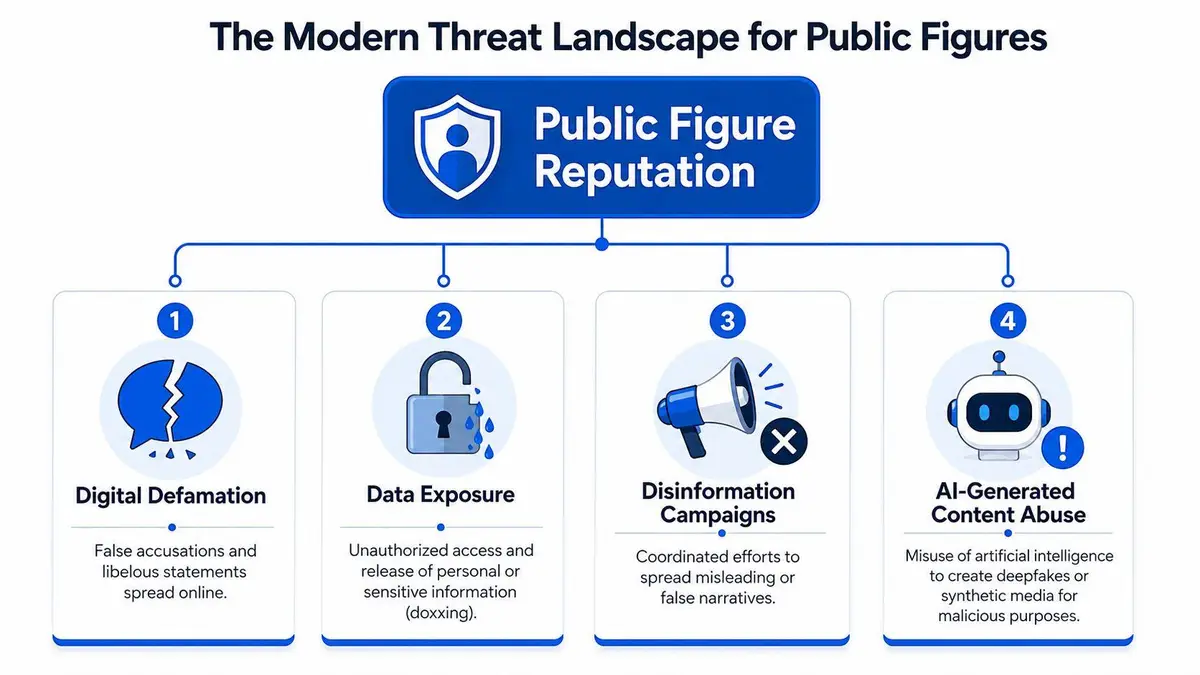
Four attack classes that matter
Not all reputational threats require the same response. Treating them as one bucket produces bad decisions.
| Threat type | What it looks like | Primary risk |
|---|---|---|
| Digital defamation | False accusations on blogs, forums, videos, or social accounts | Search persistence and reputational contamination |
| Data exposure | Leaked private details, contact information, location data, or personal files | Safety, extortion pressure, and follow-on abuse |
| Disinformation campaigns | Coordinated rumor spread, clipped context, fake “receipts,” networked posting | Narrative capture and audience confusion |
| AI-generated abuse | Deepfakes, cloned voice notes, synthetic video, fake account content | Authenticity collapse |
The last category is where generic PR advice fails fastest. Celebrity reputation management must now account for AI-generated impersonation. In 2024, the U.S. Federal Trade Commission warned that AI impersonation is being used in scams, and Europol has highlighted deepfakes as a growing fraud and identity-risk vector, which shifts the challenge from responding to bad press to disproving forged material before it hardens into accepted fact (AI impersonation risk for celebrities).
Why AI changes the speed of the problem
A false article can be denied. A deepfake can feel self-authenticating to the audience. People trust what looks or sounds familiar, especially when the clip confirms what they already suspect or want to believe.
That means your team can’t rely on traditional sequencing. The old order was detect, discuss, draft, approve, then speak. In an AI-driven incident, that pace loses. You need technical verification, platform reporting, legal review, and communications coordination moving at the same time.
One useful operational layer is sentiment tracking. Teams comparing monitoring platforms can use MicroPoster’s guide to sentiment tools to understand which systems are better for volume detection, alerting, and trend interpretation. The right tool won’t solve the problem by itself, but it will tell you whether a spike is isolated chatter or the start of a reputational event.
If your team can’t separate a manipulated clip, a coordinated rumor burst, and a genuine press inquiry within minutes, your response process is underbuilt.
The hidden danger of online archaeology
A second class of threat isn’t synthetic. It’s archival. Adversaries now search old posts, interviews, and public interactions looking for fragments they can detach from context and weaponize. That work is systematic. It often starts before a product launch, a casting announcement, an award campaign, a legal filing, or a political endorsement.
That’s why reputation management for celebrities has to cover both invention and retrieval. Some attacks fabricate. Others excavate.
Proactive Reputation Shielding and Digital Control
The strongest reputation work happens before an incident. Once a false story is indexed or a leak is mirrored across platforms, your choices narrow. Prevention is cheaper, quieter, and far more effective than cleanup.
A workable defense has three parts. Privacy controls, brand discipline, and monitoring. Leave out any one of them and the system weakens.
Start with the archive
A foundational milestone in celebrity reputation management is the shift to continuous digital monitoring. One industry guide recommends reviewing a public figure’s full digital footprint every quarter, with a 10-year social media audit as the immediate first step, so reputation is managed as an ongoing risk-control process rather than occasional PR maintenance (quarterly digital footprint review guidance).
That recommendation is sound. Most celebrity teams know the recent past. Few know the full searchable past.
Review the archive in layers:
- Owned accounts. Old posts, captions, likes, follows, tagged photos, abandoned channels, and forgotten bios.
- Third-party media. Interviews, podcast appearances, event footage, fan uploads, and quote aggregators.
- Associative exposure. Past partnerships, affiliations, co-appearances, and references that may read differently now.
You’re not looking only for scandal. You’re looking for ambiguity, inconsistency, and material that a hostile editor could crop into a different story.
Separate search from social
Search and social are not the same battlefield. Search shapes what people find when they deliberately look for you. Social shapes how quickly a rumor moves before anyone verifies it.
Your operating model should reflect that split. For search, build and maintain strong official assets, current biographies, controlled media pages, and authoritative content that accurately defines your identity and work. For social, set alert thresholds, escalation rules, impersonation reporting procedures, and internal approval discipline.
A useful external perspective on this broader defensive mindset appears in Carlos Alba Media’s guide for protecting your business online. It’s business-focused, but the underlying principle applies directly to public figures. Control what you can before someone else fills the vacuum.
Build a monitoring system that your team will actually use
Monitoring fails when it becomes noise. Your team doesn’t need endless alerts. It needs triage.
Use a system that distinguishes between background chatter and actionable risk. Track core name queries, common misspellings, project titles, known hostile narratives, impersonation indicators, and high-risk forums or channels. Then assign ownership. Someone has to decide whether an item is legal, technical, communications, or all three.
For ongoing oversight, a dedicated reputation monitoring program gives teams a standing view across search and social instead of forcing them to scramble after a crisis breaks.
Practical rule: If nobody on your team is accountable for the archive, the search page, and the alert queue, then nobody is protecting your reputation in a serious way.
The Remediation Playbook for Damaging Content
When harmful material appears, the first question isn’t “How do we get rid of this?” It’s “What exactly is this, where is it hosted, and which remedy fits?” Bad decisions at this stage waste time and often make the content more visible.
A takedown request, a de-indexing request, and a suppression campaign are different tools. Use the wrong one and you either fail or create unnecessary attention.
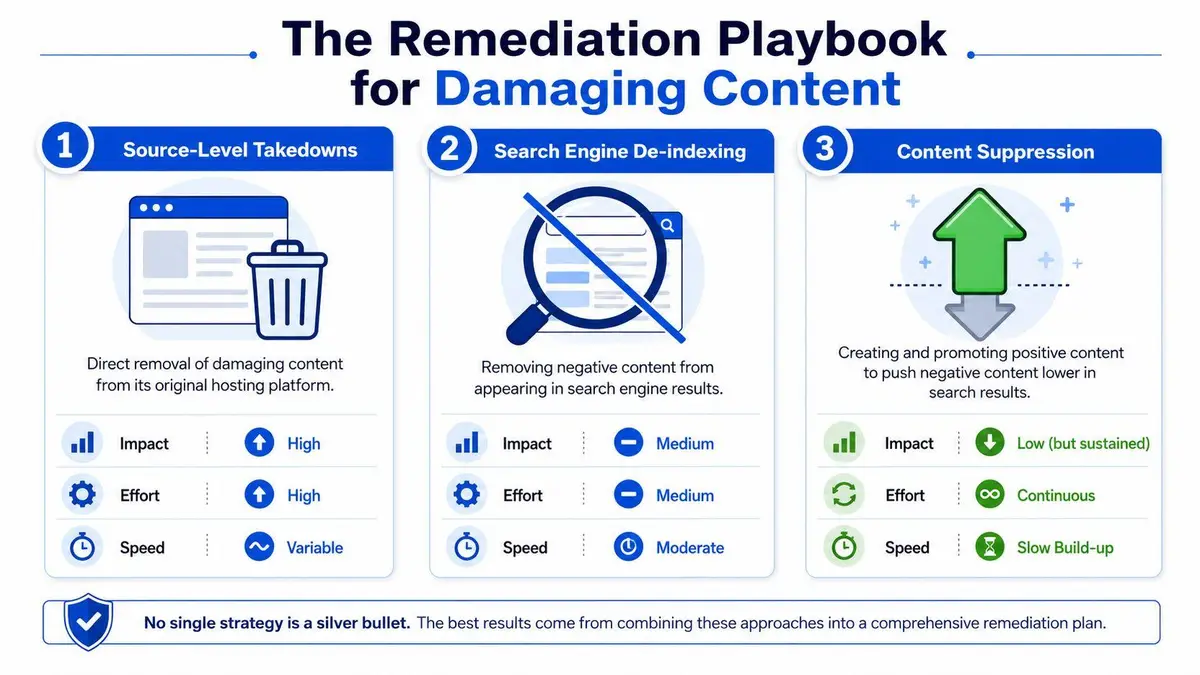
Match the remedy to the content type
Here’s the clean comparison your team should use.
| Strategy | Best used when | Limitation |
|---|---|---|
| Source-level takedown | The content violates law, platform rules, copyright, privacy standards, or site terms | Requires leverage and evidence. Some hosts resist or ignore requests |
| Search engine de-indexing | The content remains online but can potentially be reduced in search visibility | It doesn’t remove the underlying page |
| Content suppression | Accurate, non-removable, or legacy material needs to be displaced over time | Slow. Requires sustained publishing and optimization |
Source-level action is always the first serious question. If the material is false, invasive, non-consensual, pirated, impersonating, or unlawfully exposed, go to the host or platform first. Remove the source and you stop the spread at origin.
If the source remains but search visibility can be challenged, de-indexing becomes relevant. That’s a search result remedy, not a truth remedy. It matters because most reputational damage starts with discoverability.
Suppression is different again. It means building and promoting stronger, accurate content so harmful but non-removable results lose prominence over time. That’s a long game. It works best when tied to a coherent public identity, not random positive fluff.
For cases involving webpages, images, videos, impersonation, or persistent search results, firms offering online content removal services can handle the technical and procedural side of source removal and de-indexing workflows.
When the material is true
This is the part most agencies avoid because it ruins the fantasy that everything can be made to disappear.
A critical gap in standard advice is what to do when the negative material is true and journalistic. Public interest reporting often remains visible, and the smarter strategy may be narrative rebalancing and long-term credibility repair rather than removal attempts that fail or backfire (guidance on true but harmful coverage).
That requires maturity. If the article is accurate, recent, and published by a high-authority outlet, don’t lead with threats you can’t enforce. You will lose, and you may produce a second story about trying to bury the first one.
Use a different framework instead:
- Check legal boundaries. Accuracy doesn’t eliminate privacy questions, contextual errors, unauthorized images, or republication problems.
- Reduce secondary spread. Challenge false summaries, misleading reposts, fake quote cards, and copycat blog versions.
- Rebalance the record. Increase publication of credible, current, on-message material that reflects the total person and not only the incident.
- Demonstrate change where relevant. Silence may be correct in some cases. In others, the only durable remedy is visible corrective conduct over time.
“Can it be removed?” is often the wrong first question. Ask whether removal, de-indexing, correction, or rebalancing is the strategy that actually improves your position.
Don’t trigger the Streisand effect by accident
Public figures create self-inflicted damage when they overreact to low-authority content, argue publicly with anonymous posters, or launch weak legal threats against mainstream reporting. Escalation should be selective.
A disciplined response prioritizes origin, authority, reach, and search impact. A random post with no traction may warrant quiet monitoring. A fabricated allegation on a site that ranks for your name is different. So is a synthetic clip spreading across fan accounts while sponsors call your manager.
Executing Crisis Communications in Real Time
The first forty-eight hours decide whether you look controlled or cornered. Organizations often falter when they confuse speed with noise. They issue too many statements, to too many audiences, before they know the facts.
A better approach is structured and narrow. Verify, centralize, speak once, then update only when the update changes the story.
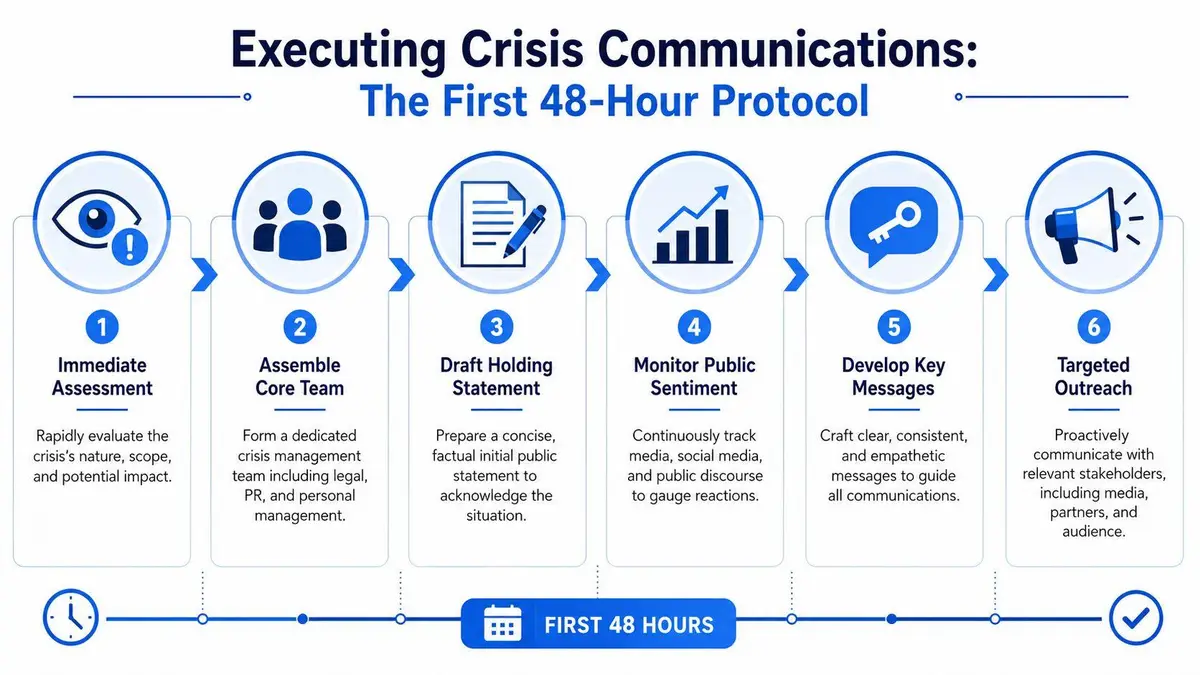
The first six hours
At the start of a crisis, appoint one person to gather facts and one person to approve outward communications. If five people are freelancing responses by text, DM, and email, you don’t have a strategy. You have contamination.
For visible public figures, search engine reputation management and social monitoring are separate control surfaces. The practical benchmark is continuous monitoring plus rapid response only to influential mentions, because source-level correction is more effective than chasing every post after it has already spread (guidance on SERM and social monitoring).
That distinction should shape your first moves. If the issue is social velocity, identify the accounts, clips, and posts that are driving amplification. If the issue is search contamination, identify what has already indexed and what authoritative sources are attaching your name to the event.
The holding statement and the source of truth
A holding statement should do one job. Stabilize the situation without speculating. If authenticity is in dispute, say that verification is underway. If facts are known, state only those facts. Don’t explain your feelings in the first wave. Don’t litigate the entire story in public comments.
Use one owned channel as the reference point. That may be a verified Instagram account, a website statement page, or another official platform your audience recognizes. Every inquiry should route back there.
A sound rapid-response sequence looks like this:
- Confirm authenticity before rebutting or apologizing.
- Freeze nonessential posting across personal and team-managed channels.
- Issue one concise statement on the designated official channel.
- Brief private stakeholders such as agents, counsel, sponsors, and key partners before they learn your position from social chatter.
- Correct influential falsehoods at source, not in endless reply threads.
The designated verifier
Deepfakes and manipulated audio require one additional role. A designated verifier. This is the person or small unit authorized to confirm whether a file, account, statement, or clip is genuine.
During an AI-related crisis, audiences don’t just want a denial. They want a clear answer about what is authentic, where that answer lives, and who is authorized to give it.
That role matters because a fragmented team creates mixed signals. One assistant says the clip is fake. A stylist says no comment. A friend posts support. A manager hints at legal action. The public reads chaos as guilt.
Engaging Legal Counsel and Specialist Firms
There’s a point where a standard PR team is no longer enough. That point arrives early in matters involving defamation, impersonation, data exposure, intimate content, cross-border publication, or high-authority search visibility. Publicists shape perception. They usually don’t remove material, preserve evidence, negotiate with platforms, or structure legal escalation.
You need the right division of labor.
Who should handle what
A defamation lawyer should assess falsity, evidence, jurisdiction, notice strategy, and litigation exposure. Privacy counsel should evaluate leaked personal information, publication boundaries, image use, and platform rights. A technical remediation firm should handle source identification, takedown routing, search result treatment, impersonation reporting, and re-upload monitoring.
Those functions overlap, but they are not interchangeable. A threatening letter without platform fluency often goes nowhere. A takedown request without legal analysis can be weak or misframed. A PR statement without evidence preservation can damage your later position.
Many public figures lose time. They hire one adviser and expect that adviser to solve a multi-system problem.
How to evaluate a specialist partner
Don’t hire on charisma. Hire on method.
Ask direct questions:
- Can they act at source level, not just publish counter-content?
- Can they coordinate with counsel without undermining legal strategy?
- Do they understand impersonation, leaked media, de-indexing, and platform workflows?
- Can they operate discreetly across jurisdictions and under confidentiality pressure?
- Will they tell you when removal is unrealistic and pivot to a different plan?
If you’re evaluating legal escalation in a defamation-driven matter, this strategic guide to internet defamation attorney consultation is a useful reference point for what a serious intake and case assessment should cover.
One practical option in the market is ContentRemoval.com, which works on content removal, de-indexing, impersonation handling, and related reputation protection workflows. The relevance isn’t branding. It’s capability. Public figures need teams that can do more than advise from the sidelines.
The wrong adviser reassures you. The right adviser classifies the threat, preserves leverage, and moves on the parts of the problem that can actually be controlled.
Conclusion Owning Your Digital Legacy
The central mistake celebrities make is treating reputation as a publicity issue that flares up only when something goes wrong. It’s a standing risk discipline. Your search results, old posts, official channels, third-party coverage, and impersonation exposure all form one public record. That record affects endorsements, partnerships, access, negotiations, and personal safety.
Strong reputation management for celebrities has three components. First, proactive shielding. Know your archive, tighten privacy, and separate search control from social monitoring. Second, remediation. Use the right tool for the right problem, and stop pretending that every damaging result can be erased. Third, crisis execution. In the first hours of an incident, verification, message control, and source-level correction matter more than volume.
The hard truth is that some threats can be removed, some can be de-indexed, some can be corrected, and some must be outlasted through disciplined credibility repair. Serious teams understand the difference. Amateur teams try one tactic for everything and then wonder why the story grows.
Your digital legacy won’t be shaped by a single apology, a single interview, or a single lawyer’s letter. It will be shaped by systems. Monitoring systems. Response systems. Evidence systems. Approval systems. If those systems are weak, your reputation stays vulnerable even when the headlines are quiet.
If you’re a public figure, assume the next issue won’t announce itself politely. It may arrive as a forged clip, a resurfaced post, a misleading article, a fake account, or a coordinated narrative push timed to a launch or a legal event. The answer is readiness, not improvisation.
If your name, likeness, or search results are already under pressure, or you want a confidential assessment before they are, ContentRemoval.com can help you map the exposure, identify the right remediation path, and build a controlled response strategy.
Frequently asked questions
What should a celebrity do when a deepfake of them goes viral?
Confirm authenticity before rebutting or apologizing, freeze nonessential posting, and issue one concise statement on the designated official channel. Run technical verification, platform reporting, legal review and communications at the same time rather than in sequence, and give one designated verifier the authority to say what is genuine.
Can a celebrity get a true news article removed from Google?
Public interest reporting on a high-authority outlet usually stays visible, and weak legal threats can produce a second story about trying to bury the first. The better path is to check privacy and image-use boundaries, challenge false summaries and copycat reposts, and rebalance the record with credible current material.
Who should handle online reputation problems for a public figure?
Split the work. A defamation lawyer assesses falsity, jurisdiction and litigation exposure, privacy counsel handles leaked information and image rights, and a technical remediation firm handles source identification, takedown routing, de-indexing, impersonation reporting and reupload monitoring. Expecting one adviser to solve a multi-system problem loses time.