
To remove personal information online, audit your footprint across the open, deep and dark web, then send the source website a firm, documented takedown notice with the exact URLs, the policy or legal basis and a deadline. If ignored, submit evidence-backed de-indexing requests to search engines, work through data brokers from people-search sites to primary aggregators, and escalate legally.
Key facts
- Start with the source website, not the search engine; that record supports every later escalation.
- Work brokers in order: Whitepages, Spokeo and MyLife first, then aggregators, then LexisNexis-level sources.
- California’s DELETE Act allows one request to opt out of more than 500 registered data brokers.
- Dark web exposure cannot be served a letter; it needs monitoring, source disruption and law enforcement liaison.
Where ContentRemoval.com comes in. ContentRemoval.com is the specialist tier in this guide’s decision table: broker removal at scale with continuous re-checks, formal notices and platform escalation for defamation and intimate imagery, and dark web monitoring when credentials or documents have leaked, with results confirmed in writing. Executives, legal teams and family offices usually make the first contact. A free 15-minute Exposure Scan maps what is exposed and what is removable, and the report is yours to keep. Get a Free, Confidential Exposure Scan or read how our personal data removal work is done.
Before taking action to remove personal information online, a comprehensive audit of your digital footprint is the mandatory first step. This involves a systematic search for your name, address, telephone numbers, and other identifying details across the open, deep, and dark web. The objective is to build a complete inventory of exposed data to prioritize removal targets based on risk.
Why Controlling Your Digital Footprint Is Non-Negotiable

The exposure of personal data is not an abstract privacy issue; it is a direct and immediate threat to your security, financial stability, and reputation. For executives, public figures, and high-net-worth individuals, the stakes are exponentially higher. Each piece of unsecured data represents a potential vector for a sophisticated attack.
Seemingly innocuous details (a past address from a public record, a legacy phone number, or a list of relatives from a genealogy site) are invaluable assets for data brokers. These entities collect, aggregate, and package this information into detailed dossiers, which are then sold. This practice creates a pre-built toolkit for adversaries planning sophisticated phishing campaigns, doxxing attacks, identity theft, or physical threats.
The modern risk landscape dictates that unsecured data is a liability. It’s not a matter of if your information will be used against you, but when and how. Taking decisive control is the only viable defense.
The Escalating Threat From Data Exposure
The volume of compromised personal information is staggering and expanding. Recent data breaches have exposed the personal details of over 353 million individuals in a single year, a 78% increase. This flood of stolen data flows directly into the databases of people-search sites and other aggregators, enabling adversaries to construct a comprehensive profile on any target with unprecedented ease.
This is not merely a consumer-level problem. Corporate consequences are severe. By 2026, the average cost of a data breach in the U.S. has climbed past USD 10 million, driven by regulatory fines and extensive remediation costs. Adversaries can connect your professional life, family members, and personal assets, creating vulnerabilities that are not immediately apparent.
The following matrix provides a framework for assessing your exposed data and prioritizing initial actions.
Initial Threat Matrix Assessment
| Data Type | Common Sources | Associated Risk Level | Initial Triage Action |
|---|---|---|---|
| Home Address & Phone | Data brokers, public records, old profiles | CRITICAL | Immediate takedown requests; prioritize data broker opt-outs. |
| Family Member Details | Social media, people-search sites, news | HIGH | Scrub social profiles; send removal requests to aggregators. |
| Date of Birth (Full) | Data brokers, breaches, public databases | HIGH | Focus on removing from data brokers where it’s often paired with other PII. |
| Financial/Asset Info | Property records, corporate filings | MEDIUM | Legal assessment; use of trusts or LLCs for future anonymity. |
| Old Social Media Posts | Archived profiles, forgotten accounts | LOW to HIGH | Manual deletion or account deactivation; check archive sites. |
This matrix establishes a clear starting point. Once the information is categorized, you can proceed from assessment to action with a defined strategy.
From Digital Data to Real-World Harm
The distinction between online data and real-world risk has been erased. A leaked home address from a property filing can lead to direct harassment. A list of past colleagues scraped from a professional network can be used to craft a convincing spear-phishing email that compromises your entire organization.
These are not hypotheticals; they are tangible risks stemming from an uncontrolled digital footprint. The primary threats include financial exploitation, where attackers use personal details to bypass security questions and execute fraud; reputational damage, where old or fabricated content is weaponized to undermine professional credibility; physical safety risks, where your location and routines expose you and your family to stalking or home invasion; and corporate espionage, where personal vulnerabilities are leveraged to launch targeted attacks.
A thorough digital footprint cleanup is a fundamental component of modern personal and corporate security. The objective is to remove your information from the internet before it can be weaponized.
Executing an Immediate Takedown Strategy

When your personal information is exposed, speed is critical. The initial action is not to contact a search engine, but to address the problem at its source by contacting the website administrator or publisher directly.
This initial contact should be positioned as a firm, legally grounded demand, not a polite request. The communication must be direct and professional, demonstrating a clear understanding of your rights and a readiness to escalate if compliance is not forthcoming. This first correspondence should specify the information for removal, the legal or policy basis for the request (e.g., privacy violation, doxxing, copyright infringement), and a firm deadline for compliance. This creates a documented record for subsequent legal action.
Drafting a Takedown Notice with Legal Force
The tone of the initial communication is critical. A passive message is easily dismissed. A precise, well-structured notice signals resolve and compels action. This first step should be treated as a precursor to a potential legal process, even if the primary goal is swift, informal resolution.
The notice must include several key elements. Provide the exact URLs where the information appears. Specify the content to be removed with precision. Articulate the legal or policy violation, such as, “This page lists my home address, which constitutes a direct violation of your terms of service regarding PII exposure and doxxing.” Conclude with a clear deadline: “I require this content to be removed within 48 hours, failing which I will pursue all available legal remedies.”
A well-documented takedown request is your most important piece of evidence. It proves you’ve tried to handle this in good faith at the source before you escalate things to search engines or lawyers.
If the matter involves intellectual property, such as a photograph or proprietary text, the Digital Millennium Copyright Act (DMCA) provides a powerful legal instrument. A properly filed DMCA takedown notice carries the weight of copyright law, a mandate that most platforms take seriously and act upon quickly.
Proceeding to Search Engine De-Indexing
If the website administrator is unresponsive or refuses to comply, the next strategic objective is the search engine. Removing content from Google, Bing, or DuckDuckGo does not delete it from the source website, but it renders it functionally invisible to the vast majority of users.
Each search engine maintains its own distinct system of forms and removal policies. A successful outcome depends on a precisely executed initial submission. An incomplete or improperly framed request will be rejected, wasting valuable time.
Google’s “Results about you” tool is expanding its scope. By 2026, this tool is projected to cover not only contact information but also images of government-issued IDs, such as driver’s licenses or passports, that appear in search results. To leverage these tools effectively, your request must align perfectly with the search engine’s specific removal criteria.
Building Your Case for Search Engine Removal
A successful de-indexing request is predicated on evidence. It is insufficient to state a preference; you must prove that the search result causes demonstrable harm or violates a specific policy.
The evidence required for your submission includes proof of your personally identifiable information (PII) via screenshots of the webpage; documentation of harm, such as screenshots of harassing messages resulting from the exposure; proof of your initial removal attempt, including copies of your correspondence with the website administrator; and a clear statement of the policy violation, such as, “This result links to a page containing ‘doxxing content,’ as defined by your harmful content policies.”
By assembling an organized, evidence-based case, you transform a simple complaint into a compelling legal argument, dramatically increasing the probability of a swift and favorable decision.
Dismantling Your Data Broker Profile
Removing a single piece of negative content is a tactical victory, but it treats a symptom, not the underlying disease. The root cause is the data brokerage industry, a vast and opaque ecosystem that continuously buys, sells, and trades your personal information with alarming efficiency.
A few opt-out clicks on people-finder sites are insufficient. The data broker industry is hierarchical. At the apex are primary aggregators like LexisNexis and Acxiom, which compile extensive dossiers from public records, credit histories, and purchasing data. This information cascades down to hundreds of smaller, consumer-facing “people search” sites, making your profile easily accessible.
A serious privacy reclamation strategy requires a methodical approach, targeting not only the retail-level sites but also the wholesale suppliers that furnish their data. This is not a one-time task; it is an ongoing campaign against an industry designed to repopulate the very data you seek to remove.
How to Prioritize Your Targets in the Data Broker Ecosystem
With hundreds of data brokers operating in the U.S. alone, a strategic approach is essential to avoid burnout. The objective is to focus on the brokers that hold the most comprehensive data and possess the largest digital reach.
The first step is a thorough audit to identify which brokers possess your information. This will likely reveal dozens of profiles, each a different snapshot of your life containing old addresses, forgotten phone numbers, relatives’ names, and property records.
Once the targets are identified, the removal process should proceed in a specific order. Begin with high-visibility people-search sites like Whitepages, Spokeo, and MyLife, which frequently appear on the first page of Google search results and are common sources for doxxing. Next, target second-tier data aggregators that syndicate data to smaller players; removing your profile here has a cascading effect. The final and most impactful targets are primary source aggregators like LexisNexis. Their opt-out procedures are often deliberately convoluted, sometimes requiring notarized physical forms, but their removal yields the most significant privacy gains.
For a more tactical breakdown, our own detailed guide on removing yourself from data collection sites provides further instruction.
Why Opt-Out Forms Are Intentionally Difficult
Data brokers have a direct financial incentive to make the removal process as arduous as possible. Their business model depends on retaining your data.
Expect to encounter a series of deliberate obstacles. Opt-out links are often buried in dense privacy policies. Many brokers require a copy of your government-issued ID for “verification,” a catch-22 that forces you to provide more personal information to remove existing data. A common tactic is to require confirmation via an email link; if missed, the request is voided. Some brokers also mandate separate processes for removing public records versus marketing profiles, adding another layer of complexity.
The real challenge isn’t just finding the opt-out form; it’s navigating the labyrinth of procedural hoops they’ve built to make sure most people simply give up. This is where meticulous record-keeping and sheer persistence make all the difference.
While new privacy laws provide some recourse, they are not a complete solution. Data from past breaches continues to circulate and, by 2026, is being weaponized for sophisticated AI-driven scams and deepfake fraud. This has fueled a surge in doxxing that blurs the line between online harassment and real-world physical risk.
New regulations like California’s DELETE Act, effective in 2026, aim to simplify the process by enabling a “one-click” universal opt-out request to all registered brokers. However, for executives and individuals with a global footprint, a more customized strategy is necessary to scrub personal identifying information (PII) from the internet worldwide.
A One-Time Purge Is Never Enough
The most common misconception is that once data is removed, it is gone permanently. This is incorrect.
Data brokers continuously scrape the web and refresh their databases from public records and other sources. A removed profile can and often does reappear within months, weeks, or even days. The profile effectively becomes a zombie, resurrecting itself after removal.
This reality necessitates a strategic shift from a one-time “purge” to a model of continuous monitoring and remediation. True control is only achieved through a system that constantly scans for your data and automatically initiates removal requests the moment a new profile appears.
For high-net-worth individuals and executives, whose information is a high-value commodity, this automated vigilance is not an option but a necessity for maintaining a clean digital footprint and ensuring personal security.
When standard takedown requests fail due to an unresponsive webmaster or a hostile actor, a more forceful strategy is required. For serious issues such as defamation, impersonation, non-consensual imagery, or sustained harassment, the response must be commensurate with the threat. It is time to transition from polite requests to legal and technical demands.
Deploying Legally Backed Removal Demands
The first significant escalation is a formal cease-and-desist letter. Drafted by legal counsel, this is not an email but a formal legal document. It specifies the laws being violated (e.g., defamation, copyright, right of publicity) and details the legal consequences of non-compliance.
This action achieves two immediate objectives. First, it commands attention. The involvement of a law firm transforms the matter from a user complaint into a credible legal threat, making inaction a costly risk for the opposing party. Second, it builds the legal case. The letter creates a formal record of your attempt to resolve the issue, a critical prerequisite for potential litigation.
A well-crafted cease-and-desist is a strategic tool designed to compel removal without the expense and time of a full lawsuit.
A cease-and-desist letter changes the entire dynamic. It’s no longer a request they can ignore. It’s a demand backed by a credible legal threat. You’re shifting the risk onto them, forcing a choice between the simple act of removing content and the very real possibility of a costly court battle.
Securing Court Orders for Content Removal
If the cease-and-desist is ignored, the next escalation is a court order. This is a legal mandate from a judge compelling a party (the website owner, hosting company, or search engine) to remove the specified content.
Obtaining a court order is a formal legal process that begins with filing a lawsuit, typically for causes of action like defamation or invasion of privacy. You and your legal team must present clear and convincing evidence that the content is unlawful and causing you tangible harm.
An issued court order is a powerful instrument. Major platforms like Google are highly responsive to judicial mandates, as it removes their discretionary role; they are simply complying with a legal directive.
The legal landscape is evolving. As of 2026, while most jurisdictions have data protection laws, enforcement remains a challenge. In the U.S., states are becoming more aggressive; California’s DELETE Act, for example, allows residents to opt out of over 500 data brokers with a single request. This growing judicial awareness makes courts more receptive to removal cases.
Navigating these legal complexities, particularly in regulated sectors like healthcare, requires specialized knowledge of regulations such as HIPAA compliant software requirements.
Confronting Threats on the Dark Web
When your personal information appears on the dark web, the standard legal playbook is obsolete. Cease-and-desist letters cannot be served to anonymous actors on encrypted networks. This environment demands a specialized technical response.
This is not a do-it-yourself task. Removing data from the dark web is a high-stakes operation involving deep monitoring with proprietary tools to scour forums and marketplaces; source disruption to trace the leak and, where possible, dismantle the criminal infrastructure in cooperation with cybersecurity firms and law enforcement; and, in certain cases, data poisoning to devalue the stolen information by flooding the system with fraudulent data.
This is the domain of digital forensics and intelligence. For high-profile individuals whose data is a valuable commodity, engaging a firm specializing in dark web remediation is the only viable method for neutralizing these threats. The objective is not just removal but the disruption of the illicit data economy.
Remediation Pathway Decision Guide
The appropriate course of action (DIY removal, legal counsel, or specialist intervention) depends on the specific scenario. This table outlines the most effective pathways for common situations.
| Scenario | Standard Takedown Request | Legal Cease & Desist | Court Order / Litigation | Specialist Intervention |
|---|---|---|---|---|
| Old Forum Post | Often effective, especially if it violates platform rules. | Overkill unless the post is defamatory and the site is unresponsive. | Not applicable unless there’s significant, ongoing harm. | Rarely needed unless part of a larger reputation attack. |
| Defamatory Blog Post | Unlikely to work if the author is malicious. | Strong first step. The legal threat often compels removal. | The necessary next step if the C&D is ignored. | Recommended if the attack is coordinated across multiple sites. |
| Non-Consensual Imagery | Use platform reporting tools first (e.g., NCII forms). | Essential for uncooperative sites or individuals. | The ultimate tool to force removal by hosts and search engines. | Critical for widespread leaks and dark web monitoring. |
| Data Broker Listings | Possible via manual opt-out, but tedious and often ineffective. | Not applicable. Brokers respond to legal forms, not letters. | A powerful tool (like under the DELETE Act) but for specific cases. | Highly effective for comprehensive, ongoing removal from hundreds of brokers. |
| Dark Web Data Leak | Completely ineffective. | Useless. You can’t serve a letter to an anonymous actor. | Impossible. The courts have no jurisdiction here. | Essential. This is the only realistic way to address the threat. |
There is no one-size-fits-all solution. A simple request may suffice for minor issues on cooperative platforms. As the severity and maliciousness of the threat increase, the force of the response must escalate accordingly. Knowing when and how to escalate is key to reclaiming control.
Building Your Proactive Long-Term Defense
Data removal is a tactical victory in a broader strategic campaign. The ultimate objective is to construct a defense so robust that your information does not reappear online. This requires a shift from crisis management to a state of perpetual readiness, transforming your digital presence from a liability into a fortress.
This long-term strategy is rooted in operational security (OPSEC), adapted for public-facing individuals. The core principle is to minimize your attack surface by controlling the dissemination of your personal data before it can be compromised.
Adopting Advanced OPSEC Strategies
For executives and public figures, basic privacy settings are insufficient. You must adopt a security-first posture, treating your personal information with the same diligence as a sensitive corporate asset. The most effective method is to create strict compartmentalization between different facets of your life.
Key real-world strategies include data silos, a non-negotiable practice of using separate emails, phone numbers, and personal details for private versus public-facing activities. A data breach at a non-critical service should not expose your primary corporate credentials. Employ sterile identities, using pseudonyms and disposable email addresses for online activities that do not require your real name. This prevents your primary identity from being linked to less secure services. Finally, practice security-first social media discipline. Every tag, check-in, and comment is a data point. Avoid sharing real-time locations or high-resolution photos that reveal personal details. Assume all posts will be archived and analyzed by malicious actors.
The point of strong OPSEC isn’t to live like a hermit. It’s to consciously build a minimal, controlled, and defensible public footprint. Every piece of information you put out there is a potential weapon for an adversary.
The Imperative of Continuous Monitoring
Even with stringent defenses, information can be exposed through public records, third-party breaches, or media coverage. A one-time cleanup is a temporary fix. True security is achieved only through continuous, automated monitoring.
This is the only method to detect new exposures at the moment of occurrence and initiate remediation before significant damage occurs. This involves implementing robust Data Loss Prevention (DLP) best practices to prevent sensitive data from leaving its designated silo.
When a new exposure is detected, the response pathway must be immediate.
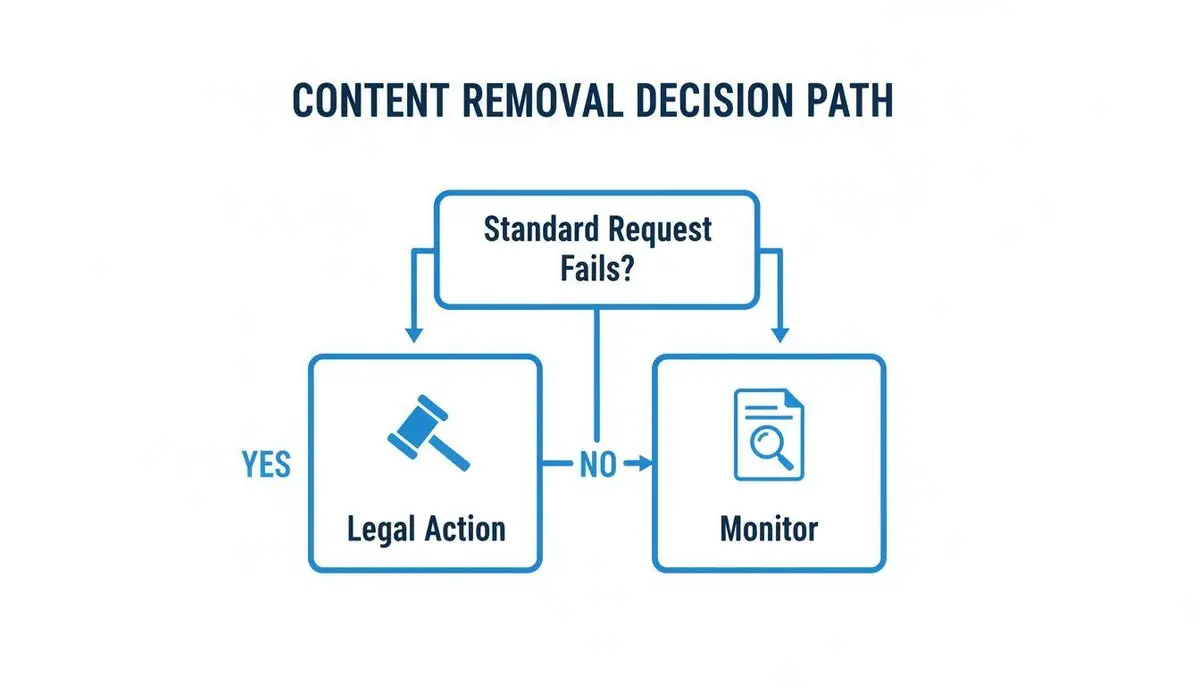
This workflow illustrates the feedback loop: if a standard takedown fails, escalate. The entire strategy, however, is predicated on the constant monitoring that provides the initial alert.
Establishing an Automated Alert System
Monitoring cannot be a manual process of periodic self-Googling. An effective system requires comprehensive, automated scanning of the clear, deep, and dark web for your personal identifiers.
An automated alert system must track several key areas. It must monitor for name and keyword mentions, providing instant alerts when your name or associated terms appear on new websites, in news media, or on social platforms. It must scan dark web marketplaces and criminal forums for your credentials, including email addresses, passwords, or government ID numbers. Finally, it must detect data broker resurfacing. Automated systems must continuously re-check broker sites and immediately trigger new opt-out requests the moment your data reappears.
This constant vigilance shifts your posture from reactive to proactive. By detecting new exposures within hours, you can initiate the removal process before the information is indexed by search engines or scraped by other actors, breaking the cycle of digital whack-a-mole and building a resilient online posture.
Answering Your Questions About Professional Data Removal
Engaging a specialist for a serious online privacy matter is a significant decision. The following are direct answers to the most common questions from executives, high-profile individuals, and legal professionals considering professional intervention.
How Is a Professional Service Different From DIY?
The primary distinctions are speed, scope, and expertise. A DIY approach pits one individual against a vast, fragmented, and hostile ecosystem, a task that can quickly become a full-time commitment.
A professional service leverages specialized tools, established processes, and a dedicated team to engage hundreds of data brokers simultaneously. We possess established back-channels and legal contacts to escalate takedowns that are ignored or denied. Our expertise lies in navigating the opaque internal policies of uncooperative platforms and, critically, ensuring that removed data remains offline.
What Can Realistically Be Removed?
Not all information can be expunged from the internet. The probability of success is contingent on the nature of the content and its location.
- High-Success Removals: Personal information on data broker sites, clear violations of a platform’s terms of service (e.g., doxxing, harassment), and non-consensual private imagery are consistently removable.
- Complex but Manageable: Defamatory blog posts or negative but factually accurate news articles present a greater challenge. These scenarios demand a sophisticated strategy involving legal pressure, search engine de-indexing, or court-ordered removal.
- Permanent Records: Information on government websites or in official court filings is generally permanent. In these cases, the strategy shifts to damage control and containment, preventing that public data from being scraped and disseminated across the web.
Complete erasure from the internet is a myth. The real goal is to control what people see, clean up the first few pages of search results, and get rid of the most damaging and easily found information. This neutralizes 99% of the threat.
What Is the Timeline and Cost?
There is no standard answer. A straightforward project, such as a comprehensive data broker purge, can yield results within days. In contrast, a complex case involving litigation, deep web content, or a coordinated multi-platform attack may require several months to resolve fully.
Cost is directly correlated with this complexity. A single-site takedown is a limited engagement. A full-scale campaign involving the removal from hundreds of data brokers, continuous dark web monitoring, and potential legal action represents a more significant investment. We provide a clear, fixed-fee proposal following an initial confidential assessment, ensuring full transparency.
When DIY methods have been exhausted and the stakes are too high for trial and error, professional intervention provides the certainty, efficiency, and force required. The team at ContentRemoval.com specializes in rapid, discreet, and durable solutions for complex digital privacy challenges. Schedule your confidential assessment today.
Frequently asked questions
What should a takedown notice to a website say?
The exact URLs, the precise content to be removed, the policy or legal violation such as a terms of service breach on PII exposure or doxxing, and a firm deadline, with a statement that you will pursue legal remedies if it is ignored. Keep it professional; it becomes evidence of a good-faith attempt before you escalate.
Which data brokers should I remove myself from first?
Start with high-visibility people-search sites like Whitepages, Spokeo and MyLife, which rank on page one and feed doxxing. Then target second-tier aggregators that syndicate to smaller sites, and finally primary sources such as LexisNexis, whose opt-outs are the hardest but most impactful.
Why do data brokers make opting out so difficult?
Their business depends on retaining your data. Expect buried links, demands for a government ID to verify, confirmation emails that void the request if missed, and separate processes for public records and marketing profiles. Record-keeping and persistence are what get through.