
To remove a news article before a job search, lock down evidence and gather court or dismissal records in the first 24 hours, map every copy of the story, then approach the right editor with one defined remedy: removal, name redaction, a material update, a noindex tag or a revised headline. Where publishers refuse, pursue de-indexing and suppression in parallel.
Key facts
- Search your name in quotes, with employer, with city, in Google News and Google Images before contacting anyone.
- Local outlets: contact the editor or managing editor; national outlets: standards or corrections first.
- In the US, accurate old articles are hard to remove; redaction, updates and noindex are the practical wins.
- Publisher outreach takes weeks; search requests days to weeks; suppression months, with earlier movement possible.
Where ContentRemoval.com comes in. ContentRemoval.com runs pre-employment article matters against the hiring clock: the full search map, evidence-backed publisher negotiation for a defined remedy, de-indexing requests where a policy or privacy basis applies, and suppression so branded search reflects the candidate’s present life. Candidates often reach us directly, or through a recruiter, executive coach or lawyer who has seen the result. A free 15-minute Exposure Scan maps what is removable in your timeline, and the report is yours to keep. Get a Free, Confidential Exposure Scan or read how our news article removal work is done.
A hiring process can collapse because of one old link.
You’re preparing for a final interview, a board conversation, or a discreet transition into a more visible role. Someone searches your name, and an old article appears. Maybe it covers an arrest that never became a conviction. Maybe it reports a dispute, a termination, or a personal matter that has nothing to do with your present life. The article may be factual. That doesn’t make it fair, and it doesn’t make it harmless.
If you need to remove news article before job discussions begin, treat it like a strategic operation, not a customer service request. Panic produces bad outreach, bad timing, and bad records. Precision produces options. The right campaign combines evidence gathering, publisher negotiation, legal positioning, search engine remedies, and, when removal isn’t realistic, aggressive suppression that pushes the article out of meaningful visibility.
Many individuals waste time on the wrong first move. They email the newsroom in anger. They threaten a lawsuit they can’t sustain. They file half-complete search engine requests. They overlook syndicated copies and social mirrors. By the time they realize the problem is broader than one URL, they’ve already weakened their position.
You need a tighter playbook.
The Critical First 24 Hours
The usual sequence is brutally predictable. A candidate gets invited into late-stage interviews. A recruiter goes quiet. An internal champion starts asking oddly cautious questions. Then the candidate searches their own name and finds the article they hoped nobody would see.
At that point, common reactions include freezing or overreacting. Both are mistakes.
Your first day isn’t about winning removal. It’s about stopping unforced errors and building a clean record. If the article concerns an old criminal allegation, dropped charge, or dismissed matter, gather the disposition documents before you contact anyone. If you don’t already have them, your lawyer should. If you’re trying to understand the underlying criminal process in a charge-related matter, a practical primer like how to get assault charges dropped can help you frame what documentation may exist and why the status of the case matters.
What you do first
Start by separating emotion from task. The article may feel like a personal attack, but your response must read like executive correspondence under privilege review.
Use the first 24 hours for four actions:
- Lock the evidence down: Save the article URL, screenshots, headline, publication date, byline, cached version, and any visible social shares.
- Stop improvising: Don’t call the newsroom. Don’t post rebuttals. Don’t threaten legal action in writing.
- Build the facts file: Collect court records, dismissal notices, expungement paperwork, employer references, and proof of present professional standing.
- Assess the actual risk: Ask one question. What appears when someone searches your full name, your full name plus company, and your full name plus city?
Practical rule: Your first email can either open a path to removal or close it. Most clients lose ground because they write too soon.
What not to do
Don’t assume the article can be “taken down” because it feels old. News organizations don’t remove content because it’s inconvenient. They remove or alter content when you give them a credible basis: inaccuracy, outdated context, disproportionate harm, privacy concerns, legal risk, or decayed newsworthiness.
Don’t assume one article is the whole problem, either. The original story may have been syndicated, copied into local aggregators, indexed in image search, or mirrored on social platforms.
The first day should leave you with control, not closure. Closure comes later. Control comes from discipline.
Immediate Triage and Strategic Assessment
A failed campaign usually starts with a bad map. The client sees one damaging article and assumes that is the problem. It is rarely the whole problem. Search results often include the original piece, republished versions, cached pages, image results, social reposts, and headline fragments that still tie your name to the story.

Your first job is to identify the full exposure. Do that before you contact a publisher, lawyer up publicly, or submit platform requests that leave a paper trail you may later regret.
Build the map before you send anything
Run the assessment like pre-litigation review. Use an incognito browser. Search your name in multiple forms, on multiple devices if possible, and log what appears. A clean-looking result on your office laptop proves nothing if a recruiter sees something different on mobile, in Google News, or in image search.
Run these search variations:
- Your full legal name in quotes
- Your full name plus employer
- Your full name plus city or state
- Quoted article headline
- site:publication.com “Your Name”
- site:publication.com “Headline fragment”
- Your name in Google News
- Your name in Google Images
Then document each result in a spreadsheet or chronology. Track the URL, title, ranking position, publication, date, issue type, and whether the page is the original, a syndication, a cached result, a social post, or a scraper copy.
Disciplined clients distinguish themselves from impulsive ones. The map determines the operation.
Classify the article correctly
Every article falls into a strategy lane. If you classify it badly, you waste time, weaken your credibility with editors, and sometimes trigger a firmer refusal.
| Article type | Primary strategy | Secondary strategy |
|---|---|---|
| False or materially misleading | Legal review and correction demand | Search engine escalation |
| Old but factually accurate | Publisher negotiation based on harm and relevance decay | Suppression |
| Privacy-invasive personal detail | Policy-based removal request | De-indexing where available |
| Charge or allegation without current context | Ask for update, correction, or anonymization | Noindex negotiation and suppression |
This distinction matters. In the United States, a truthful article is often difficult to remove unless you can show clear inaccuracy, privacy violations, unfair omission of later developments, or a strong editorial basis for revision. In the European Union, privacy and data protection rights may create stronger grounds for delisting or reduced visibility, especially where the information is outdated or disproportionate to current public interest. High-stakes cases require you to assess both routes early, because the right forum changes the pressure points.
Do not choose your theory based on outrage. Choose it based on proof, jurisdiction, and the publisher’s actual incentives.
Create the case file
A persuasive request is built on documents, sequence, and positioning. Editors and counsel respond to a coherent record. They ignore emotional narratives dressed up as evidence.
Include:
- Core records: docket entries, dismissal orders, expungement records, correction notices, prior correspondence
- Professional impact materials: recruiter emails, offer-stage concerns where appropriate, board or licensing issues
- Current-life evidence: executive role, compliance history, awards, community involvement, recent accomplishments
- Search evidence: screenshots of rankings, duplicate pages, cached results, image results, and social reposts
Also identify the next likely searcher. Recruiter. Board member. Investor. Lender. Admissions office. Opposing counsel. That answer sets priority. A local article ranking first for your full name creates one problem. A stale mugshot in image search creates another. A syndicated headline spread across local affiliates creates a different one again.
If you need a model for how to structure outreach after the assessment is complete, review this professional guide to asking a journalist to remove an article. Use it after the map is finished, not before.
Decide what stays untouched for now
Bad timing destroys good cases. Do not contact every site at once with inconsistent explanations. Do not send legal threats before your factual record is organized. Do not ask a publisher for removal while a related matter is active unless counsel has approved the sequence.
A controlled operation starts with a complete inventory, a correct legal and editorial theory, and a ranked target list. That is how you prevent a narrow cleanup effort from leaving the actual exposure untouched.
Executing Publisher Engagement and Negotiation
An editor receives your email at 8:12 a.m. By 8:20, they have decided whether you are a credible party with a clean, reviewable request or a problem they can ignore. That judgment shapes the outcome.
Editors respond to precision. They act when you present a narrow remedy, a documented basis, and a reason the current publication now causes harm out of proportion to any remaining public interest. If you need to remove news article before job scrutiny intensifies, treat outreach as a controlled negotiation, not a personal appeal.

Experience shows that measured outreach with a well-organized evidence package gets reviewed far more often than angry demands. It also preserves your position if the matter later shifts to counsel, platform complaints, or search suppression.
Contact the right person
Start with the decision-maker who can act without creating unnecessary resistance. For a local or regional outlet, that is usually the editor, managing editor, standards editor, or corrections desk. For a larger publication with formal review policies, go to standards or corrections first. Bring legal counsel in early only if the article is false, materially misleading, or exposes a clear privacy issue.
Use this decision table:
| Situation | First contact |
|---|---|
| Local news article with old factual content | Editor or managing editor |
| National outlet with formal standards policy | Standards or corrections team |
| False allegations with measurable damage | Counsel to legal department |
| Archived article requiring update or redaction | Editor with supporting records |
Generic contact forms disappear into process. A direct note to a named editor gets read.
Frame the request like a serious counterparty
Your ask should be easy to approve.
State the specific remedy. State the factual reason. State why the current version no longer serves a legitimate editorial purpose at its current level of visibility. Keep emotion out of it. Editors do not need your outrage. They need a clean record and a solution they can defend internally.
Use one of these requests:
- Remove the article if it is false, legally exposed, or no longer justified under the outlet’s own standards.
- Anonymize or redact your name if identification is no longer necessary to the story.
- Add a material update such as dismissal, expungement, acquittal, or corrected facts.
- Apply a noindex tag if the publication wants to keep the archive online but reduce search exposure.
- Revise the headline and metadata if the framing is outdated, incomplete, or disproportionately damaging.
A strong message sounds like this in substance: the article concerns an event from years ago; the matter was later dismissed, resolved, or materially changed; continued name-based search visibility now causes current professional harm; and you are requesting one defined editorial remedy supported by records.
For a tighter model on wording, sequencing, and escalation, review this professional guide to asking a journalist to remove an article.
Negotiation rule: Give the editor an outcome they can approve without admitting wrongdoing.
Negotiate alternatives that solve the real problem
Deletion is only one outcome. Search invisibility, reduced identification, and factual updating often solve the hiring problem faster and with less resistance.
If the publisher rejects full removal, press for one of these alternatives:
- Noindex implementation: The page stays live on the site but can drop out of search results after recrawl.
- Name redaction: Your name is removed from the headline, body, image captions, and metadata.
- Article update: The outlet adds the missing development that changes how a recruiter or board member reads the story.
- Headline softening: The article remains, but the search-facing title stops doing unnecessary damage.
- Archive demotion: The page stays in the archive with reduced internal prominence and weaker search signals.
For US clients, these alternatives are often the practical win because many publishers resist deletion on principle. For EU-linked cases, the conversation can be broader because privacy and de-indexing arguments carry more weight across the overall operation. The point is simple. Solve the search problem, not your ego.
What effective outreach looks like
A strong request is short, orderly, and documented. It attaches one evidence file or one clean folder. It cites the article URL, the exact requested remedy, and the supporting records. It gives the publication a path to act without a fight.
Weak outreach does the opposite. It accuses the outlet of ruining your life, cites no false statement, copies half the newsroom, and threatens public retaliation or a lawsuit that will never be filed. That does not project strength. It tells the publisher you are disorganized and unlikely to follow through.
Handle outreach like private counsel would handle it for a high-net-worth client. One theory. One ask. One record. Then negotiate from position, not emotion.
Navigating Legal and Search Engine Remedies
When a publisher won’t cooperate, the operation shifts from persuasion to rights enforcement and technical invisibility. These are different tools with different burdens. Confusing them wastes time.
The legal path asks whether the article can be challenged. The search path asks whether the article can remain online yet stop appearing where employers look.
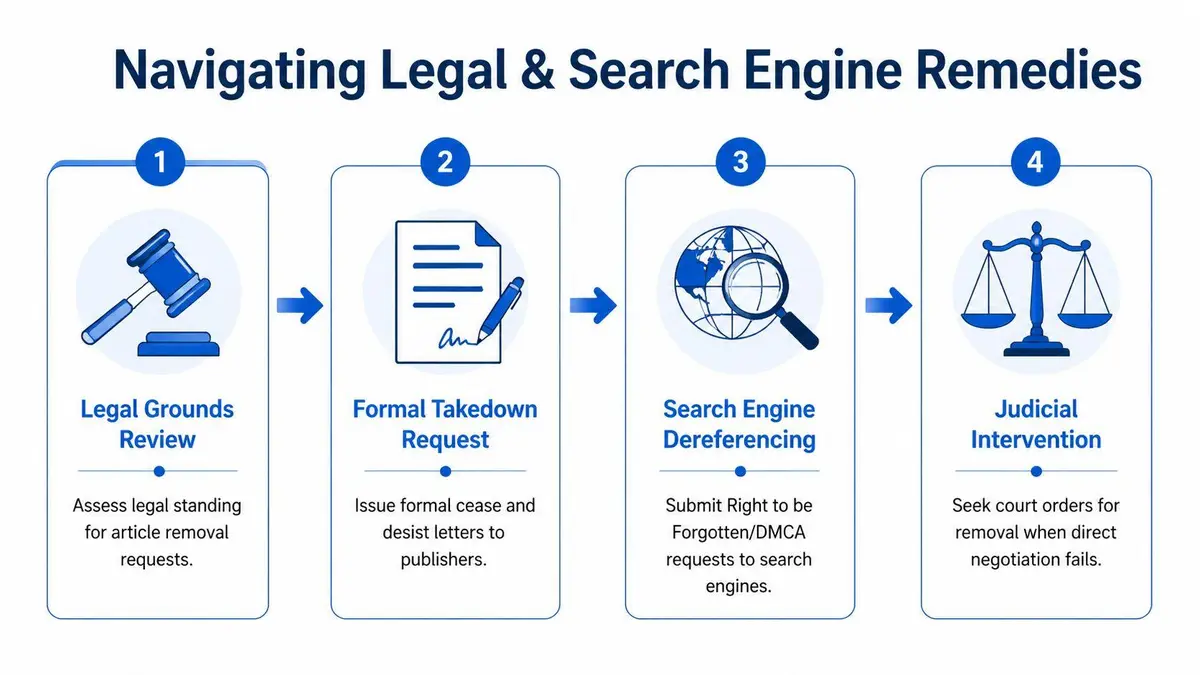
The strongest search-based remedy in Europe began with the 2014 European Court of Justice ruling in Google Spain v. AEPD, which established the Right to be Forgotten. By 2023, Google had processed over 3 million RTBF requests and approved approximately 45% for de-indexing, and news articles containing personal data, including old convictions that interfere with employment, account for a meaningful share of those removals according to this review of RTBF and article removal practice.
The legal lane in the United States
If the article is false, materially misleading, or omits critical context in a way that creates a false impression, counsel should review defamation and related claims. Privacy torts may also matter in narrow cases involving highly private facts or misuse of identifying information.
But factual reporting sits behind strong First Amendment protection in the United States. That means many clients with accurate but old articles don’t have a winning lawsuit. They have a visibility problem, not a liability claim.
Use this framework:
| Legal question | Why it matters |
|---|---|
| Is the statement false? | Defamation usually requires falsity or materially misleading presentation |
| Can you prove damage? | Vague reputational harm won’t carry much force |
| Is the matter public record? | Public-record reporting is harder to attack |
| Has the article become inaccurate over time? | Failure to reflect dismissal or expungement may support correction pressure |
A cease-and-desist letter should never be your first reflex unless you have real legal footing. Empty legal threats educate the publication about your weakness.
The RTBF lane in Europe and similar jurisdictions
If you live in the EU or your circumstances otherwise qualify under European rules, search de-referencing can be the decisive tool. RTBF does not usually erase the article from the publisher’s site. It targets search visibility tied to your name.
That distinction matters. For employment screening, de-indexing often solves the operational problem even when source removal is impossible.
Search engines evaluate requests based on factors such as time passed, public interest, accuracy, and current relevance to your life. Old allegations, spent convictions, and stale articles with little continuing public value can qualify. The more complete your evidence packet, the better the request.
For a more detailed tactical walk-through, this guide on how to remove a news article from Google outlines the executive-facing process.
A search result can be more damaging than the article itself. Most employers never go beyond the search page.
Google tools and technical remedies
Not every remedy depends on RTBF. Some are global and technical.
If a publisher removes or changes the page, the Outdated Content Tool can help clear stale search snippets and cached versions. If a page has been marked noindex, you still need verification after recrawl. If personal information on the page falls under search engine policies, you may have a separate policy route independent of publisher consent.
Here is the practical sequence:
- Confirm what changed at the source.
- Submit the relevant search engine request.
- Track cache status and result persistence.
- Recheck branded search queries, not just raw URL visibility.
When counsel, platform tools, and service providers align
The highest-functioning campaigns synchronize legal review, publisher negotiation, and technical de-indexing. That requires disciplined messaging and record control. One factual theory. One evidence set. One escalation plan.
That is where firms and specialized providers can add value. A service such as ContentRemoval.com handles article removal, de-indexing, and monitoring workflows, which can be useful when a client needs one coordinated process instead of separate ad hoc outreach.
The mistake to avoid is fragmented action. A lawyer sending one theory, a PR consultant sending another, and the client improvising a third is how these matters stall.
Building a Digital Firewall via Content Suppression
Some articles won’t come down. Some won’t de-index. Some will, but not fast enough to protect the hiring window. That’s when you stop arguing with the article and start outranking it.
Suppression is not cosmetic. It’s a deliberate effort to occupy your branded search results with stronger, controlled, relevant assets so the unwanted article loses practical visibility.

What belongs in the firewall
The strongest suppression assets are authoritative, identity-linked, and professionally coherent. Random blog posts won’t help. Thin press release spam won’t help. Anonymous microsites won’t help for long.
Prioritize assets you can control and defend:
- Executive website: full-name domain if available, biography, media, board roles, speaking, publications
- LinkedIn profile: complete, current, and written for branded search
- Company leadership page: robust executive profile, not a two-line stub
- Industry publications: bylined articles tied to your expertise
- Podcast and conference pages: especially if they rank for your name
- Professional association profiles: bar, medical, academic, or industry bodies where relevant
Build for search intent, not vanity
When an employer searches your name, they’re trying to answer basic questions. Who is this person. What do they do. Are they credible. Are they current. Your assets should answer those questions better than the old article does.
That means your content needs consistency. Use the same name format across profiles. Align your job titles, dates, headshot, and biographical language. Include enough substance for search engines to treat the assets as primary identity sources.
A strong suppression campaign usually includes:
| Asset | Purpose |
|---|---|
| Personal site | Central identity hub |
| High-trust professional verification | |
| Employer bio | Institutional authority |
| Bylined articles | Topical expertise |
| Podcast or event pages | Third-party validation |
Operational advice: Don’t publish ten weak pages. Publish a smaller set of stronger assets and support them consistently.
Promotion matters
Publishing the asset is the starting line, not the finish. The page needs signals. Internal links from your company site help. Consistent citations across profiles help. Press mentions tied to current work help. Thought leadership on reputable sites helps.
Many DIY efforts fail when a client launches a personal website and assumes Google will “notice.” Search engines notice authority, consistency, and reinforcement.
What suppression can and cannot do
Suppression does not rewrite history. It changes what appears first when someone searches your name. For employment outcomes, that distinction is often enough.
It also buys time. If a source-removal or de-indexing request is pending, suppression can reduce exposure during the waiting period. If the article survives, suppression can still make it effectively irrelevant to most searchers.
The standard you should care about isn’t emotional satisfaction. It’s search visibility under your name.
Assessing Timelines, Risks, and Jurisdictional Realities
A hiring committee is reviewing finalists on Monday. On Friday, an old article is still ranking for your name. At that point, the question is not whether the article is unfair. The question is which remedy can change exposure fast enough, in the right jurisdiction, without creating a bigger problem.
Geography controls strategy.
In the United States, a factual news article is usually difficult to remove outright. Publishers have strong protections, and search engines rarely intervene unless a clear policy basis exists. In the EU, privacy law can create stronger search-side options for outdated, disproportionate, or no-longer-relevant name-based results. Those are different operating environments, and they require different sequencing.
What this means in practice
A US case usually turns on pressure points other than full deletion. That means disciplined publisher outreach, correction demands where the record supports them, targeted de-indexing requests when a platform policy applies, and parallel suppression.
An EU case may justify a more aggressive privacy-based route, especially where the result is old and tied to personal name searches rather than current public interest. That does not guarantee removal. It gives you a stronger legal frame and better negotiating position.
Timing matters just as much as venue. If interviews start in two weeks, you do not wait for one remedy to fail before starting the next.
Timelines by remedy
Different tracks move at different speeds. Run them in parallel where the facts support it.
| Remedy | Typical pace |
|---|---|
| Publisher outreach | Weeks, sometimes longer |
| Search engine cache and de-index requests | Days to weeks |
| Legal escalation | Weeks to months |
| Suppression campaign | Months, with earlier visible movement possible |
This is why high-stakes clients do not bet everything on a single outcome. They start the publisher process, prepare legal review, file platform requests where justified, and keep the search results from sitting still in the meantime.
Risk is operational, reputational, and legal
The biggest mistake is treating one visible win as closure.
A result can disappear from one query and remain on another. A publisher can update an article but leave the damaging headline intact. A syndicated copy can survive after the original is changed. A cached version, image result, or data broker reference can continue circulating after a partial cleanup. If you are facing pre-employment screening, partial resolution is often the most dangerous outcome because it creates false confidence.
Monitoring has to be specific. Track branded searches, image results, publisher archives, syndication copies, and jurisdiction-specific versions of search results. If you need a realistic benchmark for search-side timing, review how long it takes to remove a Google search result. Then build your plan around the slower tracks, not the fastest ones.
The finish line is when the article stops affecting decisions made about you.
The strategic conclusion
Jurisdiction decides your legal options. Timeline decides your sequence. Facts decide your influence.
A US executive dealing with accurate reporting needs one kind of campaign. An EU executive with a strong privacy claim needs another. A candidate trying to contain exposure before final interviews needs immediate action across several channels at once.
Precision wins. Optimism does not.
Taking Command of Your Digital Narrative
If an old article is threatening a career move, you don’t need generic advice. You need a controlled operation.
That operation starts with disciplined mapping. It advances through evidence-backed publisher negotiation. It escalates through legal review and search engine remedies where the facts support them, and when removal isn’t available, it shifts into suppression so your search results reflect your present life, not your worst archived moment.
This work is technical, political, and jurisdiction-specific. It also moves faster when one party controls the message, the records, and the escalation sequence. That is why executives, family offices, and counsel shouldn’t treat this like a casual cleanup exercise.
You can’t change the fact that the article was published. You can change whether it keeps showing up at the worst possible time.
If you need a confidential assessment, ContentRemoval.com can evaluate the article, map the full search footprint, and recommend a coordinated removal, de-indexing, or suppression strategy based on your jurisdiction, evidence, and hiring timeline.
Frequently asked questions
Will a newspaper delete an old article about my arrest if the charges were dropped?
Not simply because it is old or inconvenient, but a dismissal, acquittal or expungement gives an editor a credible basis to act. Ask for one defined remedy such as a material update, removal of your name, a noindex tag or a softened headline, and attach the disposition records with the request.
What should I ask a publisher for if they will not remove the article?
A noindex tag so the page drops from search after recrawl, redaction of your name from headline, body, captions and metadata, an update adding the later development, a revised headline or archive demotion. For US candidates these alternatives are often the practical win because publishers resist deletion on principle.
Can I use the right to be forgotten to get an article delisted before interviews?
If you live in the EU or otherwise qualify under European rules, search de-referencing can remove the result from name searches even though the article stays on the publisher’s site. Search engines weigh time passed, public interest, accuracy and current relevance, so a complete evidence packet matters.