
Removing yourself from the internet starts with a footprint audit of every username, email and photo, then a takedown campaign on several fronts: permanently deleting accounts you own, opting out of data brokers at scale, removing content you do not control through DMCA notices, privacy law and terms of service reports, and monitoring because brokers repopulate your data.
Key facts
- Search old usernames, emails and phone numbers in quotation marks to force exact matches.
- Always choose deletion over deactivation; deactivated data stays on the company’s servers.
- A terms of service report citing the specific rule breached gets more moderator attention.
- The first audit and removal wave typically takes one to three months; legal cases run longer.
Where ContentRemoval.com comes in. ContentRemoval.com runs this as an operation for executives and families who want functional invisibility: a forensic audit including the deep and dark web, data broker removal at scale, legal and technical takedowns of content you cannot delete yourself, and monitoring so the footprint stays small. Family offices, chiefs of staff and security teams are the usual point of contact. A free 15-minute Exposure Scan maps what is out there and what is removable, and the report is yours to keep. Get a Free, Confidential Exposure Scan or read how our reputation management work is done.
The question of how to “remove myself from the internet” is no longer a matter of paranoia. It is a calculated business and security decision. For executives, high-net-worth individuals, and public figures, a scattered digital footprint represents a significant and quantifiable liability. The process extends beyond deleting old accounts; it requires a systematic dismantling of your online presence to achieve genuine anonymity and security.
Why a Digital Disappearance Is a Strategic Imperative

For a high-profile individual, the drive to scrub your presence from the web transcends basic privacy; it is a critical component of risk management. Every data point (an old social media profile, a public record on a data broker site, a passing mention in a news article) is a potential vulnerability that adversaries can exploit.
These vulnerabilities are not theoretical. They manifest with real and severe consequences. We have witnessed innocuous information weaponized for corporate espionage, allowing competitors to map professional networks and anticipate business moves. This exposure also fuels substantial personal security risks for family offices, as details about assets, routines, and even children become publicly accessible to malicious actors.
The Anatomy of Online Vulnerability
The internet does not distinguish between a harmless decade-old comment and a critical piece of intelligence. For a high-value target, every fragment of data contributes to a mosaic that adversaries can assemble. The issue is not one embarrassing photo; it is the cumulative exposure that creates a detailed and highly exploitable personal profile.
This exposure materializes in several high-stakes scenarios. First, reputational attacks, such as a single negative article, a string of fake reviews, or a targeted social media smear campaign, can nullify years of brand-building and credibility virtually overnight. Second, hostile competitors leverage publicly available data to profile key executives, identify internal weaknesses, and gain an unfair market advantage. Third, information regarding home addresses, vacation patterns, and family members, often scraped and sold by data brokers, creates direct physical security risks, leading to stalking, harassment, and sophisticated financial scams.
The financial and reputational stakes are astronomical. The average cost of a data breach has now climbed to $4.45 million: a figure that escalates when the target is a public figure with a large digital footprint. What is truly alarming is that a significant percentage of these breaches involve personal information that can be traced back to an individual’s online presence.
For entrepreneurs and executives, this means old forum posts, data from a past breach, or even an impersonation account can surface and cause catastrophic damage. We have seen it compromise reputations built over decades. You can review more of these digital footprint statistics and their real-world impacts.
A piecemeal approach, deleting a few social media accounts or setting a profile to private, is dangerously naive. It is analogous to locking your front door while leaving every window in the house wide open. Real security demands a comprehensive, systematic erasure of your public-facing data.
Beyond Privacy Platitudes
This conversation must move beyond generic advice. For the clients we serve, this is fundamentally a matter of asset protection. Your online reputation is an invaluable asset, as is your family’s safety and your company’s strategic integrity. A scattered and uncontrolled digital presence actively devalues those assets daily.
Taking the initiative to remove yourself from the internet is a core component of modern wealth and reputation management. It is a defensive strategy designed to neutralize threats before they materialize. This is not about hiding; it is about reclaiming control over your narrative and eliminating vulnerabilities at their source.
Your First Step: A Full Digital Footprint Audit
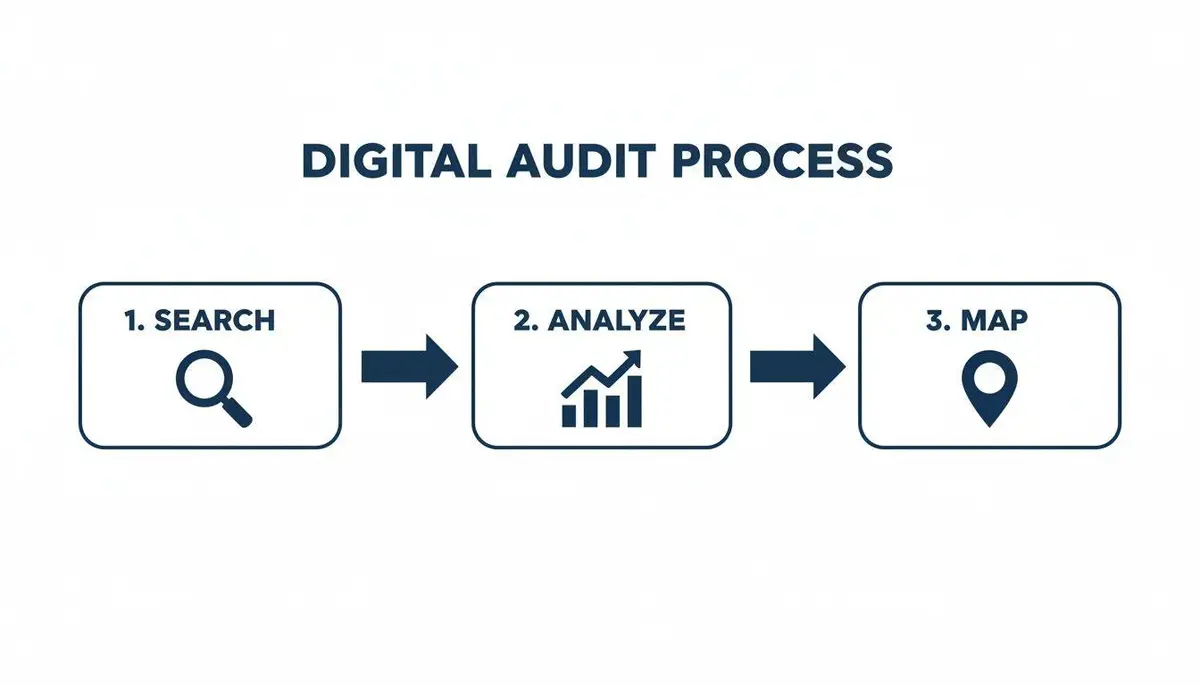
Before you can begin to remove your personal information from the internet, you must know exactly what exists. A complete map is required. This involves building an inventory of your digital self, moving far beyond a cursory Google search to uncover every account, mention, and stray piece of data tied to your name. This audit is the bedrock of your entire removal strategy.
To execute this, you must adopt the mindset of an investigator or even an adversary. A simple search for your name reveals only the tip of the iceberg. The most significant risks often lie in data that is not immediately obvious but is easily found by a motivated party.
Digging Deeper Than a Simple Search
Your first objective is to catalogue every digital asset linked to you. This requires a methodical approach. Use a spreadsheet to track findings, with columns for content type (social media, forum, data broker), the URL, and a risk assessment.
Employ precise search queries to uncover what is hidden in plain sight. Search every username you have ever used, both common and obscure, in quotation marks (e.g., "SkaterBoi1998") to force an exact match; this will uncover forgotten forum, gaming, or blog accounts. Search for every email address and phone number you have ever owned, again using quotes like "my.old.email@aol.com"; this is a primary method for finding where your data has been leaked in breaches or scraped by data brokers. Finally, conduct reverse image searches using every profile picture or headshot you have ever used on platforms like Google Images and TinEye. This step can reveal unauthorized use of your photos on old company pages or fake social media profiles.
At this stage, your focus is intelligence gathering, not removal. Every old comment, photo tag, or mention is a target to add to your list.
Organizing Findings and Assessing Risk
With a raw list of your digital assets, you must now analyze them. This transforms a simple list into a strategic plan. The goal is to understand how each piece of information contributes to your overall exposure.
This audit is an exercise in seeing yourself through the eyes of an adversary. The most damaging information is rarely a recent social media post, but rather forgotten data on an obscure website from a decade ago.
Categorize each item by risk level. Your public LinkedIn profile is a high-risk asset that you control. A profile on a data broker site is also high-risk but outside your direct control. A dormant account on a gaming forum from 15 years ago might seem harmless, but if it contains your date of birth or a former address, it becomes a key puzzle piece for an identity thief.
This is also where you will confront the sprawling, automated world of data brokers. These companies exist to scrape, buy, and sell your information, and manual searching will only uncover a fraction of these profiles. Understanding how to address this specific challenge is a prerequisite for any effective takedown campaign, a process detailed in our digital footprint cleanup service.
Ultimately, a thorough audit provides the clarity needed to act. It ensures your effort to remove myself from the internet is not a random game of whack-a-mole but a focused, intelligence-driven operation.
Executing a Systematic Takedown Campaign
With your digital audit complete, you have a clear map of your online presence. The next phase moves from discovery to action, the systematic takedown. This is a deliberate process of dismantling your digital self, starting with assets you control and progressing to more complex challenges.
First, address the low-hanging fruit: the accounts you own. This includes social media profiles, old forum accounts, e-commerce sites, and any professional networks no longer in use. For each platform, you face a critical choice: deactivate or delete.
Deactivation is a temporary measure. Your profile becomes invisible, but your data remains on the company’s servers, ready for reactivation. Deletion, conversely, is permanent. It is the digital equivalent of shredding the files. Always choose deletion.
The Data Broker Problem
Deleting your own accounts is straightforward. The real battle begins with the data broker industry. These companies scrape, buy, and bundle your personal information from public records, social media, and data breaches, then sell it to anyone.
Their business model is engineered to make removal difficult. You may send a request to one broker and they might comply, but weeks later, your data reappears, fed back into their system from another source in their network.
The only effective countermeasure is automated, professional intervention. A manual approach is akin to emptying the ocean with a bucket. Professional services deploy the correct tools to solve a complex, automated problem, sending simultaneous removal requests to hundreds of known brokers and using established protocols to ensure compliance. They also provide the continuous monitoring required to combat data repopulation.
Launching a Multi-Front Campaign
A successful takedown is not a single action but a coordinated campaign on multiple fronts. You must address every type of exposure simultaneously to secure your digital past.
The attack should be structured as follows. First, secure your assets by permanently deleting all social media, e-commerce, and forum accounts identified in your audit. Remember to download any data you wish to keep before initiating deletion. Second, tackle data brokers by engaging a professional service that can send and verify removal requests at scale and provide the continuous monitoring needed to prevent data from reappearing. Third, de-index content from search engines. Even after removal from a website, content can linger in Google’s cache. Requesting de-indexing is an essential final step. Our guide on how to remove negative content from Google search provides a deep dive into this process.
By moving on all fronts at once, you systematically dismantle your digital presence and close vulnerabilities as you go.
Legal and Administrative Removals
Sometimes, the information requiring removal exists not on a social media site but in an official or public record. This is particularly true for individuals with past legal issues, where an old mistake can cast a long shadow online.
In these situations, the takedown process enters the legal arena. For instance, if you have a past criminal charge, it is worth exploring how to clear your record through expungement or nondisclosure. These legal instruments are powerful tools for aligning your real-world record with your goal of digital privacy.
This is often the most complex part of any removal effort, requiring a solid understanding of both legal procedures and platform policies. Without that expertise, it is easy to waste time on requests that are ultimately denied, leaving your sensitive information exposed. This is another area where professional guidance is invaluable for navigating the system and achieving permanent removal.
Removing Content You Don’t Control
The most difficult challenge in an effort to remove myself from the internet is addressing content you do not control. This is hostile territory: defamatory articles, fake reviews from disgruntled ex-employees, leaked private photos, or mugshots on third-party websites. You cannot simply log in and press “delete.”
Success in this realm is not achieved by asking nicely. It is about identifying the correct levers of pressure to make removal the path of least resistance for the website owner. This is less a customer service issue and more a strategic, legally-informed campaign.
Your Takedown Toolkit: A Legal-Centric Approach
When another party hosts damaging content about you, your objective is to build an undeniable case for its removal and present it to the site owner or their hosting provider. The strongest arguments are not emotional pleas but are grounded in legal and policy frameworks.
The most effective tools include copyright claims under the Digital Millennium Copyright Act. If someone has used your original work (a photo, video, or written text) a correctly filed DMCA takedown notice legally compels the hosting company to remove the content or face liability. Privacy laws, such as Europe’s GDPR and California’s CCPA, also provide recourse if a site publishes your private information without a legitimate public interest. Finally, a website’s own Terms of Service (ToS) can be leveraged. Every legitimate platform has rules against harassment, hate speech, impersonation, and non-consensual intimate imagery. A report that cites a specific ToS violation (e.g., “This post violates Section 7b of your user agreement prohibiting targeted harassment”) commands a moderator’s attention in a way a generic complaint does not.
Crafting these notices is an art. A sloppy DMCA claim is easily dismissed, and a vague ToS report will be buried.
Your objective is to make it easier and safer for the website to remove the content than to keep it. A professional, well-structured takedown notice signals that you understand your rights and are prepared to escalate, dramatically increasing the probability of success.
De-Indexing vs. Deletion: Knowing the Difference
It is crucial to understand the two potential outcomes: source removal and de-indexing.
Source removal is the ultimate goal. The content is completely wiped from the website where it was published. The URL is dead, the page is gone. This is a permanent solution, but it is the hardest to achieve as it requires the website administrator’s cooperation or a court order.
De-indexing is the next-best and often more realistic objective. The content still exists at its original URL, but it is removed from search engine results like Google and Bing. Since the vast majority of users never go past the first page of search results, the content becomes functionally invisible. For the average person, if it is not on Google, it does not exist.
While complete deletion is ideal, de-indexing neutralizes the threat by cutting off the primary discovery vector. A sophisticated strategy involves fighting on both fronts simultaneously: pressuring the source for a full takedown while filing de-indexing requests with search engines. This two-pronged attack is a core tactic for anyone serious about an effort to remove myself from the internet, and it is where the technical and legal experience of a professional service becomes invaluable.
Establishing Long-Term Digital Defense and Anonymity

Scrubbing your personal information from the internet is a significant achievement, but it is not the final step. Without a robust plan to keep your information offline, it will inevitably reappear. The objective is not a one-time project to remove myself from the internet; it is the establishment of an ongoing security protocol.
The Inevitable Repopulation Problem
The greatest threat to your renewed privacy is the data broker industry. These companies operate on autopilot, constantly scraping public records and online sources to rebuild the very profiles you fought to take down. A successful removal can be undone in months as their automated systems repopulate your data.
This is an inherent feature of the data economy, and it is why most DIY removal attempts ultimately fail. A recent digital footprint survey highlights the futility of individual efforts against an army of data brokers.
A successful digital removal is not a static achievement. It is a dynamic state of security that requires constant vigilance and active defense against automated systems designed to undermine your privacy.
The only effective strategy is a system that continuously scans for your information and automatically issues removal demands the moment it reappears. This is a task for a professional monitoring service that uses AI to monitor the clear, deep, and dark web for your name, providing real-time alerts.
Managing a Controlled Online Presence
For many professionals, complete disappearance is neither realistic nor desirable. A minimal, controlled online presence is often essential for business. The strategy, therefore, is not to vanish but to operate under a carefully managed persona where every public detail serves a deliberate purpose.
This requires adopting key habits for all future online activity. Practice data minimization: treat your personal information like cash and do not provide it unless absolutely necessary. Employ identity compartmentalization by using different email addresses for different life functions: one for work, one for close contacts, and disposable accounts for online services. This contains the damage from any single breach. Finally, use anonymization tools, such as renting temporary phone numbers for sign-ups, to create a buffer between you and the internet.
Adopting these practices ensures you do not accidentally rebuild the digital footprint you worked to erase. Every new account must be viewed through a risk-management lens. By controlling the data you share, you starve data brokers of the raw material they need to exploit you.
When to Engage Professional Internet Removal Services
Attempting to scrub your own information from the internet can be likened to patching a leaky roof with duct tape. While you can handle basic tasks like deleting old social media profiles, a DIY approach falters when the problem is more severe.
When faced with stubborn defamatory content, negative articles protected by free speech, or data brokers that persistently repopulate your information, individual effort is insufficient. It is not just inefficient; it is often a losing battle. The question is not if you need professional assistance, but how much time and frustration you are willing to endure before seeking it.
The Scope of Professional Services
Engaging a specialist firm like ContentRemoval.com is not merely outsourcing the cleanup. It is deploying a strategy that an individual cannot replicate. These services operate on a different level, using proprietary tools, established legal networks, and years of experience to secure results.
While you might spend hundreds of hours sending emails that go unanswered, a professional service can automate the entire data broker removal process, targeting hundreds of sites simultaneously and verifying that your information remains removed.
A comprehensive engagement is a full-scale risk management operation. It begins with a forensic audit to uncover your entire digital footprint, including the deep and dark web. This is followed by automated data broker removal using specialized software. The firm then executes legal and technical takedowns, using tools like DMCA notices and GDPR requests, alongside direct negotiation to get harmful content removed at the source. Finally, and most critically, professional services provide continuous monitoring and defense, scanning the web for any new mentions or re-uploads to ensure you remain protected.
This level of thoroughness is impossible to achieve alone. Our guide on companies that remove personal information from the internet explains what to look for in a provider.
Hiring a professional service is an investment in certainty. It condenses a process that could consume years of your life into a matter of months, with a significantly higher probability of success in complex cases.
Ultimately, the goal is not just deleting links; it is restoring control and peace of mind. For executives, high-net-worth individuals, or anyone facing a serious reputational threat, the time, legal complexity, and sheer scale of the task make professional expertise the only realistic path forward.
Straight Answers to Your Digital Removal Questions
When you are under pressure, you require clear answers, not vague promises. Clients frequently approach us with critical questions about the process, realistic outcomes, and timelines.
Can You Truly Erase Yourself From the Internet?
The honest answer is no, not 100%. Certain information, such as data held in government databases or content on the dark web, is beyond reach.
However, you can achieve what we term functional invisibility. Through a strategic and aggressive campaign, it is entirely possible to remove 95-99% of your public-facing information. This means scrubbing your name from data broker lists, deleting forgotten accounts, and taking down harmful content. The result is a digital footprint so small that, for all practical purposes, you have vanished online. It is the most powerful step toward reclaiming your privacy.
What Is a Realistic Timeline?
The timeline depends entirely on the depth of your digital footprint. Typically, the initial phase, a deep audit and the first wave of removals targeting data brokers and old social profiles, takes one to three months. If we are dealing with more stubborn content like defamatory articles or mugshots that require legal action, the process can extend longer.
After that initial push, the work shifts from active removal to continuous monitoring.
The most significant error is treating digital removal as a one-time task. It is an ongoing security process. The best strategies transition from active removal to continuous defense to prevent data from being re-published.
De-Indexing vs. Source Removal: What Is the Difference?
Understanding this distinction is crucial for setting proper expectations.
De-indexing makes content invisible on search engines. We petition Google and other search providers to remove the link from their results. The page still exists, but it cannot be found through a search. It is a fast, effective method for hiding information.
Source removal is the gold standard. The content is permanently deleted from the website itself. The URL is dead, the page is gone, and the problem is resolved.
Source removal is always the primary objective, but it is much harder to achieve. It often requires difficult negotiations with site owners, leveraging a Terms of Service violation, or applying legal pressure. A sophisticated strategy attacks the problem on both fronts simultaneously.
When the stakes are high, a self-managed approach is a gamble you cannot afford to take. ContentRemoval.com possesses the experience and operational capacity to manage complex, high-profile removals with the precision and discretion your situation demands. Start with a confidential assessment to build your strategic action plan.
Frequently asked questions
How do I find everything about me online before I start deleting?
Search every username you have used in quotation marks to force exact matches, do the same for every email address and phone number, and run reverse image searches on every headshot through Google Images and TinEye. Log each result in a spreadsheet with the URL, content type and a risk rating.
Why does my information keep coming back after I opt out of data brokers?
Brokers scrape public records, social media and breach data on autopilot and share data among themselves, so a profile removed from one is rebuilt from another source within months. The only durable answer is a system that keeps scanning and re-issues removal demands as soon as a listing reappears.
What can I do about a website that posts content about me and will not delete it?
Build a case around a lever the site owner cannot ignore: a DMCA notice if they used your photo or writing, a GDPR or CCPA request if they publish private information without public interest, or a report citing the exact terms of service clause on harassment, impersonation or intimate imagery. File de-indexing requests with search engines at the same time.