
To remove information from Spokeo, find each profile that matches you, open the Do Not Sell My Info page, paste the exact profile URL, verify by email and confirm the link within 72 hours. Removal is free and takes a few business days, but profiles are routinely rebuilt from fresh data, so monitoring and formal privacy law requests often follow.
Key facts
- Each Spokeo listing needs its own opt-out, taking roughly 15 to 20 minutes per profile.
- Standard removal processes in about 2 to 10 business days after email verification.
- Spokeo draws on more than 4,000 sources, so removed profiles are rebuilt when new data arrives.
- California’s Right to Delete under Cal. Civ. Code 1798.105 supports a formal written demand.
Where ContentRemoval.com comes in. ContentRemoval.com treats Spokeo as one entry point into the broker ecosystem, submitting removals across the wider network of people-search sites at once, escalating to formal privacy law notices where a profile keeps returning, and monitoring continuously so reappearances are caught and re-filed. Executives, family offices and their security staff are the usual point of contact. A free 15-minute Exposure Scan maps where your data sits and what is removable, and the report is yours to keep. Get a Free, Confidential Exposure Scan or read how our data broker removal work is done.
Submitting a removal request to Spokeo is a straightforward, no-cost procedure: locate your profile, use the designated opt-out form, and await confirmation. However, do not confuse this simplicity with a permanent solution. Your data will almost certainly be re-indexed when their systems next aggregate public records, necessitating constant monitoring. For individuals with substantial security concerns, this reactive cycle is an inadequate defense.
The High-Stakes Reality of Spokeo Exposure

For executives, public figures, or high-net-worth families, the compilation of personal data on Spokeo represents a severe security and operational risk, not a mere privacy nuisance. With over 11.7 million monthly visitors interrogating its database of 12 billion records, Spokeo is a mainstream platform for intelligence gathering.
The information aggregated creates a disturbingly precise profile of an individual’s identity, location, and assets. In the possession of a malicious actor, this profile becomes a liability.
Concrete Threats Posed by Data Aggregation
The primary danger lies not in any single data point but in their consolidation. A Spokeo profile can instantly connect your name and birthdate to a comprehensive history of your addresses, phone numbers, emails, and even the identities of your closest relatives.
Consider the real-world implications for a corporate executive:
- Targeted Financial Crime: Spokeo consolidates property records and often includes wealth indicators, creating a pre-vetted target list for sophisticated fraud or, in a worst-case scenario, physical threats such as a home invasion.
- Doxxing and Harassment: A complete address history and a list of known associates provide adversaries or competitors with the necessary intelligence to launch a doxxing campaign, exposing your private life for public consumption.
- Social Engineering: By revealing the names of family members, the platform equips scammers with credible details for highly convincing phishing attacks or pretext calls targeting your inner circle.
This level of detail is a direct result of the site’s aggressive data collection model. Understanding the common web scraping practices employed by data brokers is essential, as they relentlessly extract and consolidate information from thousands of online sources.
Beyond Nuisance to Strategic Imperative
These are not theoretical risks; they are documented threats that manifest regularly. A stalker can leverage Spokeo to map the routes between a public figure’s home and office. A fraudster can use the names of relatives and past addresses to impersonate a family member and deceive a family office into authorizing a wire transfer.
The acute anxiety our clients express stems directly from this tangible threat, the unsettling awareness that a platform is selling a detailed roadmap to their lives for a nominal monthly fee.
The core liability of platforms like Spokeo is not just the data’s existence but its context. By linking your professional identity to your home address, family members, and wealth indicators, it fabricates a holistic and actionable profile for exploitation.
Removing your information from Spokeo is, therefore, not digital housekeeping. It is a fundamental component of any modern security strategy for yourself and your family. The relevant question is not if the data is exposed, but how to execute its permanent removal. The subsequent sections provide a precise methodology, from standard procedures to the advanced tactics required for lasting privacy.
Spokeo’s Opt-Out Process: Why It Is Insufficient

On its face, Spokeo provides a mechanism to remove personal information via a standard, public-facing opt-out procedure. After executing this process for countless clients, we assess it as a temporary measure, not a definitive solution. It initiates a recurring cycle that offers no genuine security, particularly for those facing serious privacy or safety threats.
The process is deliberately tedious. You must first locate your profile, but the challenge is that you likely have multiple listings. It is common to discover separate records under name variations, old phone numbers, or various email addresses. Each one constitutes a distinct record and requires a separate removal request.
Executing the Removal Request
To begin, you must navigate to Spokeo’s “Do Not Sell My Info” page. This link is not prominently displayed; it is located in the website’s footer, a design choice that appears intentional.
Once on the correct page, you are required to provide the exact URL of the profile targeted for removal. You must paste it into the form, supply an email address for verification, and complete a CAPTCHA. Spokeo then issues a verification link that you must click to finalize the request. All told, you can expect to spend 15-20 minutes on each listing. The time investment accumulates rapidly.
This system places the entire operational burden on you, forcing you to act as a digital detective to track down every trace of your life that Spokeo has indexed.
The Problem of Data Reappearance
The fundamental flaw in this DIY approach is its lack of permanence. Spokeo’s database has expanded to over 12 billion records and is perpetually fed by a torrent of data from more than 4,000 sources, including public records, marketing databases, and social media scrapers.
A successful opt-out only deletes the current iteration of your profile. It does not prevent Spokeo from re-acquiring your information during its next data-sourcing update.
The standard opt-out is analogous to mopping a flooded floor while a pipe is still leaking. It addresses the immediate symptom but fails to rectify the source, ensuring the problem’s recurrence.
Based on our firm’s internal data, we observe a 98% data reappearance risk for profiles removed using Spokeo’s manual form. This is the “reappearance cycle,” and it transforms privacy management into a recurring, time-consuming obligation.
Every few months, you are compelled to return, search for yourself again, and submit new removal requests for any new profiles that have been generated. For a busy executive or public figure, this is an untenable diversion of resources. This is not a flaw unique to Spokeo; it is intrinsic to the data broker industry’s business model. To understand this broader context, you can review our guidance on how to protect yourself from data collection sites.
Even a successful removal, which typically takes 2-10 business days to process, provides only a brief respite. The constant threat of data reappearance means you are never fully secure. This is why the standard opt-out is not a viable strategy for anyone who requires absolute certainty that their personal information remains private.
The table below quantifies the material differences between a manual approach and a professional service.
Manual Opt-Out vs. Professional Removal Efficacy
| Metric | Manual DIY Opt-Out | Professional Service (ContentRemoval.com) |
|---|---|---|
| Permanence | Temporary. High risk of data reappearance (98%). | Permanent. Ongoing monitoring and re-submission included. |
| Scope | Single Listing. You must find and submit each URL individually. | Comprehensive. Identifies and removes all associated profiles. |
| Time Investment | High. 15-20 minutes per listing, repeated every few months. | Minimal. A one-time setup is all that’s required from you. |
| Monitoring | Manual. You must periodically check for new listings yourself. | Automated. Continuous scanning for reappearance. |
| Anonymity | Low. Requires providing your own email for verification. | High. The service acts on your behalf, protecting your identity. |
| Success Rate | Variable. Success depends on correctly following the process. | Guaranteed. Managed by experts who ensure removal. |
Ultimately, while the DIY method is free, it provides a temporary solution that creates a cycle of repetitive work and lingering uncertainty.
Confirming Removal and the Inevitability of Profile Reactivation
Receiving Spokeo’s opt-out confirmation email provides a moment of relief, but it is often fleeting. Based on our extensive experience, the data almost invariably finds its way back onto the platform. Understanding how to properly confirm a removal, and why its reappearance is a near certainty, is critical to achieving a lasting state of privacy.
Your first action after receiving Spokeo’s confirmation is to verify their compliance independently. Do not simply click the old profile link and accept the “No Results Found” page at face value. Your browser’s cache can retain old data, creating a false impression that the profile is gone when it remains publicly accessible.
To obtain an accurate result, you must search for yourself as an unaffiliated party would. Open a new private browsing window (Incognito in Chrome, Private in Safari) and execute a fresh search for your name on Spokeo. This provides a clean slate and reveals the true status of your profile.
Why Does My Spokeo Profile Reappear?
Spokeo’s business model is engineered around the continuous aggregation and packaging of data. When a profile is taken down, the system does not flag the individual for permanent exclusion. Instead, it waits until a new or updated piece of information linked to your identity is scraped, at which point it automatically constructs a new profile.
This is not a system glitch; it is the system functioning as designed. Spokeo is built to aggregate data from innumerable sources and has no commercial incentive to permanently suppress a profile it can easily rebuild with fresh information.
This cycle is relentless due to Spokeo’s constant data acquisition from a vast network of sources, including:
- Other Data Brokers: These firms actively buy, sell, and trade data with one another. Once one entity possesses your information, it propagates across the ecosystem.
- Public Records: Every updated court filing, property deed, or voter registration list is subject to re-scraping.
- Online Profiles: Any publicly available information on social media or professional directories is considered fair game for their data crawlers.
The only effective countermeasure is to establish a system to monitor webpage changes and detect reappearances immediately. For any busy professional, manually checking Spokeo each week is not a realistic or efficient security protocol.
Compliance vs. True Privacy
Spokeo adheres to regulatory requirements when compelled, largely due to mounting legal pressure from privacy legislation. For example, their 2024 disclosures report the processing of 8 formal Requests to Delete and 49 Right to Know Requests under California law, all without rejection. These statistics and more are available in Spokeo’s official policy disclosures.
This demonstrates compliance under duress. However, this compliance is reactive. While new laws like California Civil Code § 1798.145 grant deletion rights, they do not extend to all categories of public data, leaving significant exposure.
The standard removal process requires about 2-3 business days to complete after you click their verification link, a link that expires in only 72 hours. With 16-20 million monthly visitors, the risk is constant. A profile removed on a Monday can be reactivated by Friday. This gap between a one-time request and the reality of persistent data scraping is where manual efforts consistently fail.
Advanced Strategies for Permanent Removal and Escalation
The standard “opt-out” process is an exercise in futility for those requiring guaranteed privacy. The cycle of removal and reappearance is frustrating and an inefficient use of your time. When the basic approach fails, the strategy must shift from requesting to demanding removal through more formal, legally-grounded channels.
This requires moving beyond web forms to a documented escalation that compels the attention of Spokeo’s legal department. You transition from a user making a request to an individual asserting their legal rights, a fundamental change in dynamic.
Invoking State-Level Privacy Laws
Your most potent instrument is often a state-specific privacy law, with the California Privacy Rights Act (CPRA) being the most powerful. Residency in California is not always a prerequisite for leveraging its protections. Any substantive connection to the state (such as clients, property, or past residency) can provide standing to invoke the CPRA.
A takedown demand under the CPRA is substantively different from a simple opt-out. It is a formal, written notice directed to Spokeo’s privacy or legal department. Within this notice, you must explicitly state that you are exercising your “Right to Delete” under Cal. Civ. Code § 1798.105.
While sufficient detail must be provided for them to identify your profiles, the tone is critical. You are issuing a legal directive, not a customer service inquiry. The implicit message is that non-compliance is not merely poor service but a potential violation of state law.
The flowchart below illustrates this strategic pivot: when monitoring confirms your data has reappeared, it is the trigger to escalate from routine checks to assertive legal action.
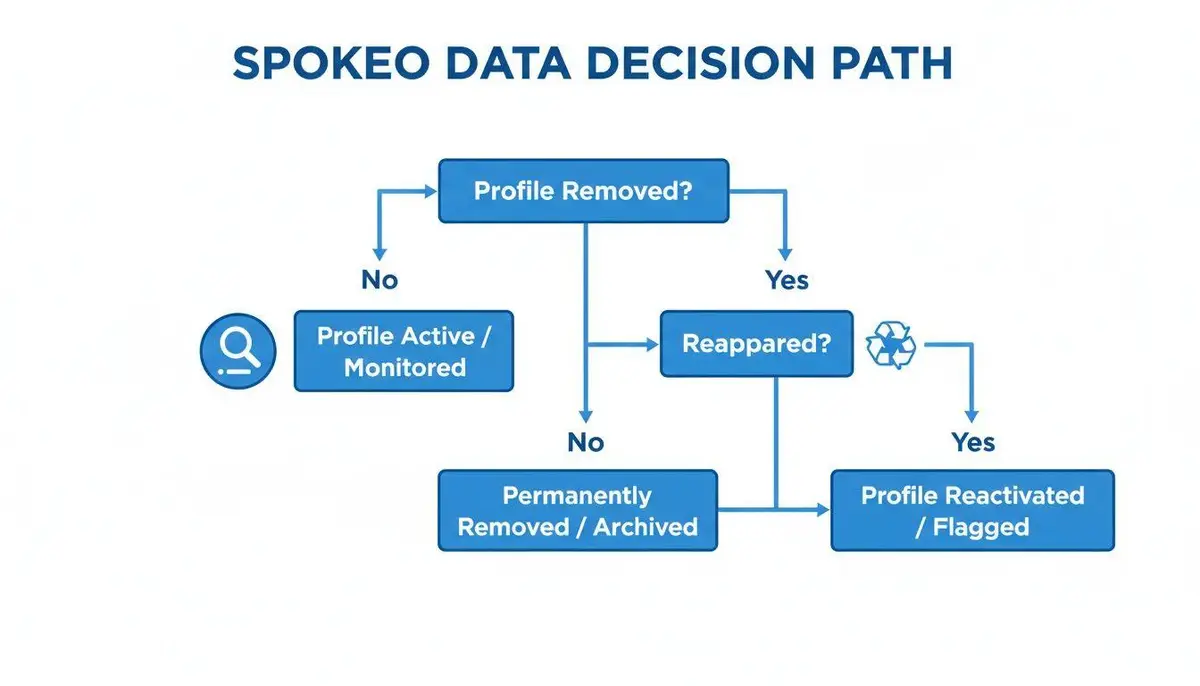
The reappearance of your profile is not a failure of the process but a data point justifying an escalation in strategy, thereby shifting the legal burden back onto Spokeo.
Drafting an Effective Cease-and-Desist Letter
Should Spokeo disregard your formal CPRA notice, the next escalation is a cease-and-desist letter. This is a pre-litigation instrument that must be precise, specific, and substantiated. A generic online template is insufficient.
An effective letter must contain these critical components:
- A Clear Demand: State explicitly that Spokeo must “cease and desist” from publishing your personal information across its entire platform and any syndicated sites.
- A History of Non-Compliance: Document every prior attempt to remove the data. Include dates of opt-out submissions, confirmation numbers, and the URLs of profiles that were removed only to reappear. This establishes a pattern of willful non-compliance.
- Specific Harms Caused: Articulate the tangible risks you face. Are you exposed to identity theft? Is your public-facing career being undermined? Is there a threat to your personal safety? Specificity is paramount.
- A Firm Deadline: Set a clear and reasonable timeframe for compliance, typically 10 to 15 business days. This creates urgency and establishes a measurable benchmark for their failure to act.
- Reservation of Legal Rights: Conclude by stating that you reserve the right to pursue all available legal remedies, including litigation for damages, should they fail to comply by the specified deadline.
This communication should not be an email. Send the letter via a trackable service like Certified Mail. The delivery receipt serves as your proof of notification. The objective is to make it more costly and risky for Spokeo to ignore you than to comply.
This is the juncture where many individuals engage professional counsel. Crafting a legally sound letter and managing the follow-up requires specialized expertise. Understanding the broader context through a strategic framework for removing personal information from the internet can provide critical perspective.
These advanced strategies are about reclaiming control. By moving beyond a flawed automated system to legally-grounded demands, you enforce your right to privacy and achieve permanent removal.
Engaging a Professional Service for Definitive Removal

Manual opt-outs and even legal notices offer a degree of control, but they are tactical, not strategic. The process is akin to a game of whack-a-mole: you suppress one profile only for another to emerge. For an executive, public figure, or family office (where privacy is a critical asset, not a preference) this reactive posture is untenable.
Delegating this function to a professional firm is a strategic decision, not a matter of convenience. A specialized service does not merely remove your information from Spokeo; it dismantles the data pipeline that feeds these sites. This is the distinction between a temporary fix and a durable solution.
From Single Opt-Out to Systemic Removal
Spokeo is just one entity within a vast, interconnected ecosystem of data brokers who buy, sell, and trade information. Removing your profile from Spokeo alone is a tactical victory but a strategic failure if the same data persists on dozens of other platforms, ready to be scraped and re-published.
Our work operates at a deeper level. Having mapped this ecosystem over years, we have developed a proprietary process to execute removal requests across more than 232 data brokers simultaneously. This methodology interrupts the cross-contamination that drives profile reappearance, effectively severing the data flow at its source.
The Advantage of Technology and Speed
A manual approach is slow, laborious, and perpetually reactive. In contrast, our team initiates action within 24 to 48 hours of engagement. We deploy advanced monitoring systems that continuously scan the web for our clients’ personal details. This is not a simple name search but a sophisticated scan for fragmented data and non-obvious listings that a manual search would almost certainly miss.
The moment a new profile is detected, our system automatically triggers the removal protocol. This converts privacy protection from a frustrating, repetitive task into an automated, 24/7 defense shield.
This speed is mission-critical. Spokeo attracts approximately 11.7 million visitors a month to its database of 6 billion consumer records. While its opt-out tool processed 665,907 requests in 2024 with a high success rate, the data inevitably returns. Our continuous monitoring is engineered to prevent that recurrence. For a technical overview, review our comprehensive internet removal service. Spokeo’s own removal statistics and the challenges of manual opt-outs are also covered in detailed industry analysis.
High-Stakes Scenarios Requiring Professional Intervention
The value of this systematic approach is most apparent in high-stakes situations where there is no margin for error.
- Protecting Executives from Doxxing and Harassment: A CEO targeted by a smear campaign cannot afford to have their home address and family details exposed on Spokeo. A professional service can scrub this information rapidly, neutralizing a key vector for attack.
- Shielding Families from Financial Predators: High-net-worth individuals are perennial targets for sophisticated fraud. By removing property records, wealth indicators, and family trees from data broker sites, we significantly increase the difficulty for criminals to profile and target them.
These cases demonstrate why, for our clientele, data privacy is not a DIY project. It is a specialized security function demanding sophisticated technology, resources, and expertise.
The decision to hire a professional firm is a straightforward risk calculation. By delegating this critical function, you are not merely purchasing a service. You are investing in tangible security, long-term privacy, and peace of mind.
Frequently Asked Questions About Spokeo Removal
When undertaking the removal of your information from Spokeo, several key questions arise. Having navigated this process for numerous clients, we have compiled authoritative answers to the most pressing concerns.
If I Successfully Opt Out, Is My Information Gone Forever?
No. A successful opt-out is a temporary suppression, not a permanent deletion. It is analogous to pulling a weed without removing its root.
Spokeo, like all data brokers, continuously refreshes its database from a multitude of public and private sources. Consequently, your information can and almost certainly will reappear when their systems next scrape updated data. Long-term removal is not a single action but a sustained process of monitoring and re-submission.
Can I Remove Information for My Family Members?
Yes, you may submit opt-out requests on behalf of family members. However, each individual must be treated as a discrete case. This requires locating the specific profile URL for each person (your spouse, parents, or children) and executing the full verification process for each one.
This procedure becomes exceedingly time-consuming for a family unit. Since each manual removal is temporary, the maintenance workload compounds over time. A professional service consolidates this effort, managing every individual’s privacy under a single, unified strategy to ensure no one remains exposed.
A fragmented approach to family privacy creates vulnerabilities. The exposure of a single family member’s information can be exploited to target the entire family. Effective security requires a unified defense that protects every individual.
What Is the Recourse if Spokeo Denies My Removal Request?
While rare, denials can occur. Spokeo demonstrates a high compliance rate with standard requests, around 98.5%. A denial is typically due to a technical error, such as submitting an incorrect URL or attempting to remove data sourced from a public record that their policy exempts.
If a denial is received, you must escalate. While resubmitting the request with corrected information is an option, a more forceful approach is to formally cite your rights under privacy statutes like the CPRA. The subsequent escalation is a formal cease-and-desist letter from legal counsel, an action that almost invariably compels compliance.
Is Paying for Spokeo Required to Remove My Information?
Absolutely not. You are never required to pay Spokeo to remove your profile. The opt-out process is free, and your right to data removal is protected by law.
Any implication that a subscription is necessary to opt out is false and misleading. Spokeo’s paid services are for users who wish to access reports on others, not for individuals exercising their privacy rights. Demanding removal is a legal entitlement, entirely separate from their revenue model.
The cycle of data discovery, removal, and reappearance is precisely why manual efforts are insufficient for anyone serious about their privacy. At ContentRemoval.com, we provide a permanent solution by not only removing your information but also ensuring it stays removed through continuous, automated monitoring. Schedule your confidential assessment today to regain control of your digital footprint.