

To remove yourself from TruthFinder, submit a suppression request through PeopleConnect’s portal, confirm your email, match every record that belongs to you and save the confirmations. Suppression hides the public listing but does not delete backend data, so residents with statutory rights such as the CCPA can also send a deletion request, and ongoing monitoring is needed because records reappear.
Key facts
- TruthFinder is owned by PeopleConnect, and opt-outs run through PeopleConnect’s suppression portal.
- Requests are queued for removal within 48 hours, and the form takes 10 to 15 minutes per email.
- Suppression hides the public listing; backend data stays accessible to licensed users.
- Suppressed records commonly need re-suppression within 6 to 12 months as databases refresh.
Where ContentRemoval.com comes in. ContentRemoval.com handles TruthFinder as one node in the wider data broker footprint, running suppression, statutory deletion requests where the client’s residency allows, the adjacent brokers that mirror the same household data, and the rechecks that catch re-ingestion. Executives, family offices and people facing harassment usually reach us through an assistant, security lead or lawyer. A free 15-minute Exposure Scan maps where your data appears and what is removable, and the report is yours to keep. Get a Free, Confidential Exposure Scan or read how our content removal work is done.
You search your own name and see your home address, age, relatives, past locations, and fragments of your public record assembled into a profile that reads like an intelligence brief. For an executive, founder, family office principal, or public figure, that’s not a nuisance. It’s an exposure event.
Individuals who want to remove from TruthFinder are already under some pressure. A board appointment is pending. A dispute has turned personal. A journalist, competitor, estranged associate, or unstable individual now has a simple way to map your household and history. At that point, a casual opt-out guide isn’t enough. You need a controlled process that reduces visibility fast, then deals with the harder problem most free guides ignore: recurrence.
The Imperative of Removing Your Data from TruthFinder
TruthFinder sits inside a much larger data broker economy. The scale matters because it explains why your information appears there in the first place, and why it rarely stays gone after one request. Over 500 million Americans’ records have been exposed across data broker sites, and a 2023 FTC report found that data brokers collect and sell information on 95% of U.S. adults, generating $1.1 billion in annual revenue industry-wide, with TruthFinder processing millions of searches monthly, according to Incogni’s TruthFinder guide.
For high-net-worth clients, the risk isn’t abstract. A visible TruthFinder profile can help a hostile actor connect an executive to a spouse, an LLC address, a former residence, or an extended family member. That changes the security posture around travel, litigation, hiring disputes, succession matters, and even routine media attention.
Why exposure on TruthFinder feels different
A social profile shows what you chose to post. A data broker profile assembles what you never intended to package together. That distinction matters.
TruthFinder can create a shortcut for anyone trying to answer questions you never consented to organize in one place. Where do you live now. Where did you live before. Who are your relatives. Which records might point to property, litigation history, or prior contact details. Even when the underlying source material is fragmented or public in isolation, aggregation changes the risk.
A private fact becomes operationally dangerous when a broker makes it searchable, cross-referenced, and easy to act on.
That’s why I advise clients to treat TruthFinder removal as part of broader reputation and personal security management, not as a one-time housekeeping task. The goal isn’t just to hide a profile for a weekend. The goal is to reduce discoverability in a way that holds up under scrutiny, repeat searches, and data refreshes.
What actually works
The first move is usually tactical. You submit a suppression request and get the public listing taken down as quickly as possible. But speed and permanence aren’t the same thing.
The stronger approach has three layers:
| Layer | Purpose | Limitation |
|---|---|---|
| Standard suppression | Hides the visible record quickly | Doesn’t remove backend data |
| Legal deletion request | Pushes for permanent removal rights where available | Requires proper eligibility and documentation |
| Ongoing monitoring | Catches reappearance and secondary listings | Needs discipline or professional oversight |
If you’re searching how to remove from TruthFinder, the immediate answer is straightforward. The strategic answer is more demanding. You need to know what kind of removal you’re getting, what remains behind the curtain, and what happens when the data comes back.
Understanding the TruthFinder Data Ecosystem
TruthFinder is not just a standalone search page. It operates within the broader PeopleConnect ecosystem, which is why the mechanics of removal matter more than many individuals realize. PeopleConnect acquired TruthFinder in 2019, and the service aggregates public records, government data, social content, and commercial data sources into unified profiles.

If you want a deeper overview of how these businesses operate, this strategic guide to executive privacy and data brokers is useful context. The key point is simple: the visible listing is only the front end of a much larger data-handling system.
Suppression and deletion aren’t the same remedy
Many individuals say “delete my profile” when what they complete is a suppression request. Those are not interchangeable.
According to VanishID’s step-by-step TruthFinder opt-out guide, TruthFinder’s opt-out process runs through PeopleConnect’s suppression portal, and requests are queued for removal within 48 hours. But that same source makes the critical distinction clear: suppression only hides the public listing. It doesn’t delete the data from PeopleConnect’s backend database, which remains accessible to licensed users.
That distinction changes how I advise clients. If someone is facing active harassment, press attention, family-office confidentiality concerns, or executive protection issues, public suppression may help with immediate search visibility. It does not resolve the full privacy problem.
Why records come back
TruthFinder draws from source records and secondary broker inputs that continue to refresh. If a source updates, the profile can be rebuilt. If a related broker republishes the same information, the exposure can spread sideways even after the original listing disappears.
That makes TruthFinder less like a static website and more like a recurring ingestion system.
Operational rule: if the source remains available and the broker continues refreshing feeds, a one-time opt-out is a temporary intervention.
What this means for a high-stakes client
A routine user may accept a basic suppression because the visible listing disappears and that feels like closure. A principal with real security concerns can’t rely on that standard. The practical questions are different:
- Who can still access the retained data: Public searchers may lose visibility, but backend retention changes the risk profile.
- How often do sources refresh: If public records update, a prior removal can become stale.
- Whether related brokers mirror the same profile: Removing one listing may leave copies elsewhere.
The result is a simple but often missed conclusion. If your objective is to remove from TruthFinder in a durable way, you need to choose the right remedy first. Otherwise you’re solving for appearance, not exposure.
Executing the Standard TruthFinder Suppression Request
The standard route to remove from TruthFinder starts at PeopleConnect’s suppression portal. It isn’t difficult, but it does punish inattention. Most failed requests trace back to record-matching errors, missed verification steps, or assumptions about what “removed” means.

Start with the right portal
Use the official PeopleConnect suppression page, not a third-party form or reseller page. The workflow typically asks for your email, then requires identity-related details such as full name and date of birth so the system can surface matching records. Expect a verification sequence before suppression takes effect.
The process generally takes 10 to 15 minutes per email address, and users often have to choose among multiple matching records, according to Security.org’s TruthFinder opt-out analysis. For a client with common-name duplication, prior addresses in multiple states, or family members with similar identifiers, mistakes often begin during this stage.
The practical sequence
Follow the request carefully and treat every screen as consequential.
- Open the suppression portal and enter your email address. Use an inbox you control directly. Corporate filtering and delegated assistants often cause avoidable delays.
- Complete the email confirmation immediately. If you leave the session idle, you may have to restart.
- Enter your identifying information exactly. Use your legal name as it appears in records. If you have aliases, maiden names, or alternate spellings, you may need separate passes.
- Review each matching profile line by line. Check age range, cities, relatives, and known addresses. Don’t assume the first result is yours.
- Confirm the suppression request and save every confirmation message. Take screenshots. Archive emails. You may need the submission trail later.
A good supplemental reference for broader broker removal work is this executive privacy guide to removing yourself from data broker lists. The reason I mention broader removal here is that a correct TruthFinder submission often reveals how many adjacent listings you’ll need to address next.
Where users lose control
The portal is designed for consumer-scale requests. It is not designed for fragmented identities, litigation-sensitive removals, or exposure involving old contact channels. The weak points are predictable:
- Duplicate profiles: One person may have several records tied to old addresses or alternate spellings.
- Shared-family confusion: Relatives in the same household history can make records look deceptively similar.
- Verification dependency: If the system relies on stale contact information, the request can stall before completion.
For readers dealing with criminal-process exposure or any law-enforcement-adjacent search visibility, a separate but useful resource is Gerald Miller P.A.’s Miranda Rights guide on when to stop talking. The relevance here is judgment under pressure. People often overshare when trying to “fix” a record issue. With data brokers, as with any sensitive process, disclose only what’s required.
A visual walkthrough can help if you want to see the interface before starting:
What to expect after submission
Once the request is accepted, suppression is generally queued rather than executed instantly. Public visibility may drop quickly, but don’t assume completion because the page accepted your form. Recheck the listing after the expected processing window. Search by name, city, and related identifiers.
Save proof of every submission. The client who keeps records usually resolves disputes faster than the one who relies on memory.
If the listing disappears, that’s a useful first result. It is not the end state. Standard suppression is the front gate, not the final lock.
Troubleshooting Common Opt-Out Failures
A failed TruthFinder opt-out usually isn’t dramatic. The portal accepts part of the request, the code never arrives, the wrong profile was selected, or the record vanishes briefly and then another version remains live. For high-profile clients, those “small” failures matter because partial exposure is still exposure.

When verification breaks
This is common with legacy phone numbers, abandoned email accounts, and records touched by identity theft. According to this video guide discussing PeopleConnect remediation, TruthFinder’s verification by email or phone code often fails in those scenarios and may require escalation to [email protected] for manual remediation.
When that happens, don’t send a vague complaint. Send a concise, documented request. Identify the record, explain that the linked contact channel is no longer under your control, and ask for manual review. Include only the minimum information needed to confirm identity and locate the listing.
When multiple records match your name
This is one of the most common points of consumer error. Clients often remove one profile and assume the matter is closed while a second or third record remains searchable under a variant city, age band, or family association.
Use a disciplined review method:
| Problem | What it looks like | Better response |
|---|---|---|
| Fragmented profile set | Several records with overlapping addresses | Check every known city and family linkage before submitting |
| Common-name confusion | Similar profiles with different relatives | Match against household members, not just age |
| Alias mismatch | Maiden name or shortened version appears separately | Search all known name variants and submit separately if needed |
When the portal accepts the request but the record remains
Sometimes the issue is timing. Sometimes it isn’t. If the expected window passes and the profile is still public, repeat the search using a private browser session and varied search terms. Cached views and search indexing can create the illusion of persistence, but direct listing visibility is what matters first.
If the record is still live, escalate with the saved confirmation trail. That is where screenshots, timestamps, and original submission emails become useful.
Don’t restart blindly. Confirm whether you’re dealing with the same profile, a duplicate profile, or a fresh ingestion event.
When removal doesn’t last
Many self-managed efforts break down at this point. The same YouTube source notes that 40 to 60% of suppressed records require re-suppression within 6 to 12 months due to database re-updates. That means a technically successful request can still fail strategically if nobody monitors for recurrence.
For an ordinary consumer, that may mean frustration. For a family office, public company executive, or public figure, it means the risk returns. A proper troubleshooting mindset doesn’t end with “was the form submitted.” It asks whether the profile stayed down, whether duplicates remain, and whether the underlying exposure has shifted to adjacent brokers.
Leveraging Legal Frameworks for Permanent Removal
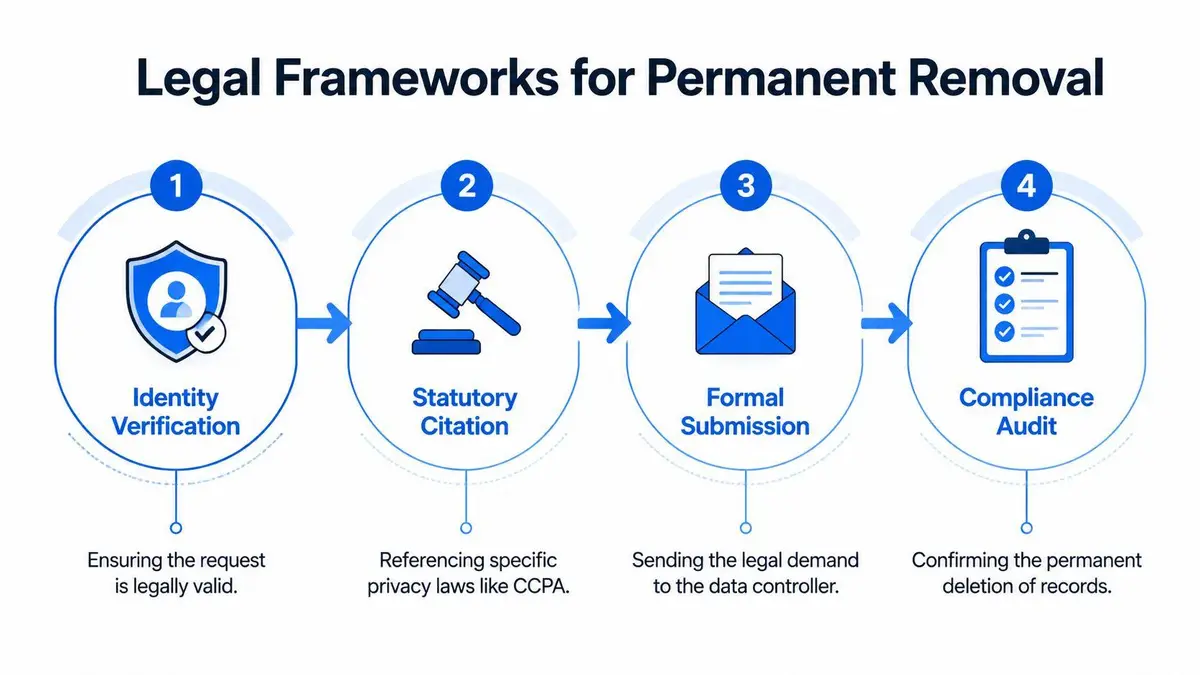
A family office often discovers the limit of a standard opt-out only after the risk returns. The profile disappears, staff assumes the matter is closed, and then the same household details surface again through a refreshed listing, a related broker, or a mirrored dataset. For high-exposure clients, that cycle is unacceptable. Legal deletion exists to change the broker’s obligations, not just the public-facing result.
Why legal deletion matters
Suppression usually hides a record from public search. A statutory deletion request can require the company to delete personal information it holds, subject to the limits and exceptions in the law. That distinction matters because a hidden profile can still leave underlying data in circulation inside the broker’s system.
For California residents, that usually means using the Right to Delete under CCPA. Residents of other states may have similar rights, but the scope, verification standard, appeal rights, and exemptions differ. For clients with cross-border ties, the analysis gets more complex because residency, processing location, and corporate structure all affect which law applies.
A useful companion read is this professional overview of the right to be forgotten in the US.
How to submit a legal request that holds up
A legal request fails for predictable reasons. The sender cites the wrong statute, sends the request to the wrong entity, omits profile URLs, or cannot satisfy identity verification without exposing more information than necessary.
Handle it methodically:
- Confirm jurisdiction first: State residence and the specific privacy rights available to that resident control the request.
- Send the request to the correct privacy contact: For TruthFinder-related data handling, that often means the PeopleConnect privacy process rather than the public suppression form.
- State the right clearly: Ask for deletion under the applicable statute, identify the data at issue, and reserve appeal rights if the request is denied.
- List every known identifier: Full name, aliases, prior names, cities, age ranges, and profile links help prevent partial deletion.
- Keep a clean record: Save the request, confirmation, screenshots, and any follow-up correspondence for escalation.
Legal pressure works best as part of a broader strategy
Well-informed clients sometimes assume the statute alone solves the problem. It does not. Legal deletion can improve your position with the broker, but it does not stop upstream source collection, downstream republication, or parallel exposure from unrelated sites. That is why one-time guides underperform. They treat the form as the finish line instead of one step in an ongoing control process.
In practice, I treat legal removal as one track inside a wider privacy program. The program usually includes source mapping, repeat checks for re-ingestion, parallel broker review, and defined escalation points when a company ignores or mishandles a valid request. If a client’s exposure includes owned web properties, weak site security can also widen the problem by exposing addresses, staff details, or family information. Basic hardening still matters. These essential steps for website threat protection are relevant when public exposure and technical exposure overlap.
When to escalate beyond the request itself
Some cases justify counsel early. That includes active harassment, domestic security concerns, executive protection matters, stalking history, and situations involving minors or household members whose details create a broader risk pattern. In those cases, delay has a cost.
If the broker rejects a valid request, fails to verify it properly, or removes only part of the data set, escalate in writing. Cite the governing law, attach the prior correspondence, and set a deadline for response or appeal. The goal is a documented record that supports the next step, whether that is a formal appeal, a regulator complaint, or attorney-led action.
For high-stakes clients, permanent removal is rarely a single event. It is a managed process with legal pressure, evidence discipline, and follow-through.
Sustaining Your Digital Privacy After Removal
The test isn’t whether a profile disappears once. The test is whether it stays gone.
That distinction is why one-time guides leave advanced readers exposed. They teach the form submission and stop there. But broker data doesn’t behave like a static webpage. It is refreshed, merged, republished, and redistributed. If nobody checks after removal, the profile can return without notice while everyone assumes the matter was handled.
Reappearance is the rule, not the exception
According to PrivacyBee’s discussion of recurring broker listings, 62% of profiles re-emerged within 6 months of a manual opt-out. The same body of verified data also notes that without ongoing monitoring, reappearance occurs in 20 to 30% of cases within 6 months. However you read the variation across methods and datasets, the practical conclusion is the same: manual removal has a shelf life.
For executives and high-net-worth families, this creates a false sense of closure. The profile is gone when the assistant checks. Months later, a revised version is visible again, often because a source refreshed or a parallel broker republished overlapping data.
What a sustainable privacy posture looks like
A durable remove from TruthFinder strategy has to move beyond the original listing. The strongest programs usually include a repeatable monitoring and response cycle.
- Periodic broker checks: Search for exact-name listings, common misspellings, former cities, and household associations.
- Trigger-based review: Recheck after litigation filings, real estate transactions, board appointments, press mentions, or address changes.
- Adjacent exposure control: Audit companion brokers and search engine results so the same data isn’t discoverable elsewhere.
- Documentation discipline: Keep timestamps, screenshots, case emails, and request histories in a single file.
Privacy isn’t separate from security
A visible broker profile often becomes useful only when paired with another weakness. That may be a poorly secured website, a leaked contact point, or public metadata that helps someone validate the data they found. That is why privacy work should sit alongside baseline digital hardening. For readers reviewing broader surface-area risks, Up North Media’s guide to essential steps for website threat protection is a practical complement to broker removal.
The professional difference
What separates a consumer opt-out from a real privacy program is continuity. Someone must watch for re-ingestion, re-suppression needs, duplicate identities, and legal follow-up opportunities. If that doesn’t happen, the burden shifts back to the exposed person, usually at the exact moment they have the least time to deal with it.
The clients who manage this well adopt a simple principle. They stop treating data broker removal as a task and start treating it as a standing risk-control function. That means fast suppression when needed, legal deletion where available, and active oversight after the initial record disappears.
If you are serious about removing from TruthFinder, that is the standard that holds.
If your TruthFinder exposure involves executive security, family-office confidentiality, active harassment, reputational risk, or repeat reappearance after prior opt-outs, ContentRemoval.com can assess the matter discreetly and build a targeted removal strategy. The work begins with a confidential review of the listing, the governing privacy rights, and the wider search and broker footprint, followed by a clear action plan focused on durable removal rather than temporary relief.
Frequently asked questions
Does opting out of TruthFinder delete my information?
No. The standard opt-out is a suppression request that hides the public listing. The data remains in PeopleConnect’s backend database and stays accessible to licensed users, which is why a statutory deletion request under a law like the CCPA is a separate step.
Why did my TruthFinder profile come back after I removed it?
TruthFinder refreshes from public records and secondary broker feeds, so when a source updates the profile can be rebuilt, and related brokers can republish the same data. The article cites figures showing a large share of suppressed records need re-suppression within 6 to 12 months.
What if the TruthFinder verification code never arrives?
This is common when the record is tied to an old phone number, an abandoned email or identity theft. Escalate to PeopleConnect’s support contact with a concise, documented request that identifies the record, explains the contact channel is no longer yours and asks for manual review.