
Removing a disciplinary record from the internet is a campaign across three layers: the official source, the copies on aggregators and people-search sites, and the search results that point to them. Legal relief such as sealing or expungement strengthens removal requests but does not erase copies. Webmaster outreach, de-indexing and suppression finish the job for results that stay online.
Key facts
- Expunged or sealed records often stay online because third-party sites copied them before any official update.
- Defamation is a poor fit when a publisher accurately repeats a true public record.
- A strong request names the record, the legal basis, the remedy sought and attaches proof.
- Search suppression is measured over months and relies on consistent, authoritative owned assets.
Where ContentRemoval.com comes in. ContentRemoval.com runs disciplinary record matters as one program: evidence capture, publisher and aggregator outreach, search de-indexing, and suppression for regulator pages that will stay live, coordinated with the client’s counsel rather than handed off between vendors. Physicians, attorneys, founders and regulated professionals often make contact through their lawyer or chief of staff. A free 15-minute Exposure Scan maps every indexed copy and what can be done with each, and the report is yours to keep. Get a Free, Confidential Exposure Scan or read how our court record removal work is done.
You search your name before a financing meeting, a board review, a licensing renewal, or a profile in the business press. You expect the usual. A company bio. A conference panel. A charitable board listing. Instead, a disciplinary record appears near the top of the results.
That moment changes the problem. The issue usually isn’t the existence of the record alone. It’s the visibility, framing, and persistence of that record across search, data brokers, archived pages, and copied databases. A matter you assumed was contained is suddenly searchable by investors, recruiters, journalists, counterparties, and competitors.
High-net-worth clients often make the same initial mistake. They treat this as a simple deletion request. It rarely is. A disciplinary record online is usually part legal problem, part search problem, and part distribution problem. Even where relief exists through sealing or expungement, the internet keeps its own memory. Third-party sites, aggregators, and stale search listings don’t update themselves out of courtesy.
If you want to remove disciplinary record from internet results in any meaningful way, you need a campaign, not a complaint. That campaign starts with precision. You identify every indexed instance, classify what can be removed, separate what requires legal means from what requires technical action, and then suppress what won’t come down.
That’s the approach I’d recommend to any executive, founder, physician, attorney, or regulated professional facing this problem under pressure. Calmly. Quickly. With documentation, and with no illusions about how fragmented the online record ecosystem has become.
Introduction The Discovery and the Stakes
A client once called after a harmless routine search. He was preparing for a private capital introduction and wanted to see what surfaced under his name. The first page looked ordinary until one result did not. A disciplinary notice from years earlier had been copied beyond the original source, summarized by an aggregator, and then echoed by people-search sites.
The original matter was manageable. The online presentation was not.
That distinction matters. Most disciplinary issues become reputational crises only after search engines turn them into a shortcut for strangers. A regulator’s archive, a licensing database, a broker profile, or a scraped record can become the first thing a banker or journalist sees. Once indexed, the record stops being contextual and starts being shorthand.
Practical rule: Your first objective isn’t to argue with the internet. It’s to reduce the record’s visibility where decision-makers actually look.
Clients under pressure usually ask the wrong first question. They ask, “Can this be deleted?” The sharper question is, “Which versions can be removed, which can be de-indexed, which must be suppressed, and how fast can we control page one?”
That mindset changes everything. It keeps you from wasting weeks sending emotional emails to site owners who won’t respond. It also keeps you from assuming that a legal victory inside a courthouse automatically translates into digital cleanup outside it.
A disciplined response starts with triage. Then legal measures. Then technical execution. Then search control. In matters like this, reputation isn’t recovered by one clever move. It’s recovered by sequencing the right moves in the right order.
Initial Triage Assessing the Digital Footprint of the Record
A discreet client usually learns the same lesson the hard way. The disciplinary matter itself is contained. The internet version is not. By the time you find one page, the record has often split into an original source, several copies, stale search results, and one or two hostile summaries that rank better than the source ever did.

Start with a full exposure audit. A branded Google search is not enough. You need to know where the record appears, who controls each instance, how visible it is, and whether you are dealing with a source page, a scraped copy, a cached result, or a search snippet that survives after the page changes.
This is the gap that catches people. Legal relief affects the underlying record. Reputation damage usually comes from the distribution layer built on top of it.
Build a threat matrix
Use a spreadsheet if you want speed. Use case management software if counsel is already involved. What matters is discipline. Give every URL its own line and force a decision about it.
Track these fields:
- Exact URL and page title. Record the precise location and the title shown in search.
- Platform type. Classify it as a regulator archive, court database, people-search site, data broker, news article, blog post, forum thread, social post, or cached result.
- Search visibility. Note whether it appears on page one, page two, or only through narrower search strings.
- Ownership and contact route. Identify a webmaster email, legal form, privacy portal, or the absence of any useful contact path.
- Likely treatment. Mark the page as removable, de-indexable, suppressible, or effectively permanent.
Do this before sending a single request. Clients who skip this step waste time on low-value targets while page-one results keep doing the damage.
Search wider than your name
Run searches in multiple formats. Use the full legal name, common short form, name plus profession, name plus city, name plus license type, and name plus terms such as “discipline,” “complaint,” “consent order,” “board action,” and “sanction.”
Then search the sites that feed search results. People-search databases, legal aggregators, broker directories, and licensing mirrors matter because they republish records long after the original source has been updated or buried. If you want a basic primer on discovery methods, how to find arrest records online shows how public records spread across search interfaces and secondary databases. The search logic is similar for disciplinary material.
Search like opposing counsel, not like the subject of the record.
Separate the source from the spread
Treat the original record and its copies as different problems. The source may sit with a regulator, a licensing board, or a court-linked repository. The copied versions usually create the sharper reputational risk because they strip out context, compress the facts into a headline, and rank in clusters.
That distinction should drive your sequence. Some pages call for legal action. Some respond to webmaster outreach or de-indexing requests. Others will stay online and must be pushed down through search suppression. A serious strategy combines all three. DIY guides usually miss this and treat removal as a single yes-or-no question.
Use your matrix to sort targets into operational tiers:
| Category | What it includes | Immediate action |
|---|---|---|
| High-risk visibility | Page one results, rich snippets, broker pages, copied summaries | Escalate first for legal review, direct outreach, and search control planning |
| Mid-risk distribution | Page two results, specialist databases, lower-authority mirrors | Queue for systematic removal requests and ongoing monitoring |
| Low-risk persistence | Hard-to-find copies, stale cache entries, weak pages with little traffic | Preserve, track, and address after priority targets are contained |
For clients with broad exposure, I usually recommend a parallel review of owned and favorable assets. A focused digital footprint cleanup strategy gives you stronger material to support suppression later, especially if several listings will remain online for the near term.
Preserve evidence before you make contact
Take screenshots of the page and the search result. Save the URL, title tag, visible snippet, and publication date. If the page appears defamatory or materially misleading, preserve the source code and archive the result before anyone edits it.
Do not begin with threats. Document first. Classify second. Then act with a sequence that matches the type of page you are dealing with.
That is how you turn a messy online record problem into a controlled campaign.
The Legal Playbook Expungement, Sealing, and Defamation
Legal relief matters. It just doesn’t do the whole job.

The most common misunderstanding in this field is the belief that if a court seals or expunges a record, Google and every third-party site will fall into line. That’s not how the internet behaves. Official systems may update. Private publishers often don’t. Aggregators almost never do unless someone forces the issue through process.
Expungement and sealing are leverage, not cleanup
For many matters, the legal path begins with expungement or sealing. In major U.S. jurisdictions, this is a prerequisite for 80 to 90 percent of third-party site removals, according to Secure Online Reputation’s methodology overview. The same source notes that after a court order is obtained, 75 percent of websites comply within 14 to 30 days, rising to 92 percent with persistent follow-up.
That should shape your expectations. A court order is often the document that turns a polite request into a credible demand. It is not self-executing internet erasure.
The process also isn’t uniform. Eligibility turns on jurisdiction, case type, age of the matter, and what category of disciplinary action you’re dealing with. Some records involve court-linked proceedings. Others sit in professional board systems with their own rules. Some are framed as public protection records and are far harder to remove at the source.
For readers dealing with state-specific relief questions, this guide on how to expunge a criminal record in Texas is a useful example of how jurisdiction-specific eligibility analysis works. The broader lesson is the same in every state. You don’t guess. You verify eligibility first.
The internet afterlife problem
The primary gap sits after legal relief, not before it. Expunged records can remain online because third parties copied them before any official update occurred. The NAACP’s discussion of internet identity cleanup makes that point directly, noting that even after expungement, information often remains online because third parties have republished it and operate independently of court systems.
That is the structural problem clients need to understand. The legal system governs official records. It does not automatically govern every scraper, archive, blog, people-search engine, or database mirror that copied the record years earlier.
A sealed file in a courthouse and a searchable result on page one are two different realities. You have to resolve both.
Effective legal strategy is important. Counsel should decide not only whether relief is available, but what form of relief creates the strongest downstream removal posture. In some matters, a sealed disposition is enough for secondary takedowns. In others, you’ll need targeted letters that explain why continued publication is inaccurate, outdated, non-compliant, or unnecessarily invasive.
A detailed overview of the legal and downstream removal relationship appears in this professional guide to removing court records from the internet, which is worth reviewing if your matter spans both official records and copied search results.
When defamation is useful and when it isn’t
Clients love the word “defamation.” Sites fear it less than clients assume.
If a page is factually false, materially misleading, or presenting a disciplinary matter in a distorted way, a defamation or cease-and-desist strategy may be justified. But when a publisher repeats a true public record, defamation is often a poor fit. Sending an aggressive letter on a weak theory can harden a publisher’s position or provoke unnecessary attention.
Use legal pressure where it aligns with facts and jurisdiction. Use restraint where the claim is weak but the removal argument is still viable on privacy, outdated-information, or compliance grounds.
Here’s a practical briefing that explains the broader context before you engage counsel on the next move:
What a strong legal package looks like
A takedown request backed by legal authority should usually include:
- The exact identity of the record. Case number, agency reference, or docket-linked identifier where applicable.
- The legal basis for removal. Sealing order, expungement order, privacy right, factual inaccuracy, or outdated status.
- The requested remedy. Full removal, redaction, name removal, or de-indexing support.
- Proof. Court order, agency correspondence, or certified documentation.
Weak requests wander. Strong requests define the record, the right, and the remedy in a way the recipient’s legal or compliance team can process.
That’s the legal playbook in plain terms. Use the law to create an advantage. Don’t confuse an advantage with completion.
Executing Technical Removal From Webmaster Outreach to De-Indexing
A sealed or expunged record does not remove itself from the internet. That gap is where reputational harm continues.
This stage decides whether your legal win becomes an actual reduction in visibility or just a paper result. Treat it as an execution problem. Precision matters more than indignation, and persistence matters more than a single demand.
Send requests that a compliance team can process
Generic takedown emails fail because they force the recipient to do your work. A good request does the opposite. It identifies the exact URL, states the basis for action, attaches proof, and asks for a specific remedy.
Use language a publisher, platform, or database operator can route internally. Ask for one of four outcomes: full removal, redaction, name removal, or confirmation that the page has been updated so search engines can recrawl it. Do not ramble about reputational harm. Do not threaten litigation unless counsel is prepared to follow through.
A workable request usually includes:
- A clear subject line such as “Request for removal of outdated disciplinary record at [URL]”
- The exact basis. Expunged matter, sealed matter, inaccurate status, privacy issue, or stale cache
- Proof. Court order, agency correspondence, screenshot, or confirmation that the source record changed
- A specific action request. Remove the page, redact identifying details, or update the page and confirm
- A response deadline stated professionally
- A follow-up path if the first contact ignores the request
That level of specificity gets routed. Vague complaints get discarded.
Treat each publisher type differently
A local blog, a licensing database, a data broker, and a major search engine do not respond to the same argument or the same process. Handle them accordingly.
Small publishers often respond to a concise explanation and attached proof. Aggregators respond to forms, identity checks, and repeated submissions. Search engines respond to policy-based requests and technical signals. Some operators will remove a page. Others will only amend it. Some will do neither, which is why a serious removal campaign cannot rely on one channel.
As noted earlier, records spread across multiple databases and mirror pages. Expect recurrence. Build for it.
If you want to remove disciplinary record from internet results, run the work in rounds. One request rarely finishes the job.
Separate source removal from search removal
Clients often ask for “Google removal” when the actual issue sits somewhere else. There are two distinct targets. The page that hosts the record, and the search result that points to it.
Start with the source whenever possible. If the page is removed, redacted, or materially changed, search visibility usually becomes easier to clean up. If the page stays live, de-indexing options narrow and depend on policy, legal authority, or outdated-cache procedures. A clear explanation appears in this guide to de-indexing search results strategically.
This distinction is where many DIY efforts break down. They win a legal order but never convert it into technical removal steps, or they file a search request while the source page remains untouched and fully crawlable.
Execute in sequence
Order matters. Sloppy sequencing creates avoidable delays and weakens later requests.
| Stage | Main action | Why it comes first |
|---|---|---|
| Source review | Confirm the page is live and preserve evidence | You need a record of the page before it changes |
| Publisher outreach | Request removal, redaction, or update directly | Direct action at the source gives you the best cleanup path |
| Follow-up | Re-submit with cleaner documentation or through a formal workflow | Many operators ignore the first request |
| Search action | Request de-indexing, cache refresh, or outdated-content removal | Search cleanup works best after source changes |
| Monitoring | Watch for re-indexing, mirrors, and data-feed republication | Removed records often reappear |
This is the integrated framework generic guides miss. Legal authority creates power. Technical execution converts that power into removal. Monitoring prevents the same material from resurfacing months later through a broker feed or a copied archive.
One final point. If you hire a firm, find out whether they only draft letters or whether they also run platform submissions, evidence capture, search requests, and recurrence monitoring. Those are different services with very different outcomes. For a sensitive disciplinary matter, paperwork alone is not a strategy.
The Suppression Playbook Controlling Search Results
Your matter is sealed. Your counsel is satisfied. Then a prospective investor searches your name and the disciplinary record still controls page one.
That is the internet gap. Legal relief changes status. It does not automatically change search results, copied archives, old news coverage, aggregator pages, or stale snippets. If a record cannot be removed everywhere, you stop treating deletion as the only win and start controlling what people see.
Suppression is a ranking strategy, not image repair
Suppression means building a stronger branded search environment than the negative result can compete with. The goal is simple. Push the harmful result out of the positions that shape first impressions.
That matters because decision-makers rarely conduct an academic review of your search results. They scan. They click the first few entries. They form a view quickly. If the disciplinary record holds one of those positions, it defines the conversation before you ever enter the room.
This is also the point generic DIY advice misses. Expungement, sealing, de-indexing, publisher outreach, and suppression are not separate lanes. They are one program. Once removal options narrow, suppression becomes the method that closes the gap between legal progress and public visibility.
Build the assets you control first
Start with properties you own or can direct with precision. Those assets are faster to improve, easier to update, and more dependable than rented media placements.
Priority assets usually include:
- Personal website or executive bio hub optimized for your exact name
- LinkedIn and other professional profiles aligned to the same naming convention
- Company biography pages on firm, portfolio, foundation, and board websites
- Authored articles, interviews, and commentary tied to your actual expertise
- Third-party profile pages on credible industry organizations, speaking platforms, and professional directories
Consistency decides whether this works. Your name, credentials, headshot, title, and geography should match closely across every major asset. If one page uses a middle initial, another omits it, and a third uses an outdated title, you dilute branded relevance and give weaker pages room to rank.
Win the first page with authority, not volume
The amateur mistake is obvious. They publish a pile of thin pages, repeat the name excessively, and call it strategy. Google usually ignores that material, and discerning searchers can spot it instantly.
A serious suppression campaign publishes fewer, better assets with clear ranking intent. Each page should answer a branded query, reinforce a legitimate professional identity, and sit on a domain with real trust. You are not trying to look louder. You are trying to look established, current, and more relevant than an aging disciplinary result.
A useful asset mix looks like this:
| Asset type | Strategic role |
|---|---|
| Executive biography | Captures core branded searches with a controlled narrative |
| Firm or portfolio profile | Associates your name with current business standing |
| Board and philanthropic pages | Broadens identity signals beyond the disputed record |
| Authored analysis or commentary | Gives search engines fresh, topic-relevant material to rank |
| Interview, podcast, or event pages | Adds credible third-party results under your name |
| Professional directories | Occupies lower positions that would otherwise go to negative pages |
Suppression fails when the program is disconnected
I see the same error repeatedly. Counsel handles the legal record. A vendor posts a few profile pages. Nobody coordinates naming, indexing, publication timing, or search monitoring. The result is predictable. The legal status improves, but the old result keeps ranking because no one built a stronger search ecosystem around your name.
Treat suppression as a managed campaign. Map the exact queries that trigger the record. Identify which positive or neutral pages can realistically outrank it. Publish in a sequence that gives search engines repeated, consistent signals. Then monitor rankings, snippets, and new copies of the record with the same discipline you would apply to a litigation matter.
Avoid tactics that create a second problem
Poor suppression work leaves fingerprints. Over-optimized anchor text, cloned bios, low-grade guest posts, and sudden bursts of irrelevant content can weaken performance and damage credibility.
Use editorial judgment. Publish on domains that make sense for your career. Write for real readers. Keep the message restrained. For a high-value reputation, the standard is not whether content exists. The standard is whether a knowledgeable counterparty would consider it legitimate.
If the source record is permanent, suppression is not a fallback. It is the primary mechanism for controlling visibility, shaping first impressions, and reducing commercial damage.
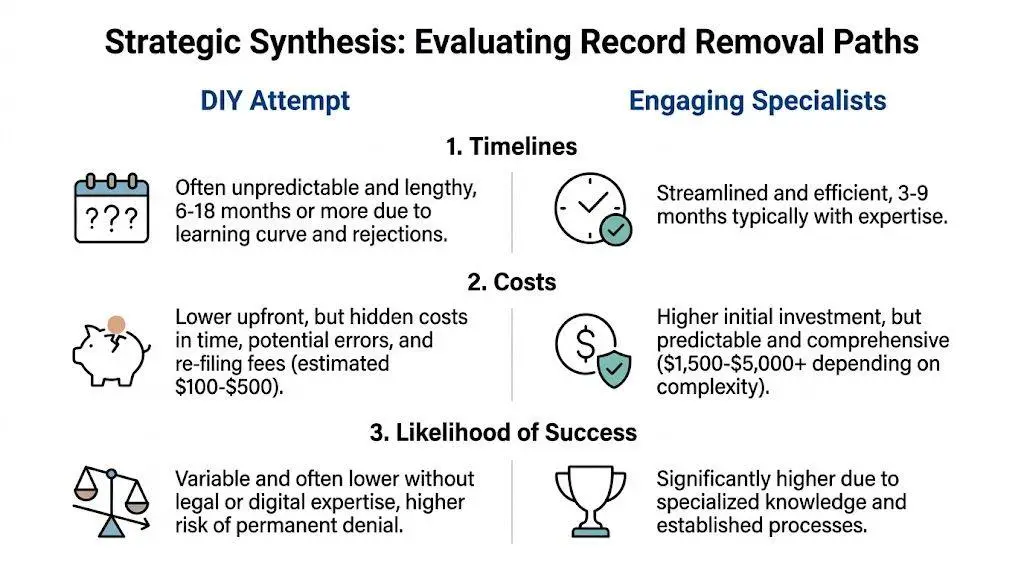
Strategic Synthesis Evaluating Timelines, Costs, and When to Engage Specialists
A client discovers a disciplinary record in search two weeks before a board vote, financing event, or major profile piece. By then, the legal question is only part of the problem. The main issue is exposure. Who can still find it, where it has spread, and how quickly you can reduce visibility before the market treats an old record as current truth.
That is why I do not assess these matters as a simple removal project. I assess them as a gap-control exercise between legal status and online reality. Expungement, sealing, correction, de-indexing, webmaster outreach, and suppression each solve a different part of the problem. If you treat them as separate workstreams, you get delay, duplication, and avoidable failure.
What each path is actually buying you
A DIY effort buys autonomy and lower cash outlay. For a narrow problem on a small number of cooperative sites, that can be enough.
It also buys risk.
You need to identify every indexed copy, determine whether the source is authoritative or derivative, choose the right basis for removal, write requests that do not trigger defensiveness, and keep records for later escalation. One poorly framed demand can harden a publisher’s position or create a paper trail that weakens your next move.
A legal-only approach buys formal authority. That matters when sealing, expungement, correction, or defamation claims are available. But many legal teams stop once the order is in hand. The order does not contact webmasters, clear stale snippets, monitor republication, or push entrenched search results down the page.
A specialist remediation program buys coordination across all three layers. Legal relief strengthens removal requests. Technical removals reduce what search engines can surface. Suppression limits the commercial damage from material that will remain online. That synthesis is the difference between procedural activity and actual containment.
Disciplinary Record Remediation Strategy Comparison
| Strategy | Primary Goal | Typical Timeline | Cost Profile | When It Works Best |
|---|---|---|---|---|
| Legal removal | Create formal authority to challenge publication | Often tied to court, agency, or administrative processing time | Variable legal fees, filing costs, and counsel time | Matters eligible for sealing, expungement, correction, or formal notice |
| Technical takedown | Remove copied, stale, or brokered records from source sites and search results | Usually iterative, with multiple rounds of outreach and follow-up | Operational cost in research, submissions, tracking, and recurrence response | Data brokers, third-party directories, duplicate listings, and outdated cached results |
| Search suppression | Reduce the prominence of persistent negative results in branded search | Usually measured over months, not days | Ongoing content, publishing, optimization, and monitoring cost | Legitimate archives, regulator pages, and other sources that are unlikely to come down |
When DIY is rational and when it isn’t
DIY is rational when the record is isolated, low-ranking, and commercially unimportant. It also makes sense when legal relief is already secured and only a small number of straightforward removals remain.
DIY stops making sense when the result sits on page one for your exact name, appears across several site types, or threatens a transaction, appointment, licensing review, or press cycle. The same is true when the source involves a regulator, a court-linked database, or facts that invite scrutiny beyond the original record.
At that point, this is no longer an administrative clean-up task. It is a reputation risk matter with timing pressure.
The hidden cost of waiting
The internet rewards persistence, not fairness. A record that remains visible gets screenshotted, copied, summarized, and re-published. Each additional copy creates another removal target, another indexing path, and another reason the issue survives after the original source changes or disappears.
That is the gap many clients underestimate. Legal relief can be real and still fail to solve the search problem. A sealed matter may remain visible through scraped copies. A corrected record may still live in old snippets, archives, people-search sites, or low-grade directories. Delay gives those secondary versions time to spread.
The practical consequence is simple. Early coordination lowers total cost. Late intervention raises it because you are no longer solving one publication problem. You are solving a distribution problem.
A clear decision framework
If I were advising a client privately, I would set the sequence this way.
Start legal relief immediately if it is available. Do not wait for that process to finish before addressing copied pages, stale search entries, and broker sites. If a source is likely to remain online, begin suppression in parallel so search results improve while legal and technical work continues.
That sequencing produces compounding advantages. A court order or correction notice gives takedown requests more force. Source removals improve de-indexing outcomes. Better search coverage reduces the business harm caused by material that cannot be erased.
ContentRemoval.com is one provider in this market that handles content removal, de-indexing, and monitoring across websites, search engines, and related platforms. The right question is not which vendor promises the most. The right question is whether one team can run legal coordination, technical execution, and search control without forcing your counsel, PR advisers, and outside vendors to improvise the handoff.
Experienced clients do not pay for motion. They pay for containment, speed, and fewer points of failure.
What I recommend to high-net-worth clients
Measure the issue by visibility, audience, and business consequence. That is how strategic decisions get made.
If the record is obscure and contained, test direct removal first. If legal relief is available, file promptly. If the result is entrenched, ranks for your name, or threatens a transaction or leadership role, treat suppression as part of the primary plan from day one.
The right model is integrated control. Source control. Search control. Recurrence control.
That is how you remove disciplinary record from internet visibility in the only sense that matters. You reduce how often it appears, how high it ranks, how widely it spreads, and how likely it is to define you before anyone sees the rest of the record.
Frequently asked questions
If my record is expunged, will it disappear from Google?
Not on its own. Expungement or sealing changes the official record, but aggregators, people-search sites and archived pages that copied it earlier operate independently of the court. The order becomes the proof behind removal and de-indexing requests you still have to send.
Can I sue a website for publishing my disciplinary record?
Only if the page is false or materially misleading. When a publisher repeats a true public record, defamation is usually a weak theory, and an aggressive letter can harden their position. Privacy, outdated-information and compliance grounds are often the better basis for a request.
What should a removal request for a disciplinary record include?
The exact URL, the specific basis such as a sealed matter, inaccurate status or stale cache, attached proof like a court order or agency correspondence, the precise remedy requested, a professional deadline and a follow-up path. Requests written that way can be routed by a compliance team; vague complaints are discarded.