
To remove bad articles about a company, classify the article first: false, misleading or opinion; credible publisher or opportunistic; current or stale; legal violation or none. Then pick one lead objective, takedown at the source, de-indexing from search, or suppression with stronger assets, and map every mirror and syndicated copy before contacting anyone. A documented evidence packet beats anger.
Key facts
- Direct publisher requests reportedly achieve full removal about 18% of the time versus 42% for legal defamation interventions.
- Incomplete syndication mapping leads to roughly 30% reappearance after a removal.
- Ask for a specific remedy such as correcting a paragraph or applying noindex, not a vague please remove this.
- Escalate to counsel when allegations imply fraud, criminality or misconduct, or the publisher ignores a documented request.
Where ContentRemoval.com comes in. ContentRemoval.com handles hostile articles for companies where the piece is ranking for the brand name, has been syndicated across domains, or threatens a fundraise, enterprise sale or executive appointment. General counsel, the CEO’s office or the company’s PR agency usually makes contact, often after a first outreach has already stalled. A free, confidential 15-minute Exposure Scan maps the article’s full footprint and the right remedy for each copy, and the report is yours to keep. Get a Free, Confidential Exposure Scan or read how our news article removal work is done.
You’re probably reading this because a board member, investor, prospect, recruit, or journalist searched your company name and found something you want gone. It might be false. It might be outdated. It might be technically accurate but framed to inflict maximum damage. Either way, the effect is the same. It sits in search results, gets forwarded internally, and starts shaping decisions before you’ve had a chance to answer it.
Most executives make the same mistake in the first 48 hours. They react emotionally. They fire off a hostile email to the publisher, ask marketing to “push it down,” or call outside counsel before anyone has mapped the exposure. That usually makes the problem harder to solve.
If you need to remove bad articles about company reputation, treat it like a containment problem. Define the asset at risk. Identify the publication path. Decide whether you need source removal, search de-indexing, suppression, or all three. Then move fast and discreetly.
The Anatomy of a Corporate Reputational Crisis
The moment is usually mundane. A CEO gets a text from sales. A prospect “has concerns.” A banker asks for context. Someone on the board forwards a screenshot without commentary. You search the company name and there it is: a hostile article ranking on page one, often above your own website, investor materials, or branded social profiles.
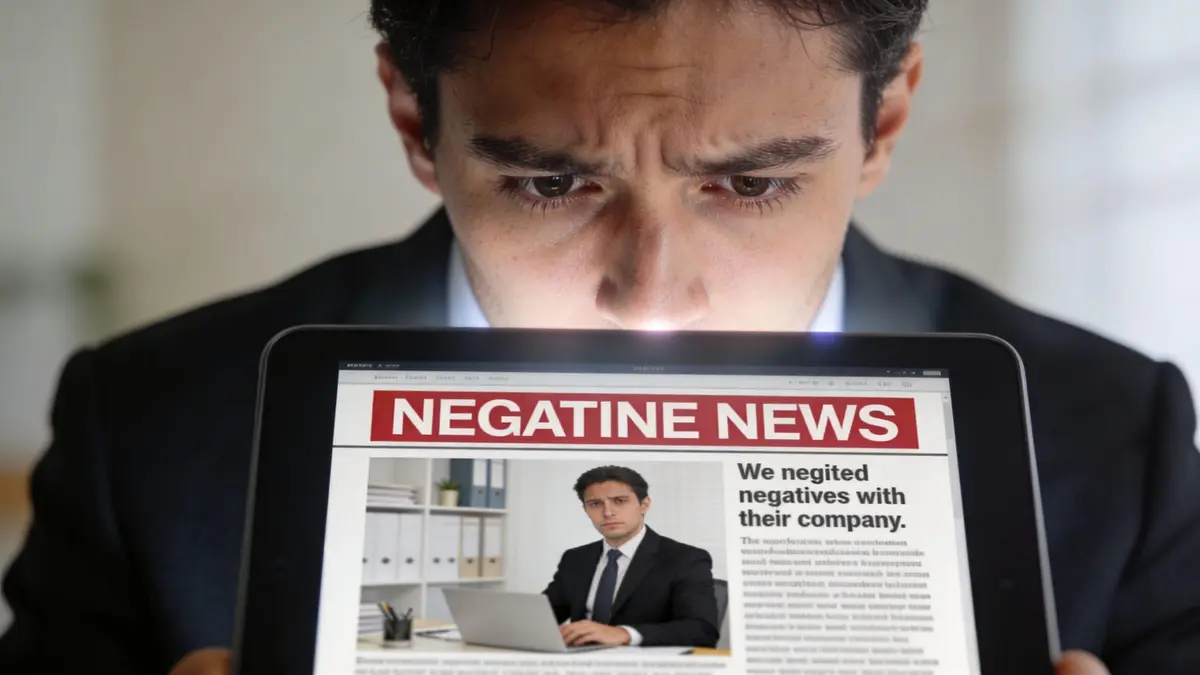
At that point, this stops being a communications annoyance. It becomes a commercial threat. A single negative article on Google’s first page results in a 22% revenue loss, while 90% of consumers avoid businesses with poor online reputations and 86% hesitate to buy from businesses with negative reviews, according to reputation management statistics compiled by Electro IQ.
What executives get wrong first
The first error is assuming the article matters only if it’s defamatory. That’s too narrow. Search-visible content hurts you long before a court would label it unlawful.
The second error is treating all bad coverage the same. A local blog post, a trade publication feature, a Reddit thread, and a syndicated news hit require different playbooks. If you use the wrong one, you waste your only easy chance at removal.
The third error is underestimating distribution. What you see in Google is rarely the whole footprint. One article may have mirrors, RSS copies, snippets, social reposts, and cached versions. The visible article is often just the front door.
Practical rule: If a negative result is ranking for your company name, assume it is already affecting sales, hiring, and counterparties, even if nobody admits that directly.
The crisis is real, but it’s manageable
Executives under pressure tend to ask the wrong question. They ask, “Can we get this removed?” The better question is, “What is the fastest path to reducing visibility and preventing recurrence?”
Sometimes removal is realistic. Sometimes it isn’t. Sometimes you can get the source corrected, de-indexed, or displaced. Sometimes the right move is to bypass the publisher entirely and attack the search layer. Sometimes you need all of it in parallel.
If your team hasn’t built a defensive search posture before this happened, fix that later. Right now, handle the live threat. Then put proper controls in place. If your company hasn’t done that work yet, this guide on ways to protect your business’s online reputation is a useful baseline, but don’t confuse prevention reading with active crisis response.
The Triage Framework Assess Damage and Define Objectives
You can’t choose a remedy until you classify the article correctly. At this stage, most internal teams fail. Legal looks only at defamation. Marketing looks only at rankings. PR looks only at messaging. You need a single assessment that covers all three.
Classify the article before you touch it
Start with the content itself. Ask four direct questions.
- Is it false, misleading, or opinion?
A factual error provides an advantage. A misleading omission may support a correction request. Pure opinion is harder to attack unless it relies on false facts. - Is the publisher credible or opportunistic?
Mainstream media, industry trades, investor blogs, complaint sites, and anonymous “news” domains behave differently. Some will correct. Some will negotiate. Some exist to provoke takedown panic. - Is the article current or stale?
An old article with no present relevance can sometimes be attacked on fairness or public-interest grounds, especially if the reporting is incomplete or outdated. - Does it expose legal or policy violations?
Defamation, copyright misuse, impersonation, manipulated media, privacy violations, and platform rule breaches all create different pressure points.
Don’t email anyone yet. First build the file.
Map the digital footprint
A negative article’s damage depends on where it ranks, what query triggers it, and whether it has copied versions elsewhere. A proper triage review should include:
- Search exposure: Check branded queries, executive-name queries, product queries, and “company + scam” style modifiers.
- Syndication risk: Look for duplicates on Yahoo mirrors, local affiliates, RSS republishers, scraper sites, and cached versions.
- Snippet damage: Sometimes the headline is survivable, but the meta description or AI-generated snippet carries the primary sting.
- Social amplification: Track whether the article has been posted on LinkedIn, X, Reddit, or niche forums where journalists and analysts might discover it again.
Here, in-house teams often make the problem worse. They focus on the URL they can see and ignore the network around it.
If you haven’t mapped the mirrors, you haven’t assessed the problem. You’ve identified one symptom.
Define the objective
Not every bad article should be handled with the same end goal. Pick one primary objective.
| Objective | What it means | When it makes sense |
|---|---|---|
| Remove | Delete or materially edit the source article | Best when there are factual errors, policy breaches, or cooperative publishers |
| De-index | Remove the result from search visibility while the source may stay live | Best when the source is stubborn but search platform rules offer an advantage |
| Suppress | Push the result down with stronger assets | Best when the article is difficult to remove but vulnerable in rankings |
A common mistake is choosing “full removal” as the objective because it feels satisfying. That’s emotional, not strategic. If a page can be de-indexed quickly while source negotiations continue, take the win.
Separate business harm from ego
The issue isn’t whether the article feels unfair. The issue is what it’s costing you and who is seeing it. Ask your team:
- Who encounters this first? Prospects, lenders, journalists, recruits, regulators, or counterparties.
- Which transaction is at risk? Fundraise, M&A, enterprise sale, hiring cycle, licensing, or crisis containment.
- How long can you tolerate visibility? Some matters can sit in a queue. Others can’t survive another week on page one.
This discipline matters because strategy changes under time pressure. A pre-IPO company, a founder in due diligence, and a consumer brand in a social flare-up do not get the same advice.
Know the inflection point
DIY action stops making sense the moment one of these conditions is present:
- The article is syndicated across multiple domains
- The publisher has legal counsel or formal editorial process
- The issue crosses jurisdictions
- The content involves allegations of fraud, misconduct, or criminality
- Your first contact has already been mishandled by someone inside the company
Once that threshold is crossed, amateur outreach becomes evidence, escalates hostility, and narrows your options.
Deciding Your Strategy Takedown vs De-Indexing vs Suppression
You have three primary levers. Takedown removes the content at the source. De-indexing removes search visibility. Suppression buries the result under stronger assets. Most real matters use more than one, but one should lead.
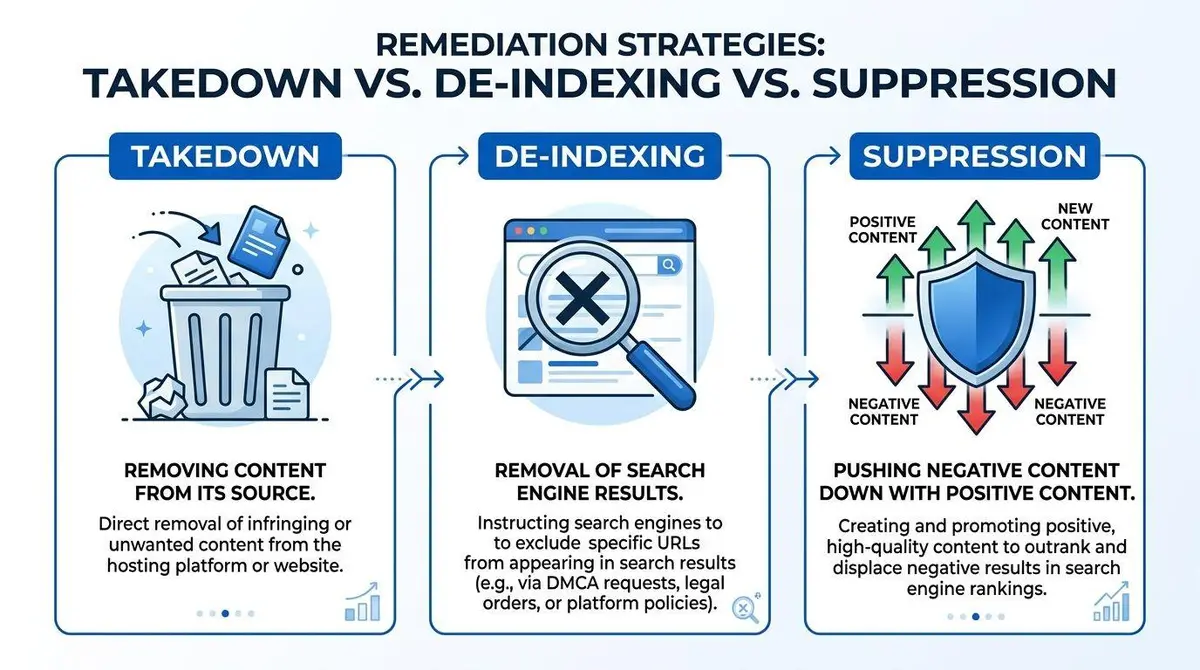
A useful starting point is this: a 2023 study cited by RBS Reputation Management on removing negative news articles found that 18% of direct publisher requests result in full removal, versus 42% for legal interventions involving defamation claims across US and EU jurisdictions. The same source states that ORM burying tactics succeed in 65% of cases for de-indexing but fail long term without monitoring.
That should reset your expectations immediately. A polite internal email is rarely enough.
Strategy comparison
| Strategy | Objective | Best For | Timeline | Risk Profile |
|---|---|---|---|---|
| Takedown | Remove or edit the source article | False statements, policy breaches, cooperative publishers | Variable, depends on publisher and evidence | Highest influence if justified, but mishandled outreach can harden resistance |
| De-indexing | Remove the article from search results | Clear search-policy violations, privacy issues, copied or outdated visibility | Often faster than source negotiation | Useful when source won’t cooperate, but visibility can return if source remains live |
| Suppression | Push negative results down with stronger assets | Lawful but harmful content that won’t come down | Slower, requires asset creation and ranking work | Lower confrontation, but weak execution wastes money and leaves the source untouched |
For a more detailed explanation of the search-side remedy, this strategic guide to search result removal and de-indexing lays out where de-indexing fits and where it doesn’t.
When takedown is the right first move
Go for source removal first when the article contains factual inaccuracies, missing context that changes meaning, unauthorized use of material, or clear editorial negligence. This is also the right move when the publication is credible enough to care about correction standards.
What matters here is influence, not outrage. If you can show that the article is false, incomplete, or exposes the publisher to avoidable risk, takedown is often the cleanest fix because it collapses the problem at origin.
But don’t confuse “I hate this article” with “this publisher is vulnerable.” If the reporting is lawful, documented, and framed as opinion or public interest, your odds drop sharply.
When de-indexing should lead
Use de-indexing when the source is unlikely to cooperate but the search engine may. This includes cases involving privacy violations, manipulated or copied material, explicit policy breaches, or stale content where search visibility is disproportionate to current public interest.
The advantage is speed. You are not asking the publisher to admit fault. You are asking the platform to stop surfacing the result.
That said, de-indexing is not deletion. The article may still exist on the site, in social shares, and in mirrors. If the issue is actively being amplified, de-indexing alone may not hold.
Search control is often more commercially valuable than moral victory. Your buyers don’t care whether the publisher still hosts the page if they can’t find it.
When suppression is the only practical answer
Suppression is what you use when the content is legal, durable, and difficult to dislodge. It works by filling page one and page two with stronger, relevant, authoritative assets that you control or can influence.
This can include executive bios, company microsites, newsroom pages, thought leadership, partner profiles, industry coverage, social profiles, video assets, and tightly optimized third-party placements. Weak suppression campaigns fail because they publish generic fluff on weak domains. Strong ones are built around assets with ranking potential.
Suppression is not a shortcut. It is a media and SEO campaign with a litigation mindset. It requires precision.
A key decision rule
Use this decision test:
- If the article is false and the publisher is responsive, pursue takedown.
- If the article violates platform or search policy, lead with de-indexing.
- If the article is lawful and entrenched, build suppression around it.
- If the article is high-authority and syndicated, run parallel tracks. One path won’t be enough.
The critical inflection point is this. If your first outreach fails, if mirrors appear, or if the article targets a founder, board member, or regulated business, stop improvising. The cost of a clumsy second move is usually higher than the cost of specialist intervention.
The Publisher and Legal Outreach Playbook
Publisher outreach is not customer service. It is controlled advocacy. Your job is to make removal or correction the least painful option for the other side.

The benchmark data is clear. According to RBS Reputation Management’s article removal methodology, negotiated removals succeed in 60-80% of cases per industry ORM benchmarks, Google de-indexing via policy flags hits 70% for clear violations, and full source removals average 50% within 14-30 days. The same source warns that incomplete syndication mapping leads to 30% reappearance rates.
Build the evidence packet first
Don’t contact the author with a vague complaint. Build a file that answers the questions a publisher or lawyer will ask.
Include:
- The exact URL set: original article, cached versions, syndications, mirrors, and search result screenshots.
- The contested statements: quote them exactly and explain why they’re false, misleading, outdated, or unsupported.
- The proof set: documents, timelines, court records, correspondence, public filings, or technical evidence.
- The requested remedy: correction, update, noindex, headline revision, article removal, or complete depublication.
The cleaner your packet, the easier it is for an editor to act without defending the piece out of pride.
How to approach the publisher
Most companies sabotage themselves by writing an angry letter. Don’t do that. A publisher is more likely to respond to a concise, documented, non-theatrical request.
Your outreach should do four things:
- Identify the article and the error precisely
No speeches. No accusations about bias. State the problem in one sentence. - Show the evidence immediately
Don’t promise proof later. Put it in the first communication. - Ask for a specific remedy
“Please remove this” is weaker than “Please correct paragraph three, revise the headline, and apply noindex pending review.” - Set a deadline without posturing
A short review window creates urgency. Threats create resistance.
If you need a model for tone and framing, this guide on how to ask a journalist to remove an article professionally is directionally correct. The central principle is simple. Respect the process, but don’t drift into apology or debate.
A good takedown request reads like a file prepared for an editor and a court at the same time.
When legal escalation is justified
Escalate to counsel when any of the following is true:
- The article contains plainly false factual allegations
- The publisher ignores a documented correction request
- The allegations imply fraud, criminality, professional misconduct, or regulatory breach
- The article is being syndicated despite notice
- The matter spans multiple jurisdictions
At that stage, a cease-and-desist letter isn’t just a pressure tactic. It clarifies the legal theory, preserves the record, and signals that you understand the consequences of publication.
That doesn’t mean litigation is always the answer. Often the letter’s value is that it gives the publisher a face-saving reason to revise or remove the piece without admitting broader fault.
A short visual summary helps when coordinating legal and search tracks internally.
Common errors that kill removals
The mistakes are predictable.
- Overclaiming defamation: If every criticism is labeled defamatory, you lose credibility fast.
- Contacting the wrong person: Authors don’t always control corrections. Editors, legal, standards, or web teams may.
- Ignoring the mirrors: You win one removal and the copies remain.
- Letting marketing handle legal facts: Brand teams write persuasive copy. They don’t build evidentiary records.
There is one more problem. Once you’ve sent a bad letter, your influence drops. Editors circulate it internally. Counsel sees it. Positions harden. If the article matters commercially, your first outreach needs to be right.
Where specialist support becomes necessary
This is the point where one option among others becomes practical. Firms such as ContentRemoval.com handle source outreach, de-indexing requests, syndication mapping, and monitoring for reuploads, which matters when the issue extends beyond a single article or jurisdiction.
That’s the threshold. Not “we’re busy.” Not “our agency can probably handle it.” The threshold is complexity, permanence, and consequence.
Advanced SEO Suppression and Technical De-Indexing
If legal outreach doesn’t solve the problem, you move to search control. Many companies waste months at this point. They publish a few press releases, update the About page, and wonder why the bad result stays put.
Search suppression works only when you treat page one as a finite piece of digital real estate and build assets specifically to occupy it.
What technical de-indexing does
Technical de-indexing targets the search layer, not the publisher. According to this analysis of online reputation repair and search suppression, submitting requests via Google Search Console citing policy breaches can lead to processing in 24-72 hours. The same source states that de-indexing alone yields 75% invisibility on page 1 within 7 days for high-authority news, but drops to 45% without source removal, and that overlooking syndicated mirrors causes 35% persistence.
That last point matters. If the original source remains live and mirrors remain indexed, your “removal” can be cosmetic.
Build suppression assets that can rank
Weak assets won’t move entrenched news results. You need search-credible properties tied to the entity name and query set.
A practical suppression stack often includes:
- Branded web pages: executive leadership pages, governance pages, newsroom hubs, investor content
- Third-party profiles: professional directories, conference speaker pages, association profiles
- Media assets: YouTube interviews, podcasts, image-rich pages, slide decks
- Controlled editorial content: contributed articles, case studies, partner announcements, founder commentary
Use search workflows, not guesswork. If your internal team needs a toolkit for identifying ranking opportunities, content gaps, and SERP competitors, this roundup of best SEO tools is a reasonable operational reference.
The execution standard most companies miss
You are not publishing “positive content.” You are engineering relevant, rankable, defensible assets around the exact queries that trigger the bad result.
That means:
- Matching search intent: Corporate profile pages should rank for company-name searches. Executive bios should rank for founder-name searches.
- Using entity consistency: Company name, executive names, descriptions, and structured brand language should align across assets.
- Supporting with links and distribution: A new page with no authority, no internal support, and no pickup won’t move anything.
Suppression fails when companies publish content they want to say instead of content Google is willing to rank.
De-indexing and suppression should inform each other
The strongest campaigns combine both. If a search engine removes one or more harmful URLs, suppression assets fill the vacuum and make re-entry harder. If de-indexing fails, suppression still reduces exposure over time.
Technical discipline matters here. Every indexed mirror, every stale snippet, and every weak branded page becomes part of the equation. Search results are portfolio management. One neglected asset can leave the entire page vulnerable.
Fortifying Your Digital Reputation Against Future Threats
A one-time cleanup is not a defense system. If your company solves one article and then returns to passive monitoring, you haven’t fixed the problem. You’ve bought time.
That approach is especially dangerous now because the next wave of attacks won’t always look like a normal article. They may involve manipulated media, AI-assisted fabrication, synthetic screenshots, or blended stories that combine true details with false narrative.
The threat profile has changed
The pressure is already visible. Searches for “remove AI deepfake news about company” spiked 150% in 2025, according to Entrepreneur’s reporting on removing bad press and reclaiming your online reputation. The same source states that in the EU, the 2024 AI Act boosts takedown success for harmful deepfakes to 55% within 24 hours, compared with 12% in unregulated US markets.
That gap tells you two things. First, jurisdiction matters. Second, speed matters more.
If manipulated content spreads for even a short period, journalists, employees, counterparties, and search systems may replicate it before the original is addressed. By the time legal reviews are complete, the reputational event has already multiplied.
Monitoring is not optional
Most corporate teams still monitor reputation manually. They rely on Google Alerts, scattered vendor reports, or someone in marketing noticing a bad result too late.
That isn’t enough. You need ongoing detection across branded search, executive names, visual content, major platforms, and republishing channels. Without that, removals don’t hold and small incidents become entrenched.
A serious monitoring posture should answer these questions every week:
- What newly indexed pages mention the company, products, founders, or board?
- Which negative or misleading items have moved up in search?
- Have old articles reappeared through mirrors, cached versions, or reposts?
- Is manipulated content circulating on social platforms before it reaches search?
Know when in-house response stops being credible
There is a clear point where this no longer belongs with internal legal, PR, or SEO acting alone.
That point arrives when:
- The issue spans more than one platform
- The article or media is copied across domains
- The allegations threaten financing, enterprise sales, licensing, or executive employment
- The matter crosses the US, EU, UK, or other jurisdictions with different removal rules
- The content may be synthetic, manipulated, or bot-amplified
At that point, delay is expensive. So is fragmented advice. Legal may preserve claims but miss search exposure. Marketing may improve optics but damage evidence. PR may stabilize messaging while the underlying result stays live.
The right time to bring in specialists is before your second failed move, not after your reputation has been copied across ten domains.
Build a durable defense, not a cleanup habit
The executive view should be simple. Your company needs three layers.
First, a response layer for active removals, de-indexing, and emergency outreach.
Second, a search control layer for suppression, owned assets, and resilient branded visibility.
Third, a monitoring layer that catches reuploads, mirrors, and new threats before they rank.
That’s the inflection point most companies miss. They think the question is whether they can remove one bad article about company reputation. It isn’t. The critical question is whether they can stop the next one from becoming a recurring commercial liability.
If the answer is no, the decision is straightforward.
If a negative article is affecting revenue, hiring, investor confidence, or executive credibility, get a confidential assessment from ContentRemoval.com. The work starts with a precise review of the article, search footprint, and jurisdiction, then moves to the right remedy: source outreach, de-indexing, suppression, or a coordinated combination. When the stakes are real, speed and discretion matter more than generic advice.
Frequently asked questions
Can a negative news article about my company be deleted?
Sometimes, when it contains factual errors, missing context that changes meaning, unauthorized material or editorial negligence and the publisher is credible enough to care about correction standards. Lawful, documented reporting framed as opinion or public interest is much harder to remove, and de-indexing or suppression become the practical routes.
What is the difference between de-indexing and suppressing a bad article?
De-indexing removes the result from search visibility while the source may stay live, and it is often faster than negotiating with the publisher. Suppression pushes the result down by ranking stronger assets you control, which works for lawful content that will not come down but takes longer.
How should I contact a publisher about a damaging article?
Build an evidence packet first with every URL, the exact contested statements, proof and a specific requested remedy. Then send a concise, non-theatrical request that identifies the error in one sentence, includes the evidence immediately and sets a short review window without threats.