
Radaris people search assembles addresses, relatives, phone numbers and photo matches into a single profile that often ranks beside your legitimate results. Removal starts with the opt-out at control.radaris.com: find the exact profile, copy its URL, select the correct record, verify with a compartmentalized email and confirm. Because upstream brokers feed the data, the listing can return, so monitoring follows.
Key facts
- Radaris can be searched by name, address, phone, email or organization and describes billions of entries.
- Its photo search lets a user upload an image and return matched identity details, names and locations.
- Capture screenshots and the exact URL before submitting any request, since changed content loses proof.
- A completed opt-out is a tactical win, not durable removal; recheck branded search and name variants.
Where ContentRemoval.com comes in. ContentRemoval.com handles Radaris and the wider broker chain behind it for executives, family offices and public figures whose listing exposes a residence, links relatives or reappears after an opt-out. A chief of staff, security lead or counsel usually flags it ahead of a board event, financing round or press cycle. A free, confidential 15-minute Exposure Scan maps every broker profile and search result tied to your name and what is removable, and the report is yours to keep. Get a Free, Confidential Exposure Scan or read how our data broker removal work is done.
You search your name, or your principal’s name, because something feels off. A board appointment is pending, a financing round is active, a custody issue is sensitive, or a harassment matter has already started to move offline. Then you see it. A Radaris profile with addresses, relatives, phone numbers, and fragments of a life that were never meant to be assembled in one place.
That moment changes the problem. This isn’t a housekeeping task. It’s exposure.
For executives, public figures, and family offices, Radaris people search creates a usable dossier for strangers, litigants, opportunists, hostile media, and anyone willing to weaponize public record fragments. The right response isn’t panic. It’s disciplined containment, followed by a removal strategy that accounts for replication, search visibility, and the limits of one-off opt-outs.
Confronting Your Digital Exposure on Radaris
The first mistake is treating a Radaris listing as embarrassing but harmless. It isn’t harmless when it maps a residence history, links associates, and gives a stranger a shortcut into your private life.
I’ve seen the same sequence repeatedly. An executive assistant flags the profile before a shareholder event. A family office discovers multiple listings while tightening residential security. Counsel finds a people-search page ranking beside legitimate professional results during a diligence review. In each case, the issue isn’t curiosity. The issue is access.
What the listing actually signals
A Radaris profile tells you three things immediately. First, your personal data has already been assembled into a single searchable record. Second, third parties can reach that record without context or permission. Third, the profile may not be the only copy.
That last point matters most. If one broker has stitched the profile together, others often have the raw material too.
Immediate rule: Treat discovery of a Radaris profile as a live privacy event, not a future reputational concern.
If you’re reviewing your broader privacy posture, the fastest way to understand how responsible operators frame collection and use of personal information is to compare it against a published data handling policy. Not because that policy governs Radaris. It doesn’t. But because it sharpens the contrast between transparent data practices and opaque aggregation.
What to do in the first hour
Your first hour shouldn’t be spent arguing about fairness. It should be spent preserving evidence and narrowing risk.
- Capture the profile with screenshots and the exact URL.
- Search for variants of your name, including middle initials, old cities, and common misspellings.
- Check search visibility by reviewing how the profile appears in branded search results.
- Assess related exposure such as spouse, child, or principal residence records that may be linked.
Do that before you start submitting requests. Once content changes, you may lose useful proof of what was displayed and how widely it was indexed.
Deconstructing the Radaris Data Aggregation Engine
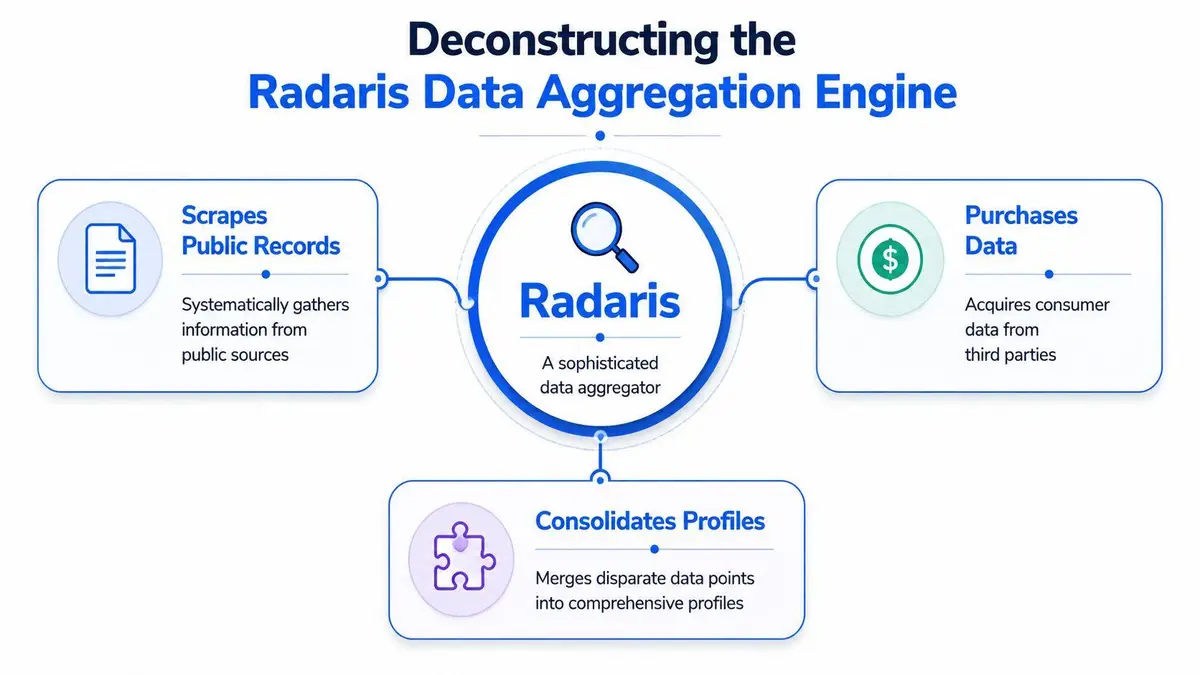
Radaris isn’t a simple directory. It operates like an aggregation layer built to consolidate scattered identity signals into a single profile.
Radaris says it can be searched by name, address, phone number, email, or organization name, and its site describes an “extensive database with billions of entries”. Its positioning reflects a broad public-record and commercially available data model, not a narrow contact listing. Radaris also presents itself as a universal people directory founded in 2013 on its public-facing service pages.
Why this matters
A common misconception arises. Many assume the profile exists because one source published one bad data point. That’s rarely the actual problem. The underlying issue is consolidation.
A property record here, an old phone number there, a social profile, a licensing entry, a business association, a relative match. Aggregators package those fragments into something far more invasive than any single source.
That’s why a deletion request at one origin point often doesn’t solve the exposure. It may remove one ingredient while leaving the assembled profile largely intact.
How to think about the engine
Use this framework:
| Function | Practical effect |
|---|---|
| Search by multiple identifiers | A stranger doesn’t need your full legal name to find you |
| Aggregated profile structure | Separate records become a single dossier |
| Broad database scope | Suppressed data can re-enter when source feeds refresh |
For executives, this changes the tactical response. You’re not removing one page from one site. You’re dealing with a system designed to ingest and reconnect identity fragments. If you need a broader primer on the ecosystem behind sites like this, this guide on what data brokers are and why they matter for executive privacy is the right framing document.
A visible profile is usually the endpoint of a larger broker chain, not the beginning of it.
Assessing the Reputational and Security Threats
The threat isn’t abstract. It’s operational.
A Radaris profile reduces the work required to identify, contact, locate, and pressure a target. For a public company officer, that can mean spear-phishing and social engineering. For a founder in litigation, it can mean pressure tactics directed at family members. For a public figure, it can mean doxxing, stalking, or coordinated harassment amplified by search visibility.

The most serious escalation point
Radaris’ face-search functionality materially changes the risk profile. Radaris’ people-search-by-photo workflow allows a user to upload a photo or image URL and return matched indexed images with associated identity details such as names, contact details, social profiles, and location on its photo search page.
That matters because the attacker no longer needs a name. A public photo can become the entry point.
If your image appears on a conference site, podcast page, foundation gala gallery, school event, or social post, facial lookup can connect that image to structured identity data. For clients with existing threat concerns, that’s the bridge from online recognition to real-world targeting.
How exposure turns into harm
The risk pathways are straightforward:
- Harassment campaigns begin with a searchable home geography, family links, or direct-contact trails.
- Phishing operations improve when attackers can cross-check identity details and build believable pretexts.
- Corporate intelligence gathering gets easier when personal and professional identifiers are packaged together.
- Physical security threats increase when publicly available imagery can be tied back to names and locations.
Who should treat this as urgent
Not every listing has the same consequence. These categories warrant immediate escalation:
| Profile type | Why urgency is higher |
|---|---|
| Public company leaders | Higher likelihood of targeted fraud and investor-facing scrutiny |
| Founders in active disputes | Opposing parties and online agitators look for pressure points |
| Family offices and HNW households | Residence privacy and household mapping become security issues |
| Media-facing figures | Public images create more opportunities for reverse identification |
If a stranger can move from a face to a profile, your risk has already crossed from digital inconvenience into personal security.
Why Radaris Profiles Dominate Search Results
What unsettles most clients isn’t only that the profile exists. It’s that the profile often shows up when someone searches their name.
Search engines reward pages that appear tightly matched to a specific query. A people-search profile usually contains the exact ingredients that search systems like to see for name-based searches: a full name, location references, associated identifiers, and a page structure built around one individual. That gives the page relevance even when the information is stale, incomplete, or unwanted.
Why your official pages don’t always win
Your company biography may be polished but brief. Your LinkedIn page may require a login for some viewers. A personal site may be thin. By contrast, an aggregator page is often designed as a dense identity record.
That density affects perception. Search engines don’t evaluate dignity. They evaluate signals.
Here’s the practical result:
- Branded searches get hijacked when the broker page is treated as a direct match for your name.
- Diligence reviewers click the first result if it looks thorough.
- Negative assumptions form fast when a profile implies hidden addresses, aliases, or unexplained associations.
What this means strategically
Don’t reduce the problem to “remove the page.” Also ask whether the page has already shaped your visible search narrative.
If the Radaris result appears near your legitimate assets, the issue is dual-track. You need source-level suppression where possible, and you may need search-result remediation if the URL persists in index or cached snippets after a takedown.
Search visibility is reputation control. Whoever owns the first page often defines the first impression.
A Step-by-Step Guide to the Radaris Opt-Out Process
Start with the platform’s own removal mechanism. It’s the right first move, but don’t confuse it with a complete solution.
The baseline removal workflow
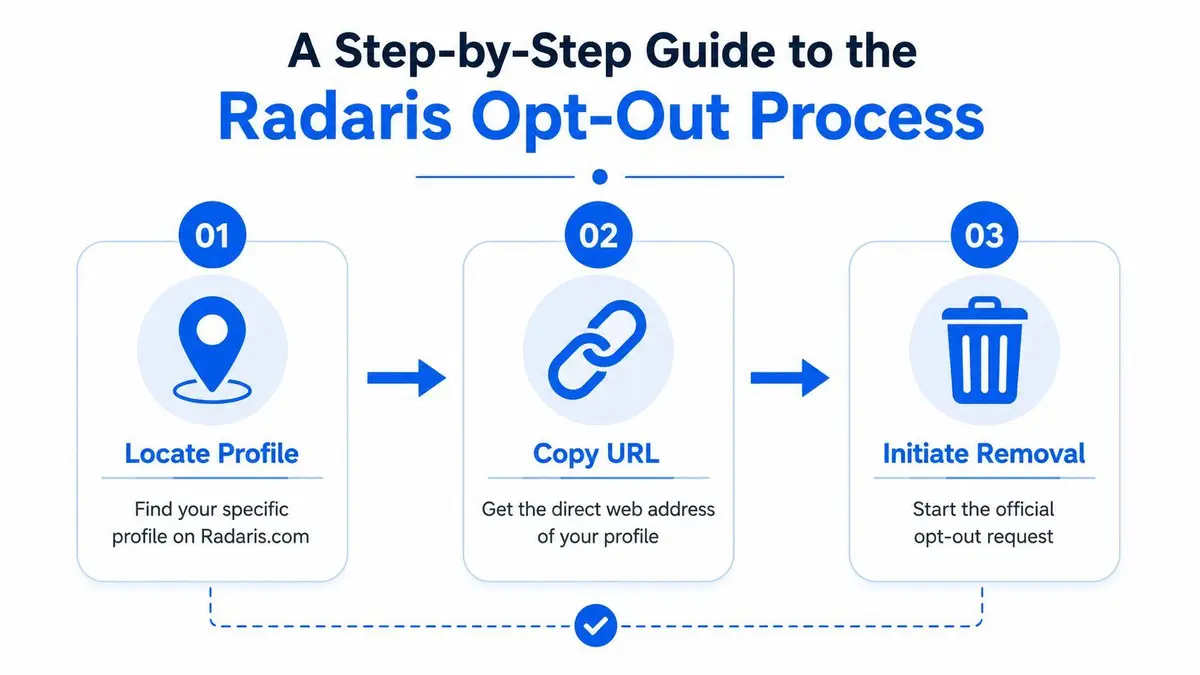
Use a controlled process. Don’t improvise.
-
Find the exact profile
Search Radaris for your name and location, then identify the correct listing. Be careful with duplicate records, old cities, and alternate spellings.
-
Copy the profile URL
You need the direct page address, not just the search results page. Preserve it in your case file with screenshots.
-
Go to the removal portal
Radaris directs users to its opt-out system at control.radaris.com. Follow the prompts to locate the same profile inside the removal workflow.
-
Select the correct record
Confirm that the profile corresponds to you and not a relative or namesake. Mistaken removal attempts create delay.
-
Use a compartmentalized email
Submit an email address for verification. For privacy-sensitive matters, use a dedicated address that isn’t tied to your personal or executive identity footprint.
-
Complete the confirmation step
If Radaris sends a verification email, click the confirmation link promptly. Until you complete that step, the request may remain inactive.
A short walkthrough can help if you’re delegating the task internally:
What the DIY process doesn’t solve
The opt-out only addresses the visible record you found. It doesn’t guarantee that every variant is gone, that cached search results will disappear immediately, or that upstream source material won’t feed future re-listing.
That’s the structural weakness. Executives often complete the form, see temporary suppression, and assume the matter is closed. Then the profile reappears under a name variation or a related household record.
Here’s the practical checklist after submission:
- Recheck branded search results for the profile URL and any duplicate listing.
- Search adjacent identities including former addresses, business entities, and relatives.
- Document the timeline of submission, confirmation, and outcome.
- Expand beyond Radaris if the same profile data appears across other broker networks.
If you need a more complete operating framework for that broader cleanup, this resource on people search removal and private data protection is the right next read.
Operational warning: A successful opt-out is a tactical win. It isn’t proof of durable removal.
When DIY Removal Is Insufficient A Case for Specialists
At 6:30 a.m., your chief of staff forwards a screenshot. Your Radaris profile is back. It now connects your residence history to relatives, and the page is ranking beside your company bio. That is the point where this stops being a privacy chore and becomes a risk management problem.
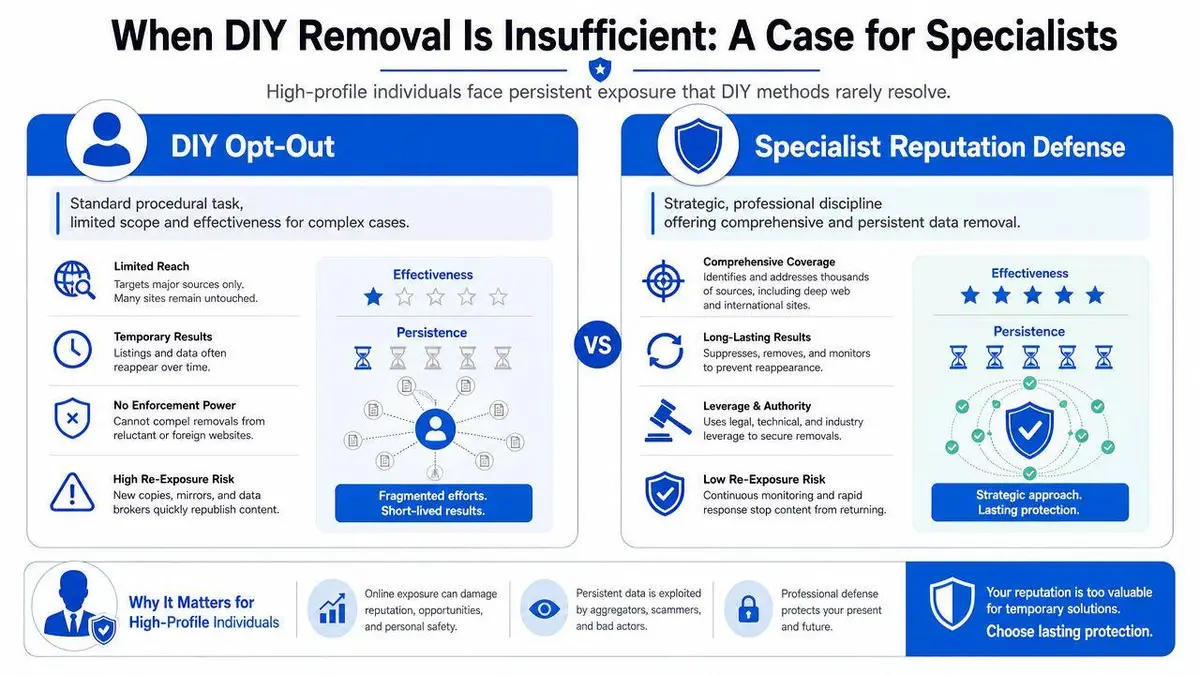
DIY removal fails in predictable situations. It fails when identity variants exist, when search visibility matters, when family members are exposed, and when hostile third parties are already watching. Public executives, founders, investors, physicians, and public-facing counsel should treat those conditions as escalation triggers.
The decision line
Use a simple standard. If the issue can affect personal security, litigation posture, deal activity, or press exposure, assign it to a specialist.
| Situation | DIY may be enough | Specialist intervention is warranted |
|---|---|---|
| Single low-visibility profile | Yes | Not usually |
| Executive or public figure exposure | Rarely | Yes |
| Family address or household links exposed | Sometimes | Usually |
| Reappearance after opt-out | No | Yes |
| Connected harassment or defamation | No | Yes |
The dividing line is control. A form submission can remove one page. It does not control copies, variants, search persistence, related broker records, or coordinated abuse.
What specialists change
Specialists build a case file, not a one-off request. They map name variants, former addresses, household links, duplicate profiles, and the other broker entries that keep repopulating the same exposure. They also document every submission, response, reappearance, and escalation point so the work holds up under scrutiny from legal, security, and communications teams.
That matters most when the Radaris listing is only the visible symptom. The underlying problem is often a repeatable identity trail spread across broker databases, search indexes, cached pages, and low-quality directories. If your team needs a tighter operating model, use this executive guide to removing yourself from data broker lists. For the search side of the equation, digital reputation strategies for 2025 is a useful companion.
When internal handling should stop
Stop routing this through an assistant, intern, or general marketing staffer if any of these conditions apply:
- Your home address, building, or neighborhood is visible and your security posture depends on location privacy.
- Children, spouse, or relatives are named or linked in ways that widen the target set.
- The profile has reappeared or multiplied after a prior opt-out.
- You are in active litigation, fundraising, a board event, a proxy fight, or a press cycle where search results will be reviewed by adversaries.
- Harassment, impersonation, extortion, or defamatory content is connected to the listing on other sites.
- Your name generates multiple legitimate public references that make identity matching harder and errors more likely.
Delay creates exposure. Once a profile is indexed, copied, screenshotted, and cross-referenced, the cleanup becomes more expensive and less predictable.
For high-profile individuals, specialist intervention is not about convenience. It is about reducing attack surface, tightening search visibility, and keeping one broker listing from turning into a wider reputational incident.
Implementing a Long-Term Digital Reputation Shield
At 6:30 a.m., before a board meeting or media appearance, someone searches your name and finds a Radaris profile with an old address, relative names, and enough fragments to map your private life. By then, the risk is already operational. Cleanup started too late.
A long-term shield treats Radaris exposure as an ongoing risk management problem. Broker records refresh. Search results shift. New references enter the public record through real estate activity, business filings, media coverage, event pages, and commercial data feeds. A one-time opt-out does not control any of that.
The right model has three working parts:
- Continuous monitoring for new broker profiles, duplicate listings, and search-result changes tied to your name.
- Fast removal action before a new page gains search traction or gets copied into other databases.
- Search control so verified professional assets outrank thin identity pages built from scraped data.
As noted earlier, a broader search strategy matters. So does a disciplined broker-removal process. Used together, they reduce recurrence, shorten exposure windows, and keep one Radaris listing from becoming a larger reputation problem.
Many executives make an expensive mistake when they treat opt-outs as clerical work. That approach fails once exposure affects residence privacy, family security, investor diligence, active litigation, or a live press cycle. At that point, the issue is no longer administrative. It is protective.
DIY removal works for isolated, low-risk listings. It breaks down when profiles reappear, spread across broker networks, or intersect with search visibility and personal security. Public figures and senior operators should make that call early. Delay gives bad data time to index, copy, and harden.
If your Radaris exposure affects executive security, family privacy, search visibility, or an active reputation matter, engage ContentRemoval.com for a confidential assessment. The right response is documented, targeted, and built to reduce repeat exposure, not just remove one page.
Frequently asked questions
How do I remove my information from Radaris?
Locate the exact profile on Radaris, copy its direct URL, then go to the removal portal at control.radaris.com and select the same record, taking care not to pick a relative or namesake. Submit a dedicated verification email and click the confirmation link promptly, since the request may stay inactive until you do.
Why does my Radaris profile keep coming back after I opt out?
Radaris is an aggregation layer fed by property records, old phone data, social profiles and other broker sources. Removing the visible page does not remove the ingredients, so when source feeds refresh, a new profile or a name-variant listing can appear. Durable removal needs monitoring and cleanup across the broker network.
When should I hire a specialist instead of doing the Radaris opt-out myself?
When your home address or household links are visible, children or relatives are named, the profile has reappeared or multiplied, you are in litigation, fundraising or a press cycle, or harassment, impersonation or defamation is connected to the listing elsewhere. A single low-visibility profile can usually be handled directly.