
Public disclosure of private facts is a privacy tort covering the widespread publication of truthful, private information that a reasonable person would find highly offensive and that is not of legitimate public concern. Unlike defamation, truth is no defense. The claim needs all four elements, faces consent, newsworthiness and already-public defenses, and is often slower than a removal-first strategy.
Key facts
- The four elements come from California’s CACI No. 1801: publicity, private fact, highly offensive, no legitimate public concern.
- Forwarding to one friend usually fails the publicity requirement; a public post or indexed page changes the analysis.
- Public figures face harder newsworthiness arguments when leaks touch public conduct, office or controversy.
- Filing suit creates records and discovery that can revive the story; litigate deliberately, not reflexively.
Where ContentRemoval.com comes in. ContentRemoval.com works on the containment side of a private facts problem: mapping the distribution chain, filing targeted platform takedowns for leaked images and screenshots, pursuing de-indexing and watching for reuploads while counsel weighs a claim. Clients often come through their lawyer or family office once copies start spreading. A free, confidential 15-minute Exposure Scan maps what is removable now and what needs a legal route, and the report is yours to keep. Get a Free, Confidential Exposure Scan or read how our content removal work is done.
A private photo appears in search results. A confidential board email is suddenly circulating in screenshots. A journalist calls asking for comment on something that was never supposed to leave a closed circle. By the time individuals realize they have a privacy problem, they no longer have a private problem. They have a distribution problem.
That distinction matters. Shame makes people freeze. Strategy restores advantage.
If someone has exposed truthful but intimate information about you, this may fall under public disclosure of private facts. That doctrine can be useful, but it isn’t a magic button. It has strict elements, strong defenses, and real tradeoffs. In high-stakes matters, the wrong response often causes more reputational harm than the original leak.
Your objective shouldn’t be emotional vindication. It should be control. Stop the spread, preserve evidence, reduce visibility, and choose the remedy that matches your actual goal.
Anatomy of a Digital Crisis
A founder sends a personal message to someone they trust. The exchange turns sour. Hours later, cropped screenshots are posted to a social platform, copied to a gossip forum, and indexed by search engines. The messages are real. That’s what makes the situation dangerous.
A family office executive faces a different version of the same problem. A private image, never intended for publication, is shared in a group chat. One recipient forwards it. Another posts it anonymously. Then a third party republishes it with commentary. The original betrayal hurts, but the actual damage comes from replication.
Why panic produces bad decisions
Individuals often react in one of two ways. They either threaten everyone immediately, or they do nothing because they’re afraid any action will amplify the story. Both responses can be costly.
Threatening suit before you understand who published what, where it sits, and how far it has spread usually weakens your position. Waiting too long lets copies proliferate across platforms, search results, and archives. In privacy matters, time doesn’t just pass. It multiplies exposure.
The first task isn’t to argue. It’s to map the distribution chain.
That means identifying the original source, the highest-visibility reposts, the platforms involved, whether search engines have indexed the material, and whether the content violates platform rules independent of any legal claim.
Treat this as a business risk
If you’re an executive, investor, public figure, or family-office principal, a disclosure like this isn’t just personal. It can affect board confidence, counterparties, employee trust, family safety, and media posture. A private leak can quickly become a negotiation problem.
Here’s the practical lens:
- Reputation risk: What appears when someone searches your name now.
- Exploitation risk: Whether the publisher is using the material to pressure, embarrass, or extort.
- Litigation risk: Whether your facts support a viable privacy claim.
- Containment risk: Whether copies are already spreading faster than a legal process can address.
The law gives you one set of tools. Platform enforcement, de-indexing requests, source removal work, and monitoring give you another. In serious matters, you usually need to evaluate both at once.
Defining the Invasion of Privacy Tort
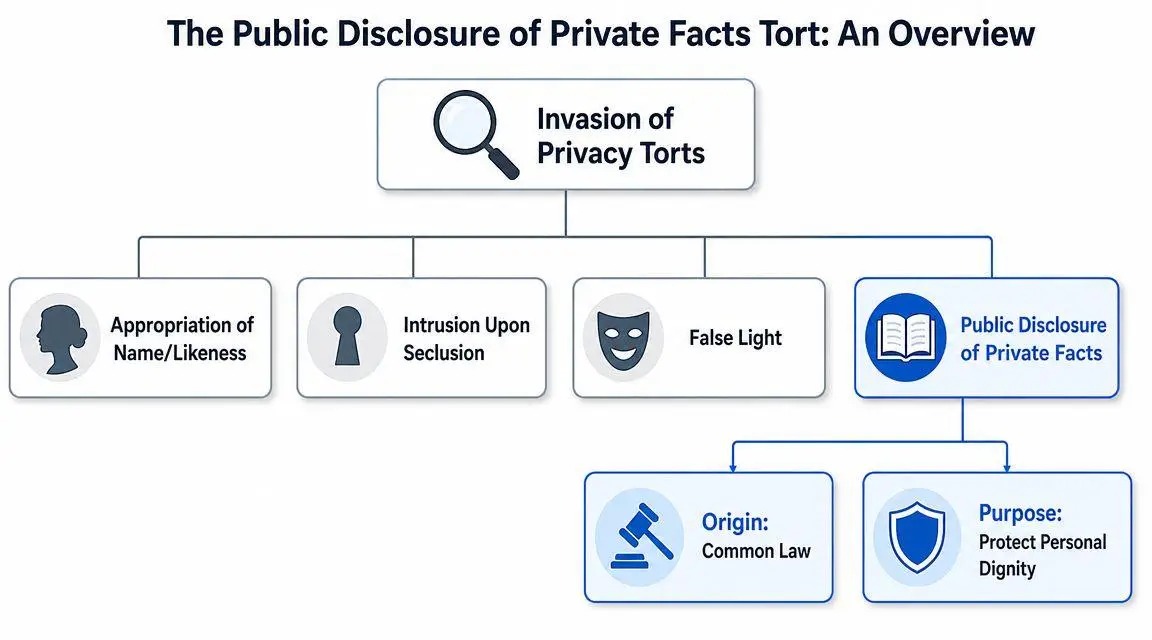
Public disclosure of private facts is not defamation. Defamation concerns false statements. This tort concerns the publication of true information that should not have been exposed to the public in the first place.
That difference is where many knowledgeable clients misjudge their options. They tell counsel, “But it’s true.” Exactly. Truth may defeat a defamation claim, but it doesn’t automatically defeat a privacy claim.
Where this claim came from
The doctrine is a relatively modern privacy concept. It is commonly traced to Samuel D. Warren and Louis D. Brandeis’s 1890 Harvard Law Review article, “The Right to Privacy,” and U.S. courts later developed it into a four-part structure reflected in California’s jury instruction, CACI No. 1801, requiring publicity, private facts, offensiveness, and lack of legitimate public concern, as summarized by the Freedom Forum discussion of public disclosure of private facts.
What the tort is really protecting
This area of law exists to protect dignity and control over intensely personal information. Not every embarrassment qualifies. Not every intrusion qualifies. The core problem is wider publication of something intimate, nonpublic, and unjustified by real public interest.
Working definition: Public disclosure of private facts is a claim based on the widespread publication of truthful, private information that a reasonable person would find highly offensive to have exposed, where the material is not legitimately newsworthy.
That last point matters more than most non-lawyers realize. Courts don’t just ask whether something is interesting. They ask whether the public has a legitimate reason to know it.
What clients should take from the definition
Don’t ask only, “Was this invasive?” Ask the sharper questions.
| Question | Why it matters |
|---|---|
| Was the information actually private? | If it was already genuinely public, your claim weakens fast. |
| Was it shared broadly enough? | A message to a handful of people often isn’t enough. |
| Would an ordinary person find this highly offensive? | Personal embarrassment alone isn’t the legal test. |
| Is there a plausible public-interest argument? | This is often where defendants fight hardest. |
The doctrine can be powerful. But it rewards disciplined facts, not outrage.
The Four Legal Elements You Must Prove
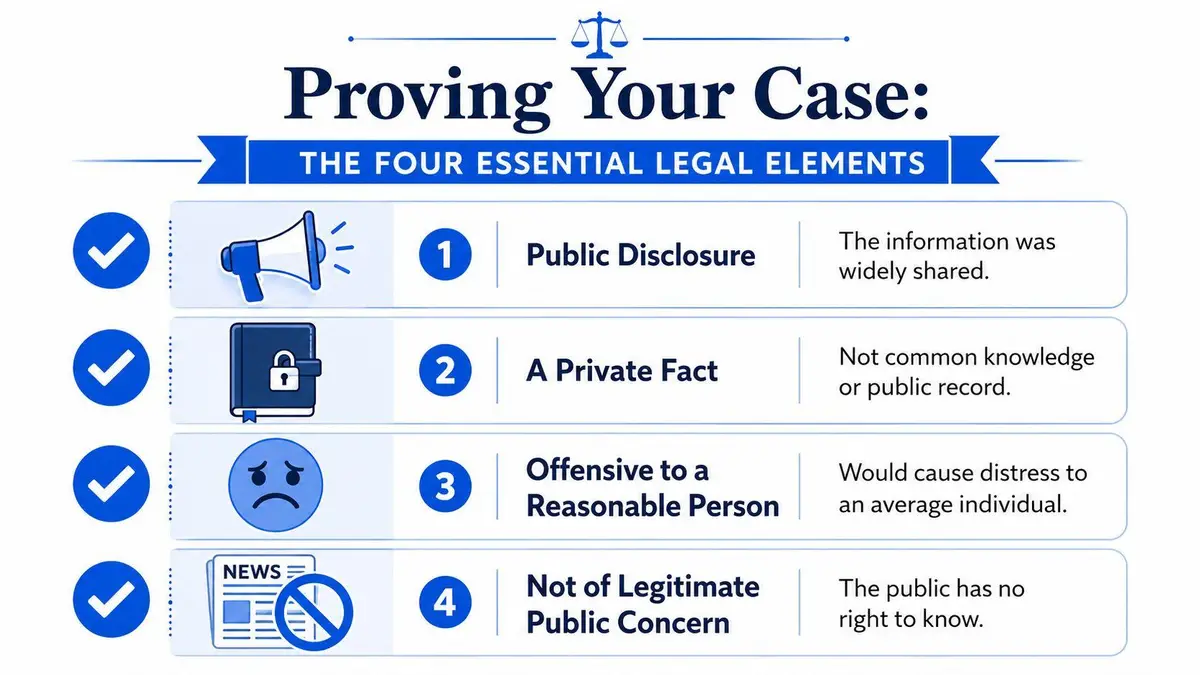
The legal test is narrower than commonly assumed. Under U.S. privacy-tort doctrine, public disclosure usually requires dissemination to the public at large or to so many people that the matter is substantially certain to become public knowledge, and the disclosed fact must be private, highly offensive to a reasonable person, and not of legitimate public concern, as reflected in CACI No. 1801 on Justia.
Public disclosure
This is the first trap. Clients often assume any unauthorized sharing counts. It doesn’t.
If a former partner sends a private image to one friend, that may be wrongful in other ways, but it may not satisfy the publicity requirement for this tort. If that same image is posted on a large social platform, indexed by search engines, or syndicated across multiple public sites, the analysis changes.
A useful practical distinction is this:
- Private transmission: one-on-one forwarding, a small chat, a narrow internal email chain
- Public exposure: a website post, open social post, forum thread, searchable article, or mass-distributed publication
The legal injury here is tied to reach.
A private fact
A fact isn’t private just because you dislike its publication. It needs to be something not generally known and not already public in a meaningful sense. Medical details, intimate photos, private sexual communications, confidential family issues, and sensitive personal messages often raise this issue.
Corporate clients miss a separate angle. A leaked personal issue tied to workplace conduct may still be private, but if the publication is framed as governance, misconduct, or investor protection, the defendant will try to convert a private fact into a public-interest story.
Highly offensive to a reasonable person
This standard is objective. The question isn’t whether you were upset. Of course you were. The question is whether a reasonable person in your position would view the publicity as highly offensive.
Courts look for something more serious than awkwardness. They look for exposure that decent people would recognize as a substantial invasion.
Intimate images usually present this issue more cleanly than unpleasant gossip. Cropped DMs can be trickier if they show rude, foolish, or hypocritical behavior but not private material of a significant nature.
Not of legitimate public concern
This is often the primary battlefield. If you’re prominent, wealthy, politically connected, or publicly visible, defendants will argue that your conduct, relationships, spending, communications, or past records bear on matters the public has a right to evaluate.
That doesn’t mean every salacious detail becomes protected journalism. But it does mean high-profile people face a harder path than private individuals.
Use this rough screening table early:
| Scenario | Likely pressure point |
|---|---|
| Intimate image posted publicly | Offensiveness and privacy often favor the claimant |
| Screenshot of private texts about a public scandal | Newsworthiness may dominate |
| Old personal incident republished without current relevance | Public concern may be contestable |
| Family photos exposed for humiliation | Private-fact and offensiveness issues may be strong |
A viable claim needs all four elements to work together. One weak link can collapse the case.
Why These Claims Are Difficult to Win
Clients often assume that if material is private and harmful, a lawsuit follows naturally. That isn’t how this works. Privacy litigation is usually a contest over defenses, exceptions, and practical proof.
The defendant may say you consented
Consent doesn’t have to look like a formal media release to become a problem. If you voluntarily provided the material in circumstances that a court sees as authorizing publication, or if you knowingly participated in a public-facing process, your position weakens.
That issue comes up often with interviews, recorded conversations, publicity efforts, and messages sent to people you later accuse of disclosing them. The harder the factual record points toward permission, the worse the case becomes.
Newsworthiness is broad and elastic
Public concern isn’t limited to traditional hard news. If the defendant can connect the disclosure to public conduct, public office, public controversy, professional standing, or a topic that readers have a legitimate interest in, they will push that defense aggressively.
For executives and public figures, emotion can get expensive. You may feel violated and still face a serious argument that the publication had enough public significance to defeat liability.
A court won’t rescue you from reputational pain just because the facts are true and cruel.
Already public is the hardest digital question
A primary defense is that there’s generally no liability for merely repeating information that is already public, but the difficult issue is what counts as public in practice, especially with reposts, screenshots, and search indexing, as discussed in the KAASS overview of what is public disclosure of private facts.
That is the nuance most online commentary skips. A fact can be technically accessible and still not obviously “public” in the sense that defeats a claim. One obscure upload is different from broad circulation. One archived page is different from a first-page search result. One court record is different from a sensational retelling detached from any current public purpose.
Litigation creates its own exposure
Even when the facts support a strong claim, filing suit can worsen the underlying reputation problem. Pleadings become records. Reporters may revisit the story. Opposing counsel may test your private history in discovery. If your real goal is disappearance, not damages, court may be the wrong first move.
That doesn’t mean litigation lacks value. It means you should use it deliberately, not reflexively.
Online Scenarios Leaked Images DMs and News Articles
Modern privacy crises don’t arrive in neat legal categories. They arrive as posts, screenshots, mirrors, caches, and search results.

Leaked intimate images
This is often the cleanest fact pattern for privacy enforcement. If the image was private, shared without consent, posted publicly, and serves no legitimate public concern, the legal and platform arguments are usually aligned.
But don’t confuse a strong moral position with a complete remedy. Even when the original post comes down, copies often survive on secondary sites, message boards, and search results. If you’re dealing with this scenario, a parallel legal and removal strategy is usually smarter than relying on one pathway alone. For a focused triage plan, see this professional guide on what to do if your nudes are leaked.
Screenshots of DMs, emails, and texts
These cases are more mixed. A private message can plainly involve a private fact. But a court may ask what exactly was disclosed. Was it intimate medical information, family trauma, sexual content, or financial distress? Or was it merely unpleasant speech, hypocrisy, flirtation, or internal politics?
The more the screenshots relate to a public controversy, workplace misconduct, investor communications, or abuse allegations, the more likely the publisher will frame the disclosure as legitimate public concern.
A useful internal test:
- Stronger privacy posture: highly personal content with no public significance
- Weaker privacy posture: messages tied to a scandal, official role, or broader accountability issue
Old news stories and renewed circulation
This is the problem many wealthy clients face. An old article resurfaces and starts ranking again. The material may be true, stale, and devastating.
Here the question isn’t just whether the story once appeared somewhere. It’s whether renewed visibility serves a current public purpose. A dated report with little present relevance may be a better candidate for suppression, de-indexing requests, or negotiated removal than for headline litigation.
Former employee leaks
When a former employee posts internal messages, travel details, family information, or confidential personal material, the case often spans privacy, contract, employment, and trade secret concerns. That can be useful. Multiple pressure points yield significant influence.
But strategy matters. If your legal team overstates a weak privacy claim while ignoring stronger contractual or platform-based grounds, you lose momentum. The fastest route is often to separate what is personal, what is confidential, and what is operationally removable.
Your Immediate Response Strategy
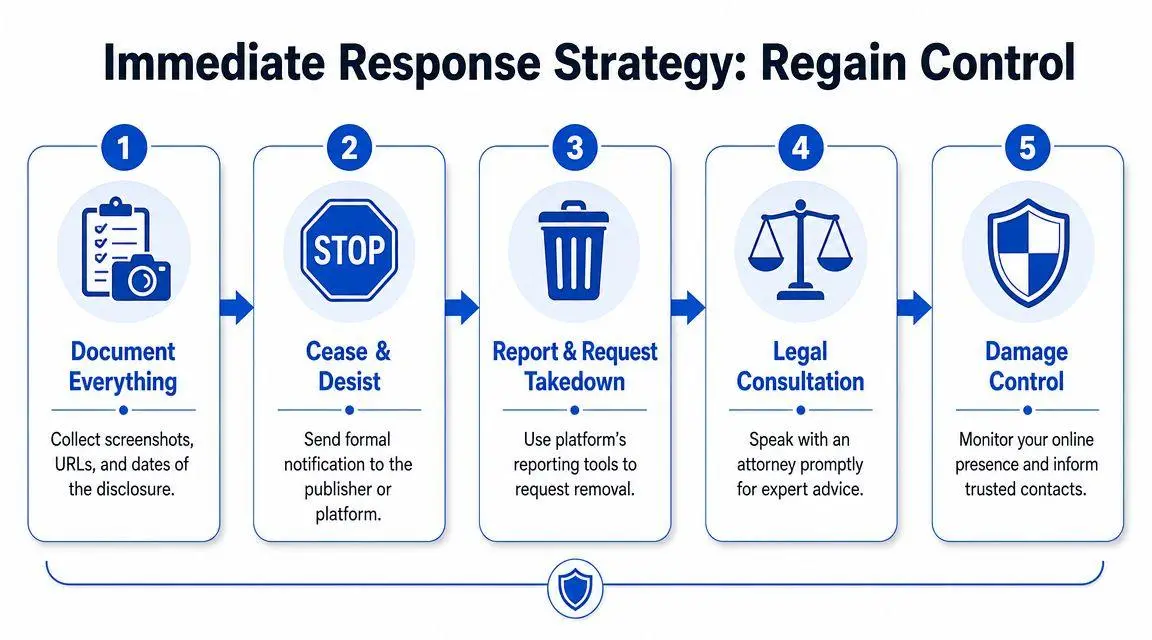
The first two days shape the entire outcome. Rash moves create evidence gaps and publicity. Silence lets the material spread. You need a disciplined sequence.
Assess the exposure
Start by identifying what was posted, where it appeared first, which copies matter most, and whether search engines have indexed the content. Distinguish between source sites, reposts, and commentary accounts. A hidden forum thread and a high-authority news result are not the same problem.
Don’t contact everyone at once. Contacting the wrong person too early can trigger more reposts.
Preserve the evidence
Before anything disappears, capture it. That means screenshots, timestamps, profile names, URLs, comment threads, visible metrics, and any identifying details about uploaders or hosts. Preserve the original context, not just cropped fragments.
Practical rule: If you can’t prove what was published, when it appeared, and how it spread, you weaken both takedown efforts and legal options.
A clean evidence file should include:
- Full-page captures: Show the post, account, date, and surrounding context.
- Direct URLs: Save each live location, not just a homepage.
- Search visibility records: Document whether your name queries surface the material.
- Communications trail: Keep threatening messages, extortion attempts, or admissions.
Act on the right layer
Different problems require different levers. A platform violation should be handled as a platform violation. A search visibility problem may require de-indexing work. A hostile publisher may require a formal demand. Ongoing reposts require monitoring, not one-off complaints.
Use a short response matrix:
| Problem | First move |
|---|---|
| Clear platform rule violation | File targeted takedown requests immediately |
| Search result exposure | Evaluate de-indexing and suppression options |
| Identifiable hostile actor | Send a tailored legal notice after evidence capture |
| Copycat reposts | Put monitoring in place to catch reuploads |
If the content is moving fast, ongoing reputation monitoring is not optional. You need to know whether a takedown solved the problem or merely displaced it.
Legal Action vs Professional Removal Which Path to Choose
If your goal is compensation, deterrence, or forcing an identifiable wrongdoer into a formal process, legal action may be the right path. It creates pressure. It can compel evidence. It can produce a public ruling. It is also slower, more expensive, and less private.
If your goal is to make the material harder to find, remove it from platforms, limit search visibility, and reduce recirculation quickly, professional removal is often the better first move. That path is usually more discreet and more aligned with the primary objective most clients have, which is reputational containment.
Choose based on outcome, not instinct
Use this decision frame:
- Choose legal action when you need damages, injunctive power, or a formal record against a known publisher.
- Choose removal-first strategy when speed, discretion, and suppression matter more than courtroom process.
- Choose both when you have a strong claim and an urgent distribution problem.
A strategic response often uses law as one tool, not the entire strategy. That is especially true where truth, public-interest arguments, or “already public” defenses make a clean court win less certain than the client expects.
For executives weighing those tradeoffs, this strategic guide to online content removal laws is a useful starting point. If you need operational support, ContentRemoval.com handles source removal, de-indexing, and monitoring for online privacy exposures, which can complement legal counsel in fast-moving matters.
If private information about you is already online, don’t treat it as a theoretical legal issue. Treat it as a live containment problem. ContentRemoval.com offers confidential assessments for individuals and organizations dealing with leaked images, private posts, search-result exposure, and broader online reputation threats.
Frequently asked questions
Can I sue someone for posting true but private information about me?
Possibly, under the public disclosure of private facts tort, but only if the information was genuinely private, was published widely, would be highly offensive to a reasonable person and has no legitimate public concern. The defendant will test consent, newsworthiness and whether the fact was already public.
Are leaked screenshots of my private messages covered by privacy law?
It depends on what they reveal. Intimate, medical, family or financial content sits on stronger ground. Messages tied to a public scandal, an official role or misconduct allegations are more likely to be framed as legitimate public concern, which weakens the claim.
Should I take legal action or use a removal service for leaked private content?
Choose legal action when you need damages, injunctive power or a formal record against a known publisher. Choose a removal-first approach when speed, discretion and reduced visibility matter most, since it is faster and more private. Serious matters often need both running in parallel.