
To protect reputation during an investigation, treat the matter as both a legal case and a live digital threat. Freeze scheduled publishing, lock account access, preserve evidence, route every inquiry through one spokesperson working from counsel-approved lines, then run a takedown queue that removes leaked documents, de-indexes what cannot be removed, suppresses the residue and monitors for reuploads.
Key facts
- In the first hour: pause outbound content, lock admin access, archive pages and search results, centralize inquiries, brief staff.
- A holding statement acknowledges awareness, shows process, signals governance and avoids admissions or speculation.
- Leaked documents may be removable under copyright or confidentiality; impersonation accounts move fastest through platform identity channels.
- Regulatory matters often require cooperation and disclosure alongside active suppression of misleading online spread.
Where ContentRemoval.com comes in. ContentRemoval.com runs the takedown and suppression queue while an investigation is live: copied internal PDFs on forums, defamatory posts ranking for the company or executive name, impersonation accounts and data broker pages that make targeting easier. General counsel or the communications lead usually makes the call within the first day. A free, confidential 15-minute Exposure Scan maps what is removable, suppressible or better left alone, and the report is yours to keep. Get a Free, Confidential Exposure Scan or read how our reputation management work is done.
You’ve just received the notice. It may be a regulator’s inquiry, a board-directed internal review, a subpoena, a dawn raid warning from counsel, or a call from a reporter who somehow already knows. Your instinct is to explain, reassure, and keep the business moving.
That instinct is dangerous.
When an investigation starts, reputation damage rarely begins with the final finding. It begins with search results, screenshots, employee speculation, leaked PDFs, copied headlines, and badly timed statements that give the internet a permanent artifact to index. If you want to protect reputation during investigation, you need a command structure, a digital containment protocol, and an aggressive takedown strategy. Generic PR won’t get you there. Passive legal advice won’t get you there either.
I’ve worked with executives in exactly this position. The pattern is consistent. The organizations that fare best are not the ones with the best slogan or the most polished spokesperson. They are the ones that move first, lock down the digital perimeter, preserve evidence, centralize communications, and remove harmful content before it compounds.
The First 48 Hours Defining an Investigation’s Outcome
At 6:40 a.m., the CEO gets a message from outside counsel. A regulator wants documents. By 8:15, two directors know. By 9:30, a senior employee has texted a friend in the industry. By lunch, a niche trade reporter is asking for comment. By late afternoon, the company’s LinkedIn page is still pushing a cheerful recruiting post while staff speculate in private Slack channels. That is how a manageable matter becomes a reputational event.
The first 48 hours are not for public debate. They are for command and control.
A surprising but useful point sits behind this. A study of 45 companies found that firms can see a 26 to 29% increase in reputational intangible capital following a data breach investigation when the response is well executed, according to the Journal of Cybersecurity research on breach reputation effects. The lesson is simple. An investigation does not automatically destroy reputation. Mishandling it does.
What executives get wrong first
Most leaders make one of three mistakes.
They speak too soon.
They let too many people speak.
They treat the issue as a messaging problem before they treat it as an information-control problem.
That order is backward. Before you say anything externally, you need a decision structure for legal, digital, operational, and personnel actions. If you don’t already have one, even a practical resource like ABCO Security incident response can help frame who owns decisions, who approves language, and how escalation works under pressure.
Practical rule: If three people can answer the same question from media, staff, or investors, you already have a reputational leak.
What happens in a disciplined response
The executive who protects reputation moves quickly, but not noisily. Counsel is looped in immediately. Communications are centralized. A digital review starts before lunchtime. Staff are told what they may say, what they may not say, and where all inbound inquiries must go. Search results are captured. Social accounts are frozen. Evidence is preserved.
That’s also the moment to establish active monitoring. If your team can’t see what’s surfacing across search, social, forums, and copied mentions, you’re working blind. A serious reputation monitoring system gives you the visibility needed to stop rumor becoming record.
The correct mindset
Treat the investigation as both a legal matter and a live digital threat. One without the other is incomplete. Regulators, journalists, employees, competitors, and anonymous posters don’t wait for factual certainty. They act on fragments. Your job is to stop fragments from hardening into a public narrative.
That means the objective in the first 48 hours is not to “look calm.” It is to reduce uncontrolled publication, preserve strategic flexibility, and create the conditions for precise action. If you do that well, you can exit the initial stage with your options intact. If you don’t, every later decision becomes more expensive, slower, and less effective.
The Containment Protocol Digital Lockdown
The first operational move is silence with structure. Not secrecy. Not evasion. Structure.

A disciplined digital footprint process can deliver up to a 70 to 80% reduction in negative search visibility within 30 to 60 days, and the critical trigger is an immediate audit and content lockdown within 24 to 48 hours, as described in this digital footprint management methodology. Those numbers matter because they show something executives often resist admitting: your online exposure is technical, not just reputational. It can be reduced methodically.
Freeze publication before you draft statements
Your company is probably publishing constantly without thinking about it. Scheduled LinkedIn posts. Recruitment ads. drip email campaigns. Executive social content. Auto-generated newsroom pages. CRM-triggered announcements. Webinar reminders. Sales outreach. Investor relations updates.
Pause all of it.
If your channels continue broadcasting while an investigation is unfolding, your organization looks confused. Worse, those unrelated posts become magnets for hostile comments, screenshots, and quote-tweets. A frozen channel is controllable. A live channel is a liability.
Use a simple first-hour sequence:
- Pause outbound content: Stop scheduled social posts, newsletters, ad campaigns, and automated notifications.
- Lock account access: Review who has admin rights to social, CMS, review platforms, YouTube, and executive accounts. Remove unnecessary access immediately.
- Preserve evidence: Archive current pages, mentions, comments, and search results before anyone edits or deletes material.
- Route inquiries centrally: Staff need one inbox, one legal contact, and one communications contact.
- Issue internal instructions: Tell employees not to speculate, post, forward, or “clarify” anything online.
Audit the full exposure map
Seasoned professionals audit the corporate website and main social profiles, then stop. That’s amateur work. The actual threat map is wider.
You need to review executive LinkedIn accounts, dormant microsites, old press release repositories, affiliate pages, Google Business profiles, video channels, recruitment platforms, staff bios on third-party directories, and any forum or subreddit where your company is already being discussed. If a family office principal or founder is involved, add charity pages, portfolio company bios, conference speaker pages, and cached interview transcripts.
A useful working table looks like this:
| Asset class | Immediate risk | First action |
|---|---|---|
| Corporate site | Press, comments, cached statements | Archive and restrict changes |
| Executive profiles | Off-message posts, biography scrutiny | Freeze updates and review old content |
| Social channels | Viral speculation, hostile replies | Pause publishing and tighten access |
| Review platforms | Coordinated attacks, false reviews | Capture evidence and queue disputes |
| Employee channels | Leaks, screenshots, rumors | Centralize guidance and reporting |
Silence is a tool if it is organized
A communication freeze is often misunderstood. Executives worry that saying less creates suspicion. Uncontrolled talking creates more.
Stop unauthorized speech first. Then decide what the authorized message needs to achieve.
That applies internally as much as externally. Employees need a short written directive. Keep it factual. Tell them an investigation or review is underway, all media and external inquiries must be forwarded, no one should comment publicly, and records must be preserved. Don’t write a dramatic memo. Don’t speculate. Don’t moralize.
Preserve without contaminating
Legal and digital discipline need to work together. You may need to remove or hide harmful content later, but the first step is preservation. Capture screenshots, URLs, timestamps, account names, search positions, and repost chains. Store them under counsel’s direction where appropriate.
Do not let panicked staff start deleting random posts or editing old web pages without approval. Deletion may look strategic rather than routine. It can also destroy evidence you need for takedown requests, internal inquiries, or litigation.
Build a short-term control room
For the next few days, your organization should operate through a tightly restricted group. In practice, that means legal, one decision-maker from the business, one communications lead, one digital lead, and one HR or operations lead if staff conduct is involved. Everyone else gets instructions, not discretion.
If that sounds severe, good. Severe beats sloppy. The internet punishes sloppy every time.
Strategic Communications The Controlled Narrative
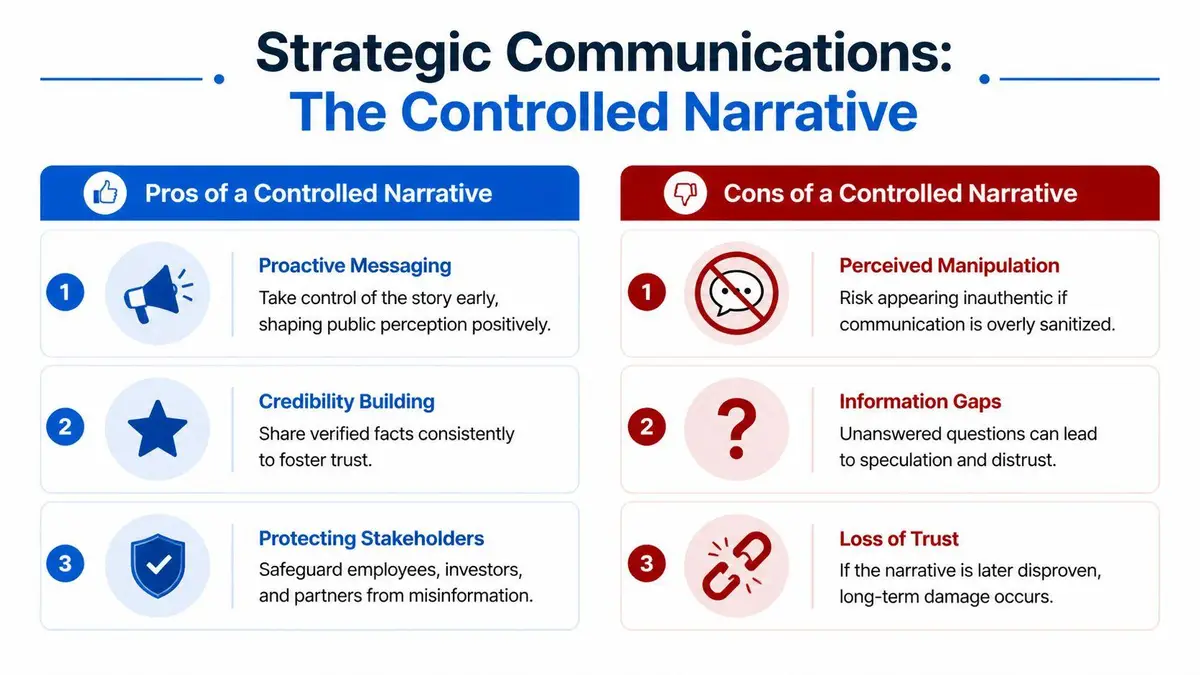
Most reputational damage during investigations is self-inflicted. The market rarely gets a full factual record at the start. It gets fragments, body language, timing, headlines, and the emotional tone of your response. If your communications are delayed, inconsistent, or defensive, you hand your critics the narrative.
A clear example is the Michigan Taco Bell matter discussed by Chambers. The franchise delayed action for over two months, drew EEOC criticism for failing prompt and remedial action, and suffered severe brand damage. Chambers also notes that communication failures during investigations can produce costs reaching millions of dollars and trigger sharp share-price declines. The analysis is laid out in Chambers on protecting company reputation during investigations.
The holding statement must do less, not more
Executives often ruin the first public statement by trying to sound complete. Don’t. Your first statement should acknowledge the matter, confirm process, show control, and avoid argument. It is not the place to litigate facts or satisfy everyone’s curiosity.
A competent holding statement usually does four things:
- Acknowledges awareness: Confirm that the organization is aware of the investigation or allegations.
- Shows process: State that the matter is being reviewed or that the company is cooperating through proper channels.
- Signals governance: Confirm that the appropriate internal or external advisers are engaged.
- Protects legal position: Avoid admissions, blame, speculation, and emotional language.
That’s enough. You are not writing a manifesto. You are starving speculation without creating fresh material for investigators, plaintiffs, journalists, or hostile accounts.
Why no comment usually fails
“No comment” sounds disciplined to lawyers and evasive to everyone else. It creates a vacuum. Vacuums get filled by ex-employees, anonymous accounts, rivals, and reporters who need a line before deadline.
A controlled narrative is different from overexposure. You provide a narrow band of verified facts and repeat them consistently. If asked something outside that band, your spokesperson says the facts aren’t verified or the matter is under formal review. That answer works because it is grounded in process, not panic.
The public doesn’t expect omniscience in the first hours. It does expect coherence.
For leaders dealing with malicious amplification or coordinated attacks around an inquiry, the playbook overlaps with targeted digital abuse. The mechanics are similar to those described in this executive guide to targeted online smear campaigns, where the main mistake is letting fragmented rebuttals multiply the attack surface.
A short explainer on controlled messaging is useful here:
One spokesperson means one voice
Do not appoint a “small group of spokespeople.” That phrase sounds practical and usually ends in contradiction. Use one firewalled spokesperson for all external inquiries. That person should work from written lines approved by legal and leadership. If the matter is highly technical, they can take questions and revert after verification. They should not improvise.
Internally, your executives also need language discipline. The board update, employee note, investor call script, manager FAQ, and media statement must align. Not word-for-word. Strategically.
This comparison is useful:
| Approach | Result |
|---|---|
| Multiple informal explainers from different leaders | Inconsistency, screenshots, quote conflicts |
| One approved external voice, one internal guidance set | Fewer contradictions, lower speculation |
| Emotional denial before facts are established | Credibility loss if details change |
| Calm, fact-limited messaging | Preserved flexibility |
What never belongs in your first communications
Some phrases consistently make matters worse.
Don’t say the issue is “baseless” unless you’re prepared for every document and witness to support that claim. Don’t promise full transparency if legal constraints will prevent it. Don’t attack the complainant or regulator. Don’t overstate confidence. Don’t suggest the issue is minor before you’ve established that.
Most of all, don’t let urgency produce false precision. If you later revise a statement, critics won’t praise your good-faith update. They’ll say you changed the story.
Communication discipline protects more than headlines
A controlled narrative isn’t only for the press. Employees watch leadership language for cues about ethics and stability. Investors watch for governance and process. Customers watch for continuity. Future recruits search the company name and judge what they see.
Bad communications broaden the damage radius. Good communications keep the issue bounded.
That is the target. Not applause. Not instant absolution. Containment.
The Legal and Technical Takedown Arsenal
Most advice in this area is timid. “Monitor the situation.” “Engage with stakeholders.” “Tell your side of the story.” Fine. Meanwhile, leaked documents get mirrored, defamatory posts rank in search, fake accounts impersonate executives, and copied allegations spread across platforms.
That passive model is obsolete.
A 2025 survey referenced by Christman Attorneys reported that 46% of executives faced regulatory investigations in the past year, and 62% reported revenue loss from unaddressed online amplification of probe details. This underscores a critical gap in standard crisis advice. Regulatory matters often require not only cooperation and disclosure, but active suppression of harmful digital spread. The analysis appears in this discussion of protecting reputation during investigations.
De-indexing and source removal are not the same thing
Executives often use “take it down” as if it’s one action. It isn’t.
De-indexing removes or limits visibility in search results. The content may still exist on the original site, but people won’t find it as easily through search engines. This matters when a page is weak, stale, duplicative, or vulnerable under privacy or policy rules.
Source removal deletes the content from the originating website, platform, or server. That is stronger, but usually harder. It often depends on legal authority, platform policy, copyright ownership, impersonation rules, privacy rights, or court orders.
You need both options available because different threats require different tools.
Match the weapon to the content
Not every harmful item should be attacked the same way. Use the wrong mechanism and you waste time.
- Leaked documents or copied internal materials: Assess copyright ownership, confidentiality obligations, and platform policy. If copyright applies, a properly framed notice can move quickly. For teams handling copied materials, this practical guide on how to file a DMCA takedown notice is a useful baseline.
- False statements presented as fact: Build an evidentiary record first. Defamation demands precision, not outrage.
- Impersonation accounts: Use identity, trademark, and platform impersonation channels. These often move faster than broad reputational complaints.
- Search-result pollution from old or duplicative pages: Prioritize de-indexing, cache updates, and suppression strategies rather than arguing with every publisher.
- Dark web chatter or leak trading: Treat this as intelligence and containment work. Preserve evidence, identify repost pathways, and cut off downstream publication where possible.
Why PR alone loses
PR can shape perception, but it cannot remove a PDF from a forum, stop a copied article from ranking, or get an impersonation account disabled. Lawyers can help, but many firms do not run fast technical workflows and many don’t understand platform escalation. You need legal logic combined with operational execution.
That means working issue by issue. What is removable? What is suppressible? What is better answered than attacked? What needs quiet escalation instead of a public fight?
The strongest reputation defense during an investigation is surgical. Remove what you can. De-index what you can’t remove. Suppress what won’t move. Monitor everything.
Regulatory investigations require a different posture
Criminal and white-collar investigations often produce advice centered on silence. Regulatory matters are different. You may need to disclose, cooperate, and document compliance while simultaneously fighting online amplification of incomplete or misleading material.
That is where many executive teams fail. They assume any visible intervention looks guilty. It doesn’t. If leaked material is circulating out of context, if anonymous accounts are speculating about enforcement before findings exist, or if old filings are being algorithmically recirculated as fresh scandal, technical intervention is prudent. Leaving that material untouched is not ethical restraint. It is negligence.
Build a live action queue
A takedown campaign should run like litigation support, not like brand marketing. Every item needs a status, owner, basis for removal, evidentiary support, jurisdiction note, and escalation path. High-priority items include first-page search results, social posts gaining traction, copied articles, videos, image search results, and data-broker pages that make doxxing easier.
Speed matters, but sequencing matters more. Remove the easiest high-impact items first. Then suppress and out-rank the residue. While that runs, monitor for mirrors and reuploads. If you don’t, your own success creates a game of whack-a-mole.
Building a Resilient Reputation Post-Investigation
Once the immediate threat cools, many leaders make the same mistake. They declare victory because the calls slow down. Search engines, aggregators, copied pages, and hostile posters do not care that your inbox is quieter.
The post-investigation phase is where you decide whether this was a contained incident or the start of a permanent digital scar.

A formal incident response plan with board oversight can mitigate reputational damage by 75 to 85%, and organizations with such plans recover 40% faster than those relying on ad hoc responses. Ad hoc reactions also worsen harm in 70% of crises, according to SecurityScorecard’s guidance on reputational risk management. Those numbers explain why well-prepared organizations don’t treat crisis management as a one-off project.
Turn emergency measures into standing infrastructure
The temporary war room you built during the investigation should not disappear. It should become a permanent incident response structure. Board oversight matters because reputational crises often begin below the board line and explode before governance catches up.
At minimum, that structure should formalize:
- Decision rights: Who can approve statements, removals, legal escalations, and executive outreach.
- Monitoring responsibilities: Who reviews search changes, social spikes, leak chatter, and copied content.
- Evidence handling: Where screenshots, URLs, correspondence, and escalation logs are stored.
- Escalation thresholds: What triggers legal review, outside experts, employee notices, or regulator-facing updates.
Build a digital moat around key names
Reputation recovery is not just cleanup. It is fortification.
For a company, that means strengthening the search presence around the brand, senior executives, and recurring query combinations tied to the investigation. For an individual, it means reinforcing authoritative pages, accurate biographies, controlled profiles, and legitimate media that reflect your current position rather than the moment of crisis.
This work is especially important after a regulatory inquiry, where the public may misunderstand the process itself. A practical starting point for internal education is understanding SEC inquiries, because many executives, employees, and even stakeholders confuse inquiry, examination, subpoena, enforcement, and final outcome. That confusion feeds unnecessary reputational harm.
Monitoring after removal is not optional
The dirtiest secret in reputation work is that removal often invites reposting. Once one item disappears, copies surface elsewhere, often with more hostile framing. That is why post-investigation monitoring has to stay active. Watch search results, image search, social reposts, forums, complaint sites, and low-credibility blogs that scrape content from elsewhere.
A short checklist keeps teams honest:
| Post-investigation task | Why it matters |
|---|---|
| Search monitoring | Detect old material resurfacing |
| Reupload tracking | Catch mirrors and reposts early |
| Executive profile review | Remove stale vulnerabilities |
| Content reinforcement | Push accurate, current assets upward |
| Board review of lessons learned | Convert failure points into process |
Recovery isn’t a press release. Recovery is a system.
Protect the next event before it happens
Every investigation leaves a map. It shows which employee channels leaked, which old web pages created problems, which executives freelanced, which platforms moved quickly, and which publishers resisted. Use that map.
If you do this properly, the organization comes out stronger. Not because the investigation was pleasant. Because pressure forced clarity. Clarity, if you institutionalize it, is a reputational advantage.
Advanced Scenarios and Client Questions
Experienced clients rarely need another lecture about “staying calm.” They need direct answers. These are the questions that usually matter once the basic crisis machinery is running.
What changes if the investigation is still internal and not public
A private investigation is not a private risk. Assume disclosure can happen through an employee, vendor, claimant, board conflict, or court filing later. The difference is tactical. You have more room to build your record before the public sees anything.
Use that time aggressively. Lock down internal communications, preserve evidence, review legacy vulnerabilities, and prepare response language before there is external pressure. Don’t wait for the first reporter email to decide who speaks for the organization.
If the matter never becomes public, good. You still benefited from tightening controls. If it leaks, you’re not improvising.
What changes for a public figure versus a corporation
A corporation usually fights on governance, continuity, and stakeholder confidence. A public figure fights on identity, search association, and volume of commentary. That means the same allegation can require different tactics.
For a company, first-page search results for the brand and investor-facing queries often matter most. For a founder, celebrity, or family principal, name-based search, social impersonation, image results, and gossip amplification may be the primary threat. Public figures also face a more emotional online environment. Facts matter, but so do thumbnails, captions, and copycat accounts.
The response should reflect that reality. Corporate defense focuses on institutional coherence. Personal defense focuses on identity control and search hygiene.
Can you remove content from major news outlets
Sometimes. Often not fully. The answer depends on whether the issue is falsity, privacy, copyright, impersonation, procedural defect, outdated indexing, or later developments that justify correction, update, anonymization, or de-indexing.
Top-tier outlets usually resist broad removal demands. That doesn’t mean you’re powerless. You may secure a correction. You may cut syndication. You may remove copied versions. You may de-index related pages in some jurisdictions. You may also suppress the article’s prominence by strengthening more authoritative and current content around the same search terms.
The mistake is binary thinking. “We can’t erase the article, so nothing can be done” is wrong. Plenty can be done.
Should you ever go on offense publicly
Yes, but only when the offensive move serves a legal and strategic purpose. Public aggression without evidence usually backfires. A narrow, factual rebuttal can work. A documented correction request can work. A well-timed publication of governance reforms can work. A sprawling online war rarely does.
If you are going on offense, decide what the offensive act is for. Is it to correct a falsehood? Deter a publisher? Reassure investors? Establish a record for court? If you can’t answer that in one sentence, don’t do it yet.
How fast should you expect takedowns and suppression to work
Some platform actions can move quickly. Others drag. Search-result changes often lag behind removals. News suppression takes persistence. Forum content may reappear under new usernames. Regulatory-document chatter can mutate into commentary that is harder to challenge than the original source.
Set expectations properly. This is not one request and done. It is a campaign. Fast wins matter because they reduce momentum, but the overall program works through accumulation. The right way to judge progress is by reduced visibility, fewer high-authority harmful results, and tighter control of what appears when your name or brand is searched.
What if your own employees are part of the leak problem
Then you have two parallel issues. The investigation itself, and a trust-and-governance problem. Handle them separately.
Don’t accuse broadly. Tighten permissions, preserve logs, route communications, and let legal and HR deal with accountability. Publicly, stay restrained. Internally, be exact. Employees create some of the worst reputational exposures because they possess fragments that look convincing but lack context.
What if the allegations are false, but the internet doesn’t care
That is common. Truth alone is not a distribution strategy.
You still need evidence, takedowns where available, de-indexing where justified, and a controlled body of accurate content that can rank and circulate. Outrage won’t do the job. Process will. The internet often rewards novelty, conflict, and speed. Your response has to beat that with discipline and persistence.
What should an executive do today if the threat feels imminent
Three actions. Put counsel and one senior decision-maker in direct control. Freeze unsupervised digital activity. Start evidence capture and exposure mapping immediately.
Then move. Not next week. Not after the board “has a chance to discuss.” Delay is how manageable matters turn into searchable reputational liabilities.
If you need discreet, technical help to remove harmful content, suppress damaging search results, track reuploads, or contain a live investigation-related online threat, speak with ContentRemoval.com. The firm works with executives, public figures, family offices, and legal teams that need a confidential action plan, not generic PR advice.
Frequently asked questions
Should a company go silent during an investigation?
Organized silence, yes; no comment, no. Stop unauthorized speech first by freezing channels and issuing a short internal directive, then release a narrow holding statement through one spokesperson. A pure no comment creates a vacuum that ex-employees, rivals and anonymous accounts fill.
Can leaked documents from an investigation be removed from the internet?
Often in part. Assess copyright ownership, confidentiality obligations and platform policy; a properly framed copyright notice can move quickly. Where source removal fails, de-indexing, cache updates and suppression reduce visibility, and monitoring catches mirrors and reuploads.
Does removing content during a regulatory investigation look like guilt?
No. If leaked material is circulating out of context, anonymous accounts are speculating before findings exist, or old filings are being recirculated as fresh scandal, technical intervention is prudent. Cooperation and disclosure run in parallel with controlling misleading online amplification.