
To protect family reputation online, high-net-worth families treat it as digital liability control rather than PR. The playbook has five parts: a first-24-hours protocol of evidence capture and public silence, a digital fortress of claimed profiles and tightened privacy, monitoring that covers images and forums, sequenced legal and technical takedowns, and a Family Digital Charter governing what everyone may post.
Key facts
- In the first day, preserve screenshots with dates, usernames and URLs, then limit the circle to counsel and one coordinator.
- McAfee reports 92% of families with claimed profiles avoid impersonation versus 60% with unclaimed profiles.
- Image and video searches account for about 40% of reputation damage and are often untagged.
- Deepfakes need a response in hours: platform escalation, forensic preservation and reupload control at once.
Where ContentRemoval.com comes in. ContentRemoval.com handles the takedown lane for families under pressure: impersonation accounts, leaked private media, defamatory posts hosted offshore and synthetic clips that surface the night before a closing. The family office chief of staff or general counsel usually makes the call, and the work runs alongside their legal and security advisers. A free, confidential 15-minute Exposure Scan maps what is removable and what must be contained, and the report is yours to keep. Get a Free, Confidential Exposure Scan or read how our reputation management work is done.
A transaction is moving toward diligence. Counsel has the deal documents under control. Tax is lined up. Security has checked devices and travel protocols. Then someone on the other side runs a routine search and finds an old accusation, a copied forum thread, a fake profile using a family member’s name, or a teenager’s public post that reveals far more than it should. Nothing about that moment feels theoretical. It feels expensive.
That’s why families who need to protect wealth, privacy, and negotiating power can’t treat online reputation as a soft issue. It’s an asset protection issue. It affects counterparties, lenders, schools, staff, physical security, and family governance at the same time.
The Unseen Liability in Your Family’s Digital Footprint
The most dangerous reputation problems are rarely the loudest at first. They sit in search results, on dormant profiles, in image indexes, or on low-credibility sites that still get discovered during diligence. A buyer, journalist, litigant, estranged associate, or opportunistic troll only needs one loose thread.
For high-net-worth families, that loose thread often appears at the worst possible moment. It surfaces before an acquisition closes, during a governance dispute, after a family office hire, or around a public philanthropic announcement. By then, the issue isn’t just embarrassment. It’s a vulnerability.
Why this belongs in asset protection, not PR
I advise clients to stop thinking about this as “cleanup” and start treating it as digital liability control. A reputation issue can trigger three separate consequences at once:
| Exposure area | What usually happens |
|---|---|
| Commercial risk | Counterparties question judgment, governance, or hidden liabilities |
| Personal risk | Family members face harassment, impersonation, or intrusive attention |
| Security risk | Public fragments of data get combined into highly revealing profiles |
That institutional framing isn’t speculative. Withers notes that proactive privacy planning and digital footprint management are critical for high-net-worth individuals and family offices, particularly in advance of major events such as business acquisitions, and points to dedicated guidance on online reputational risks in the STEP Family Office handbook (Third edition, September 2023).
If you haven’t already done a structured review, start with a serious digital footprint cleanup assessment. Not because every result is dangerous, but because unmanaged results become available for other people to frame against you.
Practical rule: If a stranger can assemble a coherent story about your family from scattered public fragments, you already have a reputation management problem.
What families routinely underestimate
Most clients initially focus on the obvious threat. A hostile article. A fake account. A leaked image. The larger problem is aggregation. Search results, property records, public-facing bios, tagged photos, school references, and old comments create context. Context becomes narrative. Narrative becomes reputational pressure.
That’s why protecting family reputation online requires the same discipline you’d apply to legal exposure or physical security. You inventory assets. You reduce attack surface. You monitor continuously, and when something surfaces, you move with precision rather than emotion.
First 24 Hours An Immediate Response Protocol for Attacks
The first day decides whether an incident becomes a contained problem or a self-inflicted crisis. Most families make the same mistake. Someone sees the post, article, thread, or account and responds personally. They call the poster, send threats, argue in comments, or ask a relative to “clear it up.” That impulse creates evidence, amplifies attention, and gives the attacker a second round of content.

What works is disciplined silence combined with immediate evidence preservation.
Contain first, speak later
As soon as the attack is discovered, preserve the material exactly as it appears. Capture screenshots that include dates, usernames, visible URLs, comments, captions, and profile details. Save the page source if available, archive the link, and record where the content appeared in search results or on platform feeds. If the content is visual, save the image or video file and note any account names that reposted it.
Then narrow the internal circle. Notify lead counsel, the principal or delegated family office executive, and one person responsible for operational coordination. That’s enough. Don’t circulate screenshots in family group chats. Don’t ask staff to “look into it.” Don’t let younger family members freelance a response on social media.
Use a simple internal incident log:
- What appeared: Exact URL, account name, and content description
- Where it appeared: Search engine, platform, forum, messaging app, or media site
- When discovered: Time, date, and who found it
- Why it matters: Defamation, impersonation, doxxing, leaked media, privacy breach, or transaction risk
- Immediate exposure: Whether the content names minors, addresses, businesses, schools, travel, or associates
What not to do in the first day
Three actions consistently worsen the position.
- Don’t engage emotionally: Direct confrontation often produces screenshots that outlive the original post.
- Don’t file random complaints everywhere: A poor platform report can lock you into the wrong theory and complicate later escalation.
- Don’t let multiple advisors improvise: One spokesperson and one legal strategy. Anything else creates contradiction.
When a family member wants to “set the record straight” publicly, the real answer is usually no.
That restraint matters because the first response should be built around evidence, jurisdiction, platform rules, and likely amplification risk. A false review requires one play. A manipulated image requires another. A defamatory article hosted offshore requires a different one again.
A short briefing can help your team align before anyone acts:
The right sequence for day one
I tell clients to think in four lanes running at once.
First, preserve everything. Second, classify the threat. Third, identify the controlling venue, which means the actual platform, host, search engine, or publisher with power over visibility. Fourth, decide whether the objective is source removal, de-indexing, account suspension, evidence hold, or quiet monitoring before action.
| First-day task | Why it matters |
|---|---|
| Evidence capture | Preserves proof before edits or deletion |
| Internal escalation | Prevents mixed messaging and panic |
| Threat classification | Determines legal and technical options |
| Public silence | Avoids creating fresh content for attackers |
If you want to protect family reputation online, the first 24 hours aren’t about winning an argument. They’re about preserving options.
Building Your Digital Fortress Proactive Privacy and Asset Control
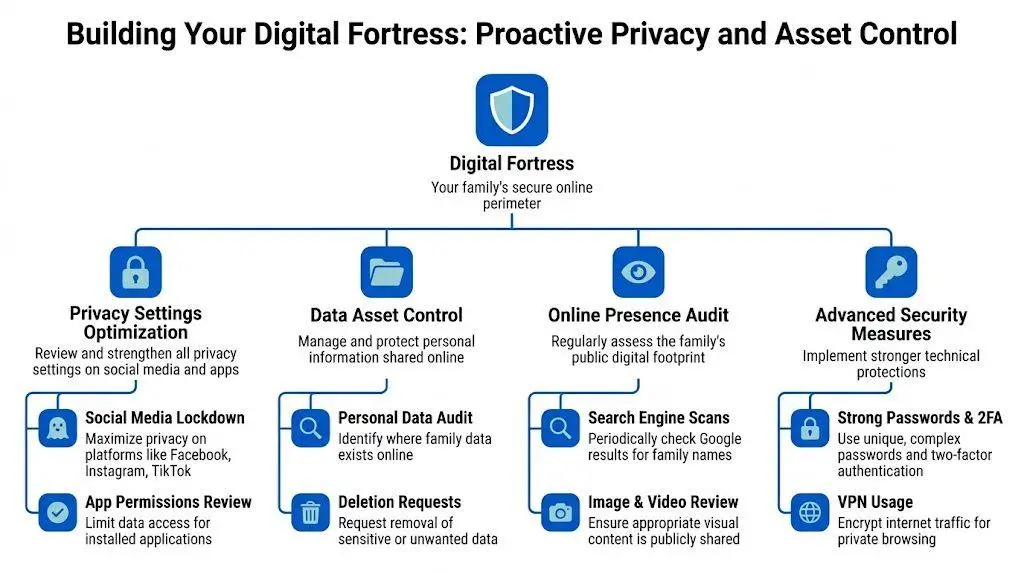
Reactive work is expensive because it starts after exposure. Smart families reduce the chance of exposure in the first place. That means controlling names, profiles, domains, public narratives, and permissions before a problem gets attached to them.
A proper defense has two layers. The first is asset control. The second is search control. Most families neglect both because they assume a low profile is enough. It isn’t.
Claim what can be claimed
Every principal, spouse, heir, and visible executive should have core profiles claimed, even if those profiles remain lightly used. Unclaimed space invites impersonation, parody, and narrative capture by other people. The same principle applies to obvious domain variants, common misspellings, and predictable family-office naming patterns.
Claiming doesn’t mean posting constantly. It means controlling the identity surface so attackers can’t occupy it first.
Tighten privacy where leakage actually happens
Families often focus on the public feed and ignore the metadata trail. That’s backward. Exposure usually comes from tags, visible friend graphs, linked accounts, app permissions, old bios, and stale media settings.
A serious audit reviews:
- Social profiles: Facebook, Instagram, X, LinkedIn, TikTok, YouTube, Reddit, and any legacy accounts
- Tagging controls: Disable auto-tagging and approval-free mentions where possible
- App permissions: Remove nonessential access to photos, contacts, location, and microphone
- Family devices: Check shared albums, cloud folders, and public link settings
- Public bios: Strip unnecessary school, residential, travel, and family relationship details
For households with children or younger adults, the governance problem is usually the app ecosystem, not the main profile. A private account with permissive app sharing still leaks.
A more complete privacy protection framework for high-profile households should sit alongside your legal and security protocols, not outside them.
Build positive authority before you need it
A family with no authoritative search presence leaves a vacuum. Vacuums get filled by old press, scraped directories, litigation mentions, hostile commentary, and low-quality aggregator pages. You need controlled, factual, high-credibility assets that can rank and persist.
That doesn’t require vanity publishing. It requires deliberate placement. Professional biographies. Verified leadership profiles. Philanthropic affiliations stated accurately. Company and foundation pages that are current. Where appropriate, thought leadership tied to business or charitable work.
Counsel’s view: The time to publish credible positive material is before an incident, not after the first hostile result appears.
What a fortified search presence looks like
| Controlled asset | Strategic purpose |
|---|---|
| Professional bios | Establish identity accuracy and authority |
| Claimed social profiles | Block impersonation and occupy branded results |
| Foundation or philanthropic pages | Surface values-based, factual public records |
| Current company pages | Keep business affiliations accurate and current |
The point isn’t to manufacture image. The point is to prevent strangers from defining your family first.
The Sentinel System Comprehensive Monitoring and Threat Detection
Most families think they’re monitoring because they have Google Alerts. That’s not monitoring. It’s a limited notification layer tied to one source type, one search environment, and mostly text. It won’t reliably catch visual abuse, impersonation on minor platforms, forum chatter, or copied content that spreads without using your exact name.
Professional monitoring starts with a broader question. What would an attacker, journalist, litigant, or extortionist see before you do?

Basic alerts versus real surveillance
A basic setup can help, but it has blind spots. It may miss nickname variations, image-based abuse, off-platform discussions, and content that isn’t indexed promptly. A real sentinel system combines search review, platform watching, visual checks, and analyst judgment.
Those benchmarks matter because time alters the ease of resolution. If counsel sees an issue while it’s still local, removal and containment are often cleaner. If the family discovers it after replication, syndication, and search indexing, every option becomes harder.
What a professional monitoring stack actually covers
The monitoring environment should include branded and unbranded queries across Google and other major search contexts, review surfaces, mainstream social platforms, forums such as Reddit and Quora, and visual search results. It should also include associated names, common misspellings, executive roles, family office entities, and identifiable properties where those associations create risk.
That’s why I recommend a standing reputation monitoring program rather than occasional manual checks.
The workflow typically looks like this:
- Search intelligence: Incognito reviews of names, aliases, entities, and image results
- Platform observation: Alerts and manual review on social networks, forums, and video platforms
- Visual detection: Reverse image checks and periodic review of image and video indexes
- Threat triage: Classification by severity, credibility, reach, and removability
The blind spot that hurts families most
Visual content causes outsized damage because it travels faster and feels more “real” to casual viewers. A family can have tight text-based monitoring and still miss a harmful image crop, a misleading caption attached to an old photo, or a short clip posted from a private event.
If you’re not checking image and video results, you’re not monitoring reputation. You’re only monitoring text.
The right system also distinguishes noise from threat. Not every mention matters. Some require archiving only. Some require quiet observation. Some require immediate escalation because they involve minors, travel, identities, addresses, or fabricated media.
Monitoring should produce decisions, not dashboards
A watchtower is useful only if someone acts on what it sees. The reporting line should tell you three things quickly: what appeared, whether it matters, and what response lane applies. If a monitoring setup produces screenshots without a decision path, it’s cosmetic.
That’s the difference between passive awareness and active threat detection. Families who want to protect family reputation online need the second.
Escalation Pathways Neutralizing Threats with Legal and Technical Takedowns
A false video of a family principal appears the night before a financing closes. By morning, copies sit on two social platforms, a forum, and a search result with a damaging snippet. At that point, monitoring has done its job. Now the work is containment, evidence control, and removal.
Affluent families lose time here because they choose the wrong lane. A demand letter without platform-specific grounds stalls. A platform report without a legal theory gets ignored. High-stakes incidents require both, sequenced correctly.
The escalation path depends on four factors: the content itself, the platform or host, the identity of the poster, and the business consequence if the material stays live for another 12 to 24 hours. During a liquidity event, board dispute, divorce, inheritance conflict, or M&A process, that timeline matters. So does preservation. If litigation is likely, your team must secure a defensible record before anyone starts firing off complaints.
Different threats require different takedown theories
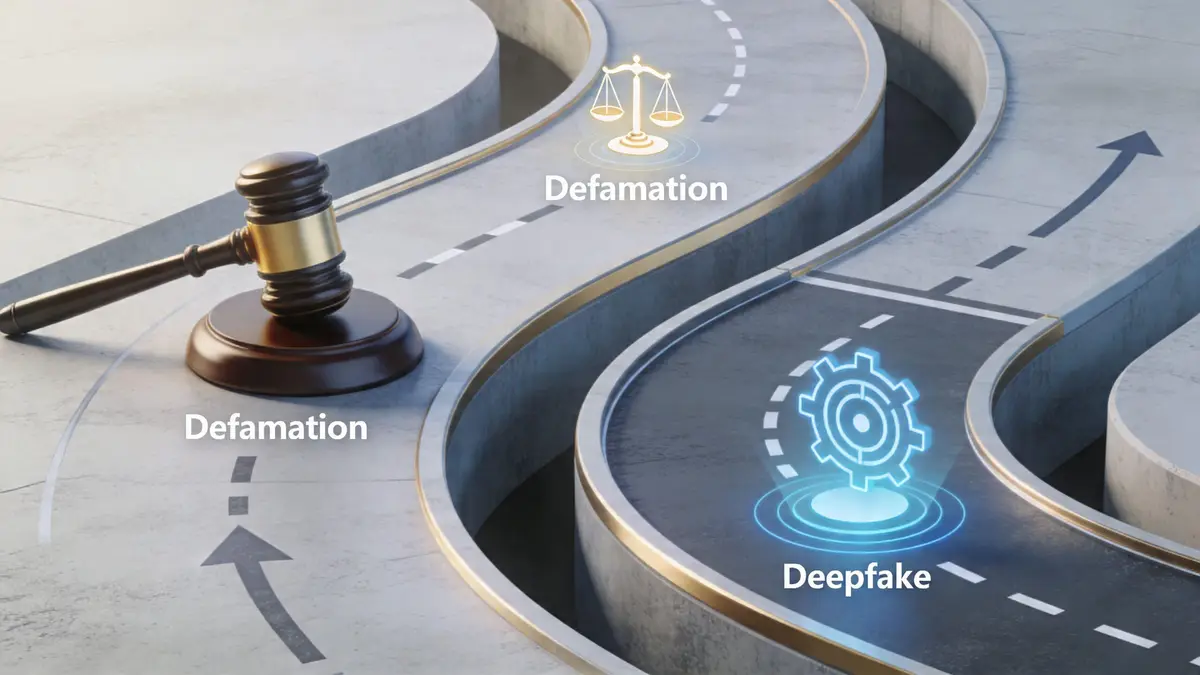
A leaked family photo, an impersonation profile, a defamatory article, and a synthetic audio clip are not variations of the same problem. They trigger different rules, different evidence standards, and different response windows. Treat them as one category and you weaken your case.
Use the narrowest viable claim and the fastest enforceable route.
| Threat type | Typical response lane |
|---|---|
| Impersonation account | Platform identity report, evidence package, account linkage review |
| Leaked private content | Platform removal request, host notice, search suppression where available |
| Defamatory article or post | Legal review, publisher outreach, host escalation, search strategy |
| Copyrighted material reuse | Rights-based takedown process where applicable |
| AI deepfake or synthetic media | Rapid platform escalation, forensic preservation, search containment, repeated reupload control |
Synthetic media creates a harder problem because speed works against the target. A convincing fake can influence lenders, counterparties, school communities, household staff, or extended family before anyone confirms it is false. Wealth does not insulate against that. It increases the blast radius.
Deepfakes now sit on the family-office risk register
High-net-worth families have a larger attack surface than they think. Public filings, archived event photos, podcast clips, litigation records, school posts, and social media from younger relatives give bad actors enough raw material to manufacture something persuasive. The threat is not limited to public scandal. It includes pressure during transactions, extortion attempts, harassment campaigns, and attempts to discredit a principal at a moment of critical importance.
That is why deepfakes require a tighter decision cycle than standard defamation matters. You are not just arguing falsity. You are stopping replication, preserving evidence for later action, and reducing visibility before the content spreads into search, group chats, and mirror uploads.
Synthetic media demands a response measured in hours, not committee meetings.
DIY takedowns fail because the theory gets muddled
In serious incidents, families often split the response across executive assistants, outside counsel, PR advisers, internal security, and a relative who knows the platform interface. The result is predictable. One message claims defamation. Another claims privacy. A third threatens suit without preserving the evidence needed to support it. Platforms and hosts do not reward emotional escalation. They act on specific policy violations backed by clean documentation.
A disciplined team picks one lead theory, builds the evidentiary packet, and decides the order of operations. If the material is clearly unlawful or violates platform rules, source removal comes first. If source removal will be slow, search de-indexing, snippet suppression, and account disruption may need to run in parallel. If reposting is likely, hash matching, repeat notice protocols, and ongoing watch coverage become part of the remedy from the start.
Legal and technical work must run together. Legal pressure without platform fluency is slow. Platform reporting without legal rigor is thin. For severe matters, firms such as ContentRemoval.com can coordinate source removal, de-indexing, impersonation takedowns, leaked media removal, and ongoing monitoring in one process. That is often more efficient than fragmenting the matter across unrelated advisers.
The primary objective is containment with durability
A post going down once is not success. If the same image returns on a forum, if a cloned account appears under a variation of the name, or if search results keep serving a stale snippet after the source changes, the threat remains active.
I advise clients to test every takedown plan against four questions:
- Can it be removed at the source?
- Can visibility be reduced while source action is pending?
- What proof must be preserved if litigation, injunctions, or law enforcement action follow?
- What stops reposting after the first removal?
That framework is stricter than a standard PR response, and it should be. Family reputation is tied to deal certainty, bargaining power, personal security, and long-term asset protection. A takedown program that addresses only the first upload is incomplete.
The Family Digital Charter Governing Conduct Across Generations
Your family name can be exposed before anyone realizes a mistake was made. A teenager posts from a summer property. A spouse tags guests at a private dinner. An assistant shares a harmless behind the scenes photo. An adult child uses a generative AI app that uploads contacts, images, and metadata into a third party system. Within hours, strangers can map residences, routines, relationships, and transaction timing.
That is why affluent families need a Family Digital Charter. It is a governance document with authority, not a set of suggestions. It sets posting rules, approval rules, escalation rules, and consequences for violations. If your family office does not have one, you are running reputational risk with no operating discipline.
The issue is larger than oversharing. High-net-worth families face a different threat profile. AI deepfakes can put a family member’s face or voice into a fake endorsement, fake scandal, or fake solicitation. Younger relatives often create exposure across multiple platforms before principals even know the accounts exist. During a sale process, financing round, succession event, divorce, or litigation, even a casual post can distort valuation, invite press attention, or create avoidable diligence questions.
Three examples show where these failures start.
A teenager opens a public TikTok or Instagram account under a nickname. The account does not mention the family business or office. Friends still tag homes, schools, vehicles, and siblings. The profile becomes an intelligence source for bad actors.
A principal updates LinkedIn while a major transaction is in motion. One line about growth, restructuring, a new region, or a leadership change is enough to trigger speculation from counterparties, employees, competitors, or reporters.
An in-law shares photos from a private event. The post reveals children, art, security layouts, guests, and travel patterns in the background. That material is then scraped, archived, and reused out of context.
A good charter prevents these avoidable disclosures by defining exactly what is off limits. Keep it short enough to be read and strict enough to be enforced.
It should cover:
- Protected subjects: no live travel, children’s schools, home interiors, license plates, security personnel, access points, private aircraft details, guest lists, or documents visible in frame
- Identity controls: no public tagging of family members, principals, residences, or regular locations without prior approval
- Transaction blackout rules: no posting about hiring, expansion, restructuring, financing, liquidity events, board activity, or unusual travel during sensitive business periods
- AI use rules: no uploading family photos, voice samples, legal documents, contact lists, calendars, or internal materials into public AI tools without approval
- Staff obligations: assistants, estate staff, security teams, household employees, and outside contractors follow the same confidentiality rules
- Minor and next-generation standards: children and young adults get platform-specific rules, privacy settings requirements, and mandatory review for public accounts
- Incident reporting: suspicious messages, impersonation, account compromise, extortion, deepfakes, and leaked media are reported internally at once, with no public response unless counsel approves it
Enforcement matters more than drafting. Assign one owner, usually the family office chief of staff, general counsel, or a designated risk lead. Require annual acknowledgment. Review the charter before major liquidity events, elections, lawsuits, relocations, and family gatherings. Update it when new platforms, AI tools, or threat patterns appear.
Do not treat younger family members as the only risk. Multi-generational families create multi-directional exposure. Grandparents overshare travel. Adult children post impulsively. In-laws disclose private settings. Senior executives reveal timing and intent without realizing it. The charter has to govern all of them.
Training should be concrete. Show examples of a photo that reveals too much. Show how a cloned voice can be built from public video. Show how one tagged post can connect a principal to a residence, school, or aircraft movement. People follow rules they understand.
A family office can outsource monitoring and takedowns. It cannot outsource judgment. The charter exists to reduce preventable exposure before it becomes a legal, security, or transaction problem.
If your family office, legal team, or principal is dealing with impersonation, doxxing, leaked media, false accusations, AI-generated content, or high-risk search exposure, ContentRemoval.com can provide a confidential assessment and a targeted action plan for removal, de-indexing, monitoring, and long-term reputation protection.
Frequently asked questions
What should a family do in the first 24 hours after an online attack?
Preserve everything exactly as it appears, notify lead counsel and one operational coordinator, classify the threat, identify which platform, host or search engine controls visibility, and stay publicly silent. Do not confront the poster, file scattered complaints or let relatives freelance a response.
Is Google Alerts enough to monitor a family’s reputation?
No. It is a limited text notification tied to one search environment and misses nickname variations, image-based abuse, impersonation on minor platforms and forum chatter. Real monitoring combines search review, platform watching, reverse image checks and analyst triage that produces a decision, not a dashboard.
What is a Family Digital Charter?
A short governance document with authority that sets posting rules, approval rules, escalation rules and consequences for every family member, in-law and staff member. It covers protected subjects like travel, schools and home interiors, transaction blackout periods, AI tool use, and mandatory internal reporting of impersonation, extortion or leaks.