
To protect executive reputation during a board appointment, treat the process as a reputational stress test. Audit your digital footprint the way a nominating committee’s researchers will, classify each item by visibility, sentiment, severity and remediability, remove what is legally actionable, suppress lawful but weak material, disclose privately what will surface anyway, and build content that answers the board’s concerns.
Key facts
- 76% of institutional investors regard a CEO’s personal reputation as a key indicator of company trustworthiness.
- A proper audit covers archived social posts, public records, niche forums, conference transcripts and association risk.
- Copyright misuse suits a DMCA notice; defamatory falsehoods call for demands or injunctions; legacy coverage needs suppression or disclosure.
- An estimated 70 to 80% of paid board roles are unadvertised and filled by referral.
Where ContentRemoval.com comes in. ContentRemoval.com works with board candidates and the search firms and counsel advising them, clearing removable liabilities before diligence begins and tracking reposts and copies while the process runs. The executive, their chief of staff or their lawyer usually makes contact once a shortlist conversation starts. A free, confidential 15-minute Exposure Scan maps what a hostile researcher would find and what can be removed, and the report is yours to keep. Get a Free, Confidential Exposure Scan or read how our reputation management work is done.
The call comes in. A search firm wants to discuss a board seat. The credentials line up, the timing works, and the role could change the trajectory of your career. Then the second thought lands. Someone is going to examine everything attached to your name.
That instinct is correct.
A serious board appointment is no longer a credentials review with a few reference checks attached. It is a reputational stress test. Search results, archived posts, old litigation mentions, trade press coverage, forum comments, political donations, conference clips, and association risk all become part of the file. If you wait until the nomination committee starts asking questions, you’re already late.
If you want to protect executive reputation board appointment risk, stop thinking in terms of cleanup. Think in terms of control. The candidate who wins is often the one who removes avoidable liabilities, frames unavoidable ones properly, and arrives with a digital profile that supports the board’s mandate rather than distracting from it.
The Boardroom Is Now a Digital Battlefield
The modern board process is less forgiving than most executives expect. Your resume gets you onto the list. Your digital history determines whether you stay there.
That’s not theory. According to the 2024 Edelman Trust Barometer, 76% of institutional investors regard a CEO’s personal reputation as a key indicator of company trustworthiness (Edelman figure cited by NED on Board). Boards understand what that means. If your name creates trust friction, you become a governance problem before you become an asset.
Why strong credentials aren’t enough
Most candidates still make the same mistake. They assume the board will separate personal reputation from enterprise value. It won’t. Chairs and nomination committees are paid to think about downstream risk, not just executive polish.
A board seat now carries a predictable pattern of scrutiny:
| Stage | What the board sees | What they infer |
|---|---|---|
| Initial review | CV, references, public profile | Capability and fit |
| Deeper diligence | Search results, media, social history, legal mentions | Judgment and risk |
| Final deliberation | How issues are explained and managed | Stability under pressure |
If a damaging article ranks highly, if a hostile post resurfaces, or if an old controversy appears unresolved, the issue isn’t just optics. The issue is whether appointing you forces the board to spend political capital defending the choice.
A board appointment can fail without anyone telling you the real reason. Most reputation failures happen off the record, inside private diligence notes.
The real contest is narrative control
This is why the digital battlefield metaphor fits. The threat isn’t only false content or hostile coverage. It’s the vacuum. If there’s no authoritative narrative around your judgment, governance readiness, and operating record, other people fill the space for you.
That demands a different posture. You need an integrated campaign that treats your online footprint as a board-level asset. That means offensive and defensive work at the same time. Audit the vulnerabilities. Remove or neutralize what can be removed. Prepare disclosures for what can’t. Build credible assets that rank, persuade, and reinforce your value.
Boards don’t appoint mystery. They appoint controlled risk.
Conducting The Deep-Dive Digital Audit
A self-search is useless for serious appointment work. It catches the obvious and misses the dangerous material.
A proper audit starts by assuming the nominating committee will use external researchers, internal legal review, and informal whisper networks. Your task is to find what they’ll find before they do, then classify it by risk, speed, and removability.

What a real audit includes
The scope has to be wider than Google page one. We audit for persistence, rediscovery risk, and association.
A credible deep-dive usually includes:
- Search environment mapping: branded search results, image search, video results, autosuggest terms, news indexation, and search variations with middle initials, former roles, and misspellings.
- Archived social media review: dormant accounts, deleted-post traces, old replies, likes, reposts, comments, and tags on platforms you no longer use but still exist in public archives or screenshots.
- Public records exposure: litigation references, regulatory notices, bankruptcy mentions, political contribution databases, corporate filings, and cached directories.
- Long-tail reputation sources: niche blogs, trade forums, investor boards, conference transcripts, podcasts, alumni pages, and academic citations that can be surfaced out of context.
- Association mapping: spouses, business partners, former co-founders, family office structures, and charities or causes that may create reputational drag by proximity.
The difference between a board-safe profile and a board-risk profile is often one old item that looks trivial until someone attaches it to a governance narrative.
Use a vulnerability matrix, not a punch list
Most executives want a list of bad links. That’s too crude. What matters is the interaction between four variables: visibility, sentiment, severity, and remediability.
Here’s the framework I use in board appointment matters:
| Variable | Question | Why it matters |
|---|---|---|
| Visibility | How easily will the item be found? | Boards react faster to discoverable risk |
| Sentiment | Is the framing negative, hostile, or ambiguous? | Ambiguity can become negative during diligence |
| Severity | Does it imply misconduct, poor judgment, or instability? | Governance implications drive concern |
| Remediability | Can it be removed, de-indexed, suppressed, or disclosed? | Response options determine strategy |
A forgotten tweet with low visibility may be less dangerous than a neutral trade article that mentions a disputed event in a way that invites follow-up questions. Severity isn’t always emotional. Sometimes it’s merely suggestive.
Practical rule: if a third party can misread a digital artifact in a way that raises a board-level question about judgment, ethics, confidentiality, or temperament, it belongs in the audit.
Monitor before the process starts
You also need live surveillance while the appointment process is active. Search results shift. New posts appear. Activists, rivals, and estranged counterparties often become interested once your candidacy leaks.
That’s where structured reputation monitoring for executives and public figures becomes operational rather than cosmetic. You need alerts for your name, variants of your name, company mentions, board references, and any known risk themes tied to your career history.
Do not outsource this mentally to an assistant. They are not equipped to evaluate legal exposure, data provenance, platform escalation paths, or how a single hostile mention can spread through search and social systems.
Audit the context, not just the content
The final step is context testing. Every item should be reviewed with two questions in mind. First, what story does this tell if read cold by a skeptical director? Second, what happens if a journalist, investor, or activist republishes it during the appointment window?
That’s where experienced counsel earns their fee. We’re not just locating debris. We’re identifying what a hostile researcher would weaponize, then deciding whether to remove it, bury it, disclose it, or prepare to fight it.
Executing Legal Takedowns And Strategic Disclosures
Once the audit is done, you move from detection to action. At this stage, weak advisers waste time. They try to suppress everything with content marketing, even when the right answer is legal removal. Or they send legal threats into situations where a calm disclosure would neutralize the issue faster.
You need a decision framework, not a reflex.

Choose the correct instrument
Not all harmful content belongs in the same bucket. The source, the claim type, and the jurisdiction decide the response.
A practical comparison looks like this:
| Content type | Primary response | Secondary response |
|---|---|---|
| Copyright infringement | DMCA notice | Search de-indexing and host escalation |
| Defamatory falsehood | Injunction, demand, negotiated removal | Search suppression after source action |
| Privacy breach or exposed personal data | Platform complaint, legal notice, privacy-based removal | Monitoring and reupload control |
| Lawful but harmful legacy coverage | SEO suppression and context building | Strategic disclosure if likely to surface |
| Anonymous smear content | Platform identification requests where available, defamation strategy | Narrative inoculation and monitoring |
Many executives often lose time by asking the wrong first question. They ask, “Can we get this off Google?” The better question is, “Can we eliminate the source, reduce visibility, and prevent recurrence?”
If a false allegation sits on a low-quality site, search suppression alone may not be enough. A journalist, investor, or activist can still use the original URL later. When the content is legally actionable, source removal is cleaner than cosmetic displacement.
For matters involving false accusations and source removal options, one relevant resource is this guide to strategic defamation content removal for executives.
Understand the limits of suppression
Suppression has its place. It works well when the harmful material is old, lawful, difficult to remove, and weaker than the positive assets you can build around it. But suppression is not exoneration. It is visibility management.
That distinction matters in board work because thorough diligence teams don’t stop at page one. If a serious issue exists, assume someone will eventually find it.
So the main question becomes whether the item is:
- Removable by legal or platform process
- Containable through search and content strategy
- Unavoidable and best handled by controlled disclosure
That third category is where strong candidates separate themselves from reckless ones.
Use strategic disclosure before you’re cornered
Suppose an old article references a workplace dispute from years ago. The matter was resolved, no finding of wrongdoing was made, but the article is framed harshly and still indexed. You may not be able to erase it. Trying to hide it completely can backfire if the chair discovers it late.
In that situation, a disciplined disclosure often works better. Not a confession. Not a rambling explanation. A concise, documented account delivered privately to the right person at the right stage.
If a board will discover a reputational issue anyway, your advantage comes from controlling timing, framing, and evidence.
The disclosure should do three things. State the issue plainly. Provide the outcome and relevant facts without embellishment. Explain why it does not impair your ability to serve. This turns a lurking surprise into a test of judgment that you can pass.
Negotiate quietly, act decisively
Direct publisher engagement still matters. Some removals happen not because the law compels it, but because the issue is old, poorly sourced, factually incomplete, or not worth defending. Quiet negotiation is often more effective than theatrical threats.
Specialist firms, including ContentRemoval.com, combine takedown process work, search de-indexing strategy, and ongoing reappearance tracking. That matters because removal is not a single event. It is a campaign against copies, mirrors, reposts, and algorithmic resurfacing.
Board appointments are lost when candidates confuse optimism with strategy. If the content is actionable, remove it. If it is lawful but weak, suppress it. If it will surface regardless, disclose it on your terms.
Building Proactive Narrative Control
Most executives spend too much time trying to erase the past and too little time building the future-facing record that boards want to see. Defensive work matters, but vacuum is dangerous. If your digital presence does not reflect board-level judgment, governance maturity, and strategic range, the market reads silence as absence.
That’s why proactive narrative control is not vanity. It is insulation.
Build the digital fortress
Your public profile should make it easy for a chair, search consultant, or fellow director to understand what you stand for and where you add value. Not in slogans. In assets.
The foundation usually includes:
- A disciplined LinkedIn profile: headline, board-relevant summary, governance language, speaking history, and selected thought leadership that reflects oversight capability rather than operator ego.
- A personal website or executive profile page: controlled biography, media references, current roles, governance themes, and a clean explanation of sector expertise.
- Board-level written content: articles or commentaries on risk, capital allocation, regulation, succession, cyber exposure, or sector strategy.
- Selective media participation: interviews and contributed pieces where the framing supports the kind of board role you want, not just the last operating title you held.
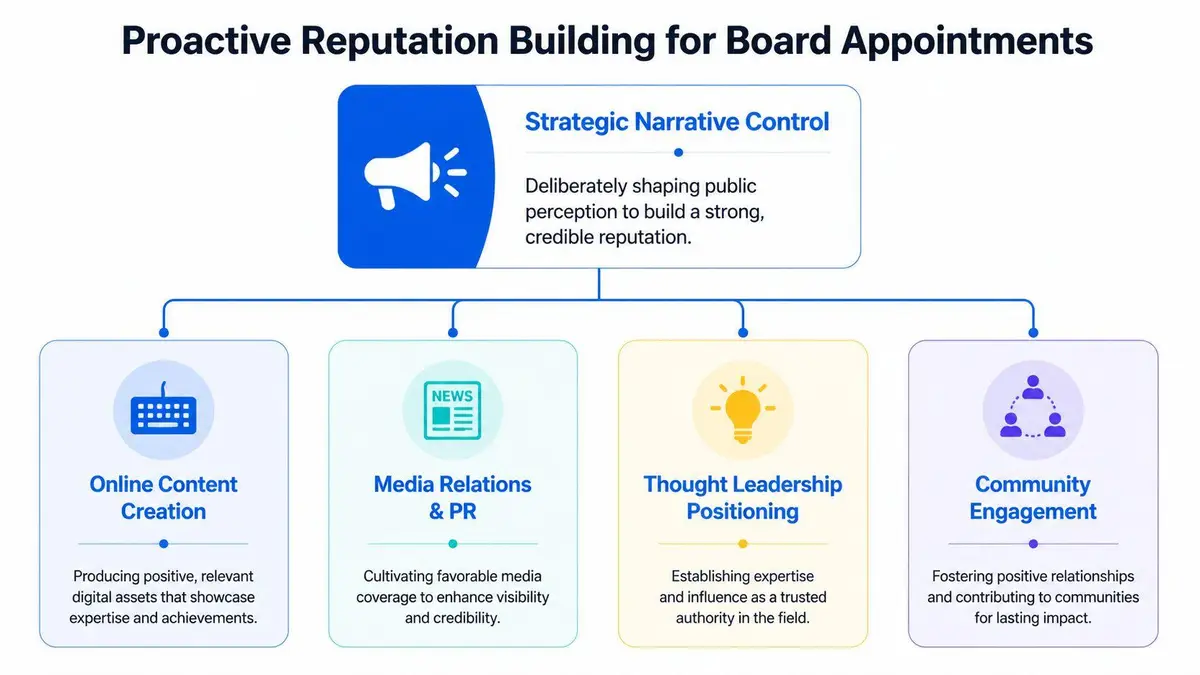
The point is coherence. Your search results, your LinkedIn profile, your public commentary, and your offline references should all tell the same story about your suitability.
Match the board’s priorities
Lazy personal branding falls flat. Generic leadership content doesn’t help. Boards are not hiring inspiration. They are mitigating risk and filling capability gaps.
So tailor the narrative to the target environment:
| Target board concern | Narrative asset that answers it |
|---|---|
| Regulatory complexity | Public commentary showing judgment on policy and compliance |
| Transformation risk | Articles or talks on execution, capital discipline, and stakeholder management |
| Reputation sensitivity | Evidence of measured communication and issue management |
| Growth or international expansion | Visible strategic thinking beyond one operating domain |
If you’re being considered for a board with public scrutiny exposure, your online presence should show restraint, range, and fiduciary instinct. If you’re seeking a private company board, the emphasis may shift toward scaling discipline, governance maturity, and trusted networks.
Support the private market with public proof
The CARE framework proves useful. A critical part of securing high-value board appointments is access to private channels, because 70-80% of paid board roles are unadvertised and filled by referrals from trusted networks (CARE framework summary from Callum Laing). That means your reputation has to work in two places at once. Privately, through referrals. Publicly, through verification.
A referral gets your name raised in the room. Your digital profile confirms that the referral is safe.
The strongest board candidates don’t rely on a single enthusiastic sponsor. They give every reviewer enough public evidence to agree with the referral.
Control tone as carefully as content
There is also a style issue that many accomplished executives miss. Board-facing narrative should be lower temperature than founder or CEO-facing narrative. Less self-celebration. More judgment. Less velocity. More calibration.
That affects everything from your post frequency to your commentary choices. Don’t wade into social arguments for sport. Don’t leave old partisan material unattended if you’re seeking a sensitive appointment. Don’t publish “hot takes” that sound clever and age badly.
When you protect executive reputation board appointment strategy this way, you’re not manufacturing an identity. You’re making sure the visible record supports the candidacy you’re asking people to back.
Deploying The Rapid-Response Playbook
The crisis rarely arrives when it’s convenient. It appears during shortlisting, final diligence, or the final conversation with the chair. An old interview clip resurfaces. A former counterparty briefs a journalist. A coordinated anonymous account thread appears on social media. Panic is what destroys candidacies, not just the triggering event.
Board credibility, shaped by strategic appointments, directly influences investor confidence and brand standing. A mishandled crisis during an appointment can shatter this credibility (board reputation analysis from Reputation X).

A realistic crisis sequence
Assume this happens on a Wednesday morning. You are in late-stage consideration for a board seat. A clip from a panel discussion years ago appears online, edited to remove context and make a remark look callous. A hostile account posts it. Two niche commentators amplify it. By midday, a reporter emails for comment.
At that moment, unprepared executives do the wrong things. They call friends for advice, start explaining by text, consider deleting old accounts, and produce inconsistent responses to different audiences.
The rapid-response playbook exists to stop that.
What gets activated immediately
Your first moves should already be assigned before any crisis occurs. The command structure needs names, not roles in theory.
Use a response grid like this:
| Function | Immediate task | Decision authority |
|---|---|---|
| Legal | Assess defamation, privacy, platform violations, preservation | External counsel or designated lead |
| Reputation counsel | Verify spread pattern, sentiment, search impact, and response options | Crisis lead |
| Principal | Approve facts and stay off ad hoc communications | You |
| Gatekeeper to board process | Coordinate with chair, search firm, or committee contact | One designated communicator |
The rule is simple. No freelance responses. No emotional posting. No “quick clarification” on social before the facts and exposure are mapped.
Critical instruction: in a live appointment crisis, speed matters, but message discipline matters more. A fast bad response creates the record your critics wanted.
For active attack scenarios, this kind of executive smear campaign response playbook is the right model. It forces triage before reaction.
Prepare holding statements before you need them
The best time to draft a holding statement is before the triggering event exists. You should have templates ready for common scenarios such as a resurfaced quote, leaked private material, a false allegation, an impersonation event, or a data breach involving your name.
Those statements should be short and functional. Acknowledge awareness. Reject falsehoods where appropriate. State that the matter is under review or has been referred for legal action. Avoid expansive explanations in the first cycle.
After the initial triage, visual and spoken messaging matter too.
Communicate up before the board hears it elsewhere
There is one audience more important than the public in this moment: the chair or the key decision-maker in the appointment process. If they hear about the issue from a third party first, you lose trust even if the underlying attack is weak.
A concise outreach should include:
- A factual summary: what surfaced, when, and whether it is edited, false, or misleading.
- The response posture: legal review, platform escalation, evidence preservation, and whether a public statement is being used.
- Your control signal: you are handling it methodically and will provide updates if the matter develops.
This is not public relations theater. It is governance reassurance.
Rehearse the playbook
No one performs well in a first-time emergency. Rehearse likely scenarios with your counsel, legal team, and assistant or chief of staff. Test who approves statements. Test who contacts the board side. Test how evidence is captured and how platform reports are filed.
The point of the playbook is not to make a crisis disappear. It is to keep a reputational event from becoming a character judgment.
Implementing Long-Term Reputation Fortification
Securing the board seat does not reduce your exposure. It changes its shape. Once appointed, your profile rises, your name becomes more searchable, and your statements carry different consequences. You are no longer just an executive with a history. You are a director whose conduct and associations can reflect on the institution.
That shift requires permanent infrastructure.
Your risk profile changes after appointment
Post-appointment scrutiny is broader and less forgiving. Journalists revisit past material with fresh interest. Activists tie your name to current issues. Search engines start connecting you more directly to the company, its controversies, and its market perception.
The maintenance program needs to cover three fronts:
- Name-based monitoring: your name, variants, titles, and combinations with the company, sector issues, or known controversies.
- Narrative reinforcement: fresh authoritative content that keeps your visible profile current, relevant, and proportionate.
- Escalation protocol: a standing process for assessment, takedown action, board-side communication, and legal review when new issues emerge.
This is why reputation management should sit closer to risk governance than to marketing. The operating logic is continuity, not promotion.
Maintain the gains you created
The positive assets built during the appointment process need upkeep. If your last thoughtful article is years old, if your profile becomes stale, or if old negative material starts outranking your current identity, your insulation weakens.
A durable maintenance rhythm usually includes:
| Asset | Maintenance action | Reason |
|---|---|---|
| LinkedIn and profile pages | Update roles, board activity boundaries, and expertise themes | Keeps the public record current |
| Thought leadership archive | Publish selectively on issues aligned with your governance remit | Reinforces board-level positioning |
| Search results review | Check ranking shifts and new associations | Catches early movement before escalation |
| Legal and platform watch | Track reposts, impersonation, or copied harmful content | Prevents recontamination |
Treat reputation like a live asset
Boards already understand oversight in finance, cyber, and compliance terms. Your reputation deserves the same discipline. It has triggers, exposures, and remediation paths. It can be stress-tested. It can be insured indirectly through process. It can also be damaged by neglect.
Reputational maintenance works best when it becomes a standing governance habit, not a panic purchase after a headline.
That means limiting avoidable exposure too. Be careful with public commentary outside your lane. Tighten privacy and account security. Review speeches and interviews with future context in mind. Keep records on resolved disputes so you can answer quickly if old matters reappear.
The executives who handle board life well are rarely the loudest. They are the ones who stay legible, controlled, and difficult to ambush.
Conclusion Your Reputation Is A Strategic Asset
The market still talks about reputation as if it were soft. It isn’t. In a board appointment, reputation functions like a strategic asset with direct influence on trust, governance comfort, and decision-maker confidence.
That’s why the correct playbook is integrated. Audit the full digital footprint. Remediate what can be removed or de-indexed. Build an authoritative public narrative that supports the role you want. Defend with a pre-built crisis response structure. Maintain the asset once visibility increases.
Most advisers only handle one slice of this. PR firms want to message around problems. Traditional law firms often focus on what can be litigated and ignore search mechanics, platform behavior, and narrative architecture. Generalist consultants do a superficial scan and call it diligence. That is not enough for a contested, high-stakes board process.
You need people who understand how harmful content spreads, how to remove it at source where possible, how to manage lawful but damaging material when it cannot be removed, and how to brief decision-makers without triggering avoidable alarm. You also need confidentiality. Reputational risk work done noisily is reputational risk work done badly.
If you are entering or already inside a board appointment process, assume your digital record is being evaluated right now. Act before someone else defines your file for you.
If you need a confidential assessment, ContentRemoval.com can evaluate your exposure, identify what should be removed, suppressed, disclosed, or monitored, and deliver a precise action plan for a live board appointment process.
Frequently asked questions
What do boards check about a candidate’s online history?
Beyond the CV and references, deeper diligence covers search results, image and video results, archived social media, litigation and regulatory mentions, political contributions, trade press, forum comments and associations with partners, family offices and causes. Most reputation failures happen off the record inside private diligence notes.
Should I disclose an old controversy to a board before they find it?
If the item cannot be removed and is likely to surface, yes. Deliver a concise, documented account privately to the right person at the right stage: state the issue plainly, give the outcome and facts without embellishment, and explain why it does not impair your ability to serve.
What should I do if a damaging clip resurfaces during a board appointment process?
Activate a pre-assigned response grid: legal assesses defamation and preservation, reputation counsel maps spread and search impact, you approve facts and stay off ad hoc communications, and one gatekeeper briefs the chair or search firm before they hear it elsewhere. No freelance responses and no quick social clarifications.