
A proactive reputation management executive program treats a leader’s public footprint as part of the enterprise risk surface and governs it like cyber or litigation exposure. It has five parts: governance with board oversight and trigger events, an early-warning monitoring system, a triage model matching removal, de-indexing or suppression to each threat, a dense owned content footprint, and board-grade KPIs.
Key facts
- An estimated 40% of CEO dismissals are linked to reputational failures, per NED on Board analysis.
- Trigger events for same-day escalation include impersonation, private data publication, leak indicators and coordinated posting.
- Monitor entities, family offices, charities, transactions and predictable attack language, not just the executive’s legal name.
- Track branded search control, threat neutralization speed and recurrence rate rather than raw mention counts.
Where ContentRemoval.com comes in. ContentRemoval.com is the intervention arm of an executive reputation program: when monitoring surfaces a false allegation, a leaked file or an impersonation profile, we handle source removal, de-indexing and suppression while counsel and communications hold their lanes. General counsel, chiefs of staff and board secretaries usually initiate contact. A free, confidential 15-minute Exposure Scan maps what already exists about an executive and what is removable, and the report is theirs to keep. Get a Free, Confidential Exposure Scan or read how our reputation management work is done.
A board meeting ends at 6:00 p.m. By 7:15, a hostile post naming the CEO is circulating in investor chats. By 8:30, a trade publication has lifted the allegation into a short item. Overnight, search results shift. Internal staff see it before leadership has aligned on a response. The executive’s personal reputation and the company’s stability are suddenly fused into one problem.
That sequence is common because digital attacks don’t wait for legal review, governance approval, or a polished statement. They spread through search, social platforms, niche forums, review ecosystems, and copied pages. If you’re an executive, your public footprint is no longer a side issue. It is part of the enterprise risk surface.
A serious proactive reputation management executive program starts from that premise. It treats reputation as a governed asset, not a branding exercise. If your current approach depends on ad hoc PR outreach, occasional Google searches, and instinct, you are exposed.
Reputation Management as a Leadership Imperative
Most executives still make the same mistake. They assume reputation becomes urgent only after a crisis becomes visible. By then, the damage has already moved through the channels that matter most: search results, stakeholder conversations, and buyer trust.
The commercial exposure is obvious. 99.95% of consumers research a brand online before making a purchasing decision, and 86% hesitate to buy from businesses with negative reviews, according to Blue Ocean Global Technology’s reputation statistics summary. That is not a marketing footnote. It is a direct warning to any leader whose name is tied to the company’s credibility.
Your name is part of the company’s risk profile
A founder, chair, CEO, or divisional head doesn’t get the luxury of separation. Buyers, employees, investors, regulators, journalists, counterparties, and plaintiffs all search the individual as well as the entity. They do it before deals, before hiring decisions, before renewals, and before disputes escalate.
When an executive’s search results include hostile commentary, outdated allegations, leaked material, impersonation, or misleading summaries, stakeholders rarely distinguish between personal narrative and corporate capability. They infer weakness in judgment, controls, and culture.
A reputation issue that starts with one executive often ends as a governance problem for the board.
The cost of waiting
Reactive cleanup is always harder than disciplined prevention. Once harmful content is indexed, repeated, screen-captured, quoted, and discussed across multiple properties, each day of delay gives third parties more material to amplify.
That is why I advise clients to stop thinking in communications terms alone. The correct frame is fiduciary duty, continuity, and downside protection. If your leadership team has formal oversight for cyber risk, litigation exposure, insider threats, and media incidents, it also needs formal oversight for executive reputation risk.
A well-run proactive reputation management executive strategy does three things before any visible crisis emerges. It identifies what exists. It monitors what changes. It puts authority in the hands of the people who can act quickly and discreetly.
Establishing the Governance Framework for Executive Reputation
Executive reputation should sit inside the company’s risk architecture. If it lives only with the press office, it will fail at the first serious test. PR can shape messaging, but PR cannot own legal exposure, internal escalation, platform coordination, employment consequences, or board reporting.
The board needs to treat executive reputation the same way it treats other leadership risks. That is especially true because an estimated 40% of CEO dismissals are linked to reputational failures, as discussed by NED on Board in its analysis of board lessons from CEO crises. Boards that ignore this are not being discreet. They are being passive.
Who should own the program
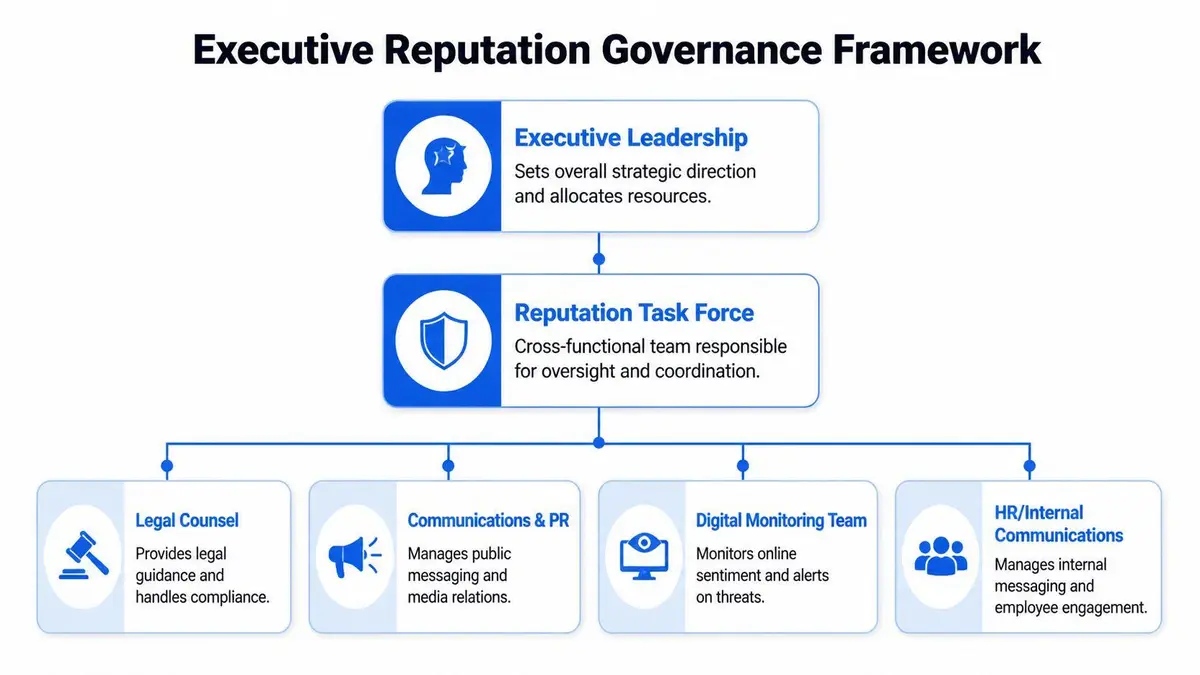
The answer is not one department. It is a controlled cross-functional group with a clear mandate, reporting cadence, and escalation rights. Call it an executive reputation task force if you want. The label matters less than the authority.
At minimum, the structure should include:
- Board or designated board committee oversight. Someone at board level must receive periodic reporting and approve the escalation framework for major threats.
- General counsel or external legal lead. This role determines when a matter involves defamation, privacy, confidentiality, platform abuse, copyright, employment law, or securities exposure.
- Communications lead. This person manages public framing, media handling, and narrative consistency.
- HR and internal communications. They control internal trust, staff briefings, and downstream employee issues.
- Security or digital intelligence function. This role handles monitoring, alert validation, impersonation mapping, and evidence capture.
- Chief of staff or executive office. This office keeps the principal informed and prevents delay.
What the board should require
Boards often ask for reassurance when they should be asking for systems. A serious framework has written rules, not verbal comfort.
Require these elements:
- A documented digital footprint audit protocol
Every executive with material visibility should undergo a structured review of search results, social platforms, review environments, media archives, forums, data broker exposure, and leak surfaces. - Defined trigger events
The company should specify which events require same-day escalation. Examples include impersonation, publication of private data, sudden negative search movement, leak indicators, false allegations, or coordinated posting. - A legal decision tree
If the content is unlawful, the legal route leads. If the content is lawful but harmful, suppression and counter-positioning may be the correct response. If the matter is both operational and reputational, multiple tracks run at once. - Confidential briefing channels
The worst outcomes often come from loose internal circulation. Limit access. Record decisions. Preserve privilege where appropriate.
Practical rule: If a board packet includes cyber risk and litigation exposure, it should also include executive reputation exposure.
Why executives should not self-govern this risk
Senior leaders are usually too close to their own footprint. They underestimate old material, dismiss fringe forums, and overvalue their ability to fix a problem through personal outreach. That instinct is understandable and often counterproductive.
The governance framework exists to solve that blindness. It creates distance, objectivity, and speed. It also protects the executive from making a panicked decision that worsens discoverability.
A strong proactive reputation management executive framework also reduces internal confusion. Legal knows when to move. Communications knows when not to speak. HR knows what staff can be told. The board knows when the issue has crossed from annoyance into risk.
Without that structure, organizations improvise. Improvisation is expensive.
Building the Digital Early-Warning System
Monitoring should be treated like executive security. It is not a vanity dashboard and it is not a weekly assistant task. It is a live detection system designed to catch weak signals before they harden into indexed harm.
Executive reputation is tied to enterprise value. 91.9% of experts link proactive management to over 25% of a company’s market value, according to Crackerjack Marketing’s discussion of executive reputation management. That same discussion ties the rise of modern monitoring to incidents such as the Yahoo data breach, which accelerated demand for dark web surveillance.

What comprehensive monitoring actually includes
Most executives think monitoring means Google Alerts. That is inadequate. A proper system tracks how your name, titles, images, associated entities, and family or asset references appear across environments where risk starts early.
The core layers should include:
- Search monitoring for branded terms, executive names, common misspellings, and combinations with accusations, litigation language, reviews, complaints, leaks, or contact details.
- Social listening across major platforms and smaller communities where reputational narratives often incubate before mainstream discovery.
- Forum and comment surveillance because anonymous boards, niche investor spaces, and industry communities often move faster than formal media.
- Image and identity monitoring to flag impersonation profiles, reused headshots, altered graphics, and false bios.
- Dark web monitoring for leaked credentials, personal data, internal documents, and references to the executive or close associates.
- Review and directory tracking if the executive is directly identified with a practice, firm, clinic, office, or product category.
Configure alerts for action, not noise
A weak monitoring setup creates inbox clutter. A strong one identifies trigger conditions and routes them to the right people.
Use these categories:
| Trigger type | What it means | Immediate action |
|---|---|---|
| Search displacement | Harmful content moves into visible branded results | Capture evidence and assess removal or suppression path |
| Identity abuse | Fake profile, impersonation, or cloned content appears | Report, preserve, and escalate to legal and platform contacts |
| Leak signal | Credentials, documents, or personal data appear in high-risk channels | Initiate containment and parallel legal-security review |
| Sentiment spike | Negative mentions rise sharply around a known event | Validate cause and prepare controlled response |
| Media pickup | A rumor crosses into a publication or indexable source | Move from monitoring to intervention |
For many clients, the cleanest route is a dedicated executive reputation monitoring program that combines search surveillance, threat detection, evidence handling, and escalation planning under one process. The operational point is simple. Monitoring only matters if it leads to timely decisions.
Build a reporting rhythm
Daily alerting is necessary. Weekly analysis is useful. Monthly board-grade reporting is where discipline shows up.
The monthly report should answer five questions:
- What new threats appeared?
- Which threats were false alarms?
- Which items require legal action, platform action, or suppression?
- How did search visibility for owned and harmful properties change?
- What patterns suggest future exposure?
Many teams fail at this point. They detect mentions but never translate them into operational priorities.
Here is a useful briefing before choosing tools and escalation thresholds:
The non-negotiable principle
Do not monitor only the executive’s exact legal name. Monitor entities, projects, family offices, charities, major transactions, key personnel, and predictable attack language. Adversaries rarely publish in the neat format your dashboard prefers.
If your system only tells you what is already obvious on page one, it is late.
A capable early-warning system gives the executive time. Time to preserve evidence. Time to choose the correct legal theory. Time to suppress before repetition spreads. Time to avoid turning a containable issue into a public test of leadership.
That time is the asset you are buying.
Executing Content Removal and Legal Suppression
Once a threat is detected, speed matters. Precision matters more. Executives get into trouble when they treat every harmful item as a public relations issue. Some matters are unlawful. Some are stale but lawful. Some are malicious but technically framed to avoid easy takedown. Each category requires a different response.

Triage the threat before you act
I advise clients to make three decisions in the first review cycle.
First, ask whether the content is illegal, policy-violating, or removable at source. That includes defamation, impersonation, non-consensual intimate material, copyright misuse, privacy breaches, forged records, and some forms of doxxing or confidential data exposure.
Second, ask whether the content is lawful but suppressible. Old allegations, misleading summaries, low-quality attack posts, and obsolete references may not disappear from the source, but they can often be de-indexed, displaced, or pushed out of visible search positions.
Third, ask whether the content is strategically better ignored while you strengthen surrounding assets. Not every ugly comment deserves oxygen. Some do.
Match the remedy to the problem
A disciplined response usually falls into one or more of these tracks:
- Source removal when the publisher, platform, or host has a viable basis to delete the material.
- Search de-indexing when search visibility can be limited even if the source remains online.
- Legal notice and escalation when formal claims provide advantage or preserve rights.
- Suppression through search strategy when positive controlled assets can outrank or dilute harmful visibility.
- Containment and monitoring when acting publicly would worsen spread.
This is the point where executives often misuse PR. A statement can reassure stakeholders, but it cannot remove a leak, de-index a malicious page, or stop reuploads. The source-backed benchmark that matters here is blunt. Spectrum Science’s discussion of proactive reputation management notes that legal-AI hybrids can achieve de-indexing success rates of over 90% within 48 hours in relevant cases. That is why over-reliance on PR is a category error.
A practical decision model
Use this table to decide quickly:
| Threat type | Best first move | Secondary move |
|---|---|---|
| False allegation on a niche site | Legal review and source challenge | Search suppression if source resists |
| Impersonation profile | Platform report with evidence | Broader identity monitoring for duplicates |
| Leaked personal data | Removal request and security containment | Ongoing surveillance for reposts |
| Outdated negative article | De-indexing analysis | Build controlled positive assets around the query |
| Coordinated smear posts | Evidence capture and pattern mapping | Multi-platform enforcement and suppression |
For executives facing a mixed problem, the most useful reference point is a clear strategic guide to content removal for executives and founders. The reason is simple. Most cases are hybrid matters. They need legal judgment, technical escalation, search understanding, and discretion.
The scenario that matters
Assume a former contractor posts a false claim tied to your name and company. A small blog indexes it. A forum thread copies it. Someone then posts the article in a comment thread under a legitimate publication. If your team responds with a press statement alone, you have not touched the source, the copies, or the search layer.
The correct approach is narrower and harder. Preserve the original URL and timestamps. Assess legal basis. Move against impersonation or false factual claims where platform rules allow it. Evaluate de-indexing where available. Launch suppression content only after legal and search priorities are clear. Monitor for republication.
The first response should reduce visibility or remove the source. It should not satisfy someone’s desire to be seen responding.
That is the difference between image management and risk control.
Fortifying Your Digital Fortress and Personal Brand
Removal and suppression are only half the job. The stronger half is building a search environment you control. If your digital footprint is thin, fragmented, or stale, a single negative asset has too much room to dominate. If your footprint is dense, authoritative, and current, attacks have less space to land.
That is why serious executives build what I call a digital fortress. It is not vanity publishing. It is controlled visibility.

Own the first page before someone else does
The strongest defensive asset is a credible body of positive, relevant, indexable material attached to your name and expertise. That includes a personal site, executive biography pages, board and speaking profiles, interviews, thought leadership articles, verified social profiles, and consistent directory entries.
This isn’t theoretical. THM2G’s proactive reputation strategy guide notes that 75% of users never scroll past page one, which is why SEO-optimized thought leadership designed to dominate first-page results is a core proactive tactic.
Build assets in layers
Do not publish random leadership content and call it strategy. Build in layers of control.
Start with core identity assets. Your personal website or profile hub should clearly establish your current role, history, sector authority, and approved biography. LinkedIn matters because it often ranks well and is easy for third parties to evaluate quickly.
Then build credibility assets. Place bylined articles, interviews, keynote pages, board memberships, podcast appearances, and professional association profiles where they can rank for your name.
Finally, develop protective assets. These are pages and articles built around the search terms most likely to matter during diligence or controversy. If your sector attracts litigation rumors, activist pressure, or regulatory scrutiny, your visible footprint should already contain mature, factual content that frames who you are and how you lead.
What to publish
A resilient executive profile usually includes:
- A definitive biography that is current, consistent, and written for both humans and search engines.
- Issue-based thought leadership tied to your actual field, not generic leadership clichés.
- Media-ready commentary that demonstrates judgment under pressure.
- Institutional alignment content that shows how your values and the company’s mission fit together.
- High-authority profile consistency across platforms, directories, and professional listings.
Strong search results don’t happen because an executive is accomplished. They happen because accomplishment has been packaged into assets that search engines can trust.
What not to do
Do not outsource your name to junior marketers who produce generic posts under your byline. Thin content weakens authority. So do self-congratulatory interviews that exist only to flatter. Search suppression works best when the assets deserve to rank.
Also, do not neglect visual consistency. Headshots, bios, titles, and summaries should match across your highest-authority profiles. Inconsistency creates doubt and gives impersonators room to operate.
A proactive reputation management executive strategy becomes durable when owned content, third-party validation, and search structure reinforce one another. That is what turns reputation defense from a recurring emergency into a stable advantage.
Measuring Performance and Justifying Investment
If you can’t measure reputation protection, you can’t govern it. Executives often tolerate weak reporting because ORM is still mislabeled as soft communications work. It isn’t. It has measurable operational outputs and measurable business consequences.
The benchmark worth watching is this: WSI’s analysis of integrated reputation management states that firms with integrated ORM see 40% faster crisis resolution and 30% revenue protection versus reactive peers. The same source identifies key KPIs including sentiment score with a target above 70% positive, average star ratings with a target of 4.7+, and competitive share of voice.
The dashboard that actually matters
A proper executive dashboard should not drown leadership in mention counts. It should answer whether exposure is rising or falling, whether control of branded search is improving, and whether the organization is neutralizing threats quickly.
Here is the core scorecard:
| KPI | Description | Executive Target |
|---|---|---|
| Sentiment score | Ratio of positive, neutral, and negative mentions across monitored channels | Above 70% positive |
| Average star rating | Public rating average where the executive or business is directly evaluated | 4.7+ |
| Competitive share of voice | Visibility of the executive versus peers in relevant digital discussions and search contexts | Increase controlled visibility over time |
| Branded search control | Percentage of first-page results occupied by owned or favorable assets | Expand and defend controlled presence |
| Threat neutralization speed | How quickly harmful items are removed, de-indexed, suppressed, or contained | Shorten resolution cycle consistently |
| Recurrence rate | Whether harmful content reappears after intervention | Drive repeat incidents down |
Measure risk reduction, not just activity
A monitoring team can produce endless reports and still fail. The right question is not how many alerts arrived. It is whether the system prevented escalation.
That means tracking:
- whether harmful items were caught before mainstream pickup
- whether removal or de-indexing reduced search visibility
- whether controlled assets improved branded results
- whether board reporting led to faster decisions
- whether incidents repeated because monitoring gaps remained
For executives evaluating budget, this is the relevant lens. Spend should be tied to threat detection, intervention capability, content control, and specialist support. If you need a practical framework for that budget discussion, review the strategic cost analysis for online reputation management.
The investment case
The lazy objection is that reputation protection is expensive. The better question is what unmanaged exposure costs when a leak, false claim, or hostile page becomes the first thing counterparties see.
A mature program justifies itself when it reduces surprise, improves response time, protects branded search, and gives the board a defensible oversight record. Those are not vanity outcomes. They are governance outcomes.
Boards approve insurance, outside counsel, forensic reviews, and security upgrades because unmanaged downside is costly. Executive reputation protection belongs in the same category.
Your Reputation Is Your Most Critical Asset
An executive’s reputation is not separate from the company’s resilience. It affects trust, negotiations, hiring, financing, media scrutiny, and board confidence. Treating it as a side project is a leadership error.
The correct playbook is disciplined. Put governance around the risk. Build a monitoring system that sees beyond obvious search results. Use legal removal, de-indexing, and suppression with precision. Strengthen the positive assets you control so your search environment cannot be easily hijacked. Measure outcomes in terms the board respects.
That is what a serious proactive reputation management executive strategy looks like. It is not glamorous. It is structured, confidential, and effective.
If you are already visible, already affluent, or already leading under scrutiny, you do not need more general advice. You need an assessment of your current exposure, your governance gaps, and the intervention options available before the next trigger event arrives.
If you’re facing a live threat, a damaging search result, leaked material, impersonation, or a broader executive exposure problem, ContentRemoval.com offers confidential assessments and customized action plans for high-net-worth individuals, founders, family offices, and public-facing executives. Their team combines legal strategy, takedown execution, de-indexing, suppression, and continuous monitoring to act quickly and discreetly where conventional PR approaches fall short.
Frequently asked questions
Who should be responsible for an executive’s online reputation inside a company?
Not one department. A cross-functional group with board-level oversight, general counsel or an external legal lead, communications, HR, a security or digital intelligence function and the chief of staff. Executives should not self-govern this risk because they underestimate old material and overvalue personal outreach.
Is Google Alerts enough to monitor an executive’s reputation?
No. A proper system covers search terms combined with accusation and litigation language, social listening in smaller communities, forum surveillance, image and identity monitoring for impersonation, dark web checks for leaked credentials and documents, and review or directory tracking where relevant, all routed to defined owners.
Should an executive respond publicly to a false claim posted online?
Not as the first move. Preserve the original URL and timestamps, assess the legal basis, act against false factual claims or impersonation where platform rules allow, evaluate de-indexing, and only then consider suppression content. A press statement alone touches neither the source, the copies nor the search layer.