

Private client reputation management is the surgical removal and suppression of harmful online content to protect the financial standing, privacy and influence of high-net-worth individuals, executives and family offices. It runs on three pillars: legal takedowns using DMCA notices and the GDPR Right to be Forgotten, technical source removal and de-indexing, and continuous monitoring across the open and dark web.
Key facts
- Targeted defamation uses networks of anonymous sites, fake review profiles and disposable accounts to poison search results.
- Source removal is the superior outcome; de-indexing from Google and Bing is the fallback when a host refuses.
- Impersonation, copyright violations and intimate imagery can often be removed within days; major news articles take weeks or months.
- Anonymous or offshore attackers can be countered through platform policy enforcement, investigation and de-indexing.
Where ContentRemoval.com comes in. ContentRemoval.com is the specialist a private client turns to when defamation, leaked material or an impersonation account threatens a transaction, board seat or family privacy. Contact usually comes from the principal’s lawyer, family office or chief of staff, and every conversation stays confidential from the first call. A free 15-minute Exposure Scan maps what is removable at source and what must be de-indexed instead, and the report is yours to keep. Get a Free, Confidential Exposure Scan or read how our reputation management work is done.
For high-net-worth individuals, executives, and family offices, reputation management is not a communications function. It is a core component of asset protection. It is the strategic, often surgical, process of removing and suppressing harmful online content to safeguard financial standing, personal privacy, and influence. Your digital reputation is a measurable asset, and its integrity directly impacts your wealth.
The Unbreakable Link Between Reputation and Value

For a company founder, a principal at a family office, or any prominent individual, the line between personal reputation and business valuation is nonexistent. A single piece of negative content (a defamatory article, a leaked private document, or a baseless accusation) can inflict immediate and severe financial harm.
This reality shifts private client reputation management from a reactive damage-control exercise to an essential, proactive strategy for wealth preservation.
The financial markets are unforgiving in how they quantify this link. A crisis of confidence in a CEO, triggered by negative online content, can erase billions in market capitalization within hours. Investment opportunities evaporate the moment due diligence uncovers a reputational red flag.
A private client’s reputation is not merely part of their brand; it is a foundational pillar of their net worth. Protecting it demands the same strategic focus and specialized skill applied to managing a major investment portfolio.
This direct connection between online perception and financial results requires a tactical approach distinct from traditional public relations.
The Financial Bleed from Digital Threats
Financial damage from a compromised reputation materializes in two forms: direct financial impacts and indirect value erosion. Recognizing these is the first step in constructing a viable defense. The impact is not theoretical. It is a quantifiable loss of capital, opportunity, and influence.
Just as financial planning is integral to a client’s future, disciplines like private wealth management demonstrate the necessity of protecting every facet of a client’s life. A reputational crisis can rapidly negate years of meticulous financial strategy.
Direct financial impacts are often swift and brutal. They include diminished market capitalization for executives at public companies, as negative personal narratives erode investor confidence. Another is the loss of investment, where private equity and venture capital deals collapse because due diligence on a key principal unearths reputational liabilities. Finally, the devaluation of personal brand equity directly cuts into the earning potential of entrepreneurs and public figures whose name is their brand.
The indirect consequences are often more insidious, causing a slow, steady drain on wealth and influence.
The Hidden Costs of a Damaged Reputation
Beyond the immediate injury to the balance sheet, the secondary effects of a negative online reputation create friction in nearly every facet of business and personal life. These costs compound, acting as a constant drag on growth and security.
This friction manifests as increased scrutiny from regulators, journalists, and potential partners, slowing operational momentum. It also appears as difficulty attracting talent, as top-tier candidates are wary of joining a leader or organization grappling with a public reputational crisis. The pressure extends beyond the professional sphere, creating significant personal and familial stress.
Failing to manage one’s digital footprint is analogous to leaving a significant portion of an asset portfolio completely uninsured. It is an unforced error that a specialist firm can prevent and rectify. A proactive defense is the only logical strategy.
Understanding the Threats: What Private Clients Face

For a private client, the internet is not a neutral forum but a minefield of specific, calculated threats designed to exploit wealth, influence, and public profile. A functional defense begins with a precise understanding of these threats.
Attacks are rarely random. They are often orchestrated by adversaries with a clear motive: disgruntled former employees, business rivals, extortionists, or activists. Their objective is to inflict maximum damage by weaponizing public perception and online information.
Weaponizing Search Results: Targeted Defamation
The most common attack vector is targeted defamation. This is not a stray negative comment but a coordinated campaign engineered to poison search results with false, malicious content. The objective is to ensure that anyone conducting diligence (a potential investor, a journalist, a new business partner) is immediately confronted with a wall of damaging material.
Attackers execute this by establishing a network of anonymously registered websites, fraudulent review profiles, and disposable social media accounts, all propagating a defamatory narrative. Because search algorithms can favor new content and engagement signals, this negative material can rapidly dominate search rankings, burying legitimate, positive information. This digital siege makes it nearly impossible to control one’s own narrative as attackers hijack your online identity.
The Dual Threats of Information Leaks and Impersonation
For our clients, confidentiality is paramount. A confidential information leak (whether involving sensitive business strategies, private correspondence, or personal family matters) is a catastrophic breach. This information is frequently weaponized for leverage or released to sow chaos.
Concurrently, sophisticated impersonation has become a severe threat. Adversaries create highly convincing fake profiles on platforms like LinkedIn, X (formerly Twitter), and Instagram. Using a client’s name and likeness, they can defraud contacts, disseminate misinformation, or destroy professional relationships, all while hiding behind the client’s established reputation.
A private client’s digital vulnerability is not just about what is said about them, but who can pretend to be them. An impersonator can dismantle a lifetime of trust in a matter of hours, making proactive defense and rapid response critical.
These threats rarely exist in isolation. A data leak is often followed by a smear campaign, which is then amplified by impersonation accounts. This multi-pronged attack creates a complex crisis that requires a specialized, multi-disciplinary response.
The table below outlines the most common digital threats and their specific impact on private clients.
Digital Threats and Their Impact on Private Clients
| Threat Vector | Primary Impact | Common Platforms/Source |
|---|---|---|
| Targeted Defamation | Destroys credibility, impacts financing and partnerships, poisons search results. | Anonymous blogs, fake news sites, Ripoff Report, forums, review platforms. |
| Information Leaks | Exposes trade secrets, financial data, and personal communications; enables extortion. | Hacked email accounts, disgruntled employees, insecure cloud storage. |
| Impersonation | Spreads disinformation, scams business partners and family, damages relationships. | LinkedIn, X (formerly Twitter), Instagram, Facebook, lookalike email domains. |
| NCII Distribution | Causes severe personal and emotional distress; used for blackmail and revenge. | Revenge porn sites, social media messaging, forums, file-sharing networks. |
| Old/Negative Content | Creates lasting reputational harm, derails background checks and opportunities. | Mugshot websites, old news articles, court record databases. |
| Dark Web Exposure | Puts personal identity and assets at risk; precursor to targeted attacks. | Data breach marketplaces, hacker forums, illicit trading channels. |
Each threat exploits a different digital vulnerability, but all converge on a tangible, real-world impact on a client’s life and business.
Ghosts of the Past and Present
The internet’s memory is long and unforgiving. An old arrest record or mugshot, even from a charge that was dismissed, can linger in search results for decades. This digital ghost creates a misleading first impression that can neutralize opportunities long after the issue was legally resolved. Outdated or factually incorrect news articles have the same effect. Strategic suppression and removal are often the only recourse.
A particularly vicious threat is the distribution of Non-Consensual Intimate Imagery (NCII), a tactic used for extortion or revenge. The speed at which this material can proliferate demands immediate, decisive action to contain the damage and remove the content at its source.
Finally, the dark web is a marketplace where stolen personal data, confidential corporate information, and plans for reputational attacks are bought and sold. Monitoring the dark web is a critical component of any robust private client reputation management strategy, as it provides intelligence on threats before they surface on the public internet.
A Three-Pronged Digital Defense Strategy
When a private client’s reputation is under attack online, the situation requires a delicate, high-stakes operation demanding a synthesis of legal acumen, technical skill, and relentless monitoring. This coordinated defense system is a framework built from years of resolving these exact situations, with each pillar (legal, technical, and monitoring) playing a specific, synchronized role.
The Legal Pillar: Takedowns and Enforcement
The initial action is nearly always legal, but it is not public litigation. We employ targeted legal instruments to compel the removal of damaging content directly at the source. For example, the unauthorized use of copyrighted photographs or documents in a defamatory article can be swiftly addressed with a Digital Millennium Copyright Act (DMCA) notice. For clients with a European nexus, we can invoke the ‘Right to be Forgotten’ under GDPR to compel the erasure of outdated or irrelevant personal data from search engines.
A successful takedown is an exercise in legal precision. It requires identifying the exact law or platform policy that has been violated and presenting an incontrovertible case. When executed correctly, hosts and platforms often comply within days, not weeks.
This legal pressure provides the necessary leverage to proceed to the technical phase of the engagement.
The Technical Pillar: De-Indexing and Source Removal
With a legal justification or a clear terms-of-service violation established, our technical team executes direct action. The two primary objectives are source removal and search engine de-indexing.
Source removal, the complete deletion of content from the publishing website, is the superior outcome. When a site owner is uncooperative, search engine de-indexing becomes the primary tool. We petition search engines like Google and Bing to remove the harmful URL from their search results. The page may still exist, but if it cannot be found, it is effectively neutralized.
The financial risk of a negative search result is staggering. Industry analysis projects that corporate reputation will account for an estimated $11.9 trillion of the S&P 500’s market value by 2026. A single negative article can reduce a company’s revenue by 22%. For an executive, that reputational impact translates to millions in lost value, underscoring the critical nature of this technical intervention.
The Monitoring Pillar: Proactive Threat Intelligence
Removing a malicious post is not the end of the engagement; it is the end of a single battle. Determined adversaries will often attempt to republish content on other domains. A one-time fix is insufficient; a permanent intelligence capability is required.
We deploy sophisticated tools that continuously scan the public web, deep web, and dark web for any mention of our client’s name or other unique identifiers. This system functions as a 24/7 digital sentry, alerting us the moment a new threat appears. By detecting new defamatory posts, impersonation accounts, or data leaks instantly, we can initiate the removal process before they achieve virality and inflict material damage. A more detailed examination of these systems is available in our guide to reputation monitoring. This transforms a reactive cleanup into a proactive, long-term defense shield.
From Crisis to Control: The Engagement Process
When under attack, the path forward must be clear, decisive, and immediate. Engaging a specialist firm is not a consultative exercise; it is a structured process designed to transition a client from a state of crisis to one of control. For a principal facing immense pressure, understanding the precise sequence of events provides critical confidence.
The process begins with a Confidential Initial Assessment. This is a secure, privileged conversation where you or your legal counsel can disclose the entire situation without reservation. Our role in this first interaction is to listen, comprehend the scope of the reputational threat, and begin mapping its digital footprint across search engines, social media, and the darker corners of the web. This is not a sales pitch but a diagnostic session to identify attack vectors, determine applicable legal and technical tools, and establish immediate priorities. All communication is protected by a strict non-disclosure agreement, ensuring absolute discretion from the outset.
From Strategy to Execution
Following a complete diagnostic, we develop a Custom Action Plan. Because no two reputational threats are identical, no two strategies can be. This plan outlines the specific legal and technical tactics to be deployed, with clear objectives and a precise sequence of actions. It may involve dispatching DMCA takedown notices or cease and desist letters, filing petitions with search engines to de-index harmful links, or conducting investigative work to unmask anonymous adversaries.
With the strategy approved, we proceed immediately to Execution, typically within a 24 to 48-hour window. In cases of viral content or ongoing data leaks, these first two days are critical for containment. Our first priority is always to stop the bleeding and initiate the removal process at the source.
The core of effective reputation management is shifting from a defensive posture to a proactive assault on the negative material. It involves a coordinated application of legal pressure, technical skill, and relentless monitoring to reclaim the narrative.
This chart illustrates how our legal, technical, and monitoring efforts interoperate.
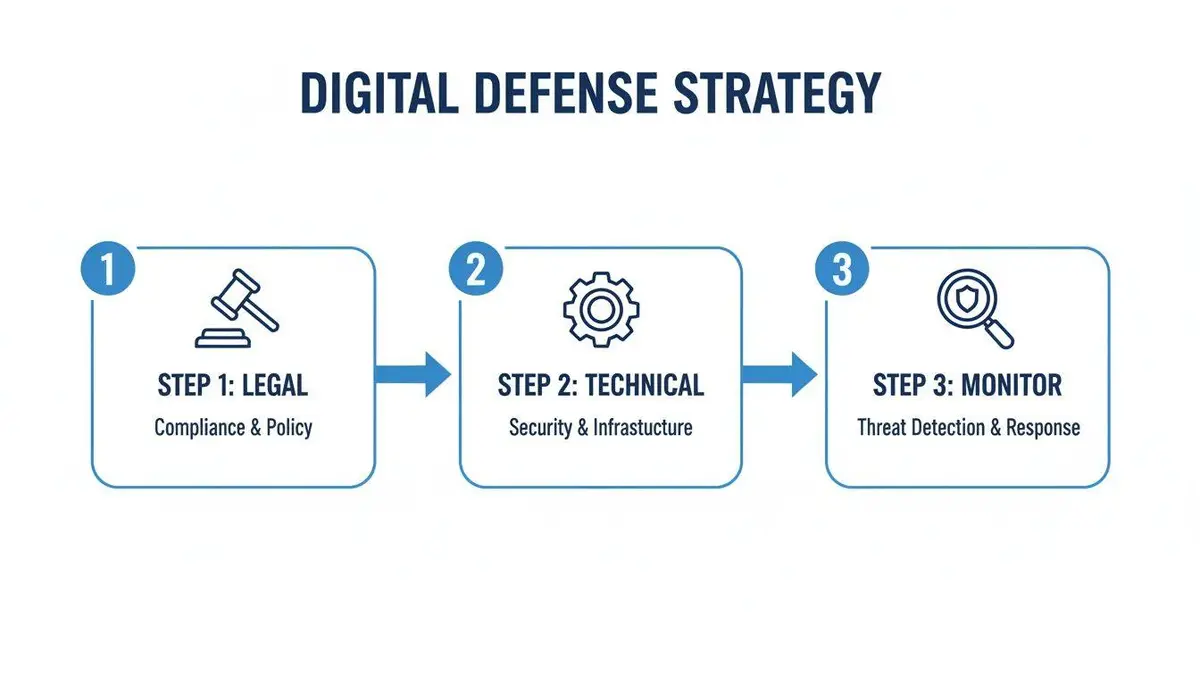
These are not sequential steps but parallel, reinforcing actions that constitute a comprehensive digital defense.
Reporting and Ongoing Vigilance
Throughout the engagement, clients receive constant, clear updates during the Reporting and Monitoring Phase. You receive confirmations of content removals, reports showing link de-indexing from search results, and intelligence on any new threats we uncover.
We establish realistic timelines and Service Level Agreements (SLAs) at the outset. While some content that clearly violates platform terms can be removed in days, more entrenched problems, like a negative article on a major news site, require a longer and more sophisticated campaign. The engagement is not complete when the initial threat is neutralized. Continuous monitoring is the final, essential component, transforming a one-time emergency response into a permanent digital shield.
Navigating Jurisdictional Complexities and Confidentiality

The internet is borderless. A defamatory blog post hosted in one country can inflict serious financial and personal damage on a client residing halfway across the world. This makes cross-border enforcement the central pillar of any viable defense strategy.
Success hinges on a firm’s ability to navigate a labyrinth of international laws, platform policies, and local customs. The legal argument for content removal is not universal; it changes depending on server location, corporate domicile, and client residence. For instance, a U.S.-hosted site may be subject to the Digital Millennium Copyright Act (DMCA), whereas removing outdated information from European search results would involve the General Data Protection Regulation (GDPR) and its ‘Right to be Forgotten’. Knowing which legal instrument to apply, and where, is critical.
The Imperative of Absolute Confidentiality
For any private client, the cure cannot be worse than the disease. The process of rectifying a reputation problem must be completely discreet; otherwise, the engagement itself becomes a public spectacle. Operational security is the foundation of our client relationships.
A true specialist firm operates with the discipline of an intelligence agency. All communications are protected by end-to-end encryption, and case details are shared internally on a strict need-to-know basis. The objective is to construct an airtight perimeter around the client, rendering their identity and the case itself invisible to the outside world.
The ultimate failure in private client reputation management is a confidentiality breach. Protecting a client’s privacy throughout the engagement is as important as removing the harmful content itself. This commitment to discretion is what separates a true specialist from a generalist agency.
This level of security ensures the solution never becomes part of the problem. Further detail on these international legal strategies can be found in our guide on navigating online content removal laws.
Adapting Strategies to a Global Arena
The challenge intensifies when confronting anonymous attackers or platforms based in jurisdictions with little respect for international law. A legal strategy effective against a U.S. publisher may be useless against a website hosted in a jurisdiction that will not recognize foreign court orders.
In these scenarios, the strategy must pivot to other points of leverage. This may involve platform policy enforcement, where a deep analysis of a platform’s terms of service reveals a violation that forces their compliance, even if the content is not illegal where hosted. It can also include investigative action to unmask the anonymous operators behind a defamatory site, thereby establishing jurisdiction in a responsive court. Finally, technical pressure can be used to de-index damaging content from search engines, effectively neutralizing it even if the source page remains live. This layered approach ensures that a locked door does not halt progress.
How to Select a Specialist Reputation Firm
Choosing a partner to manage your digital reputation is a decision with significant consequences. The wrong firm can deplete resources, prolong exposure to damaging content, and, in some cases, exacerbate the situation. It is imperative to look past marketing claims to identify a true specialist in private client reputation management, not a generalist agency. Your vetting process should be as rigorous as the due diligence for a major investment. A genuine specialist operates with the precision of a law firm, and its value is measured in successful removals and neutralized threats.
Verifiable Legal and Technical Expertise
A credible firm must possess demonstrable expertise in the laws governing online content. This means having in-house legal counsel or a dedicated legal team with a documented history of success in defamation, privacy law, and intellectual property. Request redacted case studies illustrating how they have used legal arguments to compel takedowns across different jurisdictions.
Technical proficiency is equally critical. Many firms offer only basic SEO suppression, which merely papers over the problem. A true specialist possesses proprietary methods for removing content at the source, de-indexing it from search engines, and conducting forensic analysis to identify anonymous attackers. They should be able to articulate their technical process clearly, without resorting to jargon.
Be wary of any firm that “guarantees” removals. Success is contingent upon legal interpretations and platform cooperation. Absolute guarantees are both impossible and unprofessional. An expert will be transparent about the probability of success, not make empty promises.
A Track Record with a Similar Client Profile
The firm’s experience should mirror your specific circumstances. A team that has guided other high-net-worth individuals, executives, or family offices through crises will intuitively understand the unique pressures and absolute need for confidentiality you require. They will also have established relationships with key personnel at major platforms, which can prove decisive.
Online reviews are another key battleground. With 93% of consumers using reviews to make decisions, their influence is undeniable. The problem is that an estimated 30% of all online reviews are fake. For private clients whose businesses are under constant scrutiny, this is a serious threat requiring sophisticated management tools, as highlighted by impact of online reviews on reputation from industry data.
Transparent Metrics and Client-Centric Processes
Finally, scrutinize the firm’s processes and reporting protocols. A top-tier firm provides a clear plan of action, realistic timelines, and regular, detailed progress updates. They should define success in the same terms you do: the permanent removal or neutralization of harmful content.
Vague strategies, a refusal to explain specific tactics, or a business model built on long-term retainers for simple monitoring are all red flags. A specialist is engaged to solve a specific, urgent problem. For a deeper analysis of what differentiates premier firms, consult our guide to the best reputation management companies. Ultimately, you require a partner with a documented history of discreet, surgical, and effective action.
Answering Your Questions
When facing an attack on your personal reputation, you require clear, direct answers. These are the questions most frequently posed by prospective clients during our initial confidential consultation.
How is private client reputation management different from standard PR?
Traditional corporate PR is a broadcast function. It uses a megaphone to disseminate a positive message, build a public presence, and generate favorable coverage.
Private client reputation management is the antithesis. We do not use a megaphone; we use a scalpel. Our work is quiet, precise, and focused exclusively on the surgical removal of harmful, unwanted material from the internet. We do not attempt to bury a problem with positive content. We eliminate the problem at its source using legal, technical, and investigative strategies. PR is for building a public profile. Our work is for restoring privacy and control.
Can you remove something from the internet permanently?
Yes, it is possible to have damaging content permanently removed, but it is a complex process. Success is contingent on the specifics of the case: where the content is hosted, the platform’s terms of service, and the applicable legal jurisdiction.
True removal is not about making a request; it is about compelling an action. This is achieved by deploying the correct legal instrument, whether a court order, a DMCA takedown notice for copyright infringement, or proof of a clear breach of a website’s terms. An expert team knows how to force removal at the source and then ensure the content is de-indexed from search engines like Google, rendering it invisible.
This requires a deep, functional understanding of a complex web of international laws and platform policies.
How long does the removal process take?
The timeline is dictated entirely by the nature of the threat. We initiate action, such as sending legal notices, within 24-48 hours of engagement.
Some issues have rapid resolutions. Impersonation accounts, copyright violations, or the distribution of Non-Consensual Intimate Imagery (NCII) often represent clear-cut policy violations and can sometimes be removed within days. More complex challenges demand greater patience. Contesting a defamatory article on a major news outlet or pursuing a legal case can require several weeks or months of persistent, strategic effort. Any firm that offers a generic, one-size-fits-all timeline is not being forthright. We provide a transparent, realistic assessment for each objective so you know precisely what to expect.
When facing a sophisticated digital threat, you need a specialist team with a proven track record of acting with speed, precision, and discretion. ContentRemoval.com provides the expertise required to protect your assets and restore your control. If your reputation is under attack, contact us for a confidential assessment at ContentRemoval.com.
Frequently asked questions
How is private client reputation management different from PR?
PR is a broadcast function that uses positive messaging to build a public profile. Private client reputation management is the opposite: quiet, precise removal of harmful material at its source using legal, technical and investigative tools, rather than trying to bury the problem under favorable content.
Can a mugshot or old arrest record from a dismissed charge be removed?
Often, yes. These digital ghosts can linger in search for decades, but strategic removal and suppression are available routes. The approach depends on the hosting site, its policies and the applicable jurisdiction, and de-indexing can neutralize a page even where the source will not delete it.
What should I look for when hiring a reputation firm as a high-net-worth individual?
Verifiable legal expertise in defamation, privacy and intellectual property, proprietary methods for source removal and de-indexing rather than basic SEO suppression, and a track record with similar executive or family office clients. Be wary of any firm that promises removals outright or relies on long retainers for simple monitoring.