
Personal crisis reputation management combines legal strategy, technical content removal and controlled communications to contain a reputational attack on an executive or public figure. The first 24 to 48 hours decide the outcome: enforce a communications blackout, launch takedowns and de-indexing, choose between apology, clarification or silence, then rebuild search results with authoritative content.
Key facts
- A crisis typically starts on social media or forums, then hardens in news coverage and Google results.
- Defamatory content may need a court order; copyright misuse can use a DMCA takedown notice.
- Privacy violations and intimate imagery can often be removed through platform terms of service enforcement.
- Initial containment often takes days or weeks; full recovery can take several months or more.
Where ContentRemoval.com comes in. ContentRemoval.com handles the technical and legal removal track during a personal crisis: taking down defamatory posts, leaked material and impersonation accounts, and de-indexing what cannot be removed at source. Executives, their chief of staff or their counsel usually make the first call. A free, confidential 15-minute Exposure Scan maps what is removable and what needs a longer route, and the report is yours to keep whatever you decide. Get a Free, Confidential Exposure Scan or read how our reputation management work is done.
A personal reputation crisis is not a public relations inconvenience; it is a tactical threat requiring a surgical response. For executives and high-net-worth individuals, managing such a crisis is an operation that integrates legal strategy, technical content removal, and strategic communications to seize control of the narrative, neutralize damaging information, and arrest the financial and professional fallout.
The objective is to restore credibility and regain control, swiftly and discreetly.
The Anatomy Of A Modern Reputation Crisis
A crisis targeting a high-profile individual does not unfold; it detonates. A private matter (a leaked communication, a false allegation, an old remark taken out of context) escalates from a contained issue to a public inferno with alarming velocity. This is not chaos. It is a predictable, destructive sequence of events.
The initial spark almost invariably ignites on social media or gossip forums, where context is the first casualty and outrage is the accelerant. Algorithms engineered for maximum engagement amplify the most inflammatory version of the story, broadcasting it to a massive audience, often within hours.
From there, the narrative metastasizes to mainstream news outlets, which solidify the attack and cement it at the top of Google search results for your name.
The Quantifiable Financial Damage
This digital conflagration inflicts immediate and material financial damage. A negative headline is not merely embarrassing; it is a direct assault on corporate valuations, investor confidence, and stakeholder trust. For any public-facing leader, their personal brand is inextricably linked to the financial health of their organization.
Consider the direct correlation between an executive scandal and a company’s stock price. The moment a story breaks, automated trading algorithms and reactive investors initiate a sell-off. Millions, sometimes billions, can be erased from a company’s market capitalization before the first draft of a crisis statement is complete. This is the tangible cost of hesitation.
In the high-stakes environment of executive leadership, a personal reputation crisis can devastate careers and organizations overnight. Research indicates that 41% of companies experiencing a leadership crisis suffer a direct loss of brand value and revenue within the first year.
This statistic underscores the fragility of a personal brand, particularly when a leader’s misstep can trigger systemic shockwaves throughout an entire enterprise. The same digital platforms that build a reputation can dismantle it with greater speed.
From Digital Spark To Corporate Firestorm
The trajectory from a single negative post to a corporate disaster is alarmingly direct. It begins with an erosion of public trust, which rapidly infects team morale. Employees become distracted, leadership is questioned, and productivity declines. Concurrently, partners and clients may pause engagements or sever ties entirely to insulate themselves from the controversy.
A tangible example: a single leaked email containing unprofessional remarks can trigger shareholder litigation. A false accusation of misconduct, even if later disproven, can permanently impair your ability to secure capital or recruit top-tier talent.
Each moment of inaction allows the negative narrative to embed itself more deeply, making it exponentially more difficult and costly to counter. Proactive, continuous oversight is the only viable defense, which is why we advise exploring the principles of effective reputation monitoring.
This is not a theoretical exercise; it is a warning from the field. The speed and caliber of your initial response are the single most critical determinants of the outcome. Delaying or mishandling the response guarantees maximum damage.
Immediate Vs Delayed Crisis Response Impact
The first 24-48 hours are decisive. The table below illustrates the starkly different outcomes between decisive action and a wait-and-see approach.
| Timeline | Effective Action Within 24-48 Hours | Delayed Action After 48 Hours |
|---|---|---|
| Narrative Control | Seize control of the story; establish your narrative first. | The negative story becomes “the truth” in the public’s mind. |
| Content Spread | Contain the spread to a few platforms; easier to remove. | Content goes viral across countless sites, blogs, and social media. |
| Search Results | Prevent negative content from ranking high on Google. | Negative results are cemented on the first page, becoming permanent. |
| Stakeholder Impact | Reassure investors, partners, and employees quickly. | Widespread panic and loss of confidence; partners may sever ties. |
| Financial Cost | Mitigate immediate stock drops and brand value loss. | Severe, often irreversible, financial and brand damage occurs. |
| Recovery Time | Recovery is faster and more complete. | The recovery process is long, expensive, and often incomplete. |
Waiting to “see if it blows over” is a strategy that courts disaster. A crisis must be met with an immediate, overwhelming, and structured response. It is the only way to contain the threat and begin the arduous process of recovery.
The First 48 Hours: Your Crisis Defense Blueprint
When a reputation crisis ignites, the first 48 hours are not for deliberation. This is the frontline. Every action, or inaction, will dictate the extent of the damage. Much like when you must act fast to stop a bank levy, your immediate response sets the stage for all subsequent actions. The singular goal is to control the narrative before it controls you.
The clock is running. Every share, comment, and news story makes the problem exponentially harder to solve. Hesitation allows the negative narrative to become cemented as reality in Google’s search results and, more importantly, in the public consciousness.
Go Dark: The Communications Blackout
The first operational directive is to go completely silent. This is not a suggestion; it is a command. An immediate and total internal and external communications blackout must be enforced. This directive must be disseminated to your entire inner circle: family, the leadership team, and key employees.
No one speaks. No comments to the media, no posts on social media, not even a “clarification” in a private email that can be screenshotted and leaked. A well-intentioned but emotional remark can become the next day’s headline, adding fuel to the fire and creating new legal vulnerabilities.
A disciplined silence is your first line of defense. It creates the necessary space for your professional team to assess the threat, analyze the content, and formulate a precise, strategic response without the interference of panicked, well-intentioned commentary.
The only individuals authorized to speak are your designated legal counsel and crisis management team. This centralizes control, ensuring every word is measured, legally sound, and serves the containment strategy. Anything less is an unacceptable risk.
Launch Emergency Takedowns And De-Indexing
While you maintain radio silence, the technical and legal counter-offensive begins. The mission is to scrub the most damaging content from the internet, especially from Google’s search results. This is not a single action but a coordinated assault leveraging every available legal and platform-specific tool.
An experienced crisis team will immediately triage the negative content to identify the most rapid removal pathway. The strategy is contingent on the nature of the attack. Defamatory content, which consists of false statements of fact, may require a court order to compel platforms like Google to de-index it. For copyright infringement, where your photos, videos, or written content have been used without authorization, a Digital Millennium Copyright Act (DMCA takedown notice) is a powerful and fast-acting tool. In cases of privacy violations or the distribution of Non-Consensual Intimate Imagery (NCII), expedited removal is possible through direct enforcement of platform terms of service.
This is not a do-it-yourself task. It requires specialists who can execute takedowns with surgical speed, often within 24-48 hours, choking off the crisis before it can precipitate the 25% plunge in brand value that can occur when a situation spirals.
This flowchart illustrates how quickly a small spark can become an uncontrollable blaze, reinforcing the necessity of immediate action.
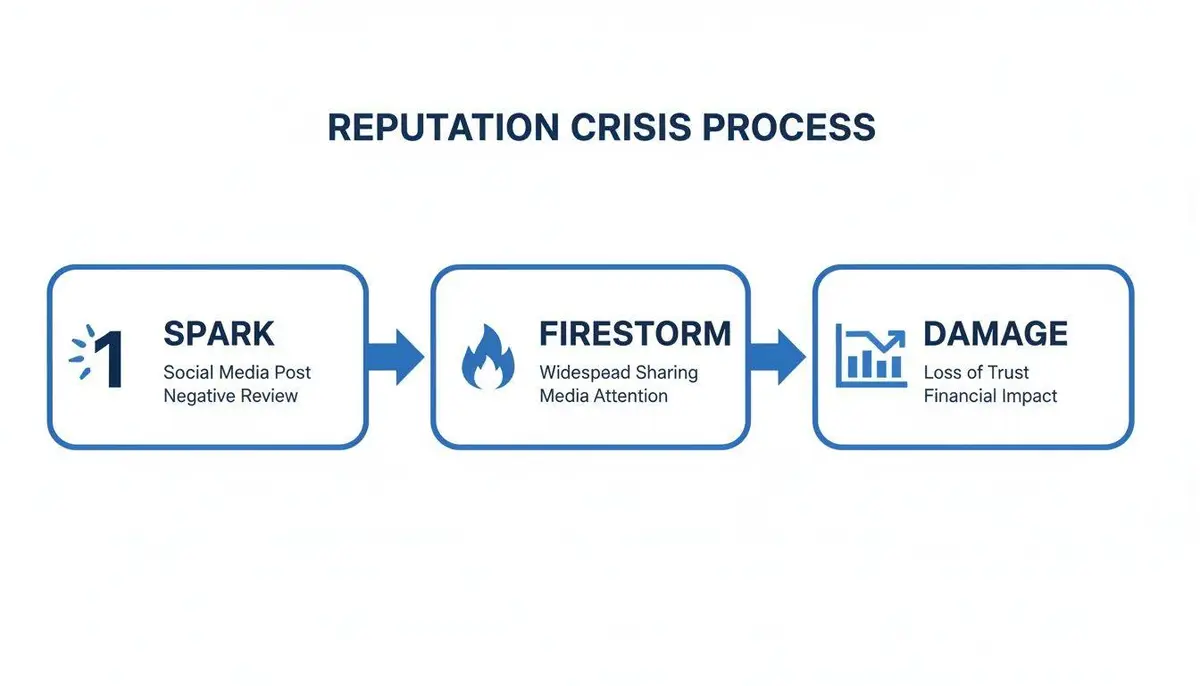
True containment is only achievable during the “Spark” phase. Once the “Firestorm” begins, the strategy must shift from targeted removal to broad-spectrum damage control. For any public figure, this escalation can occur in under an hour.
Once the immediate bleeding is staunched, defamatory content is removed and communications are locked down, the strategy shifts from defense to a calculated offense. It is time to reclaim control of the story.
Allowing a crisis to unfold in a vacuum creates a narrative void. That void will be filled with speculation, misinformation, and malice. Your objective is to fill that space first with a precise, controlled message that dictates the terms of the conversation.
Deciding what to say and when to say it is a critical judgment call. This is not about issuing a generic PR statement. It is about delivering targeted messages designed to disarm specific threats and reassure key stakeholders. Every word must be weighed for its potential legal and reputational fallout.
To Apologize, Clarify, or Stay Silent?
Your response will fall into one of three categories. Choosing the correct one is a cold calculation based on the facts of the situation, not on emotion. A reactive choice here can demolish all prior containment efforts.
A strategic apology is reserved for situations where you are unequivocally and demonstrably in the wrong. A well-executed apology is a demonstration of accountability and control. It must be sincere, accept full responsibility without equivocation, and outline concrete remedial actions.
A factual clarification is the correct maneuver when the narrative is built on misinformation, out-of-context quotes, or falsehoods. Your role is to become the definitive source of truth by issuing a clear, dispassionate statement that corrects the record with verifiable facts and evidence. It must remain concise and devoid of emotional language that could be manipulated to portray defensiveness.
The power of strategic silence is often the most potent response. If an attack is baseless, originates from a source with no credibility, and is failing to gain traction, issuing a statement can grant it unearned legitimacy. Silence starves the story of oxygen and sends a clear message: “This is not worthy of a response.”
An incorrect choice is catastrophic. Apologizing for an act you did not commit can create enormous legal liability. A “clarification” that sounds like a list of excuses will only breed more skepticism, and silence in the face of a credible, escalating accusation is perceived as an admission of guilt.
Tailoring the Message for Key Stakeholders
A one-size-fits-all press release is an amateur error. Effective crisis management requires segmenting your audiences and addressing their specific concerns. Your investors, employees, and clients have different priorities.
You must develop distinct messaging tracks for each critical group. The board and investors require confidential, data-driven communication focused on business continuity, risk mitigation, and the protection of shareholder value. Employees need reassurance regarding job security and company stability, delivered with a projection of strong leadership and a clear path forward. Clients and business partners are concerned with operational stability and require assurance that their interests are secure and that all commitments will be honored.
Finally, the public and media represent your most volatile audience. If a public statement is necessary, it must be the most carefully constructed of all: brief, fact-based, and perfectly aligned with your core legal and reputational strategy.
A public apology that outlines specific, concrete steps for how you’ll fix the problem can boost public forgiveness by over 70%. Yet, a shocking number of leaders are caught completely flat-footed. Research shows that nearly half of all companies don’t have even a basic, formalized crisis plan. You can discover more insights about the impact of crisis planning from New Media.
This demonstrates the power of a prepared, accountable response. It is not merely about expressing regret; it is about demonstrating a concrete plan of action.
Using Channels You Control
The method of delivery is as critical as the message itself. Never surrender your carefully crafted narrative to a journalist with an agenda or cast it into the chaos of a hostile social media feed.
Your strategic communications must be deployed through channels you own. Your personal or corporate website, a direct email list to stakeholders, or a verified social media account allows you to deliver your message without filter or distortion. For broader reach, an exclusive statement can be provided to a trusted media partner with a proven record of fair reporting. This maneuver transforms you from the subject of the story into the source of the official record.
Building Your Digital Fortress With Suppression

Once the immediate fire is contained and you have initiated your narrative control strategy, the mission shifts from emergency response to long-term defense. It is time to construct a digital fortress, a robust online presence engineered to suppress any lingering negative search results and create a more resilient, crisis-proof profile.
This strategy is known as Search Engine Reputation Management (SERM). Its core objective is to control the real estate on the first page of Google for your name. This involves systematically displacing negative results by creating and promoting a portfolio of high-authority, positive content that you own and control.
How Digital Suppression Actually Works
Consider it a battle for ranking positions. Google’s algorithm rewards authority and relevance. The only way to defeat a negative article is to publish something more authoritative and relevant in the eyes of the search engine.
You cannot simply wish negative content away; you must actively create and promote superior content. This process begins with optimizing existing positive digital assets and then proceeds to developing a pipeline of new, high-authority content that reinforces your desired narrative.
Start with Your Existing Assets
Your digital footprint likely contains underutilized assets. Optimizing these properties is the most efficient way to begin influencing search results.
A fully optimized LinkedIn Profile, complete with a professional headshot, detailed work history, and regular, insightful posts, is a powerful asset that Google favors in its rankings. Your Corporate Biography on the company website is prime real estate under your direct control; it must be updated, detailed, and infused with keywords that define your professional brand. Other social profiles, such as those on X (formerly Twitter) or industry-specific networks, should be locked down and curated to project a consistent, professional image.
The purpose is not merely to have these profiles; it is to make them active and authoritative. A living, dynamic profile sends powerful signals to search engines, making it a cornerstone of your digital fortress and a crucial tool for personal crisis reputation management.
By reinforcing these properties, you build a solid foundation of positive content that can begin to outrank the negative. This initial effort lays the groundwork for a broader suppression campaign. Our in-depth guide on how to suppress negative search results offers more detail on these foundational tactics.
Create a Pipeline of New, Authoritative Content
With your existing assets optimized, the next phase involves creating a steady stream of new, high-value content. This content must be published on authoritative third-party platforms to build a diverse and powerful backlink profile, which is essential for dislodging stubborn negative articles.
Effective content types for suppression include thought leadership articles published on respected industry blogs or news sites, which build immediate credibility. Guest interviews on podcasts and video platforms create powerful, engaging multimedia content that often ranks well. Positive press releases announcing genuine professional milestones can also generate favorable media attention.
Each piece of content is created with a singular purpose: to occupy a specific position on the first page of search results for your name. It is a methodical process of displacing the negative with an overwhelming volume of positive, authoritative information.
Why You Can Never Stop Monitoring
A digital fortress is not a static construction. The internet is in constant flux. A dormant crisis can be reignited by a single new article, a revived social media thread, or an old negative story that suddenly resurfaces.
Continuous monitoring is your strategic advantage. Modern monitoring tools scan the web 24/7 for any mention of your name, flagging new threats the moment they appear. This is non-negotiable. We know that brands responding to a new threat within 48 hours are 2.5 times more likely to recover trust. You can discover more reputation management statistics here.
This vigilance allows your team to neutralize threats before they gain traction, ensuring your digital fortress remains secure. This proactive posture transforms personal crisis reputation management from a purely defensive discipline into a strategic, forward-looking security operation.
Securing Your Legacy With Long-Term Resilience

Surviving a crisis is one objective. Ensuring it never recurs is the ultimate victory. This requires a shift from reactive damage control to the construction of a permanent, strategic advantage that protects your legacy.
The process begins with a forensic post-mortem audit of the entire event to pinpoint the exact vulnerabilities that were exploited. Was it a data leak from an unsecured personal device? An unvetted associate who proved untrustworthy? A pattern of communication that was too easily manipulated?
Answering these questions without ego is critical. The goal is not to assign blame but to identify and seal the fissures in your personal and digital armor.
Constructing Your Digital Moat
The most effective long-term defense is a “digital moat”, a powerful and positive online presence naturally resistant to attacks. A single negative story struggles to gain traction when it is buried beneath a dozen high-authority websites and profiles that you control.
This requires the consistent publication of content that reinforces your expertise and narrative, on your terms. This is not a one-off project but a sustained, strategic marathon. The objective is to so completely dominate the search results for your name with positive, controlled content that any new negative piece struggles to even reach the second page of Google.
A crisis, when properly deconstructed and learned from, becomes an invaluable strategic asset. It provides a real-world stress test of your entire operational security, revealing hidden risks that would have otherwise remained dormant until a future, potentially more damaging, event.
This flips the strategic paradigm. Instead of constantly reacting to attacks, you are proactively building a reputational shield that makes you a harder target.
Implementing Permanent Security Protocols
Building a digital moat is a critical component, but it is not the complete solution. True resilience demands hardening the personal and technical security weaknesses that enabled the crisis. This is where personal discipline must meet professional execution.
Key protocols for long-term security include a Data Security Overhaul, involving a complete audit of all personal data, securing social media privacy settings, transitioning to encrypted communication tools, and minimizing the digital footprint of sensitive information. Vetting and Discretion are also paramount, requiring a re-evaluation of your inner circle to ensure that access to sensitive information is granted strictly on a need-to-know basis to thoroughly vetted, trusted individuals. Finally, the Permanent Monitoring systems established during the crisis must become a permanent fixture, serving as an early-warning system to flag potential threats long before they can escalate.
Lasting resilience often involves addressing the root causes of the crisis, which may be deeply personal. Exploring comprehensive guides on various personal issues can be a crucial step in recovery and demonstrating a genuine commitment to change.
Taking these steps sends a powerful signal of accountability to stakeholders. Research indicates that 70% of consumers look more favorably on individuals and brands that admit their mistakes and demonstrate remedial action. Discover more insights on reputation management statistics here.
This disciplined, forward-looking strategy is the core of effective personal crisis reputation management. By integrating these practices into your standard operations, you do not just recover from a crisis. You emerge stronger, with a reputation fortified to withstand future challenges. To see how these elements fit into a larger recovery framework, review our professional guide to reputation repair services for individuals.
Answers to Your Most Pressing Crisis Questions
When a reputation crisis erupts, the number of urgent questions can be overwhelming. What is the immediate course of action? Can this damage be reversed? Here are the direct answers we provide to high-profile clients when the stakes are at their highest.
What Is the Very First Thing I Should Do?
Before taking any other action, make two calls: one to specialized legal counsel and the second to a crisis management firm. Do not contact friends, draft statements, or engage with anyone online.
Your next move is to implement a complete communications blackout. Go dark. This strategic silence is not an admission of guilt; it is a containment tactic. It affords your expert team the critical time required to assess the situation and initiate countermeasures.
Can Negative Content Really Be Wiped from the Internet?
Yes, in many cases, it can. While the myth that “what’s on the internet is there forever” persists, the reality is more nuanced. Damaging content can often be removed at its source or, more commonly, de-indexed from search engines like Google. This is a technical and legal battle, not a public relations one.
Successful removal is typically achieved through several legal avenues. A court order declaring content as defamatory legally compels platforms like Google to remove it from search results. A DMCA takedown notice can be used to force the removal of smear content that infringes on your copyrights by using your photos or text without permission. Furthermore, most platforms have terms of service that prohibit harassment and privacy violations, and reporting such content is often the fastest path to removal.
The correct strategy is entirely dependent on the specific content, jurisdiction, and available evidence. It is a complex battleground that demands true expertise.
How Long Does It Take to Fix a Damaged Reputation?
Reputation repair is a phased process with a variable timeline. The first phase is containment: stopping the immediate damage. We can often achieve initial containment, the removal of the most damaging articles or posts, within days or weeks.
Full reputational recovery is a strategic marathon, not a sprint. While initial defensive actions provide immediate relief, the long-term work of rebuilding trust and fortifying your digital presence requires sustained effort over several months, and in complex cases, a year or more.
After the immediate threat is neutralized, the second phase of suppression and rebuilding begins. This is a long-term campaign focused on creating and promoting a shield of positive, authoritative content. The goal is to push any residual negative items so far down in search results that they become effectively invisible. This requires a methodical and consistent approach to managing your entire digital footprint.
When your career and reputation are on the line, you require specialists who operate with speed, precision, and absolute discretion. The team at ContentRemoval.com merges legal strategy with proprietary technology to remove damaging online content and defend your reputation. To find out how we can help, schedule a confidential consultation through ContentRemoval.com.
Frequently asked questions
Should I respond publicly to false accusations during a reputation crisis?
Not immediately. Go silent while your legal and crisis team assess what exists online, because an emotional remark can become the next headline. Once the facts are mapped, choose between a strategic apology, a factual clarification or continued silence based on the credibility and traction of the attack.
Why do the first 48 hours of a reputation crisis matter so much?
Within that window the content is usually confined to a few platforms and easier to remove, and it has not yet cemented itself on the first page of Google. After 48 hours the story spreads across many sites, stakeholders lose confidence and recovery becomes longer and more expensive.
What is search engine reputation management after a crisis?
It is the process of controlling the first page of Google for your name by optimizing assets you own, such as LinkedIn and your corporate biography, and publishing new authoritative content like thought leadership pieces and interviews. The goal is to push residual negative results down until they are effectively invisible.