
People search opt out is defensive privacy operations, not housekeeping. A visible profile is one node in a broker network that ingests, matches, and republishes identity data, so the manual protocol runs record by record: verify the exact profile, submit the site-specific request, complete email confirmation within the window, audit after processing, and log every action.
Key facts
- Confirmation emails often expire within 24 hours; processing can take up to 72 hours on major sites
- Priority targets: TruePeopleSearch, Whitepages, BeenVerified, PeopleFinders, Spokeo, Radaris, FastPeopleSearch, Nuwber
- If a broker demands an identity document, redact sensitive fields and provide the minimum needed
- Deleting a broker profile does not clear the Google result; submit the indexed URL through Google’s removal tool
Where ContentRemoval.com comes in. ContentRemoval.com runs people-search removal as a standing program: mapping the broker footprint for the principal and household, prioritizing listings with a current address and relatives, submitting and re-submitting removals, de-indexing stale results, and watching for repopulation. Executive assistants, family office staff, and security leads usually make contact after a residence has surfaced across several brokers. A free 15-minute Exposure Scan maps what is removable, and the report is yours to keep. Get a Free, Confidential Exposure Scan or read how our data broker removal work is done.
You search your own name because a board colleague mentioned “something odd” appearing online. Within seconds, you’re staring at a people-search profile that lists current and former addresses, phone numbers, age ranges, and relatives. If you’re an executive, investor, public figure, or family office principal, that isn’t a curiosity. It’s a live security problem.
Most clients arrive at this issue with the wrong assumption. They think they’ve found a single bad listing. In reality, they’ve found one visible symptom of a broader data-broker network that aggregates, republishes, and resells personal information. The immediate question is rarely “How do I remove this one page?” The correct question is, “How exposed am I across the entire ecosystem, and how do I stop this from becoming a recurring liability?”
That’s the right frame for people search opt out work. It’s not housekeeping. It’s defensive privacy operations.
The Anatomy of Digital Exposure
A client sees one people-search profile and assumes they have found the problem. They have found an access point.
As the Federal Trade Commission has explained, people-search sites compile personal information from multiple public and commercial sources, package it into searchable profiles, and sell access. For a high-stakes individual, that means a visible listing is usually one node in a larger broker network, not an isolated record that can be cleaned up once and forgotten.
The risk is practical, not abstract. A current or former address gives a hostile actor a starting point. Relative associations create easy routes for impersonation and pretexting. Old phone numbers, age ranges, and location history give fraudsters enough detail to sound credible to an assistant, banker, school administrator, or family member.
Exposure isn’t random
People-search listings exist because data brokers treat identity data as a product. They ingest records, match them across sources, and republish them in formats designed for search, resale, and redistribution. If you need a clearer view of that supply chain, this strategic guide to what data brokers are explains the operating model behind the listings you see online.
That operating model is the reason manual opt-outs fail so often for executives, public figures, investors, physicians, and principals with real security exposure. One broker copies from another. A fresh source file repopulates a removed record. A second profile appears under a name variation, an old city, or a relative-linked match. The work does not end when one page disappears.
A people-search profile is a distribution point, not the root cause.
This has corporate consequences as well. Founders and directors are often targeted first through their personal data trail, then through company systems, brand channels, or staff. For organizations evaluating visibility and trust from a business angle, this essential guide for Australian small businesses offers a useful commercial perspective. Personal exposure carries sharper safety and coercion risks.
Treat this as an ongoing risk-control problem. Manual opt-outs can reduce surface exposure, but they do not change the broker economy that keeps recreating the record. If your name carries money, authority, public attention, or family risk, the strategic question is persistence: who is monitoring, documenting, re-submitting, and suppressing the next wave after the first removals go through?
The Manual Opt-Out Protocol
If you insist on handling removals yourself, do it systematically. The process is procedural, not intuitive. Most failures happen because people rush through it, miss a confirmation step, or remove one record while leaving several adjacent profiles untouched.
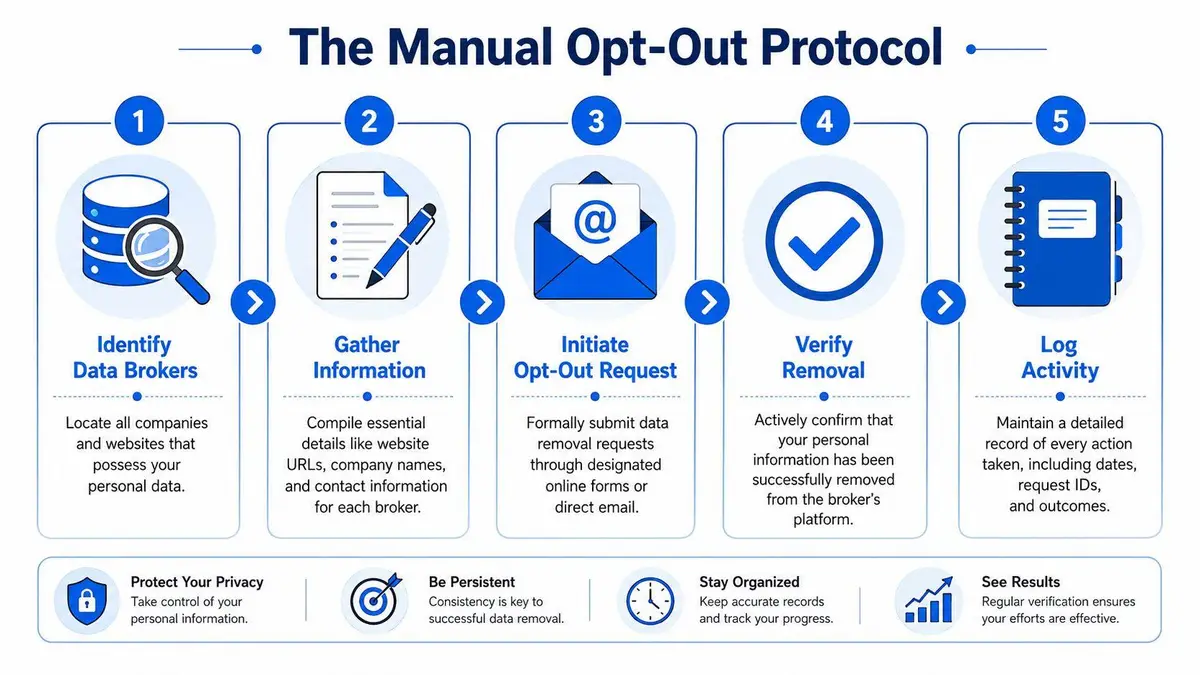
A practical workflow is usually multi-stage: first verify the exact profile, then submit the site-specific removal request, then complete an email confirmation within a 24-hour window, and finally re-check after the provider’s stated processing period, which can be up to 72 hours on some major people-search sites. The process is often record-by-record rather than account-wide, so one name can generate multiple profiles that each need separate removal action (practical opt-out workflow details).
Phase one: verify the exact profile
Start by identifying the precise listing or listings connected to you. That sounds obvious, but many people make the first mistake at this stage. They find a similar profile and submit a request against the wrong record, or they remove one listing tied to a former address and miss another tied to a current one.
Use a clean log as you search. Record the broker name, the exact profile URL, the identifying fields shown on the page, and whether the record appears to be current, outdated, or mixed with another person’s details.
Two practical rules matter here:
- Match carefully: Check address history, age band, relatives, and phone fragments before submitting anything.
- Assume duplicates exist: Search variations of your name, including middle initials, former surnames, and common misspellings.
Phase two: submit the site-specific request
Each broker uses its own opt-out process. Some provide a public form. Some route you through a hidden help page. Some require email-based verification. A few create enough friction that casual users give up.
Many people underestimate the workload. There is no universal removal command. There is no central registry that clears your data from all major people-search sites at once. You work broker by broker, record by record.
If you want a more detailed operational view, this executive privacy guide to removing yourself from data broker lists is a sensible companion to your manual campaign.
Practical rule: Never provide more identity data than the broker requires to locate the listing you already found.
Phase three: complete confirmation without delay
Many removals stall because the broker sends a verification email and the user misses it, ignores it, or clicks it after the confirmation window has expired. If the broker requires confirmation and you don’t complete it promptly, nothing meaningful happens.
Create a dedicated folder in your inbox. Watch it. Check spam. If you’re using counsel or an assistant to coordinate submissions, make sure one person owns confirmation follow-through. Shared responsibility produces missed deadlines.
Phase four: audit after the processing period
A submitted request is not a completed removal. Revisit the exact profile URL after the broker’s stated processing period. Then search the site again. Then search your name externally to confirm the listing isn’t still discoverable under a slightly different profile.
Phase five: log every action
Without a log, your campaign turns into guesswork. You’ll forget which requests were submitted, which were confirmed, and which records were only partially removed.
At minimum, record:
- Broker name
- Exact profile URL
- Submission date
- Email used for confirmation
- Confirmation status
- Expected review date
- Outcome
- Notes on duplicates or republished records
Manual opt-outs can work on individual listings. They do not work casually.
Executing Removals on High-Priority Targets
You don’t need a list of every broker on the internet. You need a priority order. Start with the sites that are highly visible in name searches and commonly surface detailed identity profiles. The purpose isn’t completeness on day one. The purpose is to suppress the most exposed public-facing records first, then expand outward.
For context on the broader mechanics of these sites, this privacy guide for removing content from people-search sites explains why high-visibility targets deserve immediate attention.
Initial removal targets
| Data Broker | Opt-Out Portal Link | Key Procedural Note |
|---|---|---|
| TruePeopleSearch | TruePeopleSearch opt-out process | Verify the exact record first. Some profiles are easy to confuse with similar name matches. Expect a confirmation step and then a later audit. |
| Whitepages | Whitepages suppression request page | Follow the site’s own workflow carefully. Capture screenshots of each stage because later verification can be harder if the page changes. |
| BeenVerified | BeenVerified opt-out page | Search all common name variants tied to you before stopping. One visible listing rarely represents the full footprint. |
| PeopleFinders | PeopleFinders opt-out form | Confirm that you’re acting on the exact record URL you documented. Mixed or stale records can create false confidence. |
| Spokeo | Spokeo opt-out portal | Track email confirmations closely. If you miss them, the request may sit unresolved. |
| Radaris | Radaris control page | Read the form prompts carefully. Sites with layered workflows often create user error by design or through poor interface choices. |
| FastPeopleSearch | FastPeopleSearch opt-out process | Search across current and former locations, especially if your record set includes multiple addresses. |
| Nuwber | Nuwber removal request page | Keep a copy of the submitted URL and any on-screen confirmation. You may need it later for follow-up. |
What matters more than the list
The table is only the opening move. The strategic issue is execution quality.
Some brokers present a straightforward form and a confirmation email. Others add friction through CAPTCHAs, hidden support paths, or requests that pressure you to disclose more identity information than you should. If a site demands an identity document, use the minimum necessary and redact sensitive fields before submission. Don’t hand over a clean, fully legible ID because a data broker asked for it.
That same caution applies to your own workflow. Don’t use a rushed assistant with no privacy training. Don’t assign this to an intern. Don’t let multiple staff members submit overlapping requests without a unified log. Poor coordination creates duplicate submissions, conflicting records, and missed confirmations.
Prioritize by risk, not convenience
Use a triage model:
- Highest priority: Listings with current home address, direct phone number, and relative associations.
- Next priority: Listings that rank prominently for your name or your spouse’s name.
- Then: Secondary brokers and duplicate records that mirror the same data points.
- Last: Low-visibility listings that require disproportionate effort and reveal little.
Remove the most dangerous records first. Administrative completeness can come later.
If you’re protecting a principal, not just yourself, think in clusters. Search the executive, spouse, adult children, household staff where relevant, and shell entities or trusts that may create predictable association trails. Advanced targeting rarely stays confined to one individual listing.
A manual people search opt out effort becomes materially harder the moment your risk model includes family members, former residences, or multiple jurisdictions. That’s where amateur workflow breaks down.
Establishing Your Evidence Log
If you don’t maintain an evidence log, you’re not running a privacy program. You’re clicking forms and hoping for the best. That may be acceptable for a casual consumer. It is unacceptable for anyone with a real security profile.

The benchmark for scaled opt-out work is persistence, not one-time deletion. Consumer guidance recommends rechecking removed records weeks or months later, and in some cases twice per year, because listings can reappear or be repopulated from upstream data brokers. The same guidance notes that some brokers add friction such as CAPTCHAs, confirmation emails, or identity-document requests, and advises redacting sensitive fields if an upload is required (Experian guidance on persistent monitoring and redaction).
What the log must contain
The log should be built like an evidentiary file, not a to-do list. At minimum, include:
- Broker and profile identifier: The company name and exact page URL.
- Submission record: Date submitted, method used, and the email address used for confirmation.
- Proof of action: Screenshot of the form completion page, confirmation email, or request ID if one exists.
- Review schedule: A future date to verify removal and another to check for reappearance.
- Escalation notes: Any unusual friction, repeat publication, or demand for identity materials.
This is the difference between control and confusion. When a listing reappears months later, your log tells you whether it is a failed original removal, a duplicate profile, or a repopulated record from another upstream source.
Why documentation changes the outcome
Documentation turns an irritating task into a managed operation. It lets you delegate intelligently. It lets counsel or a protection team audit what’s happened. It creates a timeline if you later need to escalate with a broker, a search engine, or another intermediary.
It also prevents the most common executive error in this area: false completion. A principal sees a page disappear and assumes the matter is closed. The log forces periodic verification.
The removal request is not the asset. The evidence trail is.
A simple spreadsheet is enough at the beginning. For more complex matters, use a secure case-management workflow with standardized naming, screenshot storage, and assigned review owners.
For a visual explanation of why disciplined tracking matters, this walkthrough is useful:
What to record when ID is requested
When a broker asks for identity documentation, log three extra items:
- What was requested
- What was provided
- What fields were redacted
That protects you from your own process. If a site later claims noncompliance or if a household office needs to repeat the request, you won’t be reconstructing events from memory.
Beyond the Broker: Suppressing Search Results and Preventing Repopulation
Your home address disappears from a broker page on Monday. By Friday, the old result is still sitting in Google, a duplicate profile is live on a smaller broker, and a cached snippet still exposes the street name. That is the point where manual opt-outs stop looking like a cleanup project and start looking like what they are: ongoing exposure management.
Google treats source removal and search suppression as separate requests. If private information still appears in search, you may need to submit the exact indexed URLs through Google’s removal tool guidance. Deleting a broker profile does not reliably clear the search result on its own.
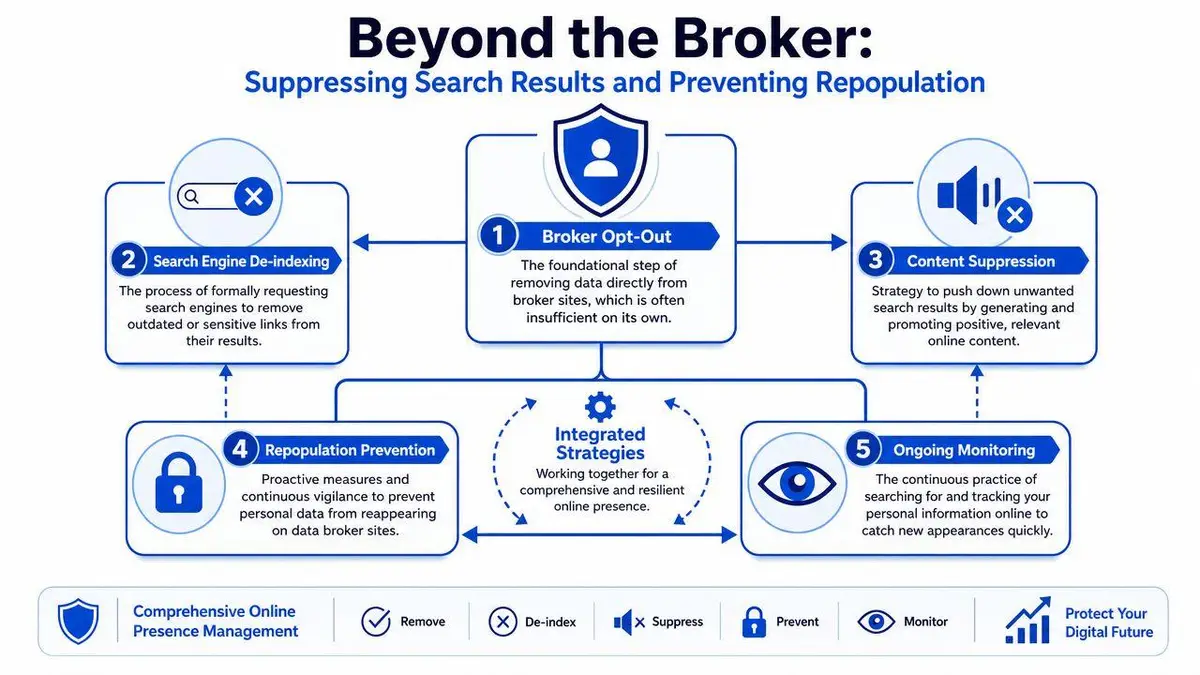
Source removal and search suppression are different jobs
Broker removal deals with the page itself. Search suppression deals with whether that page, or an outdated version of it, remains easy to find.
For a high-stakes individual, discoverability is the actual risk. Stalkers, hostile litigants, disgruntled customers, and opportunistic scrapers do not need a live broker profile if search still hands them the trail. A stale result can keep driving clicks long after the source page changes. That gap matters because the threat is not abstract publication. It is practical access.
The more persistent problem is repopulation
Data brokers do not operate as isolated files. They pull from public records, commercial feeds, reseller networks, and one another. Remove one listing and another source can refill it. Remove that one, and a smaller broker can publish a variant under a different URL with the same identifying details.
This is why manual people search opt out work fails as a lasting strategy for executives, physicians, investors, and anyone facing real security or reputation risk. The process rewards patience but not finality. You can complete every form correctly and still lose control because the system keeps rebuilding the exposure behind you.
A useful reference point comes from ordinary SEO. The mechanics behind making your website visible also explain why harmful results persist. Search visibility depends on indexing, duplication, and repeated signals. Privacy protection requires the inverse: repeated suppression, verification, and response.
Removing one profile resolves one record. Keeping that record from resurfacing requires a standing process.
What to do after each removal
Treat every successful opt-out as the start of verification, not the finish line.
- Capture the exact broker URL before removal and confirm what the page returns afterward.
- Search the URL directly in Google to see whether the result is still indexed or cached.
- Check name variants that include middle initials, former locations, and household members.
- Look for mirrored records on lower-tier brokers that often republish the same data set.
- Schedule a recheck because repopulation usually appears later, not immediately.
If you skip this second track, you create a false sense of closure. For a low-risk consumer, that means wasted effort. For a person with meaningful exposure, it leaves the core problem in place.
When to Escalate to Professional Removal Services
An executive leaves the office after a difficult termination. By dinner, a search for their name shows a home address, relatives, age, and old phone numbers across multiple broker sites. At that point, manual opt-outs are no longer a sensible primary strategy. They are triage.
As noted earlier, opt-outs are limited by design. Removing one profile from one broker does not shut down the intake, resale, republication, and indexing cycle that created the exposure in the first place. For anyone facing stalking risk, litigation pressure, executive visibility, family-office concerns, or active reputational harm, the actual problem is operational persistence. You need coverage, monitoring, repeat removals, and documented follow-through.
The escalation triggers
Bring in professional help when any of these conditions exists:
- Your residence is already exposed across several brokers: Delay gives the data more time to spread, copy, and rank.
- Relatives appear in the records: Once spouses, children, or associates are linked, the matter expands beyond a single name.
- Records keep returning: Reappearance means you are dealing with a live data supply chain, not a closed file.
- Your role makes your time expensive: Senior principals should not spend hours managing broker queues, ID requests, and confirmation loops.
- The issue touches legal, security, or reputational risk: Broker removals often sit next to impersonation, false content, workplace threats, or search-result problems that require coordinated handling.
That last point matters most.
High-stakes privacy work fails when it is treated as a collection of isolated forms. The job is to reduce exposure across the system, preserve evidence, track recurrence, and keep pressure on the brokers and search results that keep reviving the record.
What professional handling changes
Professional removal services are useful when they operate as an ongoing program. The right provider maps the broker network, prioritizes the highest-risk listings, submits and follows up on removals, watches for repopulation, and keeps records that support the next round without rebuilding the file from scratch. That is what durable control looks like.
ContentRemoval.com is one example of a provider that handles people-search removals as part of a broader privacy and content-removal process. For high-risk individuals, that structure is usually the rational choice. You are not buying convenience. You are assigning a repetitive, adversarial, time-sensitive process to a team built to run it continuously.
Manual people search opt out work still has a place. Use it to understand your exposure and clear a few urgent records. Once the issue affects safety, family, executive time, or persistent search visibility, escalation is the right move.
If your name, address, relatives, or contact details are circulating across people-search sites, don’t treat it as a minor nuisance. ContentRemoval.com can assess the exposure, map the broker footprint, coordinate source removals and de-indexing, and manage the ongoing monitoring required to keep listings from returning. For executives, public figures, and family offices, that is usually the difference between a short-lived cleanup and an actual privacy strategy.
Frequently asked questions
Why does my information keep coming back after I opt out of people search sites?
Because brokers pull from public records, commercial feeds, reseller networks, and each other. Remove one listing and another source can refill it, or a smaller broker publishes a variant under a different URL. Consumer guidance recommends rechecking weeks or months later, in some cases twice a year.
Do I have to send my ID to a data broker to remove my listing?
Some brokers add friction through CAPTCHAs, confirmation emails, or identity-document requests. If a document is required, provide the minimum necessary and redact sensitive fields before uploading. Never hand over a clean, fully legible ID, and never give more identity data than is needed to locate the listing you already found.
Which people search sites should I remove myself from first?
Prioritize by risk rather than convenience: listings showing a current home address, direct phone number, and relatives come first, then profiles ranking prominently for your name or your spouse’s, then secondary brokers mirroring the same data. The article’s starting list includes TruePeopleSearch, Whitepages, BeenVerified, PeopleFinders, Spokeo, Radaris, FastPeopleSearch, and Nuwber.