
Online reputation management monitoring is a risk surveillance function, not audience listening. A professional system crawls forums, review sites, fringe social spaces, and republishing domains as well as mainstream platforms, analyzes recurrence, source authority, and account clusters, then routes each incident to legal, communications, security, or a specialist firm through preset thresholds and named owners.
Key facts
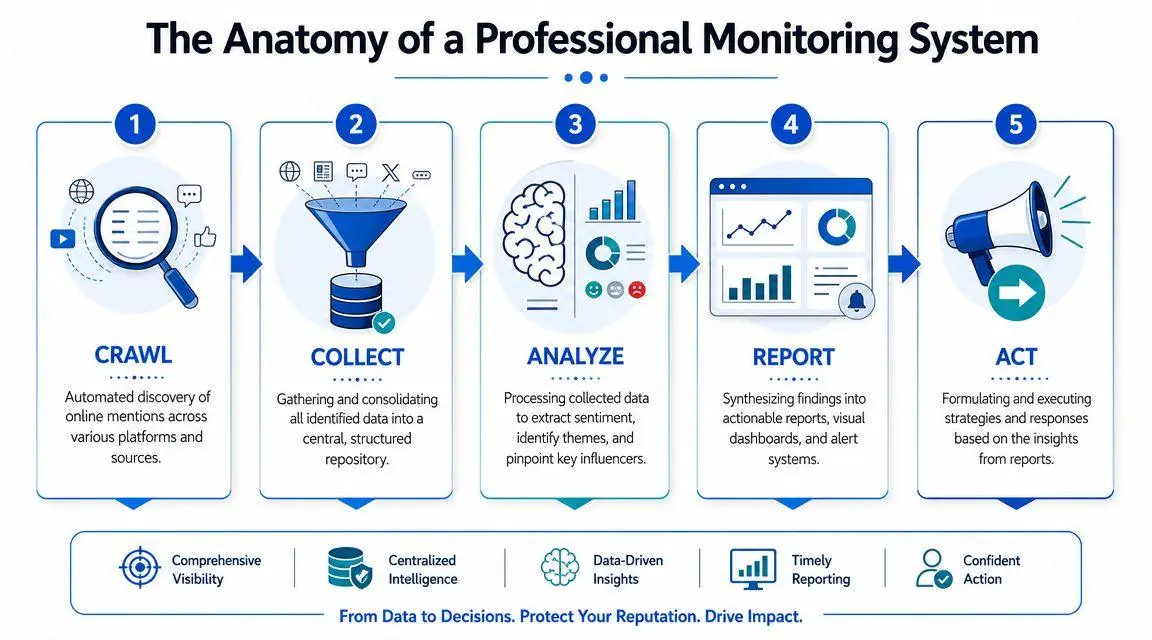
- Architecture runs crawl, collect, analyze, report, then act; if one stage fails the system is decorative
- Verify four points before any statement: authenticity, first appearance, exact allegation, and reach or search persistence
- Baseline KPIs per AppFollow: average star rating, review volume, response rate, response-time speed, sentiment distribution
- Specialist thresholds: executive targeting, impersonation, leaked or intimate material, and cross-platform recurrence
Where ContentRemoval.com comes in. ContentRemoval.com takes over where in-house listening stops: detection across harder-to-monitor surfaces, evidence preservation to a standard that supports platform and legal action, mapping of removal routes, and pressure on recurrence after the first takedown. The head of communications, the general counsel, or a family office security lead usually makes contact once alerts outpace the team’s ability to verify them. A free 15-minute Exposure Scan maps what is removable, and the report is yours to keep. Get a Free, Confidential Exposure Scan or read how our reputation management work is done.
A board member forwards a screenshot at 6:40 a.m. A senior executive has been accused of misconduct in a thread nobody on the communications team was watching. By 8:15, the claims have spread to niche forums, copied into short-form social posts, and quoted in one-star reviews that have nothing to do with the original allegation. Marketing says they never saw it coming. That’s usually true. They weren’t looking in the places where these situations begin.
That gap is what matters. Most organizations have some form of brand listening. Very few have online reputation management monitoring that can withstand a hostile event, a targeted smear, leaked personal material, impersonation, or a coordinated review pattern. Google Alerts is not a defense posture. A social dashboard is not an intelligence function. If your name, company, or family office has real exposure, monitoring has to work like risk surveillance, not audience engagement.
The Critical Gap Between Seeing and Knowing
By the time a harmful post is obvious, the decision window is usually closing.
Public content can be easy to find and still easy to misread. A hostile thread appears on a forum. The allegation is copied into a private Telegram group. A pseudonymous account republishes it on a review site. A low-authority blog picks it up, and search starts indexing the repeat version rather than the origin. Each item is visible in isolation. The risk sits in the pattern, the pace, and the threshold for action.
That is why marketing-grade visibility fails under pressure.
Internal coverage is usually split by function. Communications tracks press. Marketing tracks large social platforms. Customer support watches ratings and reviews. Legal is called after someone labels the content defamatory or threatening. That structure produces fragments, not intelligence. It tells you where something appeared. It does not tell you whether the event is coordinated, whether private-channel amplification is underway, whether platform policy has been triggered, or whether the matter has crossed into a legal or executive protection issue.
A useful primer on the public-facing side of this discipline is Sift AI’s modern social media operations guide. Use that as baseline context, not as an operating model for a high-risk matter. Executive-grade monitoring serves a different purpose. It identifies signals that can damage negotiations, trigger regulatory questions, affect personal safety, distort search results, or justify preservation, takedown, and escalation steps.
Public visibility and situational awareness are different functions.
Knowing requires judgment, not just collection.
A professional monitoring posture does three things well:
- Covers the right sources: forums, review sites, fringe social spaces, republishing domains, and relevant private or semi-closed channels where narratives often gain momentum before they become searchable
- Adds context: separates routine criticism from impersonation, coordinated review activity, leaked material, false allegations, or targeted harassment
- Triggers action: routes the issue to legal, communications, security, HR, or outside counsel based on defined thresholds, not on whoever happens to notice it first
If your report says only that negative sentiment increased, it is not decision-ready. Leadership needs to know who started the claim, whether the account is authentic, how the allegation is spreading, whether the content breaches platform rules, whether evidence should be preserved, and whether search persistence will outlast the social cycle.
Seeing mentions is basic monitoring. Knowing what matters, early enough to contain it, is a risk function.
The Anatomy of a Professional Monitoring System
A serious monitoring program works more like a security operations center than a marketing dashboard. The labels vary by vendor, but the architecture doesn’t. If one stage fails, the entire system becomes decorative.
Crawl and collect
First, the system has to crawl broadly enough to find what matters. Effective monitoring is a multi-source ingestion and alerting system. It continuously collects mentions from search results, news, blogs, forums, review sites, and social platforms, then normalizes them for sentiment classification and prioritization, as described in SurveyLab’s overview of online reputation management tools.
That sounds obvious. It usually isn’t implemented properly. Teams over-index on mainstream social platforms and under-index on forums, complaint sites, local listings, app stores, and secondary domains that republish harmful content. Crawl coverage should be driven by threat exposure, not convenience.
Collection is different. Once mentions are found, they need to be pulled into a structured repository. If every team is looking at separate tools, you don’t have monitoring. You have competing fragments.
Analyze and report
Raw mentions are useless without interpretation. The system has to analyze sentiment, themes, recurrence, and source authority. It should also identify whether multiple posts use the same phrasing, whether the same account cluster is involved, and whether a review pattern points to a product issue or manipulation.
A competent reporting layer answers questions executives ask:
| Question | Monitoring output needed |
|---|---|
| Is this isolated or spreading? | Volume trend plus source map |
| Is it opinion, falsehood, or impersonation? | Content classification and legal review flag |
| Who needs to act? | Owner assignment by risk type |
| Can we wait? | Severity score and escalation threshold |
Practical rule: If the dashboard can’t tell you what to do next, it’s a vanity instrument.
Act, or the system has failed
The final stage is action. Not observation. Not summary. Action.
That may mean a response to a review, a request for platform removal, a preservation step for evidence, search result suppression strategy, executive protection, or legal escalation. Some organizations use internal teams and point solutions. Others use specialist services that combine monitoring with takedown and remediation workflows. The specific provider matters less than the integration between intelligence and response.
For executive exposure, I prefer a structure with named owners and preset thresholds:
- Low-risk dissatisfaction goes to customer support or reputation operations.
- False factual allegations go to legal review.
- Impersonation, doxxing, leaked media, or stalking indicators go to a combined legal and protective response.
- Cross-platform recurrence triggers continuous monitoring until reappearance stops.
The Executive Workflow for Monitoring and Response
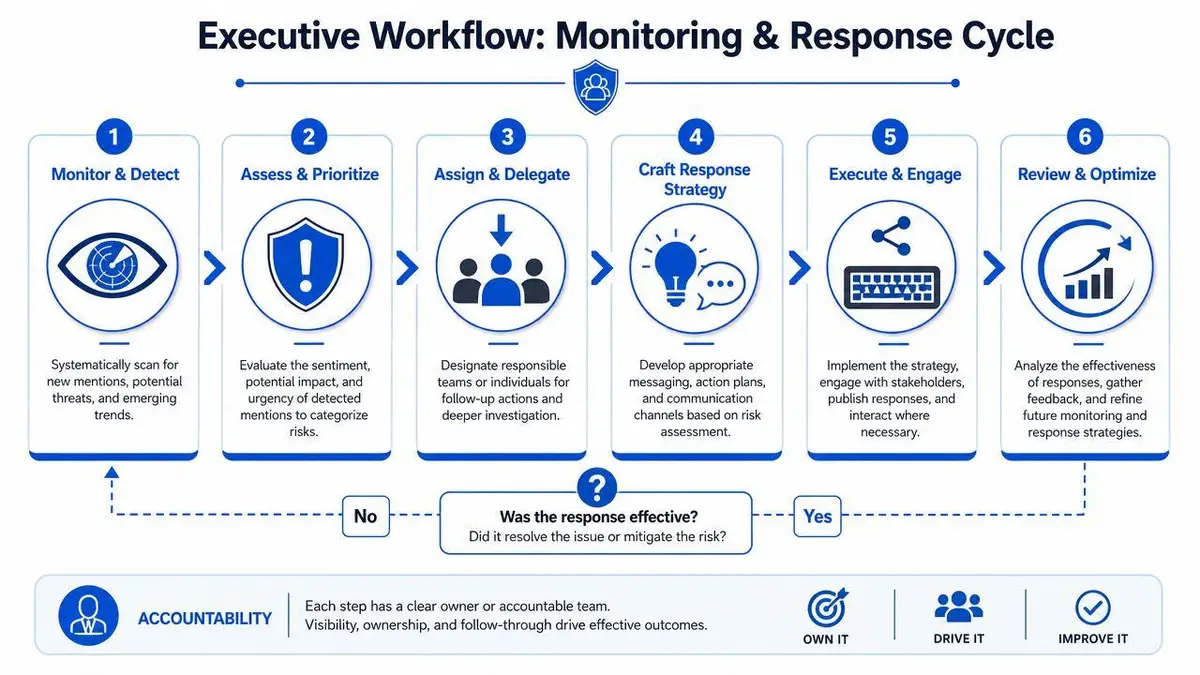
The right workflow removes improvisation. A reputation incident should be handled with the same discipline you’d expect after a data breach or insider threat. Panic creates contradictory responses, deletes evidence, and turns a containable issue into a prolonged one.
Detection and verification
Detection is mechanical. Verification is judgment.
A mention enters the queue because a rule catches it, a dashboard flags it, or a person reports it. Before anyone drafts a statement, someone must verify four points: is the content authentic, where did it first appear, what exactly is being alleged, and does the source have reach or search persistence? Executives don’t need every alert. They need validated facts.
Verification also means preserving records. Screenshots alone are weak if a matter may later require platform action or legal proceedings. Capture URLs, timestamps, account identifiers, and replication patterns. If the issue involves a forged account or manipulated media, preserve the surrounding account context too.
Triage and assignment
Not every negative mention deserves escalation. Some deserve a refund. Some deserve silence. Some require immediate legal review.
A practical triage model sorts incidents by type rather than by emotional intensity:
- Service complaints: handle quickly and publicly where appropriate.
- False factual claims: review for platform violations and legal options.
- Impersonation and fake accounts: move to identity and platform enforcement.
- Leaked or intimate material: activate removal and reupload monitoring.
- Coordinated campaigns: assess common language, timing, and account behavior.
That assignment logic is what most internal teams lack. Marketing teams tend to over-own reputational events because they’re visible. They shouldn’t. Visibility and authority are different.
For internal planning, many executives benefit from a more formal framework for sponsorship and accountability, especially when they need budget and cross-functional support. ContentRemoval’s guide on presenting a reputation management proposal to your boss is useful because it frames reputation work as an operational and governance issue rather than a branding line item.
Strategy, execution, and review
Once the issue is classified, choose the response path. There are only a handful that matter:
| Response path | Best fit |
|---|---|
| Public reply | Legitimate complaints and visible customer issues |
| Private outreach | Resolvable disputes where public argument adds risk |
| Platform report or takedown | Impersonation, policy-violating content, some fake reviews |
| Legal notice | Defamation, privacy invasion, unauthorized content use |
| Search suppression and asset building | Persistent harmful search results that won’t be removed |
| Protective monitoring | Repeat attacks, reuploads, stalking, or cross-platform abuse |
Execution should have one owner. Joint ownership sounds collaborative and works badly under pressure.
After action, review the sequence. Which channel surfaced the issue first. Which alert fired too late. Whether the team escalated too slowly. Whether a statement amplified the story. The point of post-incident review isn’t blame. It’s reducing the next response time and tightening thresholds.
When your process depends on the availability of one calm, experienced person, you don’t have a process. You have luck.
Measuring What Matters for Reputation Risk
Most reputation dashboards are built for comfort. They display activity, not risk. A board doesn’t need prettier mention graphs. It needs evidence that management can distinguish noise from exposure.
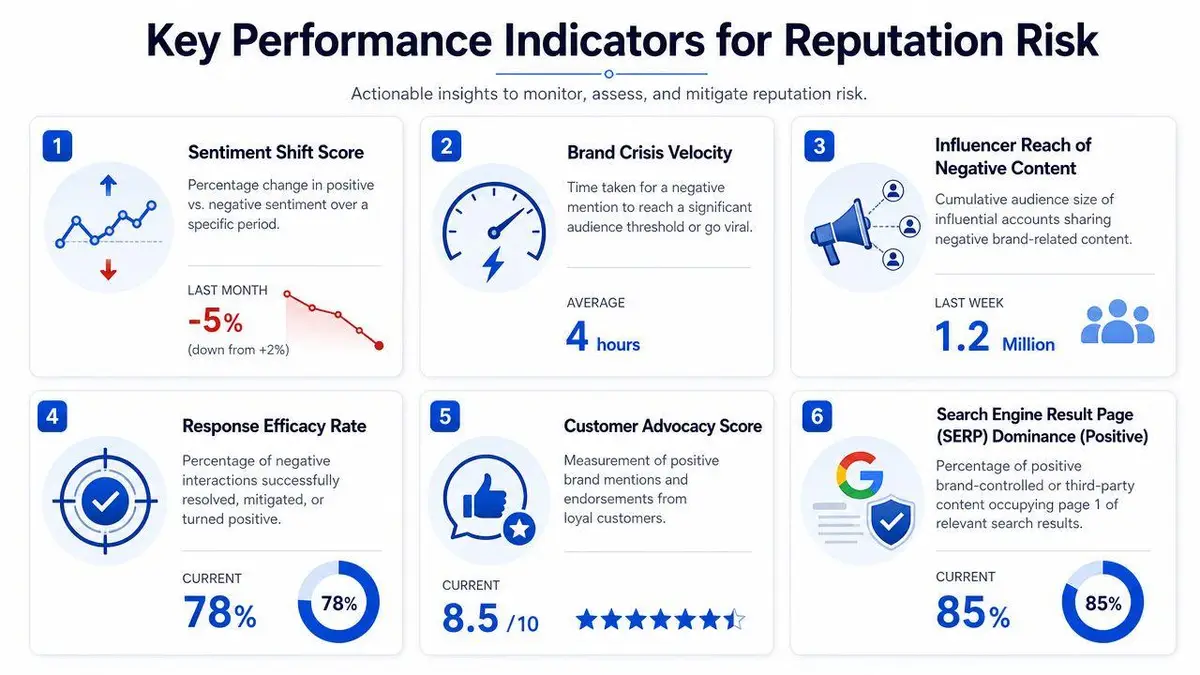
Ignore the placeholder figures in generic templates. For executive oversight, the core question is whether your metrics support decisions about response speed, ownership, and remediation quality.
The metrics worth tracking
AppFollow’s guidance is directionally correct here. Mature reputation monitoring treats mention data as operational telemetry, with key KPIs including average star rating, review volume, response rate, and response-time speed, alongside sentiment distribution. It also notes that low reply rates and slow responses leave negative content visible longer and can reveal product and operational failures, not just messaging problems, in its reputation monitoring guidance.
Those baseline KPIs are useful, but executives should read them through a risk lens:
- Average star rating tells you whether public proof points are deteriorating.
- Review volume matters when it departs from normal patterns, not as a vanity count.
- Response rate shows whether your team is leaving criticism unanswered in public.
- Response-time speed tells you whether a queue is operationally under control.
- Sentiment distribution helps separate a reputational event from routine dissatisfaction.
What those numbers should trigger
A useful dashboard doesn’t stop at reporting. It should trigger action thresholds.
For example, if response times lengthen while negative reviews cluster around a particular service line or location, that’s not primarily a communications problem. It’s an operating problem with reputational consequences. If sentiment worsens but review volume remains flat, you may be seeing a concentrated issue in influential channels rather than broad customer dissatisfaction.
This is why customer support data belongs in the same conversation. Teams that already track satisfaction and service quality will get more value from linking that data to reputation monitoring than from adding another listening tool. If your support function needs a clean primer on service-side indicators, Mava’s guide to key CSAT metrics is a practical companion.
Metrics that often mislead
The following are commonly overvalued:
- Mention volume alone: A spike can mean press interest, spam, a review attack, or one high-visibility complaint.
- Follower counts: Reach is not the same as credibility or search persistence.
- Aggregate sentiment without segmentation: It can hide a product defect in one market or a campaign against one executive.
- Share of voice: Competitive context has some value, but it rarely answers a legal or reputational threat.
A metric is useful only if it changes who acts, how fast they act, or what remedy they choose.
In-House Team vs Specialist Firm A Strategic Analysis
At 6:30 a.m., your chief executive is trending in a private Telegram channel, a fake profile has started reposting old allegations, and a journalist is asking for comment before markets open. Your social team can see the public spillover. They cannot see the full attack surface, preserve evidence to the right standard, or decide which posts justify legal action.
That is the actual decision. You are not choosing between two vendors with different pricing models. You are choosing who handles ordinary brand feedback and who handles digital threats that can affect leadership, transactions, litigation, hiring, and search visibility for months.
Where internal teams add value
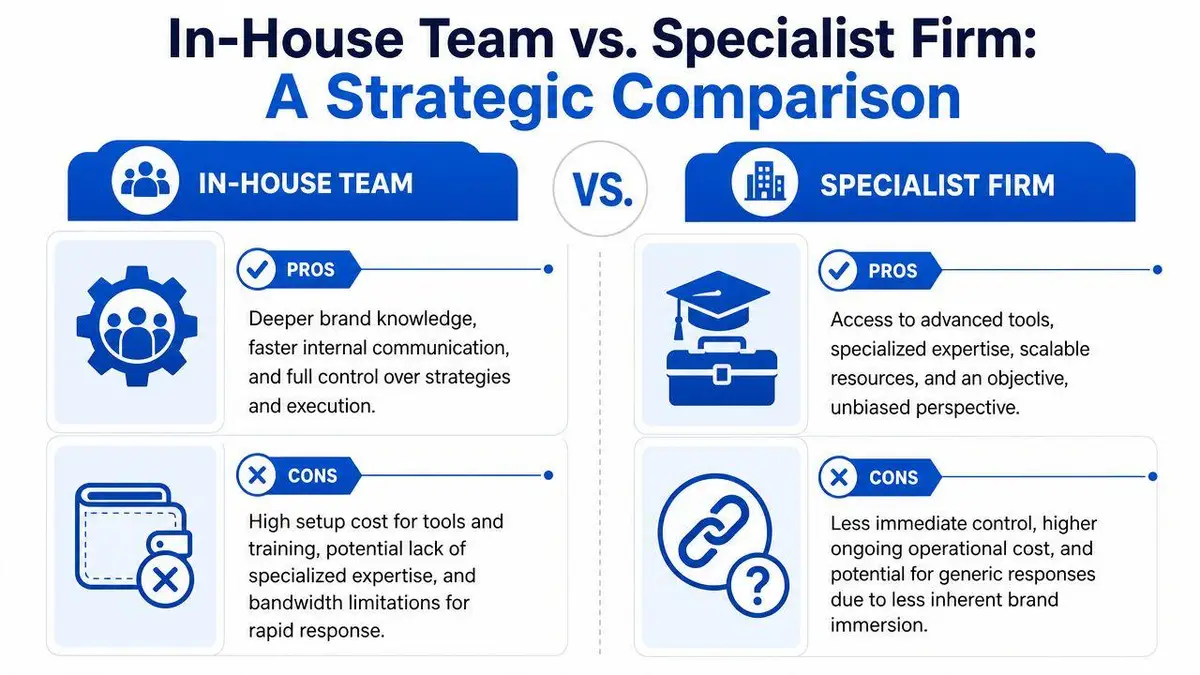
Internal teams are well placed to manage day-to-day monitoring tied to customer service, reviews, and mainstream social channels. They know the business context, the approval chain, and which complaints reflect an operational problem rather than a reputational attack.
They also control message discipline. That matters when a response should be brief, conciliatory, or withheld entirely.
Use that advantage. Do not stretch it beyond its limits.
Where internal teams break down
Pressure exposes structural gaps, not effort problems. Internal teams usually lack coverage across private or fast-moving channels, independence during attacks on senior individuals, and a single workflow that connects monitoring, evidence preservation, legal assessment, and takedown action.
| Capability question | In-house team | Specialist firm |
|---|---|---|
| Access to broader monitoring surfaces | Often limited to public channels and licensed tools | Usually wider, including harder-to-monitor environments and recurrence tracking |
| Objectivity during an executive or personal attack | Often constrained by internal politics and urgency | Usually stronger because the assessment is detached and threat-led |
| Integration with legal removal strategy | Commonly split across communications, legal, and outside counsel | Often handled as one coordinated workstream |
| Capacity during a surge event | Constrained by staffing and competing priorities | Easier to scale for triage, documentation, and repeated platform action |
| Handling recurrence and reuploads | Often reactive and inconsistent | More likely to follow a repeatable suppression and enforcement process |
That distinction matters most in four situations. Executive targeting. Impersonation. Leaked or intimate material. Coordinated review or content campaigns that reappear across platforms and search results.
Once you are in that category, the work stops being “monitoring” in the marketing sense. It becomes incident handling.
The right operating model for most organizations
Keep routine listening and customer-facing response in house. Bring in a specialist firm when the matter involves privacy, defamation, anonymous actors, cross-platform reuploads, or any threat that may require evidence handling and platform escalation on a deadline.
This is not a vote of no confidence in your team. It is basic role clarity. Communications should manage audience-facing messaging. Legal should set risk tolerance and claims strategy. A specialist firm should run detection across the relevant surfaces, preserve proof properly, map the available removal routes, and keep pressure on recurrence.
If you are comparing providers, focus on operating capability, not polished dashboards. Ask how they document evidence, how they classify legal versus non-legal harms, how they monitor private-channel spillover, and how they respond when harmful content reappears after an initial takedown. For executives reviewing service models in this category, this guide to companies that clean up your online presence is a useful starting point.
The mistake is keeping a high-stakes threat inside a team built for community management. That usually produces slow escalation, weak records, inconsistent removals, and avoidable exposure.
Navigating Legal and Jurisdictional Complexities
Monitoring only has value if the response is legally coherent. That’s where many organizations stumble. They identify harmful content quickly, then misclassify it, overreact publicly, or pursue the wrong removal route.
Not all harmful content is legally equal
A harsh opinion is not the same as a false statement of fact. An embarrassing true statement is not the same as a privacy violation. A leak of proprietary material is not handled the same way as a fake review campaign. If your team doesn’t understand those distinctions early, it will either threaten action it can’t sustain or miss opportunities that are available.
This matters even more when content crosses borders. A platform account may be registered in one jurisdiction, hosted through another, operated anonymously, and aimed at an executive located elsewhere. The law that helps you most may not be the one your team first reaches for.
Why standard monitoring is legally incomplete
Standard monitoring tools miss harmful activity in private groups, disappearing stories, and encrypted communities. For high-profile individuals, the challenge isn’t only the initial takedown but detecting the rapid reappearance of harmful content across platforms, which requires continuous cross-platform monitoring tied to takedown actions, as discussed in Greenhouse’s overview of online reputation management.
That creates a legal problem, not just a technical one. If you can’t show recurrence, pattern, or source linkage, each repost looks isolated. If each repost looks isolated, enforcement becomes slower and less persuasive.
The practical legal thresholds
Use a simple decision test:
- Defamation route: Is there a false factual allegation causing measurable reputational harm?
- Privacy route: Does the content disclose private or intimate material, personal data, or identifying details without justification?
- Copyright route: Has someone reposted protected text, images, or video you control?
- Platform enforcement route: Does the content violate impersonation, harassment, manipulated media, or review integrity rules?
You also need to know when anonymity matters. Anonymous operators are common in coordinated harassment and impersonation matters. Unmasking them can require separate procedural steps, and in many situations the immediate priority should be removal, containment, and recurrence tracking rather than identity first.
If your team needs a clearer map of these legal routes, the practical issues are laid out in ContentRemoval’s guide to navigating online content removal laws. That framework is useful because it treats removal as a jurisdictional process problem, not a generic support ticket.
The Threshold for Professional Intervention
You should bring in specialist help when the issue exceeds ordinary brand management. The threshold is lower than many executives think.
If harmful content appears across multiple platforms at once, if the same allegation keeps reappearing after removal, if the source activity sits in private or hard-to-monitor channels, or if the content raises defamation, privacy, impersonation, or intellectual property questions, your internal team is already outside normal scope. The same is true when alerts begin to outpace your ability to verify and assign them. Once response discipline breaks down, exposure grows faster than internal teams typically acknowledge.
There’s also a discretion point. High-net-worth individuals, founders, family offices, and public figures often need containment without publicity. That requires a monitoring and response posture built around confidentiality, evidence handling, jurisdiction, and persistence. General social listening won’t do that.
The sensible move is not to wait for certainty. It’s to get a confidential assessment while the matter is still containable.
If you’re dealing with a live threat, recurring harmful content, or an executive exposure issue that your current tools can’t map clearly, ContentRemoval.com can assess the risk discreetly and outline a practical response path. That usually starts with determining what can be monitored reliably, what can be removed, what must be suppressed or contained, and where legal escalation is worth pursuing.
Frequently asked questions
What is the difference between social listening and reputation monitoring?
Social listening tells you where something appeared and whether sentiment moved. Reputation monitoring tells you who started the claim, whether the account is authentic, how the allegation is spreading, whether platform rules are breached, whether evidence should be preserved, and whether search persistence will outlast the social cycle. One is visibility; the other is decision-ready intelligence.
Which reputation monitoring metrics should executives track?
Average star rating, review volume against normal patterns, response rate, response-time speed, and segmented sentiment distribution, all read through a risk lens with action thresholds attached. Mention volume alone, follower counts, unsegmented sentiment, and share of voice are commonly overvalued.
When should reputation monitoring move from an in-house team to a specialist firm?
When harmful content appears across multiple platforms at once, the same allegation keeps returning after removal, source activity sits in private or hard-to-monitor channels, or the content raises defamation, privacy, impersonation, or IP questions. Keep routine listening and customer-facing replies in house; bring in a specialist when evidence handling and platform escalation run on a deadline.