
Online reputation due diligence is a structured investigation into how a company, founder, or executive appears across the public internet and whether that visibility creates transactional, legal, commercial, or governance risk. Unlike a background check, it asks what the market already sees, which claims are gaining visibility, and which items are false but influential, then classifies each finding by remedy.
Key facts
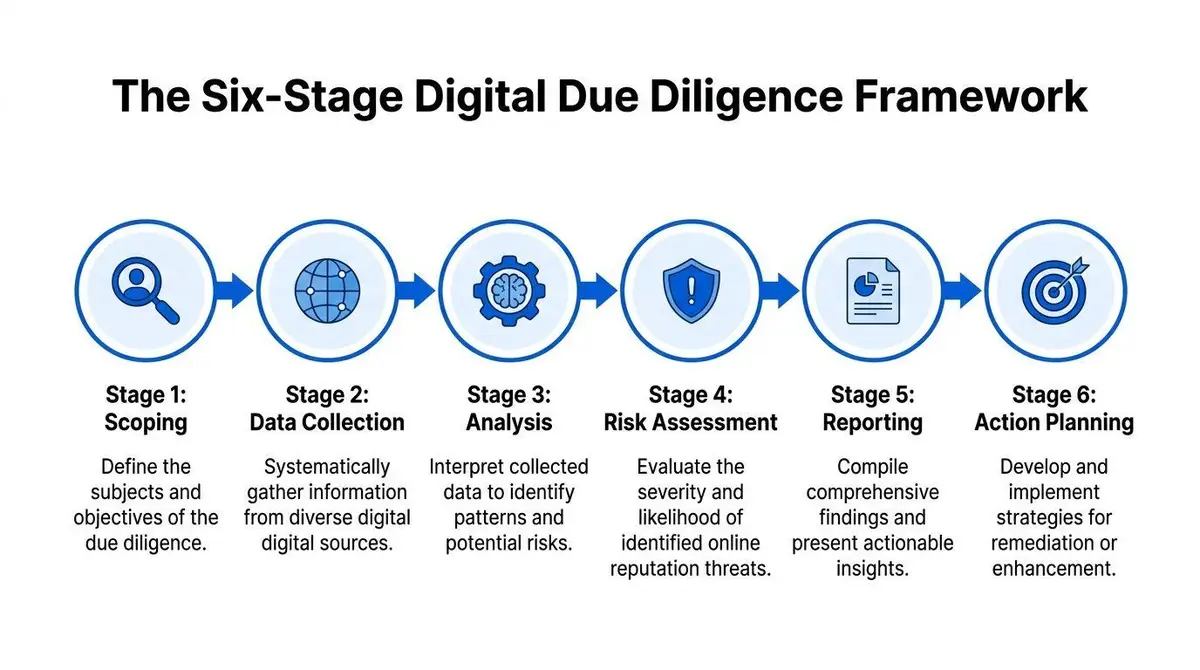
- Six-stage framework: scoping, discovery, analysis, verification, remediation strategy, and post-close monitoring
- Scope beyond the target: founders, spouses where relevant, prior entities, aliases, and flagship products
- Test each red flag on four questions: is it visible, believable, persistent, and actionable
- Deliverable: an exposure map, a risk register, a visibility assessment, and a remove, suppress, monitor, or walk-away memo
Where ContentRemoval.com comes in. When diligence turns up a verified red flag, ContentRemoval.com maps the realistic options: source removal where the content is false, impersonating, or privacy-invasive, de-indexing or suppression where it is not, and monitoring through the post-close window when dormant issues resurface. Deal counsel, the investment committee’s lead, or the family office CIO usually makes contact. A free 15-minute Exposure Scan maps what is removable, and the report is yours to keep. Get a Free, Confidential Exposure Scan or read how our reputation management work is done.
A transaction can survive a pricing dispute, a stubborn indemnity clause, even a difficult management interview. It often doesn’t survive a late-stage reputational discovery that nobody bothered to investigate properly.
That’s the situation many family offices and private equity firms walk into. The financials look clean. Counsel clears the structure. The management presentation lands well. Then someone on the investment committee runs a basic search and finds an old allegation, a cluster of hostile reviews, a copied article, an executive’s inflammatory posts, or an impersonation account that’s been sitting in search results for months. At that point, you’re no longer evaluating upside. You’re assessing contagion.
Online reputation due diligence is the process that should have happened before that moment. Not as a PR exercise. Not as a vanity search. As a formal risk discipline tied to valuation, counterpart credibility, lender confidence, customer trust, and post-close stability.
Beyond the Handshake Quantifying Digital Risk in High-Stakes Decisions
A buyer signs a term sheet for a consumer-facing asset. The target has solid top-line momentum, polished board materials, and a management team that presents well. In the final stretch, a lender’s analyst flags adverse search results tied to customer complaints and unresolved accusations against a senior executive. Suddenly the question isn’t whether the company can grow. It’s whether growth assumptions were built on a false premise about trust.
That scenario is common because most deal teams still treat digital reputation as an afterthought. They’ll commission financial diligence, legal diligence, tax diligence, cyber diligence, and commercial diligence. Then they leave the public narrative, search exposure, review profile, and executive footprint to chance. That is a category error.
The downside is measurable. Companies risk losing 22% of business when potential customers find just one negative article on the first page of search results, and that rises to 70% when four or more negative articles appear, according to Igniyte’s review of online reputation statistics. The same source notes that 93% of consumers say online reviews directly impact buying decisions. If you’re underwriting future revenue and ignoring page-one risk, your model is incomplete.
Why deal teams get this wrong
Traditional diligence privileges documents the seller can organize. Online reputation due diligence focuses on signals the seller often can’t control, or would rather not highlight. That includes search results, forum threads, review patterns, legacy press, social content, leaked material, and hostile third-party posts.
A buyer considering hospitality, retail, or other reputation-sensitive sectors should understand that digital trust often sits upstream of conversion. If you’re evaluating an operating business in a market like Dubai’s food and beverage sector, practical market context matters too. A useful starting point is this 2026 guide to Dubai restaurants, not because it solves reputational risk, but because it shows how operational attractiveness and market opportunity can look compelling even while public-facing trust issues remain hidden.
Practical rule: If public sentiment can change customer behavior before legal liability is proven, it belongs inside diligence, not outside it.
What negligence looks like in practice
It looks like approving an executive hire without reviewing their searchable history across platforms. It looks like acquiring a brand without checking whether negative content dominates branded queries. It looks like trusting review averages without testing authenticity, velocity, and spread.
In high-stakes decisions, ignorance isn’t neutral. It’s a decision to accept hidden risk without pricing it.
Defining the Scope of Online Reputation Due Diligence
Online reputation due diligence is a structured investigation into how a company, asset, founder, executive, or affiliated entity appears across the public internet and adjacent digital channels, and whether that visibility creates transactional, legal, commercial, or governance risk. It is not the same as a background check.
A standard background check asks whether a person has disqualifying records. Online reputation due diligence asks a harder set of questions. What is the market already seeing? Which claims are gaining visibility? Which narratives are likely to surface during financing, post-close integration, recruiting, customer acquisition, or a future exit? Which items are false but influential anyway?

What it includes
This work sits in the gap between investigations, litigation risk review, cyber intelligence, and strategic communications. A serious review usually covers:
- Search exposure: Branded queries, executive-name queries, image results, autosuggest behavior, and related searches.
- Review ecosystem: Major review platforms, niche industry sites, complaint boards, app stores, and employee-review environments.
- Media and commentary: News archives, blogs, syndicated content, reposted allegations, and forum amplification.
- Social footprint: Executive posts, staff conduct issues, coordinated attacks, impersonation, and engagement spikes around adverse events.
- Security-linked reputation issues: Data leak references, credential exposure chatter, doxxing, and malicious account cloning.
- Associational risk: Family members, portfolio ties, shell entities, prior ventures, and board affiliations that create searchable linkage.
When you need it
The trigger isn’t only size. The trigger is consequence. If a bad discovery can alter price, financing, insurability, board approval, or public credibility, you need the work done properly.
The highest-value use cases are usually these:
| Scenario | What the diligence is trying to answer |
|---|---|
| M&A and private equity | Is there hidden reputational drag that affects customer retention, regulatory scrutiny, or exit value? |
| Executive hiring | Will this individual import controversy, litigation exposure, or cultural risk into the business? |
| Strategic partnerships | Will association with the counterparty damage your own brand or trigger stakeholder concern? |
| Family office investments | Is the principal, operating team, or portfolio company carrying latent digital liabilities that could become public at the worst moment? |
What separates it from amateur searching
Typing a name into Google is not due diligence. It’s the beginning of discovery. Proper work requires query design, source mapping, identity resolution, verification of aliases and affiliated entities, and analysis of whether specific items are discoverable by customers, journalists, employees, regulators, or counterparties.
The question isn’t whether negative content exists. The question is whether it is credible, visible, repeatable, and remediable.
That last point matters. A hostile post with no traction is different from an indexed article, a review cluster, a copied accusation, or a leak that search engines keep surfacing. The scope of online reputation due diligence has to account for visibility, persistence, and legal removability. Otherwise you’re just collecting noise.
A Repeatable Framework for Digital Due Diligence
Most firms improvise this work. That’s a mistake. If the process isn’t repeatable, it can’t be audited, defended, or integrated into investment approval.
The framework below is the one I recommend for acquisitions, executive appointments, and other high-consequence decisions. It converts a vague concern about “bad press online” into an operational discipline with defined outputs.
Stage one and two scoping and discovery
Scoping comes first because most failures begin with the wrong subject list. Don’t limit review to the target company or the named executive. Include founders, spouses where relevant, prior entities, known aliases, flagship products, and any asset likely to inherit search association after closing.
Set decision thresholds before discovery starts. Define what counts as a deal issue, what requires a price adjustment, what requires remediation pre-close, and what can be accepted with monitoring. If you don’t define those thresholds early, every late finding becomes an argument.
Discovery is a disciplined collection exercise. Search engines matter, but so do review sites, complaint platforms, employee forums, social networks, archives, image search, video platforms, and breach-related references. Use manual review and platform tools together. At this stage, superficial work falls apart, because real problems rarely sit in one obvious place.
Stage three and four analysis and verification
Discovery creates volume. Analysis creates meaning. In this phase, AI-powered sentiment analysis tools can help process large datasets. According to Prowly’s discussion of online reputation metrics, platforms using Natural Language Processing can process 3000+ tweets in seconds to categorize sentiment and identify thematic risks. That matters when you’re dealing with fast-moving narratives, product complaints, or executive controversy that spreads across channels.
The key metric I care about is share of page-one Google results. The same Prowly source notes that a target of over 60% positive or controlled content is essential, and failure to maintain that benchmark can correlate with 10% to 20% declines in organic traffic and conversions. In transaction terms, this becomes a proxy for narrative control. If page one is hostile, your target is already paying a trust tax.
Verification is where professionals separate signal from fiction. Complaint patterns may be authentic, coordinated, copied, manipulated, or outdated. A report should identify what is substantiated, what is disputed, what appears fraudulent, what is merely opinion, and what is actionable under platform policy or law.
Advisory note: Never escalate a reputational issue inside a deal team until the item has been verified for identity, date, authorship, and current visibility.
Stage five remediation strategy
Once the findings are verified, classify them into action tracks. Some items need legal analysis. Some need platform-based takedown requests. Some require technical suppression. Some should be documented as residual risk and accepted consciously, not ignored.
A simple decision sequence works well:
- Can it be removed at source? Defamation, impersonation, copyright misuse, privacy violations, and non-consensual intimate imagery often justify direct legal or policy action.
- If not, can it be de-indexed or suppressed? Search visibility often drives the commercial damage more than the original publication.
- If neither is realistic, can the risk be contained? That may include transaction protections, governance conditions, communications planning, or delayed closing.
Stage six monitoring
Closing a deal doesn’t end the problem. It starts the period when dormant issues often resurface. Post-signing leaks, employee backlash, competitor sabotage, and recycled allegations tend to appear precisely when attention is highest.
A monitoring program should track executive names, company names, core products, and known adverse narratives. It should also watch for copied content and reuploads. If you wait for a principal, banker, or journalist to discover new material first, your response window is already too small.
What a good final output looks like
The deliverable should be concise enough for decision-makers and detailed enough for counsel. At minimum, it should include:
- An exposure map: What appears, where, and for which search queries.
- A risk register: Severity, credibility, likely stakeholder impact, and remediation path.
- A visibility assessment: Whether harmful content controls page one or remains marginal.
- An action memo: Remove, suppress, monitor, disclose, price-adjust, or walk away.
If your diligence process can’t produce those outputs, it isn’t a framework. It’s a web search.
Identifying Critical Red Flags and Reputational Threats
Most buyers focus too narrowly on obvious scandal. The better approach is to classify red flags by the kind of damage they can cause. A single ugly article may matter less than a repeating pattern of employee complaints, copied allegations, and anonymous posts tied to the same misconduct theme.
The matrix below is the format I prefer because it forces discipline. It stops teams from treating every negative item as equally important.
Reputational red flag matrix
| Threat Category | Specific Red Flag Indicator | Potential Business Impact |
|---|---|---|
| Legal and regulatory | Searchable allegations tied to litigation, sanctions references, arrest-related material, or regulatory complaints | Financing friction, enhanced legal review, board concern, delayed closing |
| Ethical and cultural | Harassment claims, discrimination allegations, toxic workplace narratives, executive social posts showing poor judgment | Talent retention issues, leadership credibility damage, employee backlash |
| Financial and commercial | Persistent customer fraud accusations, insolvency rumors, complaint clusters around billing or fulfillment | Revenue drag, higher churn risk, lower trust in growth assumptions |
| Security and privacy | Data leak references, doxxing, impersonation accounts, exposed credentials, dark-web chatter | Extortion risk, account compromise, reputational contamination, crisis response costs |
| Narrative control | Page-one dominance by hostile articles, complaint boards, copied posts, or manipulated content | Reduced conversion, reduced partner confidence, valuation pressure |
| AI-amplified exposure | Negative articles and reviews being surfaced and summarized rapidly by generative search tools | Faster spread, more stakeholder visibility, shorter response window |
Patterns matter more than isolated hits
One complaint can be noise. Ten complaints saying the same thing across different channels deserve attention. A founder with one clumsy old post may be manageable. A founder with a consistent public pattern of aggression, threats, or inflammatory commentary is a governance issue.
Many internal teams fall short. They collect screenshots but don’t interpret recurrence. They note that content exists but don’t ask whether it clusters around customer deception, employment abuse, undisclosed conflicts, or security failures.
The newer risk is speed. According to Otter PR’s summary of AI-driven reputation threats, generative AI in search can surface and summarize negative reviews or articles in hours rather than weeks, and Forbes estimates a single damaging article amplified this way can cost a publicly traded firm seven figures in valuation. Legacy diligence models miss this because they still assume a slower search cycle.
If harmful content can be summarized before your team has even verified it, your exposure is no longer just publication risk. It is interpretation risk.
The operational test for a real red flag
Ask four questions.
- Is it visible? If it ranks, indexes, or surfaces in summary tools, it matters.
- Is it believable? Anonymous content can still cause damage if it fits a broader pattern.
- Is it persistent? Copied posts, forum reposts, and syndicated content can outlive the original source.
- Is it actionable? Some content can be removed. Some can only be contained.
That last point is why ongoing reputation monitoring for executives and brands belongs inside the risk program, not bolted on after a crisis. Monitoring doesn’t fix a bad asset. It does prevent the common mistake of discovering a fast-moving issue after the other side of the market has already seen it.
Navigating Remediation and Strategic Content Removal
When a red flag is verified, the worst response is panic and the second worst is passivity. The right response is to classify the content by remedy. Every adverse item falls into one of three buckets. It can often be removed at source, it can be reduced in search visibility, or it must be managed as a residual risk with controls around it.

Source removal is the priority
If content is false, defamatory, impersonating, privacy-invasive, infringing, or platform-prohibited, your first objective should be source removal. That prevents re-indexing from the original URL and gives you the cleanest long-term outcome.
This work usually sits at the intersection of legal analysis and platform procedure. Counsel may identify the claim. A specialist team then has to translate that claim into the exact policy, evidence package, and submission path that the publisher, social platform, or search engine will process. That’s why generic PR firms struggle here. They can message around a problem. They usually can’t get it taken down.
Suppression is a tactic, not a substitute
When source removal isn’t available, technical suppression becomes relevant. That means reducing the prominence of harmful content by improving the visibility of accurate, controlled, and authoritative material. It can help, but it should never be confused with a cure.
Suppression works best when the adverse item is weak, old, or isolated. It works poorly when the source is highly authoritative, heavily linked, or repeatedly copied. In those cases, legal escalation or platform enforcement is often the only serious path.
Choose specialists by remedy, not branding
If the issue involves defamation, leaked imagery, impersonation, mugshots, copied private material, or repeated reuploads, hire for execution. Ask who handles source removal, who manages de-indexing, who verifies duplicates, and who monitors recurrence. One option in that category is specialist online content removal support, which focuses on source removal, de-indexing, and related enforcement workflows across platforms and search environments.
Good remediation doesn’t ask, “How do we make this look better?” It asks, “How do we reduce discoverability, remove the source, and stop recurrence?”
For a buyer or family office, that distinction matters. The reputational issue itself may not kill the deal. An issue with no credible remediation path often should.
Global Due Diligence Privacy and Jurisdictional Complexities
Cross-border matters are where amateur online reputation due diligence breaks down. A result that can be challenged in one jurisdiction may be untouchable in another. A search engine may de-index locally while the source remains live elsewhere. A publisher may ignore a complaint entirely unless the request is framed under the correct legal standard.
Europe and the United States require different playbooks
In Europe, privacy law can create meaningful removal and de-indexing opportunities, particularly when information is outdated, excessive, inaccurate, or no longer relevant in the form presented. In the United States, the legal environment is narrower. First Amendment protections change the analysis, especially for news reporting, commentary, and opinion.
That means a global principal or portfolio company can’t rely on a single strategy. The same item may call for de-indexing in one market, host-level negotiation in another, and suppression or monitoring elsewhere. If the business operates internationally, your diligence memo should identify where the risk is discoverable and where the remedies are viable.
Jurisdiction changes both risk and remedy
Family offices often hold assets, residences, and operating companies across several regions. Executives may have dual-market visibility. Private equity sponsors may acquire a target in one country and roll it into a platform serving several others. In each case, the practical question is the same. Where will stakeholders encounter the content, and which laws govern your response?
That’s why legal and technical planning have to work together. A useful overview of that interplay appears in this strategic guide to online content removal laws for executives. The point isn’t academic. If you misread jurisdiction, you waste time, show your hand to the publisher, and sometimes make the content harder to remove.
Global diligence isn’t broader because it sounds impressive. It’s broader because visibility and enforceability rarely align neatly across borders.
Frequently Asked Questions on Reputation Due Diligence
How is online reputation due diligence different from a standard background check
A background check looks for records. Online reputation due diligence looks for public narrative, digital associations, search visibility, and the likely commercial effect of what stakeholders find. One is a compliance screen. The other is a risk analysis tied to trust, valuation, and strategic exposure.
A standard check may tell you whether a record exists. It usually won’t tell you whether a copied accusation dominates search results, whether review manipulation is distorting public perception, or whether an executive’s historical posts are likely to resurface under scrutiny.
When should we run it in a transaction
Run it before exclusivity if the target is consumer-facing, founder-led, heavily reviewed, or likely to attract public attention. Run it before signing for any high-profile executive hire. Run it before a major partnership if your own brand could absorb the fallout.
Waiting until the end creates bad choices. By then, you’ve invested time, internal credibility, and emotional commitment. Teams become tempted to minimize what they should be pricing properly.
What’s the minimum scope for a family office or private equity firm
At minimum, review the target company, lead executives, founders, major brand names, flagship products, and material affiliated entities. Then review the same subjects through the lens of reviews, media, complaints, social activity, and security-linked exposure.
If the asset depends heavily on founder reputation, trust-based sales, or regulated relationships, expand the scope immediately. The digital footprint of one individual can alter the risk profile of the whole investment.
Can this be quantified well enough for investment decisions
Partly, yes. Fully, not yet. That distinction matters.
Research summarized by Thrive Agency on niche-specific ORM challenges notes that 97% of consumers read online reviews, but also highlights a major gap: there’s little reliable benchmark data showing exactly how a set number of negative reports on a specific platform translates into a precise revenue decline for a particular business. So you can quantify visibility, recurrence, review spread, and narrative control. You often can’t produce a universal formula that says a fixed number of adverse items automatically kills a deal.
Use thresholds, not false precision. Score visibility, credibility, legal actionability, and business relevance. Then make a decision.
What should count as a deal-breaker
There isn’t one universal trigger. But several combinations should stop a process or force a hard repricing discussion: credible allegations tied to the core offering, repeated executive misconduct themes, page-one dominance by adverse material, active impersonation or leaks, and any issue that lacks a plausible remediation path.
Context is everything. A niche B2B software company can survive some noise that a consumer wellness brand cannot. A quiet old complaint is different from a current multi-platform pattern. Don’t ask for a magic number. Ask whether the issue is visible, believable, repeated, and fixable.
How do we handle content that may be false but still damaging
Treat it as a live risk first and a truth dispute second. Verify authorship, publication history, indexing status, copies, and platform policy violations. Then decide whether you can remove it, de-index it, suppress it, or ring-fence it contractually.
Waiting for a court ruling before acting is often commercially naive. Search engines, review sites, and social platforms shape stakeholder perception long before a legal dispute is resolved.
Is monitoring really necessary after the deal closes
Yes. Acquisitions, financing rounds, promotions, and public announcements often cause dormant content to resurface. Competitors notice momentum. Former employees notice exits. Anonymous posters notice attention.
If you only investigate once, you’re treating digital risk as static. It isn’t. Monitoring is how you catch copied content, new reviews, synthetic amplification, and narrative spikes before they alter the post-close environment.
If you’re evaluating an acquisition, hiring a visible executive, or trying to understand whether a digital issue is a pricing problem or a walk-away problem, ContentRemoval.com can assess the exposure confidentially and map the realistic options for removal, de-indexing, suppression, and ongoing monitoring. The right time to do this work is before the other side of the market finds the problem for you.