
Online reputation crisis management is an operational response to a live threat, not a PR exercise. It starts with evidence preservation and a threat grade based on velocity, volume, and source credibility, then containment through the correct takedown channel for each content type, search de-indexing, disciplined communications from one master narrative, and months of remediation and reupload monitoring afterward.
Key facts
- Grade a developing incident on three variables: velocity, volume, and source credibility
- Match content to channel: impersonation reporting, copyright workflow, privacy complaints, or court-backed defamation relief
- Run containment in order: preserve, locate, choose the fastest valid takedown route, reduce search surface, then communicate
- In the US, Section 230 shifts pressure to the original speaker and policy violations; EU privacy law can support de-indexing
Where ContentRemoval.com comes in. ContentRemoval.com handles the operational core of a crisis: source removal, de-indexing, platform takedowns, and monitoring across search engines, websites, and social platforms while counsel and communications work their own tracks. The first call usually comes from the general counsel, a chief of staff, or a crisis adviser who needs the technical execution done at pace. A free 15-minute Exposure Scan maps what is removable, and the report is yours to keep. Get a Free, Confidential Exposure Scan or read how our reputation management work is done.
You usually know when the situation has crossed the line from irritating to dangerous. A search result appears that shouldn’t exist. A private image is reposted. An employee flags a fake account using your name. A journalist calls with questions before your team has even seen the underlying post. At that point, “monitoring the situation” is often just another phrase for losing time.
Online reputation crisis management isn’t a PR exercise with softer language and better graphics. It’s an operational response to a live threat. The work starts with evidence control, source identification, platform escalation, search suppression, and legal positioning. Public messaging matters, but it’s secondary to one basic objective: stop the spread, maintain control, and keep bad material from becoming permanent digital infrastructure around your name or company.
If you’re an executive, founder, public figure, or adviser to one, generic crisis advice won’t carry this. You need a tighter standard. You need to know which content can be removed, which content can only be de-indexed, which platforms move quickly, which ones require pressure, and when speaking publicly helps versus when it merely validates the attack. That distinction decides whether a bad week becomes a contained event or a standing reputational liability.
Detecting and Assessing the Threat Level
Digital crises move faster than most executive teams do. In 2017, a single viral video of a passenger being forcibly removed from a United Airlines flight wiped out $1.4 billion in market value within days, and negative content has been shown to be three times more impactful than positive coverage, according to Status Labs’ reputation statistics analysis. If you underestimate the first wave, you hand momentum to the people spreading the material.
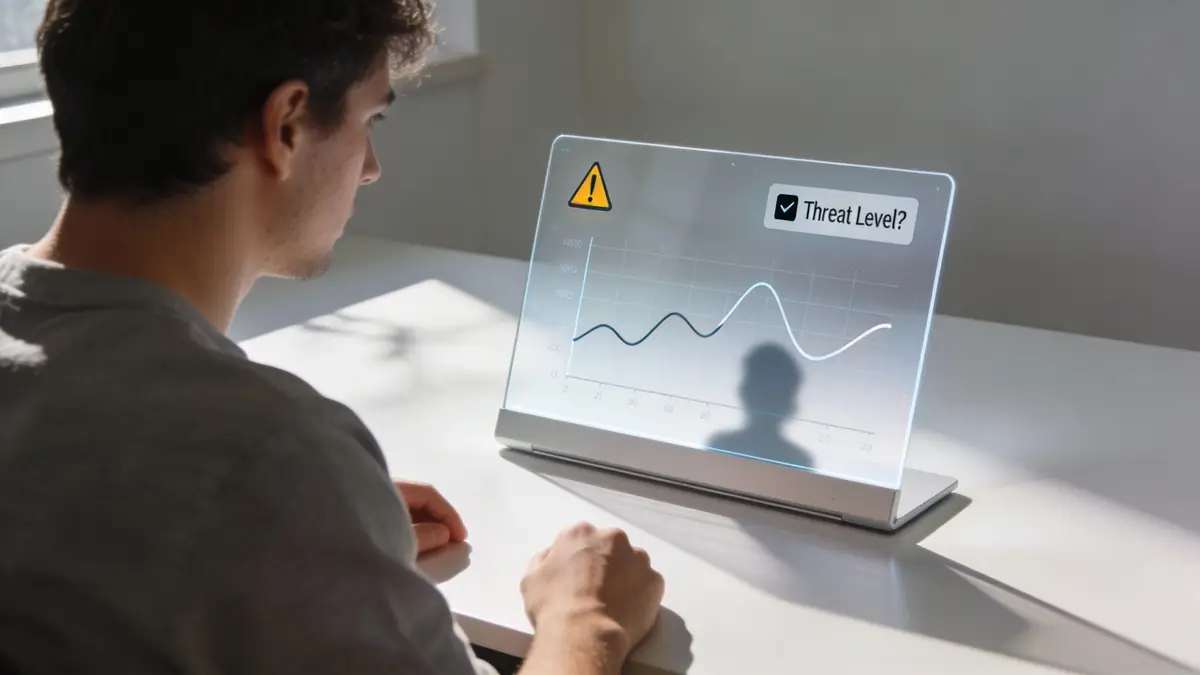
The first hour isn’t for debate. It’s for building an accurate threat picture. That means treating the situation like an intelligence-gathering operation, not a communications brainstorm.
What to capture before anything disappears
Volatile content changes fast. Posts get edited. Captions are rewritten. Accounts vanish, then reappear elsewhere. If your team starts discussing responses before preserving evidence, you’ve already weakened your position.
Collect the following immediately:
- Screenshots with context: Capture the full post, account handle, timestamp, visible engagement, comment threads, and the URL.
- Native files where possible: Save videos, images, article PDFs, cached snippets, and source code copies if legal counsel approves.
- Platform footprint: Identify whether the content lives on social platforms, publisher sites, forums, search results, review pages, or file-sharing networks.
- Amplifier map: Separate the original poster from secondary accounts, journalists, influencers, aggregator sites, and anonymous repost networks.
- Search exposure: Check branded search terms, executive name queries, and image search results to see whether the issue is already indexing.
A serious team also tracks sentiment and velocity in parallel. Not every hostile post is a crisis. Some are noise. Some are grievance. Some are coordinated attacks wearing the costume of organic outrage.
Practical rule: Don’t classify the threat by how offensive it feels. Classify it by how fast it’s spreading, who is validating it, and whether it’s becoming searchable.
A simple threat framework executives can actually use
I advise clients to grade a developing event on three variables: velocity, volume, and source credibility.
Velocity tells you whether the issue is accelerating. A defamatory blog post with no traction is different from a short clip moving rapidly across social feeds and private messaging channels. Fast-moving material demands immediate containment, even if the legal merits are still being assessed.
Volume tells you whether the issue is isolated or multiplying. Ten hostile comments under one post are manageable. Replication across search, social, reviews, and media is a different category. Once duplication begins, your task changes from rebuttal to system disruption.
Source credibility determines whether the material has persuasive power. Anonymous abuse still matters, especially if it contains private data or fabricated evidence, but a claim repeated by a known journalist, trade outlet, former employee, or apparently authentic customer carries more risk because third parties treat it as verified before it’s tested.
Here’s the blunt version. A low-credibility source with high velocity can still destroy a weekend. A credible source with indexing power can damage a year.
Move from alarm to command
Most clients calm down once there’s a structure around the problem. That structure should include a live incident log, one decision-maker, and one evidence repository. If five people are independently emailing screenshots and messaging outside counsel, confusion becomes part of the crisis.
A disciplined monitoring system helps here. Tools matter, but workflow matters more. Your team needs alerts, ownership, and a single view of what is being said and where. If you don’t already have that infrastructure, a dedicated reputation monitoring program is the right starting point because it creates the early warning layer most companies only realize they needed after the damage is public.
Distinguish irritation from emergency
Use judgment, not ego. Some attacks are ugly but containable. Others implicate safety, extortion, leaked private material, impersonation, market confidence, or regulatory exposure. Those require immediate escalation.
A quick internal triage often looks like this:
| Threat pattern | What it usually means | Initial posture |
|---|---|---|
| Single complaint with limited visibility | Customer issue or isolated criticism | Monitor, verify facts, avoid overreaction |
| Coordinated reposting across accounts | Possible harassment or organized amplification | Preserve evidence and begin containment |
| Leaked documents, private media, or impersonation | Security and legal exposure | Activate legal and takedown response immediately |
| Negative content ranking in search | Long-tail reputational damage | Combine de-indexing, removal, and suppression strategy |
| Inbound press inquiry before internal facts are clear | Narrative is escaping your control | Lock internal facts, appoint spokesperson, contain digitally |
The first mistake is panic. The second is denial. The right move is controlled escalation.
Immediate Containment and Takedown Procedures
The first day decides whether the internet builds a permanent archive around the incident. While people inside your organization are still arguing over language, harmful content is being copied, mirrored, indexed, clipped, and reposted. You need to act before the attack hardens.
Containment starts with classification. Different content types trigger different removal routes, and using the wrong route wastes precious hours. Defamation, impersonation, copyright infringement, leaked private information, and non-consensual intimate content are not interchangeable problems. Each has its own evidentiary threshold, platform policy path, and escalation logic.
Match the content to the correct takedown channel
A fake account pretending to be your executive should go through impersonation reporting, identity verification, and, where needed, counsel-backed escalation. A copied video or stolen image often belongs in a copyright workflow. If your team needs a practical reference point, this guide on how to write and file a DMCA takedown notice is useful because copyright claims rise or fall on precision, not outrage.
Defamatory content is harder. Platforms often resist making factual determinations unless the post plainly violates policy or is supported by a court order. That means your job in the first 24 hours is twofold: preserve the evidence for legal action and remove what can be removed immediately under existing platform rules.
For leaked personal data, doxxing, private imagery, forged documents, and extortion-linked posts, speed matters even more. These categories often justify immediate abuse reporting, emergency privacy complaints, and host-level escalation when the platform response is slow.
If the problem has already spread into search, executives often need a separate track focused on de-indexing and visibility reduction. A concise outside perspective on that process appears in Brian Hansford Law’s discussion of how to clear negative search results, which is worth reviewing because search exposure changes the legal and reputational stakes.
First 24-Hour Crisis Response Checklist
| Timeframe | Action Item | Owner/Lead | Objective |
|---|---|---|---|
| First hour | Freeze evidence and create a master incident file | Legal or crisis lead | Preserve proof before edits or deletion |
| First hour | Identify original source and all known reposts | Monitoring lead | Map spread and prioritize targets |
| First few hours | Classify content by takedown route | Legal and technical response | Avoid wasting time on the wrong channel |
| First few hours | File platform complaints on highest-risk content | Technical takedown lead | Reduce exposure quickly |
| Same day | Escalate to hosts, registrars, or publisher contacts where justified | External counsel or specialist | Apply pressure beyond platform forms |
| Same day | Assess search visibility and snippets | Search specialist | Prevent lasting index damage |
| By end of day | Lock spokesperson authority and internal handling rules | Executive lead and communications | Stop internal inconsistency from worsening the issue |
The order of operations matters
Too many teams begin with a statement because it feels active. Often it isn’t. If the source content remains live, indexed, and shareable, your statement can increase discovery. That’s especially true when your name, company, or allegation keywords become attached to fresh pages that search engines can crawl.
Run containment in this order:
- Preserve evidence first. Don’t rely on platforms to keep records accessible.
- Identify where the content resides. Social post, hosted article, forum thread, cached result, mirror site, or messaging app screenshot.
- Choose the fastest valid takedown pathway. Policy violation, privacy complaint, copyright claim, court order preparation, or host escalation.
- Reduce search surface area. Remove source material where possible, then work on de-indexing and snippet control.
- Prepare communications only after the factual map is stable. Public language should support the legal and technical strategy, not undermine it.
Don’t let your own team make the situation worse
Internal sloppiness creates discoverable problems. Employees speculate in writing. Junior staff message reporters. Marketing republishes a “clarification” that accidentally repeats the allegation. Those errors can be more damaging than the original post.
Issue three direct instructions early:
- One channel for facts: No parallel document sets, no off-the-cuff summaries.
- One approval chain: Legal, executive lead, and communications must clear external actions.
- One external voice: Everyone else stays off-record and off-platform.
Stop thinking in terms of “response.” Start thinking in terms of exposure reduction. Every live URL, cached snippet, repost, and fake profile is a point of failure.
This is also the stage where specialist support earns its place. Some firms focus on narrative. Others focus on litigation. High-stakes matters usually need both legal analysis and technical execution. ContentRemoval.com, for example, handles source removal, de-indexing, platform takedowns, and monitoring across search engines, websites, and social platforms. That type of work is operational. It sits closer to incident response than traditional PR.
Coordinating Strategic Communications
Most reputational damage in a crisis doesn’t come from one bad statement. It comes from inconsistent statements issued by people who were never supposed to be speaking in the first place. Once that happens, the public starts assembling a narrative from fragments, and your credibility erodes with every contradiction.
A disciplined communications strategy is the countermeasure. Not a flurry of updates. Not emotional transparency for its own sake. A controlled release of facts, responsibility, and next steps that serves the broader containment effort.

According to the Social-mediated Crisis Communication model, organizations with a pre-planned crisis strategy achieve reputation stabilization 75% faster, timely acknowledgment can reduce virality by 40-60%, but only 49% of companies have a formal plan and fewer than 25% conduct drills, as summarized by PRNEWS’ crisis planning analysis. The lesson is straightforward. Speed helps, but only disciplined speed helps.
Build one master narrative
Your team needs a single internal document that answers four questions.
What happened.
What you know for certain.
What you’re doing right now.
What you won’t speculate on yet.
That document is not a press release. It is the source text from which every approved communication is derived. Investor outreach, employee guidance, customer support language, family office briefings, board updates, and media statements should all trace back to that one record.
Here’s where judgment matters. If the underlying issue is still being verified, a holding statement is often stronger than a detailed explanation. If there is clear harm or operational failure, delayed acknowledgment can look evasive. “No comment” isn’t weak when used properly. It’s weak when it sounds like panic or concealment.
Say less when facts are unstable. Say more when silence would reasonably be read as indifference or admission.
Different audiences need different messages
Stakeholders don’t need the same thing from you.
Employees need instruction, boundaries, and reassurance that the company has control of the situation. Investors need an accurate account of risk, exposure, and response. Customers need clarity about whether they are affected and what action they should take. Family members often need private guidance before they become collateral targets online.
Use customized talking points, but keep the factual spine identical. If one group hears apology while another hears denial, the gap will surface publicly.
A practical format looks like this:
- Employees: What happened, who handles inquiries, what not to post, where to report new threats.
- Customers or clients: Whether services, safety, privacy, or delivery are affected.
- Investors or board members: Operational impact, legal posture, and timeline for further updates.
- Press: A concise statement with verified facts, corrective action if appropriate, and a contact channel.
After the first wave is under control, use owned media deliberately. Your website, verified social accounts, executive LinkedIn presence, and direct email channels let you speak without journalistic reframing. That doesn’t eliminate scrutiny, but it gives you one clean source of truth.
A short briefing on executive-facing response strategy can help set the tone before interviews or stakeholder outreach.
Choose your spokesperson with discipline
The wrong spokesperson creates a second crisis. Seniority alone doesn’t qualify someone to speak. Neither does charisma. The spokesperson should be the person with the right mix of authority, composure, and factual command for the specific issue.
If the crisis touches safety, ethics, or leadership conduct, senior executive visibility usually matters. If the issue is technical, legal, or narrow, a designated representative may be stronger. What matters is that the spokesperson can hold the line under pressure and avoid improvisation.
Three rules apply:
- No freelancing. If it isn’t in the approved narrative, it isn’t said.
- No false certainty. Overstated confidence creates future credibility problems.
- No performative empathy without action. Audiences punish empty language quickly.
Strategic communications are not separate from online reputation crisis management. They either protect the takedown strategy or interfere with it. Every word should be tested against one question: does this reduce confusion and legal exposure, or does it feed the search cycle?
Long-Term Remediation and Recovery
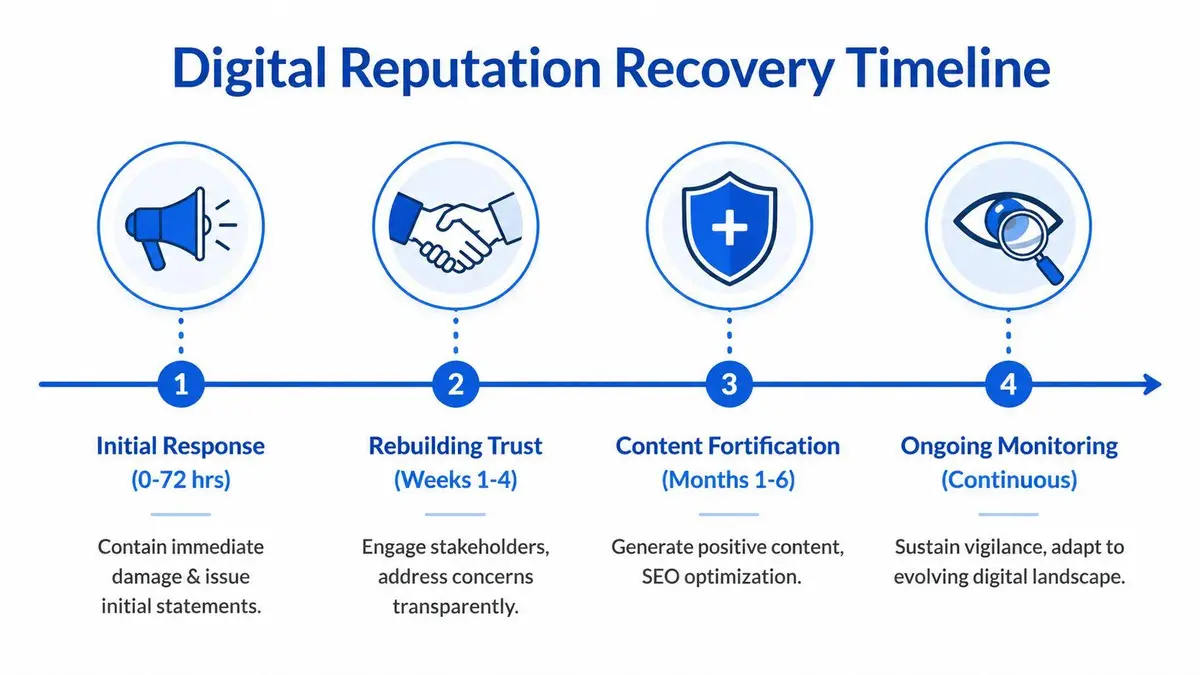
A crisis isn’t over when the headline fades. It’s over when hostile material stops resurfacing, search results stop reinforcing the attack, and stakeholders stop discovering the event as the first thing they learn about you. That takes months of coordinated work, sometimes longer.
Organizations frequently fail here because they treat removal, search remediation, and monitoring as separate projects. They aren’t. They’re one system. If you remove a harmful page but leave derivative commentary untouched, search will refill the gap. If you publish positive content without fixing indexing issues, the bad material remains dominant. If you suppress visibility but don’t monitor for reposts, the problem reappears under a new URL.
Recovery depends on building a cleaner search environment
Search is where reputation becomes durable. A social flare-up is painful. A branded search page that keeps introducing the issue to customers, investors, employers, or counterparties is worse.
That means long-term remediation usually combines three strands of work:
- Source reduction: Continue removing original and duplicate content where legal or policy grounds exist.
- Search restructuring: Push favorable, accurate, and authoritative assets into the results that matter most.
- Narrative reinforcement: Publish content that reflects current reality, not the worst moment of the crisis.
A practical legal perspective also helps when allegations are false rather than merely damaging. This discussion of false accusations legal insight is useful because it shows why reputation recovery often requires both evidentiary discipline and legal framing, not just image repair.
Reuploads are the hidden failure point
Post-crisis recovery is undermined when removed content returns. A 2025 Forrester report noted that 75% of removed harmful content reappears within 6 months without sophisticated monitoring, according to BDB Law’s discussion of online reputation crisis response. That’s why any serious recovery plan includes reupload prevention, duplicate detection, and ongoing alerts.
Many generic ORM campaigns frequently fall short. They focus on burying results with fresh content and hope the issue doesn’t come back. That approach can work against dated criticism or low-energy negative press. It doesn’t work reliably against leaks, revenge posts, copied media, impersonation, or coordinated harassment.
If harmful material was valuable enough for someone to publish once, assume they or someone else will publish it again.
Treat recovery as reputation fortification
The strongest recoveries don’t just erase traces. They establish a more resilient digital footprint than the client had before the event.
That means tightening account security, cleaning stale profiles, consolidating official biographies, improving executive websites, updating press pages, and ensuring that accurate owned assets can outrank or displace weaker third-party material. It also means monitoring image search, social clones, review ecosystems, and forum references, not just Google web results.
A useful internal framework is to ask four questions every month after the crisis:
| Recovery question | Why it matters |
|---|---|
| What harmful assets are still live? | Removal work is rarely finished after one round |
| What negative search results remain visible? | Discovery risk often shifts from social to search |
| What new authoritative content have we published? | Suppression requires credible alternatives |
| What is being reposted or mirrored? | Recurrence is often the real long-tail threat |
Recovery isn’t cosmetic. It’s structural. Done properly, it turns a public vulnerability into a managed and monitored risk.
Navigating Jurisdictional and Legal Complexities
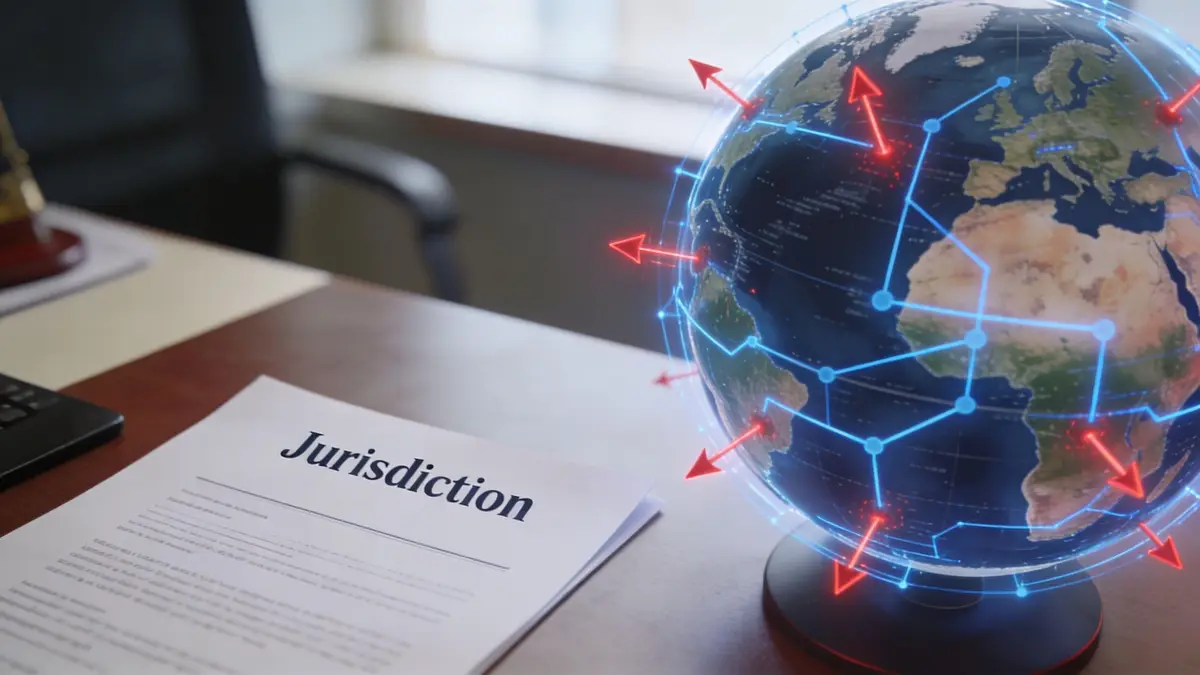
Online attacks ignore borders. Legal remedies don’t. That mismatch is where many internal teams stall.
A post can originate from one country, be hosted in another, target an executive in a third, and rank globally in search results. Your general counsel may be excellent at employment, M&A, litigation, or regulatory matters and still be the wrong person to lead digital takedown strategy. This work sits at the intersection of platform rules, privacy law, intermediary immunity, defamation standards, and technical enforcement.
A 2025 study found that 68% of high-net-worth individuals face persistent negative search results, yet only 22% remove them successfully without specialized services because jurisdiction-specific takedown strategy is often misunderstood, particularly around US Section 230 and EU GDPR, as noted in the International Journal of Progressive Research in Communication study. That gap is exactly why standard legal responses often fail.
Why US and EU approaches diverge
In the United States, Section 230 often shields platforms from liability for user-generated content. That doesn’t make removal impossible, but it changes the pressure points. You may need to focus on the original speaker, policy violations, evidentiary packages, or court-backed relief rather than exclusively threatening the platform.
In parts of Europe, privacy law can create stronger grounds for removal or de-indexing, especially where the material is outdated, inaccurate, excessive, or no longer relevant. But those rights are not automatic, and they don’t apply uniformly across every type of content or every subject.
The practical implication is simple. A lawyer who files the same demand letter everywhere is not doing strategy. They’re doing theater.
Anonymous posters and cross-border enforcement
Anonymous attacks create a different problem. Before you can sue, negotiate, or force compliance, you may need to identify the actor. That can involve subpoenas, platform disclosure requests, preservation demands, and jurisdictional analysis about where proceedings should even begin.
Even then, a favorable order is not always the end of the matter. You still need the order translated into platform action, host compliance, or search de-indexing. Some actors also migrate quickly between hosts, clone domains, or offshore infrastructure once they sense pressure.
That’s why legal analysis has to be paired with technical follow-through. If your matter involves executive-targeted smear content, this overview of online defamation of character strategic content removal for executives is relevant because executive cases often require both litigation thinking and precise platform execution.
Choose remedies based on outcome, not tradition
A lot of clients instinctively ask, “Should we sue?” That’s the wrong first question. The better question is, “What outcome do we need fastest?”
Sometimes litigation is the right move, especially where there is serious falsehood, extortion, or repeat targeting. Sometimes litigation is too slow, too visible, or too geographically limited to solve the immediate exposure. In other matters, private demand, policy escalation, de-indexing, and search remediation achieve more practical relief with less collateral attention.
A useful decision framework looks like this:
- If the content is plainly unlawful or policy-violating, pursue rapid platform and host action.
- If the content is false but framed as opinion, assess whether litigation will clarify or amplify.
- If search visibility is the main harm, combine legal pressure with de-indexing and suppression strategy.
- If private or intimate material is involved, prioritize emergency removal and recurrence prevention over public argument.
Jurisdiction determines leverage. Leverage determines speed. Speed often determines whether the damage becomes permanent.
The Proactive Stance Reputation as a Strategic Asset
Most executives still treat reputation work as a reactive spend. That’s outdated. It misunderstands both the economics and the threat model.
A PwC 2025 CEO Global Pulse survey found that 84% of executives rank brand and reputation risk as their top external concern, and online reputation constitutes 63-80% of a company’s market value, while a single negative article on the first page of search results can deter 22% of potential business, according to this summary of 2025 online reputation statistics. If that’s where the value sits, reputation management isn’t cosmetic. It’s asset protection.
Prevention is cheaper than recovery
The companies and individuals who manage crises best usually started before the crisis existed. They had monitoring in place. They knew who would make decisions. They had spokesperson rules, platform escalation paths, and approved outside specialists. They understood what content about them already ranked, where vulnerabilities sat, and which assets they controlled.
A proactive posture usually includes:
- Continuous monitoring: Search, social, reviews, image use, impersonation, and unusual spikes in branded mentions.
- Digital asset control: Verified profiles, current executive bios, clean ownership of websites and public-facing channels.
- Prebuilt escalation paths: Legal, communications, technical takedown, and family or board notification trees.
- Regular drills: Enough rehearsal that people don’t improvise when the pressure is real.
Executives should think like risk managers
Reputation isn’t separate from revenue, deal flow, recruiting, investor confidence, or personal security. For founders and high-net-worth individuals, it also affects lenders, counterparties, schools, philanthropic roles, and family privacy. A compromised digital footprint creates friction everywhere.
That’s why I advise clients to treat online reputation crisis management the way they treat cyber readiness. Not because the disciplines are identical, but because the operational logic is the same. You identify exposure early, assign ownership, test response, and build systems that can function when people are stressed and facts are incomplete.
You can’t guarantee that no one will target you. You can decide whether they hit a vacuum or a prepared defense.
If you need immediate help, ContentRemoval.com handles confidential assessments for executives, public figures, family offices, and legal teams dealing with harmful search results, leaks, impersonation, false content, and fast-moving digital attacks. The right next step is a private review of what’s live, what can be removed, what can be de-indexed, and what needs legal escalation before the situation hardens.
Frequently asked questions
Should I issue a public statement as soon as a reputation crisis starts?
Not before the factual map is stable. If the source content is still live, indexed, and shareable, a statement can increase discovery by attaching your name and the allegation keywords to fresh crawlable pages. Preserve evidence, locate every copy, and start takedowns first; say less while facts are unstable and more when silence would read as indifference.
How do I tell whether an online attack is a real crisis or just noise?
Classify by spread, not by how offensive it feels. A single complaint with limited visibility is monitored and verified. Coordinated reposting, leaked documents, private media, impersonation, or negative content ranking in search all warrant immediate preservation and escalation, and an inbound press inquiry before facts are clear means the narrative is escaping.
Why does harmful content return after a crisis is contained?
Because removal, search remediation, and monitoring were run as separate projects. A cited 2025 Forrester figure puts reappearance of removed harmful content at 75% within six months without sophisticated monitoring. Recovery has to include reupload prevention, duplicate detection, and monthly review of what is still live, ranking, or being mirrored.