
Managing brand reputation is a digital risk discipline, not a communications function. It starts with an audit that sorts exposure into owned, earned, and hostile or unowned material, then builds proactive defenses, continuous monitoring with escalation thresholds, and an incident protocol that matches each threat to the right remedy: public response, suppression, or legal and technical removal.
Key facts
- Tag every audit item by asset type, search visibility, legal posture, and operational risk
- Critical severity covers NCII, deepfakes, extortion, active doxxing, and breach-related exposure
- Incident sequence: preserve evidence first, then containment, removal, visibility control, and public position last
- 41% of companies hit by a reputation crisis lose brand value and revenue within the first year, per New Media
Where ContentRemoval.com comes in. ContentRemoval.com works the removal side of this discipline: source takedowns, de-indexing, impersonation escalation, and monitoring for reuploads once a threat has been classified. Contact usually comes from the general counsel, the head of communications, or the family office running a principal’s affairs. A free 15-minute Exposure Scan maps what is removable, and the report is yours to keep. Get a Free, Confidential Exposure Scan or read how our reputation management work is done.
Your concern usually starts the same way. A board member forwards a search result you hadn’t seen. A client mentions a forum thread that contains half-truths and private details. A family office discovers impersonation accounts, scraped biographies, stale litigation references, or leaked material indexed under a principal’s name. By the time most firms call it a reputation issue, the problem has already crossed into security, legal exposure, and commercial risk.
That’s why managing brand reputation should be treated as a digital risk discipline. Public relations has a role, but it’s not the control layer. If false content is ranking, if confidential material is circulating, or if an impersonation campaign is gaining traction, you need evidence preservation, platform escalation, search de-indexing, takedown strategy, and response governance. You also need discretion. High-profile matters get worse when too many people improvise in public.
The mistake I see most often is category confusion. Teams treat every reputational threat as a communications problem. It isn’t. Some issues require a public answer. Some require search suppression. Some require removal at source, legal notices, and technical monitoring to stop reuploads. If you don’t separate those paths early, you lose time and multiply harm.
Establishing a Definitive Baseline Through a Digital Footprint Audit
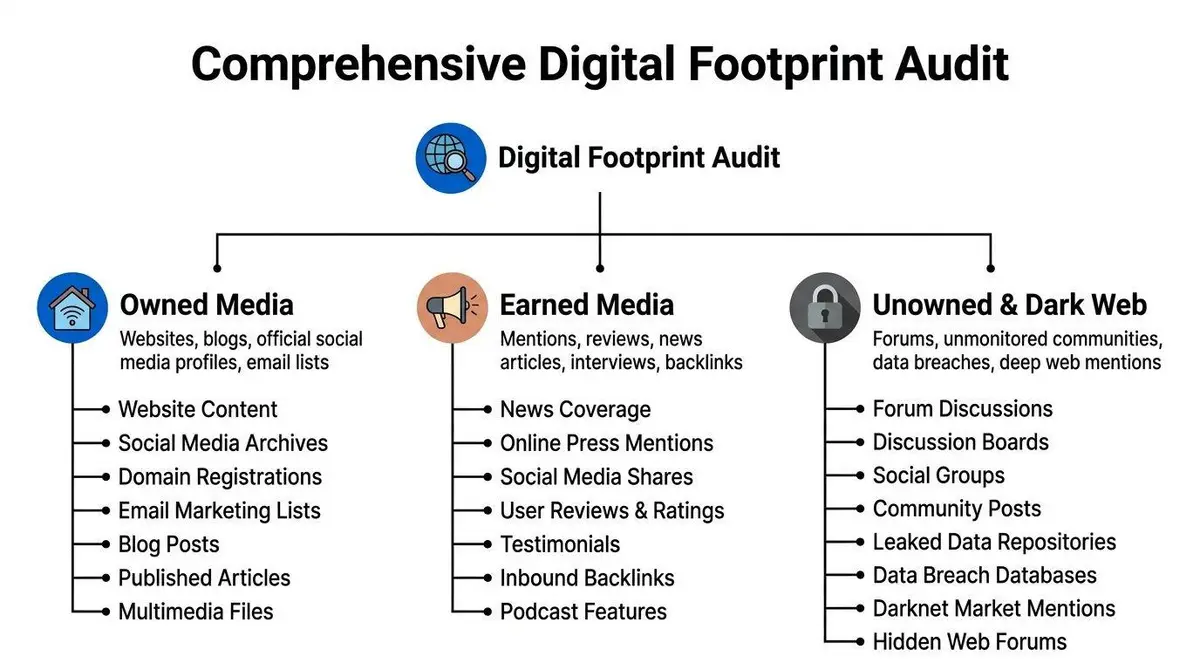
A proper audit is not a vanity exercise. It is the evidence file that tells you what you own, what others control, and what can injure you. The first cut is simple: owned media, earned media, and malicious or unowned exposure. Each category serves a different purpose, and each needs a separate review standard.
Owned media includes your websites, executive bios, investor pages, legacy microsites, official social profiles, newsletters, archived press releases, and any branded video or podcast channels. The objective here is control. You need to know whether your official assets are current, defensible, and structured to outrank low-quality third-party pages on searches tied to the company, products, and key people.
Earned media is different. It covers news coverage, interviews, backlinks, review profiles, directory listings, third-party podcasts, analyst references, and public commentary you did not publish. The objective is credibility and exposure mapping. Not all earned visibility is good visibility. Some mentions are favorable but outdated. Others are factually incomplete. Some become a problem only because they rank well.
The third category matters most in high-stakes matters. This is hostile or unowned exposure: impersonation accounts, false review clusters, copied content, leaked data, forum threads, mugshot pages, hacked material, doxxing posts, and references in spaces your communications team never monitors.
What the audit must capture
A surface-level search won’t do. A rigorous methodology starts with a thorough audit across digital channels to establish a baseline of sentiment and volume, then aligns stakeholders on brand values, as outlined by SOCi’s reputation management methodology.
Use a risk ledger, not a spreadsheet of links. Every item should be tagged by:
- Asset type whether it is owned, earned, anonymous, pseudonymous, or clearly malicious
- Search visibility whether it appears for brand terms, executive names, product names, or litigation-related queries
- Legal posture whether it is false, defamatory, privacy-invasive, infringing, manipulated, or merely unfavorable
- Operational risk whether it affects recruiting, fundraising, sales diligence, family privacy, or regulator perception
That ledger becomes your command document. Without it, teams debate optics while harmful material remains live.
Practical rule: If you haven’t catalogued the problem by ownership, search visibility, and legal removability, you are not managing reputation. You are reacting to headlines.
How to classify severity
Not every negative mention deserves escalation. Some reviews should be answered. Some articles should be contextualized. Some content should be removed without debate.
A simple triage model works:
| Severity | Typical examples | Primary action |
|---|---|---|
| Low | Fair criticism, isolated poor review, dated but accurate mention | Response, correction request, monitor |
| Medium | Repeating inaccuracies, hostile threads, misleading aggregation pages | Suppression, outreach, legal review |
| High | Impersonation, leaked private data, false criminal allegations, coordinated attacks | Preservation, takedown, de-indexing, counsel |
| Critical | NCII, deepfakes, extortion, active doxxing, breach-related exposure | Immediate legal and technical intervention |
The audit should also identify what needs strengthening. If your official footprint is thin, you are easier to attack. If executive profiles are inconsistent, impersonators have room to operate. If historical content is unmanaged, search engines will fill the gap with whatever is available.
For individuals and firms dealing with outdated, scattered, or privacy-exposing search results, a focused digital footprint cleanup assessment is often the right starting point. The point is not cosmetic polish. The point is to know exactly where the exposure sits before anyone chooses a remedy.
Building Proactive Defenses and Digital Fortification
Most reputational damage is expensive because the target had no buffer. They had weak ownership of search results, inconsistent brand assets, and too much personal data exposed in public systems. That is a preventable failure.
The right metaphor is not marketing. It is fortification. You build the perimeter before the siege. If you wait until hostile content ranks, fake profiles spread, or journalists are calling, every corrective action costs more and takes longer.

Control the first page before someone else does
Search results are not neutral. They are an exposure map. If your official website, leadership pages, verified social profiles, and authoritative third-party references do not dominate the first page for priority terms, you’ve left room for adversarial material to occupy valuable ground.
That doesn’t mean flooding the internet with fluff. It means building durable, credible assets tied to branded queries and executive names. Corporate profile pages, newsroom architecture, thought-leadership placements, verified knowledge sources, and properly structured biographies all help establish authority. For companies that need support on the visibility side, our search engine optimization services offer a useful reference point for how technical SEO and reputation defense intersect.
Many leadership teams become uncomfortable. They think proactive search strategy feels manufactured. It isn’t. It is basic defensive positioning. If a false article appears tomorrow, the strength of your existing assets will determine how much room it has to spread.
Standardize every approved asset
Inconsistency creates reputational drag. It also creates legal and security problems. A key technical specification for success is integrating Digital Asset Management software to maintain a single library of approved assets, ensuring consistency that correlates with stronger brand identity and reduced reputational risk, as noted in Bazaarvoice’s brand reputation analysis.
That matters more than most boards realize. If there are six versions of the CEO biography, three outdated logos, conflicting company descriptions, and unmanaged local pages, you don’t just look disorganized. You increase the chance that incorrect information spreads and that fake content appears plausible.
A serious DAM discipline should govern:
- Executive identity assets headshots, biographies, speaking credentials, approved company descriptions
- Corporate statements boilerplate language, legal descriptions, approved product summaries
- Crisis-use materials logos, fact sheets, executive backgrounders, media response templates
Approved assets are not a branding nicety. They are evidence-grade source material for platforms, journalists, counsel, and internal teams during disputes.
Reduce personal exposure before it is weaponized
The softest target in any reputational attack is usually publicly available personal data. Home addresses, relatives’ names, old phone numbers, shell company records, event registrations, and leaked credentials can all be stitched into a harassment or impersonation campaign.
This part of managing brand reputation belongs alongside executive protection and privacy review. Remove unnecessary personal exposure where lawful. Limit stale biographies. Clean up abandoned profiles. Lock down forgotten domains and unofficial pages. Review who can publish on behalf of the brand. If key personnel are high profile, treat data minimization as a standing control.
Firms that skip these steps often spend months trying to clean up a problem that should have been hard to launch in the first place.
Implementing Continuous Monitoring and Threat Intelligence
An audit gives you a snapshot. Monitoring gives you time. That distinction matters because most damaging incidents don’t begin as major incidents. They begin as weak signals: a new alias on a forum, a copied image on a fringe site, a sudden pattern of review hostility, or a mention tied to a misspelled executive name.
Basic alerts still have a place. Google Alerts can help with broad mention tracking. But they are a crude net. They miss context, identity linkage, and many forms of abuse that sit outside conventional indexing. High-risk brands need a monitoring stack that separates ambient chatter from actionable threat intelligence.
What automation does well and where it fails
Automated monitoring is useful for scale. It can watch brand terms, executive names, product names, review platforms, and emerging discussion clusters across multiple channels. It can also surface anomalous changes in volume and identify repeated wording that may indicate coordinated attacks.
Human review is still decisive. Automated systems struggle with sarcasm, legal nuance, and adversarial behavior designed to evade detection. A fake review campaign doesn’t always announce itself. A smear post may avoid direct brand terms while remaining obviously identifiable to anyone who understands the context. That is why escalation cannot be delegated entirely to software.
The right operating model combines both.
| Function | Automation excels | Human review excels |
|---|---|---|
| Mention discovery | Broad scanning and alerting | Identifying what actually matters |
| Pattern detection | Spotting repetition and spikes | Distinguishing criticism from malice |
| Risk assessment | Flagging predefined triggers | Legal and reputational judgment |
| Escalation | Routing alerts quickly | Deciding who acts and how |
Build a threshold-based escalation model
Monitoring fails when everything becomes urgent. Set clear thresholds. Define what triggers legal review, what goes to communications, what requires executive notification, and what remains in observation.
A practical model should include named watchlists for:
- Principal identities company name, leadership names, common misspellings, product names
- Abuse indicators impersonation, leaks, private imagery, false allegations, copied content
- Commercial risk signals reviews, investor chatter, recruiting-related mentions, partner concerns
For teams refining the operational side of this work, optimising digital product performance is a useful read because the discipline of performance monitoring carries over well to alert design, threshold setting, and signal quality review.
Don’t measure monitoring by alert volume. Measure it by whether the right people receive the right alert early enough to act.
Treat monitoring as an intelligence function
A proper reputation monitoring program should produce decisions, not dashboards. That means validating identity, preserving evidence, recording URLs and timestamps, noting whether content is indexed, and assigning owners for next actions. If no one owns the alert after review, your system is decorative.
For organizations facing persistent exposure or recurrent attacks, a dedicated reputation monitoring workflow can formalize this process. The standard should be simple: detect early, verify quickly, escalate discreetly, and preserve the option to remove.
Executing the Incident Response Protocol
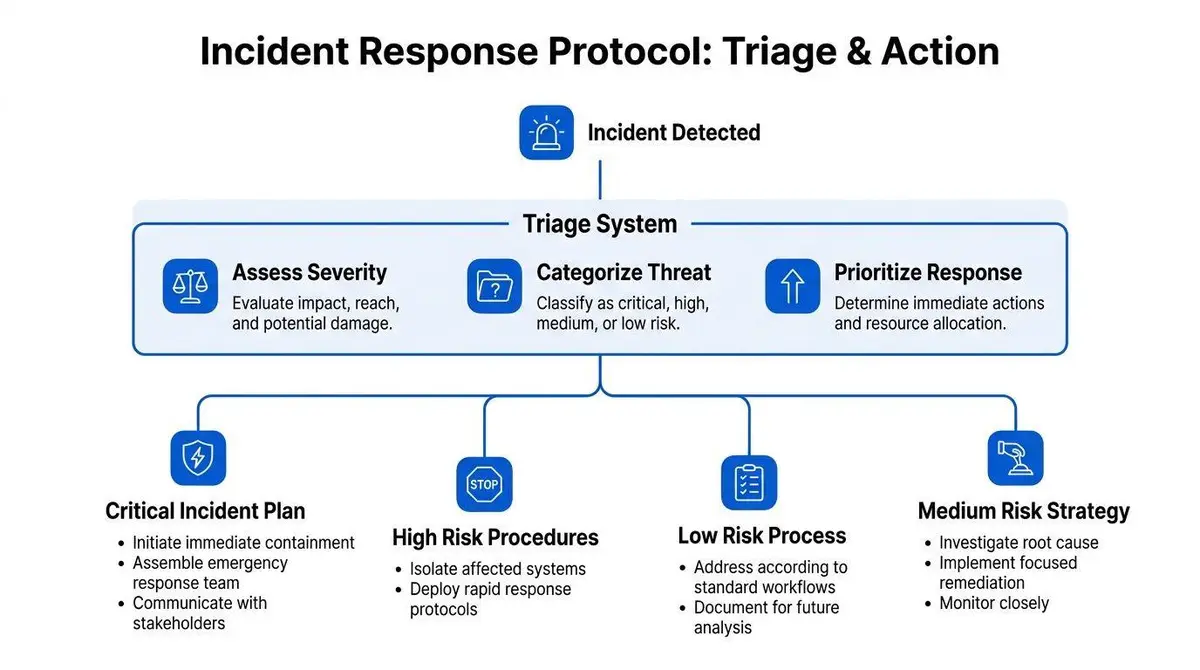
When an incident breaks, speed matters. So does discipline. The first question is not “What do we say?” The first question is “What is this, precisely?” If you misclassify the threat, you choose the wrong remedy and deepen the damage.
Use a decision matrix. Some issues belong in public response. Others belong in search suppression. The most serious require direct legal and technical action aimed at source removal, de-indexing, account takedowns, or preservation for court. Conventional reputation advice rarely addresses this gap. Yet harmful, false, or defamatory content often requires legal and technical removal mechanisms such as de-indexing or NCII takedowns, especially for high-profile clients, as discussed in Alchemer’s analysis of reputation management gaps.
A clean triage model prevents confusion.
Choose the response path
Here is the practical split:
| Threat type | Best first move | Avoid |
|---|---|---|
| Genuine negative review | Calm public response, operational fix, monitor spread | Legal threats, argument in public |
| False review cluster | Platform reporting, evidence file, pattern analysis, selective response | Treating each review as isolated |
| Defamatory article or post | Legal review, correction demand, de-indexing assessment, suppression support | Public overreaction that amplifies the claim |
| Impersonation account | Platform escalation, identity proof, handle recovery or removal | Informal outreach to the impersonator |
| NCII or intimate image abuse | Emergency takedown, legal notices, hash-based reupload monitoring where available | Negotiation with bad actors |
| Deepfake or manipulated media | Forensic preservation, platform reports, legal escalation, factual counterstatement if needed | Assuming audiences will “figure it out” |
The hardest calls usually involve mixed incidents. A data leak may also trigger false commentary. A defamatory article may be copied into forums and summarized by search results. A deepfake may spread through social accounts while image boards preserve the file. In those cases, one team cannot own the entire response.
Sequence matters more than volume
Do not start by posting everywhere. Preserve first. Capture URLs, timestamps, screenshots, source code where relevant, and indexing status. If there is leaked data, identify whether the source appears compromised or republished. If there is manipulated media, preserve the highest-quality instance and every material repost before issuing any challenge.
Then separate actions into parallel tracks:
- Containment through platform reports, account security review, and immediate search risk assessment
- Removal through takedown notices, rights assertions, privacy requests, and counsel-led demands
- Visibility control through suppression assets and corrections where source removal is slow
- Public position only if silence creates greater risk than acknowledgment
Specialist execution holds significance. A provider like ContentRemoval.com can be relevant when the incident involves breach-related search exposure, leaked materials, false reviews, impersonation, or content that needs de-indexing and source removal rather than mere rebuttal.
A short briefing for internal stakeholders should answer four points only: what exists, what is provable, what action has begun, and who is authorized to speak.
To see how response logic works in practice, this overview is useful:
Legal and technical remedies are not optional add-ons
PR cannot remove intimate imagery. It cannot de-index defamatory search snippets. It cannot stop a copied article from resurfacing on scraper domains. Legal and technical remedies are the operational core for serious incidents.
That means knowing which route applies:
- Defamation pathways where factual falsity and harm can be articulated clearly
- Privacy-based removals for exposed personal data and invasive content
- Copyright or rights-based notices where owned material is reproduced unlawfully
- Platform policy enforcement for impersonation, manipulated media, fake reviews, and harassment
- Search de-indexing requests where lawful grounds exist and source removal is delayed or impossible
The public statement is often the smallest part of the response. The real work happens in evidence, platform procedure, and jurisdiction-specific removal strategy.
Measuring Performance and Sustaining Long-Term Resilience
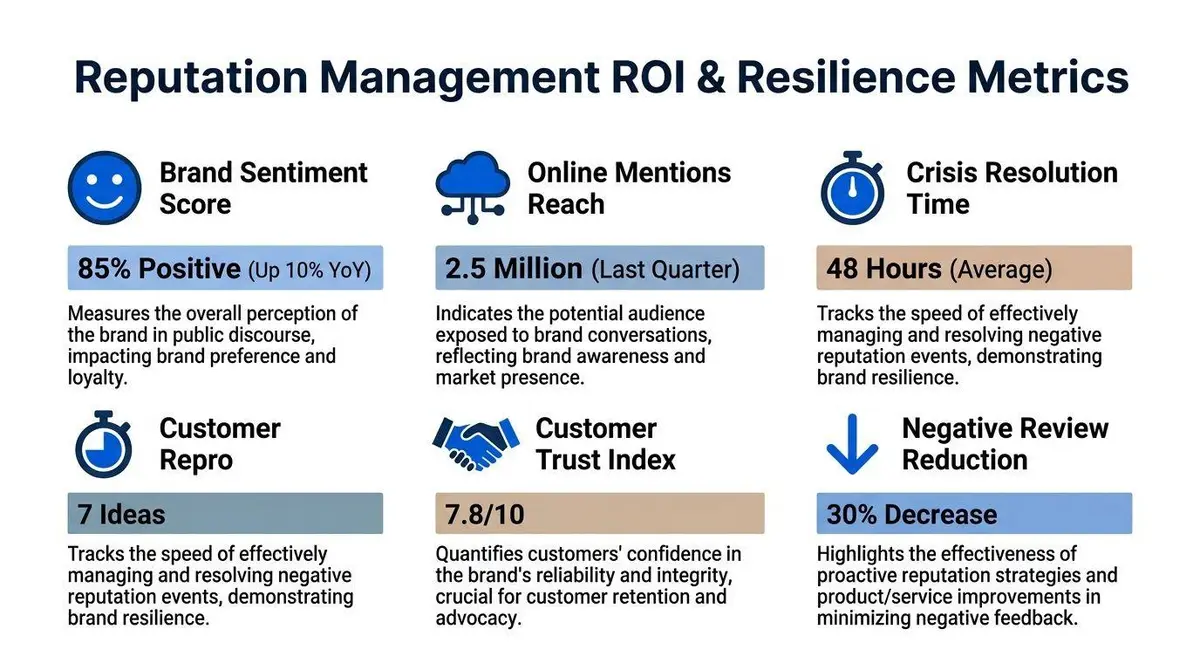
Executives don’t need more dashboards. They need proof that the exposure is shrinking, the brand is harder to damage, and commercial risk is being reduced. The wrong metrics make reputation work look cosmetic. The right ones connect directly to visibility, removability, and revenue protection.
One fact should settle the budget debate. 41% of companies that experience a reputation crisis see a direct loss of brand value and revenue within the first year, according to New Media’s reputation management statistics. That is why managing brand reputation belongs in risk management, not as an afterthought inside marketing.
Measure outcomes, not activity
Start with search and exposure control. How many harmful results remain visible for priority queries? How many were removed at source? How many were de-indexed? How quickly did new incidents get detected and classified? Those are outcome metrics.
Then examine business effects. Are clients raising fewer due-diligence concerns? Are executives encountering fewer hostile search results before meetings? Is inbound interest less disrupted by stale or false content? These questions sound qualitative, but they are often the cleanest indicators of practical improvement.
Use a scorecard like this:
| Domain | Strong metric | Weak metric |
|---|---|---|
| Search control | Harmful result reduction for priority queries | Raw content volume published |
| Incident handling | Time from detection to verified action | Number of alerts received |
| Removal success | Source takedown and de-indexing completion | Number of emails sent |
| Commercial impact | Fewer diligence objections, fewer escalations from stakeholders | Social likes and impressions |
Build a reputational moat
The strongest programs become less reactive over time. They build a moat around the brand. That moat consists of better owned assets, stronger governance, lower personal data exposure, repeatable legal workflows, and disciplined monitoring.
This is also where selective channel analysis helps. For social-heavy brands, tools used for audience quality and interaction review can offer context when engagement patterns shift. Something as simple as the Insta Peeka engagement tool can help teams spot whether visibility changes are coming from genuine audience behavior or from low-quality attention that deserves closer scrutiny.
The long-term objective is straightforward. Fewer surprises. Faster triage. Cleaner search results. Less vulnerability to copycat attacks, fake profiles, and stale content resurfacing at the worst moment.
A resilient reputation is not one that never gets attacked. It is one that is difficult to distort, quick to defend, and costly for adversaries to exploit.
The companies and principals who handle this well stop asking whether reputation work is worth it. They start asking whether every other risk function is operating with the same discipline.
If harmful search results, false reviews, impersonation, leaked material, or privacy-invasive content are already affecting your name or business, a confidential assessment with ContentRemoval.com is the sensible next step. The firm works on discreet removal, de-indexing, monitoring, and escalation strategy for executives, public figures, legal teams, and high-risk brands that need action, not general advice.
Frequently asked questions
What should a brand reputation audit include?
It should sort every item into owned media, earned media, and hostile or unowned exposure such as impersonation accounts, false review clusters, leaked data, and mugshot pages. Each item is then tagged by search visibility, legal posture, and operational risk so the team knows what to answer, what to suppress, and what to remove.
How do you respond to an impersonation account for an executive?
Escalate through the platform with identity proof and pursue handle recovery or removal, rather than contacting the impersonator informally. Preserve URLs, timestamps, and screenshots before filing, and claim executive profiles on platforms they do not use so impersonators have less room to operate.
Can PR handle a defamatory article or leaked material?
No. PR cannot remove intimate imagery, de-index a defamatory snippet, or stop a copied article resurfacing on scraper domains. Those need defamation pathways, privacy-based removals, copyright notices, platform policy enforcement, or search de-indexing requests, with the public statement often the smallest part of the response.