
A leak detection service for digital exposure is the disciplined identification and tracking of unauthorized disclosure of private information, confidential business material, images, video or intellectual property. It answers five questions fast: what escaped, where it lives, how far it spread, who controls each node, and what pressure is available, then moves to source removal, de-indexing and monitoring for reuploads.
Key facts
- Digital leak detection covers public websites, search results, social platforms, image matching, code repositories and non-public channels.
- A single alert is validated against repost patterns, search indexing, metadata changes and account behavior before escalation.
- Engagement models are monthly monitoring retainers, project-based incident response, or a hybrid of the two.
- Personal triggers include private images surfacing, doxxing, a blackmail demand or impersonation gaining traction.
Where ContentRemoval.com comes in. ContentRemoval.com handles the digital side of a leak for executives, founders, public figures and family offices: verifying what escaped, tracing where it has spread, removing it at source, pushing de-indexing where the host resists, and watching for reuploads. The chief of staff, security adviser or counsel usually makes the first call when a screenshot or forum thread has just surfaced. A free 15-minute Exposure Scan maps every copy that is removable, and the report is yours to keep. Get a Free, Confidential Exposure Scan or read how our leaked content removal work is done.
At 6:10 a.m., your chief of staff says there’s been a leak. You don’t yet know whether that means water under a slab in a residence, a compromised file from a transaction room, private images posted to a forum, or internal documents circulating where they shouldn’t. The word is the same. The exposure is not.
That ambiguity is where expensive mistakes begin. A physical leak threatens property, infrastructure, and continuity. A digital leak threatens control, influence, privacy, and reputation. One calls for acoustic correlators, thermal imaging, and moisture confirmation. The other calls for intelligence collection, verification, legal containment, and persistent monitoring across public and non-public channels.
If you’re a visible executive, founder, public figure, or advisor to one, the first decision is simple. Don’t hire a generalist because the problem uses familiar language. Hire the discipline that matches the leak.
Understanding the Anatomy of a Modern Leak
A physical leak is concrete. Water escapes. Materials absorb it. Damage spreads through walls, floors, insulation, and equipment. Utilities and facilities teams have treated this as a serious operational threat for years because the scale is obvious. The U.S. loses about 2 trillion gallons of treated drinking water every year from water main breaks and undetected leaks, according to the U.S. Department of Energy summary of leak-detection technologies.
A digital leak is harder to read in the first hour. The damage may be invisible while it’s already circulating. A copied contract, private image set, customer list, litigation memo, or draft announcement can move through messaging apps, search indexes, social platforms, code repositories, mirror sites, or dark web listings before anyone inside your organization confirms what happened.
The first call is usually wrong
Most clients initially frame the issue too narrowly. They ask, “Can you remove this post?” when the underlying question is, “Where else has this spread, who has it, and what legal and technical pressure points exist right now?”
That’s the distinction. A leak is not the file, image, or post you’ve found. It’s the full path of unauthorized disclosure.
A visible item online is rarely the beginning of the problem. It’s usually the first sign that the problem has already moved.
The same discipline applies in physical settings. A stain on drywall isn’t the leak. It’s evidence of a leak. Digital exposure works the same way. The screenshot, forum thread, or indexed result is evidence of a broader event.
Why leaders get this wrong under pressure
Executives are trained to triage quickly. That’s useful until speed turns into category error. They call a plumber for a data problem, or a cybersecurity vendor for a reputational dissemination problem. Neither solves the entire exposure.
If your concern is broader digital visibility, search persistence, impersonation, leaked media, or personal information spread, start with a disciplined assessment of your digital footprint cleanup options. That’s often the difference between a contained incident and a long-tail reputational problem that keeps resurfacing.
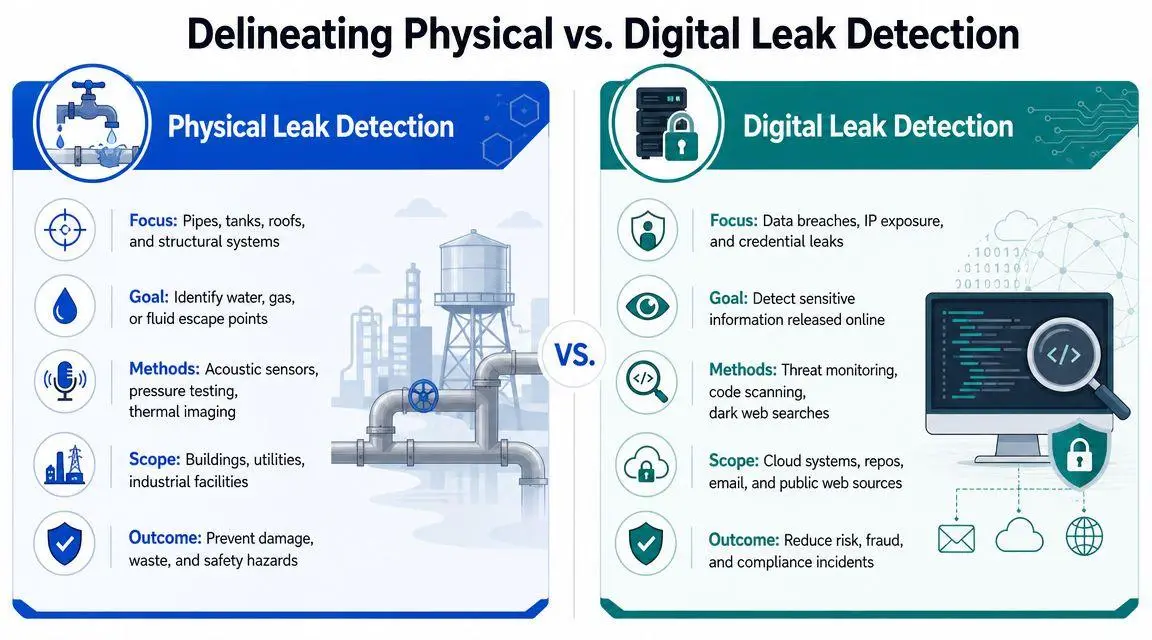
Delineating Physical and Digital Leak Detection
Physical leak detection is a mature service category. It exists because buildings, pipelines, and municipal systems fail in predictable ways and require specialized tools to locate hidden faults without tearing everything apart. In the United States, the physical water leak detection and repair services market was valued at USD 347.4 million in 2022, according to Grand View Research’s market report. That market exists because leak location is technical, urgent, and expensive to ignore.
What a physical leak detection service actually does
For water and building issues, reputable providers usually combine methods rather than trusting one instrument. Acoustic microphones and correlators help with pressurized lines. Infrared thermal imaging can screen for temperature anomalies behind walls or under floors. Tracer gas helps with concealed piping. Moisture measurement confirms the extent of impact.
That combination matters because each tool has limits. Acoustic detection works well when escaping fluid generates measurable vibration or noise. Thermal imaging is useful when there’s a real temperature differential. Moisture meters confirm, but they don’t independently explain cause.
A concise comparison makes the point:
| Dimension | Physical leak detection | Digital leak detection |
|---|---|---|
| Primary target | Pipes, valves, slabs, walls, infrastructure | Files, images, credentials, communications, proprietary content |
| Core tools | Acoustic correlators, thermal imaging, tracer gas, moisture meters | Monitoring systems, human investigation, web intelligence, platform enforcement |
| Proof standard | Confirm leak location before repair | Confirm spread, source, copies, and legal takedown path |
| Immediate objective | Stop water or gas loss, limit structural damage | Stop dissemination, remove visibility, preserve leverage |
What digital leak detection really means
Digital leak detection is not IT help desk work and it’s not ordinary brand monitoring. It is the disciplined identification and tracking of unauthorized exposure involving private information, confidential business material, intellectual property, images, video, or narrative content that can harm the subject if left in circulation.
The objectives are different from plumbing. You are trying to answer five questions fast:
- What escaped: Is it personal data, internal strategy, copyrighted media, deal material, or fabricated content packaged as a leak?
- Where it lives: Public websites, social platforms, search results, messaging channels, repositories, forums, or dark web venues.
- How far it has spread: Original post, reposts, mirrors, screenshots, scraped copies.
- Who controls the nodes: Platform operators, anonymous users, hosts, indexers, intermediaries.
- What pressure is available: Contractual, copyright, privacy, defamation, impersonation, court-backed, or negotiated removal.
If you’re selecting support in this category, prioritize providers that understand both exposure mapping and online privacy service options for sensitive cases. A plumber can find the source of moisture. A digital leak specialist has to find the source, the copies, the distribution path, and the pressure points to shut it down.
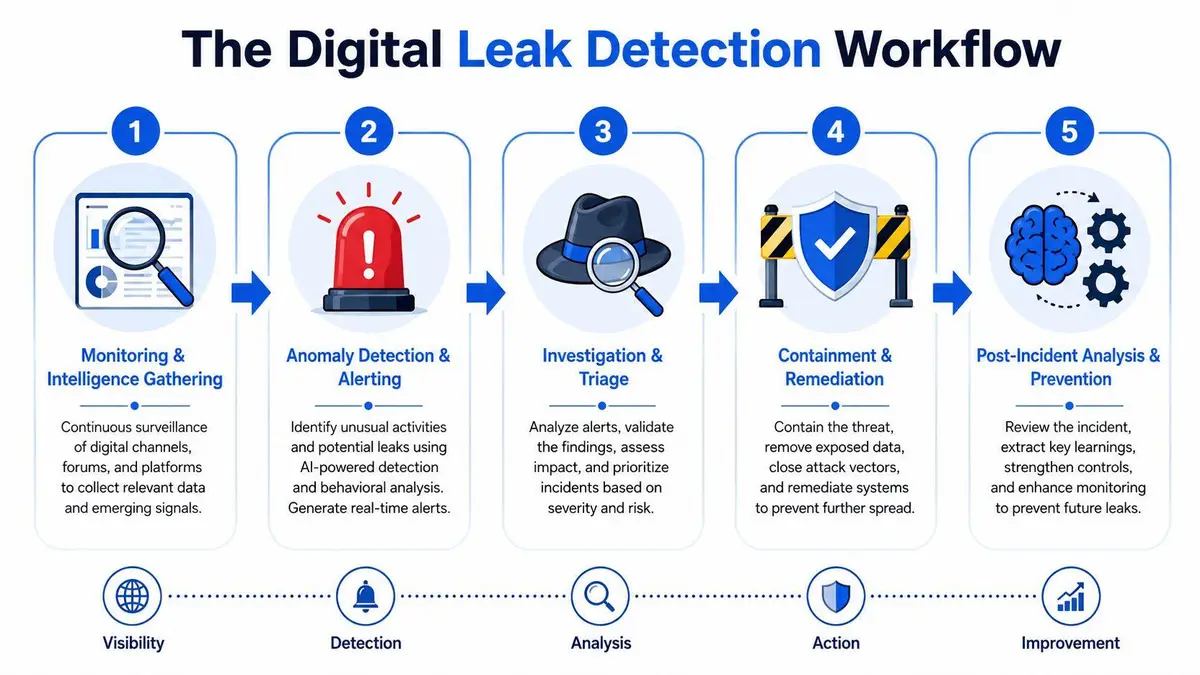
The Digital Leak Detection Workflow
Digital leak detection should run like an intelligence operation, not a customer support ticket. The workflow is continuous, layered, and skeptical of first impressions. A single alert means very little until someone verifies context, severity, and propagation.
Monitoring and anomaly detection
The first stage is persistent monitoring. That includes public websites, search results, social media surfaces, image matching environments, code repositories, and channels where sensitive material often appears before mainstream discovery. The point is not to collect noise. The point is to identify anomalies that deserve human scrutiny.
Industrial pipeline systems offer a useful analogy. More advanced leak monitoring can use Extended Real-Time Transient Model methods to analyze a leak “signature” against a fingerprint database before triggering an alarm, which can reduce false alerts compared with simple thresholds, as described in the Wikipedia overview of leak detection. Digital work should follow the same principle. One mention or one upload isn’t enough. Corroboration matters.
Practical rule: Don’t escalate on a single signal alone. Validate against adjacent indicators such as repost patterns, search indexing, metadata changes, and account behavior.
Investigation and triage
Once a signal appears, a professional team has to determine whether it is authentic, manipulated, stale, already mirrored, or part of a larger campaign. Inexperienced vendors often waste time at this stage. They search the obvious platform, ignore the copies, and miss the operator behavior around the leak.
The triage questions are blunt:
- Is the material genuine or synthetic
- Does it expose personal, commercial, or legal risk
- Can the source still be contained
- What jurisdiction or platform rules matter first
- What must be preserved as evidence before removal efforts start
In regulated or professional settings, this analysis also needs policy awareness. Healthcare organizations, for example, face social posting risks that don’t look like conventional breaches until the material is already public. Guidance on how to prevent social media HIPAA breaches is useful because it shows how ordinary publishing behavior can become a leak event.
Containment, remediation, and continued watch
Once the facts are clear, strategy follows. Some incidents need immediate takedown requests. Others require evidence preservation, staged outreach, de-indexing pressure, and monitoring for re-uploads before any direct contact is made.
Basic alert software falls short. Monitoring tells you something happened. It doesn’t tell you what to do next. Effective response combines technical surveillance with legal judgment and disciplined reputation monitoring for recurring exposure. Without that final layer, a leak may disappear briefly and then return through mirrors, screenshots, or commentary that becomes more durable than the original post.
Critical Triggers for Engaging a Detection Service
Delay is a frequent problem. Affected parties often call after the story hardens, after search results index, after copies proliferate, or after an adversary realizes the subject is disorganized. That delay is avoidable.
For physical property, delay has a familiar cost. Household leaks in the United States waste nearly 1 trillion gallons of water annually, and an average home can waste about 10,000 gallons per year from leaks, as noted in ACS Underground’s discussion of leak detection economics. The analogy is useful because small digital exposures behave the same way. Left unattended, they turn into structural reputation damage.
Personal triggers
If you are the principal, not the company, engage a detection service immediately when any of the following appears:
- Private images or messages surface online: Especially where reposting, extortion, or non-consensual sharing is involved.
- Doxxing begins: Home address, family details, travel patterns, or personal contact data start circulating.
- You receive a blackmail demand: At that point, the issue is not hypothetical. Someone believes they have a hold over you.
- Impersonation gains traction: Fake accounts, fabricated statements, or manipulated material begin to travel under your identity.
If someone else controls the timing of disclosure, you already have a live risk event.
Corporate triggers
Companies miss early warning signs because they misclassify them as “internal issues.” That’s a mistake. These events require immediate external exposure mapping:
- Pre-release product material appears outside approved channels
- M&A documents, board materials, or investor communications circulate unexpectedly
- Customer or employee data is offered, traded, or sampled
- Trade secrets show up in a competitor-adjacent environment
- Internal strategy documents are weaponized in a smear or pressure campaign
If you want a simple contrast with physical trades, review what Sydney leak specialists do in the built environment. Their job is to isolate the source with minimal destruction. The digital equivalent is broader and more demanding. You’re not just finding the leak. You’re identifying dissemination, preserving evidence, and deciding whether to remove, suppress, negotiate, or litigate.
The wrong threshold
Clients often ask whether the issue is “serious enough” yet. That’s the wrong threshold. The right threshold is whether delay improves your position. In digital leak matters, it usually doesn’t.
Vendor Selection Checklist and Cost Structures
A leak detection service is not interchangeable with a cybersecurity scanner, a PR firm, or a law office that sends generic notices. You need an operator that can verify exposure, act under pressure, and protect confidentiality while decisions are still reversible.
What to test before you engage anyone
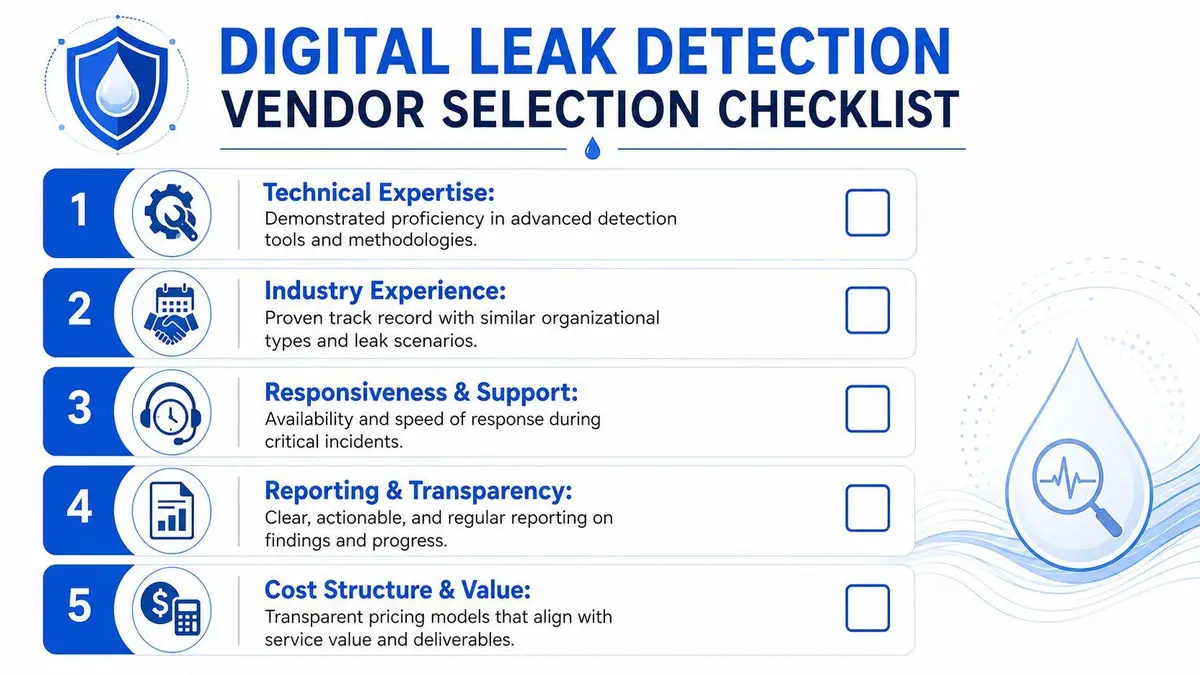
Use this checklist. If a vendor cannot answer these questions directly, move on.
- Technical capability: Can they monitor across open web, search, social platforms, image-based environments, and non-public channels relevant to your risk profile?
- Human verification: Do analysts review context, or does the firm rely on automated alerts that flood you with noise?
- Legal execution: Can they support copyright, privacy, impersonation, defamation, and platform-specific enforcement without improvising?
- Confidential handling: Do they use strict intake controls, restricted communications, and disciplined evidence management?
- Re-upload strategy: Can they keep watching after the first removal, or do they disappear once the initial ticket closes?
A serious provider should also explain what they won’t do. That’s a mark of competence. Overpromising means they don’t understand platform control, jurisdiction, or the realities of mirrored content.
How cost structures usually work
There is no single universal pricing model because the work differs by urgency, visibility, and legal complexity. But the structures are predictable.
| Cost structure | Best for | What you should expect |
|---|---|---|
| Monthly monitoring retainer | Ongoing executive or brand protection | Continuous scanning, alerting, analyst review, recurring reporting |
| Project-based incident response | A live leak or newly discovered exposure | Rapid assessment, containment strategy, takedown and de-indexing actions |
| Hybrid engagement | High-risk principals with episodic flare-ups | Baseline monitoring plus surge response when incidents break |
The most honest vendors explain the operational inputs. Scope drives cost. So do urgency, number of platforms involved, language requirements, evidence review burden, and whether legal process is needed.
If you’re evaluating the infrastructure side of online investigation, it helps to understand how network access is sometimes priced in adjacent technical markets. Reviewing residential proxy pricing won’t tell you what a leak detection engagement should cost, but it does illustrate why persistent, geographically flexible online monitoring isn’t a zero-cost backend function.
What to avoid
Avoid firms that lead with dashboards, vanity screenshots, or vague promises of “internet cleanup.” A dashboard is not a strategy. Also avoid any vendor that treats your matter like ordinary social listening. Leak detection is adversarial. The subject matter may be stolen, defamatory, private, or legally sensitive. That requires discretion, not marketing analytics.
From Detection to Remediation and Monitoring
Detection is the start. Remediation is the point. If a provider can find exposed material but can’t remove it, suppress its visibility, or monitor for recurrence, you’ve hired a spotter, not a solution.

Source removal comes first when possible
The best outcome is usually direct source removal. That means the original hosting page, post, account, file listing, or marketplace entry is taken down. The mechanism depends on the facts. Copyright claims may support DMCA notices. Privacy violations may justify platform complaints or legal demands. Impersonation, harassment, and defamation each require different framing and evidence.
This step requires precision. A sloppy notice can warn the uploader, trigger reposting, or harden the operator’s resistance. A good operator sequences action carefully.
De-indexing matters when source control is incomplete
Sometimes you can’t remove the original material quickly, or at all. Then you reduce discoverability. Search de-indexing becomes critical because many leak events become significantly damaging only when they’re easy to find by name, company, or image query.
Use a simple decision table:
| Scenario | Priority action |
|---|---|
| Original file is removable | Take down source first, then watch for copies |
| Original file is stubborn but searchable | Push de-indexing while building pressure on the host |
| Material is mirrored widely | Triage the highest-visibility nodes, then run sustained monitoring |
| Anonymous adversary keeps reposting | Combine enforcement with recurrence tracking and evidence preservation |
Removal without monitoring is temporary relief. It isn’t control.
Monitoring after the fix
Re-uploads are common because bad actors test whether the target has stamina. They post again under a variant filename, a new account, a forum mirror, or a cropped image. That’s why post-incident monitoring isn’t optional.
A proper leak detection service keeps watching for the same asset, related language, derivative copies, and secondary commentary that links back to the original material. In many cases, the commentary creates a new exposure that must be handled on its own terms.
The client’s objective is straightforward. Regain control of visibility, reduce discoverability, preserve legal options, and prevent recurrence.
Achieving Long-Term Digital Sovereignty
Leak detection is often perceived as an emergency purchase. That view is too narrow. For high-profile individuals and exposed organizations, it is part of permanent risk control.
Digital sovereignty means you know what’s circulating about you, what can be weaponized, where it appears first, and how fast you can act when something escapes. It also means your response is not improvised by whoever happens to answer the phone that day. The process is already defined. Monitoring is active. Evidence handling is disciplined. Legal and platform pathways are mapped before the next incident lands.
Three habits separate controlled environments from chaotic ones:
- Persistent visibility: not occasional searches, but active monitoring calibrated to your real threat profile.
- Fast verification: human review that distinguishes noise from an actionable leak.
- Repeatable remediation: proven workflows for source removal, de-indexing, negotiation, and recurrence control.
That is the modern standard. Not panic response. Not vague brand protection. Not generic cyber language.
If the issue on your desk involves water in a wall, call the right physical specialist. If it involves leaked content, private data, reputational exposure, or unauthorized dissemination online, use a leak detection service built for digital harm. The name is shared. The discipline is not.
If you need a discreet assessment of a suspected digital leak, ContentRemoval.com provides confidential guidance for executives, public figures, family offices, and brands facing high-stakes exposure. The firm handles source removal, de-indexing, leak tracing, dark web monitoring, and long-term reputation protection with the speed and operational discipline these matters require.
Frequently asked questions
What is the difference between digital leak detection and ordinary brand monitoring?
Brand monitoring collects mentions. Digital leak detection is adversarial work that identifies unauthorized exposure of private data, confidential documents or media, verifies whether it is genuine or synthetic, maps mirrors and reposts, and identifies the platform, host or legal route that can shut it down. A dashboard alone is not a strategy.
When should I hire a leak detection service?
As soon as private images or messages surface, doxxing begins, a blackmail demand arrives or impersonation gains traction. For companies, the triggers are pre-release material, M&A or board documents, customer or employee data, or trade secrets appearing outside approved channels. The article’s threshold is whether delay improves your position, and in digital matters it usually does not.
What should I check before choosing a digital leak detection vendor?
Whether they monitor across open web, search, social, image-based and non-public channels, whether analysts review context rather than flooding you with automated alerts, whether they can execute copyright, privacy, impersonation and defamation enforcement, how they handle confidentiality and evidence, and whether they keep watching for reuploads after the first removal.