
International reputation management for executives and family offices is a removal, jurisdiction and speed problem rather than a messaging exercise. The work is to classify the threat as defamation, impersonation, leak or negative press, pick the strongest jurisdiction, preserve evidence before contact, target the right intermediary among publisher, host, platform, registrar and search engine, and pursue urgent de-indexing first.
Key facts
- Cross-border removal means reconciling conflicting laws, such as GDPR in Europe against First Amendment protections in the US.
- EU privacy and data rights offer stronger de-indexing routes for outdated or excessive content than US law.
- Defamation campaigns replicate across blogs, complaint sites and repost networks, so mirrors must be mapped.
- A lawful but damaging article may stay online in one jurisdiction yet be de-indexable in another.
Where ContentRemoval.com comes in. ContentRemoval.com handles cross-border takedowns, de-indexing, impersonation removal and reupload monitoring for executives, public figures and family offices whose advisers are split between PR, local counsel and a monitoring vendor. The family office, general counsel or chief of staff usually makes contact when content is indexed in a country where nobody on the team has standing. A free 15-minute Exposure Scan maps what is removable and in which jurisdictions, and the report is yours to keep. Get a Free, Confidential Exposure Scan or read how our reputation management work is done.
A hostile article is indexed in a country where you don’t have local counsel. A fake profile is messaging investors in your name. Private images or internal documents are mirrored across multiple hosts, and each removal request seems to trigger a fresh repost somewhere else. Meanwhile, your board, family office, or management team wants a simple answer to a messy question: who can stop this?
Most advice on international reputation management fails at that exact point. It treats a live cross-border attack as a messaging problem. For high-stakes matters, it usually isn’t. It’s a removal problem, a jurisdiction problem, and a speed problem.
The distinction matters because passive monitoring doesn’t change search results, remove defamatory pages, or stop impersonation from spreading across platforms. It only tells you you’re under attack. For an executive, founder, public figure, or family office principal, that’s not enough. You need a response that combines legal analysis, platform process, search de-indexing, evidence preservation, and technical suppression where removal isn’t immediately available.
The Reality of a Borderless Crisis
A borderless reputation crisis rarely begins with a dramatic announcement. It usually starts with one asset. A search result. A forum thread. A review cluster. A copied article republished on a foreign domain. Then it spreads because every platform, search engine, and intermediary treats the content differently.
For clients with substantial personal or commercial exposure, the first mistake is often assuming influence travels internationally. It doesn’t. A strong domestic legal position may have little immediate effect against a host in another region, a platform applying a different policy standard, or a publisher that ignores correspondence. In that gap between harm and enforceability, reputational damage accelerates.
That is why this field has stopped being a narrow PR concern. The global online reputation management market reached $7.75 billion in 2026 and is projected to reach $14.01 billion by 2031, while 25% of a company’s market value is directly tied to its reputation, according to Mordor Intelligence market analysis on online reputation management. That number matters less as a market forecast than as a legal and commercial signal. Reputation now sits alongside capital structure, litigation exposure, and cyber risk as a board-level asset.
What the client is usually facing
In practice, cross-border matters tend to fall into a familiar pattern:
- A false or distorted narrative appears first: The material may be defamatory, selectively true, misleading by omission, or unlawfully disclosed.
- Search and social systems amplify it next: Third-party commentary, reposts, and screenshots create a second layer of harm that is harder to reverse.
- Advisers split into silos: PR proposes messaging, local counsel assesses one jurisdiction, and nobody owns the integrated removal strategy.
Practical rule: If harmful content is live, indexed, and spreading across jurisdictions, your first objective isn’t better messaging. It’s containment and removal where removal is legally or technically possible.
Why passive strategy fails under pressure
A family office principal doesn’t care that a dashboard captured sentiment accurately if private material remains visible. A CEO doesn’t need a monitoring summary when counterparties are already seeing the attack. Delay creates a false sense of diligence. Activity is mistaken for progress.
Effective international reputation management starts with a harder question: what can be removed, where, by whom, and in what order? Once that’s answered, communications can support the strategy. They can’t substitute for it.
Defining the Modern International Threat Matrix
Not every reputation threat deserves the same response. That’s where many teams lose time. They treat defamation, impersonation, leaks, and hostile commentary as one category called “negative content.” That category is too broad to be useful.
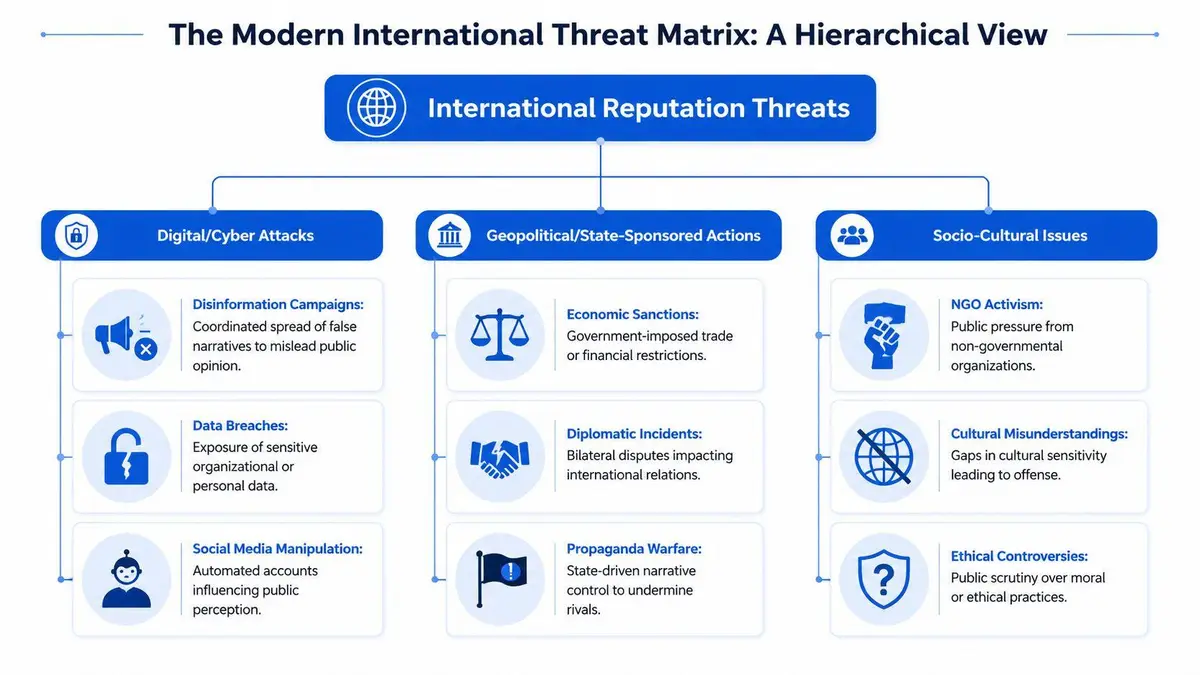
Four threat types that require different handling
The practical matrix begins by separating the threat by content type, distribution pattern, and removability.
Defamation campaigns are often coordinated rather than isolated. The same allegation appears across blogs, complaint sites, low-moderation forums, and repost networks. The key issue isn’t only falsity. It’s replication. If you remove one copy and ignore the syndication path, the campaign survives.
Executive impersonation sits closer to fraud and platform abuse than to classic PR. Fake profiles, spoofed outreach, and fabricated endorsements can affect investors, employees, and counterparties quickly. The right response usually starts with evidence capture and platform escalation, not public statements.
Leaks and intimate or confidential material create a very different legal posture. Here the focus shifts to privacy rights, intellectual property, consent, contractual breach, data protection, and emergency de-indexing. Messaging is often counterproductive because it confirms the material’s existence to a wider audience.
Negative media coverage is a commonly misunderstood category. Some articles are lawful and difficult to remove, even if they’re unfair. Others cross into defamation, privacy invasion, or inaccurate republication. The legal assessment turns on what was said, how it was sourced, whether it’s current, and where it’s being accessed.
Regional differences change the threat profile
The same content behaves differently depending on platform culture, moderation practice, and legal environment.
A viral falsehood on a fast-moving social platform requires immediate platform-level intervention because screenshots and reposts multiply before formal legal correspondence has any effect. By contrast, a negative feature in a reputable European publication may spread more slowly but carry greater credibility with banks, regulators, and business partners. One is a velocity problem. The other is an authority problem.
A useful early assessment asks:
| Threat type | Main danger | First response priority |
|---|---|---|
| Defamation network | Replication across domains | Map origin and mirror sites |
| Impersonation | Fraud, confusion, direct outreach | Lock evidence and report platform abuse |
| Leak or private material | Privacy invasion and persistence | Pursue urgent removal and de-indexing |
| Negative press | Credibility and search permanence | Test legal vulnerability and search strategy |
The wrong classification leads to the wrong remedy. A press rebuttal won’t stop leaked media. A cease-and-desist letter won’t solve a bot-driven impersonation network on its own.
What sophisticated clients should look for first
The first hour should answer three questions.
- Is the content illegal, policy-violating, or merely unfavorable: That determines whether removal is realistic or whether suppression and counter-positioning are the better route.
- Is this a single source or a distribution system: If it’s systemic, you need to identify affiliates, mirrors, and search footprints immediately.
- Who is the primary audience at risk: Consumers, investors, employers, journalists, regulators, or personal contacts all require different containment choices.
That discipline is what turns international reputation management from a vague communications exercise into a risk classification exercise with workable next steps.
Navigating the Global Legal and Regulatory Maze
Cross-border removal fails when advisers assume one legal theory will travel cleanly from country to country. It won’t. The governing issue is conflict. Privacy rights, free expression standards, intermediary liability, and search engine obligations vary sharply, and urgent matters expose those differences fast.
The central obstacle is captured plainly in this analysis of global market entry and reputational risk: cross-border removal means navigating conflicting laws like GDPR in Europe versus First Amendment protections in the US, and generic cultural advice does nothing for urgent takedowns involving defamation or leaks. That’s the dividing line between market-entry commentary and real crisis work.
The United States and Europe are not variations of the same problem
In the United States, speech protection is unusually strong. That doesn’t mean harmful content is untouchable. It means removal arguments must be more precise. False impersonation, platform rule breaches, privacy violations, copyright claims, terms-of-service violations, and certain forms of unlawful disclosure may offer better routes than broad outrage about reputational harm. A client who says, “this is unfair and damaging,” may be morally right and legally underpowered.
In the European Union, privacy and data rights can create stronger pathways, especially where content is outdated, excessive, inaccurate, unlawfully processed, or no longer proportionate to public interest. Search de-indexing may be more realistic there than in the US, but even then, success depends on facts, category of claimant, and local treatment of public-figure status. Europe isn’t a magic switch. It’s a more structured terrain.
For executives who need a disciplined overview of how these pathways differ, this strategic guide to navigating online content removal laws is useful as a planning framework.
Why one-size-fits-all advice breaks down
A generic reputation vendor often proposes the same sequence everywhere: send complaints, publish positive content, and wait. That approach breaks because each jurisdiction answers different questions:
- Who bears responsibility: Publisher, host, platform, search engine, or uploader.
- What right is engaged: Defamation, privacy, data protection, harassment, intellectual property, or impersonation.
- What remedy is available: Source removal, geo-restriction, de-indexing, account suspension, or evidence preservation for litigation.
A lawful but damaging article may remain online in one jurisdiction while becoming de-indexable in another. A leak may be removable at source in one place and only suppressible in search elsewhere. The strategy has to follow the remedy map.
What clients should demand from counsel
When assessing cross-border options, I look for a response plan that does four things in sequence.
- Pins down the strongest jurisdiction first. Not the most familiar one. The strongest one.
- Preserves evidence before contact. Weak screenshots and incomplete logs sabotage later steps.
- Targets the correct intermediary. Search engine, host, CDN, social platform, registrar, and publisher all have different points of influence.
- Separates urgent relief from final relief. You may need fast de-indexing or account suspension before any fuller legal resolution.
A legal strategy that isn’t tied to a distribution map usually becomes paperwork. International reputation management is won by matching the right legal argument to the right choke point.
Advanced Monitoring and Proactive Threat Detection
Most clients arrive after harm is visible. That’s understandable, but it’s late. A credible monitoring program has one purpose: detect the threat early enough that removal and containment are still realistic.

The benchmark that matters is speed. According to QuestionPro’s reputation management strategy analysis, AI-driven sentiment analysis systems can detect reputational threats with 89% precision, enabling automated takedown workflows within the 24 to 48 hour window, which reduces reputational harm by 65% compared to slower responses. Those figures are relevant because they match what experienced practitioners already know. Early detection preserves options.
What proper monitoring actually includes
Google Alerts is not an international monitoring system. It misses too much, arrives too late, and doesn’t handle multilingual context well.
A serious setup usually includes:
- Branded search surveillance: Monitoring names, entities, products, family members, and known aliases across major search engines.
- Platform-level tracking: Social platforms, review sites, complaint boards, forums, messaging spillover, and video reposts.
- Multilingual sentiment review: Not just translation, but context. Sarcasm, slang, and coded allegations matter.
- Dark web and leak-signal checks: Especially for credentials, stolen files, extortion threats, and pre-release chatter.
For organizations that need a formal baseline, reputation monitoring services built for active brand protection can sit alongside legal and communications teams rather than replacing them.
Monitoring without escalation logic is wasted effort
The dashboard is not the system. The escalation rule is the system.
If a monitoring feed flags a new impersonation profile, somebody must already know who verifies authenticity, who reports it, who captures the evidence, and whether counterparties need direct notice. If a defamatory article appears, the team must know whether to preserve first, notify the host, contact search engines, or remain silent while removal steps begin. Monitoring only works when it triggers a defined action path.
A short explainer helps illustrate how that posture differs from passive listening:
The practical detection model
The most effective monitoring programs work in layers.
First layer: detect appearance.
Second layer: classify legality and risk.
Third layer: route to the right responder.
Fourth layer: watch for reuploads, mirrors, and search persistence.
That final layer is where many teams fail. They remove the original item, declare success, and ignore reposts. In cross-border matters, recurrence is part of the threat model, not an exception to it.
A Framework for Decisive Global Response
Once a threat is identified, hesitation usually causes more damage than an imperfect first move. What matters is choosing the right lane quickly. Some incidents need explanation. Some need legal pressure. Some need direct technical suppression and de-indexing before anything public is said.
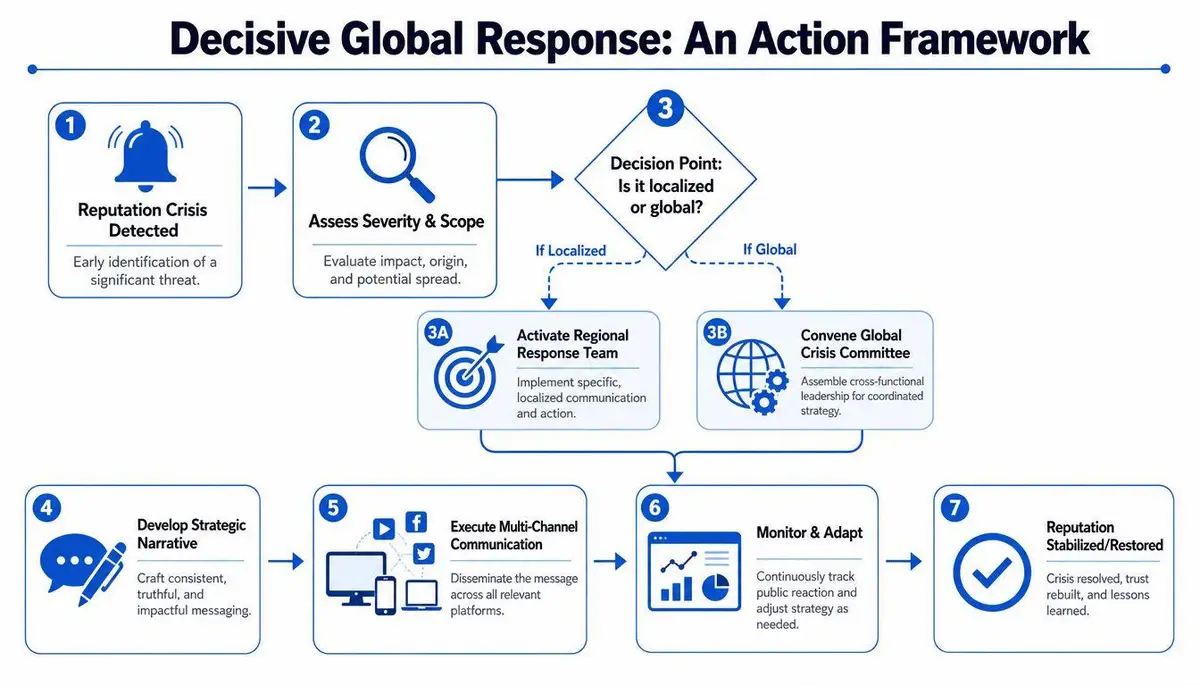
The decision tree that works under pressure
Start with one threshold question: is the content merely unfavorable, or is it removable?
If it reflects a misunderstanding, a dated narrative, or criticism that’s lawful but incomplete, a strategic communications response may be enough. The aim there is clarification, not combat. Public correction, stakeholder outreach, and controlled factual rebuttal can work when the underlying material isn’t likely to be taken down.
If the material is defamatory, impersonating, privacy-invasive, non-consensual, or clearly platform-violating, the matter should move immediately into a removal track. That means preserving evidence, identifying the strongest legal and policy hooks, and selecting the proper target. The proper target might be the publisher. It might be the host. It might be the search engine. It might be all three, but not at the same time and not in the same order.
The suppression benchmark is not abstract
Where source removal is delayed or unavailable, search suppression becomes tactical rather than cosmetic. According to Terakeet’s analysis of online reputation management search dynamics, brands need a 30 to 50% increase in positive branded keyword rankings within 14 days to push damaging URLs off the first search page, and the first page captures 92% of user traffic. That establishes a useful benchmark. If your suppression effort isn’t moving branded search visibility quickly, it isn’t functioning as a protective measure.
That doesn’t mean publishing shallow promotional material. It means deploying authoritative assets capable of outranking harmful results, then aligning that effort with de-indexing and source challenges.
A practical response sequence
In high-pressure matters, I’d generally separate actions this way:
- Contain the spread first: Archive evidence, identify mirrors, and avoid statements that widen discovery.
- Choose the lead remedy: PR for confusion. Legal for unlawful content. Technical de-indexing when search visibility is the main driver of harm.
- Coordinate outward communications carefully: A strong legal point can be undermined by a reckless public statement.
- Measure outcome by visibility, not activity: Fewer harmful impressions matter more than a stack of unanswered letters.
If harmful material remains easy to find, the response has not succeeded, no matter how busy the advisers were.
What doesn’t work
Three patterns routinely fail.
- Premature outrage: Public attacks on the publisher or platform often entrench the content and invite more coverage.
- Single-channel strategy: Legal alone, PR alone, or SEO alone rarely solves a serious international matter.
- Treating search as secondary: If the harmful result remains prominent, stakeholders continue to encounter it regardless of private progress behind the scenes.
That’s why decisive international reputation management has to be integrated. The remedy and the visibility path must be handled together.
Case Studies in International Reputation Defense
The theory becomes clearer when you look at how these matters unfold. The details below are anonymized, but the patterns are typical.
A technology executive targeted across Southeast Asian forums
A senior executive at a growth-stage technology company was accused of fraud through translated posts on regional forums and repost accounts. The allegations were false, but they were written in a way that made them look like whistleblower disclosures. A general PR response would have amplified them.
The first move was evidence capture and origin mapping. The second was selective platform escalation where impersonation and fabricated records could be shown clearly. At the same time, local counsel reviewed which posts crossed from opinion into actionable false statement. Only after the worst material was isolated did the team consider outward communication to investors. That sequencing mattered. A broad denial at the start would have directed more people to the accusations.
A family office facing leaked financial material on European infrastructure
A family office discovered private financial documents circulating on European servers, with snippets appearing in search and discussion boards. The instinct inside the office was to threaten immediate litigation everywhere. That would have scattered resources and increased exposure.
The better approach was narrower. The team separated authentic confidential material from commentary about it, then used privacy, confidentiality, and data-rights arguments where they were strongest. Search visibility was addressed in parallel because even partial indexing was enough to give bad actors an advantage. Internal communications were kept extremely tight. The office briefed only the advisers and counterparties who needed to know. In leaks, operational discipline often matters as much as legal theory.
Quiet action usually outperforms theatrical action in leak matters. The audience you most need to avoid is the one you create yourself.
A luxury brand dealing with counterfeit promotion and impersonation
A luxury brand faced fake distributor pages, counterfeit offers, and executive impersonation tied to social profiles in difficult enforcement environments. The legal team initially treated it as trademark abuse alone. That was too narrow. The more immediate problem was consumer deception and reputational contamination.
The response combined brand-protection enforcement with impersonation reporting, payment-path disruption, and search cleanup. The key lesson was that fake offers don’t only divert sales. They reshape trust. When a customer believes the brand tolerated fraud, reputational damage persists after the listings disappear. The answer wasn’t one lawsuit. It was a coordinated takedown program tied to recurring monitoring and reupload control.
Choosing a Specialist and Your Executive Action Plan
By the time most high-net-worth clients seek help, they’ve already learned what generalist providers can’t do. A PR firm can shape narrative but may have no route to source removal. A conventional law firm may draft excellent letters but lack the platform process knowledge, technical workflow, or multilingual evidence handling needed to get results. A monitoring vendor may detect the attack and stop there.
That gap is why specialist intervention matters. As this reputation management guide notes, reputation accounts for approximately 30% of market value for listed companies, and the inability to physically remove harmful content is a catastrophic risk that monitoring tools alone can’t solve. For serious international matters, removal capability isn’t an optional add-on. It’s the core competence.
What to test before you instruct anyone
A credible specialist should be able to answer these questions without resorting to slogans:
- Can you distinguish source removal from de-indexing: They are not the same remedy, and clients need both concepts explained plainly.
- How do you handle reuploads and mirror sites: Initial takedown is only half the job.
- What jurisdictions and platform processes do you work across: Cross-border matters fail when the provider only understands one legal culture.
- Who manages evidence, escalation, and stakeholder risk: A fractured workflow creates avoidable mistakes.
One practical resource for internal budgeting and governance is this guide on building a business case for proactive reputation management. It helps management teams explain why prevention and rapid-response capacity deserve formal investment.
The right team is usually hybrid
No single discipline carries the whole matter. The best outcomes usually involve a combination of specialist legal analysis, digital forensics, platform process knowledge, and controlled communications. In some cases, a provider such as ContentRemoval.com can handle source removal, de-indexing, impersonation takedowns, and continuous monitoring as part of that wider response structure.
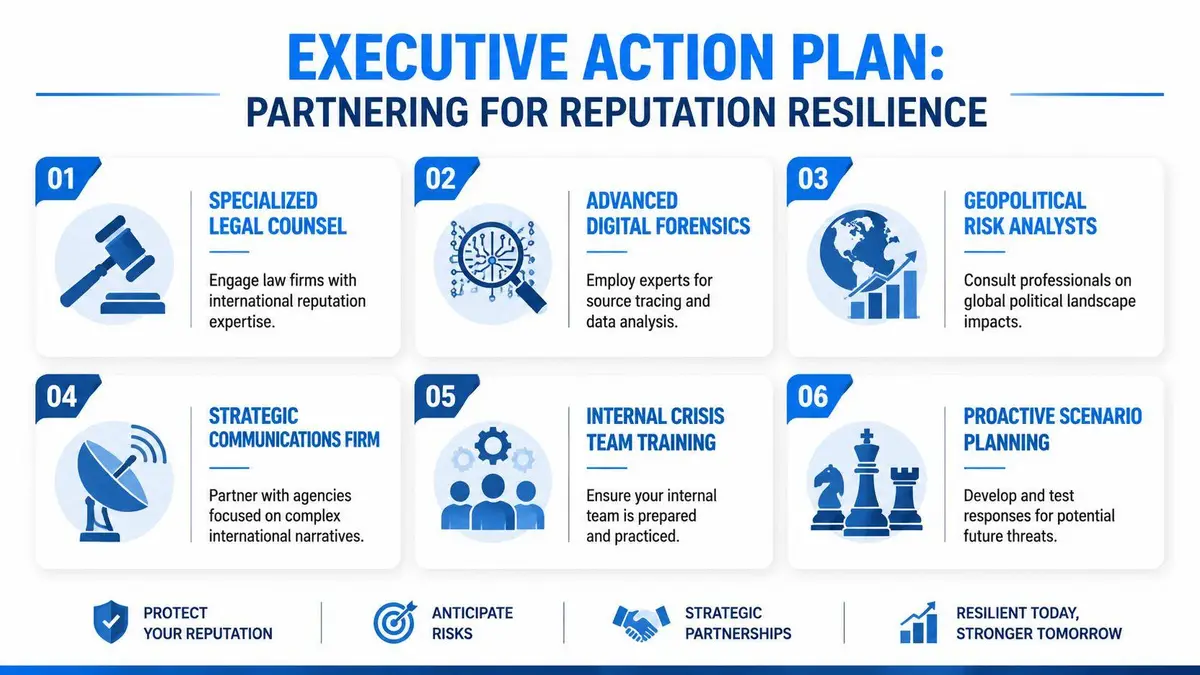
An executive action plan you can use immediately
If you’re dealing with an active international threat, do these things now:
- Freeze the evidence: Capture URLs, timestamps, search appearances, account details, and distribution paths before any outreach begins.
- Limit internal circulation: Don’t turn a contained issue into a company-wide spectacle.
- Separate harm types: Defamation, impersonation, leaks, and criticism need different remedies.
- Demand a remedy map: Ask exactly what can be removed, what can be de-indexed, what can only be suppressed, and in which jurisdictions.
- Insist on recurrence planning: If the provider has no answer for reposts, you’re buying a temporary pause, not protection.
International reputation management works when someone takes ownership of the whole chain. Detection. Classification. Removal. Search visibility. Reappearance. Most firms cover one or two of those stages. Under real pressure, that isn’t enough.
If harmful content is spreading across borders, delay usually increases visibility, advantage for bad actors, and clean-up cost. ContentRemoval.com works with executives, public figures, family offices, and legal advisers on confidential assessments, cross-border takedown strategy, de-indexing, and ongoing monitoring when standard PR or general legal correspondence won’t resolve the problem.
Frequently asked questions
Can content that is legal in the US be removed in Europe?
Sometimes. EU privacy and data protection rights create stronger pathways where content is outdated, excessive, inaccurate, unlawfully processed or no longer proportionate to the public interest, so search de-indexing can be more realistic there than in the US. Success still depends on the facts, the claimant’s public-figure status and local treatment, and the page may remain visible from other regions.
What should I do first when a fake profile is messaging investors in my name?
Treat it as fraud and platform abuse rather than a PR matter. Capture evidence of the profile, messages and recipients, then escalate through the platform’s impersonation process and notify counterparties directly where needed. A public statement at that stage usually widens the audience without stopping the outreach.
Who should I target with a takedown request when content is hosted abroad?
Match the legal argument to the choke point. The publisher, host, CDN, social platform, registrar and search engine each have different points of influence, and the strongest jurisdiction, not the most familiar one, should be chosen first. Urgent relief such as de-indexing or account suspension often comes before any final legal resolution.