
Saving your reputation in a crisis starts with freezing the evidence and stopping the spread, not with a public statement. In the first 48 hours you preserve every result, identify the source and host, build a claim matrix per URL, file platform and legal removal reports in parallel, brief defamation counsel, and only then decide whether to issue a statement.
Key facts
- Google separates policy removals such as impersonation or exposed data from law-based removals needing a legal basis.
- Legal removals may be restricted only in the region where the content is unlawful; the source page stays online.
- UK notice-and-takedown rules give a poster five days to respond after an operator forwards a complaint.
- A denial that repeats the allegation can become a new searchable asset alongside the original claim.
Where ContentRemoval.com comes in. ContentRemoval.com coordinates the removal side of a reputation crisis for executives, family offices and public figures: evidence preservation, platform submissions, legal-removal requests, de-indexing and reupload monitoring, so the person is not managing every contact personally. The chief of staff or general counsel is usually the one who calls. A free 15-minute Exposure Scan maps what is removable across search and platforms, and the report is yours to keep. Get a Free, Confidential Exposure Scan or read how our reputation management work is done.
You open your laptop late on a Sunday and search your own name. A hostile headline appears first. Beneath it sits a Glassdoor thread, a copied accusation, or a manipulated video that appears to show something you never did. Your phone starts ringing before you’ve drafted a response. A board member wants an explanation, a spouse has received a screenshot, and someone on your team asks whether they should comment.
This is not a normal communications exercise. It’s a digital triage event involving evidence, platform procedures, legal exposure, and search behavior. If you’re learning how to save your reputation, your first objective isn’t to sound persuasive. It’s to preserve the record, identify the source, and stop the material from multiplying.
A single negative result on the first page can cause a business to lose 22% of potential customers, while three or more negative results can raise the potential loss to 59%, according to industry reputation benchmarks. More than four negative reviews are also associated with a 70% decrease in total sales in the same reporting. Those figures make the priority clear: online criticism can become a conversion problem before a public statement reaches anyone.
When the First Result Goes Red
The founder in this situation usually makes the same first mistake. They open the article, read it repeatedly, then send an angry message to the publisher or post a denial from a personal account. That reaction feels productive, but it can destroy useful evidence, alert the source, and create new language that search engines may index alongside the original allegation.
Start by treating the visible result as a live incident. Search your name, company name, executive names, product names, and distinctive phrases from the allegation in private browsing. Record the result pages, snippets, dates, URLs, social posts, video titles, review pages, and related searches exactly as they appear. Save screenshots and page archives before contacting anyone.
What the first calls reveal
The first caller often isn’t a journalist. It’s a client, investor, family member, employee, or colleague who saw a screenshot in a private group. Ask what they saw, where it came from, and whether they still have the original message or attachment. Don’t ask them to forward the allegation widely. Have them preserve the original material and send it through a controlled channel.
Your crisis folder should contain the first search results, copies of every asset, timestamps, account names, publication details, and a record of who received what. Preserve metadata where possible. If the material is a video, retain the original file, thumbnail, transcript, and any captions. If it’s a review or forum post, capture the profile, thread context, replies, edits, and visible engagement.
Immediate rule: Don’t publish a rebuttal until the digital footprint has been frozen and counsel has reviewed the removal theory.
Reputation damage is measured in how quickly people encounter and repeat the claim, not in the length of the news cycle. A copied post can appear on a forum, social platform, aggregator, and search result while your communications team is still debating wording. Source removal, de-indexing, and platform reporting come before narrative repair.
The First 48 Hours of Crisis Triage
The first two days require a controlled sequence. Assign one person to maintain the incident log, one person to preserve evidence, and one decision-maker to approve legal and platform actions. Keep public communications separate from the removal work. A premature statement can become another searchable asset.
Hour 0 to 2
Capture full-page screenshots, browser records, search-result pages in private browsing, and archived versions of the offending pages. Hash the original files if your technical team can do so reliably, then store them in a restricted crisis folder with timestamps. Lock down personal and corporate social accounts by reviewing administrators, changing compromised credentials, enabling available multifactor authentication, and preserving current profile states.
Don’t edit the original evidence. Work from copies. Record the exact search terms, location, device, and account state used to find each result, because visibility can vary by market and personalization.
Hour 2 to 6
Identify the originating account, publisher, domain owner, hosting provider, platform, and any syndication or copying pattern. Pull publicly available registration information and locate abuse, copyright, privacy, impersonation, and legal contact routes. A copied allegation requires a different path from a hacked account, a fake profile, or an altered image.
Build a claim matrix. For each URL or asset, note the alleged violation, supporting evidence, requested remedy, jurisdiction, and escalation owner. This prevents a team from sending the same generic complaint everywhere.
Hour 6 to 12
File reports in parallel through the relevant high-priority channels. Google, X, LinkedIn, Reddit, social networks, review platforms, and the originating publication each apply different standards. Use impersonation channels for fake accounts, privacy channels for exposed personal information, copyright procedures for copied protected material, and legal-removal processes for claims requiring legal analysis.
A specialist workflow such as ContentRemoval.com’s 72-hour emergency removal service can help coordinate evidence, submissions, and follow-up without making the affected executive manage every contact personally.
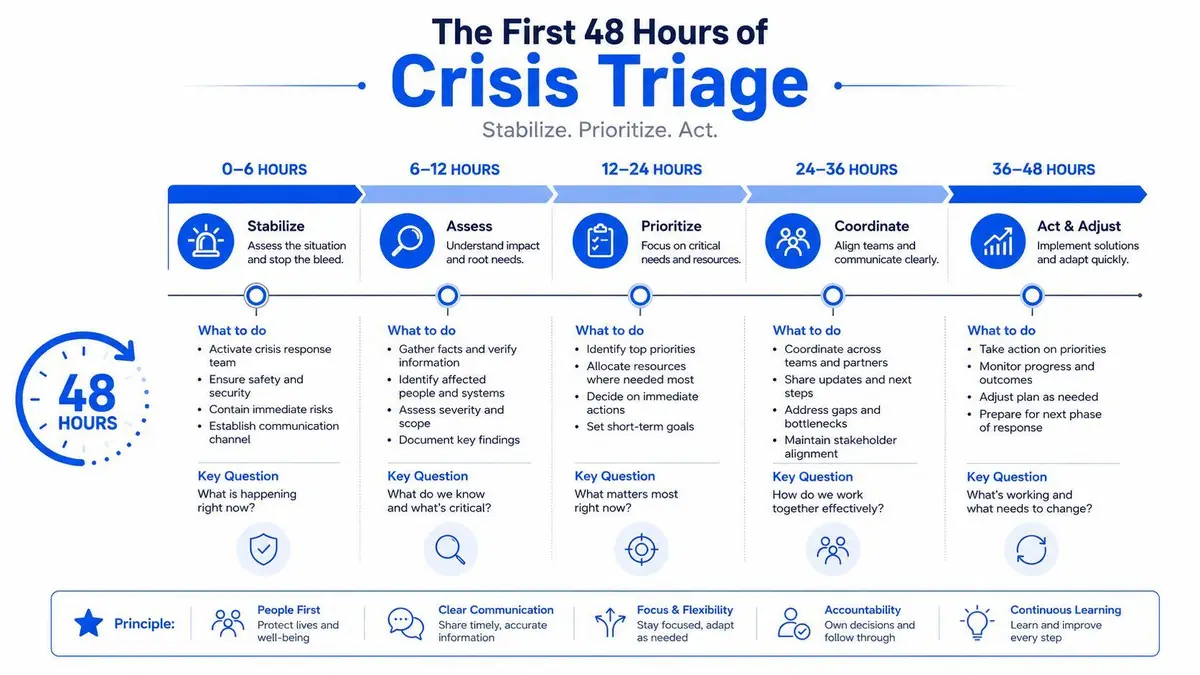
Hour 12 to 24
Engage defamation counsel to assess falsity, identification, publication, jurisdiction, and available remedies. Send preservation letters where litigation or a formal demand is plausible. Request temporary removal or account restriction when platform policy permits it. Don’t threaten criminal or civil action unless counsel has confirmed the basis and the recipient.
Hour 24 to 48
Monitor reuploads, mirrors, edited versions, quote-posts, and new search results. Document gaps in the public record without trying to manufacture a counter-narrative. Only after removal work is active should you brief spokespeople, prepare a holding statement, or decide whether silence remains the safer option.
Policy and Legal Removal Paths to De-Indexing
Google removals operate through two distinct lanes. Policy-based removal addresses content that violates a platform rule, such as exposed personal information, impersonation, hacked material, or certain forms of non-consensual intimate imagery. Law-based removal depends on a legal right, court order, statutory process, or documented claim that satisfies the relevant jurisdiction.
Google’s legal framework distinguishes between policy removals and law-based removals, and its centralized legal-removals process may restrict access only in the country or region where the material is unlawful. That means a local remedy can be more realistic than demanding worldwide deletion. The source page may remain online even after a search result is delisted.
| Removal Type | Trigger | Evidence Required | Jurisdictional Reach | Typical Time |
|---|---|---|---|---|
| Policy removal | Platform-rule violation | Screenshots, URLs, account details, policy-specific facts | Often platform or search-policy dependent | Often days, depending on review |
| Legal removal | Law, court order, or formal legal claim | Counsel-reviewed facts, legal basis, identity, affected URLs | Frequently country or region specific | Varies with legal process and review |
| Source takedown | Publisher, host, or platform obligation | Proof of infringement, falsity, privacy harm, or abuse | Depends on recipient and governing law | Can move quickly when the trigger is clear |
| Court-ordered restriction | Injunction or other judicial order | Pleadings, evidence, and court documentation | Defined by the issuing court | Depends on filing and court action |
The right-to-be-forgotten process demonstrates why de-indexing isn’t automatic. Google reported receiving 654,808 requests involving 2,436,788 URLs between May 2014 and February 2018, and delisted 43% of those URLs, as described in reporting on Google’s transparency data. The same reporting noted approval rates of about 41% in another European period.
Country-specific strategy matters. Earlier reporting showed France generating 17,500 requests involving about 58,000 URLs, Germany generating 16,500 requests involving about 57,000 URLs, and the UK generating 12,000 requests involving around 44,000 URLs. Delisting affected Google Search, Image Search, and Google News for the queried name or term, while the underlying page remained at its source, according to coverage of Google’s country-level data.
Escalate when the content is clearly unlawful, the source refuses a well-supported correction, the platform ignores a qualifying report, or continued publication creates material personal, commercial, privacy, or safety harm. For UK matters, the cited UK defamation notice-and-takedown regulations provide a procedure in which an operator can remove the statement or forward the complaint to the poster, who is asked to respond within five days. For a structured legal submission, use Google’s legal removal request pathway rather than a general complaint form.
Takedowns Across News, Social, Forums, and Piracy
Every surface has its own trigger. A publisher may respond to demonstrable factual error, lack of verification, privacy concerns, or a legal demand. A platform may act on impersonation, harassment, manipulated media, copyright infringement, or exposed personal information. A forum moderator may require a rule violation, while a search engine may need proof that the source has already changed or removed the material.
Start with the source that created the content. For a news article, send a concise correction request to the editor, author, legal desk, and corrections desk where available. Identify each false statement, provide supporting documents, distinguish factual errors from disagreement, and request a specific remedy, such as correction, update, removal, or de-indexing. Don’t send a long emotional narrative. Editors need a verifiable record.
Match the evidence to the surface
For republished photos, videos, articles, or proprietary documents, use a copyright process when you own the rights or represent the rights holder. Include the original work, the infringing URL, the location of the copied material, your authority to act, and the requested removal. A copyright claim won’t solve a false statement that merely references your work, so don’t force the wrong theory.
For X, Meta, TikTok, LinkedIn, Reddit, Trustpilot, and similar services, preserve the account URL, post ID, profile history, timestamps, replies, and evidence of impersonation or manipulation. Report the specific policy violation through the highest-priority channel available. Forum outreach should go to moderators and administrators with the thread URL, rule provision, offending passages, and evidence supporting the request.
Search engine cache and index requests come after source action or when a distinct search-policy or legal basis exists. A coordinated campaign links each source, copy, account, and search result in one evidence map. That coordination prevents the common failure where one page disappears while five mirrors remain visible.
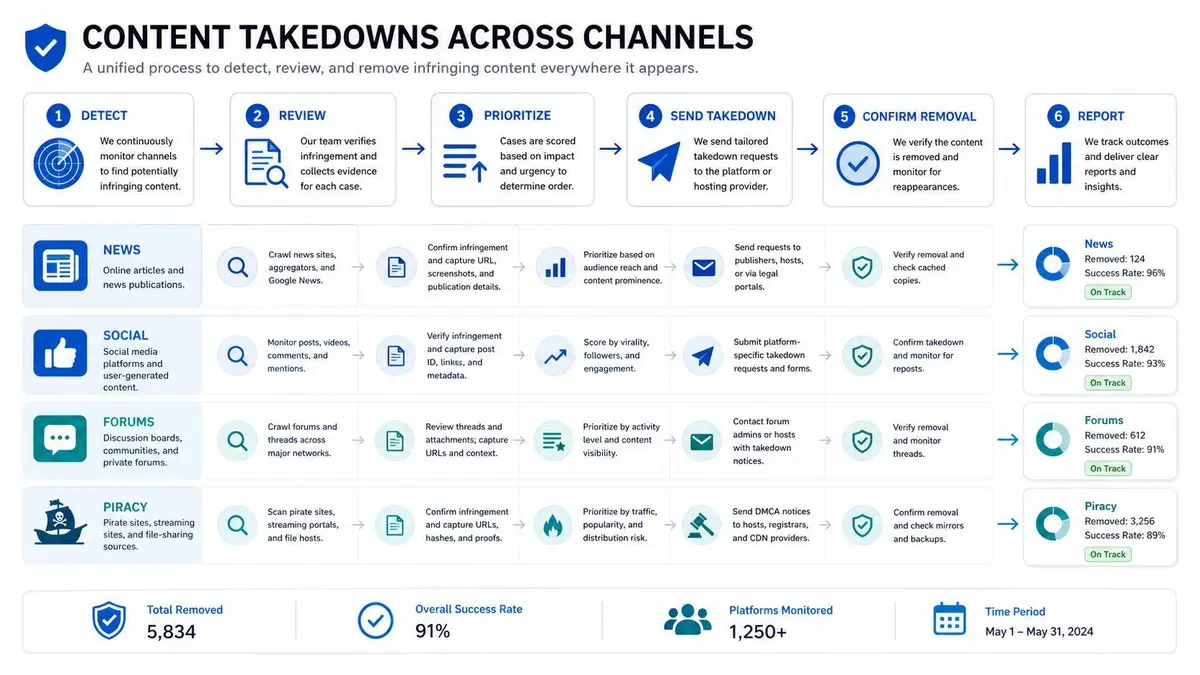
Send every contact a clean package: the affected URL, a short factual summary, the precise violation or legal basis, supporting files, your authority, and the requested action. Keep follow-up dates in the incident log. If the recipient rejects the claim, ask which element was missing and revise the submission rather than resending the same text.
PR and Messaging Sequenced After Action
Public messaging has a role, but it shouldn’t lead the response. Before removal work begins, a denial can repeat the allegation, attract fresh attention, create quotable inconsistencies, and encourage the publisher to update the page with your response. Search systems may then connect your name with both the original claim and your rebuttal.
Issue a public statement only when it serves a defined purpose. That might include correcting a dangerous falsehood, protecting customers from an operational risk, responding to a direct media inquiry, satisfying a disclosure obligation, or preventing silence from being interpreted as confirmation. If none of those conditions exists, silence is often the more disciplined choice.
Build a controlled message
Prepare a short holding statement, an internal Q&A, and a spokesperson assignment. The holding statement should address what you can verify, avoid repeating unnecessary allegations, and avoid claims about motive. It should not speculate about investigations, identify private individuals, or promise an outcome that counsel can’t support.
A useful sequence is simple:
- Before action: preserve evidence, assess the legal theory, and restrict unscripted commentary.
- While reports are active: answer only necessary questions through one spokesperson.
- After movement: publish a factual correction or update if it will reduce confusion and support the removal strategy.
- After resolution: decide whether the incident merits a permanent explanation, a private briefing, or no further amplification.
Counsel’s position: Empathy is not a substitute for accuracy, and a denial is not a takedown strategy.
Executives often want to sound human immediately. That instinct can help in a genuine service failure, but it can hurt when the allegation is fabricated, manipulated, or legally contested. Don’t apologize for conduct that hasn’t been established, and don’t accuse the source of criminal behavior without evidence and legal review. Messaging should support the removal plan, not create a second crisis.
Suppression, Monitoring, and Reupload Defense
Removal is the cleanest outcome, but it isn’t always available. When the source remains online, the durable response combines lawful suppression, monitoring, and reupload defense. The objective is to reduce the prominence of harmful material while detecting new copies before they become established results.
Suppression starts with a technical audit of the search environment. Review branded and unbranded queries, executive names, image results, video results, news results, autocomplete behavior, and related searches. Strengthen legitimate assets, including authoritative biographies, company pages, professional profiles, interviews, publications, and owned media. Organize these assets into a coherent content structure so search engines can understand the relationship between the executive, company, credentials, and public work.
Structured data can clarify legitimate entities and profiles, but it won’t erase a defamatory page. Content quality, ownership, relevance, links, and ongoing publication all matter. Avoid mass-produced filler. Thin content creates more pages to manage without giving users a credible reason to trust the result.
Build a response layer
Monitoring should cover more than brand mentions. Track new URLs, copied phrases, image matches, fake accounts, altered videos, review activity, paste sites, piracy locations, and dark-web exposure where the threat warrants it. Set alerts for names, domains, product terms, executive aliases, and distinctive phrases from known attacks.
| Layer | Function | Tools / Methods | Response Time |
|---|---|---|---|
| Search visibility | Detect ranking changes and new harmful results | Incognito SERP audits, desktop and mobile checks, image and news review | Same day |
| Source discovery | Find new mentions, copies, and mirrors | Mention alerts, phrase matching, reverse-image searches, URL mapping | As alerts arrive |
| Platform defense | Identify impersonation, manipulated media, and abusive accounts | Native reporting channels, account monitoring, evidence logs | Promptly after detection |
| Legal workflow | Match facts to removal theories | Counsel review, preservation letters, demand packages, court strategy | Based on urgency |
| Reupload control | Find recurring copies after a takedown | Hashes, phrase searches, image matching, automated resubmission workflows | Continuous |
| Reputation reporting | Measure whether visibility is improving | SERP position records, URL status, sentiment review, response logs | Scheduled and incident-based |
A specialist service such as ContentRemoval.com’s reputation monitoring can combine removal work with ongoing detection, including search-page strategy, harmful-content identification, impersonation response, and reupload monitoring. Delegate the technical surveillance and repetitive reporting. Keep final decisions about legal posture, public disclosure, and business continuity with senior leadership and counsel.
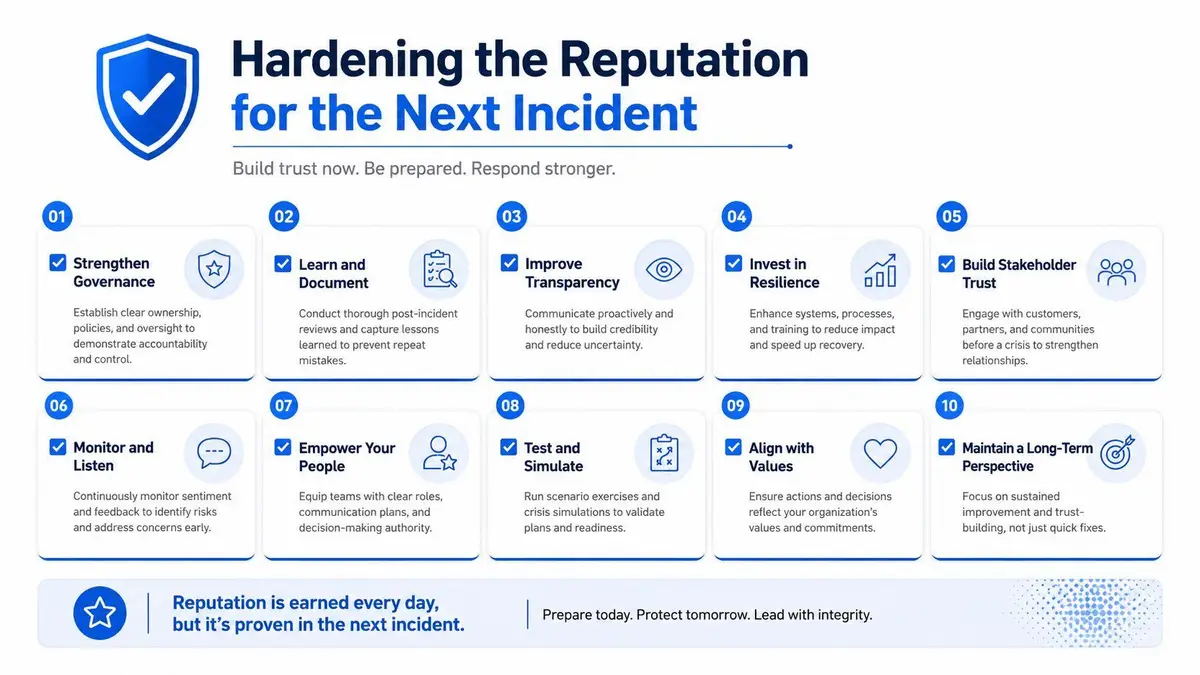
Hardening the Reputation for the Next Incident
A reputation that depends on emergency improvisation is already exposed. Treat it as a managed asset with an owner, an audit schedule, documented evidence procedures, and pre-approved escalation routes. The right question isn’t whether an incident can occur. It’s whether your team can identify, preserve, and act on it before the material becomes a trusted search narrative.
Run a quarterly audit across executive names, company names, product terms, images, videos, third-party mentions, dormant negative URLs, employee profiles, and impersonation risks. Record the baseline rather than relying on memory. Review which assets rank, which pages are outdated, which profiles lack authority, and which unresolved sources could become a problem during a transaction, hiring process, financing event, or public dispute.
Pre-position the legal response
Maintain a relationship with defamation counsel before you need an emergency opinion. Prepare adaptable DMCA, privacy, impersonation, platform-policy, and correction templates. Document who can preserve evidence, who can approve a demand, who controls social accounts, and who can brief the board.
Create playbooks for an executive allegation, product failure, data leak, fraud accusation, deepfake, fake review campaign, and stolen-content event. Each playbook should name the owner, define the first evidence package, specify escalation triggers, and include approved holding language. A dark-web monitoring plan, domain watchlist, and impersonation alerts should operate before the next incident, not after the first screenshot reaches a client.
Steady, accurate publishing also matters. Authoritative profiles, credentials, interviews, technical commentary, company information, and legitimate third-party references give search engines and users a stronger record to evaluate. Employee advocacy can help when it reflects genuine experience, but manufactured praise and coordinated reviews create their own liability.
Board oversight is justified because reputation risk now sits inside enterprise risk management. Willis Towers Watson’s 2026 survey covered 500 senior executives across 20 countries, while its 2023 research found that 95% of companies had allocated budgets for reputational damage and 87% understood the cost of transferring reputation risk, according to the Willis Towers Watson research record. Industry reporting cited in that material projects that brand reputation may represent 30% to 40% of total enterprise value by 2026, so leadership should review reputation exposure alongside other valuation risks.
The operating environment is also becoming harder to control. About 68% of U.S. Google searches ended without a click in early 2026, compared with roughly 60% in 2024, according to reputation search behavior reporting. If users see an allegation in a search interface and never visit the source, traditional PR may arrive too late to change the impression.
Misinformation deserves its own response plan. 53% of consumers believe any given piece of misinformation about the average company, while Bloomberg Media’s 2025 Corporate Reputation Pulse study identified access to advanced monitoring technology as a top challenge for 26% of respondents and keeping pace with technological advancement as the leading communications obstacle for 40%, as reported by Provoke Media’s reputation resilience coverage. That is why detection, prioritization, source removal, de-indexing, and reupload defense belong in the same operating plan.
For executives managing public visibility while carrying organizational pressure, navigating career pressures as a leader offers useful context for the human decisions surrounding a reputational event. Your resilience plan should protect both the public record and the leader responsible for making decisions under scrutiny.
ContentRemoval.com helps executives, family offices, public figures, and legal professionals address harmful search results, defamatory content, impersonation, leaks, fake reviews, and reuploads through coordinated removal, de-indexing, and monitoring work. Visit ContentRemoval.com for a confidential assessment and a case-specific action plan, especially if the harmful result is already ranking or spreading across multiple platforms.
Frequently asked questions
Should I respond publicly to a false story about me right away?
Not before the digital footprint has been frozen and counsel has reviewed the removal theory. An early denial can repeat the allegation, create quotable inconsistencies and prompt the publisher to update the page with your response. Issue a statement only when it serves a defined purpose such as correcting a dangerous falsehood or answering a direct media inquiry.
What is the difference between a policy removal and a legal removal on Google?
A policy removal addresses content that breaks a platform rule, such as exposed personal information, impersonation, hacked material or non-consensual intimate imagery. A legal removal depends on a legal right, court order or documented claim and may only restrict the result in the country where the material is unlawful.
How do I stop a damaging post from reappearing after it is removed?
Run a monitoring layer that tracks new URLs, copied phrases, image matches, fake accounts, altered videos and paste sites, using hashes and reverse-image searches to catch reuploads. Link every source, copy, account and search result in one evidence map so one page does not disappear while five mirrors remain.