
Removing a news article from Google depends first on whether the story is accurate. False or outdated reporting supports a publisher request or a defamation or copyright claim. Accurate reporting rarely comes down, so the realistic outcomes are anonymization, a noindex tag, an editor’s note, or suppression that pushes the article off page one. Google de-indexes only for legal breaches.
Key facts
- Publishers seldom delete accurate articles; anonymization, a noindex tag or an editor’s note are common alternatives.
- A copyright claim over a headshot or copied text needs no proof of falsity or harm, only ownership.
- The EU and UK Right to be Forgotten lets residents ask Google to delist outdated links.
- Google’s outdated content tool only clears cached copies after the publisher has already changed the page.
Where ContentRemoval.com comes in. ContentRemoval.com negotiates with editors and media legal departments for executives whose old article is surfacing during a capital raise, a board appointment or an acquisition. The approach often comes through the person’s counsel or chief of staff once the publisher has replied with an archival policy. A free 15-minute Exposure Scan maps which articles are removable, which can be anonymized or de-indexed, and which need suppression, and the report is yours to keep. Get a Free, Confidential Exposure Scan or read how our news article removal work is done.
When a negative news article surfaces in your search results, the effect is immediate and visceral. For an executive undergoing due diligence, an individual seeking capital, or a professional facing a board review, the appearance of such content can jeopardize years of work. The anxiety is palpable, and the potential for tangible, real-world damage is severe.
Removing a negative story is not a matter of a simple request. Legitimate journalism is afforded significant legal protection, and Google’s primary function is to index public information, not to conceal it. This, however, does not render you powerless. The initial step is to replace panic with strategic analysis.
Your First Move: Assess The Damage And The Facts
Your entire strategy hinges on a single, critical question: Is the information in the article factually accurate? Answering this with objective clarity dictates the legal and reputational pathways available to you.
This decision tree outlines the strategic divergence. If the story is demonstrably false, you possess legal leverage. If it is factually correct, a different set of tactics is required.
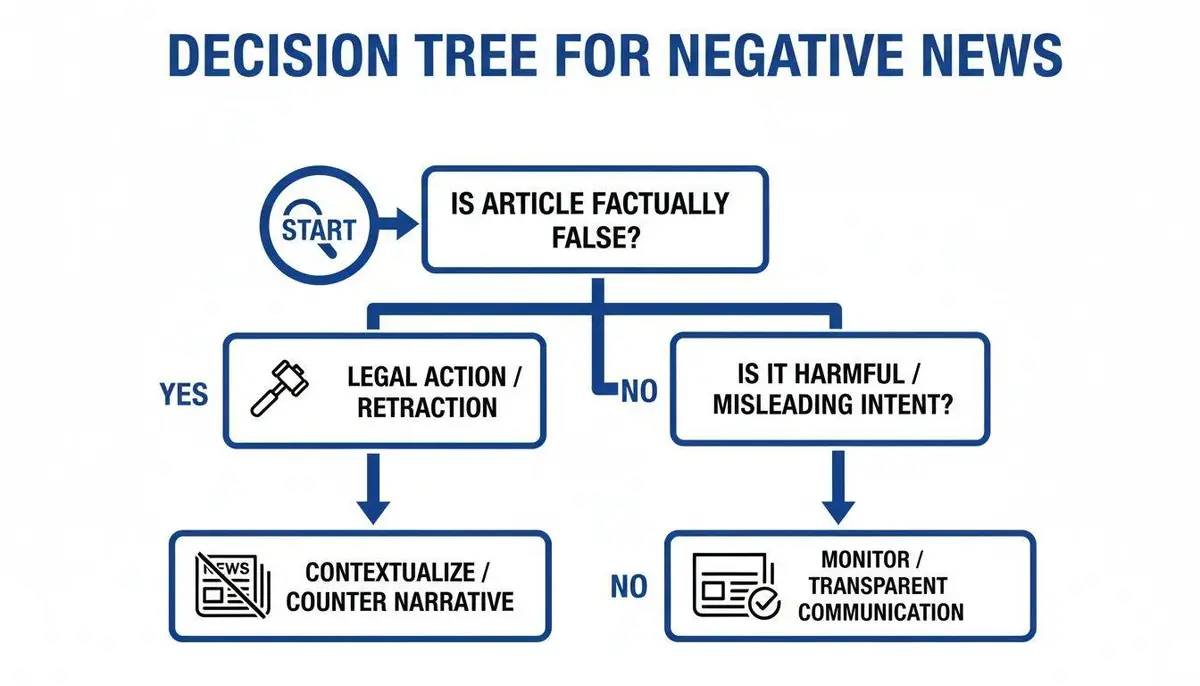
An article that is verifiably false (for instance, one that reports an arrest but omits that the charges were subsequently dropped and the record expunged) provides a firm foundation for a removal request. In such cases, the argument is direct: the harm precipitated by this outdated, inaccurate information vastly outweighs any residual public interest.
Conversely, consider an article that is technically true but reputationally catastrophic. A story detailing a minor business dispute from a decade ago, long since resolved, now presents a misleading and inequitable portrait of your current standing. Here, your approach must be diplomatic rather than demanding.
It is a pervasive myth that litigation can erase any negative press. News organizations are seldom legally obligated to remove or amend old articles, even following the dismissal of criminal charges. To compel removal, you must prove a clear legal violation such as defamation.
This distinction is paramount. A legal threat is impotent if the story is factually sound. Your strategy must adapt to the reality of the circumstances.
Initial Assessment Of Your Removal Options
| Strategy | Best For | Likely Outcome |
|---|---|---|
| Publisher Outreach | Factually inaccurate, outdated, or misleading content where a compelling, non-threatening case can be made. | Complete removal is rare. An update, correction, or anonymization is more common. Success is highly variable and depends on the publisher’s policies and the quality of the approach. |
| Legal Takedown | Clear instances of defamation, copyright infringement, or violations of privacy (right-to-be-forgotten in the EU/UK). | High probability of success if the stringent legal standard is met. This path can be costly, public, and time-consuming if not handled with precision. |
| Google De-indexing | The publisher is unresponsive or refuses to act, and the content meets Google’s specific removal criteria for legal or privacy violations. | The article is removed from Google search results but remains live on the original site. This effectively renders the content invisible to the public. |
| Suppression | Factually accurate articles that cannot be removed or de-indexed. This is the most common scenario for reputation management. | The negative article is displaced to page two or three of search results, making it virtually invisible. This requires a sustained, professional effort. |
Each of these strategies is a specialized tool. The key is deploying the correct one with precision.
The Four Main Strategies Explained
- Direct Publisher Negotiation: This is the optimal scenario, as it removes the problem at its source. Success is not achieved through demands, but by constructing a respectful, persuasive case that the content causes undue harm and no longer serves the public interest.
- Legal Action: This represents the heavy artillery, reserved for clear-cut legal violations. It is a powerful tool for leverage but requires a high burden of proof and can escalate into a prolonged, expensive, and public conflict if not managed correctly.
- Google De-Indexing: This is the essential middle ground. When the publisher is intransigent, you can appeal directly to Google. If your request is approved based on specific legal or policy violations, the article vanishes from search results. Although it exists on the publisher’s website, for all practical purposes, it becomes invisible.
- Search Suppression: When all removal avenues are exhausted, you bury the content. This is the most prevalent strategy for managing accurate but damaging news. It involves a sophisticated campaign to create and promote positive assets that outrank the negative article, pushing it deep into search results where it will not be discovered.
Each approach, from careful negotiation and legal analysis to aggressive digital marketing, is distinct. This guide will detail how to execute the right strategy for your specific situation.
Going Straight to the Source: Publisher Negotiation
The most effective method for eliminating a damaging news article is to convince the publisher to remove it. This is not a matter of sending a polite email and hoping for a favorable outcome; it is a strategic negotiation. A successful outcome means the article is permanently expunged, an objective achieved by building a powerful, fact-based case that persuades an editor or their legal team that removal is the correct course of action.

This direct approach, which we term source removal, is the gold standard. When the original article is unpublished, it is automatically purged from Google’s index and all other search engines. Achieving this, however, is difficult and requires a precise strategy.
Building Your Case for Removal
Your entire approach must be grounded in logic, not emotion. Publishers, from global media conglomerates to local blogs, are inherently protective of their content and almost invariably maintain policies against unpublishing. To persuade them to deviate, your argument must appeal to their own ethical standards or legal obligations.
The strongest arguments are built on one of these three pillars:
- Factual Inaccuracies: This provides the most potent leverage. If you can definitively prove the article contains erroneous information (mistaken identity, incorrect financial data, or reporting on charges that were later dropped and expunged) you have a solid foundation for your request.
- Disproportionate and Ongoing Harm: You must demonstrate that the article’s continued availability is causing severe, demonstrable harm that far outweighs any public interest it may have once served. This argument is particularly effective for older articles.
- Outdated and Irrelevant Information: The story may have been accurate a decade ago, but circumstances have evolved. A business dispute settled years prior or a minor legal issue fully resolved are prime examples of information that no longer serves the public interest and is actively misleading.
An emotional appeal regarding your personal distress will be disregarded. A well-reasoned request, substantiated by evidence and showing why the article is now misleading or unfair, compels the publisher to engage seriously.
The key is to frame the removal not as a personal favor, but as an act of journalistic integrity. For a detailed examination of effective communication strategies, consult our professional guide on how to ask a journalist to remove an article.
What to Do When They Say No to Deletion
Publishers will frequently refuse a full deletion, citing archival policies. When this occurs, you must have secondary solutions prepared. A skilled negotiator views a “no” not as an endpoint, but as an opening to discuss alternative resolutions.
Your fallback positions should be:
- Anonymization: Request that the publisher edit the article to remove your name and any other personally identifiable information. The story remains, but its connection to you is severed.
- De-indexing: Request that the publisher apply a “noindex” tag to the article’s HTML header. The page will still exist on their site but becomes invisible to search engines. For all practical purposes, it is removed from public view.
- An Update or Correction: Propose the addition of a prominent editor’s note at the top of the article. This note can clarify the current situation, for instance, stating that charges were dismissed or a lawsuit was settled in your favor.
You must enter this process understanding that a complete takedown is the exception, not the rule. Being prepared to negotiate for these alternative outcomes dramatically increases your chances of mitigating the damage.
The Case for Professional Help
The disparity in success rates between self-directed requests and those managed by reputation management specialists is stark. While direct publisher contact is the preferred route, success rates can increase to 65% when handled by professionals, compared to just 20% for individuals acting alone.
Other factors also influence the outcome. For instance, an article over five years old is 75% more likely to be removed, particularly with proof of expungement or dismissal of charges.
A professional firm provides more than a well-drafted letter. They leverage established relationships with media legal departments, a deep understanding of journalistic ethics, and the implicit threat of targeted legal action. It is this combination of diplomacy and leverage that frequently converts a low-probability request into a successful removal.
Bringing in the Lawyers: Using Legal Muscle for a Takedown
When polite negotiation fails and the publisher remains intransigent, it is time to escalate. This is not about dispatching an angry email threatening litigation; it is about constructing a formal, undeniable legal case that compels their counsel to take notice.
The objective is to shift the dynamic from a dismissible request to an unavoidable legal demand.
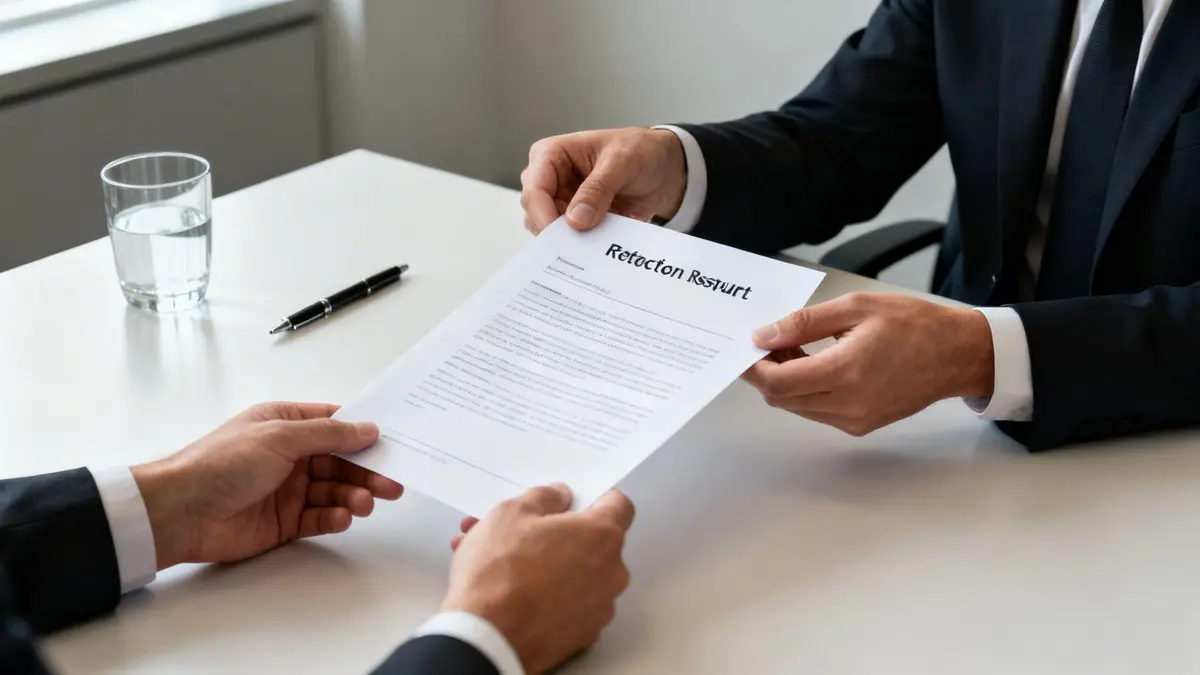
This process involves presenting a meticulously constructed argument that makes maintaining the article a greater risk for them than its removal.
The Defamation Tightrope: A Difficult Legal Standard
Defamation (specifically libel, as it is in written form) is the most common legal theory considered. The reality is that it is an exceptionally difficult claim to win. The burden of proof rests entirely on you.
You must prove two elements: the article contains a false statement of fact, and that falsehood caused you real, quantifiable harm.
A general claim of “reputational damage” is insufficient. You must demonstrate tangible financial loss: a rescinded contract, a withdrawn job offer, or a documented decline in revenue directly attributable to the false statement. This high legal standard exists to protect freedom of the press and is thus a powerful but narrowly applicable tool.
It is also critical to distinguish between a false fact and a negative opinion. A journalist is well within their rights to write, “In my opinion, John Doe’s leadership was a disaster.” A defamation claim is viable only if they write, “John Doe stole company funds,” and you can prove you did not.
Copyright Infringement: A Cleaner, Faster Route
A more direct, and often more successful, legal angle is copyright infringement. This is the optimal strategy when a news outlet has used your proprietary creative work without permission, a frequent occurrence in the rush of online publishing.
Common examples include:
- Unauthorized Photos: The article features a professional headshot from your LinkedIn profile or a personal photograph from a private social media account. If you own the copyright to that image, its use is a violation.
- Copied Text: The story reproduces substantial portions of text from a private email, a proprietary company report, or a blog post you authored, exceeding the bounds of “fair use.”
The strategic advantage of a copyright claim is that you do not need to prove the article is false or that it caused you harm. The only requirement is to prove your ownership of the content and the publisher’s lack of permission to use it. A Digital Millennium Copyright Act (DMCA) takedown notice is the appropriate instrument. When correctly filed, it legally compels platforms and search engines to remove the infringing material.
A DMCA takedown is exceptionally effective because it shifts the legal burden to the service provider (e.g., Google or the website’s host). Failure to comply jeopardizes their legal “safe harbor” protection, a risk most are unwilling to take.
This approach bypasses the publisher’s editorial staff and directly enforces your rights as the content owner.
The Right to Be Forgotten and Evolving Privacy Laws
For individuals within the EU or the UK, the GDPR provides a potent tool known as the ‘Right to be Forgotten’ (RTBF). This right allows you to request that search engines like Google remove links to personal information that is “inadequate, irrelevant, or no longer relevant.”
Consider an old, damaging article from 2015 that continues to surface when your name is searched, costing you opportunities in 2026. This is precisely the scenario the RTBF was designed to address. Since the original ruling on May 13, 2014, its impact has been substantial. By 2023, Google had reviewed over 1.6 million requests, approving 46.5% and de-indexing nearly 744,000 URLs in Europe. It is a proven pathway for reclaiming your digital narrative.
The United States does not have a federal equivalent, but a growing number of state privacy laws are beginning to offer analogous protections. These laws can be strategically employed to remove sensitive personal data, especially where no compelling public interest justifies its continued publication.
Each of these legal avenues (defamation, copyright, and privacy) demands a specific strategy and precise execution. You must understand exactly how to submit a Google legal request, as a single procedural error can result in the rejection of your claim. Achieving a takedown is not merely about being right; it is about presenting your case flawlessly.
Pushing Back: Google De-Indexing and Search Suppression
You have contacted the publisher, and they have refused to act. The negative article remains online. This is a common impasse, but it is not the end of the strategic road. The objective now shifts: instead of attempting to erase the content from the source website, you must make it disappear from the one place that matters most, Google Search.
This is where two powerful strategies are deployed: Google de-indexing and search suppression.
De-indexing is a targeted strike. You are requesting that Google remove a specific URL from its search results. The page itself will persist, but it will be undiscoverable through search. Suppression, in contrast, is a long-term campaign. It involves creating and promoting so much positive, authoritative content about you that the negative link is pushed down and buried deep within the search results.
Working with Google’s Removal Tools
Google provides specific channels for requesting removal, but you must adhere to their stringent rules. Your request must fit precisely into one of their policy violations. A generic complaint about an article’s unfairness will be summarily rejected. You must select the correct form and provide the exact justification Google requires.
A critical warning: cease clicking on the negative link when searching your name. Clients frequently make this mistake, and each click signals to Google that the link is relevant, which can inadvertently boost its ranking. If you must view the article, copy its URL and paste it directly into your browser’s address bar.
Here are the primary channels Google provides and their true functions:
- Removal of Personal Information: This is reserved for severe privacy violations, such as doxxing (publishing private contact information), non-consensual explicit imagery, or leaked financial/medical records. A negative news story, however damaging, typically does not meet this high standard.
- Outdated Content Removal: This tool is widely misunderstood. It is not for requesting the removal of a live article you dislike. It is a technical function used after a publisher has already altered or deleted a page to ask Google to clear its old cached version and index the updated one.
- Legal Takedown Requests: This is your most powerful option, but it requires legal justification. This form is used to report content that violates a law, for example, when you possess a court order demanding removal, a legal ruling of defamation, or a clear case of copyright infringement (DMCA). Submitting a request through this channel without a solid legal basis is futile.
The success of any Google removal request hinges on one factor: can you prove the content violates a specific Google policy or a law? Google does not arbitrate fairness; it acts only on clear violations.
For a deeper understanding of the mechanics, you can learn more about what is de-indexing in our strategic guide. Google functions as a librarian, not a judge. It will remove links to illegal content but will not intervene in a dispute between you and a publisher.
The Long Game: Winning with Search Suppression
What is the solution when de-indexing is not an option? This is the reality for factually accurate news reporting, which is legally protected. When the link is permanent, suppression becomes your primary weapon.
This strategy, often called “reverse SEO,” is about seizing control of the first page of your search results. The objective is to build and promote a portfolio of positive, authoritative digital assets that outrank the negative article.
Imagine the first page of Google as prime real estate. The negative article is a derelict building on the most valuable block. Your task is to construct newer, larger, and more impressive structures around it, pushing it out of sight.
This is not a quick fix. It is a methodical, long-term project that demands expertise in SEO, content development, and digital public relations.
The Building Blocks of a Suppression Campaign
An effective suppression campaign is not a matter of creating a few social media profiles and hoping for the best. It is a coordinated effort where multiple tactics work in concert, requiring ongoing management to secure and maintain top search rankings.
The core elements include:
- High-Authority Content Creation: Publishing well-written, in-depth articles, professional biographies, and expert commentary on respected websites within your industry.
- Profile Optimization: Fully developing and optimizing profiles on all relevant professional networks, social media platforms, and industry directories, not merely creating them.
- Strategic Media Outreach: Actively securing positive press, such as interviews or guest articles, on websites with high domain authority, which signals credibility to Google.
- Backlink Acquisition: The process of obtaining links from other high-quality websites to your positive content, which signals to search engines that your assets are important and trustworthy.
A few social media profiles and a personal blog post are insufficient. Every piece of content must be optimized with keywords for your name and then actively promoted to gain authority. You are competing for dominance on the world’s most valuable digital real estate, a fight that requires a sustained, professional campaign.
When to Engage Professional Reputation Counsel

Attempting to manage a high-stakes reputation crisis independently is a significant misstep. While the impulse is to act quickly and resolve the problem yourself, this approach frequently backfires due to a lack of leverage, procedural errors, or an encounter with a stonewalling journalist. There are clear inflection points when it is imperative to cease self-directed efforts and engage expert counsel.
This is not an admission of defeat, but a sound business decision. When a negative article is jeopardizing a transaction, threatening a board seat, or damaging your company’s valuation, the cost of inaction, or incorrect action, far exceeds the investment in specialist services. The objective is to move beyond futile emails and execute a coherent strategy that delivers a swift, definitive result.
When The Publisher Is Unresponsive
The primary reason clients engage a firm is because the media outlet is either ignoring them or has become hostile. You have likely sent a polite, well-reasoned email requesting a correction or removal, only to be met with silence or a templated response citing their “archival policy.” This is the point where most self-managed efforts fail.
Publishers are accustomed to dismissing complaints from individuals. What they cannot ignore is a formal communication from a law firm or a recognized reputation management consultancy that understands their internal operations and the precise legal pressure points to apply.
Professional intervention elevates the matter from a personal plea to a formal corporate issue. It signals that you are serious, possess resources, and are prepared to escalate through legal and technical channels, compelling the publisher’s counsel to review the case.
A specialist knows whom to contact beyond the general news desk, targeting editors-in-chief, the in-house legal department, or even executives at the parent corporation. This persistent, multi-level engagement is not realistically achievable on your own.
When The Stakes Are Financial And Time-Sensitive
When a negative article is actively costing you money, speed is paramount. Every day that content remains at the top of Google, it deters investors, alienates clients, or nullifies employment opportunities. In these high-pressure situations, a self-directed approach is an unacceptable gamble.
Consider these common scenarios:
- During a Capital Raise: A damaging story can cause potential investors to halt due diligence, placing millions in funding at risk.
- Executive Vetting: A misleading article from a decade ago can abruptly disqualify a candidate for a CEO or board appointment.
- Mergers and Acquisitions: Negative press discovered during due diligence can reduce a company’s valuation or derail the entire transaction.
In these moments, you require a result, not a crash course in content removal. A professional firm possesses the infrastructure for rapid deployment and can typically initiate work within 24-48 hours. This rapid response is crucial to stanch the financial bleeding and reclaim the narrative before the damage becomes irreversible.
Navigating Complex Legal And Jurisdictional Issues
The legal framework governing online content is a complex web of international regulations. The GDPR’s “Right to be Forgotten” in Europe contrasts sharply with the patchwork of defamation and privacy laws in the U.S. Navigating this legal minefield without expert guidance is a recipe for failure; a single misstep can invalidate your entire claim.
A specialist firm offers a unique synthesis of legal knowledge, proprietary technology, and established media relationships, an approach that a general law firm or PR agency cannot replicate. They will analyze your case from every possible angle (legal, technical, and diplomatic) to identify the most efficient path to removal.
This could involve a DMCA takedown for a copyright violation, a formal legal threat citing specific case law, or a discreet back-channel negotiation leveraging long-standing contacts. When the problem transcends a simple request, you require a coordinated, strategic campaign. For that, you absolutely need professional counsel.
Your Questions Answered: The Realities of Content Removal
When a damaging article appears online, urgent questions arise. Clients want to know what is possible, how long it will take, and whether they can resolve the issue themselves. Here are the direct answers we provide every day.
How Long Does It Take to Remove a News Article?
This is the most frequent question, and the honest answer is: the timeline depends entirely on the strategy and the publisher’s response. There is no magic wand.
A direct request to a smaller, cooperative publisher might result in an update or de-indexing within a few weeks. That, however, is the best-case scenario. If the publisher is uncooperative or ignores you, a “simple” request can extend indefinitely with no result.
When legal escalation is necessary, the timeline is measured in months. The legal system moves deliberately. Filing claims, awaiting responses, and navigating court procedures is not a swift process. The same applies to formal de-indexing requests with Google, which can take several months to be reviewed, particularly for complex cases requiring extensive documentation.
Suppression operates on a different timeline. Initial positive movement, displacing negative content from page one, may be visible within 90 to 180 days. However, securing and maintaining control of the first page requires a dedicated, long-term campaign.
Is News Article Removal a Permanent Solution?
Permanence is contingent on how the content was removed.
The only truly permanent solution is the complete unpublishing and deletion of the article from the source website. Once the original page is gone, it is gone for good. It cannot be re-indexed and will not reappear in search results.
De-indexing an article from Google is a significant victory, but it is not synonymous with deletion. The page persists on the publisher’s server; it simply becomes nearly impossible for the public to find via search. A small risk remains that a technical error or a site-wide update could inadvertently re-expose it to Google’s crawlers. This is why professional services include ongoing monitoring to detect any re-emergence and act immediately to suppress it.
Can I Do This Myself or Do I Need a Professional?
You can attempt this yourself. The tools to contact a publisher or submit a Google removal form are publicly available. However, this is analogous to representing yourself in major litigation. You have the right to do so, but you lack the critical components for success: established relationships, specialized legal knowledge, and genuine leverage.
The typical outcome of a DIY attempt is a polite refusal from the publisher’s legal team, at which point the effort stalls.
A professional firm fundamentally changes the dynamic. We bring legal and procedural expertise that compels media organizations to take the matter seriously. For any case involving a major publication, an unresponsive editor, or a situation where each day the article remains online incurs financial loss, professional assistance is not optional. It is essential.
- Success Rate (DIY): Often below 20%
- Success Rate (Specialist Firm): Can be 65% or higher
Simply put, a professional transforms a “no” into a negotiation.
When your reputation is on the line, you need a team that combines legal strategy with technical precision. ContentRemoval.com provides expert counsel and decisive action to protect your digital presence. To discuss your situation in complete confidence, schedule a confidential assessment with our specialists.
Frequently asked questions
Will a newspaper delete an article if the charges against me were dropped?
Rarely on request alone, because news organizations are seldom legally obligated to unpublish. A dropped charge or expungement is strong grounds for asking, and the more common outcomes are an editor’s note stating the outcome, removal of your name, or a noindex tag that keeps the page out of search.
Does clicking on a bad article about myself make it rank higher?
Repeatedly clicking the link when searching your name can signal to Google that the result is relevant. If you need to view the article, paste the URL directly into the address bar instead of searching for it.
How long does it take to push a news article off the first page of Google?
Suppression usually shows first movement within 90 to 180 days, with ongoing work needed to hold page one. Publisher outreach can produce an update or de-indexing within a few weeks when the outlet cooperates, while legal escalation and formal Google reviews run for months.