
Removing defamatory content from Google requires framing the request as a violation of a specific Google policy rather than a truth dispute. Preserve full-page captures and a third-party archive, stay silent toward the attacker, then choose the policy that fits: personal information, impersonation, harassment or exploitative removal practices. A pure defamation claim generally needs a court order.
Key facts
- Capture full-page timestamped screenshots with the URL, save a PDF, and create an archive.today or Wayback snapshot.
- Google does not judge truth; personal data or impersonation policies often remove content faster than a defamation claim.
- A court order for Google must be a final judgment naming both parties and listing the exact URLs.
- A WHOIS lookup identifies the host, whose terms of service can force removal even when the author is anonymous.
Where ContentRemoval.com comes in. ContentRemoval.com handles this for executives and companies when the self-service request has been rejected: identifying the policy that fits, escalating to the host, coordinating with counsel on an order Google will accept, and removing the content at the source rather than only from search. The client’s lawyer, general counsel or communications adviser usually makes contact. A free, confidential 15-minute Exposure Scan maps what is removable and by which route, and the report is yours to keep. Get a Free, Confidential Exposure Scan or read how our defamation removal work is done.
Discovering your name or business being defamed in Google search results constitutes a unique form of crisis. The immediate instinct is often to retaliate, to dispatch an angry email, post a public rebuttal, or undertake any action to compel its removal.
Resist this impulse. The initial 72 hours are critical, and your conduct during this period will determine the success of any removal effort. This is not a public dispute; it is a strategic operation requiring precision and control.
Your Immediate Action Plan for Defamatory Attacks
A successful removal campaign begins not with aggression, but with a methodical, dispassionate response. Your focus must shift from the perpetrator and the emotional desire to set the record straight. The sole objective is to transition from a state of crisis to one of control by gathering evidence and assessing the digital battlefield.
The following protocol outlines the precise steps to execute upon discovery of a defamatory attack.
Defamation Triage: An Initial Response Protocol
When you first encounter defamatory content, every action must be deliberate. This protocol details the immediate steps required to preserve evidence and secure a strategic advantage from the outset.
| Action Item | Strategic Purpose | Critical Mistake to Avoid |
|---|---|---|
| Screenshot & Archive | Create an immutable, timestamped record of the defamatory content in its current state. This serves as primary evidence. | Using basic “Print Screen” functions. A legally defensible record requires full-page captures that include the URL. |
| Identify the Publisher | Determine if the author is an anonymous actor, a known adversary, or a platform (e.g., review site, forum). This dictates removal strategy. | Making immediate contact with the publisher or website owner. This can escalate the situation and compromise your position. |
| Maintain Absolute Silence | Do not engage the attacker or comment on the post. Any interaction provides fuel and can be used against you. | Attempting to reason with the perpetrator or issuing a public rebuttal. This grants them the attention they seek and validates their platform. |
| Assess the Platform | Analyze the website’s Terms of Service (TOS) and Google’s own policies to identify clear, actionable violations. | Mistaking all negative content for legal defamation. A TOS violation often presents a more direct path to removal. |
Adherence to this protocol prevents unforced errors in the initial stages, preserving the full spectrum of legal and technical options for the removal process.
Preserve and Document All Evidence
Before contemplating removal, you must secure the evidence. Digital content is ephemeral; it can be edited or deleted by an attacker to undermine your claims or portray you as dishonest. Your objective is to create a digital time capsule of the attack.
Execute the following actions with precision:
- Secure Full-Page, Timestamped Screenshots: Utilize a browser extension or third-party service to capture the entire webpage, ensuring the image file includes the full URL, date, and time. Standard screen captures are insufficient.
- Save the Page as a PDF: Employ your browser’s “Print to PDF” function. This creates a clean, self-contained document preserving the text and layout, which serves as corroborating evidence.
- Create a Third-Party Archive: This is non-negotiable. Use services such as archive.today or the Wayback Machine to create a permanent, independently verifiable snapshot of the live URL. This provides undeniable proof of the content’s existence, a crucial asset when dealing with platforms and legal counsel.
This evidentiary file is the foundation for all subsequent actions, from a simple report to a web host to formal court proceedings. Without it, your efforts are fundamentally compromised. Our comprehensive guide on what to do if you are a victim of online defamation provides further detail on constructing this critical record.
Do Not Engage the Attacker
It must be stated unequivocally: do not contact, reply to, or otherwise engage with the publisher of the defamatory content. This is the single most destructive mistake an individual can make, one that reliably transforms a containable problem into an unmanageable crisis.
Engaging with a malicious actor provides the precise validation they crave: attention. You legitimize their platform and often supply them with new material to use against you, prolonging the conflict and making it exponentially more difficult to resolve. Your silence is a weapon.
All communication must be conducted through formal channels, executed by a reputation management specialist or your legal counsel. The objective is the quiet and efficient removal of the content, not a public debate or personal vindication. Focus on the strategic goal, erasure of the content, and refuse to be drawn into a public confrontation.
Navigating Google’s Complex Removal Policies
Securing the removal of defamatory content from Google is not a matter of simply completing a form. Countless self-service attempts fail because they neglect a fundamental principle: Google does not adjudicate truth. It acts as a referee, enforcing its own rulebook.
Your success hinges entirely on your ability to frame the issue not as unfair or untrue, but as a clear-cut violation of a specific, documented Google policy. There is a significant legal distinction between a negative opinion and a provably false statement of fact. The former is generally protected speech; the latter is defamation and may provide grounds for action. Your task is to present objective evidence that aligns perfectly with one of Google’s removal policies.
Constructing a Winning Removal Request
Most rejections occur for two reasons: citing the wrong policy or providing insufficient evidence. You must approach this as if building a case file for a reviewer who has approximately 90 seconds to make a decision. The burden of proof rests entirely on you.
While defamation may seem like the obvious policy violation, it is often not the most efficient path to removal. A different violation can provide a more direct route.
Consider these alternative categories for your request:
- Personal and Confidential Information: This is your strongest argument if the content exposes private data such as your phone number, home address, financial details, or government-issued ID.
- Impersonation: This policy is applicable if an individual has created a fake profile or is publishing content under the pretense of being you.
- Harassment and Bullying: This applies when the content is clearly intended to maliciously target, threaten, or intimidate you.
- Exploitative Removal Practices: If a website, such as a mugshot database, demands payment to remove your information, Google may de-index the page for violating this policy.
Selecting the correct policy is paramount. A defamation claim often requires a court order to succeed, whereas a claim for exposed personal information may only require a clear screenshot and the URL. We have analyzed these policies in our guide to Google’s removal policy framework.
Before initiating contact with Google, you must have a methodical, emotion-free plan to assemble your evidence.
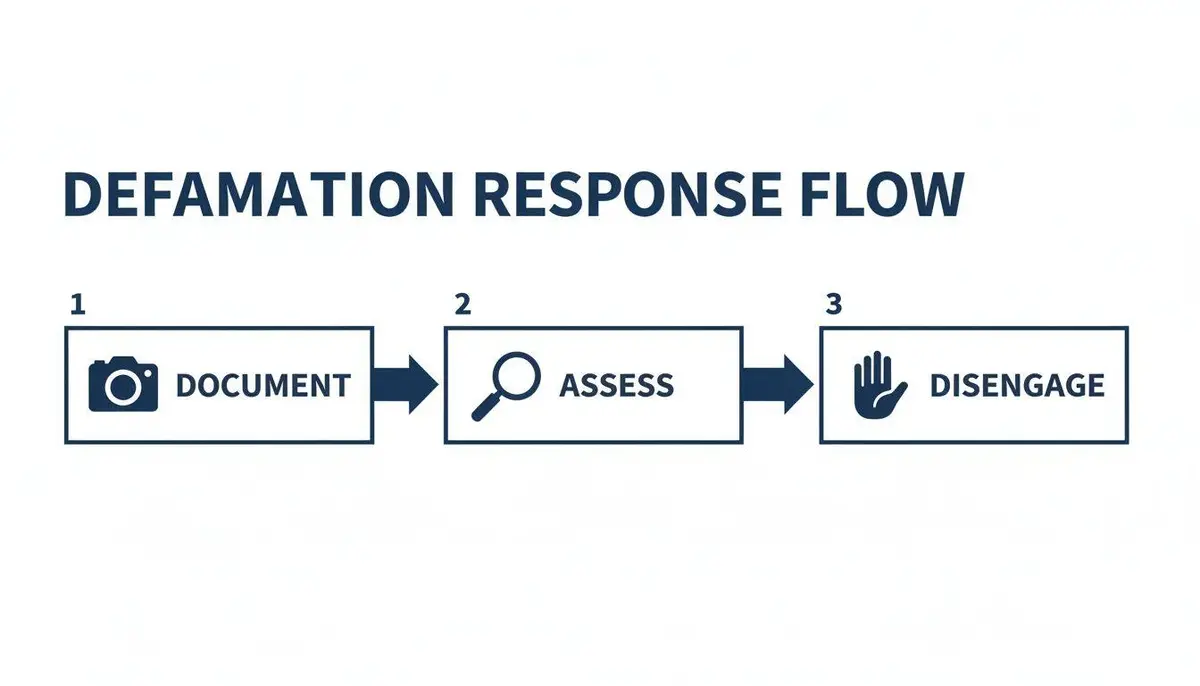
This process (Document, Assess, Disengage) is the foundation of any successful removal effort. Following these steps ensures you have a complete and compelling case before submission, helping you avoid the common errors that lead to immediate rejection.
Matching Evidence to the Appropriate Policy
Once you have identified the optimal policy, you must assemble the requisite proof. The evidentiary standard varies significantly between policies, and understanding this distinction is critical.
For a direct defamation claim, your request gains immense strength with the inclusion of a court order that specifically lists the URLs and declares the content defamatory. Without one, you are asking a Google support agent to make a complex legal judgment, a task they are neither trained nor authorized to perform.
A removal request is not a plea for a favor; it is a demonstration that a specific rule has been broken. Your evidence must be so conclusive that removal is the only logical course of action for the reviewer.
Consider a scenario where a hostile blog post contains false claims but also includes your personal phone number. Arguing the nuances of libel is a slow and arduous process. By contrast, pointing to the publication of your private phone number is a clear, undeniable violation of the “Personal and Confidential Information” policy.
Framing your request around this concrete violation is far more likely to yield a swift and positive result. This strategic approach can transform a high-stakes problem into a manageable, process-driven solution.
When polite requests and takedown notices fail, you are not out of options. You are simply arriving at the most potent tool in the arsenal: a court order. This is the one certain method to compel Google’s compliance. It elevates the matter from a policy review to a legal directive they must obey. While it is a significant step requiring time and financial investment, for high-stakes reputational attacks, it is the only strategy that guarantees removal of defamatory content from Google’s search results. Your objective is simple: obtain a judicial declaration that the content at a specific URL is illegal.
Securing a Court Order Tailored for Google
Google maintains a specific, non-negotiable process for handling court orders. A strongly-worded cease-and-desist letter from your lawyer may intimidate a blogger, but it is meaningless to Google’s legal department. To compel action, you need an order crafted precisely to their requirements.
For Google to accept your court order, it must:
- Be a final judgment from a court with proper jurisdiction.
- Clearly name the plaintiff (you) and the defendant (the publisher).
- State explicitly that the content is unlawful or defamatory.
- List the exact URLs of the content to be removed. Any ambiguity will result in an immediate rejection.
When presented with an order that meets these criteria, the dynamic shifts. You are no longer asking for a favor; you are serving a legal command they are obligated to follow. This strategy is now the standard for serious cases. Since 2020, courts and governments have issued nearly 330,000 such takedown requests to Google, a figure climbing by approximately 34% annually. This demonstrates its effectiveness in controlling false online narratives.
Collaborating with Legal Counsel for a Definitive Win
The first step is retaining an attorney specializing in internet law and defamation. However, their mandate extends beyond simply winning a case. You require counsel who understands that the ultimate goal is crafting a court order that Google will accept without question. The litigation strategy must be built around this objective from day one. The jurisdiction where the lawsuit is filed can also be a strategic advantage. While you can sue where you or the defendant reside, certain jurisdictions, such as Germany, have strict privacy and defamation laws, often making them a strategic venue for securing removal orders within the EU.
A court order is the ultimate trump card in a content removal campaign. It cuts through platform ambiguity and forces a tech giant to comply, turning a difficult request into a non-negotiable directive.
The legal process typically begins by filing a suit against the publishing entity. Often, these defendants are anonymous or simply fail to appear in court. This can be advantageous, leading to a “default judgment” in your favor, which is generally faster and less costly than a full trial. The expertise of your legal team is paramount. They must present the evidence correctly and, most importantly, draft the final order with the precise language and URL lists that will secure immediate compliance from Google’s legal department. When vetting legal assistance, look for firms offering specialized Law Firm SEO Services or similar expertise. The right team knows how to connect a legal victory to technical execution, ensuring the defamatory content is not just ruled unlawful. It is permanently erased from search results.
Eliminating Defamatory Content at the Source
De-indexing a defamatory link from Google is a crucial first step, but it is not a complete victory. The harmful content persists on its original website, accessible via a direct link or through other search engines like DuckDuckGo or Bing.
True resolution is achieved through source removal: the permanent deletion of the content from the internet itself. This requires shifting focus from Google to the entity that published the content. It means dismantling the problem at its core so it is gone for good.

Identifying the Responsible Party
The initial move is to determine who controls the website. This can be the site administrator, the hosting company, or the individual author. Your investigation begins with a WHOIS lookup. This technical search can reveal the domain registrant and the website’s hosting provider, your first points of contact.
Many site owners use privacy services to conceal their identity. When this occurs, pivot your focus to the hosting provider. Every web host enforces a Terms of Service (TOS) agreement that prohibits illegal activities, harassment, and copyright infringement. A carefully drafted notice demonstrating a clear TOS violation can compel the host to take down the offending page or site, even if the owner remains anonymous.
Tailoring Your Communication Strategy
There is no universal script for this engagement. The approach depends entirely on the publisher. An anonymous blogger requires a different tactic than a major news outlet.
- Anonymous Bloggers and Forums: Direct contact is almost never advisable. It is a high-risk action that can provoke further attacks. The most effective route is a formal complaint to the hosting provider, citing specific TOS violations.
- Established News Organizations: Reputable publishers rarely remove articles due to journalistic principles. However, they may be receptive to corrections, updates, or redactions if you provide incontrovertible evidence of factual errors. A court order remains the most powerful instrument in this scenario.
- Review Platforms and Social Media: These platforms operate under their own internal policies and reporting mechanisms. Success requires framing your complaint within their specific rules, focusing on clear violations like harassment, privacy breaches, or impersonation, which they address more seriously than simple defamation claims.
Regardless of the recipient, all communication must remain professional and fact-based. This is not a forum for emotional appeals but for the presentation of clear, objective evidence.
The goal when contacting a publisher is not to win an argument, but to provide a compelling business or legal reason for them to act. A formal cease-and-desist letter from an attorney fundamentally alters their risk calculation.
The Power of a Cease-and-Desist Letter
When direct requests and platform reports are exhausted, the next escalation is a formal cease-and-desist letter from a qualified law firm. This is not merely a strongly worded email; it is a critical strategic instrument. It signals your readiness to pursue legal action and creates an official record of your attempts to resolve the issue amicably.
A properly drafted cease-and-desist letter will:
- Identify the exact defamatory statements.
- Provide clear evidence of their falsity.
- Detail the specific damages caused to your reputation or business.
- Demand removal of the content by a firm deadline.
For many smaller publishers, the threat of costly litigation is sufficient to compel compliance. For larger organizations, it is a necessary legal precursor to securing a court order. Source removal is a process of escalating pressure, applied methodically until the publisher concludes that retaining the content is a greater liability than its removal. This is how permanent erasure is achieved.
Engaging Professional Services for High-Stakes Situations
When your reputation is under a severe, high-stakes attack, a DIY approach to removing defamatory content from Google is a strategic error. The impulse to take immediate control is understandable, but such attempts frequently backfire, leading to low success rates and potentially making the problem more entrenched.
The digital landscape is a complex maze of opaque platform policies, shifting legal precedents, and unwritten rules of engagement.
The Professional Advantage: Technology and Expertise
An individual flagging content directly with a platform is at a significant disadvantage. Industry data indicates a success rate of only 20-30% for such attempts. These reports typically lack the specific policy language, evidentiary weight, and legal authority required to compel action from a large technology company.

Specialized firms operate on an entirely different level, routinely achieving removal or de-indexing in 70-90% of cases. This is not a matter of luck but the result of combining proprietary tools, established platform relationships, and deep legal expertise. These firms can often initiate the process within 24-48 hours: a critical advantage when a single fraudulent review can reduce a business’s revenue by over 20%.
Engaging a specialist is not an admission of defeat; it is a calculated decision to deploy superior firepower. You are exchanging uncertainty for a clear, results-driven action plan executed by professionals who manage these situations daily.
Google’s own data substantiates this. In 2024, Google removed over 240 million policy-violating reviews, a 40% increase from the previous year, driven largely by its Gemini AI. This demonstrates that automated systems are designed for volume, not nuance. They frequently miss sophisticated attacks while erroneously flagging legitimate content. Experts know how to bypass this automated noise and present a case that demands human intervention.
Beyond a Single Takedown: Continuous Monitoring and Defense
Effective reputation management is not a singular event. Premier professional services employ AI-powered monitoring systems that continuously scan the web. They watch for the re-emergence of removed content and identify new threats, ensuring a resolved problem remains solved.
This proactive defense is non-negotiable. Malicious actors are persistent and often attempt to re-upload defamatory content on different platforms or under new identities. Without constant monitoring, you are trapped in an endless cycle of digital whack-a-mole.
Specialists deliver a definitive solution by:
- Deploying Jurisdiction-Specific Strategies: They leverage favorable laws in regions like Germany to compel faster platform compliance.
- Building Airtight Legal Cases: They are experts in securing court orders that platforms like Google cannot ignore.
- Maintaining Platform Relationships: They have access to direct escalation channels and contacts unavailable to the public.
Consider this real-world scenario: An executive is targeted by a smear campaign on an anonymous blog. A DIY attempt to flag the post is rejected by the platform’s automated system. A professional firm, however, quickly identifies the web host, documents clear Terms of Service violations, and dispatches a legal notice that gets the content removed at the source, all while simultaneously working to de-index the original damaging Google result. This is the standard of care required when the stakes are high. For a deeper analysis of what to look for when retaining help, review our guide on evaluating professional content removal services.
Inside Our Playbook: Key Questions on Defamation Removal
When facing an online attack, you need clear, practical answers, not abstract theory. Based on years of managing complex content removal campaigns, we address the most critical challenges our clients face. This is our direct analysis of what you must understand to execute the right moves.
What Is the Realistic Cost of Content Removal?
There is no flat fee for this work. The investment required to remove defamatory content depends on the resistance encountered. A straightforward case involving a clear violation of a website’s rules may require only a few hours of an expert’s time. A campaign against a dedicated, anonymous attacker, however, is a significantly more involved and costly engagement.
The investment typically proceeds through several stages:
- Initial Takedown Efforts: The foundational step involves drafting and filing precise takedown notices with website hosts and platforms. This is the fastest and most cost-effective initial action.
- Legal Escalation: If initial efforts are unsuccessful, legal counsel is engaged to send a formal cease-and-desist letter. This move immediately raises the stakes and demonstrates serious intent.
- Litigation and Court Orders: The final and most powerful option is filing a lawsuit to obtain a court order. This is the most expensive route but offers the highest probability of success, especially against a non-cooperative party.
Consider this an investment in protecting your most valuable asset: your reputation. Most professional services operate on a retainer basis, billing against it as the complexity and legal requirements of the case evolve.
How Do You Pursue Anonymous Attackers?
Unmasking an individual hiding behind an anonymous username is a specialized process combining digital forensics with legal leverage. We follow digital breadcrumbs back to the source, using the legal system to compel companies to reveal the identity of the user.
The primary instrument is a “John Doe” lawsuit. By suing an unknown defendant, we can serve subpoenas to platforms, hosting companies, and internet service providers. These legal orders compel them to disclose account details, IP logs, and other data that can unmask the perpetrator.
Anonymity is not an impenetrable shield. It can be dismantled with the right combination of legal and technical pressure. The objective is to hold the attacker accountable in the real world.
Once identified, all legal remedies become available. We can not only force the removal of the content but also pursue financial damages. In many cases, the act of being identified is sufficient to halt the attacks permanently.
When Is It Time to Escalate to Legal Action?
Knowing when to transition from platform requests to legal action is a critical strategic decision. Premature escalation can be inefficient, but waiting too long can cause irreparable damage.
It is time to engage legal counsel when:
- Polite, fact-based removal requests have been ignored or rejected.
- The platform’s internal reporting mechanisms have failed.
- The defamatory content is causing demonstrable, material damage to your business or personal life.
- The attacker is relentless, re-posting content after each successful takedown.
The primary trigger is a wall of non-cooperation. A cease-and-desist letter from an attorney is the first volley in a legal conflict. It fundamentally alters the opposing party’s risk calculation and often achieves compliance where informal requests did not.
Google’s own data highlights the criticality of this legal path. As takedown requests escalate, court orders provide the surest means to cut through the noise. Google’s automated systems are overwhelmed; in 2025 and 2026, its own review deletions have spiked. Global removal requests shot up 34% annually, exceeding 100,000 back in 2023. In this environment, a court order is your most reliable weapon. You can discover more insights about Google’s review removal policies on almcorp.com to understand this trend. For a broader perspective on cleaning up search results, this guide on how to remove negative search results offers further strategies for building a resilient digital reputation.
When your reputation is on the line, you require a team with proven expertise and the right tools to achieve a swift, discreet resolution. ContentRemoval.com specializes in the permanent removal of damaging online content for high-profile clients and organizations. Schedule a confidential assessment, and we will provide a clear, results-driven action plan. Begin the process at ContentRemoval.com.
Frequently asked questions
Will Google remove a page just because it is defamatory?
Rarely on a bare claim. Google enforces its own policies rather than deciding what is true, so a defamation request usually needs a court order. If the same page also exposes your phone number, address or ID, or impersonates you, that policy violation is a faster and more direct route.
What does a court order need to say for Google to act on it?
It must be a final judgment from a court with jurisdiction, name you as plaintiff and the publisher as defendant, state that the content is unlawful or defamatory, and list the exact URLs to be removed. Any ambiguity leads to rejection, so counsel should draft the order with Google’s requirements in mind.
Should I contact the person who posted defamatory content about me?
No. Engaging gives them attention, can supply new material to use against you, and often escalates a containable problem. All communication should run through formal channels: platform reports, a notice to the hosting provider, or a cease and desist from counsel.