
Protecting your reputation online starts with a risk assessment that maps every search result, profile, public record and data broker listing tied to your name, then ranks each threat. Damaging content is contained through platform terms of service reports, DMCA notices and de-indexing while source removal is pursued. Owned assets then hold the first page, backed by ongoing monitoring.
Key facts
- Search your own name the way an opponent would, pairing it with lawsuit, complaints and old usernames.
- The most actionable platform violations are impersonation, harassment, copyright infringement and doxxing.
- De-indexing removes a page from Google results while source removal deletes it from the website.
- Owned assets to secure include a personal website, LinkedIn profile and Google Knowledge Panel.
Where ContentRemoval.com comes in. ContentRemoval.com takes on the content that platform reports and DMCA notices cannot shift: the persistent news article, the mugshot in search, the defamatory post on an offshore site, using publisher negotiation, legal routes such as the Right to be Forgotten and de-indexing. Executives, their communications advisers and their lawyers usually make contact once a result is already ranking. A free, confidential 15-minute Exposure Scan maps what is removable, and the report is yours to keep. Get a Free, Confidential Exposure Scan or read how our reputation management work is done.
Reacting to online attacks is a failed strategy. By the time a reputational crisis materializes, the damage is done. True protection requires anticipating threats, then systematically uncovering and neutralizing them before they detonate.
This necessitates more than a cursory Google search. It demands a strategic audit of your entire digital presence, swift containment of negative material, and the construction of a formidable defensive wall of positive assets to control your narrative.
Conducting a Digital Risk Assessment

An unmanaged digital footprint is not merely untidy. It is a direct threat to your income, security, and credibility. A casual vanity search is insufficient. A professional-grade audit is required to map exposure and pinpoint vulnerabilities before a hostile party does.
This is not an inventory; it is an intelligence-gathering mission. The objective is to identify liabilities across search engines, social media, public record databases, and the dark web. You must know what others can find, how it could be weaponized, and which of your assets are most vulnerable.
Mapping Your Complete Digital Footprint
The first step is a deep analysis across multiple platforms, employing search techniques that extend far beyond simple name queries. Specialized search operators and proprietary methods uncover connections and content that standard searches will always miss.
When an executive vets a potential partner, they do not simply look up a name. They search for strings like "[Partner's Name]" + "lawsuit" or "[Partner's Company]" + "complaints". They may investigate niche forums for old usernames or email addresses. Your own audit must be equally rigorous.
You must anticipate the methods a motivated opponent would use. Think like an opposition researcher, a hostile journalist, or a disgruntled ex-employee. You are searching for the puzzle pieces that, when assembled, could create a narrative you do not control.
This process involves cataloging every piece of data tied to you, your family, and your business interests. This information becomes the foundation of your risk analysis, enabling a shift from a reactive, defensive posture to a proactive one. To understand what this deep analysis entails, review our professional digital footprint cleanup service.
Categorizing and Prioritizing Threats
Once your digital footprint is clearly mapped, you must sort and rank all information. Not all negative data carries equal weight. An old, embarrassing photograph on a defunct social media page is a low-level concern. A defamatory blog post accusing you of financial misconduct is a Tier 1 crisis.
To assist in this process, we have developed a framework for classifying the various online threats you might face.
Threat Vector Analysis Framework
This table provides a structured method for categorizing potential threats identified during your audit, helping to prioritize response efforts.
| Threat Vector | Description | Potential Impact | Immediate Action |
|---|---|---|---|
| Direct Attacks | Defamatory content, negative review campaigns, or impersonation accounts. | High (Immediate brand damage, loss of trust). | Document evidence; initiate removal/takedown procedures. |
| Vulnerable PII | Exposed personal information like home address, phone number, or family details. | High (Risk of doxxing, harassment, identity theft). | Request removal from source and data brokers. |
| Misleading Information | Outdated news, old business records, or inaccurate articles that present a false narrative. | Medium (Can create confusion or misrepresent your current status). | Contact publisher for an update, correction, or follow-up story. |
| Negative Associations | Search results or social links connecting you to controversial people or entities. | Medium-Low (Can create “guilt by association” over time). | Build positive content to change search associations (suppression). |
Utilizing a system like this allows you to move from a state of overwhelm to a clear, actionable plan.
The financial stakes are substantial. Data shows 87% of consumers check online reviews before making a purchase. Research from RepTrak reveals companies with strong reputations can see revenue growth 2.5 times higher than their peers. Conversely, a scandal can decimate a company’s stock price.
Every threat must be scored based on its visibility, severity, and potential for escalation. This is the foundation of a real-world action plan.
Immediate Damage Control and Triage
When a negative post, a fraudulent review, or a damaging leak appears, the clock starts. The first 48 hours are critical. Inaction is not a neutral choice; it is a guarantee that the problem will worsen as search engines index the content and cement it into your digital footprint. You must act swiftly and with precision.
The goal is containment. Do not engage with the attacker, do not post denials, and do not attempt to reason with an anonymous account. Such actions almost always backfire, adding fuel to the fire, signaling algorithmic importance to search engines, and amplifying the very content you seek to bury. Your response must be technical, not emotional.
Weaponize the Platform’s Own Rules
Every online platform, from social media giants to niche review sites, operates under a Terms of Service (ToS) agreement. This is your most direct path to content removal. If you can demonstrate that a post violates their rules, you can often compel removal without entering a courtroom.
Identify clear-cut violations. The most actionable infringements typically include:
- Impersonation: An actor is masquerading as you or a key person in your organization. Platforms address this with urgency.
- Harassment: The content is abusive, contains direct threats, or is designed to incite others to harass you.
- Copyright Infringement: The attacker has used your logo, a photograph you own, or other copyrighted material without permission.
- Privacy Violations: The post disseminates private, non-public information like a home address or personal phone number (doxxing).
When filing a report, be specific. Reference the exact clause in their ToS being violated, provide direct links, and include screenshots with the problematic sections highlighted. Remove emotion from your communication and adhere strictly to the facts. The objective is to make it simple for a platform moderator to recognize the violation and approve your request.
An effective takedown request is not a legal debate. You are not trying to convince a judge you are a good person. You are demonstrating to a platform administrator that one of their users broke their rules. Frame everything around their policies, and your probability of success increases dramatically.
De-Indexing vs. Source Removal: Know the Difference
It is critical to understand the two primary methods of content disappearance. They are not interchangeable.
- Source Removal is the optimal outcome. The content is permanently deleted from the website where it was posted. It is gone for good. This is always the objective but can be difficult if the website owner is uncooperative.
- De-indexing is the next-best alternative. The content is removed from search engine results (like Google) but technically still exists at its original URL. A user would need the direct link to find it, which effectively cuts off over 90% of its visibility.
In an emergency, de-indexing is the superior first move. It stops the bleeding by making the damaging post practically invisible to the public. While you continue to pursue full source removal, de-indexing provides crucial breathing room.
When to Deploy a DMCA Takedown Notice
If the attack involves your intellectual property (a leaked internal document, stolen photographs, or pirated video) the Digital Millennium Copyright Act (DMCA) is a powerful tool. A DMCA takedown notice is a formal legal request sent to the hosting provider or platform where the infringing content resides.
To be valid, a DMCA notice must contain specific information, including proof of ownership of the original work and a sworn statement of authorization. This is not merely a strongly-worded email; it is a legal instrument. Executed correctly, it compels the hosting company to remove the content to protect its own “safe harbor” legal status.
This is a technical process. A single error in filing can result in the request’s dismissal or, worse, expose you to liability for a false claim. The concept is simple, but the execution must be flawless.
While these triage steps are essential for immediate control, they are only the first part of a comprehensive defense. To learn how to detect these threats before they escalate, review our guide on professional reputation monitoring. A complete strategy combines rapid response with systems for long-term vigilance.
Executing Strategic Content Removal
While platform reports and DMCA notices can serve as effective first steps, they often fail against entrenched, damaging content. This includes persistent negative news articles, haunting mugshots in search results, or defamatory posts on uncooperative offshore websites.
When facing this level of threat, standard channels are a dead end. Success depends on a strategic blend of legal pressure, technical expertise, and direct negotiation. This is the point where professional intervention transitions from a luxury to a necessity.
Navigating Advanced Legal Frameworks
For many high-profile individuals and businesses, the most effective tools are the legal frameworks that supersede a website’s internal policies. These are not simple requests but carefully constructed legal arguments tailored to specific jurisdictions and content types.
Two key legal doctrines form the foundation of many successful removal campaigns:
- The Right to be Forgotten (RTBF): A powerful instrument, primarily in the EU and select other regions, allowing individuals to request that search engines like Google de-index links containing personal information that is outdated, irrelevant, or inaccurate. It is incredibly effective for addressing old news stories that unfairly damage a current reputation.
- Court-Ordered Removal: For clear cases of defamation or libel, a court order is the definitive solution. Once a judge has declared the content unlawful, platforms and search engines are legally compelled to remove it to avoid their own liability.
Attempting to leverage these tools without deep legal expertise is a recipe for failure. An RTBF request, for instance, requires a nuanced argument that balances an individual’s right to privacy against the public’s right to information. A weak or poorly drafted request will be denied.
The Art of Publisher Negotiation
Beyond legal action, direct communication with publishers, editors, or webmasters can be a surprisingly effective, but delicate, strategy. This is not about sending angry emails or making threats. That approach almost always backfires and can exacerbate the situation.
The process involves initiating a discreet, professional dialogue. It begins by identifying a solid rationale for the publisher to act. This could be a factual error in the article, a new development that alters the story’s context, or a clear violation of their own editorial standards. Your objective is to present them with a compelling reason that makes removing or updating the content a simple, low-risk decision for them.
A successful negotiation is an exercise in strategic empathy. You must understand the publisher’s motivations (their legal exposure, editorial integrity, and business interests) and frame your request in a way that aligns with their objectives. It is about making removal the easiest and most sensible path forward for them.
This is where most individuals and inexperienced firms fail. It requires a network of contacts and a reputation for professionalism and discretion. When a publisher receives a request from a specialist firm they know and respect, it carries significantly more weight than an emotional plea from the subject of the content.
When to Engage a Specialist Firm
Knowing when to escalate to a specialist is a critical judgment call. You should always exhaust standard takedown options first. This decision tree provides a simple framework for your initial response.
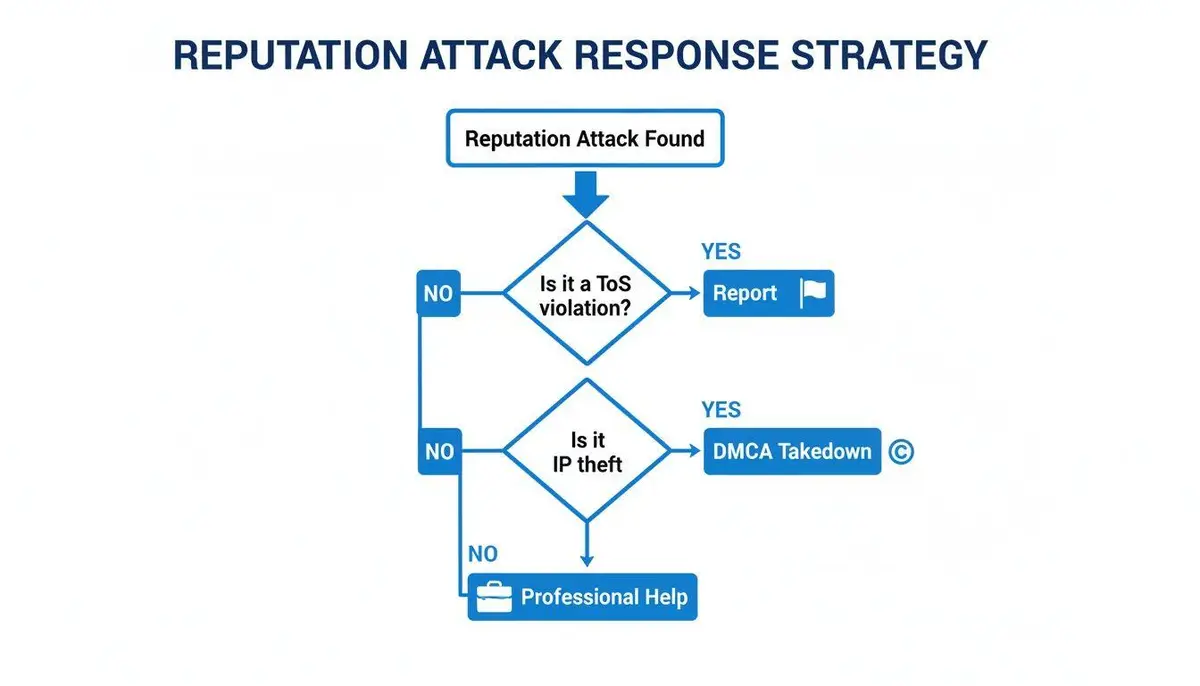
As the model indicates, when basic channels fail or are inappropriate, it is time to engage professional help.
Data supports this approach. For leaked images or mugshots, a legal de-indexing strategy via the Right to be Forgotten has a 92% success rate in EU markets. For urgent attacks like impersonation or non-consensual intimate imagery (NCII), formal reporting channels are critical. In 2026 alone, over 2 million reports of NCII were filed globally through platforms like StopNCII.org.
A specialist firm combines these legal strategies with proprietary technical methods to secure removals. You can learn more about the specific situations where our team can remove damaging online content. This deep expertise is the differentiating factor when facing stubborn negative content and requiring a quiet, effective resolution.
Building a Proactive Digital Defense

Optimal online reputation management is not defensive; it is offensive. A powerful, positive digital presence is your most effective shield, creating a reputational buffer that can absorb the impact of negative events.
This strategy is akin to building a digital fortress. The objective is to create a portfolio of high-authority web properties that you own and control. By doing so, you can dominate the first page of Google for your name so completely that new negative content struggles to gain a foothold. This approach effectively pushes attacks and falsehoods to the second page of search results and beyond, where they become invisible.
Claim Your Digital Real Estate
Your first move is to secure and optimize the web properties that search engines like Google inherently trust. These become the cornerstones of your online narrative. Controlling them is non-negotiable.
You must own the top search results for your name. This requires claiming and meticulously curating a core set of digital assets.
- A Personal Website: This is your digital headquarters. It must feature a professional biography, a high-quality headshot, and a clear summary of your accomplishments. Secure a domain that is your exact name (e.g.,
YourName.com). - A LinkedIn Profile: For any professional, LinkedIn is indispensable. It almost always ranks in the top three search results for a name and serves as your public-facing curriculum vitae and a platform for demonstrating expertise.
- Knowledge Panel: This is the information box that appears on the right side of Google’s search results. By claiming and managing your Knowledge Panel, you can directly influence the photographs, biography, and professional details Google displays to the world.
These assets require ongoing management. You must optimize them for search engines to ensure they consistently outrank potential threats. This involves using your name consistently across all platforms, interlinking your properties, and regularly adding fresh, relevant content.
Shape Your Narrative with Strategic Content
Owning the properties is just the first step. You must then populate them with content that actively constructs the reputation you desire. This is how you transition from defending your turf to defining your public identity.
Social media has dramatically increased the stakes. Research shows that 41% of US adults have experienced online harassment. For executives, the scrutiny is more intense; one report found that 72% of recruiters have rejected candidates based on social media findings.
Your content strategy is the most direct countermeasure to this risk. By consistently publishing thoughtful, positive material, you create a body of work that defines you. This is what partners, investors, and journalists will find when they search your name.
Assume the role of a thought leader. This could involve publishing articles on industry topics, commenting on market trends, or sharing unique insights from your professional experience. The goal is to create a trail of credible, positive information that reinforces your authority. Building a winning social media marketing strategy is integral to this effort, helping you consistently project your desired image.
Maintain Your Fortress
Once this proactive defense is built, maintenance is not a significant time commitment. The key is consistency.
Allocate a small amount of time each month to review and update your primary properties. This keeps them current and signals to search engines that they remain relevant and authoritative. The purpose is to build a reputational buffer that works for you continuously, providing a durable defense against future attacks and securing your professional image for the long term.
Establishing Long-Term Monitoring and Vigilance

The belief that the work is finished after extinguishing an immediate fire is a dangerous miscalculation. Reputation protection is not a one-time project; it is an ongoing discipline. After initial crisis management, the objective shifts from reactive triage to a state of constant readiness.
Threats can emerge at any time. The difference between a minor issue and a full-blown catastrophe is often speed of detection. A robust, long-term monitoring system is the only way to ensure you are never caught unprepared. While free tools can provide a baseline, they are insufficient for anyone with significant assets to protect.
Establish Basic Automated Alerts
Your first line of defense is a set of simple tripwires. Automated alerts are non-negotiable. They constantly scan the public web for mentions of your name, your company, and other critical keywords, serving as your basic radar.
Set up Google Alerts immediately. It is free and will capture a significant amount of public chatter. However, for high-stakes situations, professional services utilizing AI-powered monitoring can secure de-indexing of harmful content in just 24-48 hours. This is critical, as nearly 40% of DIY removal attempts are defeated by the same content being re-uploaded. You can find more on this in academic research about securing your digital footprint.
These basic alerts are valuable for highlighting the gaps in your defenses.
Advance to Professional-Grade Surveillance
The deficiency of basic alerts is their limited scope. They only monitor the surface web. For high-profile individuals, the most severe damage often originates in less visible corners of the internet: closed Facebook groups, private subreddits, obscure forums, and the dark web. Free tools cannot penetrate these areas, leaving you blind to developing threats.
This is where professional monitoring services are essential. They employ sophisticated AI to conduct deep surveillance of these hidden digital spaces. The technology moves beyond simple keyword matching to analyze sentiment and context, distinguishing between a neutral mention and the genesis of a coordinated smear campaign.
A monitoring system that only shows you what is already public is a lagging indicator of a problem. A professional system is a leading indicator, designed to detect threats at their point of origin, before they reach the first page of Google and become exponentially more difficult and costly to remediate.
This level of intelligence actively hunts for:
- Impersonation Accounts: AI can detect fraudulent profiles attempting to impersonate you, even with slight variations in usernames or images, across hundreds of social platforms.
- PII Leaks on the Dark Web: Specialized crawlers continuously search dark web markets for your personal information, from leaked credentials to financial data.
- Emerging Negative Narratives: By analyzing sentiment across thousands of sources, these systems can identify a growing storm of negative comments that signals an imminent PR crisis.
This is the intelligence that enables a proactive, rather than reactive, defense.
Create Your Escalation Playbook
Detecting a threat is one half of the equation; knowing how to respond is the other. Intelligence is worthless without a clear action plan. A pre-defined escalation protocol that dictates who does what for each type of alert removes guesswork and emotion from high-stress situations.
Your playbook must be tiered. A hostile comment on a major news site requires a different response than discovering your home address on a doxxing site. The protocol should define specific actions for each threat type based on its severity and location.
This framework ensures your response is swift, intelligent, and effective every time. It is how you cease to be a reactive target and become the vigilant guardian of your own reputation.
Your Questions Answered: A Look Inside Reputation Protection
Clients often approach us in a state of crisis. Their questions are pointed, specific, and invariably high-stakes. Here are frank answers to the questions we hear most often from executives, public figures, and individuals who find themselves in the digital crosshairs.
How Long Does It Take to Get Negative Content Off Google?
There is no single timeline; the required strategy depends entirely on the nature of the content. A straightforward takedown for a clear violation of platform rules, such as impersonation or harassment, can often be resolved in 24-72 hours.
The true challenges are persistent issues, a negative news article or a defamatory blog post on a site with an uncooperative owner. In these instances, de-indexing the page from Google can be rapid once a solid legal or technical justification is established. However, complete source removal, erasing the page from the internet entirely, is a more complex undertaking that requires careful negotiation or legal action and, consequently, more time.
Rushing the process without a coherent strategy is the worst possible action. It often backfires, making the negative content even more prominent.
An amateur removal attempt is like a poorly executed negotiation; it not only fails but also signals to the other party that you are not a serious threat. A professional, strategic approach ensures the first action is the right one, preserving leverage and maximizing the probability of a quiet, permanent resolution.
Is It Really Possible to Remove a Negative News Article?
Yes, but it is one of the most difficult challenges in reputation management. News organizations are protected by powerful free press laws, so one cannot simply demand a takedown. That approach is only viable if you can prove a clear factual or legal error, such as libel.
Therefore, we employ creative strategies. The most successful approaches include:
- Pitching an update or correction. We can often persuade a publisher to amend an article by presenting new, verifiable information.
- Targeting the search engine. In certain jurisdictions, we can leverage legal frameworks like the Right to be Forgotten (RTBF) to have the article de-indexed from search results.
- Executing a suppression campaign. Here, the focus shifts from removing the negative to promoting the positive. By creating a wave of high-quality, authoritative content, we can push the negative article off the first page of Google, effectively burying it and neutralizing its impact.
What’s the Difference Between De-Indexing and Source Removal?
Understanding this distinction is crucial as it dictates the entire strategy.
Source removal is the final objective. The content is permanently deleted from the website where it was published. It ceases to exist online.
De-indexing is a tactical victory. The content is removed from search engine results like Google, but the page itself remains live at its original URL. A person would need the direct link to view it, which cuts off nearly all public traffic.
Frequently, we will pursue de-indexing first as a rapid containment measure to stop immediate damage. While this is in progress, we work in the background on the more complex, long-term goal of achieving source removal.
This hybrid approach is vital. For businesses, social listening tools can flag 95% of mentions immediately, helping to avert 80% of potential crises. High-net-worth individuals require a more discreet service, such as dark web monitoring and takedowns of fraudulent accounts, which can successfully eliminate 98% of impersonation profiles. You can learn more about the importance of protecting your digital footprint with these strategies.
When facing a threat that standard methods cannot resolve, you need a specialist. At ContentRemoval.com, we merge legal expertise with proprietary removal technology to succeed where others fail. Reach out for a confidential consultation regarding your situation.
Frequently asked questions
Should I reply to a negative post or fake review about me?
No. Engaging with the attacker, posting denials or reasoning with an anonymous account almost always backfires, adds material and signals importance to search engines. Keep the response technical: document evidence and use the platform’s own rules or a legal route to remove it.
Can a negative news article about me be removed?
It is one of the hardest tasks because publishers are protected by press freedoms, so a demand alone rarely works unless there is a factual or legal error. The article describes three routes: pitching an update or correction, de-indexing through the Right to be Forgotten in jurisdictions where it applies, and a suppression campaign that pushes the story off page one.
What is the Right to be Forgotten and does it apply to me?
It is a legal mechanism, mainly in the EU and some other regions, that lets individuals ask search engines to de-index links containing personal information that is outdated, irrelevant or inaccurate. It requires a reasoned request balancing privacy against public interest, and weakly drafted requests are denied.