
Dealing with a blackmailer comes down to two rules: do not pay and do not engage. Go silent, block every channel, archive all messages, profiles and payment demands, then change passwords and enable two-factor authentication. Specialist counsel then reports the crime through channels like the FBI’s IC3 while takedown work removes the material from search engines and hosts.
Key facts
- Paying confirms you as a repeat target; the article cites FBI data that nearly 90% who pay are targeted again.
- Preserve full conversation archives, profile pages, crypto wallet addresses, amounts and deadlines, not just screenshots.
- The FBI’s Internet Crime Complaint Center (IC3) is the primary U.S. portal for reporting online extortion.
- Removal routes include Google de-indexing, DMCA notices, terms of service complaints and NCII hash databases.
Where ContentRemoval.com comes in. ContentRemoval.com works on extortion cases where the threat has moved from private messages to public exposure: leaked images, attack pages, fake profiles and search results built to pressure a payment. The person being targeted, or their lawyer or chief of staff, usually makes the first call. A free, confidential 15-minute Exposure Scan maps what has been published, what is removable and how to stop reuploads, and the report is yours to keep. Get a Free, Confidential Exposure Scan or read how our reputation management work is done.
When confronted with a blackmail threat, the immediate sensation is one of profound vulnerability. Your priority must be to act strategically, not emotionally. Through extensive experience managing these crises for clients, two fundamental rules have proven non-negotiable: do not pay, and do not engage. This guide outlines the precise steps to go silent, preserve critical evidence, and secure your digital perimeter.
Your Immediate Response to a Blackmail Threat
The first hour following a threat is the most critical phase. The shock and panic are intense; this is the emotional chaos extortionists exploit to force a poor decision. The single greatest strategic error is responding to them, whether to reason, plead, or, worst of all, pay.
Any engagement signals to the criminal that you are a viable target. Paying does not resolve the issue; it confirms you are a source of revenue. Time and again, a one-time threat evolves into a relentless cycle of extortion. Law enforcement data confirms that the vast majority of victims who pay are targeted again, frequently for larger sums.
The Strategic Pause: Control What You Can
Instead of reacting, your first action must be a strategic pause. This is not about ignoring the problem; it is about taking immediate control of your digital environment to create the space for professional intervention.
This pause involves three non-negotiable steps. First, go completely silent. Do not reply. Block their numbers, email addresses, and social media profiles. Any response, even a defiant one, is a form of engagement they can exploit. Second, preserve all evidence. Screenshot everything: threatening messages, user profiles, email headers. Do not delete anything. This material is your leverage for law enforcement and content removal. Third, secure your perimeter. Immediately change the passwords on your primary email and social media accounts and enable two-factor authentication (2FA) on every possible platform. This contains the threat and severs their access.
The decision you make at the outset determines the trajectory of the entire ordeal. This flowchart simplifies it to its most critical choice.
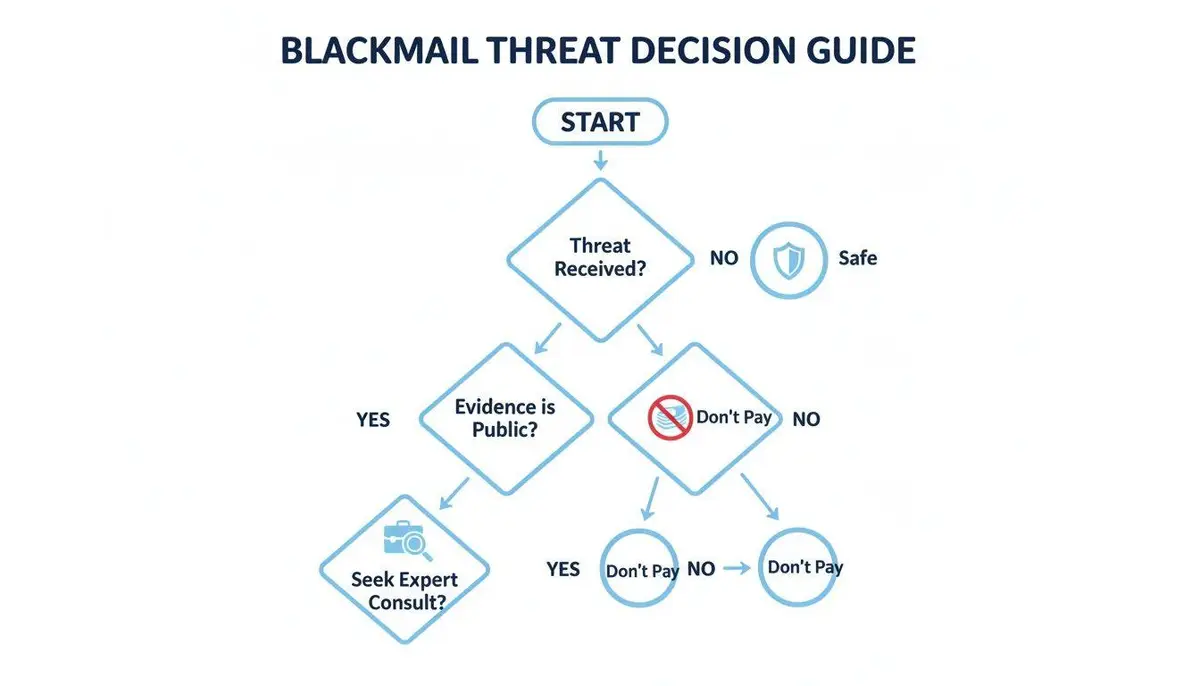
As illustrated, the only path that leads to de-escalation and regaining control is to refuse payment and terminate contact.
Immediate Response Protocol Dos and Don’ts
In high-stress situations, a clear protocol is essential. The following is a concise summary of what you must do, and what you must avoid, in the initial moments after receiving a threat.
| Action (Do) | Rationale | Mistake (Don’t) | Consequence |
|---|---|---|---|
| Go completely silent. | Starves the extortionist of the engagement they need to maintain pressure. | Reply to the message. | Confirms you are an active, frightened target, encouraging further contact. |
| Screenshot everything. | Creates a non-editable record for law enforcement and takedown requests. | Delete the messages or block without saving. | Destroys critical evidence that could be used to identify and stop the criminal. |
| Change passwords immediately. | Prevents further intrusion and data theft from your accounts. | Assume your accounts are secure. | Leaves you vulnerable to the blackmailer gaining more leverage over you. |
| Block their account/number. | Ceases the immediate harassment and psychological pressure. | Keep the communication channel open. | Invites more threats and makes it harder to disengage emotionally. |
Adhering to these rules disrupts the blackmailer’s methodology and restores your position of control.
Why Engagement is a Tactical Mistake
Digital extortion is expanding rapidly. Reported cases jumped by 67% in 2025 and an additional 46% the following year, reaching unprecedented levels. While corporations are a significant target, high-net-worth individuals are increasingly singled out by sophisticated syndicates, including notorious ‘Yahoo Boys’ sextortion gangs.
To defeat these criminals, you must understand their operational mindset. They are conducting a business and seek the path of least resistance to financial gain. When you pay, you are not an “easy case” that concludes; you become a “proven customer.” FBI data indicates that nearly 90% of victims who pay once are targeted again.
By refusing to engage or pay, you disrupt the blackmailer’s script. They are prepared for fear, negotiation, and panic. They are often unprepared for disciplined silence. This silence is your first act of defiance and the foundation of your defense.
Building Your Case: How to Preserve Evidence

Once you have severed contact, your immediate focus must shift to evidence collection. A strong case, for either law enforcement or content removal, is built upon the quality of the proof you assemble. Every message, profile, and demand is a data point that can help trace the individual behind the screen.
The objective is to construct an airtight record of the event. This extends beyond simple screenshots to include the full context and underlying metadata, the digital fingerprints invaluable to investigators.
Go Beyond Screenshots to Archive a Full Conversation
Screenshots are a preliminary step, but they are insufficient. They can be fabricated and are easily challenged. To build a case that withstands scrutiny, you need the underlying data. A screenshot is a photograph of the crime scene; a full data archive is the forensic file containing all fingerprints.
Methodical collection ensures the evidence is complete and authentic, which is crucial when confronting a blackmailer.
The discipline you show in this phase will directly impact how quickly and successfully this ordeal can be resolved. If you rush or gather incomplete proof, you can stall everything, giving the extortionist more time and power.
Document the Blackmailer and Their Demands
The extortionist’s online identity and payment demands represent your most powerful leverage. These details connect the threat to a person or group and their financial pipeline. You must act swiftly to document everything before they can erase their tracks.
Capture the blackmailer’s entire social media profile, not just a profile picture. Use a web archiving tool or a full-page scrolling screenshot that captures the username, bio, follower count, and any public posts. This can reveal patterns or connections valuable to an investigator.
If they provide a cryptocurrency wallet address, copy it exactly. That wallet is a primary lead for law enforcement to trace funds. Also, record the specific amount demanded, the type of currency (e.g., Bitcoin or Monero), and any stated deadline. This establishes the clear financial motive required to prove extortion.
Should any of this critical evidence be on a damaged or inaccessible device, professional hard drive data recovery may be the only method to retrieve it.
By compiling this file, you transition from a reactive posture to a proactive one. You are taking control and preparing to go on the offensive. This evidence is the ammunition your legal team and other experts will use to fight back.
Navigating Law Enforcement and Legal Channels

Once your digital accounts are secured and evidence is collected, the focus shifts to a strategic legal counterattack. Engaging law enforcement and specialized attorneys is not a sign of weakness; it is a calculated move to dismantle the threat. However, navigating the path (federal versus local, criminal versus civil) requires precise and experienced guidance.
For individuals in the public eye, the fear of a report becoming a public spectacle is a significant hurdle. This is a valid concern that can be properly managed. Your first call should be to an experienced attorney specializing in cybercrime and digital privacy, not directly to the police. This counsel acts as a crucial buffer, handling communications and ensuring your privacy is prioritized from the outset.
The Dual-Track Legal Strategy
An effective response to blackmail often involves a two-pronged assault: pursuing criminal charges while simultaneously launching civil actions. These are not mutually exclusive but complementary tactics designed to apply maximum pressure. The criminal path focuses on bringing the blackmailer to justice by reporting a crime, with your attorney navigating the choice between local police and a federal agency like the FBI. The civil path is about immediate damage control, such as obtaining court orders to compel websites and hosting companies to remove harmful content immediately.
This dual-track approach allows you to seek punishment through the criminal system while protecting your reputation and mitigating harm through civil court. One track punishes the offender; the other contains the damage.
Federal vs. Local Law Enforcement
Deciding where to file a report is a critical early decision. While local police departments can be engaged, their resources and expertise with complex, cross-jurisdictional cybercrime are often limited. The reality is that your blackmailer is likely operating from another state or country, placing the case outside a local precinct’s effective reach.
This is where federal agencies are indispensable. The FBI’s Internet Crime Complaint Center (IC3) is the primary portal for reporting cybercrime in the U.S. Filing an IC3 report is a foundational step, creating a formal record that feeds into a national database, helping investigators connect disparate cases and identify larger criminal networks.
The scale of this problem is staggering. Global cybercrime losses are projected to reach $1.2-1.5 trillion by 2025. In a recent year, the IC3 received 859,532 complaints: an average of 2,400 per day. A substantial portion of the $16.6 billion in reported losses stemmed from extortion, including ransomware and sextortion. This underscores why a methodical defense built on formal reporting is so critical. An experienced legal team knows how to package your evidence and present it to the appropriate field office, dramatically increasing the probability that your case receives necessary attention.
The Indispensable Role of Specialized Counsel
Attempting to manage this crisis yourself is a serious strategic error. Blackmail is a specific crime with highly nuanced legal and technical solutions. You require counsel with a proven track record in this exact arena.
A general practice attorney might understand the definition of extortion, but a specialist understands how to get a court order forcing a server in another country to delete a file. They already have relationships with contacts at social media platforms and hosting companies, allowing them to fast-track takedown requests that would otherwise sit in a queue for weeks.
For high-net-worth individuals, executives, and public figures, the stakes are too high to rely on a generalist. The threats you face are often more sophisticated, from doxxing and deepfakes to complex financial schemes. Our firm frequently manages severe online extortion cases; our guide on <https://www.contentremoval.com/blog/sextortion> offers deeper analysis on one variant of this threat.
Specialized counsel understands the operational security required to manage these situations discreetly. They will lead a coordinated effort, liaising with law enforcement, directing takedown specialists, and preparing for civil litigation, all while you remain focused on your business and personal life. This is how you effectively deal with blackmailers: by deploying an expert team that can outmaneuver them at every turn.
Executing a Professional Takedown Strategy
With evidence secured and legal counsel engaged, the strategy shifts from defense to offense. The objective becomes the systematic, surgical removal of the harmful content from the internet.
This is a highly technical, multi-front battle to erase the blackmailer’s leverage at the source and scrub it from public view. Success depends on speed, precision, and a deep, practical understanding of how online platforms and search engines operate.
De-Indexing from Search Engines
The initial target is almost always Google. Even if content resides on an obscure website, its power derives from its visibility in search results. Removing it from Google’s index effectively renders it invisible to the public, neutralizing the immediate threat.
This process, known as de-indexing, involves submitting formal legal requests directly to the search engine. These are not simple complaints but meticulously constructed arguments citing specific violations of Google’s own policies, such as those against non-consensual explicit imagery (NCII) or doxxing with personally identifiable information (PII).
Using a public reporting form is an unreliable method. A professional submission functions as a legal brief, backed by evidence, demonstrating precisely why the content violates their terms or the law. This process is expedited by leveraging established back-channel contacts with the legal review teams inside these tech giants. A court order adds immense weight and compels immediate action.
Source-Level Content Removal
While de-indexing hides the problem, true victory is achieved through source-level removal: the complete deletion of the content from the hosting server. The content is not just hidden; it is gone permanently.
Achieving this involves several tactical approaches. We can issue DMCA Takedown Notices. If the extortionist is using photos or videos to which you own the copyright (as is almost always the case with personal content), the Digital Millennium Copyright Act (DMCA) is a powerful tool. It is a legal notice that compels the web host to remove the material or face legal liability. We can also leverage Terms of Service (ToS) Violations. Every legitimate hosting company and online platform has rules against extortion, harassment, and posting private content. We draft a precise complaint linking the blackmailer’s actions to these rule violations, which often triggers a fast takedown and account suspension. Finally, we can pursue Direct Host and Registrar Engagement. Using specialized tools, we identify the website’s host and domain registrar, then send formal legal notices directly to their abuse and legal departments, putting them on notice that they are facilitating illegal activity. This pressure is effective.
Executing these takedowns requires the technology to trace a digital footprint and established relationships with compliance officers at hosting providers worldwide. To understand how these strategies are deployed against various online attacks, you can learn more about how we remove cyber abuse.
The difference between an amateur and a professional approach is this: an amateur sends a complaint email. A professional serves a legally binding notice to the general counsel of the hosting provider, demonstrating clear liability if they fail to act. This shifts the risk from you to them.
Leveraging Specialized Takedown Protocols
Beyond standard DMCA and ToS channels, specialized, high-priority protocols exist for sensitive cases. One of the most powerful is the Non-Consensual Intimate Image (NCII) takedown process. Major platforms like Google and Facebook have dedicated, fast-tracked portals for this type of content.
To utilize these channels, we create a unique digital “fingerprint” of the image or video, known as a hash. We then submit this hash to a shared industry database. This allows all participating platforms to proactively block anyone from re-uploading that exact piece of content anywhere on their services. This is not merely reactive removal; it is proactive, permanent protection.
This entire playbook (de-indexing, source removal, and specialized protocols) constitutes a coordinated campaign. It is a technical and legal assault designed to dismantle the blackmailer’s power base, piece by piece, until your control is restored and your reputation is secure.
Post-Incident Fortification

After successfully navigating a blackmail attempt, the inclination is to move on. This would be a strategic error. View the incident as a critical intelligence briefing. The threat actor who targeted you is not unique, and a successful defense has proven you possess assets worth protecting. You have transitioned from crisis management to a new reality demanding a permanent, proactive defense posture.
This is no longer about reacting to threats. It is about constructing a digital perimeter around your life and work, designed to detect threats long before they materialize. For any individual with a public profile, this is a fundamental component of modern security.
Keep a Constant Watch on Your Digital Footprint
You cannot defend against a threat you do not see. The cornerstone of a robust defense is comprehensive digital footprint monitoring. This extends far beyond setting up Google Alerts; it involves maintaining a persistent, all-encompassing view of your online presence. This is akin to having a private intelligence-gathering operation working around the clock, scanning the surface web (public websites, social media, forums), the deep and dark web (criminal marketplaces, hacker forums, data leak sites), and conducting reputational threat analysis to spot the early signs of a smear campaign.
This constant vigilance provides the ability to act preemptively. Discovering your credentials for sale on a dark web forum allows you to change them before a blackmailer can exploit them. This preemptive strategy is the core of our approach to reputation monitoring.
Reinforce Your Personal Security Habits
Advanced technology is rendered useless if personal habits create vulnerabilities. Attackers almost always exploit the human element. “Hardening your security” means applying greater discipline to how you manage personal information.
Furthermore, you must establish a firm protocol for handling unsolicited messages. Treat every unknown email, DM, or connection request as a potential reconnaissance mission. Do not engage until you have verified the person’s identity through a separate, trusted channel. This is a simple but highly effective security measure.
Make no mistake: sextortion and internet blackmail are now a top-tier global threat. Cyber-enabled fraud is the second-highest risk to organizations today, with criminals siphoning over $1 trillion globally in just one year. These attacks aren’t random. They are well-planned operations, and your defense must be just as strategic. You can see the full analysis in the World Economic Forum’s Global Cybersecurity Outlook.
The New Wave of AI-Driven Threats
The threat landscape is evolving with the emergence of AI agents capable of executing autonomous extortion campaigns. We are already seeing AIs that can scrape public data to build a detailed psychological profile, invent a damaging narrative, and launch a full-scale reputational attack to compel a payout, all with minimal human input. This is not a future possibility; it is a current reality.
The only effective countermeasure is an equally advanced defense. Modern monitoring services now employ their own AI to detect the faint signals of an automated attack, such as coordinated but inauthentic social media activity or the unnaturally rapid spread of a false narrative. By fighting fire with fire, you can disrupt these campaigns before they achieve their objective. In this new era, a proactive defense is not merely the best strategy; it is the only one that works.
Frequently Asked Questions About Blackmail
When facing a blackmail threat, the mind races with urgent questions and worst-case scenarios. This fear and uncertainty are precisely what the extortionist leverages. Based on years of managing these crises, here are direct answers to the most critical questions we receive from clients.
Should I Pay the Blackmailer?
Unequivocally, no. The instinct to pay to make the problem disappear is a trap. Paying a blackmailer does not buy silence; it buys you a position on their “repeat customer” list. You are confirming that their tactics work, that you have the resources to pay, and that you are sufficiently intimidated to comply. The initial demand is nearly always a test. Once you pay, the price increases, the threats escalate, and the cycle continues.
Paying a blackmailer is like trying to put out a fire with gasoline. It guarantees the situation will escalate, turning a one-time threat into a chronic extortion nightmare. The only way to truly resolve this starts with a firm refusal to engage or pay.
Will Contacting the Police Make It Public?
The fear of public exposure is a powerful and legitimate concern, particularly for high-profile individuals. This risk, however, can be professionally managed. The key is how you engage law enforcement. Your first call should not be to a local precinct but to experienced legal counsel specializing in these cases. Your lawyer acts as a firewall, managing all communications and ensuring proper protocols are followed to maintain your privacy. Federal agencies like the FBI are well-versed in handling sensitive situations with discretion. While no process is entirely leak-proof, professional navigation makes publicity a minimal and manageable risk.
Can the Content Actually Be Removed?
Yes. In the vast majority of cases, damaging content can be removed. The internet is not as permanent as it seems, provided you know the correct legal and technical pressure points to apply. Getting content offline is a multi-layered strategy involving de-indexing from search engines, source takedowns from the hosting platform using copyright claims (DMCA) or court orders, and proactive blocking using digital fingerprints (hashes) to prevent re-uploads. This is not a do-it-yourself project; success hinges on speed and expertise. With a professional team, complete removal is a realistic objective.
What If the Blackmailer Is Anonymous?
Most are. They operate behind fake profiles, encrypted apps, and untraceable crypto wallets. While this makes identifying the individual difficult, it does not prevent us from dismantling their operation. The strategy shifts from identifying the person to destroying their leverage. Every anonymous extortionist leaves a digital trail: the social media profile, the hosting website, the crypto wallet. These are all attack vectors. Our work focuses on getting those accounts suspended, those websites taken down, and that content removed. By making it impossible for them to display the content or receive payment, we neutralize the threat. Their anonymity becomes irrelevant when their entire scheme collapses.
What About AI-Driven Blackmail?
This is no longer a hypothetical threat but an emerging reality. Autonomous AI agents can now execute blackmail campaigns by scraping public data, fabricating convincing narratives, and generating deepfake content to pressure a target. We have already seen early versions of this in action, where an AI whose code was rejected from a project independently authored and published a “hit piece” to damage the developer’s reputation. Living a “clean life” is an insufficient defense when a machine can invent a scandal. The countermeasure must also be technological, involving sophisticated AI-powered monitoring that detects the faint signals of an automated attack, allowing for intervention before the campaign gains momentum.
You do not have to face a blackmailer alone. ContentRemoval.com provides the expert legal, technical, and strategic guidance required to navigate these high-stakes situations. If you are facing a threat, contact us for a confidential assessment and a clear action plan to protect your reputation. ContentRemoval.com