
Family office cybersecurity reputation is the recognition that a breach and a reputational event are the same risk file. Attackers breach the digital wall first, then monetize it by leaking correspondence, impersonating advisers or feeding disputes. Protection needs one accountable owner, OSINT reduction, vendor tiering, layered controls, and an incident playbook that runs takedowns and de-indexing alongside forensics.
Key facts
- Deloitte found 43% of family offices suffered a cyberattack in 12 to 24 months; only 26% rate response plans effective.
- A 2025 report found 68% of reputation and physical security incidents were preceded by OSINT gathering.
- Vendors such as law firms, accountants and concierge providers form part of the perimeter and need tiered scrutiny.
- The first hour should open an online remediation track in parallel with containment, not after it.
Where ContentRemoval.com comes in. ContentRemoval.com is the reputation track in a family office incident: locating where leaked material has surfaced and been mirrored, running platform, host and search-level takedowns, shutting down impersonation profiles and monitoring for reappearance while counsel and forensic responders handle their lanes. The chief of staff, general counsel or the family’s security adviser usually makes contact. A free 15-minute Exposure Scan maps what is removable and the report is yours to keep. Get a Free, Confidential Exposure Scan or read how our reputation management work is done.
At some point, every new family office principal has the same uneasy realization. The office may control complex structures, sensitive communications, private travel, household staff, legal disputes, philanthropic activity, and multiple operating businesses, yet the public still sees only one thing when trouble surfaces. The family name.
The breach itself is rarely cinematic. A finance lead approves the wrong request. A principal’s assistant opens the wrong attachment. A vendor account is compromised, then used to reach shared folders and private correspondence. Hours later, screenshots begin circulating in private groups, search results start changing, and a technical incident turns into a reputational event.
That is why family office cybersecurity reputation can’t be treated as a narrow IT issue. If you manage wealth across generations, your cyber posture and your public exposure sit in the same risk file. Separate them, and you’ll underinvest in both.
The Inevitable Intersection of Cyber Risk and Reputation
A principal wakes early, checks a secure tablet, and sees a message from counsel. Private internal emails have appeared online overnight. The initial compromise looks mundane. A phishing email reached an executive assistant, credentials were captured, and a cloud account was accessed long enough to pull correspondence, beneficiary details, and draft legal material. The technical failure lasted minutes. The reputational fallout may last years.

This is the mistake many family offices make at formation. They assume cyber risk means system uptime, password rules, and insurance forms. It doesn’t. In practice, a breach means family conflict exposed to outsiders, counterparties questioning discretion, adversaries harvesting context for further attacks, and online material becoming discoverable by journalists, litigants, activists, competitors, and estranged insiders.
Why this is no longer a low probability problem
The sector is already being hit with frequency that should end any debate. According to a 2024 Deloitte survey of family office cybersecurity, 43% of family offices globally have suffered at least one cyberattack in the past 12 to 24 months, with North America at 57%. Only 26% say their incident response plans are effective. That gap is the main issue. Attack rates are high. Response maturity is not.
A family office doesn’t need to be publicly prominent to be vulnerable. In many cases, privacy itself creates weakness. Lean internal teams, fragmented advisors, and informal workarounds often produce a false sense of control. The office may be discreet in public and porous in operation.
The first indicator often isn’t technical
In family office matters, the first sign of compromise is often reputational. A suspicious article appears. A manipulated account contacts a banker. A search result indexes leaked material. A fake social profile goes live using genuine family details. If you’re not already running reputation monitoring for family offices and principals, you’re waiting to learn about a cyber event from the public side of the damage.
Practical rule: If a cyber incident can alter what a counterparty, family member, or journalist sees online, it belongs on the reputation agenda from day one.
The Dual Threat to Family Office Integrity
A modern family office protects two assets at all times. The first is obvious. Capital, structures, transactions, and the operational machinery around them. The second is easier to undervalue until it’s damaged. Reputational capital, meaning discretion, credibility, trust with counterparties, internal cohesion, and confidence that the office can act without attracting unnecessary attention.
Treat those as two walls of the same fortress.
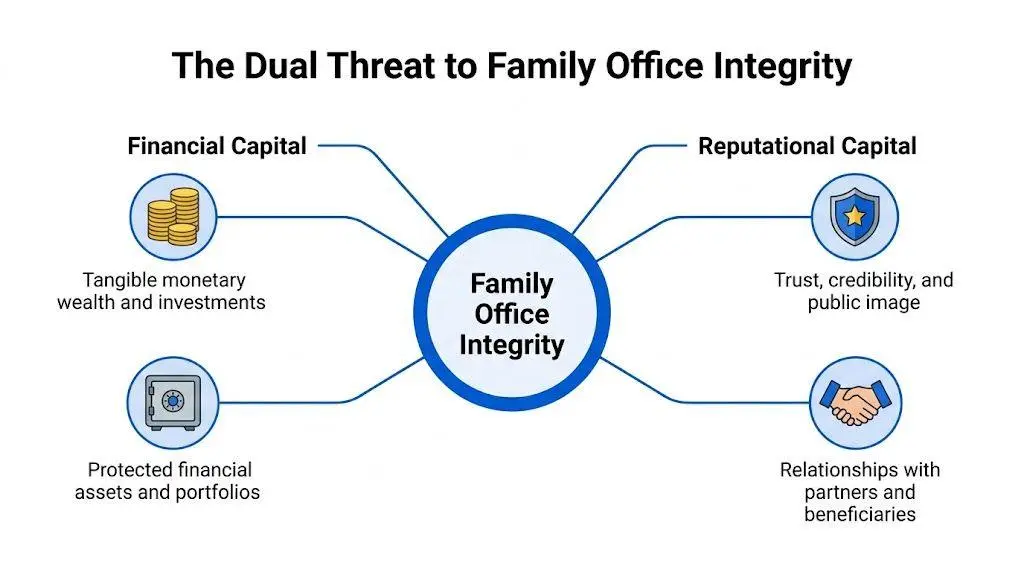
Two walls, one attack path
Attackers usually breach the digital wall first because it’s cheaper, faster, and easier to automate. But they often monetize the attack by collapsing the public wall. Stolen material becomes a source of influence. Private correspondence becomes embarrassment. Contact lists become phishing infrastructure. Internal disagreements become selective leaks.
The office then faces two separate but linked problems.
| Asset under attack | Immediate consequence | Secondary consequence |
|---|---|---|
| Financial capital | Access disruption, fraud attempts, data theft | Operational interruption and higher legal exposure |
| Reputational capital | Public embarrassment, rumor, impersonation | Lost trust, strained relationships, weakened negotiating position |
The second column is where principals often focus first. The third column is where significant damage accumulates.
What attackers are really trying to control
Most principals still think in terms of theft. That is too narrow. Attackers increasingly want influence. They want to shape how others interpret your office, your family, and your internal dynamics.
They may use stolen material to do any of the following:
- Pressure the family privately: Leak samples, threaten wider publication, and force payment or concessions.
- Disturb external relationships: Contact banks, lawyers, or portfolio company executives with enough real context to appear credible.
- Escalate disputes: Feed documents into litigation strategy, commercial rivalries, inheritance tensions, or activist narratives.
- Create confusion: Launch impersonation campaigns, deepfake content, or edited screenshots that exploit the credibility of real information.
That last point matters more than many principals realize. Once genuine data has been stolen, fabricated material becomes easier to believe.
The technical intrusion opens the door. The reputational narrative does the real work.
Why trust is the ultimate target
A family office runs on controlled access and selective disclosure. Your counterparties don’t expect celebrity. They expect restraint, competence, and secure handling of sensitive matters. Once that expectation weakens, every relationship gets more expensive to manage.
Vendors ask more questions. Lenders hesitate. Co-investors become cautious. Family members stop using approved channels and create more shadow communications. Advisers limit what they put in writing. The office gets slower, noisier, and less governable.
That is why family office cybersecurity reputation should be treated as a single board-level issue. Not because every incident becomes public, but because every meaningful cyber incident carries reputational blast radius whether it reaches the front page or not.
Fortifying Governance and Proactive Digital Hygiene
Most family offices begin in the wrong place. They buy tools before they define authority. They add software before they set reporting lines. They outsource fragments of security without deciding who owns principal risk, household risk, executive risk, and advisor risk across the full operating environment.
Governance comes first because cyber failures in family offices are usually coordination failures wearing a technical disguise. The office isn’t breached only because a filter missed an email. It’s breached because no one set a firm rule for executive communications, no one controlled data sprawl across advisors, and no one treated publicly available family information as an attack surface.
Governance before gadgets
You need one accountable decision-maker for digital risk, even if execution is outsourced. That person should have clear authority over access standards, incident escalation, vendor onboarding, family education, and online exposure reduction. If responsibility is split informally between a chief of staff, a personal assistant, an external IT provider, and outside counsel, the office doesn’t have governance. It has wishful thinking.
A defensible governance model usually includes:
- Defined authority: One senior owner of cyber and digital reputation risk, with direct access to the principal or governing committee.
- Clear policy boundaries: Separate rules for office staff, household staff, principals, and NextGen members, because their behaviors and exposures differ.
- Mandatory escalation triggers: Any sign of impersonation, exposed credentials, leaked documents, or suspicious public content should trigger the same response path every time.
- Advisor alignment: Lawyers, accountants, wealth managers, concierge teams, and security providers need compatible handling rules for sensitive data.
The strongest offices don’t confuse privacy with silence. They document expectations precisely and enforce them discreetly.
OSINT is the front door most families ignore
Open-source intelligence, or OSINT, is how adversaries build attack plans from public scraps. Property records, charity pages, LinkedIn biographies, event photos, school posts, travel hints, press coverage, and data broker listings all create usable context. A well-crafted phishing email doesn’t need broad access if it already knows who travels with whom, which entities are active, and which assistant approves wire instructions.
The risk is not theoretical. A 2025 family office security report found that 68% of reputation and physical security incidents targeting family offices were preceded by OSINT gathering, while fewer than 20% deploy OSINT monitoring or suppression services. That is a serious governance failure, not a niche technical issue.
Digital hygiene for principals and NextGen
Digital hygiene isn’t a lifestyle preference. It’s a control environment. Principals and younger family members often create the richest OSINT trail without meaning to. A tagged event photo can expose location patterns. An uploaded document can retain metadata. A charity board page can reveal family relationships, business affiliations, and naming conventions used in internal accounts.
The baseline discipline should include the following:
- Data scrubbing: Remove home addresses, phone numbers, relatives, and historical identifiers from data broker and people-search systems where possible.
- Metadata cleaning: Strip location and device metadata from images, PDFs, decks, and media shared publicly or with broad external circulation.
- Profile review: Audit biographies, social accounts, foundation pages, and archived mentions for unnecessary detail that strengthens impersonation attempts.
- Leak exposure checks: Monitor whether personal identifiers, credentials, or related accounts appear in publicly exposed datasets.
A practical starting point is a structured household privacy review such as this framework for online privacy protection for high-profile families.
Advisory note: If your family office can be mapped accurately by reading public material for an afternoon, an attacker can do the same before writing the first phishing email.
Training has to fit the family office reality
Generic corporate awareness training won’t solve this. Family offices need scenario-based education tied to their actual risks: invoice fraud, advisor impersonation, luxury service provider compromise, travel schedule harvesting, and deepfake voice or video requests. Household staff, family members, executive assistants, and finance personnel should not receive identical training because they do not face identical attack patterns.
The office should also normalize reporting without embarrassment. Staff need to escalate suspicious events quickly, even when they clicked, replied, or nearly approved something. Fear delays reporting. Delay worsens impact.
Integrating Technical Controls and Vendor Risk Management
Once governance is in place, technical controls become far more effective because they serve a defined operating model. Without that foundation, tools get installed unevenly, exceptions multiply, and attackers find the old systems, the forgotten accounts, and the advisors who were never fully onboarded.
The family office environment is especially exposed because it tends to be small in headcount, broad in responsibility, and dependent on outside firms. That mix creates two predictable weaknesses. First, legacy systems linger because replacing them isn’t anyone’s top priority. Second, trusted vendors get broad access because the office values convenience and continuity.
The control stack that actually matters
A sensible technical posture is layered. Not flashy. Layered. You need visibility into endpoints, strong access control for privileged users, encrypted handling of sensitive information, and segmented systems so one compromised account doesn’t expose everything at once.
The following controls deserve immediate attention:
- Endpoint detection and response: Laptops, mobile devices, and executive endpoints need active monitoring, not just basic anti-malware.
- Privileged access management: Administrative rights should be restricted, reviewed, and separated from daily use accounts.
- Encryption in storage and transit: Sensitive files, communications, and archives should be protected in a way that limits usefulness if data is exfiltrated.
- Backup discipline: Backups must be recoverable and protected from the same compromise path as production systems.
- Access review cadence: Shared drives, file rooms, investor materials, legal archives, and advisor portals need recurring permission reviews.
These controls are not excessive for a family office. They’re proportionate to the concentration of risk.

Legacy systems and AI-enabled deception
Weak recovery capability often starts with old infrastructure and poor user confidence. According to reporting on family office cybersecurity risks in Wealth Management, 72% of family offices believe they are targeted for their wealth, 67% say legacy systems hinder recovery from breaches, 83% worry about deepfakes, and only 60% are confident employees can detect AI-powered attacks.
That combination is dangerous. Offices know they’re attractive targets, know their recovery posture is constrained, and still overestimate staff readiness to identify synthetic impersonation. A principal hearing a familiar voice on a voicemail or seeing a convincing message from an adviser may assume authenticity because the context is accurate. Attackers exploit that assumption.
Your supply chain is part of your perimeter
Most family offices don’t lose control through a spectacular direct attack. They lose control through a connected party with weaker discipline. Law firms, accountants, concierge providers, estate managers, philanthropic consultants, wealth platforms, and external assistants often hold enough information to become a viable entry point.
A mature vendor review should classify third parties by the sensitivity of data they access and the functions they can influence. If you want a useful external reference, this guide to a robust vendor risk management process is a practical framework for formalizing tiers, due diligence, and ongoing review.
A simple classification model works well:
| Vendor tier | Typical examples | Required scrutiny |
|---|---|---|
| High risk | Legal, accounting, wealth platform, IT provider | Contractual security terms, evidence review, ongoing monitoring |
| Medium risk | Travel, household tech, payroll, concierge | Access limitation, policy alignment, periodic reassessment |
| Low risk | Limited-scope service vendors | Minimal data sharing and narrow permissions |
Contracts need operational teeth
Too many vendor agreements mention confidentiality and say almost nothing useful about security execution. That is a drafting problem. Your contracts should address incident notification speed, data retention, subcontractor controls, access revocation, and cooperation in removals or takedowns if exposed content surfaces online.
If a vendor can touch your data, that vendor can affect your reputation.
Family office cybersecurity reputation rises or falls on this point. You are not only defending your office. You are defending every pathway through which your office can be described, impersonated, or exposed.
The Unified Incident Response and Reputation Recovery Playbook
Most incident response plans fail family offices for one reason. They’re written as technology documents. Real crises don’t unfold that way. The first hour of a serious incident isn’t just about logs and forensics. It’s about preserving privilege, deciding who speaks for the office, controlling further exposure, and stopping harmful material from spreading across search results, social platforms, messaging channels, and leak sites.
A family office needs one integrated playbook that combines technical response, legal decision-making, stakeholder communication, and online damage control at the same time. Anything less creates delay, duplication, and contradictory action.
The problem with siloed response
The readiness gap remains severe. As noted in this analysis of Deloitte’s family office findings, 43% of family offices have faced a cyber incident and 31% lack any cyber incident response plan. The same analysis highlights another issue that deserves more attention. Most guidance still focuses on technical mitigation and not enough on post-breach reputation repair such as de-indexing leaked material or removing defamatory content.
That omission is costly. Once harmful content begins to spread, every hour matters. Search engines index. Aggregators republish. Adversaries mirror content. Journalists and counterparties begin to investigate before the office has settled its facts.
Minute one through hour four
The opening window should follow a disciplined sequence, but not a linear one. Several actions have to run in parallel.
- Confirm and triage the incident.
Validate whether the event is a compromise, a leak, an impersonation campaign, or a blended attack. Identify which systems, individuals, and external channels are involved. Preserve evidence immediately. - Contain the active threat.
Reset compromised accounts, suspend risky sessions, isolate affected devices, and lock down shared repositories that may be exposed. Do this under legal oversight where appropriate so evidence handling doesn’t become sloppy. - Activate the crisis cell.
This should include technical lead, outside counsel, principal decision-maker, communications lead, and reputation response capability. Not later. Immediately. - Open the online remediation track.
If leaked files, fake profiles, manipulated media, or copied documents are already circulating, start takedown and suppression work at once. A practical route for this includes content removal and de-indexing support for harmful online material.
What the reputation track should do in parallel
The reputation track is not public relations theater. It is evidence-based operational work.
It should include:
- Source identification: Determine where harmful material first appeared and where it has already been mirrored or indexed.
- Takedown workflow: Submit platform, host, and search-level requests where grounds exist, and preserve records of each submission.
- Impersonation response: Secure usernames, report fraudulent profiles, and document account abuse for platforms and counsel.
- Stakeholder communications: Prepare controlled, accurate messages for banks, co-investors, family members, and key advisors before they hear distorted versions elsewhere.
- Search result strategy: Assess whether current results are already changing and whether additional factual, controlled assets need to be strengthened over time.
One of the few times speed outranks elegance is in online exposure control. Perfect language can wait. Preservation and suppression cannot.
A leaked document isn’t just a legal problem once it appears online. It becomes a search problem, an impersonation problem, and a trust problem.
Recovery is not the end of the matter
After containment and visible cleanup, the office still has to finish the job properly. That means a genuine post-mortem, revised controls, and a review of what the incident revealed about family visibility online. If the attack exploited public breadcrumbs, your response must include counter-OSINT measures. If the damage spread through search indexing or copied posts, your recovery plan must include sustained monitoring and follow-up removals.
This is also the point where specialized external support becomes sensible. Law firms handle privilege and legal remedies. Technical responders handle forensics and containment. Reputation specialists handle online discovery, suppression, de-indexing, source removal coordination, and persistent monitoring for reappearance. Those functions are distinct. They should be coordinated, not confused.
Used properly, that model is not over-engineering. It’s the minimum competent response for a family office with a meaningful name to protect.
Anatomy of a Modern Family Office Reputational Crisis
The easiest way to understand the failure pattern is to look at a plausible scenario. Not a dramatic outlier. A routine modern mess.
The Smith Family Office runs lean. It has trusted legal counsel, a capable accountant, one internal operations lead, and an outsourced IT provider. The principal believes the office stays below the radar. The family itself is more visible than he admits. A daughter posts regularly, a son sits on charity boards, and several household and travel relationships are easy to map from public information.

The quiet opening failure
The initial compromise doesn’t occur inside the office. It starts with a third-party luxury service provider used by a family member. Credentials tied to that relationship are exposed elsewhere, then reused against an email account with overlapping patterns. From there, an attacker gains access to correspondence with assistants, travel details, and draft documents related to a sensitive family matter.
No one notices immediately because the office lacks any meaningful OSINT monitoring and doesn’t track whether family-related data is surfacing outside controlled systems. By the time unusual messages are spotted, screenshots have already been shared privately.
The response goes sideways
The office calls IT first. That part is reasonable. The mistake comes next. IT focuses on password resets and mailbox review. Legal isn’t informed promptly because no one wants to “overreact.” Communications is brought in even later because the principal still thinks this is a contained systems issue.
That delay creates three separate failures:
- Discovery failure: Nobody checks search indexing, fake profiles, or reposts while harmful content is beginning to travel.
- Coordination failure: Lawyers, technical responders, and communications professionals operate from different fact sets.
- Narrative failure: External stakeholders begin asking questions before the office has a controlled statement or direct outreach plan.
A breach can survive operationally and still fail reputationally. This office proves it.
Public indexing changes the case
The situation worsens when leaked material reaches pages that search engines can crawl. At that point, the problem is no longer limited to whoever received the screenshots first. A family dispute that should have remained private becomes discoverable. A rival in a commercial negotiation gains an advantage after seeing references to internal liquidity pressure. Family members begin blaming each other for social exposure.
This kind of escalation is easier to grasp in visual form:
The most painful part is that the crisis was not caused by one catastrophic technical flaw. It was caused by a chain of ordinary omissions. Too much public information. Too much trust in a connected vendor. No integrated incident team. No takedown plan. No search awareness. No recognition that cyber and reputation were always the same problem.
What would have changed the outcome
An office using the unified playbook would have acted differently. It would have treated the vendor ecosystem as part of the perimeter, reduced public breadcrumbs before the incident, escalated counsel and reputation response immediately, and moved to suppress online exposure while technical containment was underway.
The lesson is simple. Family office reputational crises don’t usually arrive fully formed. The office assembles them, one unmanaged weakness at a time.
Beyond Defense Building a Resilient Digital Legacy
A serious family office doesn’t manage wealth with a one-time decision. It manages it through discipline, review, and correction. Digital risk works the same way. If your office treats cybersecurity as a yearly checklist and reputation as something to address only after embarrassment, you are preserving neither capital nor legacy.
Resilience comes from integration. Governance defines who owns the risk. Technical controls reduce the chance of compromise. Vendor oversight limits inherited exposure. Incident response coordinates the first critical hours. Reputation recovery prevents a contained event from becoming a permanent public artifact. Remove any one of those elements and the structure weakens fast.
What principals should insist on now
At minimum, a principal should require three things.
First, a realistic assessment of digital exposure across the office, the household, and the family footprint. That includes public data, not just internal systems.
Second, a response model that joins technical, legal, and reputational action from the start. Separate workstreams are fine. Separate strategies are not.
Third, outside specialists who understand that online exposure doesn’t behave like a conventional legal or PR issue. Harmful material gets copied, indexed, remixed, and rediscovered. If you don’t have people who know how to remove, suppress, and monitor it, you’re leaving the final stage of the crisis unmanaged.
Legacy protection is not a branding exercise
For family offices, reputation is often discussed too softly. It gets framed as image, perception, or communications. That understates the matter. The family name affects trust, access, pricing, cooperation, discretion, and continuity across generations. Once compromised online, it can alter opportunities long after the immediate technical breach is closed.
The objective isn’t to look polished. It’s to remain governable, trusted, and hard to exploit.
The offices that handle this well don’t chase perfect invisibility. They build controlled visibility, disciplined privacy, and a response capability that can act before a leak becomes a permanent digital record. That is what resilient stewardship looks like now.
If your family office needs a discreet review of cyber exposure, online vulnerability, leaked-content risk, or post-incident reputation strategy, start with a confidential assessment from ContentRemoval.com. The right brief should identify where your digital footprint is creating unnecessary disadvantage for the family, what can be suppressed or removed, and how to align legal, technical, and reputational response before the next incident tests your office in public.
Frequently asked questions
Why is a family office cyber breach also a reputation problem?
Because stolen material is usually monetized through influence rather than theft alone. Leaked emails become embarrassment, contact lists become phishing infrastructure and internal disagreements become selective leaks. Once genuine data is out, fabricated material becomes easier to believe, and counterparties, lenders and journalists start asking questions.
What is OSINT and why does it matter for family offices?
Open-source intelligence is the collection of publicly available scraps such as property records, charity pages, event photos, LinkedIn bios and data broker listings into a usable map. Attackers use it to craft credible phishing and impersonation. Reducing that public footprint and monitoring it is a governance task, not a technical nicety.
Who should own cyber and reputation risk in a family office?
One senior decision-maker with direct access to the principal or governing committee, even if execution is outsourced. That person controls access standards, escalation triggers, vendor onboarding, family education and online exposure reduction. Splitting the role informally between a chief of staff, an assistant, an IT provider and outside counsel leaves nobody in charge.