
An executive communication plan is a control system, not a publishing calendar. It sets who speaks, which channel is authorized, what stays internal and what must be cleared before release. Its core is a message bible of approved facts, red-line phrases and holding language, a fixed legal and reputation review path, and a crisis protocol with named roles.
Key facts
- Map audiences as a risk analyst would: ask what each group could misunderstand, misstate or escalate.
- Stress-test every message for accuracy, consistency with prior statements and how one sentence reads when screenshotted.
- Crisis protocol triggers: a credible media inquiry, a verified leak of material information, or a fast-moving allegation.
- Measure output, outcome and impact; sends and opens prove activity, not comprehension or reduced exposure.
Where ContentRemoval.com comes in. ContentRemoval.com runs alongside the communications plan when false or unlawful material is already circulating: evidence preservation, takedown assessment, platform escalation, de-indexing and monitoring so the message team is not reassuring stakeholders while nobody knows where the damaging content lives. General counsel, a chief of staff or the communications lead usually makes contact. A free 15-minute Exposure Scan maps what is removable and the report is yours to keep. Get a Free, Confidential Exposure Scan or read how our reputation management work is done.
The call comes before dawn. A reporter says they’re preparing a story. An employee has forwarded a confidential note. Investors are asking whether leadership still has control. Your general counsel wants every word reviewed. Your communications lead wants speed. Your board wants certainty.
That is when most executives discover they don’t have an executive communication plan. They have habits, drafts, and a few trusted lieutenants. Under pressure, that isn’t a system. It’s exposure.
Beyond Announcements The Plan as a Defensive Shield
Reactive communication creates two problems at once. First, it slows decision-making because every message turns into a debate. Second, it creates inconsistencies that opponents, reporters, plaintiffs’ lawyers, and hostile commentators can exploit.
Most executives still underestimate this. They treat the executive communication plan as an internal publishing calendar. That’s too shallow. In a high-stakes environment, the plan is a defensive control mechanism. It tells your organization who speaks, what gets said, what stays internal, which channel is authorized, and what must be cleared before distribution.
Why the absence of a plan becomes expensive fast
Poor communication doesn’t just irritate staff. It burns time, salary, and trust. Axios HQ reports that a single employee earning between $50,000 and $100,000 can lose 35+ working days per year because of ineffective communication, which equals about $10,140 in annual salary loss per employee. For leadership, that isn’t a culture issue. It’s an operating risk.
When communication fails at the top, everyone else starts improvising. The board hears one version. managers hear another. Employees fill gaps with rumor. External stakeholders notice the drift before leadership does.
Practical rule: If your message requires cleanup after release, the failure happened before distribution.
That is why a serious executive communication plan should sit alongside legal review protocols, escalation procedures, and governance controls. If your company is also managing automation, data handling, or executive use of AI systems, this guide to executive AI governance is worth reading because the same discipline applies. Define authority, define risk, define approved use, and remove ambiguity before it becomes liability.
Control the narrative before someone else does
The plan’s first job is not engagement. It’s control. You need a structure that prevents unvetted statements, reduces internal contradiction, and keeps sensitive facts from leaking through casual channels.
That matters even more when your reputation is already under strain. Once a false or distorted version of events starts circulating, the window to impose clarity narrows. At that point, communication and reputation defense become inseparable. Executives dealing with active scrutiny should think in terms of controlling the online narrative, extending their efforts beyond issuing updates.
A weak plan produces noise. A strong one creates command. That distinction is what protects credibility when scrutiny turns hostile.
Laying the Foundation for Communication Control
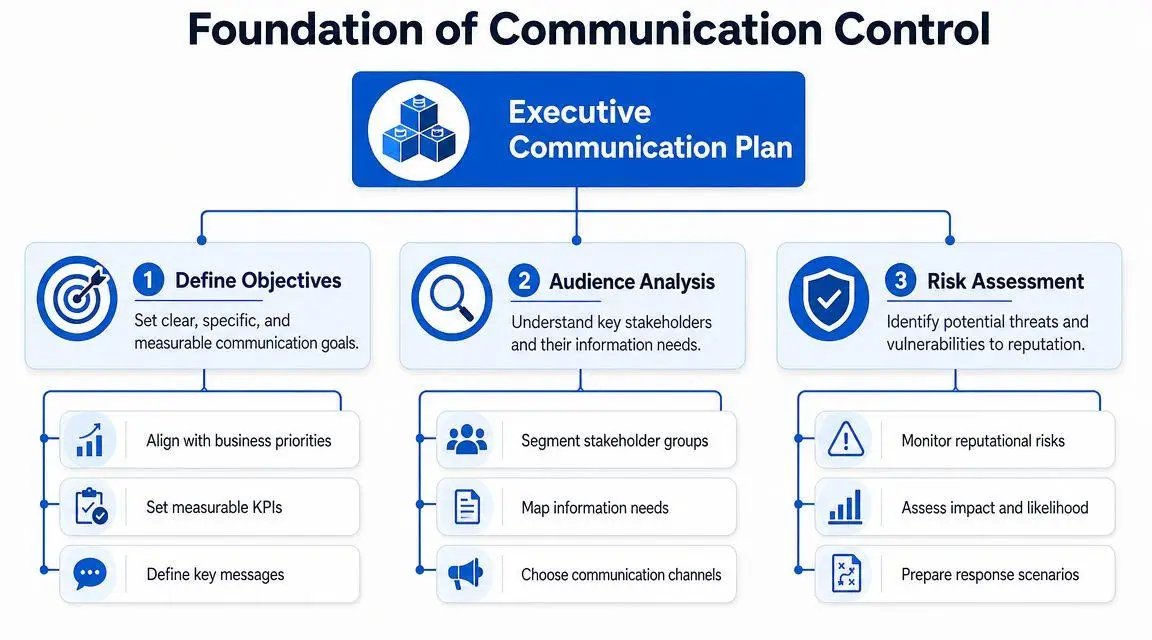
Most communication plans fail before the first message goes out. They fail at the objective-setting stage because leadership uses vague language that can’t be defended, measured, or enforced. “Improve transparency” sounds harmless. It also gives you no standard for deciding what must be shared, what can wait, and what should remain restricted.
A defensible executive communication plan starts with disciplined scope. Narrow the priorities. Define the audiences. Decide where ambiguity is unacceptable.
Set objectives you can enforce
An effective executive communication plan is a stepwise system: define priorities, map audiences, match messages to channels, set a sustainable cadence, and measure comprehension. Poppulo’s guidance adds a point most executives resist but need to hear. The hardest part is deciding what not to talk about.
That is exactly right.
Your objective should never be broad disclosure. Your objective should be controlled understanding. That means each audience gets the information required for its role, not a mass dump of context that creates confusion, discovery risk, or leaks.
A useful planning reference is this template for internal communications planning. Use it as a structural aid, not as your strategy. A template won’t tell you what must remain privileged, what should be limited to leadership, or which audience is likely to weaponize partial information.
Map audiences like a risk analyst
Treat audience mapping as a threat assessment. Don’t ask only what each group needs to know. Ask what each group could misunderstand, misstate, or escalate.
Use a simple decision matrix like this:
| Audience | Primary concern | What they need | What they don’t need |
|---|---|---|---|
| Board | Governance exposure | Verified facts, risk posture, response authority | Draft speculation |
| Investors | Stability and decision quality | Direction, timing, approved position | Internal disputes |
| Senior leaders | Message discipline | Core language, approved Q&A, escalation rules | Off-script commentary |
| Employees | Operational clarity | What changes, what doesn’t, where to direct questions | Sensitive legal analysis |
| Regulators or counterparties | Accuracy and consistency | Formal position, documented response | Internal sentiment |
This is where reputation monitoring becomes operationally useful. If you aren’t tracking what stakeholders are already seeing, hearing, and repeating, you’re mapping audiences in the dark.
Decide in advance what remains off-limits
Executives often create risk by overexplaining. They talk to appear transparent, then discover their own words have created a record they can’t manage. Don’t do that.
Use a short internal exclusion list:
- Non-final matters: Ongoing investigations, unresolved allegations, draft decisions.
- Privileged analysis: Anything counsel has not cleared for broad circulation.
- Identity-sensitive details: Names, personnel matters, or facts that can trigger retaliation or privacy claims.
- Strategic noise: Topics that distract from the core issue and invite unnecessary questions.
The cleanest message is often the one that says less, but says it with authority.
That restraint is what separates communication planning from reputational self-harm.
Crafting and Vetting Indisputable Core Messages
The center of your executive communication plan should be a message bible. Not a collection of talking points. A controlled record of approved language, verified facts, prohibited phrasing, and issue-specific fallback statements.
When an executive says one thing in an internal note, another thing on video, and a third thing in a board session, the problem isn’t style. It’s governance failure. A message bible prevents that drift.

Build one source of truth
Every high-pressure organization needs a single approved language set for recurring themes. That includes strategic priorities, litigation-sensitive issues, leadership changes, investigations, layoffs, cyber incidents, compliance matters, and hostile media inquiries.
Your message bible should contain:
- Core narrative: The official position in plain English.
- Approved facts: Only information leadership has verified and can repeat.
- Red-line phrases: Wording that creates legal, market, or reputational risk.
- Audience variants: Same core meaning, adjusted for board, employees, investors, and external parties.
- Holding language: Short statements for situations where facts are still developing.
This is not busywork. It stops executives from improvising under pressure. Improvisation is where admissions slip, blame gets assigned too early, and contradictory explanations become searchable artifacts.
Formal approval is not optional
Strong plans don’t rely on trust alone. They rely on workflow. Fratzke Media reports that 61% of leaders in companies that value internal communications use data to inform strategy, and 73% say email is the most effective channel. The operational implication is obvious. If email remains the primary vehicle, approval discipline matters even more because a poorly written executive email can be forwarded, leaked, screenshotted, and archived in minutes.
Use a fixed review path:
- Drafting authority sits with a designated communications lead or chief of staff.
- Fact review is completed by the relevant business owner.
- Legal review clears exposure, privilege, and wording.
- Reputation review checks likely public interpretation and media extractability.
- Final sign-off comes from the executive or designated authority only.
Don’t collapse those steps because the issue feels urgent. Speed without control is how leaders create evidence against themselves.
A message isn’t ready when it sounds polished. It’s ready when legal, operational, and reputational risk have all been tested.
Write for hostile reading, not friendly intent
Most executive messages are drafted as if the audience will read them in good faith. That is naive. Assume every sentence may be read by a skeptic, a journalist, a regulator, or opposing counsel.
Stress-test each message against three questions:
| Test | What to ask |
|---|---|
| Accuracy | Can we prove every factual statement right now? |
| Consistency | Does this align with previous statements and internal records? |
| Extractability | If one sentence is screenshotted alone, does it still hold up? |
That standard feels severe because it is. High-stakes communication should feel constrained. That constraint is what keeps reputational damage from becoming evidentiary damage.
Executing Your Controlled Channel Strategy
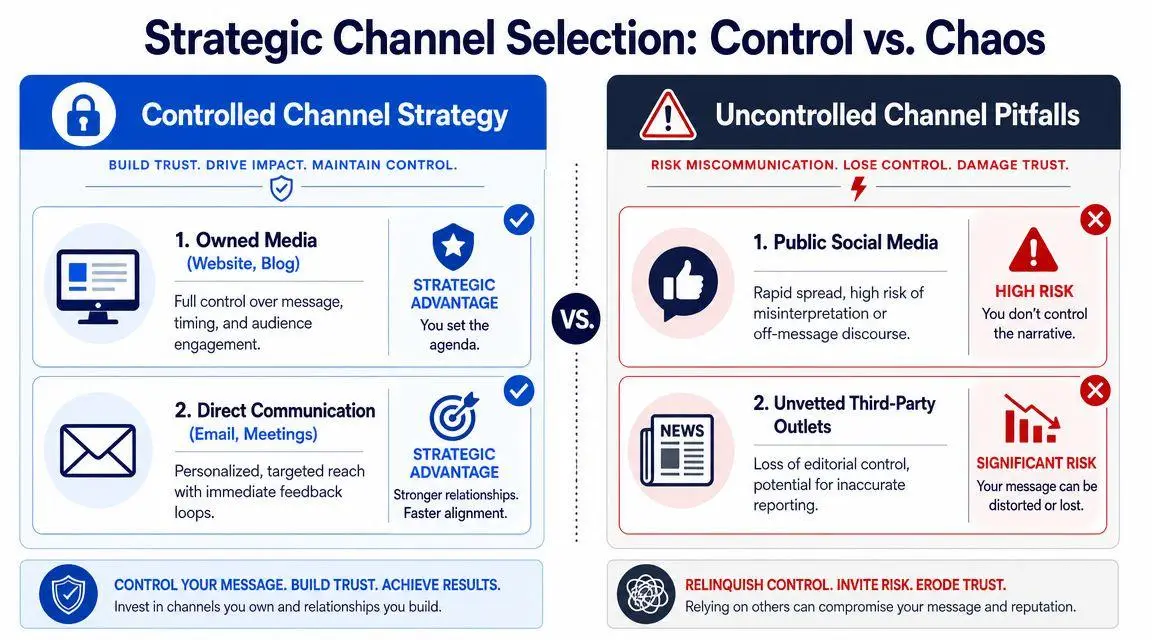
A channel is not just a delivery mechanism. It’s a risk signal. It tells the recipient how formal the message is, how confidential it may be, whether feedback is invited, and whether redistribution is expected. Executives who ignore that end up pushing sensitive material into the wrong environment.
Your executive communication plan should treat channel choice as a control decision. The wrong message in the wrong channel doesn’t just reduce clarity. It increases leak probability, strips away context, and invites commentary before facts stabilize.
Match channel to sensitivity
Use owned and direct channels first when the issue carries reputational or legal weight. Reserve public or highly social channels for messaging that has already been pressure-tested and can survive fragmentation.
A practical comparison looks like this:
| Channel | Best use | Main advantage | Main risk |
|---|---|---|---|
| Secure board portal | Governance and board communications | Controlled access and formality | Slow if not maintained |
| Direct executive email | Leadership directives and sensitive updates | Clear authority and documented delivery | Forwarding and screenshots |
| Pre-recorded video | Company-wide messages requiring tone control | Consistency of delivery | Less adaptive in live scrutiny |
| Live meeting or briefing | Tight stakeholder groups needing immediate Q&A | Real-time clarification | Off-script answers |
| Public social post | Broad external reassurance only after review | Fast public visibility | Context collapse |
The point is discipline. Don’t let convenience choose the channel.
Build a channel-frequency matrix
Most executives either overcommunicate during stress or disappear. Both create instability. You need a matrix that sets not only the channel, but also the allowable cadence for each audience and message type.
Some communication guides still stop at opens and clicks. That is too primitive. A recent executive communications guide says open rates and click-throughs are only “table stakes,” and recommends pulse surveys to determine whether employees noticed and acted on the message. That distinction matters. Distribution isn’t comprehension.
Use a matrix with at least four fields:
- Audience: Board, investors, managers, all employees, regulators.
- Message class: Routine, strategic, confidential, crisis.
- Authorized channel: One primary route, one backup route.
- Cadence limit: How often leadership should use that route before fatigue or confusion sets in.
If a message can’t survive being forwarded, don’t send it through a channel built for forwarding.
Avoid channel chaos
Executives lose authority when the same issue appears in scattered formats without hierarchy. A leaked Slack note, followed by an email, followed by a loosely framed town hall answer, creates an evidentiary mess and a credibility problem.
Your channel strategy should answer these operational questions in advance:
- Which channel creates the official record?
- Which version governs if summaries differ?
- Who may restate the message downstream?
- When does a manager need a script instead of discretion?
Mature communication planning begins to resemble crisis containment. In fact, that’s precisely its nature.
Activating the Crisis Response Protocol
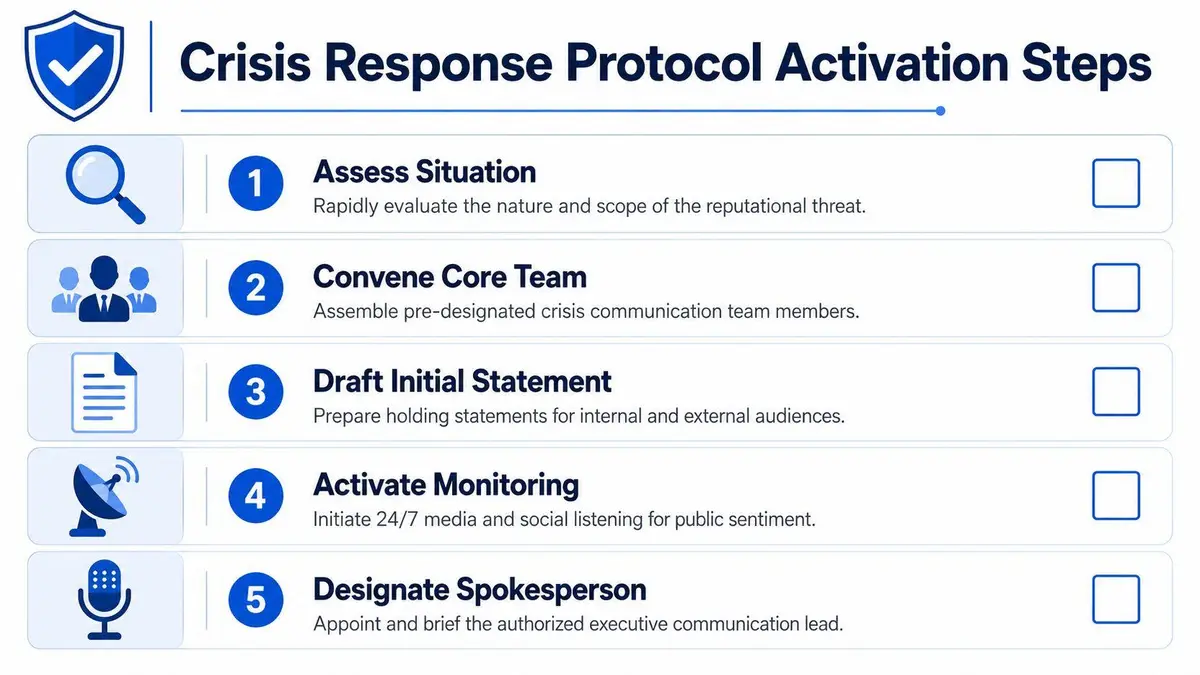
An executive communication plan without a crisis protocol is incomplete. The moment a reputational threat emerges, the normal rhythm ends. You need a break-glass procedure with trigger points, assigned authority, and pre-cleared actions.
That protocol should start the instant one of three conditions appears: a credible media inquiry on a sensitive issue, a verified leak of material information, or a fast-moving allegation that could alter stakeholder confidence. If your team debates whether the issue is “serious enough” while screenshots spread, you’ve already surrendered time you won’t get back.
The first hour decides whether you contain or amplify
The first sixty minutes should be run like an incident response sequence, not a brainstorming session.
Use this order:
- Verify the trigger
Confirm what happened, what is alleged, where it appeared, and whether the content is authentic, altered, incomplete, or false. - Convene the core team
Bring in legal, communications, the relevant business leader, and the executive decision-maker. If the issue affects market perception, investor relations belongs in the room. If it involves a digital attack, security belongs there too. - Freeze unauthorized commentary
Instruct leadership and managers not to improvise. No off-the-cuff replies. No “quick clarifications” in chat. No personal social posting. - Pull the message bible and holding statement
Use pre-approved language while facts are still being confirmed. A holding statement buys time without creating contradiction. - Start active monitoring
Track where the issue is spreading, who is amplifying it, what narratives are forming, and which claims need legal review.
Use holding statements correctly
A holding statement is not an admission. It is a containment tool. It should acknowledge awareness, avoid speculation, protect legal position, and state when further communication will follow.
Bad holding statements do one of two things. They deny too aggressively before facts are confirmed, or they sound evasive and hollow. Good ones are narrow, factual, and disciplined.
A workable internal rule set looks like this:
- Acknowledge awareness without validating unverified allegations.
- State the review status in plain terms.
- Avoid assigning blame before legal review.
- Set the next communication point so silence doesn’t invite rumor.
Under pressure, the public often forgives incomplete information. It rarely forgives contradiction.
Coordinate communications with legal remedies
High-stakes reputation defense doesn’t stop at wording. If false or unlawful material is circulating, your communications protocol must connect directly to legal and technical response options. That includes preservation, takedown assessment, platform escalation, and possible defamation analysis.
Executives facing active digital fallout should understand the mechanics of how to handle online reputation for a business in a crisis. The communication plan and the response operation have to run in parallel. If one team is trying to reassure stakeholders while another team is still identifying where the damaging content lives, the effort fragments.
Define roles before the crisis, not during it
Role confusion destroys speed. The spokesperson should already be named. The approval authority should already be known. The legal gatekeeper should already understand when a statement requires privilege protection or disclosure caution.
A compact role grid helps:
| Role | Responsibility during crisis |
|---|---|
| Executive lead | Final decision and visible authority |
| Legal counsel | Exposure review, privilege protection, takedown or claim options |
| Communications lead | Drafting, sequencing, internal-external alignment |
| Operations leader | Fact validation and implementation impact |
| Monitoring lead | Media, search, social, and stakeholder signal tracking |
Don’t assume your CEO should always be the first voice. Sometimes the chief legal officer, board chair, or business unit leader is the safer and more credible choice. The right spokesperson is the one who can speak with authority and survive scrutiny.
Preserve discipline after the first response
The initial statement doesn’t end the crisis. It starts the controlled phase. After that, every update should answer one of three needs only: clarify verified facts, correct material error, or direct the audience toward the next decision point.
Anything outside those categories is usually ego, not strategy.
The executive communication plan earns its value here. It gives your team a command structure when pressure is highest and public patience is lowest.
Measuring What Matters From Output to Impact
Most executive teams measure communication badly. They count sends, views, attendance, and completions, then declare success. That proves activity, not control. A high-stakes executive communication plan should be measured the same way any serious risk function is measured. Did it deploy correctly, did people understand it, and did it reduce exposure or improve alignment?
That requires a more disciplined model.
Use the three-layer KPI stack
Guidance summarized by Finn Agency points to a three-layer framework: output measures what was implemented, outcome measures how the audience responded, and impact measures business effect. It also highlights the common failure. Teams stop at output. MindTools’ recommendation within that discussion is the right one. Ask audiences whether they understood the message.
That means your scorecard should separate activity from effectiveness.
| KPI layer | What to track | What it tells you |
|---|---|---|
| Output | What was sent, published, or delivered | Whether execution happened |
| Outcome | What audiences understood, believed, or did next | Whether the message landed |
| Impact | Whether trust, alignment, or risk posture improved | Whether communication changed the real situation |
Measure comprehension, not just exposure
If your CEO email reached inboxes, that is not success. If your executive video was watched, that is not success. The issue is whether the intended audience interpreted the message correctly and acted accordingly.
Use a combination of methods:
- Pulse checks: Ask targeted groups what they understood, what remains unclear, and what action they’re taking.
- Manager feedback loops: Identify repeated questions, recurring confusion, and unauthorized reinterpretation.
- Monitoring comparison: Track whether rumor velocity drops after official communication or continues to outrun it.
- Behavioral signals: Look for whether the audience follows the instructed process, timing, or escalation path.
A message has done its job only when the audience can repeat it accurately without your help.
Tie communication back to reputation defense
At this stage, the executive communication plan stops being a communications artifact and becomes a governance asset. If stronger message discipline reduces contradiction, lowers escalation, supports legal defensibility, and stabilizes stakeholder interpretation, then the plan is doing exactly what it should.
Executives who treat communication as performance art usually discover its weakness during a crisis. Executives who treat it as a controlled system are harder to rattle, harder to misquote, and harder to corner.
That is the dividing line between amateur communications and professional reputation defense.
When reputational pressure is already building, planning alone isn’t enough. You need execution, discretion, and a team that understands takedowns, search visibility, platform escalation, and crisis containment. ContentRemoval.com works with executives, brands, and high-profile clients to remove harmful online material, contain digital threats, and protect long-term reputation with confidential, results-focused action plans.
Frequently asked questions
What should an executive holding statement say during a crisis?
It should acknowledge awareness without validating unverified allegations, state the review status in plain terms, avoid assigning blame before legal review, and set the next communication point so silence does not invite rumor. A holding statement is a containment tool, not an admission, and it buys time without creating contradiction.
Who should be the spokesperson when an executive’s reputation is under attack?
Not automatically the CEO. The right voice is the one who can speak with authority and survive scrutiny, which may be the chief legal officer, board chair or a business unit leader. Name the spokesperson, the approval authority and the legal gatekeeper before the crisis, because role confusion destroys speed.
How do you choose the right channel for a sensitive executive message?
Treat the channel as a risk signal. Use secure board portals and direct executive email for governance and sensitive updates, pre-recorded video where tone control matters, and public social posts only after the message has been pressure-tested. If a message cannot survive being forwarded, do not send it through a channel built for forwarding.