
Executive background check reputation work means auditing your own footprint before a search committee, investor or board does, then sorting every flagged item into source removal, de-indexing or suppression. Media searches, foreign-language coverage, dark web exposure and old credential claims are all in scope. What cannot be removed needs a short, counsel-reviewed disclosure prepared before diligence deepens.
Key facts
- Executive checks now include media searches across news, press and interviews, not just employment and degree verification.
- Search in the languages and jurisdictions that shaped your career; results localize and investigators search multilingually.
- Fix every credential claim on controlled bios first, then correct third-party copies in order of visibility.
- Deleting old social posts is cleanup, not resolution; screenshots, archives and reposts remain findable.
Where ContentRemoval.com comes in. ContentRemoval.com runs the removal-first side of pre-diligence work for executives: takedowns of false or private content, de-indexing of stale results, dark web and impersonation monitoring, and suppression of lawful material that will not come down. The executive, a search firm contact or their counsel usually reaches out ahead of a board, financing or hiring process. A free 15-minute Exposure Scan maps what is removable and the report is yours to keep. Get a Free, Confidential Exposure Scan or read how our reputation management work is done.
A search committee is ready to move. Counsel is already reviewing filings. An investor’s diligence team has a report open on screen. Then an old article, a disputed credential, a hostile post, or a foreign-language reference shows up without context. At that point, reputation is no longer a branding concern. It is a transaction risk.
That is why executive background check reputation work starts the moment a potential issue is identified. You do not wait for the screening firm to define the problem for you. You identify what can be removed, what must be corrected, what needs legal review, and what requires a controlled explanation. If your exposure is broad or hard to map, start with a professional digital footprint cleanup service for executives and build from there.
Resume and reputation discrepancies are common at the executive level. Senior candidates are examined for omissions, inconsistencies, unresolved disputes, old press, archived profiles, and third-party claims that look credible enough to slow or stop a decision. In a hiring, financing, board, or regulatory process, the standard is not fairness. The standard is risk avoidance.
Treat every flagged item as a live file. Some issues call for content removal requests, publisher corrections, platform escalation, defamation review, privacy complaints, or jurisdiction-specific takedown work. Others cannot be erased and need a disciplined suppression and disclosure strategy before anyone asks. The mistake is letting investigators discover the issue first. The right move is to close what you can, contain what you cannot, and control the record before scrutiny hardens into a judgment.
The Pre-Emptive Strike Your Digital Reputation Audit
An executive background check no longer means a narrow verification of employment dates and degrees. For executive hires, media searches are technically imperative in the verification workflow, scanning news, press, and interviews to map public reputation and decision-making patterns, as noted by iProspectCheck. If outside reviewers are going to do that work, you should do it first, and with more discipline.

Define the audit perimeter
Start with names, not narratives. Review your full legal name, common short forms, previous surnames, company affiliations, board memberships, charitable roles, quoted interviews, speaker bios, author pages, and cached profile fragments. Then run the same review against direct family associations and closely linked entities if your personal brand and business identity overlap.
Don’t stop at page one of search results. Investigators won’t. They check news results, image results, video results, business listings, archived profile pages, comment sections, review platforms, PDF filings, conference pages, and scraped data broker entries. They also look for inconsistency. A flattering biography on one site and a conflicting timeline on another creates suspicion even if neither item is malicious.
Build an evidence file, not a loose list
Create a working log with five columns. Keep it plain and clinical.
| Audit item | What to capture | Why it matters |
|---|---|---|
| Search result or record | URL, screenshot, date found | Preserves evidence before edits or deletion |
| Content type | News, profile, filing, forum, review, social post | Determines legal and technical response |
| Risk level | Low, medium, high | Helps prioritize action under time pressure |
| Accuracy status | Accurate, misleading, false, out of context | Shapes disclosure and takedown strategy |
| Control status | You control it, third party controls it, unknown owner | Decides whether correction is realistic |
This file becomes the spine of your response. Without it, executives waste time arguing about impressions when they should be assigning actions.
Practical rule: If a result would force you into a long explanation during a board interview, treat it as a high-priority liability even if it’s technically true.
Search in layers
A serious audit has three layers.
- Surface web review: Search engines, major news databases, social platforms, podcasts, YouTube interviews, event pages, business listings, review platforms, and image search.
- Structured record review: Court dockets, licensing records, archived corporate pages, old press releases, conference bios, and document repositories that may preserve outdated claims.
- Exposure review: Leaked credentials, impersonation profiles, doxxing material, breach-related mentions, and copied content circulating outside your official channels.
Most executives under-search social content because they assume deleted material is gone. It often isn’t. Aggregators, reposts, quote-posts, screenshots, and scraped profile archives keep material alive long after you think it vanished.
Audit the assets you can still control
Before you chase removals, stabilize what you own. Update executive bios, LinkedIn summaries, board profiles, speaker pages, and author pages so they are accurate, consistent, and legally safe. If your official properties are thin, they leave too much room for third-party pages to dominate the search results.
A disciplined cleanup of owned assets often does two things at once. It reduces inconsistency risk, and it gives you stronger material for later suppression work. If your footprint needs a structured cleanup, this professional digital footprint cleanup guide for executives is a useful reference point.
Red flags that deserve immediate escalation
Some issues can wait for planned handling. Others require same-day review by counsel and reputation specialists.
- Credential conflicts: Degree inflation, unfinished programs presented as completed, or title inflation on biographies.
- Legal artifacts: Old complaints, dismissed matters, settlements discussed out of context, or stale allegations still ranking prominently.
- Narrative traps: Articles that are technically accurate but framed to imply misconduct you didn’t commit.
- Personal exposure: Home address, family details, personal email credentials, leaked files, or impersonation pages.
- Business adjacency risk: Content about a former company or partner that doesn’t name you prominently but links your name through metadata, tags, or repeated association.
Treat the audit as discovery, not self-defense. The point isn’t to feel better. It’s to know exactly what a hostile reviewer can find before they find it.
Assessing Your Global Footprint and Digital Blind Spots
Domestic search results are only half the problem. Executives operating across borders leave traces across regulators, publishers, local business media, regional social platforms, and litigation systems that most U.S.-centric reviews barely touch.

According to Intelligo, a frequently unaddressed issue is international and digital footprint risk in executive background checks, including a 40% increase in multinational executive checks uncovering adverse foreign media, with 15% involving dark web data leaks. That matters because one non-English article, one sanctions-adjacent mention, or one leaked credential set can derail an appointment just as quickly as a domestic lawsuit report.
Where global exposure usually hides
Most executives don’t have a “hidden scandal” abroad. They have fragmented records abroad. That’s enough to create trouble. A foreign article may translate badly. A local court reference may identify the wrong individual. A sanctions or watchlist discussion may mention a counterparty you once touched through a deal, and your name stays in the indexing trail long after the matter is resolved.
Look closely at these categories:
- Foreign media coverage: Trade press, local-language financial news, activist blogs, and archived interviews.
- Cross-border business records: Directorships, dissolved entities, affiliate registrations, and local corporate disclosures.
- Regulatory adjacency: Mentions tied to counterparties, subsidiaries, distributors, or joint ventures under scrutiny.
- Regional social platforms: Country-specific networks where an old controversy can circulate outside your normal monitoring.
- Compromised data: Breach dumps, password reuse exposure, passport scans, tax identifiers, or internal documents posted in illicit forums.
Why standard search habits miss the real risk
Executives often search only in English and only from their home jurisdiction. That’s a mistake. Search engines localize results. So do publishers and platform indexes. What looks clean from New York can look very different from London, Dubai, Singapore, or Frankfurt.
Worse, many investigators use multilingual review methods and region-specific searches. If you don’t, you’re effectively letting someone else perform the first real analysis of your international footprint.
Search your name, company names, and deal counterparties in the languages and jurisdictions that shaped your career. If you don’t know which ones matter, your audit isn’t finished.
A practical review should test transliterations, old company names, common misspellings, and abbreviated initials. It should also examine whether your name appears in relation to a broader event, not just as a direct headline subject.
Here’s a useful benchmark for blind spots:
| Blind spot | Why executives miss it | Why reviewers won’t |
|---|---|---|
| Non-English media | They never search in local language | Review firms and investigators often do |
| Old foreign entities | “That company was dissolved years ago” | Records and archives persist |
| Leaked credentials | No visible public page | Exposure may surface through dark web checks |
| Regional social posts | Outside your main audience | They still affect judgment under scrutiny |
Later in the process, visual explanation often helps internal teams understand how broad these exposures can be.
Dark web exposure isn’t just a security issue
Executives often treat dark web monitoring as a cybersecurity matter for the IT team. That’s incomplete. If credentials, internal files, or personal data circulate in criminal forums, the issue quickly becomes reputational. A board may ask whether your practices were careless. A hiring committee may worry about blackmail risk, operational security, or future disclosures.
The same applies to impersonation. If someone creates fake profiles, fabricates correspondence, or repackages old press under a manipulated identity, you’re not dealing with mere nuisance. You’re dealing with evidence contamination. That can distort a background file before anyone verifies the underlying facts.
The right response to global blind spots
Don’t wait for a foreign hit to appear in a diligence memo. Commission multilingual searches. Review cross-border business associations. Check whether any old biographies or press interviews overstate a credential or role in a way that conflicts with local records, and if dark web exposure is detected, lock down credentials, preserve evidence, identify the publication points, and move on remediation immediately.
The worst posture here is passive confidence. If your career has crossed borders, your executive background check reputation exists in multiple legal systems, multiple languages, and multiple indexes at once.
Developing a Takedown and Content Suppression Strategy
A board search firm opens your file on Monday morning. By noon, they have found an old profile that overstates your degree, a copied article that strips out the correction, and a forum post that mixes rumor with real facts. At that point, speed matters, but sequence matters more. If you attack the wrong result with the wrong tool, you waste the narrow window you still control.
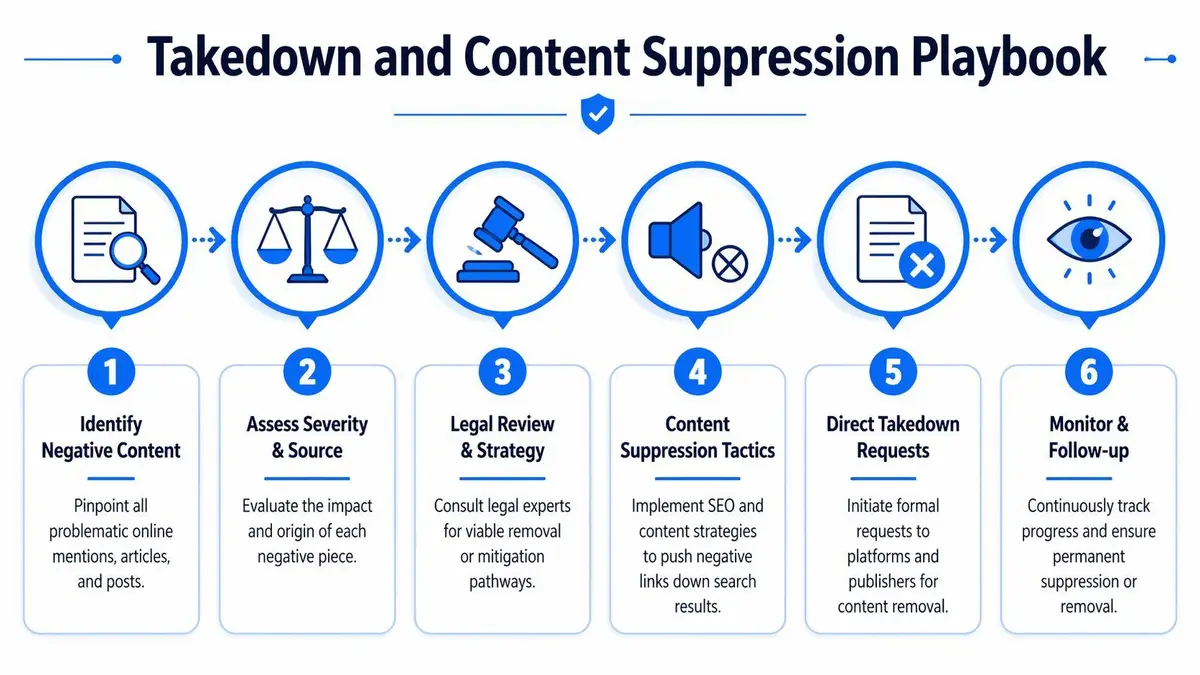
Put every harmful result into one of three buckets: source removal, de-indexing, or suppression. That classification drives the response. Executives get into trouble when they treat all negative content as a PR problem. It is an exposure-control problem first.
Credential inflation is a common trigger. Sometimes it was intentional. Often it came from years of copied bios, lazy conference edits, or inherited marketing language. The cause does not matter to the reviewer reading the file. Fix every version you control immediately, then go after the third-party copies in order of visibility.
Choose the remedy by content type
Start with the nature of the content, not your frustration with it.
| Situation | Best primary move | Why |
|---|---|---|
| False statement on a site you don’t control | Source removal request | Removes the original publication before it spreads further |
| Lawful but outdated search result | De-indexing request where available | Lowers visibility even if the page stays live |
| Accurate but damaging article on a high-authority site | Suppression | Replacement is unlikely, so ranking control becomes the objective |
| Copied or stolen proprietary content | Legal takedown pathway | Copyright and ownership claims can force action |
| Personal data or leaked material | Platform removal and privacy escalation | Fast containment reduces both security and diligence risk |
Source removal first when the content is wrong
If a page is false, misleading, impersonating you, or exposing protected personal information, go at the source first. Contact the publisher, platform, host, or site administrator with a clean evidence package. Include screenshots, exact URLs, publication dates, archive captures if available, and a short statement of what is false or unlawful.
Do not send a long complaint. Send proof.
Legal process should be evaluated early. Copyright notices can work when material was copied without permission. Privacy rules can apply to exposed personal data, impersonation, or intimate material. Defamation claims may justify formal action if the facts support it. Many bad actors ignore polite requests and respond only when counsel or platform enforcement enters the picture.
De-indexing when removal is unlikely
Some pages will stay up. That does not mean they need to stay prominent.
De-indexing is useful when the content is stale, thin, misleading by omission, or disconnected from your current professional record. It does not erase the page. It reduces the chance that a recruiter, board member, investor, or journalist sees it in the first page of results. For an executive under active diligence, that distinction can change the entire review.
Use this route selectively. A failed de-indexing request wastes time and can alert a publisher that you are under pressure.
Suppression when the content is lawful but still dangerous
Some results will survive challenge because they are substantially accurate, archived, or protected by the publisher’s standards. Those results still need to be handled. The answer is suppression built on stronger, more credible material that deserves to rank above the liability.
That means improving controlled assets and publishing high-trust content tied to your actual record: board biographies, executive profiles, bylined articles, interview transcripts, case studies, correction pages, and verified professional profiles. The goal is simple. Change what a decision-maker sees first. If your issue is entrenched in search, this strategic guide to suppressing negative search results for executives is a useful framework.
Do not launch a thin rebuttal microsite in a panic. It rarely ranks well, and it signals weakness to anyone who finds it.
Correcting credential problems without making them worse
Credential issues require discipline because every rushed explanation creates a new record. Handle the repair in a strict order:
- Correct all controlled biographies, corporate profiles, speaker pages, and board materials.
- Update every active resume, CV, and candidate packet with exact degree language, dates, and status.
- Map the third-party pages repeating the wrong claim by search visibility and authority.
- Request factual correction with supporting documentation.
- Preserve a record of each correction request and response.
- Prepare a short disclosure statement if the discrepancy is still likely to surface.
Ask for accuracy, not sympathy. Editors and platforms respond better to a documented correction than to a reputational plea.
If the discrepancy was deliberate, involve counsel before outreach. If it was inherited or accidental, move fast, document every fix, and close the gap before someone else writes the narrative for you.
Know when to bring in specialists
These are separate disciplines. Counsel handles legal risk and formal process. Search suppression specialists handle ranking and visibility. Technical removal teams handle hosts, platforms, impersonation, leaks, repeat reposting, and indexing issues.
ContentRemoval.com is one example of a firm that handles takedowns, de-indexing, dark web monitoring, impersonation removal, and negative content suppression through a removal-first model. That matters when you need one plan, one evidence file, and one chain of command.
Old content is not harmless. Old content that survives into a background check becomes implied credibility. Your job is to break that credibility before the reviewer gives it weight.
Navigating Disclosures and Strategic Communications
Not everything can be removed. Some facts are fixed. Some records are lawful and public. Some articles won’t come down. In those cases, silence isn’t sophistication. It’s surrender.
Executives often resist proactive disclosure because they think disclosure makes an issue real. That’s backwards. The issue is already real if a board, investor, or hiring committee can find it. Your choice is whether they encounter it cold, stripped of context, or hear it from you in a controlled form tied to evidence and judgment.
Disclosure is a control mechanism
A smart disclosure doesn’t confess weakness. It demonstrates command. It tells the decision-maker three things at once. You know the issue exists, you’ve assessed it accurately, and you’ve already taken steps to contain its operational and reputational impact.
Use proactive disclosure when the item is likely to be found, likely to be misunderstood, and difficult to remove before diligence concludes. That includes credential corrections, settled disputes likely to appear in search, stale allegations still ranking well, and business controversies where your role is likely to be overstated.
If an issue can be surfaced in five minutes by a skeptical reviewer, assume it will be.
What a usable disclosure statement looks like
Most executives make one of two mistakes. They either over-lawyer the statement until it sounds evasive, or they over-explain until they create fresh exposure. Neither works.
A workable disclosure statement is short and factual. It should answer:
- What happened
- What the record shows
- What you’ve done to correct, clarify, or contain the issue
- Why it doesn’t impair your judgment, integrity, or fitness for the role
That statement should be drafted with counsel if litigation, regulatory issues, confidentiality obligations, or disputed facts are involved. Once it’s drafted, rehearse it verbally. If you can’t deliver it calmly in under two minutes, it isn’t ready.
Timing matters more than tone
Disclose too early and you may magnify an issue that never would have mattered. Disclose too late and you look calculated. The right timing is usually just before formal diligence deepens, or immediately after you know a specific issue is likely to appear in the file.
That doesn’t mean broadcasting every blemish. It means disclosing material vulnerabilities with discipline. If the matter is minor, low-visibility, and already resolved in the record, prepare a response but don’t volunteer it casually. If the matter is central to trust, fitness, or judgment, waiting is reckless.
A simple framework helps:
| Issue type | Recommended posture |
|---|---|
| Findable and likely misunderstood | Proactive disclosure |
| Findable but minor and easily explained | Prepared response |
| Not findable, low relevance, fully resolved | Monitor and hold |
| Legally sensitive or disputed | Counsel-led communication only |
Counsel should enter earlier than most executives think
Many executives call counsel after the problem becomes public in the process. That’s too late. Counsel should review disclosures before they are delivered if the issue involves allegations, settlements, former employers, restrictive agreements, confidential investigations, or regulatory contact.
The communication objective isn’t to sound innocent. It’s to sound precise. Precision reassures serious decision-makers. Vagueness alarms them. A controlled statement, paired with documentary support and a parallel remediation plan, often neutralizes more risk than aggressive denial.
A hidden issue suggests judgment failure. A disclosed issue with a credible remediation trail suggests leadership.
Implementing Long-Term Reputation Monitoring and Defense
Most executives treat reputation cleanup as a transaction. Fix the article. Remove the leak. Suppress the result. Move on. That’s amateur thinking. The significant risk starts after the immediate crisis, when old material resurfaces, copied pages reappear, and new threats emerge from accounts, platforms, and forums you don’t actively watch.

According to FADV, an underserved angle is post-hiring reputation monitoring, despite 62% of C-suite scandals in 2025 involving resurfaced social media posts. Even if that trend is framed as a future-dated observation, the lesson is obvious. Post-hire monitoring isn’t optional if your name carries enterprise risk.
Build an early-warning system
A proper monitoring system should detect four categories of threat: new media, recycled old media, impersonation, and exposure events. Those are different problems and require different response paths.
- New media hits: Articles, interviews, list placements, podcasts, and commentary that attach your name to a live issue.
- Resurfaced content: Old posts, screenshots, archived remarks, and prior allegations that suddenly regain distribution.
- Identity abuse: Fake profiles, spoofed domains, impersonation accounts, false executive statements, and manipulated media.
- Exposure signals: Breach references, leaked files, credential mentions, private data circulation, or doxxing attempts.
Monitoring should cover search engines, news alerts, major social platforms, image and video search, key forums, review environments, and exposure surfaces tied to data leaks. If your role is global, the system must also include multilingual monitoring and entity-based tracking for companies, boards, and family office structures linked to your name.
Defense works only if someone owns the response
Monitoring without escalation protocol is theater. Someone must own triage. Someone must decide whether an alert triggers legal review, platform outreach, source removal, de-indexing, or a suppression push.
Use a simple internal matrix:
| Alert type | Immediate owner | First action |
|---|---|---|
| False article or impersonation | Legal and reputation lead | Preserve evidence and submit removal demands |
| Negative but accurate article | Communications and search team | Assess visibility and prepare suppression response |
| Leaked personal data | Security, legal, and reputation lead | Contain accounts, document leak, remove exposure points |
| Old post resurfacing | Executive office and communications | Prepare context statement and visibility response |
A reputation threat gets expensive when it sits unassigned for two days while everyone debates whose problem it is.
Post-hire monitoring is part of executive governance
Boards and CEOs should treat this as governance, not vanity. A resurfaced clip, copied allegation, or impersonation event can affect deal flow, employee confidence, regulatory posture, and lender comfort. If your name is linked to the company, your reputation has become a business asset with direct downside risk.
That means maintaining current bios, controlling official media, reviewing dormant social accounts, securing credentials, preserving evidence from each incident, and keeping a standing response process ready for weekends and travel periods. The monitoring itself can be run internally, through counsel, through a specialist vendor, or through a hybrid arrangement. What matters is speed, discretion, and continuity.
For executives who need an external monitoring layer, reputation monitoring services can provide ongoing detection and escalation support across search, media, leaks, and impersonation risks.
The durable strategy
The strongest reputation defense combines three disciplines. First, keep controlled information accurate and current. Second, remove or reduce harmful content quickly when it appears. Third, maintain continuous watch so the next problem is caught before a third party packages it as a surprise.
That’s what serious executive background check reputation management looks like. Not a one-time cleanup. A permanent defensive posture.
Frequently Asked Questions on Executive Reputation
The call usually comes late. A board chair wants clarification. A recruiter has “one follow-up.” Outside counsel asks for supporting dates by morning. At that point, the issue is no longer whether something exists online. The issue is whether you control the interpretation, the paper trail, and the response.
As noted earlier, executives are screened harder than they expect. Seniority does not buy forgiveness. It raises the standard for accuracy, judgment, and disclosure.
| Question | Direct answer |
|---|---|
| Should I disclose a resume discrepancy before they find it? | Yes, if it is material and likely to surface in diligence. A controlled disclosure with documents and context protects credibility better than a forced explanation after discovery. |
| Can I remove a truthful article? | Sometimes. If removal fails, shift immediately to de-indexing, suppression, and a prepared statement that limits the damage the item can do. |
| Is deleting old social posts enough? | No. Copies, screenshots, archives, and reposts often remain visible long after deletion. Treat deletion as cleanup, not resolution. |
| If the issue is old, will reviewers ignore it? | Only if it looks isolated, resolved, and irrelevant to current judgment. If it suggests dishonesty, poor controls, harassment, or regulatory risk, age will not save you. |
| Should PR handle this alone? | No. PR manages message discipline. Legal handles exposure. Search and platform specialists handle removal, de-indexing, suppression, and evidence preservation. |
A few questions need blunt answers.
Can I wait and see if the background check catches it
You can. It is a bad call.
If the issue is discoverable, waiting hands control to someone else. The reviewer finds it without context, asks a narrower question than you want, and judges your response under time pressure. Fix the file first. Gather records, correct controlled properties, preserve screenshots, and decide what must be disclosed before diligence starts.
If the issue is technically true, should I stay silent
No.
Truth is not the same as fair presentation. A dated lawsuit, a clipped article, a hostile blog post, or an old disciplinary reference can be technically accurate and still create a false impression about current fitness. Your job is to address that gap fast. That can mean a rebuttal, a clarifying disclosure, a takedown demand, a privacy complaint, or a search suppression plan.
The standard is simple. Ask what a tired general counsel, investor, journalist, or board member will conclude after five minutes of review.
Is this just a hiring problem
No. It affects financing, board seats, succession planning, M&A diligence, lender review, regulatory attention, and internal trust.
For an executive, reputation exposure becomes an enterprise issue the moment your name influences capital, governance, or strategic decisions. That is why post-issue work matters so much. You are not checking a box. You are reducing the chance that an old allegation, a copied error, or an avoidable search result becomes a live business problem.
What should happen first after an issue is identified
Start with triage.
Decide whether the issue is false, misleading, private, outdated, defamatory, infringing, or damaging but lawful. That classification determines the remedy. False statements may support legal demand. Private personal data may support platform removal. Lawful but harmful material may require suppression, responsive content, and a disciplined explanation. Executives waste time when they jump to one tactic before defining the problem.
Do I need legal counsel before contacting a publisher or platform
If the matter touches defamation, privacy, employment records, sealed matters, extortion, or active litigation, yes.
Uncoordinated outreach can make things worse. It can alert the publisher, trigger a fresh post, damage privilege, or create discoverable admissions. High-risk matters need legal review first, then a removal or suppression plan built around that advice.
If you’re facing imminent scrutiny, don’t hand this to general PR and don’t wait for the report. ContentRemoval.com works with executives, founders, family offices, and legal teams on discreet takedowns, de-indexing, suppression, leak response, and long-term monitoring. Start with a confidential assessment, identify the exposure, and act before someone else defines it for you.