
eBay feedback removal is a policy enforcement process, not a fairness appeal. eBay removes feedback only when it fits a published violation category such as meaningless content, wrong-transaction comments, rating and text mismatches, personal attacks, extortion or manipulation, or a protected transaction scenario like buyer non-payment. Sellers win by naming the category and attaching matching evidence.
Key facts
- eBay removes qualifying feedback typically within 24 hours of notification, with Seller Help requests allowed within 90 days.
- Buyer Feedback Revision Requests give the buyer 10 days to act, with eligibility limited to 30 days from posting.
- Protected scenarios include buyer cancellation, non-payment, address problems, disclosed listing issues and site errors.
- Strong submissions state one policy category, then attach the transaction record, feedback screenshot and primary proof.
Where ContentRemoval.com comes in. ContentRemoval.com works with sellers, founders and brand owners whose marketplace feedback is false, coercive or has spread beyond eBay after the standard review failed. We assess the policy basis, package the evidence and manage escalation so the matter is handled as a documented enforcement issue. A free 15-minute Exposure Scan maps what is removable across every platform, and the report is yours to keep. Get a Free, Confidential Exposure Scan or read how our content removal work is done.
A negative feedback alert on eBay rarely arrives at a convenient moment. It lands when inventory is moving, buyers are watching, and your account reputation is already doing real commercial work for you. If the comment is false, misplaced, retaliatory, or plainly abusive, the instinct to fire off a quick response is understandable. It’s also usually the wrong move.
Professionals should treat eBay feedback removal as a policy-enforcement exercise, not a customer service ritual. eBay doesn’t remove feedback because a seller feels wronged. It removes feedback when the comment fits a recognized violation category or when the transaction falls into one of the platform’s stated removal scenarios. That distinction matters. It changes how you read the feedback, how you preserve evidence, and how you present the dispute.
The practical mindset is simple. Stop asking whether the comment feels unfair. Ask whether it is removable under a rule you can prove. If the answer is yes, proceed with discipline. If the answer is no, don’t weaken your position by making emotional or unsupported claims.
That same legalistic approach applies beyond marketplaces. If you’re dealing with broader reputational exposure, this guide on how to remove negative online content is useful because it frames removal as a structured process tied to platform rules, documentation, and escalation.
Introduction The Professional’s Response to Unfair Feedback
The sellers who handle feedback disputes well usually do one thing differently. They separate insult from risk.
A harsh comment may offend you. That part is irrelevant. The critical point is whether the statement damages buyer trust, creates avoidable account friction, or sits on your profile despite violating a rule eBay has already published. Once you understand that, your posture changes. You stop negotiating with the platform emotionally and start pressing it to apply its own standards.
Practical rule: Your removal request should read like a compliance submission, not an apology letter.
That means three immediate actions. First, preserve the listing, transaction record, and buyer messages before anything changes. Second, classify the comment by violation type, if any. Third, decide whether the best path is buyer revision or direct escalation through Seller Help.
Most weak requests fail for a predictable reason. The seller describes the situation in broad fairness terms. eBay’s system, by contrast, is built to evaluate narrow categories. If your submission doesn’t identify the category, connect the evidence, and explain the match in plain language, you’re making the reviewer do legal analysis for you. That is a bad strategy.
Analyzing Grounds for Removal Under eBay Policy
Before you contact anyone, read the feedback as if you were reviewing a claim file for someone else. Emotion clouds judgment. Precision wins.
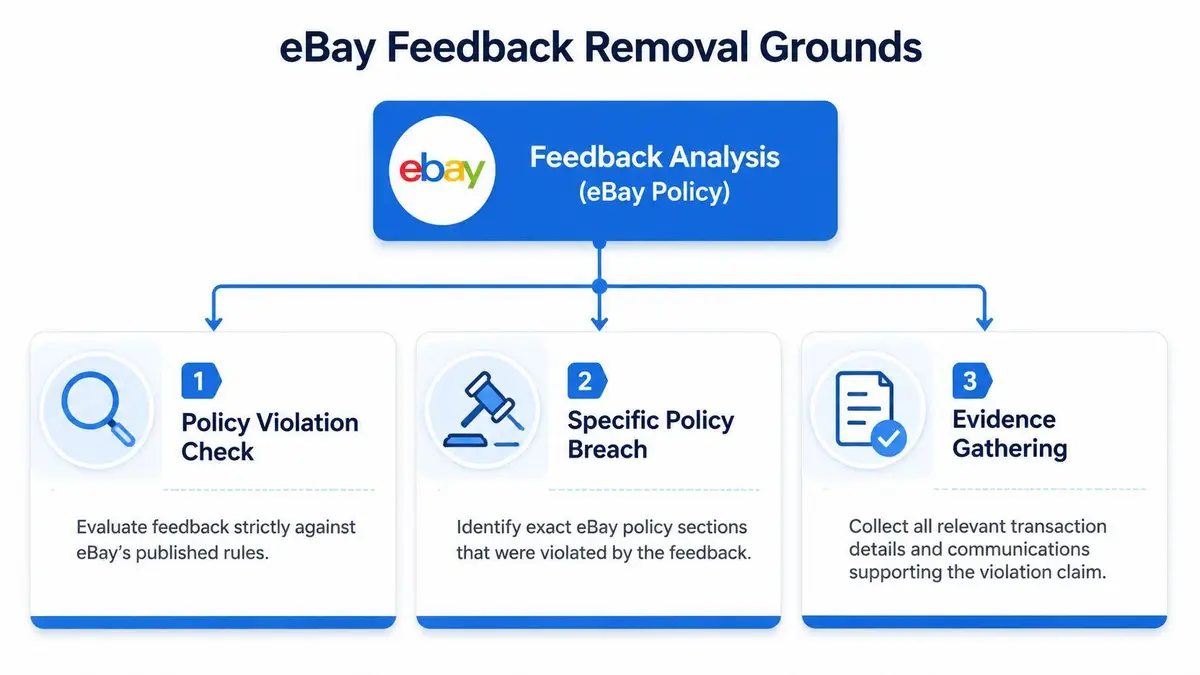
According to eBay’s updated framework, the company removes feedback containing “meaningless content,” comments meant for another item or seller, rating and text mismatches, personal attacks, extortion, or manipulation. It also removes neutral or negative feedback in certain transaction scenarios, including buyer cancellation, non-payment, address problems, disclosed listing issues, technical site errors, and some dispute outcomes. eBay says qualifying feedback is typically removed within 24 hours after notification, sellers can request review through Seller Help within 90 days of the transaction, and clear violations may be handled automatically while unclear cases go to manual review, as summarized in this analysis of the eBay feedback removal policy update.
The categories that actually matter
A seller should think in categories, not grievances.
| Feedback problem | Likely policy angle | What you need to verify |
|---|---|---|
| Nonsense, gibberish, irrelevant text | Meaningless content | The comment has no intelligible relation to the transaction |
| Complaint clearly about another order or seller | Wrong transaction or seller | Text references facts that don’t match your sale |
| Positive wording with a negative rating, or the reverse | Rating and text mismatch | The text and score conflict on their face |
| Insults directed at you personally | Personal attack | The comment attacks the seller rather than reviewing the transaction |
| Demands tied to feedback pressure | Extortion or manipulation | Messages show the buyer used feedback as leverage |
| Complaint after buyer-caused failure | Protected transaction scenario | Records show cancellation, non-payment, bad address, or another covered event |
That table is more useful than generic advice to “stay professional.” Professionalism helps. It doesn’t create eligibility.
How to frame your internal assessment
Use a short decision test before escalating:
- Can you point to one removal category by name?
- Can you attach evidence that fits that category without explanation-heavy storytelling?
- Can a reviewer confirm the issue from the transaction record, listing, or messages?
If you answer no to any of those, pause. A weak submission wastes time and can make later requests look less credible.
For sellers facing broader review damage beyond eBay, this professional guide on how to remove a bad business review is a useful parallel because it applies the same evidence-first logic across platforms.
If your theory requires a reviewer to sympathize with you, the case is weak. If your theory requires a reviewer only to compare the comment to a rule, the case is stronger.
Communication that preserves authority
If you need to send an initial message to a buyer before escalation, don’t argue the merits of your business. Keep the message narrow and factual.
Use language like this:
We reviewed your feedback and would like to resolve the issue efficiently. If the comment was posted in error or no longer reflects the transaction, please confirm and we’ll send a revision request through eBay.
If the problem is a likely policy violation, use this:
Your feedback appears to reference matters inconsistent with the transaction record. We’re reviewing the matter under eBay policy and wanted to give you an opportunity to correct it directly before we escalate.
That tone matters. It doesn’t plead. It creates a clean record.
The Buyer Revision Request A Tactical First Move
When a feedback issue is fixable through the buyer, that route is often cleaner than immediate escalation. But it only works when you handle it with restraint.
The operational workflow is straightforward. First test whether the buyer is willing to revise. If the buyer agrees, you can send a Feedback Revision Request. The buyer has 10 days to accept, eBay sends a reminder after 7 days, and buyer-initiated revision or retraction eligibility is limited to 30 days from the original feedback date. That makes the first month the strongest window, as outlined in this practical overview of eBay feedback revision timing.

When buyer contact is smart
Contact the buyer when the dispute looks like an error, a misunderstanding, or a resolved service problem. Don’t contact the buyer when the messages already show hostility, coercion, or obvious bad faith. In those cases, every extra exchange creates more noise and more risk.
Good candidates for revision outreach include these situations:
- Accidental mismatch: The written comment suggests satisfaction, but the rating is negative or neutral.
- Corrected issue: You resolved the order problem and the buyer’s complaint is no longer current.
- Apparent confusion: The buyer seems to have mixed your transaction with another one.
Bad candidates include extortion, abuse, and repeat message escalation. If you already have a policy-hooked case, don’t spend that advantage on a messy debate.
The right message to send
The strongest outreach is short and easy to act on. Your message should remove friction, not reopen the argument.
A useful template:
Thanks for discussing this with us. Since the transaction issue has been addressed, I can send an eBay feedback revision request if you’re comfortable updating the feedback to reflect the final resolution.
If the buyer may have posted in error:
I believe the feedback may not match the transaction outcome. If you’d like to revise it, please confirm and I’ll send the request through eBay.
Notice what’s missing. No blame. No emotional backstory. No lecture about how hard you worked. Buyers respond better when the request feels administrative rather than adversarial.
The revision request should feel like a paperwork correction, not a confrontation.
Evidence still matters at this stage
Even though this is the softer path, build your file as if eBay will need to step in later. Save the buyer’s acknowledgment, your resolution messages, any refund or replacement record, and screenshots showing that the issue was addressed.
That documentation has a second function. If the buyer ignores the request or changes tone, you already have a timeline showing your reasonableness. That can matter when the dispute shifts from buyer cooperation to platform enforcement.
For sellers thinking beyond the single review, this guide on how to rebuild trust with customers after bad reviews is valuable because it addresses the reputation consequences after the immediate dispute is contained.
Building an Unimpeachable Case for eBay Intervention
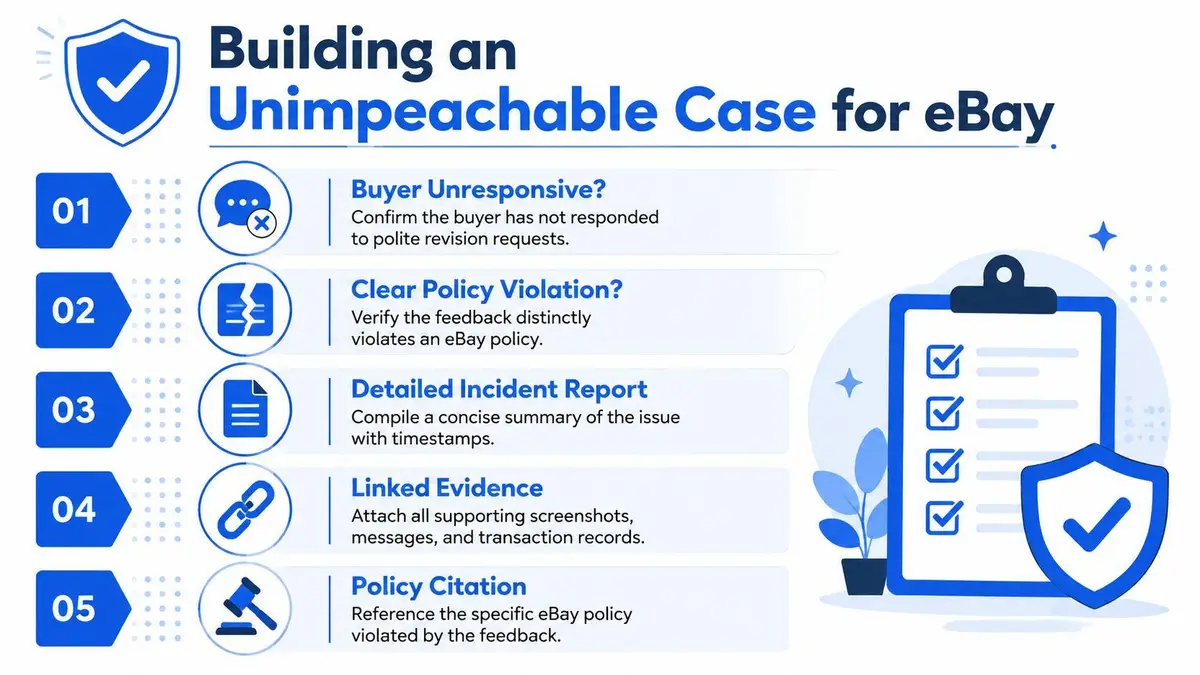
When the buyer won’t cooperate, or shouldn’t be contacted at all, your request to eBay needs to function as a closed evidentiary record. The reviewer should be able to glance at the file, compare it to the policy category, and remove the feedback without reconstructing events.
That’s where most sellers fail. They describe feelings, sequence, and fairness. They should be submitting proof.
Match the evidence to the violation
eBay’s own policy framework is narrower than most online guides suggest. The better question isn’t “How do I request removal?” It’s what exact evidence and policy hook changes the outcome? eBay’s policy structure, including extortion, feedback manipulation, irrelevant content, and certain delivery-related scenarios where the seller met obligations, is summarized in this official eBay feedback policy overview.
Here is the practical mapping:
| Policy issue | Best evidence |
|---|---|
| Extortion or manipulation | Buyer messages showing threats, demands, or leverage tied to feedback |
| Wrong item or wrong seller comment | Screenshot of the feedback plus order details showing the mismatch |
| Rating and text mismatch | Screenshot of the comment exactly as posted |
| Personal attack | Screenshot preserving the language used |
| Disclosed listing issue | Original listing screenshots showing the condition, limitation, or defect was stated |
| Address problem or buyer-caused delivery issue | Order record, address details, and delivery or dispatch documentation |
Build the file in reviewer order
Don’t upload material in the order you collected it. Upload it in the order a reviewer should understand it.
Use this sequence:
- Transaction identifier and the date of sale.
- Feedback screenshot with the objectionable text visible.
- Policy category stated in one sentence.
- Primary evidence proving the category.
- Supporting evidence only if needed to remove ambiguity.
That sequence matters because manual reviewers triage quickly. If your key exhibit is buried under screenshots of unrelated buyer chat, you’re forcing the reviewer to hunt for your argument.
Write the request like a claims lawyer
Your submission should be short. Most sellers write too much because they think volume signals seriousness. It usually signals uncertainty.
Use a structure like this:
Feedback posted on this transaction qualifies for removal under eBay policy because it contains [policy category]. The attached record shows [specific proof]. The feedback does not reflect a valid transaction complaint under the applicable rule.
If the issue concerns a disclosed listing condition, say so directly:
The feedback criticizes a condition expressly disclosed in the listing. Attached screenshots show the disclosure as it appeared at the time of sale.
If the issue is buyer coercion:
Attached buyer messages show an attempt to use feedback as leverage. That is a policy-based removal issue, not a subjective service dispute.
Strong submissions reduce interpretation. Weak submissions increase it.
Understand the mechanics before you submit
Some removals are straightforward because the violation is obvious on the face of the comment. Those can be handled quickly. Others require context, which means a human reviewer may need to compare the listing, messages, and transaction details.
That split changes your drafting. If your case is obvious from the text itself, your request should be surgical. If the case depends on context, your request should guide the reviewer to the exact exhibit that resolves the ambiguity. Don’t assume they will infer what you mean.
Navigating the Review Process Timelines and Outcomes
Once your request is in, discipline matters more than anxiety. Many sellers undermine their own position by flooding support channels with repeated explanations before the initial review has matured.
The operational structure is already clear from eBay’s published framework discussed earlier. Some cases are resolved quickly because the violation is obvious and detectable. Others move more slowly because a person has to decide whether your evidence fits a specific rule. That’s not incompetence. It’s the difference between obvious text violations and contextual disputes.
What outcomes you should realistically expect
A sound submission can still produce several different outcomes.
- Full removal: This is the clean result. The feedback comes down because the policy match is clear.
- Rejection: This usually means the reviewer didn’t see a rule-based basis, or your evidence didn’t close the loop.
- Ambiguous handling: In practice, some situations feel only partially resolved from the seller’s perspective, especially when the platform distinguishes between text, rating, and transaction history.
The critical issue is how you interpret a no. A rejection doesn’t automatically mean the feedback is legitimate. It may mean your file was incomplete, poorly framed, or reviewed too narrowly.
The business decision after a rejection
At that point, self-help starts to lose efficiency. A seller with a small account may choose to absorb the result. A seller protecting a meaningful revenue stream or a personal brand usually shouldn’t.
If the feedback violates policy and you can prove it, rejection is not closure. It is a signal to reassess the submission and the escalation path.
The reason is simple. Once a false or abusive review remains public despite a documented rule basis for removal, the issue stops being a routine support matter. It becomes a control problem. You are relying on a platform process that may not have applied its own standard correctly. That is the point where outside intervention often becomes commercially rational.
When eBay’s System Fails Advanced Escalation Strategies
The first rejection is where amateurs quit and serious operators regroup.
If you know the comment should have qualified for removal, don’t recycle the same request with a longer emotional explanation. That usually fails again. You need a tighter theory, cleaner evidence, and a sharper escalation posture.

Diagnose the first rejection correctly
A denial usually traces back to one of four failures.
- Category failure: You described unfairness, but not a recognized policy violation.
- Evidence failure: The proof existed, but you didn’t package it coherently.
- Context failure: The reviewer needed one missing screenshot, message, or listing capture.
- Review-path failure: The issue was nuanced and landed in a discretionary queue where weak framing gets discarded fast.
Each failure requires a different response. Don’t treat them as the same.
The second-pass strategy
Your next move should be narrower than the first, not broader.
Strip the issue down to one sentence: what rule was violated, and what exhibit proves it. Then rebuild the submission around that sentence. If the original request contained narrative clutter, remove it. If it lacked a decisive screenshot, add it. If the buyer messages contain a compelling argument, isolate that message and lead with it.
A strong appeal often looks more severe and less personal than the first request.
Use language like this:
The prior review appears to have missed the policy basis for removal. This feedback falls under [category], and the attached exhibit directly substantiates that classification.
That is measured. It also signals that you’re not reopening a debate. You’re pointing out a review error.
When the issue moves beyond support
There comes a point where a marketplace dispute is no longer merely about one comment. For high-value sellers, executives, founders, and public-facing operators, the feedback becomes part of a broader reputational footprint. If the statement is false, malicious, or coercive, and the platform refuses to apply its own rule set, the risk extends beyond one transaction page.
That’s where legal analysis starts to matter more than platform etiquette.
Consider escalation outside standard support when the facts suggest one of these conditions:
- False factual assertions: The feedback states provably untrue claims that damage your business reputation.
- Coercive conduct: Buyer communications suggest pressure, retaliation, or interference rather than genuine review activity.
- Identity or cross-platform risk: The same narrative appears elsewhere and begins to spread beyond eBay.
- Commercial sensitivity: Your account reputation materially affects broader brand trust, investor perception, or executive visibility.
In those cases, it helps to understand the difference between customer support friction and potential legal exposure. If the facts point toward reputational injury rather than ordinary dissatisfaction, a focused review of internet defamation attorney consultation options becomes relevant.
A platform rejection does not rewrite the underlying facts. It only tells you what that review queue did with them.
What professional intervention changes
Well-planned intervention changes the forum, the tone, and the influence.
A specialist doesn’t approach the matter as a frustrated seller asking for a favor. The matter is framed as a documented failure to enforce published policy, or in more serious cases, as a reputational harm issue with legal implications. That distinction affects how the facts are organized, which channels are used, and how hard the demand lands.
For a high-value client, the decision is rarely about whether the review is emotionally upsetting. It’s about whether leaving it in place is an avoidable business risk. If the answer is yes, escalation should be calibrated to that risk, not to the convenience of the first-line support queue.
If you’re dealing with false, abusive, or strategically damaging marketplace feedback and the standard process isn’t working, ContentRemoval.com can assess the matter confidentially and advise on the fastest credible path to removal, escalation, or legal containment.
Frequently asked questions
Can eBay remove negative feedback if the buyer never paid?
Yes. Non-payment is one of eBay’s protected transaction scenarios, alongside buyer cancellation, address problems and disclosed listing issues. Submit the order record showing the unpaid item through Seller Help rather than arguing the fairness of the comment.
How long do I have to ask a buyer to revise feedback on eBay?
Buyer-initiated revision or retraction is limited to 30 days from the original feedback date, and the buyer has 10 days to accept a Feedback Revision Request once sent. eBay sends the buyer a reminder after 7 days, so the first month is your strongest window.
What should I do if eBay rejects my feedback removal request?
Diagnose which failure caused the denial: wrong category, weak evidence, missing context or a discretionary review queue. Rebuild the request around one sentence naming the rule and the exhibit that proves it, removing narrative clutter. If the feedback is false or coercive and the platform still declines, legal review becomes relevant.