
A digital reputation audit for an executive maps every searchable identity, discovers what exists across search, social, reviews, records and the dark web, scores each asset on visibility, sentiment and strategic impact, and produces a ranked roadmap of what to remove, correct, suppress or monitor. It is a risk exercise, not a branding review, and AI summaries change the sequence.
Key facts
- Perimeter starts with identity mapping: name variants, prior entities, family office links and visual identifiers.
- Discovery covers direct, association, risk modifier, image and platform-native searches, with evidence captured.
- Assets are ranked by business consequence first, removability second, visibility trend third.
- One authoritative negative source can persist in AI Overviews, and summary updates may take 6 to 12 months.
Where ContentRemoval.com comes in. ContentRemoval.com delivers audit-led reputation work for executives and public figures: the full-perimeter discovery, a decision-ready threat register for the CEO and general counsel, then the removal, de-indexing, suppression and dark web monitoring that follow from it. The executive office, general counsel or a communications adviser usually makes contact. A free 15-minute Exposure Scan maps what is removable, and the report is yours to keep. Get a Free, Confidential Exposure Scan or read how our reputation management work is done.
Your general counsel forwards a link with no comment. It ranks for your name. A family member calls because a private detail has surfaced online. A board member mentions that a prospective partner “did some searching” and has questions. That’s usually the moment an executive realizes their online presence isn’t a branding issue. It’s a risk issue.
A proper digital reputation audit executive process starts there, but it doesn’t stay there. The point isn’t to panic over a search result. The point is to establish control before a visible problem turns into investor concern, deal friction, recruitment drag, or a personal security issue.
Most self-audits fail because they’re too narrow. They look at Google, maybe LinkedIn, then stop. They miss aliases, old entities, dark web leaks, stale profiles, forum threads, cached copies, scraped data brokers, and now the additional problem of AI-generated search layers repeating a distorted version of the record. An executive who wants a real answer needs a wider perimeter and a harsher scoring method than most marketing teams are comfortable with.
The Unseen Liabilities in Your Digital Footprint
A damaged executive search profile isn’t cosmetic. It sits directly inside enterprise risk.
The numbers are plain. The Online Reputation Management market is valued at USD 7.75 billion in 2026, and one reason demand keeps expanding is that a single negative article on the first page of search results can cause a 22% customer loss, while 49% of a company’s reputation is tied to its CEO according to ALM Corp’s online reputation management guide. If you run a company, your name is already part of the company’s balance sheet whether you like it or not.
That’s why I don’t treat an executive audit as a PR exercise. I treat it the same way I’d treat litigation exposure, insider threat review, or a sensitive diligence memo. The first question isn’t “How do we look?” It’s “What can be used against us, by whom, and how quickly?”
The first shock is usually misleading
Executives often fixate on the first bad result they can see. That’s understandable, but it’s usually the wrong focus. The visible result is often only the surface expression of a broader exposure set. A negative article may be supported by forum chatter, old cached pages, syndicated copies, scraped directory records, image search associations, or leaked personal data that gives the story more staying power.
Practical rule: If a damaging result is visible to you, assume the supporting infrastructure around it is larger than it appears.
A disciplined audit converts that anxiety into a map. You identify what’s ranking, what’s indexable, what’s being repeated, what can be removed, and what must be countered with stronger assets. You also identify what should never have been public in the first place.
Why governance teams should care
A compromised digital footprint doesn’t just affect public perception. It can erode the indicators boards and leadership teams already monitor. Direct traffic quality changes. Conversion resistance rises. Investor and partner diligence gets stickier. Recruitment conversations get longer and more defensive. None of that is abstract.
The correct response is periodic audit discipline, not ad hoc cleanup. If you haven’t built that into your risk posture, start with an executive-specific framework such as this executive guide to digital privacy and online reputation management strategy.
Here’s the blunt version. If your reputation is discoverable, it is attackable. If it is attackable, it must be audited.
Phase One Scoping the Audit and Defining the Perimeter
Most failed audits fail before anyone runs a search.
The reason is simple. The scope is wrong. Someone searches the executive’s common name, reviews the first page, checks a few social accounts, and reports that the situation is “manageable.” That’s not an audit. That’s a comfort exercise.
With 44% of a company’s market value attributed to its CEO’s reputation and 82% of users researching top management before doing business, a narrowly scoped audit creates a serious blind spot, as noted in Blue Ocean Global Technology’s reputation statistics analysis.

Start with identities, not keywords
The perimeter begins with identity mapping. That means every searchable version of the executive, not just the current public-facing name.
Include:
- Name variants: Full legal name, common short form, middle initial versions, maiden names, transliterations, prior spellings, and frequent misspellings.
- Entity associations: Current company, prior companies, portfolio companies, charities, foundations, shell entities that appear in filings, and old domain registrations connected to the executive.
- Relational exposure: Spouse, former spouse, children where legally and ethically appropriate, chiefs of staff, assistants, and any family office entities that create discoverable overlap.
- Visual identifiers: Headshots, event photos, video thumbnails, and image search associations that can connect the executive to unrelated or harmful content.
If this list is incomplete, everything that follows is compromised.
Define where risk can actually surface
A proper perimeter spans more than search engines. You need to decide where discovery matters operationally. For most executives, that includes public search, social platforms, review ecosystems, video platforms, public record databases, forums, and archived material. For higher-risk profiles, it also includes leaked-data environments and impersonation surfaces.
A useful way to scope this is by exposure class:
| Exposure class | What belongs in it | Why it matters |
|---|---|---|
| Search visibility | Branded queries, image search, news tabs, autocomplete | This is what investors, journalists, and counterparties see first |
| Social identity | LinkedIn, X, Facebook, Instagram, YouTube, dormant accounts | Abandoned or weak profiles distort legitimacy |
| Third-party commentary | News, blogs, forums, Reddit-style discussions, review pages | You don’t control these, but they often outrank owned assets |
| Records and directories | Corporate records, people-search listings, cached profiles | These often expose addresses, relatives, and old affiliations |
| Hidden exposure | Leaks, brokered data, dark web chatter, credential disclosures | These create personal security and blackmail risk, not just PR risk |
Set search rules before the audit begins
Effective search logic separates professionals from amateurs. You need search logic. Which jurisdictions matter? Which language variants matter? Which date ranges matter? Which combinations of name plus company, name plus controversy, name plus lawsuit, name plus review term, or name plus city must be tracked?
Miss one alias or one legacy entity and you can miss the result that matters most.
You also need a decision on what counts as “in scope.” I advise clients to include anything that can affect one of four outcomes: revenue, deal confidence, leadership credibility, or personal safety. If it can’t affect one of those, it’s probably noise. If it can, it belongs in the file.
A digital reputation audit executive process only works when the perimeter is wider than your immediate concern. That’s how you find the problem before someone else does.
Phase Two Comprehensive Discovery Across the Web
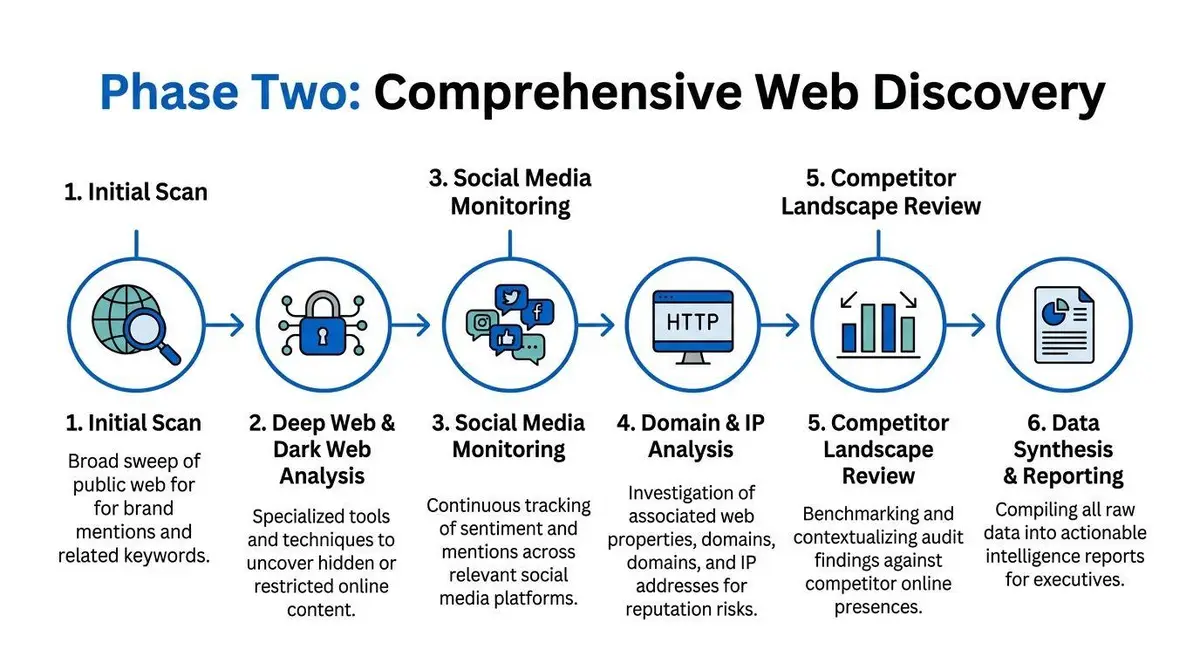
Once the perimeter is set, discovery starts. Most executives then realize how weak a basic self-check really is.
An incognito Google search is fine for orientation. It is not enough for evidence collection. It won’t show you the full spread of indexed mentions, duplicate copies, forum echoes, review-site references, old images, or hidden leaks. Professional discovery is broader and much more methodical.
Surface web discovery needs rigor
Start with controlled searches across major engines and content types. Use incognito mode. Search the mapped identities individually and in combinations. Capture branded search, image search, news results, video results, and query variants that a skeptic would use, not just the ones you prefer.
A working discovery set should include:
- Direct name searches: The executive name alone, plus all mapped variants.
- Association searches: Name plus company, board seat, investment vehicle, city, industry, and prior entity.
- Risk modifier searches: Name plus complaint terms, legal terms, scandal terms, and credibility terms where appropriate.
- Image and media searches: Reverse image review, thumbnail tracking, event-photo identification, and reused image appearances.
- Platform-native searches: Searches run inside LinkedIn, X, Facebook, Instagram, YouTube, and relevant forums because platform search often reveals material that general search surfaces poorly.
This stage is about capture. Save URLs, screenshots, timestamps, rankings, snippets, and visible context. If it disappears tomorrow, you still need the record.
The dark web is where self-audits usually fail
A serious blind spot in executive audits is the hidden web. That’s not a niche technical concern. It’s often where the most dangerous material sits before it reaches public channels.
A critical oversight in most self-audits is the dark web, where an estimated 60% of leaked personal data originates, and recent cybersecurity reporting notes a 25% increase in executive doxings via dark web channels since 2024, according to the CFA Institute reference cited in the verified brief. Traditional PR teams usually miss this because they’re trained to manage visible narrative, not private-data exposure.
What do you look for there? Credential leaks. Doxxing posts. Phone numbers. Home addresses. Family references. Travel patterns. Passport fragments. Corporate account exposure. Mentions in trade or extortion forums. If any of that exists, the issue stops being “reputation management” in the narrow sense and becomes personal risk management.
A video overview can help frame how broad discovery needs to be before analysis begins.
Don’t ignore technical and relational traces
Not every reputation threat is a page about you. Sometimes the signal sits in technical adjacency. An old domain tied to a former venture. A legacy microsite with stale executive bios. A company page listing the wrong title. A cached PDF with a signature block and direct contact details. An obscure conference page connecting your name to a disputed claim. These traces matter because journalists, litigants, and hostile researchers stitch them together.
Use discovery to connect those fragments:
- Map owned and semi-owned assets such as domains, profile pages, media pages, event pages, and archived bios.
- Identify repeat publishers that syndicate, scrape, or mirror content.
- Link mentions to narratives so you know whether one article is isolated or part of a cluster.
- Separate visibility from severity because some hidden items rank poorly today but become dangerous if amplified.
A reputation file is never just a stack of links. It’s a network map of what can be found, copied, and weaponized.
By the end of discovery, you should have raw intelligence, not conclusions. Conclusions come later. At this phase, your job is to ensure nothing material escapes collection.
Phase Three Asset Inventory and Threat Prioritization
Raw discovery is useless until you force it into a decision framework.
Most internal teams stop too early. They create a spreadsheet of links, mark items as positive or negative, and call that an audit. That doesn’t tell a board, a chief of staff, or outside counsel what to do first. A real audit needs ranking discipline.
Only 17% of businesses maintain structured, proactive reputation audits, which is reckless when 93% of consumers base trust on first-page reviews, and a high-impact, low-effort action such as de-indexing a defamatory result can deliver 3x faster recovery than traditional legal routes, according to Nadernejad Media’s reputation management statistics analysis.
Build the inventory properly
Each asset needs a standard record. No exceptions. At minimum, log the URL, asset type, publication or discovery date, current visibility, apparent sentiment, ownership status, legal posture, and whether it affects the executive personally, the company commercially, or both.
Useful asset categories include articles, review pages, forum threads, social posts, directory listings, images, videos, leaked documents, cached copies, and impersonation profiles. If one asset appears in multiple places, treat those as linked records, not duplicates. Replication is part of the threat.
Score what matters, not what irritates you
Executives often overreact to embarrassing items and underreact to operationally dangerous ones. That’s why you need a scoring method with hard criteria.
I use three core variables:
- Visibility score: How easy it is for a stakeholder to encounter the asset.
- Sentiment score: Whether the asset is favorable, neutral, negative, false, or defamatory.
- Strategic impact: Whether it affects revenue, counterparties, board confidence, hiring, regulation, or personal safety.
A negative forum post on page five may be unpleasant but low priority. A neutral directory page exposing a home address may be a top-tier risk. A dated article with an old allegation may be moderate risk in search but high risk if AI systems keep summarizing it. Priority follows consequence, not emotion.
Example Threat Prioritization Matrix
| Asset | Visibility Score (1-10) | Sentiment Score (-5 to +5) | Strategic Impact (Low/Med/High) | Priority |
|---|---|---|---|---|
| Negative news article ranking on page one | 10 | -5 | High | Immediate |
| Outdated corporate bio with incorrect role history | 6 | -1 | Med | Medium |
| People-search listing with private address details | 7 | -2 | High | Immediate |
| Dormant social profile with impersonation risk | 5 | -1 | Med | Medium |
| Positive interview on an authoritative publication | 8 | +4 | Low | Protect |
This table is simple by design. The point isn’t mathematical elegance. The point is triage.
Executive instruction: Rank first by business consequence, second by removability, third by visibility trend.
That last point matters. Some items are ugly but stable. Others are unstable and likely to spread. Unstable items often deserve earlier action even if today’s visibility is lower.
Add a second filter for actionability
Once you’ve ranked assets by risk, add an effort lens. Can the item be removed through platform policy, privacy rights, defamation procedure, or de-indexing? Can it be corrected by publisher outreach? Must it be suppressed because it’s lawful but damaging? Should it be monitored because intervention will amplify it?
Amateurs lose weeks when they attack what annoys them rather than what can be solved. A proper inventory produces an action queue, not just a threat log.
Use four buckets:
- Remove now for unlawful, policy-violating, leaked, impersonating, or privacy-invasive material.
- Correct or challenge for false, outdated, or context-missing content with a reachable publisher.
- Suppress strategically for legal but harmful assets that require stronger competing content.
- Monitor only for low-value or volatility-sensitive items where touching the issue could worsen exposure.
A digital reputation audit executive process earns its value here. It tells you where intervention is worth the oxygen.
Phase Four Building the Remediation and Suppression Roadmap
Once threats are ranked, the work stops being diagnostic and becomes operational.
Many firms default to generic “reputation management.” Publish a few positive articles. Freshen LinkedIn. Maybe add some media outreach. That approach is too shallow for executive exposure, especially now that AI summaries can preserve a negative source long after a standard search campaign appears to improve.
Emerging data from post-2025 shows that one authoritative negative article can dominate Google’s AI Overviews in 70% of executive queries, which makes simple suppression insufficient and shifts more weight toward source removal, advanced monitoring, and LLM retraining requests that may take 6-12 months, according to the referenced YouTube briefing in the verified data.
Choose the right intervention track
Not every harmful asset should be handled the same way. The roadmap should separate matters by remedy type.
-
Removal
Use this for defamation, impersonation, privacy violations, leaked documents, non-consensual material, policy breaches, or data exposures. The objective is source deletion, de-indexing, or both. This track is legal and procedural. It demands speed, evidence preservation, and platform-specific escalation.
-
Suppression
Use this when content is damaging but lawful. That includes adverse articles, stale controversy coverage, opinion pieces, and unattractive forum discussions. The objective isn’t to erase the item. It’s to reduce discoverability by strengthening more authoritative and better-optimized assets around the executive’s name and associated entities. A practical framework is outlined in this guide to suppressing negative content and restoring digital authority.
-
Strategic inaction
Some assets shouldn’t be touched immediately. Weak forum chatter with low visibility may die on its own. An obscure blog post can become more visible if you challenge it clumsily. A minor criticism may be less harmful than the paper trail created by a formal dispute. Knowing when not to move is part of competent remediation.
AI search changes the order of operations
Traditional suppression assumed that if you improved page one, you improved perception. That assumption is no longer safe. If AI Overviews or other LLM-mediated search layers keep citing the same hostile source, the visible narrative remains contaminated even after lower-ranking search results improve.
That changes the roadmap in two ways.
First, source quality matters more than volume. Ten weak positive assets won’t reliably counter one strong negative source if the AI system treats the negative source as authoritative.
Second, timelines extend. You may remove or de-index a harmful item and still need a longer cycle for machine-generated summaries to update. That means post-removal monitoring is not optional. It’s part of the remedy.
Build the roadmap as a sequence, not a wish list
A strong remediation plan has order. I advise clients to work in this sequence:
- Contain immediate privacy, leak, impersonation, and high-visibility threats first.
- Stabilize search and social surfaces that shape investor, partner, and press perception.
- Replace weak assets with accurate executive pages, stronger profiles, authoritative commentary, and clean entity signals.
- Monitor recurrence so removals aren’t undermined by reposts, mirror sites, or renewed indexing.
One option in this category is ContentRemoval.com, which offers audit-led takedown, de-indexing, suppression, and dark web monitoring services for executives and public figures. In a high-risk case, that kind of cross-channel remediation matters because the issue rarely stays on one platform.
The wrong roadmap wastes budget on optics. The right roadmap removes what can be removed, outranks what can’t, and watches for recurrence before it spreads.
If your remediation plan doesn’t clearly distinguish those three functions, it’s not ready.
Preparing the Executive Report and Establishing Monitoring
An audit isn’t finished when the findings are gathered. It’s finished when leadership can act on them without reading fifty pages of screenshots.
The executive report should be short, unsentimental, and decision-ready. I prefer a format that begins with the current exposure picture, then moves directly into ranked threats, immediate actions, medium-term remediation, and standing monitoring requirements. If a report can’t be read in one sitting by a CEO, chair, general counsel, or chief of staff, it’s too bloated.
What the report should contain
The opening page should answer five questions quickly:
- What is the current reputation posture
- Which assets create material risk
- Which risks affect the business versus the individual
- What can be removed, corrected, suppressed, or watched
- What must happen in the next operating window
After that, include the threat inventory in ranked form, then the remediation roadmap with ownership and escalation paths. Avoid vanity observations. Executives don’t need commentary on every minor mention. They need clarity on what can hurt them and what is already being done about it.
A concise report structure looks like this:
| Report section | What belongs in it |
|---|---|
| Executive summary | Plain-language risk posture and urgent findings |
| Top threat register | Ranked assets with business or personal implications |
| Remediation plan | Removal, correction, suppression, and monitoring actions |
| Escalation notes | Legal, security, HR, PR, or board-level flags |
| Monitoring protocol | Alert logic, review cadence, and responsible parties |
Turn the audit into an operating system
A one-time cleanup is fragile. If the executive is visible, exposure will continue to change. New articles publish. Old pages resurface. Review sentiment shifts. AI summaries update unpredictably. Leaks get reposted. That means the audit has to become a monitoring function.
I recommend setting a standing watch across search, social, review surfaces, and hidden-web sources, with alert thresholds based on the executive’s profile and risk history. The reporting cadence should be simple enough to survive busy calendars. If the system only works when a consultant is staring at it all day, it won’t last.
The safest executive profile isn’t the cleanest one. It’s the one under active surveillance.
Monitoring should cover three things at minimum. New mentions. Changes in ranking or summarization. Reappearance of previously addressed material. If you don’t have that, you’re relying on luck.
For teams building that ongoing layer, a dedicated reputation monitoring framework is the right place to start. It closes the gap between one-off diagnosis and durable protection.
The final point is blunt. A digital reputation audit executive process is only valuable if it changes behavior. It should alter how leadership thinks about search exposure, private-data risk, AI visibility, and response speed. If it doesn’t, you haven’t built a defense. You’ve built a document.
If your name, your company, or your family office is facing search exposure, data leaks, impersonation, or AI-amplified negative coverage, ContentRemoval.com can assess the full footprint confidentially and deliver a focused action plan for removal, suppression, and monitoring. This work is most effective when it starts before the issue spreads.
Frequently asked questions
How do you score threats in an executive reputation audit?
The article uses three variables: a visibility score for how easily a stakeholder encounters the asset, a sentiment score from favorable to defamatory, and strategic impact on revenue, deal confidence, board trust, hiring, regulation or personal safety. Items are then sorted into remove now, correct or challenge, suppress strategically, or monitor only.
Why do self-audits of executive reputation usually fail?
They search the common name on Google, check a couple of social accounts and stop. That misses aliases, legacy entities, cached copies, syndicated articles, data broker listings, image search associations and dark web leaks, which is where credentials, addresses and doxxing material typically surface before reaching public channels.
Does improving page one of Google fix an executive’s reputation?
Not reliably anymore. If AI Overviews keep citing the same hostile source, the visible narrative stays contaminated even after lower search results improve. The article shifts weight toward source removal and de-indexing, higher-quality replacement assets rather than volume, and longer post-removal monitoring while machine summaries update.