
Crisis PR reputation management treats a live attack as an exposure problem first and a communications problem third. The sequence is: lock down internal communications, build a small decision cell, preserve evidence, triage the source and claim, remove or de-index what can be reduced, then decide whether public statements help or simply add more indexable material to the internet.
Key facts
- Copyright complaints are often the cleanest, fastest tool when a harmful post reproduces owned text, images or video.
- Silence works when content is not dominant in search, media has not adopted it, and a removal path exists.
- Firms using five or more distinct communication strategies saw 40% higher recovery than apology alone, per one study.
- Do not confront a fake account in comments; it advertises the profile and rewards the operator.
Where ContentRemoval.com comes in. ContentRemoval.com runs the removal lane described here, alongside the client’s PR firm and counsel: de-indexing, source removal, impersonation and leaked media takedowns, then monitoring so a quiet period is not mistaken for a resolved one. PR agencies, general counsel and chiefs of staff bring the firm in, often after the first statement has already gone out. A free 15-minute Exposure Scan maps what is live and reducible, and the report is yours to keep. Get a Free, Confidential Exposure Scan or read how our reputation management work is done.
Your phone lights up before sunrise. A board member wants to know why a hostile article is ranking for your name. Your general counsel has three unread drafts open. Someone on your team has already replied to a journalist without clearance. Search results are shifting by the minute, screenshots are circulating, and the people around you are reaching for the wrong tools.
At this point, most reputational crises get worse.
Conventional PR treats a live attack as a messaging problem. It isn’t. It’s an exposure problem first, a systems problem second, and a communications problem third. If harmful content remains searchable, shareable, and re-uploadable, no statement will save you. You don’t win by sounding calm. You win by reducing visibility, preserving optionality, and speaking only when your legal, technical, and communications tracks are aligned.
That is the operating premise behind serious crisis PR reputation management. You don’t just manage the story. You remove what can be removed, de-index what can’t yet be deleted, contain internal leakage, monitor amplification paths, and then decide whether public communication helps or hurts. High-profile clients need that sequence because a live crisis punishes delay, loose language, and fragmented advice.
The Crisis Playbook Your PR Firm Won’t Show You
Most PR firms still behave as if the press cycle is the main battlefield. It isn’t. Search, social distribution, repost networks, review platforms, anonymous forums, and scraped copies move faster than any approved statement. Research on the gap in traditional guidance is blunt. 96% of brand crises spread internationally within 24 hours, while standard communication-led responses often take days or weeks to organize, creating a dangerous delay for executives and public figures who may benefit from immediate de-indexing or legal source removal, as noted in this analysis of the speed-reputation tension in crisis response.
That gap is where reputations are lost.
A conventional agency asks, “What should we say?” A competent crisis advisor asks three harder questions first. What exactly is live right now. Where is it ranking, spreading, or being mirrored. Which parts can be removed, suppressed, blocked, or neutralized before a public response creates more discoverable material.
Why narrative management alone fails
If a defamatory article remains indexed, if a fake profile is still impersonating you, or if leaked media continues to circulate, your “response” becomes fuel. Every interview, every clarifying post, every defensive denial creates fresh pages for search engines and fresh clips for adversaries.
The right playbook treats communications as one lane, not the whole highway.
| Traditional PR reflex | Integrated crisis response |
|---|---|
| Draft a statement first | Lock down facts and distribution first |
| Engage media early | Remove, de-index, preserve evidence, then assess outreach |
| Focus on sentiment | Focus on visibility, discoverability, and amplification paths |
| Assume coverage is inevitable | Challenge publication, indexing, and platform availability |
Practical rule: If harmful content can be reduced at the source, do that before you add a new public artifact to the internet.
The operating principle
Your first objective isn’t to “win the conversation.” It’s to stop the attack from becoming easier to find, easier to believe, and harder to reverse. That requires legal analysis, platform policy knowledge, search suppression strategy, and disciplined communications timing. Most firms offer one or two of those pieces. In a live crisis, fragmented advice is its own liability.
The First Hour Your Immediate Response Protocol
The first hour decides whether this becomes a contained incident or a rolling disaster. The immediate job isn’t eloquence. It’s command, containment, and intelligence. The Patiswiss case showed what happens when an organization misses that window. An inadequate initial response allowed negative information to go viral within seconds, severely damaging the brand’s reputation, according to the Patiswiss social media crisis case study.
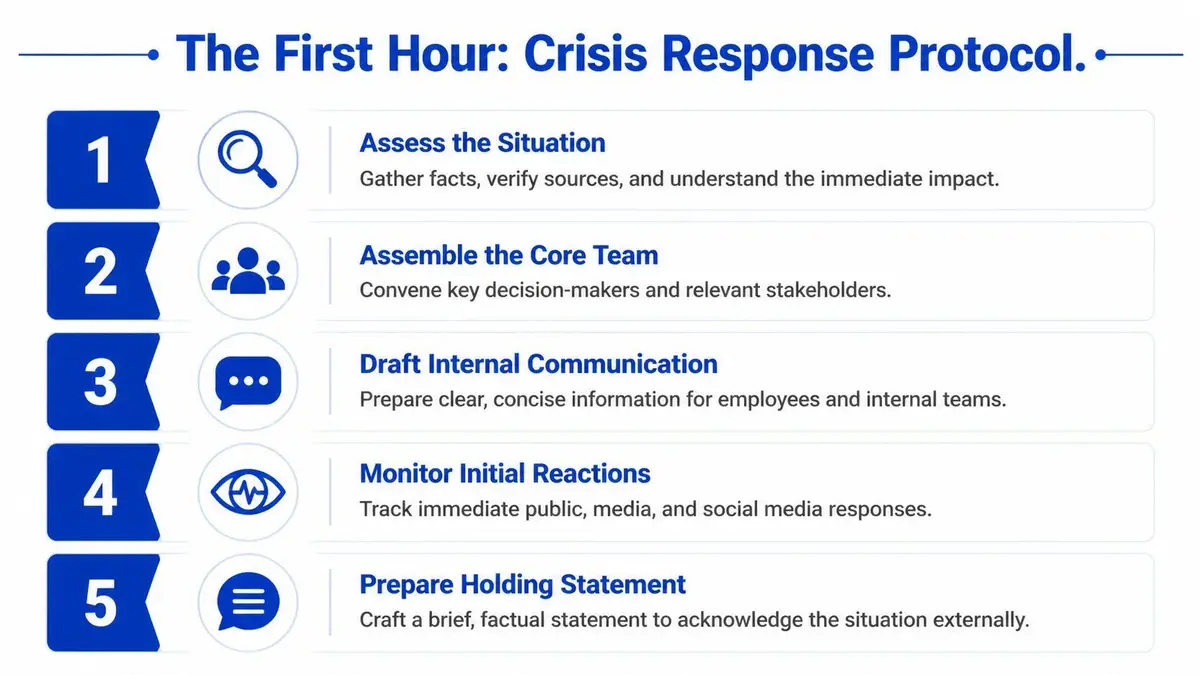
If you’re in a live incident, follow this sequence.
Lock the perimeter
Start with an internal communications freeze. No employee replies to journalists, posts on personal accounts about the matter, or “clarifies” facts to clients, vendors, or friends. Loose internal chatter becomes screenshots. Screenshots become evidence against you. Evidence against you becomes tomorrow’s headline.
Issue one instruction across leadership and staff: route every inquiry to a single response channel. If someone has already spoken out of turn, preserve it and stop the bleed. Don’t waste time assigning blame.
Build a decision cell
You need a small command group, not a crowd. Keep it tight enough to move quickly and senior enough to make binding decisions. In most serious matters, the core group includes legal counsel, one executive with final authority, one operational lead who can gather facts, one communications lead, and one specialist capable of removal and platform escalation.
Use one secure thread. One document repository. One owner for approvals.
A simple first-hour command structure looks like this:
- Decision authority
One person signs off on public language, legal demands, and platform actions. - Evidence control
One person captures URLs, screenshots, timestamps, account handles, search results, and any signs of duplication. - Outside coordination
Counsel and technical removal specialists receive the same fact set, not conflicting summaries. - Stakeholder management
One person handles board, investors, family office representatives, or other high-risk constituencies.
Triage the attack correctly
Not all crises behave the same way. A leak, a false review campaign, a hostile article, an impersonation profile, and a resurfaced lawsuit record each require different sequencing. Your first-hour triage should answer six questions:
- What is the source
Is the content on a news site, platform, forum, review page, social account, search result, or file host? - What is the claim
Is it false, misleading, private, stolen, non-consensual, impersonating, copyrighted, or partially true but framed to injure? - What is the current visibility
Search position matters. Platform velocity matters. Screenshot circulation matters. - What is the attack pattern
Organic outrage behaves differently from coordinated amplification. - What legal or policy hooks exist
Defamation, impersonation, privacy violations, copyright, platform policy, and de-indexing pathways each call for different evidence. - What will make it worse
Calling the reporter too early, threatening broadly, posting emotionally, or allowing internal contradictions.
Preserve first, then act. If content is removed later, you may still need a record of what was published, where it appeared, and how it spread.
Gather facts without feeding the fire
You need a factual spine before anyone speaks publicly. That doesn’t require a polished forensic report. It requires disciplined collection.
Create a live incident log with:
- Published assets including every URL, screen capture, repost, clip, and review
- Distribution signals such as platform reactions, search appearances, and prominent amplifiers
- Known inaccuracies separated from allegations you cannot yet disprove
- Action status for legal notices, platform reports, outreach holds, and stakeholder briefings
This is also where many teams realize they need a specialist response to a coordinated attack, not a generic press shop. If the issue involves fake accounts, manipulated media, hostile review flooding, or multi-platform smears, this executive playbook for handling a targeted online smear campaign is the right reference point.
Prepare a holding line, not a full statement
In the first hour, a holding statement is often enough. It should acknowledge awareness, confirm review, and avoid speculation. It should not argue facts you haven’t verified or offer emotional language that lawyers will spend two days undoing.
Use this structure:
We are aware of the material circulating online. We are reviewing the facts urgently, preserving relevant evidence, and will address verified information through the appropriate channels.
That buys time. More importantly, it avoids the two classic errors: denial before verification, and over-disclosure before containment.
Executing Surgical Content Removal
Serious crisis PR reputation management separates itself from public relations theater through its methodical execution. Once you’ve stabilized the first hour, you move to reduction. You identify what can be deleted from the host site, what can be de-indexed from search, what can be challenged under platform policy, and what needs parallel legal escalation.

A lot of clients arrive with one bad assumption. They think “removal” is one thing. It isn’t. It is a menu of different remedies, each with different thresholds, timelines, and strategic consequences.
De-indexing versus source removal
Start with the distinction that matters most.
| Remedy | What it does | When it matters most | Limitation |
|---|---|---|---|
| Source removal | Deletes or disables the content on the host platform or website | Leaks, impersonation, policy violations, infringing material | May require platform proof, legal grounds, or direct host action |
| De-indexing | Reduces or removes discoverability in search engines | Harmful content that’s difficult to delete quickly | Content may still exist at the original URL |
If a false profile is active on a major platform, source removal is the priority. If a stale article sits on an obscure site but dominates branded search, de-indexing may give immediate relief while larger actions run in parallel. The point is sequencing. You don’t wait for the hardest remedy before using the available one.
Match the tactic to the content type
Different content triggers different playbooks.
Defamation and false factual claims
You need precision. Broad complaints fail. A viable challenge isolates the exact false statement, documents why it is false, and shows the resulting harm or policy violation. That may support direct publisher outreach, platform reporting, host escalation, or legal demand.
Don’t send a dramatic all-purpose threat letter to everyone involved. It signals panic and often gets ignored. Use customized submissions tied to the host’s own rules and the relevant legal standard.
Impersonation and fake accounts
These cases are often more procedural than rhetorical. You identify the account, secure proof of identity, document the impersonating behavior, and push through the platform’s impersonation pathway. The public mistake here is confronting the account in comments. That advertises the fake profile to more users and gives the operator attention.
Leaked images, videos, and intimate material
The sequence here is preservation, emergency reporting, and replication mapping. Once a file is circulating, you don’t focus only on the original post. You map mirrors, reposts, clips, and indexed thumbnails. If the material falls under non-consensual intimate imagery or privacy-based platform rules, those pathways must be activated quickly and consistently across every visible node.
Copyright theft and unauthorized reposting
Copyright is often the cleanest tool available when clients hesitate to use it. If the harmful publication reproduces protected text, images, video, or other owned material without authorization, a copyright complaint may be stronger and faster than an argument over motive. It doesn’t solve every case, but it often dismantles a network of reposts efficiently.
Removal work succeeds when the submission fits the platform’s exact decision logic. It fails when advisors argue morality instead of policy.
Why timing and jurisdiction matter
The internet looks borderless to clients and fragmented to operators. The same content may be hosted in one country, indexed globally, reposted by users elsewhere, and discussed on a platform headquartered somewhere else. That means your legal path and your technical path often move on different clocks.
This is why strategic teams don’t rely on one remedy. They run layered action:
- Platform enforcement where policy is the fastest route
- Publisher or host outreach where direct removal is realistic
- Search suppression or de-indexing where discoverability is the urgent problem
- Evidence preservation in case formal proceedings become necessary
A specialist process matters most when the attack is mixed. For executives and founders dealing with leaks, defamatory search results, impersonation, or copied content across platforms, this professional guide to strategic content removal outlines the kind of integrated removal logic that generalist PR teams usually miss. One option in that category is ContentRemoval.com, which handles de-indexing, source removal, and monitoring across search engines, websites, and social platforms.
What not to do
Clients under pressure often make the takedown harder by improvising. Avoid these mistakes:
- Don’t contact every outlet at once. You may alert secondary publishers who hadn’t seen the material.
- Don’t publish a defensive rebuttal page immediately. You can accidentally strengthen the association between your name and the allegation.
- Don’t assume a legal filing solves discoverability. Court activity can create new indexed pages.
- Don’t stop after one removal. Adversaries test whether you’ll monitor for reappearance.
Surgical removal isn’t glamorous. It’s technical, repetitive, jurisdiction-sensitive work. That is why it works.
Controlling the Narrative with Strategic Communication
Once removal and containment are underway, communication becomes useful again. Not before. The central mistake in crisis PR reputation management is confusing urgency with the need to speak immediately. In many cases, silence is not weakness. Silence is discipline.

When silence is the correct move
If the content is low-credibility, confined, or already under active removal review, public response may enlarge the audience. If a hostile post sits on a fringe forum and hasn’t crossed into mainstream search or press, don’t drag it there yourself.
Silence works when you can answer yes to most of these:
- The content is not yet dominant in branded search
- Mainstream media hasn’t adopted it
- Stakeholders who matter can be briefed privately
- You have a credible path to removal, de-indexing, or policy enforcement
- A public statement would create more indexable material than it would resolve
That said, silence is not passivity. It only works when it sits on top of active removal, monitoring, and stakeholder control.
When you must speak
Some incidents require visible acknowledgment. Investors ask. Employees panic. Clients want direction. A regulator, reporter, or board expects a response. When that happens, don’t rely on a single apology and hope it calms things down. Empirical analysis found that firms using five or more distinct communication strategies saw 40% higher recovery than those relying on a single tactic such as apology alone, according to this study on multi-strategy crisis communication and reputation recovery.
That result matches what experienced advisors already know. One statement is rarely enough. Communication has to be layered.
A credible communications portfolio usually includes:
- Swift acknowledgment without speculation
- Fact transparency limited to what you can stand behind
- Corrective action language that shows movement, not spin
- Stakeholder segmentation so employees, investors, partners, and the public don’t all receive the same message
- Follow-up updates once material facts or actions change
A good statement doesn’t try to sound innocent. It tries to sound accurate, controlled, and useful.
Separate accountability from liability
Clients often get trapped between two bad instincts. One is total denial. The other is performative confession. Neither is strategic.
You can acknowledge impact without admitting every alleged fact. You can show command without sounding cold. You can communicate corrective action without volunteering legal exposure. For example:
We understand the seriousness of the claims being circulated. We are reviewing the underlying facts, preserving evidence, and taking immediate steps to address any verified misconduct or false material through the proper channels.
That works better than dramatic language because it does three things at once. It signals seriousness. It reserves factual and legal space. It tells the audience that action is already underway.
Use owned channels for that message first. Your website, verified social profiles, investor email, or internal portal should become the reference point. Don’t let hostile accounts become the primary archive of your position.
Keep message architecture tight
A communications system under stress needs hierarchy. Not everyone gets the same detail.
| Audience | What they need most | What to avoid |
|---|---|---|
| Employees | Clear instructions, reporting channels, conduct expectations | Rumor-rich internal essays |
| Investors or board | Verified facts, risk actions, timeline control | Emotional language and speculative blame |
| Customers or partners | Operational reassurance and point of contact | Overly legal phrasing that sounds evasive |
| Public | Brief acknowledgment and verified updates | Arguments with detractors in real time |
The message should get more detailed as the audience gets closer to the risk. Public language should stay shorter than internal legal and governance updates.
A short briefing on executive media posture can help frame how controlled communication should look in practice:
What disciplined communication sounds like
Use plain language. Drop adjectives. Cut self-defense. If the facts are incomplete, say so cleanly. If an allegation is false, identify the false point precisely and avoid litigating the entire issue in public.
Here are two examples.
For an internal audience
We are aware of the material circulating online. A restricted response team is reviewing the facts, preserving records, and coordinating legal, technical, and communications action. Do not comment externally or on personal accounts. Route all inquiries to the designated response channel.
For an external audience
We are aware of the online material and are assessing the facts urgently. Where content is false, impersonating, or unlawfully shared, we are taking appropriate action. We will issue further updates when verified information can be shared responsibly.
That’s not soft. It’s controlled.
Implementing Advanced Monitoring and Remediation
Most organizations think they’re monitoring because someone set up Google Alerts. That’s not monitoring. That’s delayed notification of a small part of the problem. Real crisis PR reputation management requires a live detection system that tracks spread, mutation, and reappearance across search, social, review platforms, forums, and less visible channels where harmful material often incubates.

The methodology matters. A structured media monitoring process should expand keywords, increase scans to hourly during an active crisis, prioritize high-volume platforms, track key detractors, and use AI to spot misinformation. Done properly, proactive monitoring can reduce crisis escalation by 65%, according to this step-by-step crisis monitoring methodology from Prowly.
What professional monitoring actually covers
A serious monitoring stack doesn’t just watch your exact name. It watches the ways an attack mutates.
That includes:
- Branded variants such as company names, executive names, common misspellings, and attached allegations
- Platform-specific signals including reviews, hashtags, repost chains, and comment surges
- Narrative shifts where the allegation changes form but keeps the same core attack
- Adversary behavior including repeat accounts, pseudo-journalistic blogs, and known amplifiers
- Re-upload attempts after removals, especially clips, screenshots, and mirrored files
Why basic alerts fail
Google Alerts can tell you that something indexed. They can’t give you command over velocity, coordination, or replication. They won’t reliably identify the fake account that appears before the article indexes. They won’t help much with screenshots spreading in private or semi-private spaces. They also won’t tell you whether a “new” attack is a recycled asset from an older incident.
A proper remediation loop requires more than notice. It requires classification and action.
If your monitoring system can’t tell you what changed, who amplified it, and whether it reappeared after removal, you’re not monitoring a crisis. You’re reading about it late.
Build a remediation loop
Monitoring without response is just anxiety with software attached. Every new signal should flow into an action path. Keep that path simple enough to run under pressure.
- Detect
Capture the mention, URL, account, screenshot, or file hash and record where it appeared. - Classify
Decide whether it’s false, unlawful, duplicated, policy-violating, privacy-invasive, or hostile but lawful. - Route
Send it to the correct lane. Legal review, platform report, de-index request, source removal, stakeholder briefing, or no-action archive. - Verify outcome
Was it removed, reduced, ignored, mirrored, or escalated by the target of your request? - Watch for recurrence
Re-uploads often appear in altered form. Cropped screenshots, shortened clips, and quote-post commentary can restart a dead story.
This is the difference between a one-time takedown and a sustained defense posture. For organizations and individuals who need that persistent layer, reputation monitoring services are built around ongoing detection, escalation, and remediation rather than a single pass at search cleanup.
Expand beyond the visible web
Complex attacks often germinate in places executives rarely monitor. That includes invitation-only groups, splinter forums, and dark web communities where stolen materials, internal leaks, and harassment campaigns can be prepared before they hit public platforms. You won’t address those spaces with a social media manager and a free alert product.
A mature monitoring function also watches for:
- Early leak indicators
- Credential misuse tied to impersonation
- Coordinated release timing
- Archived copies prepared for redeployment
That doesn’t mean every rumor deserves public treatment. Usually the opposite. It means you act before the visible web catches up.
Building Long-Term Reputational Armor
If you’re reading this after a crisis has already broken, the lesson is simple. Recovery is expensive because prevention was neglected. Most organizations are still underprepared. A 2023 Capterra survey found that only 49% of US companies have a formal crisis communication plan, while 23% have no plan at all or are uncertain whether one exists. The same reporting notes that 75% of crises stem from smoldering issues, not sudden shocks, which is why unaddressed vulnerabilities become public disasters, as summarized in this review of crisis preparedness and transparent response.
That should change how you think about reputation work. This isn’t emergency cleanup. It’s risk control.
Audit what can be weaponized
High-profile people usually know their obvious liabilities. They often miss the exploitable digital ones. Old bios that create inconsistency. Dormant domains. Legacy litigation references. Weak impersonation protections on social platforms. Poorly governed image libraries. Unmonitored executive review profiles. Former employee grievances sitting one search result away from prominence.
A digital vulnerability audit should identify:
- Search exposures tied to your name, company, products, and principals
- Platform weaknesses such as unverifed profiles, abandoned accounts, or spoofable assets
- Content liabilities including leaked files, stale press, copied media, and reputational dead zones
- Response gaps where internal approvals are so slow that the internet will outrun you
The point is not paranoia. The point is to close obvious doors before someone tries the handle.
Retainers beat panic buying
Clients often spend more in the first week of a crisis than they would’ve spent on quiet preparation over a much longer period. That is backward. The strongest posture is a standing one: pre-cleared counsel, known escalation paths, monitoring already tuned to your risk surface, and message templates that can be adapted without sounding canned.
Consider personal security. You don’t hire protection after the breach and pretend timing doesn’t matter.
A useful model comes from an unexpected place. Restoring trust after damage isn’t only about the apology. It depends on consistency, proof of changed behavior, and follow-through. That’s why this action plan to restore trust is a worthwhile reference. The context is different, but the principle is the same. Credibility returns when actions keep matching words over time.
Build a culture that doesn’t sabotage itself
Most reputational failures aren’t caused by one villainous act. They’re worsened by internal drift. No single spokesperson. No evidence protocol. No approved chain of command. No discipline around who can post, who can reply, and who can authorize outside advisors.
Fix that before the next incident:
- Designate decision rights so nobody debates approvals while content spreads
- Train a narrow response group rather than “informing” the whole company
- Pre-draft holding language for common scenarios without overcommitting facts
- Run simulations that test whether legal, technical, and communications teams can act in sequence
The organizations that look calm in a crisis usually weren’t calmer. They were rehearsed.
Long-term reputational armor is built the same way elite security programs are built. Discreetly, systematically, and before anyone outside the building knows why it matters.
If your name, company, or family office is facing a live reputational threat, ContentRemoval.com can coordinate confidential assessment, content removal strategy, de-indexing, and ongoing monitoring with legal and communications alignment. The right time to bring in specialist help is before the issue hardens into permanent search history.
Frequently asked questions
Should we issue a statement immediately when a story breaks?
Usually a holding line is enough in the first hour: acknowledge awareness, confirm review and evidence preservation, avoid speculation. A full statement before verification risks denial you may have to retract or disclosure before containment.
Will suing the publisher make the article disappear from Google?
Not on its own. Court activity can create new indexed pages, and a legal filing does not solve discoverability. De-indexing and source removal requests need to run in parallel with any legal action.
What is wrong with using Google Alerts to monitor a crisis?
Alerts only tell you something indexed. They miss velocity, coordination, fake accounts that appear before the article indexes, screenshots in private groups and recycled assets from older incidents. Real monitoring classifies each signal and routes it to an action path.