
A crisis communication strategy is a command structure, not a press statement. It fixes who approves language, who speaks, which facts are verified and which channels are live, then runs a 15-60-90 timeline: acknowledge within 15 minutes, give substance by 60, be ready for media by 90, while monitoring and takedowns shrink the footprint of false or harmful content.
Key facts
- Core team: executive lead, legal lead, communications lead, operations lead and a digital defense lead for takedowns.
- Pre-approve holding statements, employee notices, investor language and inquiry routing before any incident.
- First message: acknowledge awareness, state action, set expectations for the next update, route inquiries.
- Classify hostile content as defamatory, impersonation, leaked, manipulated or rumor; each has a different removal route.
Where ContentRemoval.com comes in. ContentRemoval.com is the digital defense lead in that table: de-indexing, source removal, impersonation and leaked content takedowns run in step with counsel and the communications team rather than after them. The head of communications, general counsel or the principal’s chief of staff usually makes the call, ideally before the story breaks. A free 15-minute Exposure Scan maps what is spreading and what can be removed, and the report is yours to keep. Get a Free, Confidential Exposure Scan or read how our content removal work is done.
At 10 PM, the story breaks. A reporter has your mobile number. Your general counsel is texting in fragments. Someone on your team is urging silence until the facts are cleaner. Meanwhile, screenshots are already moving across X, Reddit, group chats, and private investor threads.
That’s the moment most reputational damage becomes permanent.
Not because the underlying event is always fatal. It usually isn’t. The lasting damage comes from drift, delay, contradiction, and the false belief that communications can be separated from legal and digital containment. They can’t. A real crisis communication strategy has to do three things at once: establish control of the narrative, preserve legal defensibility, and aggressively limit the spread of harmful or false material online.
If you’re a public company executive, founder, family office principal, or public figure, generic PR advice won’t carry you through that first night. You need an operating protocol. You need message control, clear authority, live monitoring, takedown decisions, and a disciplined cadence of updates that can stand up to press scrutiny, internal review, and later litigation.
The First Call You Never Want to Make
The call usually starts with denial.
You tell yourself the story may not travel. Maybe it stays with one outlet. Maybe the post dies in the feed. Maybe the allegation is so thin that no serious journalist will touch it. That is how people waste the first window where control is still possible.
A client in this position isn’t dealing with one audience. They’re dealing with several at once. Employees want to know whether leadership has lost control. Investors want to know whether this becomes a governance issue. Customers want to know whether they’re affected. Family members want to know what they should say if someone calls. Reporters want a statement, but what they really want is hesitation they can describe as evasiveness.
That’s why panic is less dangerous than improvisation. Panic at least tells you the stakes are real. Improvisation creates inconsistent statements, unauthorized outreach, and digital debris that lives forever in screenshots.
What goes wrong in the first night
The familiar pattern looks like this:
- Legal freezes communications: Counsel worries that any statement creates exposure.
- PR over-corrects: Communications drafts something polished but noncommittal.
- Leadership freelances: A principal or executive sends texts, emails, or side comments that conflict with the official line.
- No one manages the web: False claims, impersonation, reposts, and edited clips continue spreading while the team debates wording.
The result is predictable. The public sees confusion. Reporters sense weakness. Adversaries get time.
Practical rule: If your first coordinated action starts after the story is already trending, you’re not managing a crisis. You’re absorbing one.
A defensible response starts with a pre-built system, not with a brainstorming session under pressure. If the issue involves an executive personally, the response also has to account for the overlap between corporate reputation and individual exposure. That’s where most internal teams fail. They treat the company and the person as separate communication problems when the public sees one event. If that’s your situation, this briefing on what to do when a key executive is in the news for the wrong reasons is the kind of escalation framework you need immediately.
The right frame
A crisis communication strategy is not a press statement. It is command structure.
It tells your team who approves what, who speaks, which facts are verified, which channels are live, what gets removed, what gets answered, and what gets ignored. Without that architecture, even intelligent teams become slow, political, and dangerously inconsistent.
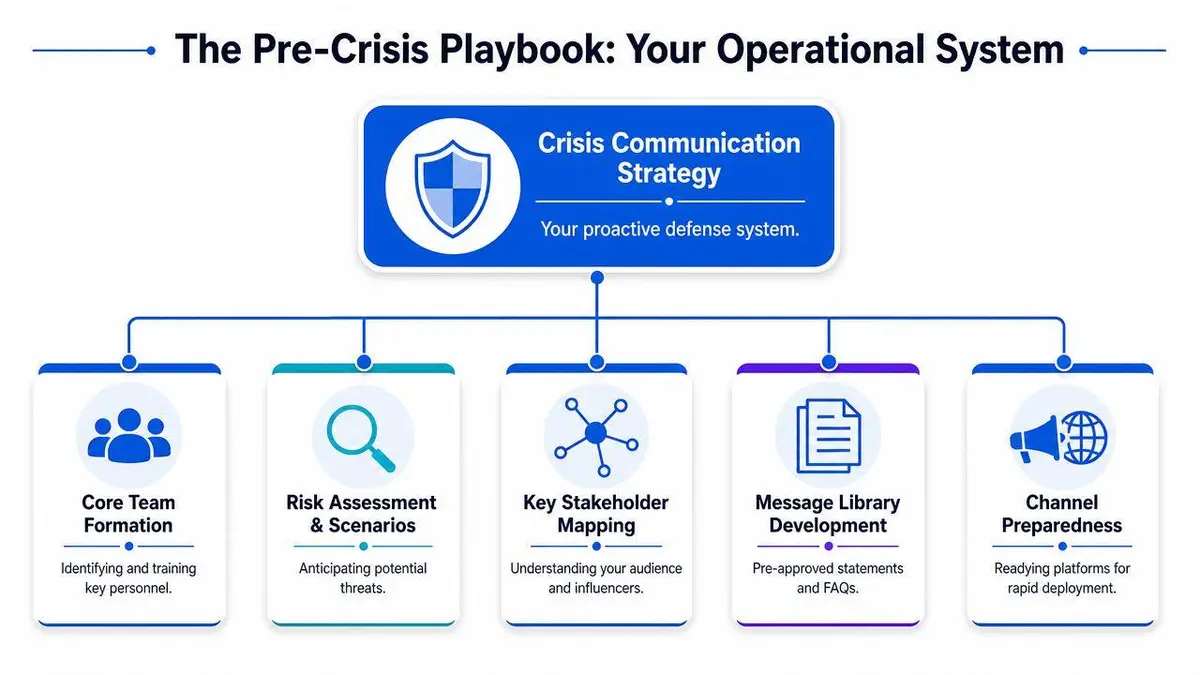
The Pre-Crisis Playbook Your Counsel Demands
The plan must exist before the incident. If you build it during the incident, you’re already late.
The best crisis plans are operational systems, not binders. They define who makes decisions, how facts are verified, which scenarios are anticipated, and how legal and communications teams clear language quickly enough to matter. Government and organizational frameworks now treat crisis planning as a measurable discipline. The UK Government Communication Service uses the STOP model, meaning Strategy, Tactics, Organisation, and People, and its guidance also calls for a quick-reference checklist and pre-planned clearance requirements. Separate emergency-response guidance recommends that crisis plans be exercised at least once a year to identify weaknesses and improve readiness, as outlined in the UK Government crisis communications planning guide.
Build the team before you need it
Your crisis team should be smaller than people expect and stronger than the org chart suggests.
At minimum, you need legal, communications, the executive decision-maker, operations, and whoever controls the technical source of truth for the incident. For a founder or public-facing principal, include a personal representative or private counsel. For a cyber or leak matter, bring in the security lead early. For a harassment, misconduct, or employment issue, HR cannot be an afterthought.
A useful structure looks like this:
| Role | What they control |
|---|---|
| Executive lead | Final business decisions and escalation |
| Legal lead | Liability review, privilege, and external exposure |
| Communications lead | Message drafting, spokesperson prep, channel coordination |
| Operations or incident lead | Verified facts and remediation actions |
| Digital defense lead | Monitoring, takedown workflow, impersonation response |
This structure matters because delay often comes from hidden veto points. If five people think they can block language, no statement gets out on time.
Pre-approve what you can
Teams often waste precious time writing from scratch. That’s amateur work.
You should already have approved holding statements, internal employee notices, investor update language, customer notices, media inquiry routing, and Q&A frameworks for likely scenarios. Those scenarios usually include allegations against an executive, cyber incidents, leaked materials, regulatory scrutiny, litigation publicity, and financial distress.
Pre-approved language doesn’t lock you into facts you don’t yet have. It gives you a clean opening move. The first message usually needs to do only a few things well:
- Acknowledge awareness: Confirm that you know the issue exists.
- State action: Say what team is doing now to verify and respond.
- Set expectations: Tell people when they should expect the next update.
- Route inquiries: Direct media and stakeholders into one controlled channel.
Fix authority before the pressure starts
Most corporate crises become slower than they need to be because nobody has settled the clearance chain in advance. You need explicit decision rights.
If the CEO is on a plane, who can approve? If the issue concerns the CEO, who takes over? If outside counsel is unreachable, does in-house counsel have authority? If the spokesperson is compromised, who is the alternate? These are not administrative details. They are survival details.
A crisis plan that requires everyone to be available at once is not a plan. It is a fantasy.
You also need a live contact list, channel access, draft templates, and a practical checklist that can be opened in seconds. Keep it current. Stale numbers and expired logins have embarrassed more than one well-established organization.
Activating Your Strategy Within the First Hour
The first hour is where disciplined teams separate themselves from frightened ones.
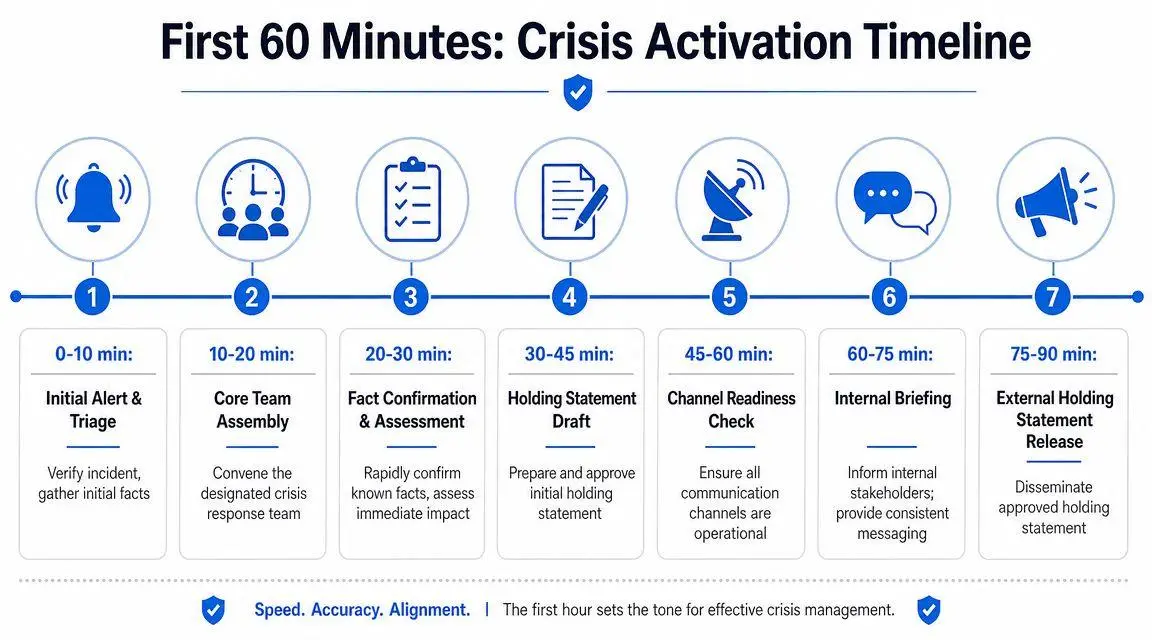
A widely used benchmark is the 15-60-90 timeline: acknowledge the crisis within 15 minutes, share more detailed information by 60 minutes, and prepare for broader media engagement within 90 minutes, according to this guidance on effective crisis communications pillars. That benchmark exists because the information cycle now outruns internal hesitation.
Start with the timeline, not with the perfect sentence.
Minutes zero to fifteen
Your first task is triage. Confirm whether the event is real, public, and escalating. You do not need every fact. You do need enough verified information to decide whether formal activation is required.
In that opening window, do three things:
- Convene the core team immediately.
- Freeze unauthorized outbound communications.
- Draft the first acknowledgment.
That acknowledgment should be short. It should not speculate. It should not assign blame. It should not try to close the issue before the investigation has started. It buys you time and shows that leadership is functioning.
Minutes fifteen to sixty
Frequently, many teams over-lawyer the message and lose the room.
By the sixty-minute mark, you should have a more substantive update for the audiences that matter most. That may not be public first. In some matters, employees, regulators, counterparties, or board members need a customized communication before broad release. The point is not volume. The point is controlled sequencing.
A workable first-hour checklist includes:
- Fact confirmation: What is verified, what is likely, what remains unknown.
- Impact assessment: Who is affected right now.
- Message discipline: One approved vocabulary set across all channels.
- Spokesperson prep: One person speaks publicly, others route inbound requests.
- Digital scan: Identify posts, clips, leaks, impersonation, and hostile amplification.
This short briefing is useful if your team needs to align quickly on the first-response mindset:
Minutes sixty to ninety
By now, the question is no longer whether you’ll engage. The question is whether you’ll do it from a position of control.
You should be ready for direct media engagement, a press inquiry wave, customer support escalation, or investor outreach. Internal stakeholders must already know the core line. If they learn the company position from social media, leadership has failed.
Use a simple message architecture at this stage:
| Message element | What it should answer |
|---|---|
| What we know | Confirm verified facts only |
| What we don’t know yet | Reduce speculation without sounding evasive |
| What we’re doing now | Show active management |
| What affected parties should do | Give practical instruction if needed |
| When we will update again | Create cadence and reduce rumor gaps |
Silence creates a vacuum. The internet fills it with whatever is most emotional, most clipped, and least accurate.
Executing a Defensible Multi-Channel Response
The crisis isn’t managed when the first statement goes out. That’s when the essential work starts.
Different audiences need different levels of detail, different framing, and different delivery channels. They do not need different facts. That distinction is where experienced teams earn trust. Your investors may need governance language. Employees may need operational reassurance and conduct guidance. Customers may need service, privacy, or continuity information. The media needs a usable, quotable line. Family and personal networks may need instructions not to comment at all.
Say less, mean more
A defensible message is not the longest message. It is the clearest one.
Benchmark guidance from government and enterprise planning sources is straightforward: use trusted messengers, communicate early and frequently, do not withhold information “to control panic,” and make clear that facts may change as the situation evolves, as summarized in this crisis communication planning guidance from Cision. That principle is essential for legal reasons too. If you pretend certainty where there is none, your next correction looks like a contradiction.
A strong response usually contains four ingredients:
- A verified factual core: No speculation, no adjectives doing legal work.
- Visible accountability: Confirm who is handling the matter.
- Measured empathy: Acknowledge impact on affected people.
- A forward signal: Say when and how updates will follow.
Match the channel to the stakeholder
A public post is not a substitute for direct communication with people who carry consequences.
Use your website or newsroom for canonical updates. Use direct email for investors, partners, or customers who need precise instruction. Use internal portals and manager briefings for employees. Use social platforms to point back to the canonical statement, not to improvise thread by thread.
The simplest way to preserve consistency is to build a message matrix.
| Stakeholder | Primary concern | Best channel | Message emphasis |
|---|---|---|---|
| Employees | Stability, conduct, talking points | Internal email, leadership briefing | What happened, what to say, what not to say |
| Investors or board | Exposure, continuity, governance | Direct memo, call | Facts, containment, next decision points |
| Customers | Impact and trust | Email, support page, website | Service implications, practical guidance |
| Media | Timely usable statement | Press line, spokesperson | Confirmed facts and update schedule |
| Personal network and family | Spillover and privacy | Direct outreach | No-comment discipline and routing |
Keep legal and communications in the same room
At this stage, mature teams act differently from ordinary PR shops.
Legal wants to avoid admissions that create exposure. Communications wants language people will believe. Both are right. The answer is not compromise by committee. The answer is disciplined drafting. State what is known. State what isn’t. State what is being done. Avoid loaded labels unless the facts are settled. Don’t hide behind sterile wording when people are plainly affected.
“We are aware, we are verifying, and we will update by a stated time” is often more credible than a polished paragraph that says almost nothing.
The best spokesperson in a crisis is rarely the most charismatic person. It’s the person with enough authority to be credible and enough discipline not to freelance.
Active Defense Through Monitoring and Takedowns
Traditional PR assumes that if you publish the correct message, the market will eventually absorb it.
That assumption is obsolete.
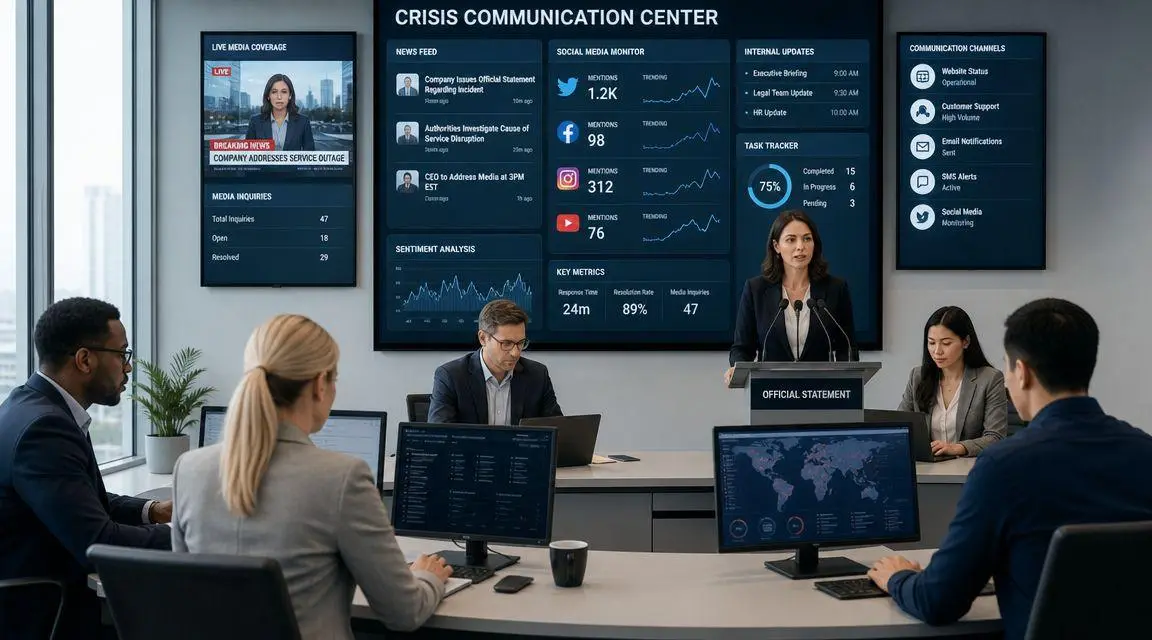
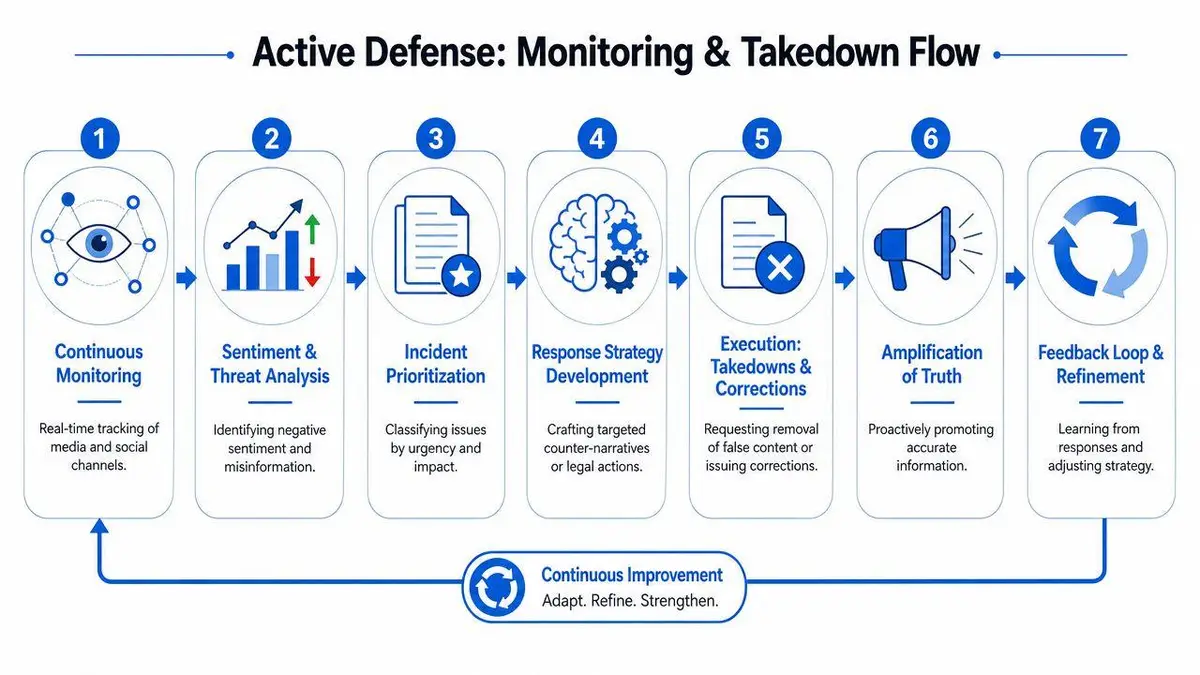
A modern crisis communication strategy has to include active digital defense. If a false allegation, manipulated image, impersonation account, leaked file, or synthetic clip is circulating, your team cannot merely issue a statement and hope accuracy wins. In an AI-shaped misinformation environment, false narratives can spread faster than official corrections, and current guidance still leaves a gap on the practical question of how to verify, prioritize, and respond when the information environment is distorted, as discussed in this analysis of crisis communication planning in a misinformation-heavy environment.
Monitoring is not optional
During an active incident, you need continuous visibility into what is spreading, not what your team assumes is spreading.
That means tracking search results, social platforms, forum reposts, video mirrors, image copies, fake profiles, and leak references. It also means watching for second-order distortions, such as edited clips, fake captions, account impersonation, or recycled allegations tied to the new incident. A serious digital defense program also checks closed environments when appropriate, including private channels and dark web references where leaked data or stolen media can surface.
If your team doesn’t already have that infrastructure, use a dedicated reputation monitoring workflow immediately. Crisis teams lose time when they’re manually searching their own names while hostile content multiplies.
Takedowns change the battlefield
There is a reason astute clients bring in removal specialists early. Communications can correct. Legal can threaten. But neither function alone reliably removes distributed harmful content at speed.
An active defense layer should classify material into clear buckets:
- False and defamatory content: Pursue platform complaints, publisher demands, and legal escalation.
- Impersonation and fake accounts: Move immediately through platform enforcement channels.
- Leaked or stolen content: Use source-removal and de-indexing tactics where available.
- Manipulated media: Preserve evidence, challenge authenticity, and seek removal where policies allow.
- Amplified rumor posts: Decide case by case whether to ignore, rebut, or suppress through authoritative updates.
One practical option in this lane is ContentRemoval.com, which handles de-indexing, source removal, impersonation matters, and related crisis-management takedown workflows. That kind of capability belongs alongside legal and communications, not after them.
Don’t answer every lie. Remove what you can.
A common mistake is treating all hostile content as a messaging problem. Some of it is a platform-enforcement problem. Some is a search problem. Some is a source-hosting problem. Some requires preservation first because litigation may follow.
Use a priority model:
| Threat type | Immediate action |
|---|---|
| Viral false claim from a credible-looking source | Rapid verification, formal correction, takedown review |
| Impersonation account | Report, preserve evidence, lock official account messaging |
| Leaked internal document | Confirm authenticity, assess privilege, pursue removal where viable |
| Synthetic or edited media | Authenticate, rebut carefully, seek platform action |
| Low-reach abuse post | Monitor unless amplification risk rises |
The point is simple. Broadcasting your truth is only half the job. The other half is shrinking the footprint of the falsehood.
Post-Crisis Reputation Remediation and Recovery
Most playbooks get you through the first wave and then abandon you in the most reputationally expensive phase.
That phase starts after public attention begins to thin out. The press may move on, but search results, copied posts, stale summaries, Reddit threads, and old headlines remain. Existing guidance often gives limited direction after the first 48 hours, yet established advice is clear that crisis communication does not end when the crisis ends and that ongoing monitoring, clarifying inaccurate information, and continuing stakeholder updates are ongoing requirements, as noted in Bryant University’s guidance on developing a crisis communication strategy after disaster strikes.
Run the post-mortem while memories are fresh
Do it promptly, and do it without political theater.
You need a written review covering what happened, which facts were hardest to verify, where approval slowed down, which channels worked, which messages landed badly, and what harmful content remained unresolved. Update the crisis playbook immediately. If you wait, people rewrite the story to protect themselves.
A strong review should answer three questions:
- What failed operationally
- What damaged trust unnecessarily
- What digital residue still needs remediation
Shift from incident response to narrative repair
Recovery is not a PR trick. It’s a sequencing discipline.
Keep correcting falsehoods that still circulate. Keep direct stakeholders informed if the issue affects them materially. But stop repeating the original incident once repetition starts refreshing the story rather than resolving it. At that point, your job is to replace the search and conversation footprint with current, credible, forward-looking material.
That usually includes leadership visibility, clean factual updates, improved owned content, profile strengthening, and selective third-party credibility signals. If you need a useful outside primer on the broader discipline, this reputation management guide gives a reasonable overview of how long-tail trust repair works after a public hit.
Know when to close the loop
Not every audience needs the same end point.
Some need a final factual resolution. Some need proof of corrective action. Some need to stop seeing the crisis dominate every search result and media query. That’s why the acute response and the remediation plan must be linked from day one. If they are not, you contain the fire but keep the smoke.
For executives dealing with the long tail, this post-crisis online reputation repair checklist is a practical framework for the cleanup phase.
If you’re facing an active reputational event, ContentRemoval.com can help assess the exposure, coordinate digital containment, and build a discreet action plan that aligns communications, takedowns, and long-tail reputation repair.
Frequently asked questions
What should the first crisis statement say?
Keep it short: confirm you know the issue exists, say what the team is doing to verify and respond, tell people when to expect the next update and direct inquiries into one controlled channel. It should not speculate, assign blame or try to close the matter early.
How quickly should a company respond to a breaking crisis?
The article uses the 15-60-90 benchmark: acknowledge within 15 minutes, share a more substantive update by 60 minutes and be ready for broader media engagement within 90. The first coordinated action should start before the story is trending.
Is issuing a correct statement enough to stop false content spreading?
No. False claims, manipulated media, impersonation accounts and leaked files keep circulating regardless of how accurate the statement is. Active defense classifies each item and pursues platform complaints, publisher demands, source removal or de-indexing alongside communications.