

Criminal record expungement in Virginia now runs on three pathways: traditional expungement for non-convictions such as dismissals, acquittals and nolle prosequi; automatic sealing of some qualifying misdemeanor arrest records under the law effective October 1, 2025; and petition-based sealing of certain misdemeanor and low-level felony convictions under the reform that took effect July 1, 2026.
Key facts
- Automatic sealing requires no prior Virginia convictions and no arrests or charges in the last three years.
- Petitions go to the circuit court tied to the original charge, with certified records and the SP-167 State Police process.
- The Commonwealth’s Attorney has a set objection window; with no objection the court may rule without a hearing.
- Expungement, sealing and pardon are different remedies; a sealed record is not the same as total destruction.
Where ContentRemoval.com comes in. Once a Virginia order is entered, ContentRemoval.com works the digital side: old docket pages, booking references, mugshot sites and stale search results that the courthouse does not control. Virginia defense counsel and the client’s assistant or family office are the usual first contact, often while the petition is still pending so the two tracks line up. A free 15-minute Exposure Scan maps where the record still surfaces, and the report is yours to keep. Get a Free, Confidential Exposure Scan or read how our court record removal work is done.
A Virginia criminal record doesn’t stay confined to a courthouse file. It follows financing reviews, board appointments, licensing applications, investor diligence, landlord screens, school admissions, and media vetting. For executives and public-facing professionals, the legal question is only the first layer. The operational question is whether the record is still visible where it can do damage.
That’s why criminal record expungement in Virginia now demands a more strategic reading than it did even a year ago. Old assumptions are outdated. Relief is broader than it used to be, but the process is still exacting, and a court order by itself won’t clean up the digital residue that often causes reputational harm.
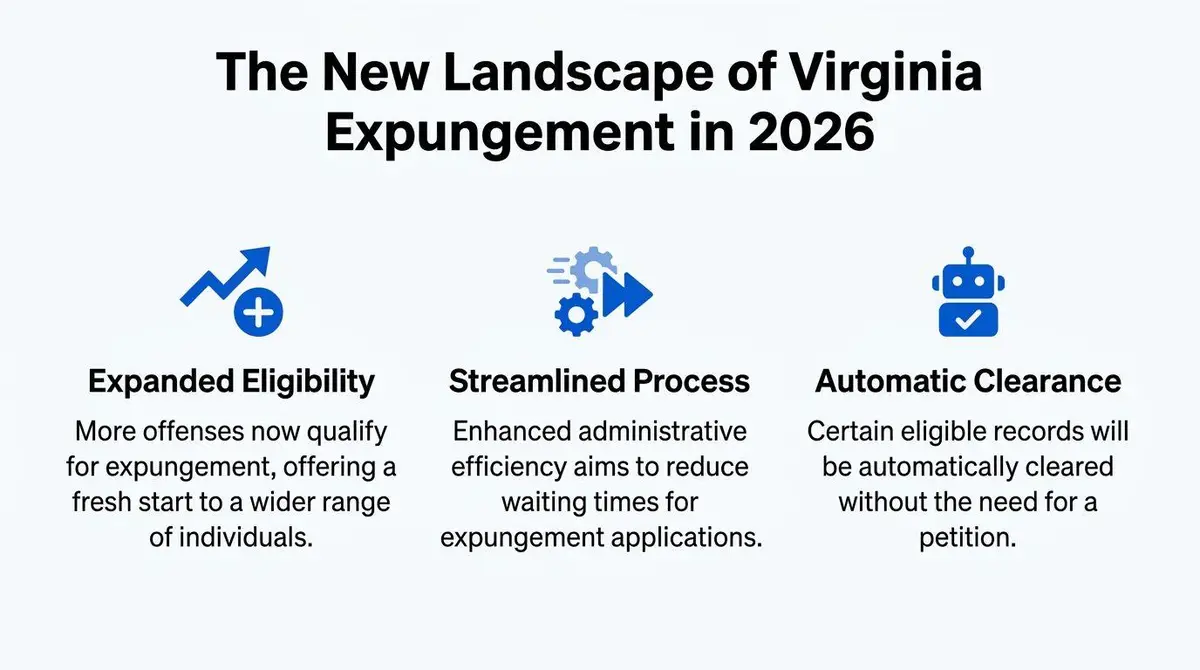
The New Landscape of Virginia Expungement in 2026
A decade-old misdemeanor that seemed buried can still surface the day a board seat, financing round, license renewal, or media inquiry puts your name under review. In 2026, Virginia changed the rules in a way that matters for exactly that kind of risk.
For the first time in Virginia, certain misdemeanor and low-level felony convictions can be sealed from public view under a law that took effect July 1, 2026, as outlined in Justice Forward Virginia’s summary of the reform. For clients with an old conviction that has outlived the conduct by years but still affects hiring, credentialing, or public trust, that change is more than procedural. It creates a real opportunity to reduce visible reputational exposure.
The old advice was simple and often fatal to a client’s options. If there was a conviction, public record relief was usually off the table. That assumption is now outdated. Anyone relying on pre-reform guidance risks making a reputational decision based on law that no longer controls.
This matters most for professionals whose records are reviewed by people who do not read legal nuance kindly. A minor conviction from years ago may not prevent you from doing the job. It can still trigger concern in due diligence, create friction in licensing, or invite questions that distract from the transaction at hand. In that setting, expungement or sealing is part of reputation management. It is not just a courthouse filing.
Why the 2026 change is materially different
Virginia’s prior system left many people with no practical way to remove a conviction from public view, even after years of stability, compliance, and professional progress. The 2026 reform changes that by adding relief for some convictions and by creating both automatic and petition-based paths in certain categories.
That has immediate strategic consequences.
- Old “you can’t clear a conviction in Virginia” advice may be wrong: A prior denial, informal screening call, or internet research result may no longer reflect your current options.
- Some clients now have a path to reduce public-facing risk tied to older convictions: That is especially important where background checks are routine and reputational scrutiny is part of the business model.
- Relief still depends on the exact record: Offense level, final disposition, timing, later charges, and compliance history still control the outcome.
The practical point is simple. A broader statute does not create automatic safety. It creates a window for disciplined review.
What sophisticated clients should understand now
The 2026 changes expanded access, but they did not simplify the consequences of getting the strategy wrong. Sealing eligibility can affect how you time a job transition, respond to a licensing inquiry, or prepare for a pending diligence event. File too early, classify the record incorrectly, or assume that public sealing fixes search visibility on its own, and you can lose time while the record continues to circulate.
In other words, the legal reform opened the door. It did not eliminate the digital aftermath.
For executives, founders, physicians, lawyers, contractors, and other public-facing professionals, that is the shift in 2026. Virginia now offers more than a narrow remedy for non-convictions. It offers, in the right case, a way to reduce a long-running reputational liability at the source. The work has to be handled with precision because the statute is only one part of the problem, and the public record is rarely the only place a damaging case history still appears.
Determining Your Eligibility Under the Expanded Law
Eligibility is now a classification exercise. Before you file anything, you need to know which legal lane you’re in. In Virginia, that usually means one of three pathways: traditional expungement for non-convictions, automatic sealing for some qualifying misdemeanor arrest records, or petition-based sealing for eligible convictions.
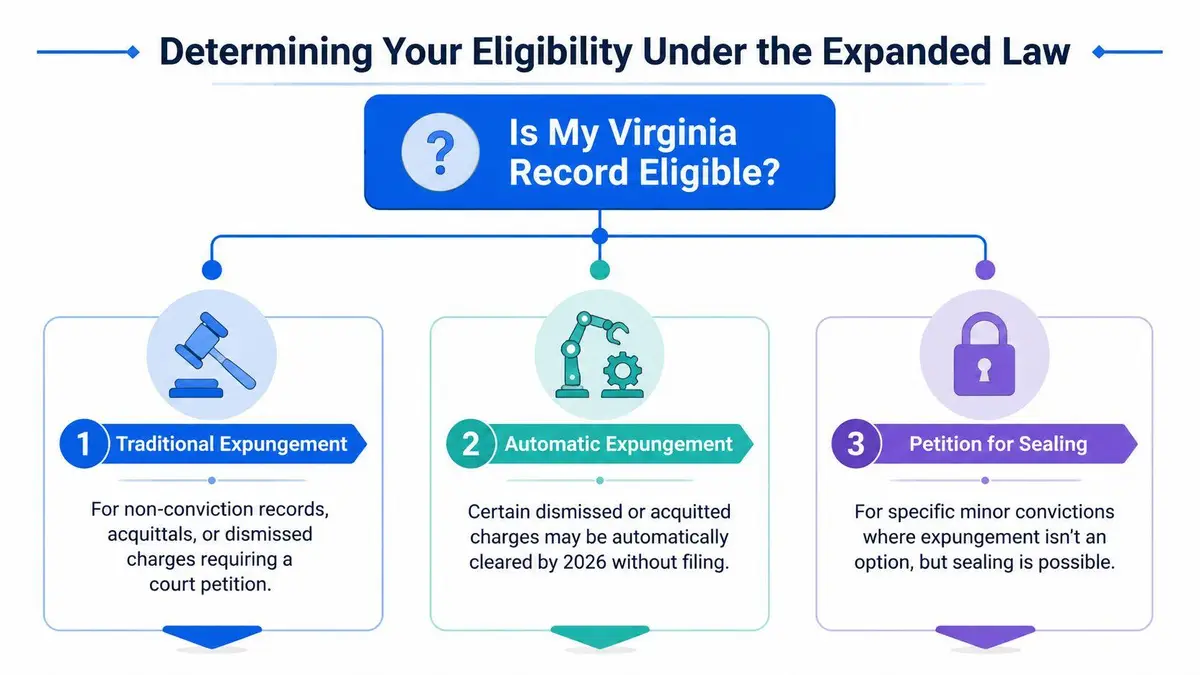
The error I see most often at the eligibility stage is conceptual, not clerical. People focus on what happened in the case and ignore what the court entered as the final disposition. Virginia doesn’t care about your memory of the event nearly as much as it cares about the legal outcome on paper.
Path one under Virginia law
Traditional expungement remains the lane for non-convictions. Historically, that means matters that were dismissed, acquitted, or ended by nolle prosequi. If your case ended without a conviction, this remains the classic route for removing the public record through court process.
That still matters even after the 2026 reforms. Not every case belongs in the new conviction-sealing framework. Some clients are better positioned under the older non-conviction model because the legal standard and relief mechanism are different.
A quick visual explanation can help if you’re comparing these pathways:
Path two for automatic relief
Some misdemeanor arrest records can now be sealed automatically. Under the revised Virginia expungement law effective October 1, 2025, individuals with misdemeanor arrest records are eligible for automatic sealing if the case was dismissed, dropped (nolle prosequi), or resulted in a finding of not guilty, provided they have no prior convictions in Virginia and no arrests or charges in the last three years, according to Greenspun Shapiro’s summary of the 2025 law.
That sounds simple until you test the facts against the record. “No prior convictions in Virginia” is the sort of phrase that can appear straightforward and then become complicated once old matters, amended charges, or out-of-date database entries enter the picture.
Automatic sealing is only automatic if the underlying record is accurate, the disposition is coded correctly, and your history actually fits the statutory conditions.
Path three for convictions
The newest and most consequential route is petition-based sealing for certain convictions. Many executives, professionals, and long-settled defendants will find their first serious opportunity in Virginia through this process.
Use this screening lens before you invest time in a petition:
- Start with the offense category. A misdemeanor or low-level felony may now be eligible for sealing under the new regime. More serious categories may remain outside the statute.
- Check the passage of time. Conviction-related relief generally turns on waiting periods and a clean period without new convictions.
- Review your sentencing events, not just charge count. Multiple charges entered on the same day can be treated as a single event for certain purposes, which can help or hurt depending on the rest of your record.
- Look for disqualifiers early. A record that appears minor can still fail if another conviction or a procedural issue knocks it out of the qualifying lane.
The decision point that matters
If you’re unsure whether your matter belongs in expungement, automatic sealing, or petition-based sealing, stop there and verify before filing. In Virginia, filing the wrong remedy wastes time, exposes weaknesses, and can complicate the cleanup effort later.
For a client with reputational exposure, the right first question isn’t “Can this be removed?” It’s “Which remedy changes public visibility fastest, most reliably, and with the fewest avoidable risks?”
The Critical Distinction Between Expungement Sealing and Pardons
Clients regularly use these terms as if they were interchangeable. They aren’t. In a high-stakes setting, sloppy terminology leads to bad decisions because each remedy changes a different part of the problem.
Expungement addresses eligible non-conviction records. Sealing restricts public access to qualifying records, including certain convictions under Virginia’s newer framework. A pardon is a separate executive act and doesn’t function as a record-clearing tool in the same way.
Virginia Record Clearance Options Compared
| Remedy | What It Does | Who Is Eligible | Public Access Post-Action |
|---|---|---|---|
| Expungement | Removes eligible non-conviction records from public view through court process | People with qualifying dismissals, acquittals, or nolle prosequi outcomes | Public access is removed in the manner ordered by the court |
| Sealing | Restricts public access to eligible records, including certain convictions under the new Virginia framework | People whose records fit the statute for automatic or petition-based sealing | General public access is restricted, though the record is not the same as total destruction |
| Pardon | Grants executive forgiveness or recognition, depending on type, but does not itself operate like expungement or sealing | People pursuing gubernatorial clemency relief | Public record issues may remain unless a separate legal remedy applies |
The distinction between removal and restricted access matters because third parties don’t all pull data from the same place. A sealed record changes public access, but that doesn’t mean every prior copy vanishes from private databases, cached search results, old articles, or mirrored court-reporting pages.
Why this distinction affects reputation strategy
A pardon often gets misunderstood as the broadest solution. It isn’t. If your real objective is to reduce what employers, journalists, counterparties, or search users can find, then the practical value of the remedy turns on visibility, not symbolism.
If you’re comparing jurisdictions, it helps to see how another state structures relief. This guide on expunging a criminal record in Texas is useful because it shows how dramatically state-specific these remedies are. The same word can mean different procedural realities depending on where the case originated.
For the digital side of the problem, legal terminology also affects what happens next. If a mugshot, booking profile, or court reference is still circulating online, a record-clearing order may support the cleanup effort, but it won’t complete it on its own. That’s the gap addressed in this strategic guide to getting a mugshot removed from the internet.
A strong strategy starts with the right verb. Expunge, seal, and pardon solve different problems.
Executing the Petition A Tactical Briefing
A common failure point looks like this. An executive has a board review, a lender is conducting diligence, or a reporter is pulling old court references. Eligibility is not the problem. Execution is. In Virginia, the petition stage is where a record-clearing strategy either holds together or starts creating new delay.

Virginia treats expungement as a civil proceeding with strict filing, service, and records-routing requirements. The process often runs for months, and timing matters if the legal objective is tied to a promotion cycle, licensing review, financing event, or public-facing reputation issue. According to Justice Forward Virginia Foundation’s procedural overview, petitioners must file in the specific circuit court tied to the original charge, obtain certified warrant or disposition records, complete the SP-167 State Police records process, and account for the Commonwealth’s Attorney objection period before the case can be resolved.
That is the legal process. The reputational process is wider.
A court file does not clean itself up online just because a petition is pending. If public docket references, index pages, or copied filings are already circulating, the filing strategy should account for the separate problem of digital visibility. For that issue, this guide on removing your name from court documents online addresses a risk many petitioners only notice after the order is entered.
Where disciplined petitions hold up
Strong petitions are built from the record backward. Start with the exact case history the court and Virginia State Police will see, then align the petition to that history line by line. Names, dates, charge descriptions, and case numbers must match across every document.
The filing court must also be correct. In Virginia, convenience does not matter. The petition belongs in the circuit court connected to the original charge, and filing in the wrong jurisdiction can cost significant time while a live reputation issue remains exposed.
The friction points that deserve active control
Several steps look clerical but carry real strategic risk:
- Certified court records: Obtain certified warrant and disposition materials that match the charge history exactly.
- SP-167 processing: Complete the State Police request correctly and confirm the record reaches the court through the required channel.
- Service: Serve the Commonwealth’s Attorney properly and track the date, because the objection timeline runs from that step.
- Hearing preparation: Build the file as if a contested hearing will happen, even if an uncontested order appears possible.
I treat those steps as control points, not paperwork. A petition can be legally eligible and still stall because the wrong certified document was attached, a case number was inconsistent, or the State Police portion was not completed in a way the court could act on.
Timing, objections, and hearing posture
The procedural timeline should be treated as a business planning issue, not just a court calendar issue. If relief needs to support a background check, media response, or leadership transition by a certain date, the filing package has to be assembled early enough to absorb delays.
The same procedural overview notes that the Commonwealth’s Attorney has a set objection window. If no objection is filed, the court may resolve the matter without a hearing. If an objection is filed, the petition becomes a contested record-clearing matter where credibility, documentation, and a precise explanation of the case history carry more weight than hopeful assumptions.
What tactical execution looks like
A sound filing plan usually includes four checks:
- Audit the disposition first. Confirm what the court entered.
- Match every document to the record. Inconsistencies create avoidable questions.
- Track records routing. Do not assume the State Police and court have everything they need.
- Prepare for opposition early. If a hearing is required, the file should already be organized for it.
That is how expungement works at the executive level. The petition is a legal filing, but it also sits inside a broader reputation-management effort. In 2026, the clients who handle this well are the ones who treat court relief and exposure control as one coordinated project.
Navigating Common Pitfalls and Strategic Considerations
A common failure scenario looks like this. The underlying charge is old, the client assumes the case is straightforward, and the petition goes in with a gap in the court record, a routing problem, or a jurisdiction error. The legal issue may still be fixable. The timing problem often is not, especially if a board review, financing event, licensing renewal, or press inquiry is already in motion.
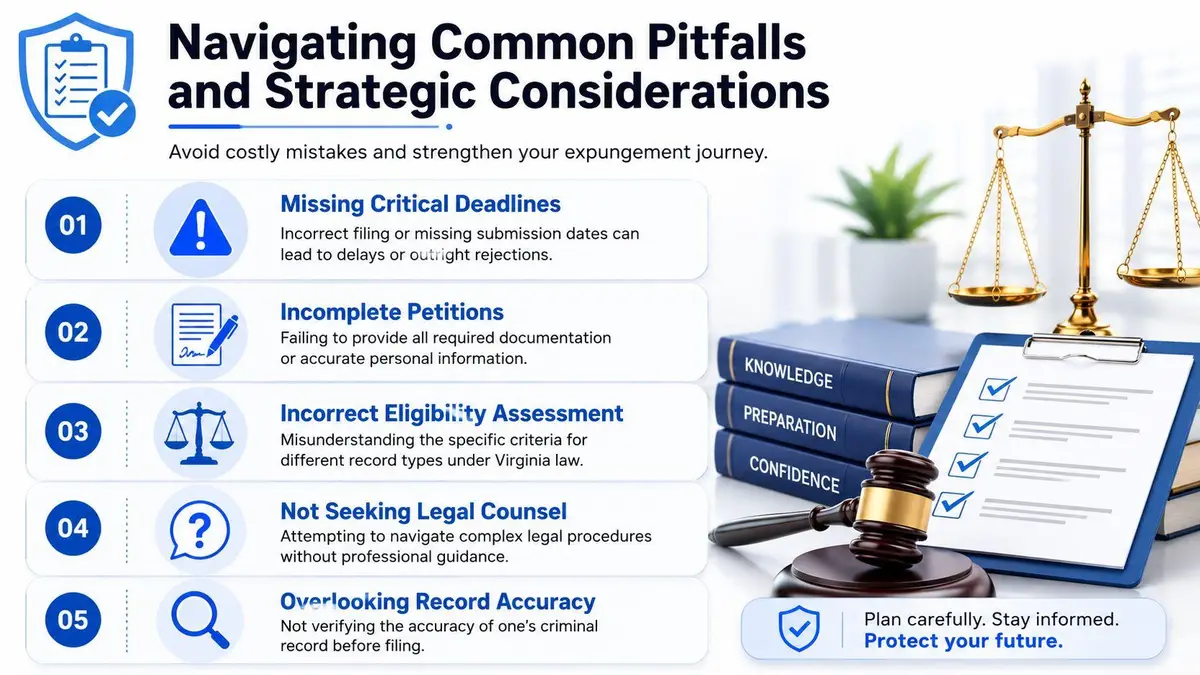
Virginia expungement work breaks down on execution more often than on abstract legal theory. As noted earlier by Student Legal Services at the University of Virginia, incomplete documentation, missed record-forwarding steps, and objections can sharply reduce the odds of a smooth result. For clients with public-facing careers, that means procedural mistakes carry reputational cost, not just legal cost.
The court process is only one part of the exposure analysis. A defective filing can keep the record active longer, extend the life of old search results, and give screening vendors more time to circulate stale data. In executive matters, that extra time matters.
Errors that change the outcome
Some mistakes create delay. Others force a reset or increase the chance of opposition.
- Wrong court: A filing in the wrong circuit court can derail the petition before the merits are even considered.
- Record mismatch: If the petition, disposition, and certified papers do not line up exactly, the file invites questions that should have been resolved before filing.
- Incomplete routing: If the required law-enforcement or record-transmission steps are not completed and verified, the court may lack what it needs to enter relief.
- Underestimating objections: A petition that looked routine on paper can become a contested matter once the Commonwealth identifies a weakness in the record.
I see the same pattern repeatedly in sensitive matters. Clients focus on the fairness of the old charge. The court focuses on whether the petition is accurate, supported, and properly before it.
Strategic judgment matters more than optimism
Objections rarely appear out of nowhere. They are often triggered by something predictable: a prior record, an unclear disposition, a charge history that reads differently across agencies, or a filing package that leaves room for doubt. Good strategy addresses those pressure points before the petition is filed.
That is why executive-level expungement work should be treated as reputation risk management with a court component, not as a form-submission exercise. The legal filing must be built with the digital afterlife in mind. If the matter is likely to attract scrutiny from employers, investors, reporters, or counterparties, the record-clearing plan should also account for how to remove court records from Google search results once relief is granted.
Pre-filing review that prevents avoidable problems
Use a disciplined review before any petition is submitted:
| Risk area | What to confirm |
|---|---|
| Court authority | The petition is going to the correct circuit court for the original charge |
| Case history | Certified records match the exact disposition entered by the court |
| Record transmission | Required agency routing has been completed and can be verified |
| Objection exposure | Any prior record, inconsistency, or factual complication has been addressed in advance |
| Reputation timing | The filing schedule aligns with background checks, leadership moves, or public-facing deadlines |
Clients often assume the hard part is proving they deserve relief. In many Virginia cases, the harder part is presenting a file that can survive scrutiny without giving anyone a reason to slow it down.
That is the strategic consideration in 2026. The expanded law gives more people a path to relief, but the process still rewards precision. For anyone managing both legal exposure and professional reputation, professional oversight is not cosmetic. It is how avoidable errors are kept from becoming public complications.
Beyond the Courthouse The Next Step in Reputation Remediation
A signed order is a legal win. It is not the end of the reputational problem.
Virginia’s framework has improved substantially, but the process remains a serious legal proceeding. Before the 2026 reform, Virginia law restricted expungement to non-convictions through a civil lawsuit with filing fees. While the new law eliminates fees for some qualifying petitions, petitioners still must ensure the Central Criminal Records Exchange forwards the necessary records to the court for review, according to Central Virginia Legal Aid Society’s explanation of the process.
That administrative reality matters for one reason beyond procedure. Even after the court record is handled correctly, older traces often remain online in places the order does not automatically cleanse.
What the court order doesn’t fix
Search engines may still show links to old docket pages, booking references, directory-style aggregators, or articles that scraped case information years ago. Third-party databases may continue circulating stale data until someone challenges, updates, suppresses, or removes it. Journalists, counterparties, and screening vendors often find those copies before they find the final legal reality.
Often, people feel blindsided. They win the petition, then search their own name and discover the internet still tells the old story.
The second phase is visibility control
For executives and public-facing clients, record relief has to be followed by active digital remediation. That may involve search result cleanup, source-site takedown requests, correction demands, de-indexing strategies, and targeted work on pages that still rank for the name.
If court material is still surfacing in search after legal relief, this guide to removing court records from Google search addresses the next layer of the problem directly.
A cleared record and a clean search profile are related goals, not identical ones.
The strategic mistake is thinking the courthouse controls the whole information ecosystem. It doesn’t. Courts control court orders. Search visibility, third-party republication, mugshot pages, archived references, and stale data vendors often require separate action.
For a client whose name is tied to capital, leadership, or public trust, that distinction is decisive. The objective is not limited to obtaining relief on paper. It’s to make sure the old record stops shaping what other people find, assume, and circulate.
If a Virginia record is threatening your professional standing, negotiations, licensing, or search visibility, ContentRemoval.com can assess the digital side of the exposure confidentially and build a precise remediation plan. The firm works with executives, public figures, family offices, and legal teams to remove or suppress harmful online material, address mugshots and court references, and close the gap between legal relief and real-world reputation recovery.
Frequently asked questions
Can a conviction be expunged in Virginia now?
Certain misdemeanor and low-level felony convictions can be sealed by petition under the law effective July 1, 2026. Relief still depends on the offense category, waiting periods, later charges and compliance history, and more serious categories remain outside the statute.
How long does Virginia expungement take?
Virginia treats it as a civil proceeding with strict filing, service and records-routing steps, and the process often runs for months. Plan the filing around any board review, licensing renewal or financing event so delays can be absorbed.
Does a sealed Virginia record disappear from the internet?
No. Sealing restricts public access to the official record, but search engines, aggregators, mugshot pages and third-party databases may still show copies scraped earlier. Those need separate takedown, correction and de-indexing work.