
A credit monitoring service watches Equifax, Experian and TransUnion files for inquiries, new accounts, address changes and fraud flags, then alerts you. It is surveillance, not prevention: for a high-net-worth household it only matters with three-bureau coverage, real-time alerts, a staffed escalation path, and integration with a credit freeze and broader reputational and identity defense.
Key facts
- Some services watch only one bureau, leaving the other two files exposed and creating false confidence.
- A credit freeze is the strongest preventative tool against new-account fraud; monitoring only reports changes afterward.
- Synthetic identity abuse and account takeover can unfold without producing a standard bureau signal.
- Right sequence for private clients: prevention first, awareness second, restoration readiness third.
Where ContentRemoval.com comes in. When identity misuse spills out of the credit file into impersonation, exposed personal data or harmful search results, that is where ContentRemoval.com comes in, removing the material at source and de-indexing what remains so one signal does not feed the next. Family offices, wealth advisers and personal assistants usually make the approach. A free 15-minute Exposure Scan maps what is visible and vulnerable, and the report is yours to keep. Get a Free, Confidential Exposure Scan or read how our content removal work is done.
You already know the pattern. A credential leak turns into a new loan inquiry, a shell company appears on a credit file you’ve never seen, and the first alert arrives after the damage has already started to touch banking relationships, counterparties, or public records. For a high-net-worth household, a credit monitoring service is not a consumer convenience. It’s a surveillance layer for financial exposure, and it only matters if it’s built to catch what standard products miss.
The market has treated credit surveillance as normal behavior for years now. TransUnion reported that more than 100 million U.S. consumers enrolled in a service to monitor credit data between the start of 2018 and September 2023, and that 58% of surveyed consumers monitor credit at least monthly, with 22% weekly and 10% daily, while 86% say monitoring is at least moderately important and 30% call it extremely important (TransUnion study). That tells you the habit is mainstream. It does not tell you the service is sufficient for serious asset protection.
For executives, founders, and family offices, the question isn’t whether to monitor. The question is whether the monitoring stack can see the right files fast enough, preserve evidence cleanly, and connect with reputation defense when the threat spills beyond finance. A useful reference point on the privacy side is data broker removal services for executives, because public exposure and credit exposure usually travel together.
Beyond Basic Alerts An Introduction
A stolen card used for a weekend of fraud is noise. The threat is the quiet identity setup in the background, where someone opens a thin credit file, builds a credible financial persona, and reuses your name, address history, or business role somewhere else. That is how credit events turn into reputational events, and why a basic consumer alert service never covers the full exposure.
TransUnion’s data shows how normal this habit has become, with 58% of U.S. consumers monitoring credit at least monthly and 86% saying it matters (TransUnion study). For a private client, the point is simple. Widespread use does not equal adequate protection. It only proves that more people now watch the file.
A credit monitoring service belongs inside a broader defense model. It gives awareness, not prevention. It helps with early intervention, fraud containment, and dispute preparation, but it will not remove defamatory material, repair a public-facing incident, or contain the reputational fallout that follows a compromised identity.
Practical rule: If the service cannot tell you exactly what it watches, how fast it alerts, and which bureaus it covers, it is not a serious protection layer.
Affluent individuals are targeted differently. They are exposed to impersonation, account opening in entities tied to the household, and attempts to use financial records as a bridge into broader social or business compromise. A private client should also use data broker removal services for executives, because public exposure and credit exposure usually travel together.
How Credit Monitoring Systems Operate
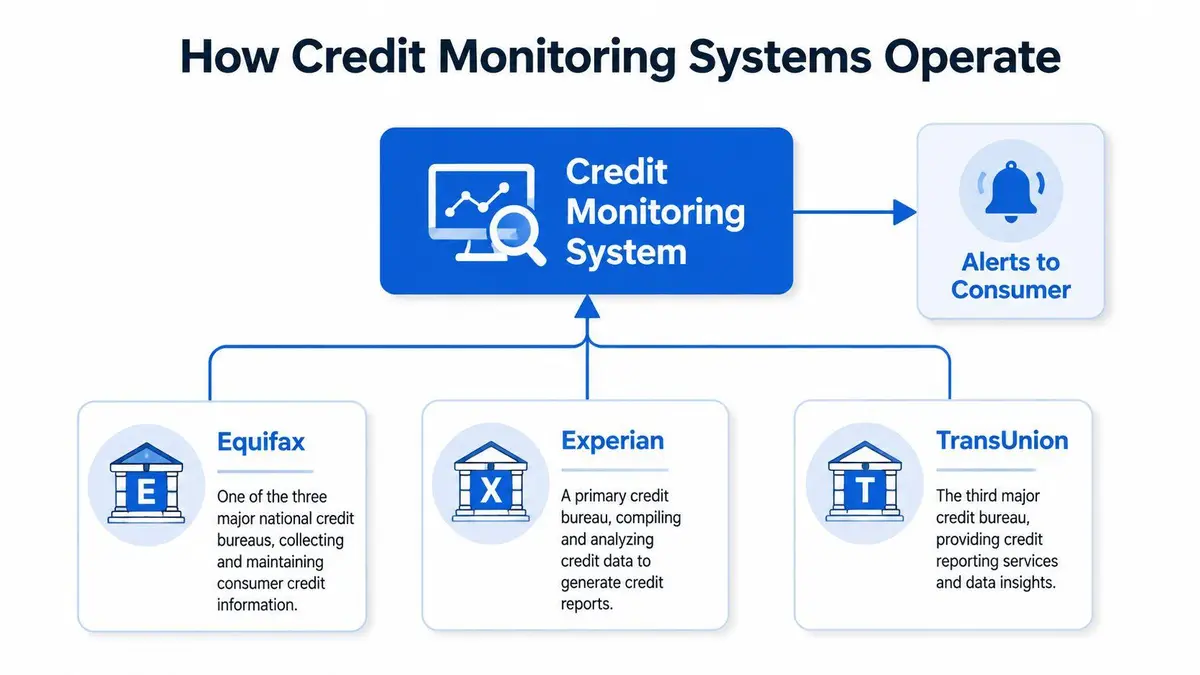
A credible system starts with the three major bureaus, Equifax, Experian, and TransUnion. It watches for file changes, inquiries, fraud flags, score deltas, and other bureau-level events, then pushes those events into alerting, CRM, and risk workflows. The architecture matters because the source of truth is not the marketing dashboard, it’s the pipeline from bureau data to notification.
What gets watched and why it matters
The signals that matter most are the ones tied to active file movement. A new inquiry, a fresh account, an address change, or a fraud flag tells you someone is doing something with identity data. A score change alone is weaker intelligence. It can tell you something changed, but not always what changed or whether it’s linked to fraud, underwriting, or normal activity.
Why modern architecture is non-negotiable
Older polling models are slower and clumsier. A event-driven and API-first service means bureau events can be consumed immediately instead of waiting for a slower refresh cycle (IJSRT on credit monitoring architecture). That lowers detection latency and improves scalability because the service can scale components independently and isolate failures. In practice, that’s what separates a decent alert feed from something your advisors can use.
If you’re evaluating providers, read the product like an operator, not a consumer. Ask whether alerts are tied to bureau events, whether the system is built for immediate consumption, and whether it can support downstream workflows. If it can’t, you’re buying noise.
For a broader view of how monitoring should sit inside your larger risk posture, review reputation monitoring alongside the credit workflow. The best protection systems don’t live in silos.
The Dangerous Blind Spots of Credit Monitoring
A monitoring subscription can look reassuring and still leave major exposure untouched. The usual failure is partial bureau coverage. Some services watch only one bureau, which leaves the other files exposed and creates a false sense of security (Privacy Rights Clearinghouse). For a high-value target, that is not a small product gap. It is a real control weakness.
What monitoring misses by design
Credit monitoring is reactive. It tells you after a change appears on a report. It does not stop someone from applying, impersonating, or testing systems before the alert arrives. It also will not reliably catch activity that never reaches the monitored bureau, or events that happen entirely outside the credit file.
That is why the service can feel reassuring while still missing a critical threat. A client may watch one report closely and remain blind to activity at another bureau, or to a compromise that begins with account access rather than a credit application. The warning from Privacy Rights Clearinghouse about partial bureau coverage is the right lens. Partial visibility is often mistaken for protection.
A clean alert feed can still leave a dirty perimeter.
The threat profile is broader than a credit event. Synthetic identity abuse can develop without an immediate standard bureau signal. Account takeover can unfold without a fresh inquiry. Medical and criminal identity abuse can cause damage without producing the kind of credit activity a consumer expects to see.
That is the point affluent clients should focus on. A monitoring service is only one layer, and a thin one at that. The core question is what it misses, what else is being watched, and whether the service is tied into a wider response process. If the answer stays vague, the service is too limited to trust.
The threats that need more than a credit file
A narrow credit monitor will not give you full protection against reputational and financial exposure. It can miss early signs of misuse in digital accounts, changes to contact information that support impersonation, or misuse that never becomes visible in the traditional credit system. That matters because high-value targets are rarely targeted through a single channel.
The practical lesson is simple. Credit monitoring is a useful signal, not a perimeter defense. For clients whose exposure extends across banking, lending, business interests, and public profile, the service must be paired with stronger controls, broader identity checks, and a response plan that does not depend on a single bureau alert.
Monitoring vs Identity Theft Protection vs Credit Freezes
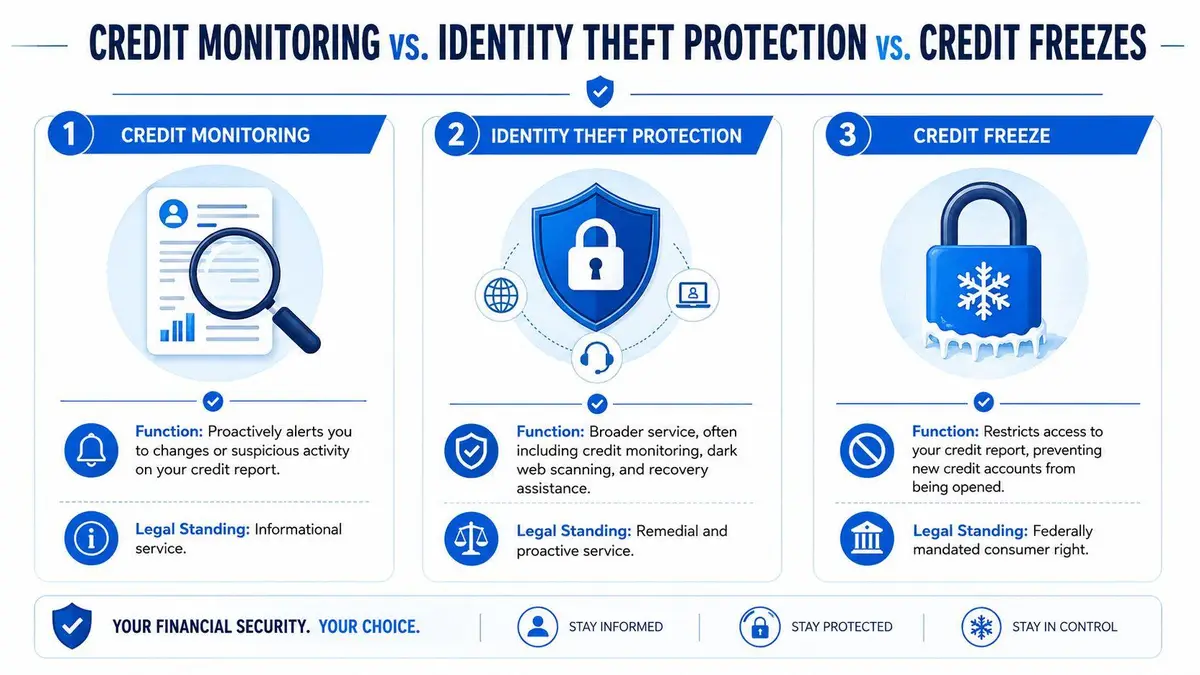
These three tools are not interchangeable, and anyone who sells them that way is simplifying the risk. Credit monitoring is surveillance. Identity theft protection is a broader service category that may include monitoring plus recovery help and other scans. A credit freeze is a preventative control that restricts access to the file so new credit can’t be opened without thawing it.
Use each tool for a different job
Monitoring tells you something changed. Identity theft protection can help with recovery and some broader threat detection, though service quality varies widely. A freeze blocks the account-opening path itself, which makes it the strongest preventative tool for new-account fraud.
That distinction is strategic. If you want awareness, use monitoring. If you want help after an incident, use protection services with restoration support. If you want to stop someone from opening new credit in your name, use a freeze.
Why affluent clients should think in layers
A private client should not rely on a single product to perform all three jobs. Monitoring is still useful, because a freeze doesn’t tell you what attempted fraud is brewing around the edges, and recovery support can’t prevent every exposure. But the freeze remains the cleanest barrier when the objective is to block new account abuse.
The right sequence is usually prevention first, awareness second, and restoration readiness third. That order keeps the file locked down while preserving enough visibility to detect attempts that matter. For executive households and family offices, that is the only sensible way to think about it.
The legal and operational side also matters. In the UK, the Lending Standards Board says firms should ensure customers understand what information is needed to monitor business performance, allow opt-outs from unsolicited borrowing limit increases, and use sufficient monitoring with triggers to identify financial stress (Lending Standards Board standards). That’s not consumer theater. It’s a reminder that monitoring is part of a controlled process, not a gimmick.
Non-Negotiable Features for High-Value Targets
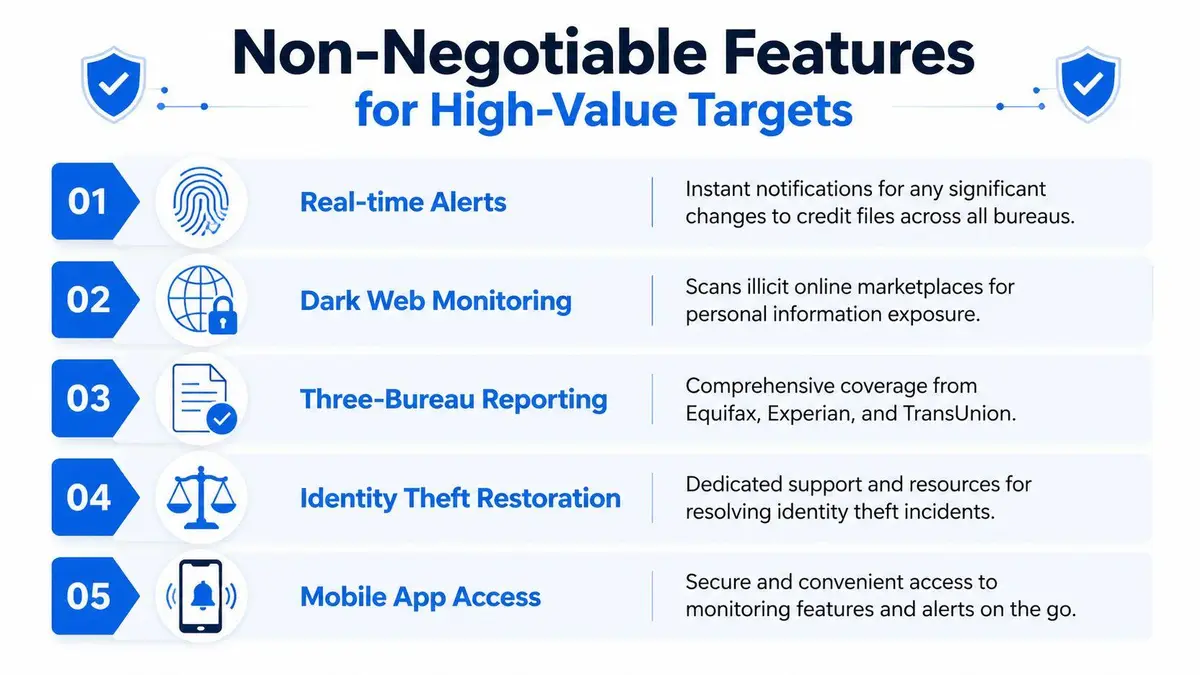
A standard service is built for convenience. A premium service for a high-value target is built for containment, evidence, and response. If the provider doesn’t offer three-bureau coverage, real-time alerts, and a clean escalation path, it’s not adequate for a client whose name, assets, or public profile can be weaponized.
The security stack has to behave like a control system
For regulated or high-stakes deployments, the stack should include explicit consent capture, immutable audit logs, encrypted transport and storage, and fine-grained API controls. Those aren’t cosmetic compliance add-ons. They materially reduce unauthorized access and strengthen the evidence trail for disputes and incident review (CRS Credit API integration guidance).
That same standard should apply to the consumer-facing service. If a vendor can’t explain how consent is handled, how logs are preserved, and how access is limited, you’re accepting avoidable operational risk. The service will be sitting on exactly the kind of data adversaries want.
Features I would treat as mandatory
I want a service to cover all three bureaus, because partial visibility is a weak posture. I want immediate alerts, not delayed summaries, because speed is what preserves options. I also want restoration support that is staffed, accountable, and available when something goes wrong.
Other features deserve scrutiny, not blind enthusiasm. Monitoring for investment accounts, retirement accounts, or home title can be useful, but only if the provider can explain the data sources, the alert logic, and the response path. A glossy dashboard means little if the incident handling is thin.
If a provider can’t describe its restoration process in plain English, assume it’s built to sell reassurance, not solve a problem.
ContentRemoval.com fits naturally into this risk layer when the issue extends beyond the credit file and into impersonation, harmful content, or public exposure. That’s a different category of control, but for HNWIs the categories overlap more often than providers admit. You need the full picture, not just a credit alert.
Integrating Financial and Reputational Defense
A compromised credit profile can turn into a reputational problem fast. False business filings, public record disputes, and identity misuse can create questions that clients, counterparties, or media contacts pick up before your internal team does. The inverse is true as well. A reputational attack can expose personal data that then feeds financial fraud.
That’s why credit monitoring should sit next to, not apart from, broader digital protection. A serious household looks at search results, impersonation activity, exposed credentials, and public mentions together, because one signal often explains another. If your name is being abused online, the credit file is often next.
For clients who want the reputational side handled with the same discipline as the financial side, digital executive protection is the natural companion category to monitoring. The point is not to stack tools for appearance. It’s to reduce the ways an identity can be exploited across search, social, data brokers, and bureau files.
A credible security posture links the alert, the investigation, and the removal work. It doesn’t leave those tasks to separate vendors who don’t coordinate. The more visible your household, the more dangerous that fragmentation becomes.
Your Personal Risk Assessment Checklist
Start with exposure, not features. Your current credit monitoring service should watch all three bureaus, send alerts in real time, and spell out exactly which events trigger notification. If the provider cannot answer those questions clearly, it is not built for serious protection.
Then test the response model. Ask who handles escalation when there is a suspicious inquiry, a new account, or a disputed record. Ask whether you get a named contact or get pushed through generic support while the issue is still active. For a client with meaningful income, entities, or public visibility, that answer matters more than any app feature.
Audit the file itself, then the process around it. You need documented audit trails, clean escalation, and a service that can show you what changed, when it changed, and who acted on it. If the alerts are vague or the history is incomplete, you are reacting late.
If you are working to reduce score risk that can attract scrutiny or complicate underwriting, use strengthen your credit score for 2026 as the practical next step, then align that work with your monitoring and freeze strategy. A cleaner file is easier to defend, but only if you are watching it properly.
Read your coverage with the same discipline you would apply to any material asset. If it does not include bureau breadth, fast alerts, documented audit trails, and a clean escalation path, replace it. If you want a confidential review of your exposure across financial, digital, and reputational channels, ContentRemoval.com can help you assess what is visible, what is vulnerable, and what needs to be removed or monitored before it becomes a larger problem.
Frequently asked questions
Is credit monitoring enough to protect a wealthy family from identity theft?
No. Monitoring is reactive and reports changes after they appear on a file. It should sit alongside a credit freeze, identity theft restoration support, and monitoring of search results, data brokers and impersonation, because high-value targets are rarely attacked through one channel.
What is the difference between credit monitoring, identity theft protection and a credit freeze?
Monitoring is surveillance of the file. Identity theft protection is a broader category that may add recovery help and other scans. A freeze restricts access to the file so new credit cannot be opened without thawing it, which makes it the cleanest barrier to new-account fraud.
What features should a credit monitoring service have for high-value targets?
Three-bureau coverage, immediate alerts rather than delayed summaries, staffed restoration support with a named contact, documented audit trails, and clear answers on consent handling, log preservation and access limits.